288
German Dialect Identification Using Classifier Ensembles
Alina Maria Ciobanu1, Shervin Malmasi2, Liviu P. Dinu1
1University of Bucharest, Romania 2Harvard Medical School, United States
Abstract
In this paper we present the GDI classification entry to the second German Dialect Identification (GDI) shared task organized within the scope of the VarDial Evaluation Campaign 2018. We present a system based on SVM classifier ensembles trained on characters and words. The system was trained on a collection of speech transcripts of five Swiss-German dialects provided by the organizers. The transcripts included in the dataset contained speakers from Basel, Bern, Lucerne, and Zurich. Our entry in the challenge reached62.03%F1 score and was ranked third out of eight teams.
1 Introduction
Discriminating between dialects and language varieties is a challenging aspect of language identification that sparked interest in the NLP community in the past few years. As evidenced in a recent survey (Jauhiainen et al., 2018), a number of papers have been published on this topic on dialects of Arabic (Tillmann et al., 2014) and Romanian (Ciobanu and Dinu, 2016), and language varieties of English (Lui and Cook, 2013) and Portuguese (Zampieri et al., 2016).
This challenge motivated the organization of a number of competitions such as the Discriminating between Similar Languages (DSL) shared tasks which included language varieties and similar languages (Zampieri et al., 2014; Zampieri et al., 2015; Malmasi et al., 2016b), the MGB challenge 2017 (Ali et al., 2017) on Arabic, the PAN lab on author profiling, which in 2017 included varieties and dialects (Rangel et al., 2017), and finally the first German Dialect Identification (GDI) shard task in 2017 (Zampieri et al., 2017). The GDI shared task 2017 preceded the second GDI shared task (Zampieri et al., 2018) in which our team, GDI classification, participated.
In this paper we describe the GDI classification system trained to identify four dialects of (Swiss) German. The GDI dataset included speech transcripts from speakers from Basel, Bern, Lucerne, and Zurich. The system is based on an ensemble of multiple SVM classifiers trained on words and char-acters as features. Our approach is inspired by the approach of Malmasi and Zampieri (2017b), which was ranked first in the first edition of the GDI task and also performed well on identifying dialects of Arabic (Malmasi and Zampieri, 2017a). We build on the experience of previous work of members of the GDI classification team improving a system that we have previously applied to a similar classification task, namely author profiling (Ciobanu et al., 2017).
2 Related Work: The First GDI Shared Task
There have been a few studies on German dialect identification published before the first GDI shared task, using different corpora and evaluation methods (Scherrer and Rambow, 2010; Hollenstein and Aepli, 2015). To the best of our knowledge, the first GDI shared task organized in 2017 was the first attempt to provide a benchmark for this task.
The GDI shared task 2017 setup and dataset were similar to those of the 2018 edition presented in more detail in Section 3. The results of the 2017 edition along with a reference to each system description paper are presented in Table 1.
Rank Team F1 (weighted) Reference
1 MAZA 0.662 (Malmasi and Zampieri, 2017b)
2 CECL 0.661 (Bestgen, 2017)
3 CLUZH 0.653 (Clematide and Makarov, 2017)
4 qcri mit 0.639
-5 unibuckernel 0.637 (Ionescu and Butnaru, 2017)
6 tubasfs 0.626 (C¸ ¨oltekin and Rama, 2017)
7 ahaqst 0.614 (Hanani et al., 2017)
8 Citius Ixa Imaxin 0.612 (Gamallo et al., 2017)
9 XAC Bayesline 0.605 (Barbaresi, 2017)
10 deepCybErNet 0.263
-Table 1: GDI shared task 2017: Closed submission results.
The ten teams who competed in the first GDI challenge applied different computational methods to ap-proach the task. These include linear SVM classifiers (C¸ ¨oltekin and Rama, 2017; Bestgen, 2017), string kernels (Ionescu and Butnaru, 2017), Naive Bayes classifiers (Barbaresi, 2017), and SVM ensembles (Malmasi and Zampieri, 2017b), which achieved the first place in 2017. For this reason, this is the approach we apply in our GDI identification system.
3 Data
In this paper we used only the dataset provided by the GDI organizers. The dataset is part of the ArchiMob corpus (Samardˇzi´c et al., 2016).1 It contains transcripts of interviews with speakers from Basel (BS), Bern (BE), Lucerne (LU), and Zurich (ZH). The interviews have been transcribed using the ‘Schwyzert¨utschi Dial¨aktschrift’ system (Dieth, 1986).
The evaluation was divided into two tracks. In the first of them organizers provided participants with a test set containing the four aforementioned dialects included in the training set. In the second track they provided a test set containing the four dialects plus a ‘surprise’ dialect not included in the training set. We opted to participate only in the first track which contained only previously ‘seen’ dialects.
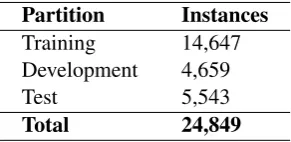
The dataset comprise nearly 25,000 instances divided in training, development, and test partitions as presented in Table 2.
Partition Instances
Training 14,647
Development 4,659
Test 5,543
Total 24,849
Table 2: Instances in the GDI dataset 2018.
4 Methodology
The system that we propose for the GDI shared task consists of an ensemble of classifiers, namely SVMs. In this approach, we employ the methodology proposed by Malmasi and Dras (2015).
Ensembles of classifiers are deemed useful when there are disagreements between the comprising classifiers, which can use different features, training data, algorithms or parameters. The scope of the en-semble is to combine the results of the classifiers in such a way that the overall performance is improved
[image:2.595.226.372.544.615.2]over the individual performances of the classifiers. Ensembles have proven useful in various tasks, such as complex word identification (Malmasi et al., 2016a) and grammatical error diagnosis (Xiang et al., 2015).
To distinguish the classifiers, we employ a different type of features for each of them. After obtaining predictions from each classifier, they need to be combined, to obtain the final predictions of the ensemble. To implement this system we used the Scikit-learn (Pedregosa et al., 2011) library. For the individual classifiers, we used LinearSVC,2 an SVM implementation based on the Liblinear library (Fan et al., 2008), with a linear kernel. For the ensemble, we used the VotingClassifier,3with a majority rule fusion method: for each instance, the class that has been predicted by the majority of the classifiers is considered the final prediction of the ensemble. When there are ties, this implementation chooses the final prediction based on the ascending sort order of all labels.
4.1 Features
Each classifier from the ensemble uses one of the following features with TF-IDF weighting:
• Charactern-grams, withnin{1, ...,8};
• Wordn-grams, withnin{1,2,3};
• Wordk-skip bigrams, withkin{1,2,3}.
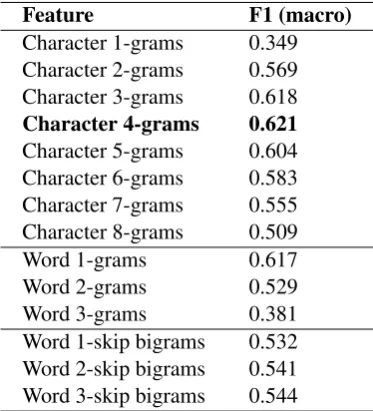
We obtain, thus, 14 classifiers. Training the individual classifiers, we achieve the results reported in Table 3. The features that lead to the best results are character 4-grams. The SVM using these features obtains 0.621 F1 score during our evaluation on the development dataset. In Table 4 we report the most informative character 4-grams for each class.
Feature F1 (macro)
Character 1-grams 0.349 Character 2-grams 0.569 Character 3-grams 0.618
Character 4-grams 0.621
Character 5-grams 0.604 Character 6-grams 0.583 Character 7-grams 0.555 Character 8-grams 0.509
Word 1-grams 0.617
Word 2-grams 0.529
Word 3-grams 0.381
[image:3.595.205.392.413.619.2]Word 1-skip bigrams 0.532 Word 2-skip bigrams 0.541 Word 3-skip bigrams 0.544
Table 3: Classification F1 score for individual classifiers on the development dataset.
To improve the performance of the SVM classifier using character 4-grams as features, we built various ensembles and performed a grid search with the purpose of determining the optimal value for the SVM regularization parameterC. We searched in{10−3, ...,103}and obtained the optimal value 1. Experi-menting with different classifiers as part of the ensemble, we determined the optimal feature combination to be charactern-grams withnin{2,3,4,5}. This ensemble obtained 0.638 F1 score on the development dataset.
2
http://scikit-learn.org/stable/modules/generated/sklearn.svm.LinearSVC.html
Class Most Informative Features
BE |n¨ac|aus|seit|nei|gsee|ein|ds|aus|hei|hei|
BS |uns|aabe|kha|rlig|kho|¨au|h¨ai|dr|h¨ai|net|
LU |sen|hem|gch|ech|o¨u|hai|gcha|hend|ond|hen|
[image:4.595.155.440.61.131.2]ZH |maal|zw¨ai|deet|¨ann|d¨an|d¨an|h¨at|d¨ann|h¨at|n¨ad|
Table 4: Top 10 most informative character 4-grams for each class.
5 Results
We submitted a single run for the GDI task for the official evaluation. The results of our system and of a random baseline (provided by the organizers) on the test dataset are reported in Table 5. The run that we submitted corresponds to our best performing SVM ensemble, comprising 4 classifiers, each using one of the following features: charactern-grams withnin{2,3,4,5}. Our system was ranked third, obtaining 0.6203 F1 score on the test set, significantly outperforming the random baseline, which obtained 0.2521 F1 score on the test set.
In the official evaluation, the ranking was made taking statistical significance into account, and thus our team ranked third. The best performing team obtained 0.685 F1 score on the test dataset.
System F1 (macro)
Random Baseline 0.2521
SVM Ensemble 0.6203
Table 5: Results for the GDI shared task on the test dataset.
Looking at the confusion matrix of our system (see Figure 1), we notice that BS is identified correctly most often, while LU is at the opposite end, with the lowest number of correctly classified instances. Out of the misclassified instances, we noticed that LU sentences are very often identified as BE.
BE
BS
LU
ZH
Predicted label
BE
BS
LU
ZH
True label
814
186
115
76
79
939
103
79
471
141
495
79
88
222
138
727
Confusion Matrix
[image:4.595.154.444.448.707.2]0.0
0.1
0.2
0.3
0.4
0.5
0.6
0.7
6 Conclusion
In this paper we presented the GDI identification entry for the GDI shared task at VarDial 2018. We employed an ensemble of SVM classifiers, continuing our previous work in this direction (Ciobanu et al., 2017). We obtained 0.6203 F1 score on the test dataset, ranking third in the competition. We experimented with various character and word n-gram features, and obtained our best performance with an ensemble of four classifiers, each using a different group of features. A variation of this system has been submitted for the Indo-Aryan language identification (ILI) shared task at VarDial 2018 (Ciobanu et al., 2018), achieving good performance, ranking third out of eight teams.
As future work, we intend to improve our ensemble implementation and to experiment with other features as well as in Bestgen (2017), in order to improve the performance of our system.
Acknowledgements
We would like to thank the GDI organizers, Yves Scherrer and Tanja Samardˇzi´c, for organizing the shared task and for replying promptly to our questions.
We further thank the anonymous reviewers and Marcos Zampieri for the feedback and suggestions provided.
References
Ahmed Ali, Stephan Vogel, and Steve Renals. 2017. Speech Recognition Challenge in the Wild: Arabic MGB-3. arXiv preprint arXiv:1709.07276.
Adrien Barbaresi. 2017. Discriminating between Similar Languages using Weighted Subword Features. In Pro-ceedings of the Fourth Workshop on NLP for Similar Languages, Varieties and Dialects (VarDial), pages 184– 189, Valencia, Spain, April.
Yves Bestgen. 2017. Improving the Character Ngram Model for the DSL Task with BM25 Weighting and Less Frequently Used Feature Sets. InProceedings of the Fourth Workshop on NLP for Similar Languages, Varieties and Dialects (VarDial), pages 115–123, Valencia, Spain, April.
C¸ a˘grı C¸ ¨oltekin and Taraka Rama. 2017. T¨ubingen System in VarDial 2017 Shared Task: Experiments with Language Identification and Cross-lingual Parsing. InProceedings of the Fourth Workshop on NLP for Similar Languages, Varieties and Dialects (VarDial), pages 146–155, Valencia, Spain, April.
Alina Maria Ciobanu and Liviu P Dinu. 2016. A Computational Perspective on the Romanian Dialects. In Proceedings of Language Resources and Evalution (LREC).
Alina Maria Ciobanu, Marcos Zampieri, Shervin Malmasi, and Liviu P Dinu. 2017. Including Dialects and Language Varieties in Author Profiling. Working Notes of CLEF.
Alina Maria Ciobanu, Marcos Zampieri, Shervin Malmasi, Santanu Pal, and Liviu P. Dinu. 2018. Discriminating between Indo-Aryan Languages Using SVM Ensembles. In Proceedings of the Fifth Workshop on NLP for Similar Languages, Varieties and Dialects (VarDial), Santa Fe, USA.
Simon Clematide and Peter Makarov. 2017. CLUZH at VarDial GDI 2017: Testing a Variety of Machine Learning Tools for the Classification of Swiss German Dialects. In Proceedings of the Fourth Workshop on NLP for Similar Languages, Varieties and Dialects (VarDial), pages 170–177, Valencia, Spain, April.
Eugen Dieth. 1986.Schwyzert¨utschi Dial¨aktschrift. Sauerl¨ander, Aarau, 2 edition.
Rong-En Fan, Kai-Wei Chang, Cho-Jui Hsieh, Xiang-Rui Wang, and Chih-Jen Lin. 2008. LIBLINEAR: A Library for Large Linear Classification. Journal of Machine Learning Research, 9:1871–1874.
Pablo Gamallo, Jose Ramom Pichel, and I˜naki Alegria. 2017. A Perplexity-Based Method for Similar Languages Discrimination. InProceedings of the Fourth Workshop on NLP for Similar Languages, Varieties and Dialects (VarDial), pages 109–114, Valencia, Spain, April.
Nora Hollenstein and No¨emi Aepli. 2015. A Resource for Natural Language Processing of Swiss German Dialects. InProceedings of GSCL.
Radu Tudor Ionescu and Andrei Butnaru. 2017. Learning to Identify Arabic and German Dialects using Mul-tiple Kernels. InProceedings of the Fourth Workshop on NLP for Similar Languages, Varieties and Dialects (VarDial), pages 200–209, Valencia, Spain, April.
Tommi Jauhiainen, Marco Lui, Marcos Zampieri, Timothy Baldwin, and Krister Lind´en. 2018. Automatic Lan-guage Identification in Texts: A Survey. arXiv preprint arXiv:1804.08186.
Marco Lui and Paul Cook. 2013. Classifying English Documents by National Dialect. InProceedings of the Australasian Language Technology Association Workshop 2013 (ALTA), pages 5–15.
Shervin Malmasi and Mark Dras. 2015. Language Identification using Classifier Ensembles. InProceedings of the Joint Workshop on Language Technology for Closely Related Languages, Varieties and Dialects (LT4VarDial), pages 35–43, Hissar, Bulgaria.
Shervin Malmasi and Marcos Zampieri. 2017a. Arabic Dialect Identification Using iVectors and ASR Transcripts. InProceedings of the Fourth Workshop on NLP for Similar Languages, Varieties and Dialects (VarDial), pages 178–183, Valencia, Spain, April.
Shervin Malmasi and Marcos Zampieri. 2017b. German Dialect Identification in Interview Transcriptions. In Proceedings of the Fourth Workshop on NLP for Similar Languages, Varieties and Dialects (VarDial), pages 164–169, Valencia, Spain, April.
Shervin Malmasi, Mark Dras, and Marcos Zampieri. 2016a. LTG at SemEval-2016 Task 11: Complex Word Identification with Classifier Ensembles. InProceedings of SemEval.
Shervin Malmasi, Marcos Zampieri, Nikola Ljubeˇsi´c, Preslav Nakov, Ahmed Ali, and J¨org Tiedemann. 2016b. Discriminating between Similar Languages and Arabic Dialect Identification: A Report on the Third DSL Shared Task. In Proceedings of the 3rd Workshop on Language Technology for Closely Related Languages, Varieties and Dialects (VarDial), Osaka, Japan.
Fabian Pedregosa, Ga¨el Varoquaux, Alexandre Gramfort, Vincent Michel, Bertrand Thirion, Olivier Grisel, Math-ieu Blondel, Peter Prettenhofer, Ron Weiss, Vincent Dubourg, et al. 2011. Scikit-learn: Machine Learning in Python. Journal of Machine Learning Research, 12:2825–2830.
Francisco Rangel, Paolo Rosso, Martin Potthast, and Benno Stein. 2017. Overview of the 5th Author Profiling Task at PAN 2017: Gender and Language Variety Identification in Twitter.Working Notes Papers of the CLEF.
Tanja Samardˇzi´c, Yves Scherrer, and Elvira Glaser. 2016. ArchiMob–A Corpus of Spoken Swiss German. In Proceedings of the Language Resources and Evaluation (LREC), pages 4061–4066, Portoroz, Slovenia).
Yves Scherrer and Owen Rambow. 2010. Word-based Dialect Identification with Georeferenced Rules. In Pro-ceedings of EMNLP.
Christoph Tillmann, Saab Mansour, and Yaser Al-Onaizan. 2014. Improved Sentence-level Arabic Dialect Clas-sification. InProceedings of the First Workshop on Applying NLP Tools to Similar Languages, Varieties and Dialects (VarDial), pages 110–119.
Yang Xiang, Xiaolong Wang, Wenying Han, and Qinghua Hong. 2015. Chinese Grammatical Error Diagnosis Using Ensemble Learning. InProceedings of the 2nd Workshop on Natural Language Processing Techniques for Educational Applications, pages 99–104.
Marcos Zampieri, Liling Tan, Nikola Ljubeˇsi´c, and J¨org Tiedemann. 2014. A Report on the DSL Shared Task 2014. InProceedings of the First Workshop on Applying NLP Tools to Similar Languages, Varieties and Dialects (VarDial), pages 58–67, Dublin, Ireland.
Marcos Zampieri, Liling Tan, Nikola Ljubeˇsi´c, J¨org Tiedemann, and Preslav Nakov. 2015. Overview of the DSL Shared Task 2015. In Proceedings of the Joint Workshop on Language Technology for Closely Related Languages, Varieties and Dialects (LT4VarDial), pages 1–9, Hissar, Bulgaria.
Marcos Zampieri, Shervin Malmasi, Nikola Ljubeˇsi´c, Preslav Nakov, Ahmed Ali, J¨org Tiedemann, Yves Scherrer, and No¨emi Aepli. 2017. Findings of the VarDial Evaluation Campaign 2017. InProceedings of the Fourth Workshop on NLP for Similar Languages, Varieties and Dialects (VarDial), Valencia, Spain.