Computing Applications on the Stream Processor
Weixia XU, Qiang DOU, Ying ZHANG, Gen LI, Xuejun YANG
Institute of Computer, National University of Defense Technology, Changsha, China Email: {xuwx, douq, zhangying, genli, xjyang}@nudt.edu.cn
Received September 19, 2009; revised October 22, 2009; accepted December 1,2009
Abstract
Compared with other stream applications, scientific stream programs are usually bound by memory accesses. Reusing streams across different iterations, i.e. loop-carried stream reuse, can effectively improve the SRF locality, thus reducing memory accesses greatly. In the paper, we first present the algorism identifying loop-carried stream reuse and that exploiting the reuse after analyzing scientific computing applications. We then perform several representative microbenchmarks and scientific stream programs with and without our optimization on Isim, a cycle-accurate stream processor simulator. Experimental results show that our algo-rithms can effectively exploit loop-carried stream reuse for scientific stream programs and thus greatly im-prove the performance of memory-bound scientific stream programs.
Keywords:Stream Reuse, Loop-Carried, Stream Processor
1. Introduction
Now conventional architecture has been not able to meet the demands of scientific computing [1,2]. In all state-of- the-art architectures, the stream processor [3], as shown in Figure 1, draws scientific researchers’ attentions for its processing computation-intensive applications effec-tively [4–8].
Compared with other stream applications, scientific computing applications have less computation density, i.e. the ratio of computations to memory accesses for involved data, especially for memory-bound scientific applications. Therefore, memory accesses totally domi-nant the performance of scientific stream programs.
The stream processor has three level memory hierar-chies [12], local register files (LRF) near ALUs exploit-ing locality in kernels, global stream register files (SRF) exploiting producer-consumer locality between kernels, and streaming memory system exploiting global locality. The bandwidth ratio between three level memory hierar-chies is large. In Imagine [9,10], the ratio is 1:13:218. As a result, how to enhance the locality of the SRF and LRF and consequently how to reduce the chip-off memory traffics become key issues to improve the performance of scientific stream programs constrained by memory ac-cess. Figure 2 shows a stream flows across three level memory hierarchies during the execution of a stream program. First, the stream is loaded from chip-off
mem-ory into the SRF and distributed into corresponding buffer. Then it is loaded from the SRF to LRF to supply operands to a kernel. During the execution of the kernel, all records participating in kernel and temporary results are saved in LRF. After the kernel is finished, the records are stored back to the SRF. If there is producer-consumer locality between this kernel and its later kernel, the stream is saved in the SRF. Otherwise, it is stored back to chip-off memory.
Reusing streams across different iterations, i.e., loop- carried stream reuse, can improve the SRF locality. In the paper, we present algorisms identifying loop-carried stream reuse and exploiting the stream reuse according to the analysis of typical scientific computing applications. We give the identification algorism to decide what applications can be optimized and the steps how to utilize loop- carried stream reuse to optimize stream organization. Then we perform several representative microbenchmarks and sci-entific stream programs with and without our optimization on a cycle-accurate stream processor simulator, Isim. Ex-perimental results show that our algorithm can improve scientific stream program performance efficiently.
2. Loop-Carried Stream Reuse
W. X. Xu ET AL. 33
[image:2.595.328.518.78.173.2]Figure 1. Block diagram of a stream processor.
[image:2.595.58.285.250.354.2]Figure 2. Stream flowing across the memory system.
Figure 3. Example code.
Figure 4.Data trace of array QP references.
can be used as input streams of kernels in the second itera-tion. If input streams are reused, we call it loop-carried input stream reuse. Otherwise, we call it loop-carried out-put stream reuse. The essential of stream reuse optimiza-tion is to enhance the locality of the SRF. Correspondingly, input stream reuse can enhance producer-producer locality of the SRF while output stream reuse can enhance pro-ducer-consumer locality of the SRF.
Figure 5. A D-level nested loop.
Then we take code in Figure 3 from stream program MVM as example to depict our methods, where NXD equals to NX+2. In the paper, we let NX and NY equal to 832.
Figure 4 shows the data trace of QP(L), QP(L+NXD) and QP(L-NXD) participating in loop2 of Figure 3. QP(1668,2499) is QP(L+NXD) of loop2 when J=1, QP(L) of loop2 when J=2, and QP(L-NXD) of loop2 when J=3. So, stream QP can be reused between differ-ent iterations of loop1. If QP(1668,2499) is organized as a stream, it will be in the SRF after loop2 with J=1 fin-ishes. Consequently, when loop2 with J=2 or J=3 run-ning, it doesn’t get stream QP(1668,2499) from chip-off memory but the SRF.
2.1. Identifying Loop-Carried Stream Reuse
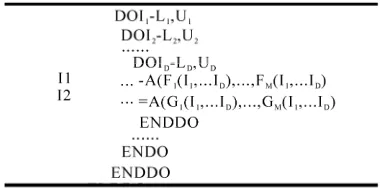
Figure 5 shows a generalized perfect nest of D loops. The body of the loop nest reads elements of the m-di-mensional array A twice. In the paper, we only consider linear subscription expressions, and the ith dimension subscription expression of the first array A reference is denoted as , where Ij is an index
vari-able,
0 , ,j* j i i
i C I C
F
D j
1 , Ci,j is the coefficient of Ij, 1jD
j C'i,0
, and Ci,0 is the remaining part of the subscript expression that
does not contain any index variables. Correspondingly, the ith dimension subscription expression of the second array A reference is denoted as . If in
the Pth level loop, the data trace covered by the leftmost Q dimensions1 of one array A read references in the nest with IP=i is the same to that of the other array A read
references in the nest with IP=i+d, where d is a const, and
they are different to each other in the same nest, such as the data trace of array QP in loop2 in Figure 3, the two array A read references can be optimized by input stream reuse in respect of loop P and dimension Q. Then we give the algorism of Identifying Loop-carried Input Stream Reuse, ILISR.
ij i C I
G ',*
Algorithm ILISR . Two array references in the same loop body can be optimized by input stream reuse in re-spect of loop P and dimension Q if:
1)when M1
0 , 1 C Ij
, i.e. array A is a 1-D array, the subscript expressions of two array A references can be written as
and respectively,
and Q=1 now. The coefficients of F1 and G1 should sat-isfy following formulas:
, 1
1 C *
F j G1C'1,j*IjC'1,0
1In this paper, we assume the sequence of memory access is the
[image:2.595.55.290.374.580.2] j j j j
j C U L
C D j j 1 , 1 ,
1 *( ))
( ) 1 ((
: (c) C1,0C'1,0d*C'1,P (h)
D i j j j
j C U L
C D j j 1 , 1 ,
1 *( ))
( ) 1 ((
: (i)
Formulas (1a) and (1b) ensure when the loop indi-ces of outmost P-1 loops are given and the loop body passes the space of innermost D-P loops, the data trace of one array A read reference in the nest with IP=i is
the same to that of the other array A read references in the nest with IP=i+d. d is a const and we specify
d=1 or 2 according to [13]. When I1, …, IP-1, are
given and IP, …, ID vary, Formula (1c) restricts the
data trace of one array A references in the nest with IP=i from overlapping that of the other in the nest
with IP=i +d. This formula ensures the characteristic
of stream process, i.e. data as streams is loaded into the stream processor to process and reloaded into the SRF in batches after process. For the stream proces-sor, the cost of random access records of streams is very high.
4) whenM1, the subscript expressions of two array
A read references should satisfy following formulas:
) (I d F
GQ Q P (j)
)) ( )
((i Q Fi Gi
i
(k)
, ,
( ( i j 0 '( ' i j 0)) i j C j j j C
'
', ,
'( ' i j 0)) ( ( 'i j
i i i C i j C
', ,
'( ' i j 0)) ( ( 'i j
i i i C i j C
', '( ' 'i j 0)) i i i C
(l)
Algorithm IsClean . Since the reuse happening in the SRF is value reuse, the reuse happens only when the values to be reused must not be changed before the reuse. For a reference to array A whose values are to be reused and a write reference, we denote the subscript expres-sions of the reuse source reference as Fi and those of
write reference as Gi. The values generated by the reuse
source are not changed by the write reference in the sub-sequent d iterations if:
2) when M1, i.e. array A is a multi-dimensional
ar-ray, the subscript expressions of two array A read refer-ences should satisfy following conditions:
d) the Qth dimension subscript expression of one array is gotten by translating the index IP in the dimension
subscript expression of the other array by d, i.e. , and,
) (I d F
GQ Q P 5) when the reuse source is used earlier than the write
reference e) all subscript expressions of one array A reference
are the same with those of the other except the Qth di-mension subscript expression, i.e. , and,
)) ( ) ((i Q Fi Gi
i
1
max{ ( { , }) }
M
Q P P P Q
Q
F I L U N
1 1
min{ ( , { , }) (0 )}
M
Q P P P P Q
Q
F I i I L U N i d
(m)or
1
min{ ( { , }) }
M
Q P P P Q
Q
F I L U N
1 1
max{ ( , { , }) (0 )}
M
Q P P P P Q
Q
F I i I L U N i d
(n)f) for the two array A references, the innermost index variable in one subscript expression will not appear in any righter dimension subscript expressions, i.e.
, ,
( ( i j 0 '( ' i j 0))
i j C j j j C
'
))
', ,
'( ' i j 0)) ( ( 'i j
i i i C i j C
6) when the write reference is earlier
, ' ',
0 j j'( ' j C'i j 0)) i i'( ' i C'i j 0
1
max{ ( { , }) }
M
Q P P P Q
Q
F I L U N
1 1
min{ ( , { , }) (0 1)}
M
Q P P P P Q
Q
F I i I L U N i d
(o)or 1
min{ ( { , }) }
M
Q P P P Q
Q
F I L U N
1 1
max{ ( , { , }) (0 1)}
M
Q P P P P Q
Q
F I i I L U N i d
(p)
It can be proved that data access trace of two array ref-erences decided by condition (2) satisfies condition (1), and when Uj-Ij is large enough, they are equivalent.
The algorism of Identifying Loop-carried Output
Stream Reuse, ILOSR, is similar to ILISR except that reusing stream mustn’t change original data dependence. Then we give the ILOSR algorism without detailed specifications.
Algorithm ILOSR. We denote the subscript expres-sions of read references as Fi and those of write
refer-ences as Gi. Two array references in loop body can be
optimized by output stream reuse in respect of loop P and dimension Q if:
2.2. Exploiting Loop-Carried Stream Reuse
W. X. Xu ET AL. 35
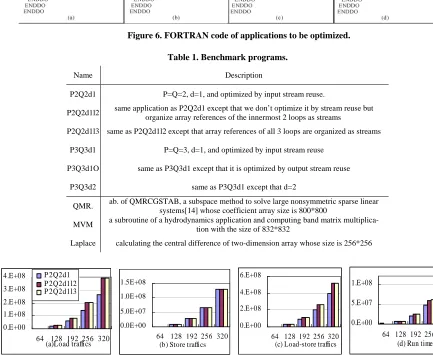
[image:4.595.70.503.119.474.2]Figure 6. FORTRAN code of applications to be optimized.
Table 1. Benchmark programs.
Name Description
P2Q2d1 P=Q=2, d=1, and optimized by input stream reuse.
P2Q2d1l2 same application as P2Q2d1 except that we don’t optimize it by stream reuse but organize array references of the innermost 2 loops as streams
P2Q2d1l3 same as P2Q2d1l2 except that array references of all 3 loops are organized as streams
P3Q3d1 P=Q=3, d=1, and optimized by input stream reuse
P3Q3d1O same as P3Q3d1 except that it is optimized by output stream reuse
P3Q3d2 same as P3Q3d1 except that d=2
QMR. ab. of QMRCGSTAB, a subspace method to solve large nonsymmetric sparse linear systems[14] whose coefficient array size is 800*800
MVM a subroutine of a hydrodynamics application and computing band matrix multiplica-tion with the size of 832*832
Laplace calculating the central difference of two-dimension array whose size is 256*256
0.E+00 1.E+08 2.E+08 3.E+08 4.E+08
64 128 192 256 320 (a)Load traffics P 2Q2d1 P 2Q2d1l2 P 2Q2d1l3
0.0E+00 5.0E+07 1.0E+08 1.5E+08
64 128 192 256 320 (b) Store traffics
0.E+00 2.E+08 4.E+08 6.E+08
64 128 192 256 320 (c) Load-store traffics
0.E+00 5.E+07 1.E+08
[image:4.595.71.520.512.602.2]64 128 192 256 320 (d) Run time
Figure 7. With the increase of array size the performance of different stream implementations of the application in 6(a) in respect of memory traffics (bytes) and run time (cycles).
0.E+00 2.E+06 4.E+06
P2Q 2d1
P3Q 3d1
P3Q 3d1
O P3Q
3d2
(a) Load traffics Without With
0.E+00 5.E+05 1.E+06
P2Q 2d1
P3Q3 d1
P3Q 3d1
O
P3Q3 d2
(b) Store traffics
0.E+00 3.E+06 6.E+06
P2Q2 d1
P3Q 3d1
P3Q3 d1O
P3Q3 d2
(c) Load-store traffics
0.E+00 1.E+06 2.E+06
P2Q 2d1
P3Q 3d1
P3Q 3d1O
P3Q 3d2
(d) Run time
Figure 8. Performance of P2Q2d1, P3Q3d1, P3Q3d1O and P3Q3d2 with array size of 64 in respect of memory traffics
onsists of the following three steps to exploit the streams
he in
e all operations on array A in the in-nermost D-P loops as a kernel.
Step C. Organize all operations in the outmost P loops as
op P in stream-level pro-gr
F by the former nest, which m
(bytes) and run time (cycles).
c
identified by algorithms ILISR, OLISR and IsClean:
Step A. Organize different array A references in t nermost D-P loops as stream A1 and A2 according their data traces.
Step B. Organiz
stream-level program. When the nest with IP=i of lo
am operates on stream A1 and A2, one of them has been loaded into the SR
0.E+00
Load Store Load-store (a) QMR.
0.E+00 0.E+00
Load Store Load-store (b) MVM
[image:5.595.117.477.82.188.2]Load Store Load-store (c) Laplace
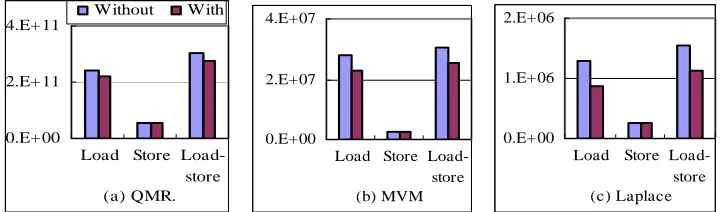
Figure 9. Effects of stream reuse on the memory traffics of scientific programs.
1.0 1.1 1.2 1.3 1.4
QMR .
MV M
Lap lace
Figure 10. Speedup of scientific programs with stream reuse.
itecture, we can know the time to access chip-off emory is much larger than that to access the SRF, so
d in loop1 as three streams accord-in
three streams ac
erformance of microbenchmarks and ons optimized and unoptimized
ams used for evalua-tion. Microbenchmarks listed in the upper half of the
here is an input stream reuse between adja-ce
affics, Figure 7(b) shows store traffics, Figure 7(c) sh
sor arch m
the method of stream reuse can improve stream program performance greatly.
In stream program MVM unoptimized, we organize different array QP rea
g their data trace ,and. organize operations in loop1 as a kernel The length of each stream is 832*832. When running, the stream program must load these three streams into the SRF, the total length of which is 692224 *3, nearly three times of that of array QP.
By the stream reuse method above, we organize dif-ferent array QP read references in loop2 as
cording their own data trace, organize operations in loop2 as a kernel, and organize operations in loop1 ex-cept loop2 as stream-level program. Thus there would be 832*3 streams in the stream program loop1, and the length of each is 832. So in stream program loop1, stream QP(L), QP(L+NXD) and QP(L-NXD) of neigh- boring iterations can be reused. As a result, the stream program only need load 832 streams with the length of 832 from chip-off memory to the SRF, the total length of which is 692224, nearly 1/3 of that of unoptimized pro-gram.
3. Experiment
We compare the p several scientific applicati
[image:5.595.116.229.220.316.2]by stream reuse. All applications are run on a cycle-accurate simulator for a single-node Imagine stream processor, Isim [9,10].
table stress particular aspects of loop-carried stream re-use, e.g., if t
Table 1 summarizes the test progr
nt loop nests in respect of loop 2 and dimension 2, the benchmark is named P2Q2d1. All microbenchmarks are stream programs of applications in Figure 6 in FOR-TRAN code. P2Q2d1, P3Q3d1, P3Q3d1O and P3Q3d2 are corresponding stream programs of 6(a), 6(b), 6(c) and 6(d), which is optimized by loop-carried stream re-use. P2Q2d1l2 and P2Q2d1l3 are corresponding stream programs of 6(a) without optimization. There are 2*N out of 4*N streams that can be reused as N stream in the SRF in every microbenchmark except P2Q2d1, in which there are 2*N2 out of 4*N2 streams that can be reused as N2 stream in the SRF. Scientific applications listed in the lower half of the table are all constrained by memory access. 14994 out of 87467 streams in QMR can be re-used as 4998 streams in the SRF, 3 out of 8 streams in MVM can be reused as 1 stream in the SRF, and 3 out of 5 streams in Laplace can be reused as 1 stream in the SRF.
Figure 7 shows the performance of different stream implementations of the application in 6(a) with the in-crease of array size. Figure 7(a) shows chip-off memory load tr
W. X. Xu ET AL. 37
he total chip-off m or
out. All th
r, we give the algorithms of identifying lo
sentative mi-robenchmarks and scientific stream programs with
ke advantage of architec-tu
d S. A. McKee, “Hitting the memory wall: Implications of the obvious,” Computer Architecture
ors,” In
Proceed-ttp://merrimac.stanford.edu/.
,
Proceedings of the 2004 SIGGRAPH
on
computing programs on imagine,” Advances
lishers, Boston, MA, 2001.
Engineering,
ications,”
Mas-gust 2003.
GPLAN ‘91
esidual variant of
stream length of P2Q2d1 is much shorter than and the number of streams are larger than the other two imple-mentations. As a result, the overheads to prepare to load streams from chip-off memory to the SRF weigh so highly that they can’t be hidden, including the time the host writes SDRs(Stream Descriptor Register) and MARs(Memory Access Register).With the increase of the array size, the run time of P2Q2d1 is smaller and smaller than the other two implementations. This is be-cause with the increase of the stream length, the over-heads to load streams into the SRF weigh more and more highly and consequently the overheads to prepare load-ing streams can be hidden well. The memory traffics of P2Q2d1 are the least and consequently the P2Q2d1 pro-gram performance is the highest.
Figure 8 shows the performance of P2Q2d1, P3Q3d1, P3Q3d1O and P3Q3d2 with array size of 64. Figure 8(a) shows chip-off memory load traffics, Figure 8(b) shows store traffics, Figure 8(c) shows t
em-y traffics, and Figure 8(d) shows the run time of them. These applications are representative examples of loop- carried stream reuse. In Figures 8(a), 8(b) and 8(c), chip- off memory load, store and total traffics have similar characteristics as those in Figure 7. In Figure 8(d), the performances of all applications except P2Q2d1 have been improved by stream reuse optimization. The reason for the reduction of P2Q2d1 performance has been given above. The results show that these representative appli-cations optimized by loop-carried stream reuse all get similar performance increase as that in Figure 7.
Figure 9 shows the effects of stream reuse on the memory traffics of scientific programs used in our ex-periments. Figure 10 shows the speedup yielded by sci-entific applications with stream reuse over with
on C
ese applications are optimized by input stream reuse. From results, we can see that because all these applica-tions are constrained by memory access, the improve-ment of application performance brought by stream reuse is nearly in proportion to the amount of streams that can be reused.
4. Conclusions and Future Work
In this pape op-
[
carried stream reuse for scientific applications and of exploiting the stream reuse. Several repre
c and Conference on Programming Language Design and
Im-plementation, ACM, New York, 1991.
[14] T. F. Chan, E. Gallopoulos, V. Simoncini, T. Szeto, and C. H. TongSIAM, “A quasi-minimal r
without our optimization are performed on Isim which is a cycle-accurate stream processor simulator. Simulation results show that the optimization method can improve the performance of scientific stream program constrained by memory access efficiently.
In the future, we are devoted to developing more pro-gramming optimizations to ta
ral features of the stream processor for scientific com-puting applications.
5. References
[1] W. A. Wulf an
News, Vol. 23, No. 1, pp. 20–24, 1995.
[2] D. Burger, J. Goodman, and A. Kagi, “Memory band-width limitations of future microprocess
ings of the 23rd International Symposium on Computer Architecture, Philadelphia, PA, pp. 78–89, 1996.
[3] S. A. William, “Stream architectures,” In PACT 2003, September 27, 2003.
[4] Merrimac–Stanford Streaming Supercomputer Project, Stanford University, h
[5] W. J. Dally, P. Hanrahan, et al., “Merrimac: Supercom-puting with streams,” SC2003, Phoenix, Arizona vember 2003.
[6] M. Erez, J. H. Ahn, et al., “Merrimac-supercomputing with streams,”
GP^2 Workshop on General Purpose Computing on Gra- phics Processors, Los Angeles, California, June 2004. [7] J. B. Wang, Y. H. Tang, et al., “Application and study of
scientific computing on stream processor,” Advances Computer Architecture (ACA’06), Chengdu, China, Au-gust 2006.
[8] J. Du, X. J. Yang, et al., “Implementation and evaluation of scientific
omputer Architecture (ACA’06), Chengdu, China, August 2006.
[9] M. Rixner, “Stream processor architecture,” Kluwer Academic Pub
[10] P. Mattson, “A programming system for the imagine media processor,” Department of Electrical
Ph.D. thesis, Stanford University, 2002.
[11] O. Johnsson, M. Stenemo, and Z. ul-Abdin, “Program-ming & implementation of strea“Program-ming appl
ter’s thesis, Computer and Electrical Engineering, Halm-stad University, 2005.
[12] U. J. Kapasi, S. Rixner, et al., “Programmable stream processor,” IEEE Computer, Au
13] G. Goff, K. Kennedy, and C. W. Tseng, “Practical de-pendence testing,” In Proceedings of the SI