doi:10.4236/ijcns.2009.27076 Published Online October 2009 (http://www.SciRP.org/journal/ijcns/).
Space-Time-Frequency Coded for Multiband-OFDM
Based on IEEE 802.15.3a WPAN
Kamal MOHAMED-POUR, Hossein EBRAHIMI
Department of Electrical Engineering, K. N. Toosi University of Technology, Tehran, Iran Email: [email protected]
Received September 9, 2008; revised February 23, 2009; accepted April 15, 2009
ABSTRACT
In this paper, Multiband-OFDM UWB system based on IEEE 802.15.3a standard is studied and simulated with spatial, time and frequency (STF)coding scheme. The using of STF coding method can guarantee both full symbol rate and full diversity advantages. The simulation results show that the STF code uses multi- path-rich and random-clustering characteristics of UWB channel environment on the performance of MB- OFDM system.
Keywords:IEEE 802.15.3a, UWB, MB-OFDM, MIMO, Space-Time-Frequency Coding
1. Introduction
Ultra wideband (UWB) systems are the first nomination for future wireless personal area networks (WPANs). The enormous band with availability provides the poten-tial for very high data rates. The ultra wide bandwidth of UWB enables various WPAN applications such as high- speed wireless universal serial bus (WUSB) connectivity for personal computers and their accessories, high-qual-ity real-time video and audio transmission, and cable replacement for home entertainment systems.
Currently, the multi-band orthogonal frequency divi-sion multiplexing (MB-OFDM) [1] is an important can-didate for the physical layer within IEEE 802.15.3a standard.
On the other hand, the rich scattering multipath chan-nel in UWB indoor environment provides an ideal transmission scenario for multiple antenna configurations. In this paper, we use a space-time-frequency coding (STFC) method [2] that can guarantee both full symbol rate and full diversity for performance improvement of MB-OFDM UWB systems over CM 1-CM 4 environ-ment with 2ISO and 2I2O MIMO configurations.
The paper is organized as follows: In Section 2, an overview of STFC MB-OFDM UWB system is given. Section 3 gives the simulation results, and finally Section 4 concludes the paper.
2. STFC MB-OFDM UWB System
2.1. UWB Channel Model
The channel model is based on Saleh-Valenzuela model [3] according to IEEE 802.15.3a standard. The channel impulse response can be expressed as
1 1
, ,
0 0
( )
c c
L K
i i
i i k l l k
l k
h t X
t T
il
(1)
where i represents the realization of the i-th impulse
re-sponse, i, k l
is the multipath gain coefficients, is the delay of the l-th cluster,
i l
T
, i k l
is the delay of k-th ray,
and Xi represents the log-normal shadowing. The cluster
arrivals and the path arrivals within each cluster are mod-eled by Poisson processes
l| l 1
exp
l l 1
,p T T T T l0 (2)
k l, | (k 1),l
exp
k l, (k 1),l
,p k0
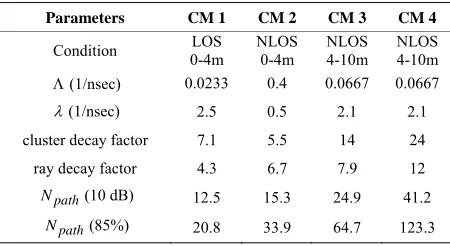
where Λ and λ (where λ >Λ) are the cluster arrival rate and ray arrival rate, respectively. Four set of channel model (CM) parameters for different measurement envi-ronments were defined, namely CM 1, CM 2, CM 3, and CM 4. Table 1 provides the model parameters of CM 1-CM 4 [4].
2.2. STFC MB-OFDM Structure
665
Table 1. The IEEE UWB channel parameters.
Parameters CM 1 CM 2 CM 3 CM 4
Condition 0-4m LOS NLOS 0-4m NLOS 4-10m NLOS4-10m
(1/nsec) 0.0233 0.4 0.0667 0.0667
(1/nsec) 2.5 0.5 2.1 2.1
cluster decay factor 7.1 5.5 14 24 ray decay factor 4.3 6.7 7.9 12
path
N (10 dB) 12.5 15.3 24.9 41.2
path
N (85%) 20.8 33.9 64.7 123.3
moved to a different frequency-band at the next interval. In Table 2 you can see the simulation parameters of MB-OFDM UWB system. The data is encoded by STF code words across Mt transmit antennas, N OFDM
sub-carriers, and KOFDM blocks. We suppose a frequency- selective fading channels based on S-V model, between any pair of transmit and receive antennas. Figure 1 represents the structure of system. Because of small wavelength in UWB environment and fast frequency hopping, consideration of independency between MIMO channel elements is reasonable. In this case, according to [2,5] the maximum achievable diversity is at most min { MtMr, rank(RT), KNMr}, where L is the number of
de-lay path and RT is the temporal correlation matrix.
We use repetition coded STF code [2] that is a full di-versity code as follows:
1
STF K SF
D 1 D (3)
where 1K×1 is an all one matrix, is tensor product, and
DSF is a full diversity SF code of size N×Mtwhich have
been proposed in [6]. At the transmitter, the information is jointly encoded across Mt transmit antennas, M OFDM
subcarriers, and K OFDM blocks. Each STF codeword is a KN×Mt matrix that can be expressed as a
,1 ,2 , ( t) t
T T T T
k k k k P 0 N P M M
D G G G (4)
where t N P M
and is an integer smaller than N, which determines the number of jointly encoded sub-carriers. Also
,1 ,2, 1 * *
,2 ,1
1
t
p p
k P KM
p p x x x x
G I (5)
where xp k, s are selected from QPSK or BPSK
constel-lations. As mentioned earlier, we use repetition STFC which is based on Alamouti’s structure. After STFC en-coder, we add some preambles and headers for channel estimation and frame and packet synchronization. The baseband OFDM signal to be transmitted by i-th transmit antenna at the k-th OFDM block can be expressed as [7]
1
0
( ) ( ) exp 2
N
k k
i i
t n
E
x t d n j n f t T
M
CP
c
(6)
where represents the complex symbol to be
transmitted over n-th subcarrier by i-th transmit antenna during the k-th OFDM symbol period. Finally, after fil-tering, up conversion and band hopping, the trans-mitted signal over i-th antenna is
( ) k i d n
1 0( ) Re ( ) exp( 2 )
K
k k
i i SYM
k
s t x t kT j f
t (7)In the receiver, after frequency dehopping, down con-verting and filtering, we have received signal at in matrix form as [2]
t
E
M
Y DH Z (8)
where D is the STF coded data, H is the MIMO channel
matrix, and Z is complex baseband noise. Because of
channel estimation pilots, we can determine H, so we
have
t t
E E
M M
W Y WDH WZ D WZ (9)
where
H
1 HW H H H . The receiver exploits a
maximum likelihood detector over received signal ma-trix. 2 t E arg min M
D = Y DH (10)
Therefore, the error probability will be as
2 1 | 2 r M e t j P Q M
H HD - D
[image:2.595.311.537.545.717.2](11)
Table 2. The MB-OFDM UWB parameters.
Information rate
200 Mbps
Number of Subcarriers
128
Channel coding 5/8 rate convolutional
Constellation
QPSK/BPSK
Data tones
100
TFFT
242.4 nsec
TCP
60.6 nsec
TGI
9.5 nsec
TSYM
312.5 nsec
Decoder
Hard viterbi
666
[image:3.595.112.483.78.232.2]
Figure 1. STFC MB-OFDM UWB system.
0 1 2 3 4 5 6 7 8 9 10
0 0.05 0.1 0.15 0.2 0.25 0.3 0.35 0.4 0.45
Delay (ns)
P
ow
er
0 2 4 6 8 10 12 14 16 18 20
0 0.05 0.1 0.15 0.2 0.25 0.3 0.35 0.4 0.45 0.5
Delay (ns)
P
ow
er
(a) (b)
0 5 10 15 20 25
0 0.05 0.1 0.15 0.2 0.25 0.3 0.35 0.4 0.45 0.5
Delay (ns)
Po
w
e
r
0 5 10 15 20 25
0 0.05 0.1 0.15 0.2 0.25 0.3 0.35 0.4 0.45 0.5
Delay (ns)
Po
w
e
r
(c) (d)
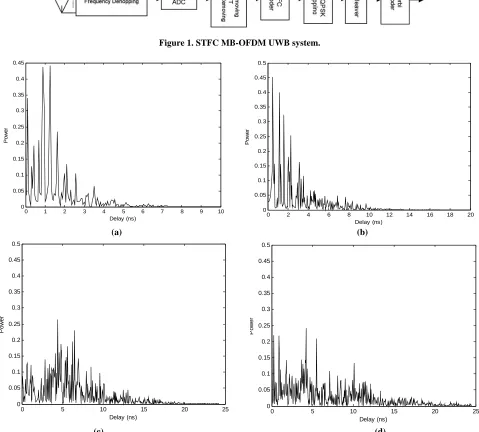
Figure 2. Simulated channel response; a) CM 1, b) CM 2, c) CM 3, d) CM 4.
3. Simulation Results
We performed simulations for a multiband UWB system with N = 128 subcarriers and the subband bandwidth of
528 MHz. Each OFDM symbol was of duration 242.42
ns. After adding the cyclic prefix of length 60.61 ns and
[image:3.595.58.537.205.637.2]667
impulse responses for CM 1-CM 4. We used a repetition STFC based on Alamouti’s structure that can guarantee full diversity [2]. Also we used 5/8-rate convolutional coding for improving performance. So our pure data rate was 200 Mbps. We first simulated UWB channel based on IEEE 802.15.3a standard. CM 2 is 0-4 m, non line of sight channel, so it is reasonable to consider CM 2 for realistic application. Figure 3 gives the BER perform-ance of MB-OFDM UWB as a function of SNR for CM 2 channel model, as frame length is 4200 QPSK symbols. In each frame, 600 symbols were preamble pilot for channel estimation. 100 channel realizations of IEEE 802.15.3a channel model (CM 1, 2, 3 and 4) were con-sidered for the transmission of each symbol.
Figure 4 gives the BER performance of STFC coded MB-OFDM UWB as a function of SNR for CM 2 chan-nel model without chanchan-nel coding with the data jointly encoded across two subcarriers. The simulation results show that for CM 2 scenario, when K=1 the 2ISO and 2I2O configurations are almost 8.5dB and 16 dB better than MB-OFDM, respectively. For K=2, the 2ISO and 2I2O configurations are almost 11.5dB and 17.5 dB bet-ter than MB-OFDM, respectively.
Figure 5 gives the BER performance of STFC coded MB-OFDM UWB as a function of SNR for CM 2 and CM 4 for 2ISO and 2I2O configurations with the data jointly encoded across two subcarriers, when K=1. In conventional MB-OFDM, performance for CM 4 is worse than other scenarios, but it can be seen that the simulated performance for CM 4 is better than CM 2, when repetition STFC is employed. In coded system un-der CM 4 the coding gain is larger. It seems that space time frequency coding yields the MB-OFDM system can gain the multipath clustering property of UWB environments. In fact, when repetition STFC is employed, in compari-son with other scenarios, CM 4 has the minimum corre-lation among OFDM subcarriers.
4. Conclusions
In this paper, MIMO-MB-OFDM has been studied. The simulation results indicate that the 2I2O STFC-MB- OFDM scheme for UWB system shows much better performance compared with un-coded MB-OFDM. On the other hand, the performance of STF coded system can be improved by increasing the number of antenna, regardless of the random clustering behavior of UWB channels.
5. References
[1] A. Batra, et al., “Multi-band OFDM physical layer pro-posal for IEEE 802.15 task group 3a,” IEEE 802.15– 03/268r3, Texas Instruments, March 2004.
[2] W. Su, Z. Safar, and K. J. R. Liu, “Towards maximum
0 5 10 15 20 25
10-4 10-3 10-2 10-1 100
SNR(dB)
BER
withouth channel coding
[image:4.595.312.536.91.397.2]5/8 convolutional coding
Figure 3. The performance of MB-OFDM UWB.
0 2 4 6 8 10 12 14 16 18 20 10-4
10-3 10-2 10-1 100
SNR(dB)
BE
R
[image:4.595.313.532.502.677.2]K=1,Nt=2,Nr=1 K=2,Nt=2,Nr=1 K=1,Nt=2,Nr=2 K=2,Nt=2,Nr=2
Figure 4. Performance of MB-OFDM for different MIMO configurations.
0 2 4 6 8 10 12 14 16 18 20
10-4 10-3 10-2 10-1 100
SNR(dB)
BER
CM2,Nt=2,Nr=1 CM4,Nt=2,Nr=1 CM2,Nt=2,Nr=2 CM4,Nt=2,Nr=2
Figure 5. Performance comparison between CM 2 and CM 4.
Per-668
formance analysis and code design,” IEEE Trans. on Wireless Commun., Vol. 4, No. 4, pp. 1847–1857, Jul. 2005.
[3] IEEE 802.15WPAN High Rate Alternative PHY Task Group 3a (TG3a). Internet: www.ieee802.org/15/pub/ TG3a.html
[4] M. Ghavami, L. B. Michael, and R. Kohno, “Ultra wide-band signals and systems in communication engineering,” John Wiley & Sons, Ltd, 2004.
[5] B. Lu, X. Wang, and K. R. Narayanan, “LDPC-based space-time coded OFDM systems over correlated fading
channels: Performance analysis and receiver design,” IEEE Trans. Commun., Vol. 50, No. 1, pp. 74–88, Jan. 2002.
[6] W. Su, Z. Safar, M. Olfat, and K. J. R. Liu, “Obtaining full-diversity space-frequency codes from space-time codes via mapping,” IEEE Trans. Signal Processing, Vol. 51, pp. 2905–2916, Nov. 2003.