JAMES EAST1AND ATTILA EGRI-NAGY2 AND JAMES D. MITCHELL3
Abstract. We describe general methods for enumerating subsemigroups of finite semigroups and techniques to improve the algorithmic efficiency of the calculations. As a particular application we use our algorithms to enumerate all transformation semigroups up to degree 4. Classification of these semigroups up to conjugacy, isomorphism and anti-isomorphism, by size and rank, provides a solid base for further investigations of transfor-mation semigroups.
1. Introduction
When studying finite structures it can be helpful to generate small examples using a computer [2,11,17– 19,26]. By investigating these sample objects we can discover patterns, formulate new hypotheses, look for counterexamples, and so on. More diverse sample sets make it easier to greater evidence for or against a conjecture. Therefore, to maximize the usefulness of these small examples we naturally aim both to enumerate all objects of a certain parameter value (such as size or dimension), and toincrease the value of this parameter. Earliest efforts to enumerate semigroups have focused on the abstract case, enumerating byorder (thesizeof the semigroup). The basic idea for enumerating by size is to find all valid multiplication tables (up to isomorphism and anti-isomorphism) of the given size [4,5,12,23,24,27,28,30,31]. Our approach here is to enumerate not by size but, rather, by degree of transformation representation [3,32]. Recall that Cayley’s Theorem (for semigroups) says that any finite semigroup S is isomorphic to a semigroup of functions on a finite set; the degree of S is defined to be the minimal size of such a set. So we aim to enumerate the valid subtables inside the multiplication table of thefull transformation semigroup Tn, which consists of alltransformationsof the set{1, . . . , n}(i.e., all functions from this set to itself); more specifically, we wish to find all such subtables (up to isomorphism and anti-isomorphism) that are not also (isomorphic to) subtables ofTn−1. All finite semigroups will eventually be listed when we enumerate by size or by degree, but the order of the list is different from one method to the other. For example, there are 52,989,400,714,478 abstract semigroups of order 9 [4,5], so one could barely imagine the number of semigroups of order 27, whereT3would first appear when enumerating by size. On the other hand, our results show that there are only 25 different transformation semigroups on 3 points of order 9. Metaphorically speaking, enumeration by size and by degree go in completely different directions and proceed at a different rate. The complexity of the multiplication of two transformations fromTn is linear inn. However, multiplication in a semigroup defined by a multiplication table has constant complexity. Hence, we choose multiplication tables as the main way of representing semigroups. This decision has two consequences. First, our algorithms fall into the class of semigroup algorithms that fully enumerate the elements. This of course restricts us to relatively small semigroups. On the other hand, multiplication table algorithms are completely representation independent, so our methods are widely applicable across different types of finite semigroups.
The article is organised as follows. In Section 2we describe a basic multiplication table method to calculate subsemigroups generated by a subset. In Section3 we present generic search algorithms to enumerate subsemi-groups of finite semisubsemi-groups. In Section4 we discuss techniques for improving the efficiency of the algorithms in Section 3, based on more specific algebraic results. Finally, in Section 5 we apply the developed methods for enumerating transformation semigroups acting on up to 4 points.
For the computational enumeration we used theGapcomputer algebra system [14] and itsSemigroups pack-age [25] and developed a new packageSubSemifor subsemigroup enumeration [8]. Instructions for recomputing the results can be found in the package documentation. We now take a moment to establish some notation.
1.1. Notation. Let S be a finite semigroup with |S| = n ∈ N. We fix an order on the semigroup elements and for convenience denote them simply by 1, . . . , n. Themultiplication table, or Cayley table ofS is an n×n matrixMS with entries from {1, . . . , n}, such that Mi,j =k if ij =k in S (we denote multiplication in S by juxtaposition). The subarray ofMS with rows and columns indexed by a subset A⊆ {1, . . . , n} is denoted by MA.
1
The set of all subsemigroups of S is denoted by Sub(S) =
T | T ≤ S . We consider the empty set a semigroup, so∅∈Sub(S). The set of maximal proper subsemigroups ofS is denoted byMax(S). ForA⊆S,
hAidenotes the least subsemigroup ofS containingA, the semigroup generated byA.
If Iis an ideal of S then theRees factor semigroup S/I has elements (S\I)∪ {0}, where 0 is a new symbol that does not belong toS, and with multiplication·defined by
s·t=
(
st ifs, t, st∈S\I 0 otherwise.
Note that ifI=∅is the empty ideal, thenS/I ∼=S0is the semigroup obtained fromS by adjoining a zero. A transformationt ∈ Tn will often be written by simply listing the images of the points, t= [t(1), . . . , t(n)]. The group consisting of all permutations of{1, . . . , n} is thesymmetric group, denoted Sn, and is the group of units ofTn.
2. The closure algorithm
A basic question in computational semigroup theory is: Given a subset A of a semigroup S, what is the subsemigroup hAi generated by A? We will also write Cl(A) for hAi, and refer to it as the closure of A (in S). Note that on the level of the Cayley table,hAiis the minimal set B (in the containment order on subsets ofS) such that the subarrayMB containsMAand all entries fromMBbelong toB. An algorithm for obtaining B =Cl(A) is as follows. First we determine the set m(A) ={x| xis an entry ofMA} \A, those products of elements ofAthat are missing fromA. We then recursively define
Cl1(A) =A∪m(A), Cli+1(A) =Cl1(Cli(A)) fori≥1.
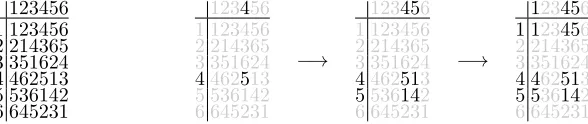
Note thatCl(A) =Clj(A), where j is minimal such thatClj(A) =Clj+1(A), or equivalentlym(Clj(A)) =∅. For example, consider the symmetric group S3, with its elements ordered 1 = (), 2 = (2,3), 3 = (1,2), 4 = (1,2,3), 5 = (1,3,2), 6 = (1,3). The subarray M{4} contains only one entry, 5, which is different from 4, so the subarray is not closed. With the above notation,m({4}) ={5}, m({4,5}) ={1} and m({1,4,5}) = ∅, soCl1({4}) ={4,5} and Cl2({4}) =Cl3({4}) = Cl({4}) = {1,4,5}, corresponding to the unique subgroup of order 3 inS3. See Fig.1.
123456 1 123456 2 214365 3 351624 4 462513 5 536142 6 645231
123456 1 123456 2 214365 3 351624
4462513 5 536142 6 645231
−→
123456 1 123456 2 214365 3 351624
4462513
5536142 6 645231
−→
123456
1 123456 2 214365 3 351624
4 462513
[image:2.612.160.454.429.491.2]5 536142 6 645231
Figure 1. The Cayley table of the symmetric group S3 (left), and calculation of Cl({4}) =
{1,4,5}(right). See text for further explanation.
The above recursive definition describes an algorithm for calculating the closure, but not an efficient one. We can avoid the full calculation of the missing elements in the recursive steps. When extending the subarrayMA by a single elementi, ifm(A) is already calculated, then all new missing elements inm(A∪ {i}) can only come from theith row or theith column. So, to calculate the closure we can extend the subarray one-by-one using the elements ofm(A) and any new missing elements encountered during the recursion. This way each table entry is checked only once.
3. Basic Search Algorithms for Subsemigroup Enumeration
One of our primary goals is to enumerate the semigroups of a given degree, and this involves enumerating the subsemigroups ofTn. This is of course a special instance of the following more general problem.
Problem 3.1. For a semigroupS, find all of its subsemigroups: Sub(S) ={T |T ≤S}.
3.1. Enumerating by Brute Force. The obvious brute-force algorithm for constructingSub(S) proceeds by first constructing the powerset 2S ={A|A⊆S}and then checking each subset for closure. For some semigroups, any method essentially reduces to the brute-force algorithm (e.g., left or right zero semigroups, where every subset is a subsemigroup), but it is inefficient in cases where only a fraction of the subsets are closed under multiplication.
3.2. Enumerating by Minimal Generating Sets. Therank of a semigroup is the least size of a generating set. The rank of a subsemigroup can be bigger than the rank of the semigroup itself. For example, the full transformation semigroup has rank 3 [13], but its minimal ideal (which is a left zero semigroup) has rank n, while its maximal proper ideal (the semigroup of all singular transformations) has rank n2 = n(n−1)/2 for n≥3 [15,20]. Assuming that we know the maximum rank for subsemigroups of S, we can check all subsets of S with cardinality up to that value to see what subsemigroups they generate. The same subsemigroup may be generated by many generating sets but the maximality guarantees that we construct all ofSub(S). On each level k, we check |S|k
many generating sets. Therefore, the method is only feasible if the maximum value of the ranks of the subsemigroups is known to be small. To the knowledge of the authors, the maximal rank of a subsemigroup ofTn is not currently known, though the maximal rank of an ideal is equal to the largest of the Stirling numbersS(n,2), . . . , S(n, n−1) [21].
What can we do if we do not know the maximum rank value? We can keep going until no new subsemigroup is generated. First we check all subsemigroups generated by one element, then those generated by two; we subtract the former set from the latter to obtain the set of rank-2 subsemigroups. We then continue up tomwhere the set of rank-msubsemigroups is empty. Unfortunately this last step is wasted, unless rank(S) =S, e.g. left zero semigroups, in which case, this is just the brute-force search.
3.3. Enumerating by Minimal Extensions. Aminimal extensionof a subsemigroupT ≤Sis a subsemigroup
hT ∪ {u}i, whereu ∈ S\T. We simply add a new element to T and calculate the closure. If we recursively calculate minimal extensions, then we obtain all subsemigroups ofS containingT. So this represents a solution to a natural generalisation of Problem3.1, that of calculating the interval [T, S] ={U |T ≤U ≤S}in the lattice Sub(S).
This algorithm is a graph search. The nodes are the subsemigroups containingT, and there is a directed edge labelledufrom V toV0 ifV0 =hV ∪ {u}i. In general, there may be many incoming edges to a subsemigroup. The efficiency of the algorithm comes from the fact that the search tree is cut when the search encounters a subsemigroup already known, simply by making no further extensions. The details are provided in Algorithm 1. Depending on how exts, the storage for extensions, behaves under the Store/Retrieve operations we get different search strategies. Ifextsis a stack, then the algorithm performs a depth-first search, and if it is a queue, then a breadth-first search is performed. A full subsemigroup enumeration can be done by starting the algorithm with parametersT =∅, the semigroup is simplyS, andX =S. This is simply extending the empty set by all elements ofS recursively.
When using the breadth-first search strategy, the generating set is minimal, so Algorithm 1 can easily be modified to enumerate minimal generating sets. A little consideration shows that this is a more efficient version of the minimal generating sets algorithm (Section3.2), but it does not escape checking generating sets one bigger than the maximal rank.
3.4. Enumerating by Maximal Subsemigroups. Assuming that we have calculated the maximal subsemi-groups ofS, we can parallelize subsemigroup enumeration by enumerating subsemigroups of the maximal sub-semigroups and merging the results, using the obvious fact that
Sub(S) ={S} ∪ [
T∈Max(S)
Sub(T).
Algorithm 1:Finding subsemigroups by minimal extensions. input : S, the semigroup
T ≤S, a subsemigroup to be extended X ⊆S, a set of elements to extend with
output: allT0 ⊆S such thatT0 =hT∪Yifor someY ⊆X SubSemigroupsByMinimalExtensions (T,S,X):
1 subs← {T}
2 exts←∅
3 fors∈(S\T)∩X do 4 Store (exts,T∪ {s})
5 while |exts|>0do 6 T0 ← hRetrieve(exts)i
7 if T0∈/ substhen 8 subs←subs∪ {T0}
9 fors∈(S\T0)∩X do 10 Store(exts,T0∪ {s})
11 returnsubs
4. Advanced Algorithmic Techniques
Since we are dealing with well-studied algebraic structures, there are many mathematical results we may exploit in order to improve the efficiency of any basic subsemigroup enumeration algorithm. In this section, we outline a number of improvements on the algorithms described in the previous section, the most powerful of which involves using an ideal to parallelize the enumeration (see Sections4.3and4.4).
4.1. Equivalent Generators. We define an equivalence relation ≡onS by s≡t⇐⇒ hsi=hti.
For instance, [2,3,1,1]≡[3,1,2,2] inT4, both transformations generating
[2,3,1,1],[3,1,2,2],[1,2,3,3] . Note that if the≡-class ofs∈Sis nontrivial, thenhsiis a cyclic group. Note also that ifs≡t, thenhU∪{s}i=hU∪{t}i
for anyU ⊆S, so when using the Minimal Extensions enumeration method (Section3.2), we only need to calculate extensions with respect to≡-class representatives.
4.2. Exploiting Symmetries. If we have information about the symmetries S might possess, then we can accelerate any subsemigroup enumeration algorithm. For example, if S is a monoid with group of units G, then Tg = g−1tg|t∈T is a subsemigroup of S for any T ∈ Sub(S) and g ∈ G. More generally, if θ is an automorphism of S, then T θ = {tθ|t∈T} ∈ Sub(S) for all T ∈ Sub(S). There is an algorithm for computing the automorphism groupAut(S) of a finite semigroup S [1]. So, during subsemigroup enumeration, whenever a subsemigroup T ≤ S is found, we may quickly find the subsemigroups T θ. If H ≤ Aut(S) is a group of automorphisms ofS, then we write SubH(S) for a set of automorphism class representatives of the subsemigroups ofS; so for anyT ∈Sub(S), there is a unique subsemigroup U ∈SubH(S) such thatT =U θ for someθ∈H.
Moreover, when extending a subsemigroupT by elements fromS\T one by one (Section3.3), we can cut the search tree further. By taking the normalizer ofT in S, i.e. the stabilizer ofT under the conjugation, we know that the conjugacy classes ofT∪ {x}will be of the formT∪ {xi}, wherexi is an element of the orbit ofxunder conjugation, thus we only need to extend with one element of the orbit. Therefore, the search algorithm has to visit only the orbit representatives ofS\T under the normalizer.
S\I S
I T
T
[image:5.612.214.392.66.241.2]L U
Figure 2. IfS has an idealI, then a subsemigroupT ≤S is partitioned into two parts by the
ideal, the upper torsoU =T∩(S\I) and the lower torsoL=T∩I.
Lemma 4.1. IfI is an ideal of S, then
Sub(S) =h(U\ {0})∪Li |U ∈Sub(S/I), L∈Sub(I) .
Proof. LetT ∈Sub(S) and putL=T∩IandU =T∩(S\I)∪ {0}. ThenT = (U\ {0})∪L=h(U\ {0})∪Li. This establishes the forward set containment. The other is trivial.
Note that a subsemigroupU ≤S/I need not contain the zero element. The method suggested by Lemma4.1 requires calculating|Sub(S/I)|·|Sub(I)|set unions and subsequent closures. However, this inefficient calculation is avoidable by using the Lower Torso Enumeration technique, as we now describe.
4.4. Lower Torso Enumeration. Suppose we have enumeratedSub(S/I) for some idealIof the semigroupS. Then{U\ {0} |U ∈Sub(S/I)} is precisely the set of all upper torsos. The next task is to find all the matching lower torsos for an upper torso. That is, for each upper torsoU, we must find all subsemigroups L ≤I such thatU∪L≤S. The method described in Section4.3involved enumeratingSub(S/I) andSub(I) and checking what the combinations generated. We can do better. The idea is that an upper torsoU acts on the elements of the idealI by multiplication, so if we do a minimal extension search (Section3.3) the extensions will often be ‘large jumps’ (see Fig.3). We can use Algorithm1starting fromU and extending only by the elements from the ideal. In practice, for the full transformation semigroups, this is a very useful trick. The main general advantage of the Lower Torso Enumeration method is that no merge is required.
5. Enumerating transformation semigroups of degree 2, 3 and 4
In order to enumerate all semigroups of degree n, we construct all subsemigroups of the full transformation semigroupTn. We use the ideal structure to make the enumeration more efficient by making the calculation parallel according to the techniques discussed in Sections4.3and4.4.
Recall that therank of a transformationtis|im(t)|. The ideal ofTncontaining all elements of rank at mosti is denoted byKn,i. The ideal structure of Tn is a linear order of nested ideals:
∅⊂Kn,1⊂Kn,2⊂. . .⊂Kn,n−1⊂Kn,n=Tn.
The maximal proper idealKn,n−1 =Tn\ Sn is also called thesingular transformation semigroup of degree n, and consists of all transformations but the permutations.
It is well known that Aut(Tn) is isomorphic to Sn, with every automorphism induced by conjugating the elements ofTn by a permutation [22,29]. As such, we are primarily interested in calculatingSubSn(Tn), a set
S\I S
I T
L U
x1
[image:6.612.164.447.67.233.2]x2
Figure 3. Calculating lower torsos for T by minimal extensions, first extending with x1 then
byx2, elements fromI. The idea is that often|T| |hT∪ {x1}i| |hT∪ {x1, x2}i|. The jumps in size are due to the upper torso acting on the elements of the ideal.
5.1. Subsemigroups of T2, the pen and paper case. The semigroup T2 has only four elements and conse-quently the brute-force search space size is only 24= 16. It is an easy exercise to find all of its subsemigroups. We order the elements lexicographically, 1=[1,1], 2=[1,2], 3=[2,1], 4=[2,2], and list the closed subarrays:
1144 1234 1324 1414 ,
1144 1234
1324
1414 ,
1144
1234
1324
1414
,
1144 1234 1324
1414
, 1144
1234 1324 1414
, 1144
1234 1324
1414 ,
1144 1234 1324 1414
,
1144
1234
1324
1414
,
1144
1234
1324 1414
,
1144 1234 1324 1414
.
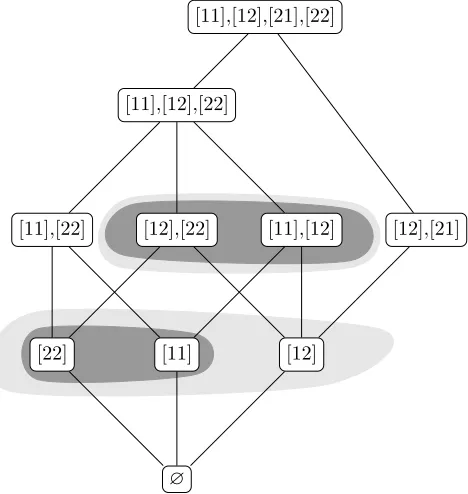
Using these we can draw the subsemigroup lattice (see Fig.4). Note that the subsemigroups{1} and {2} are isomorphic but not conjugate.
[11],[12],[21],[22]
[11],[12],[22]
[12],[22]
[11],[22] [11],[12] [12],[21]
[11]
[22] [12]
∅
Figure 4. The subsemigroup lattice ofT2. The horizontal levels correspond to classes of
sub-semigroups of the same size. Dark (resp., light) grey blobs indicate nontrivial conjugacy (resp., isomorphism) classes.
[image:6.612.195.429.402.649.2][11],[12],[21],[22]
[11],[12],[22]
[12],[22]
[11],[22] [11],[12] [12],[21]
[11]
[22] [12]
[image:7.612.179.434.72.334.2]∅
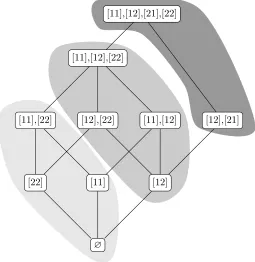
Figure 5. The subsemigroup lattice ofT2. The subsemigroups of the singular part are indicated by the lowest light grey blob. The middle group is an order-isomorphic copy of the latter, with the identity of T2 adjoined to each subsemigroup. The upper dark grey part consists of the subsemigroups containing nontrivial permutations. The size of the dark group appears to get smaller relative to the singular part for higher degrees.
of the subsemigroup lattice of Tn is formed by the subsemigroups of the singular part,Sub(Kn,n−1), and this has an order-isomorphic copy when we adjoin the identity of Tn to each subsemigroup of Kn,n−1, denoted by Sub(Kn,n−1)#. The remaining part is the set of subsemigroups that contain nontrivial permutations. Since we have no problems with fully calculating and displayingSub(T2), this division has no significance, but can be visualized easily (see Fig.5).
5.2. Subsemigroups of T3, the limits of brute-force. The brute-force search space size for T3 is 23 3
= 134 217 728, or approximately 134.2 million. Previous computational investigations further restricted the search to the singular part bringing it down to≈2.1 million [3,32]. In contrast, using the Minimal Extension method (Section3.3) together with the Equivalent Generators trick (Section4.1), only 4344 subsets need to be checked to enumerate the 283 conjugacy classes. For all the 1299 subsemigroups, 25041 checks were required. This demonstrated efficiency of the graph search algorithm highlights the benefits of our approach. The frequency distribution of the sizes of subsemigroups ofSub(T3), as well as conjugacy and isomorphism classes, is as follows:
Order 0 1 2 3 4 5 6 7 8 9 10 11 12 13 14 15 16 17 18 19 20 21 22 23 24 25 26 27 Total
#subsemigroups 1 10 45 86 136 192 206 186 144 109 63 51 30 9 3 9 6 6 1 1 3 1 1 1299
#conjugacy classes 1 3 10 19 28 38 42 38 30 25 14 12 7 3 1 3 2 2 1 1 1 1 1 283
#isomorphism classes 1 1 5 15 24 37 42 38 30 25 14 12 7 3 1 3 2 2 1 1 1 1 1 267
with anti-isomorphism 1 1 5 14 23 37 42 38 30 25 14 12 7 3 1 3 2 2 1 1 1 1 1 265
It is easy to see whyT3has no subsemigroups of size 25 and 26: the biggest maximal subsemigroup is of order 24, since subsemigroups of order≥21 correspond to those of the formK3,2∪H where H≤ S3. On the other hand, we have no such explanation for the missing orders 18, 19 and 20. Observe also that isomorphism classes only break up into multiple conjugacy classes for low cardinalities (indicated by grey cells in the table). There is only one example of anti-isomorphism inT3(and a copy of it with identity included).
rank 0 1 2 3 4 5 6 Total
#subsemigroups 1 26 201 460 410 171 30 1299
#conjugacy classes 1 7 46 101 85 36 7 283
#isomorphism classes 1 4 39 96 84 36 7 267
In particular, the maximum rank of a subsemigroup ofT3 is 6. For example, the six transformations [1,1,3], id, [2,1,1], [2,1,2], [2,2,3], [3,3,3] generate an 8-element semigroup (adding two more constants), but this semigroup cannot be generated by a smaller set.
5.3. Subsemigroups ofT4, the need for parallelization. Since|T4|= 44= 256, the brute-force search space is already enormous; 2256is a 78-digit number (by contrast, it is currently estimated that there are approximately 1080 atoms in the observable universe). Therefore, the practical calculation ofSub
S4(T4) requires the strategy of cutting K4,3 into two parts for doing the search for subsemigroups in parallel. The exact algorithm for enumeratingSubS4(T4) is described in the following six steps.
(1) Calculate SubS4(K4,3/K4,2) by the minimal extension algorithm (Section 3.3). There are 10 002 390 conjugacy classes, slightly more than 10 million.
(2) In parallel, enumerate all lower torsos for all the upper torsos derived from SubS4(K4,3/K4,2) with the Lower Torso limited enumeration method (Section 4.4). This gives SubS4(K4,3), with 65 997 018 conjugacy classes. The calculation is truly parallel since the upper torsos always differ, so there is no need for merging the elements. (The subsemigroups fromSubS4(K4,2)⊆SubS4(K4,3) are obtained in this step when extending the empty upper torso.)
(3) To get the order-isomorphic copy ofSubS4(K4,3), we simply adjoin the identity to all subsemigroups: SubS4(K4,3)
#={S∪ {id} |S∈Sub
S4(K4,3)}.
(4) To extend SubS4(K4,3) to SubS4(T4), note that T4 \K4,3 = S4 is a sub(semi)group of T4. So we enumerateSubS4(S4) instead ofSubS4(T4/K4,3), using the Minimal Extensions method. These are all closed upper torsos. This is a much easier subgroup enumeration problem.
(5) In parallel, find all lower torsos for all nontrivial subgroups inSubS4(S4). LetP be the set of subsemi-groups ofT4 with nontrivial permutations (including the subgroups as well). This part corresponds to the dark blob on Fig.5. Though the search space is the set of subsets (or in this case the subsemigroups) ofK4,3, the search is surprisingly quick. This is due to the fact that a subgroup ofS4acts on the singular part K4,3, making each minimal extension into a huge jump, meaning that adding an extra generator yields a relatively large number of new elements. In other words, we take each (conjugacy class repre-sentative) subgroup 16=G≤ S4 and look for subsemigroups ofK4,3 closed under the products with G. Even a single nontrivial permutation makes the closure relatively big. For instance, there are only 71147 lower torsos inK4,3forZ2=h(1,2)i. The total number of elements inP is 75741.
(6) Finally, we haveSub(T4) =Sub(K4,3)∪Sub(K4,3)#∪P, the set of subsemigroups of the singular part, its order-isomorphic copy with the identity adjoined to each subsemigroup, and the subsemigroups containing nontrivial permutations. The total number of subsemigroups up to conjugacy is|SubS4(T4)|= 132069776 and|Sub(T4)|= 3161965550. Note that the ratio of these two numbers is≈23.94, almost the order of
S4, whileSub(S4)/SubS4(S4) = 30
11≈2.72.
We note that if M is an arbitrary finite monoid with group of units G, then there is a similar decomposition Sub(M) =Sub(M \G)∪Sub(M \G)#∪P, whereP is defined analogously.
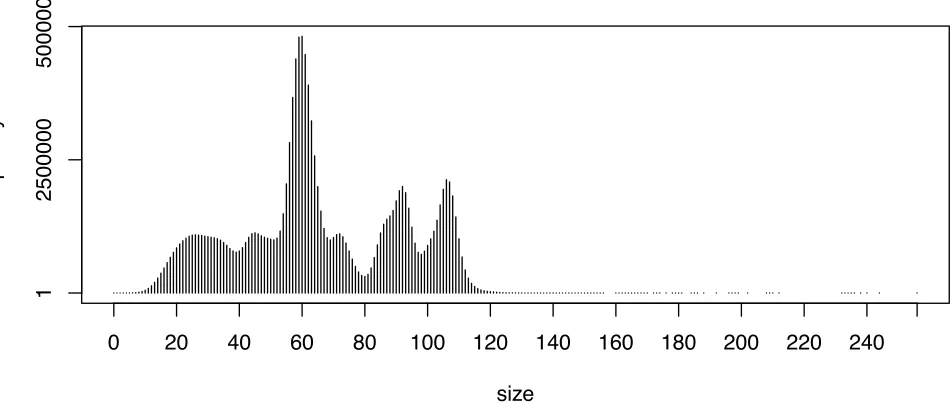
The size distribution of Sub(T4) shows an interesting pattern (see Fig. 6). For subgroups of a group, only the divisors of its order can have nonzero frequency values. If we considered the size distribution of all subsets, the maximal (middle) binomial coefficient would define the peak value. ForSub(T4) the situation is far more involved. The numbers are big and they give the impression of continuous change with several peaks. The authors do not currently have an explanation for the shape of the distribution; a systematic study of the size classes is needed.
5.4. Nilpotency. Recall that a semigroupSisnilpotentif it has a zero element 0 andSk={0}for somek∈N. It isk-nilpotent ifk is the minimal such number. (The empty semigroup is not nilpotent as it does not have a zero.) To decidek-nilpotency algorithmically, in general we do not need to calculate the powerSk. We can take a randomk-tuple of semigroup elements, evaluate it as a product and assume that this value is the zero element. If we find any otherk-tuple evaluating to a different value, then the semigroup is not k-nilpotent. The worst case is whenS is indeed k-nilpotent, we end up checking allk-tuples.
size
frequency
0
20
40
60
80
100
120
140
160
180
200
220
240
1
2500000
[image:9.612.72.547.71.276.2]5000000
Figure 6. The size distribution of SubS4(T4). The maximum is at size 60. There are 58 different size values with no subsemigroup (no corresponding dot in the figure); the values are 157, 158, 159, 171, 175, 177, 182, 183, 187, 189, 190, 191, 193, 194, 195, 200, 201, 203, 204, 205, 206, 207, 211, 213, 214, 215, 216, 217, 218, 219, 220, 221, 222, 223, 224, 225, 226, 227, 228, 229, 230, 231, 237, 239, 241, 242, 243, 245, 246, 247, 248, 249, 250, 251, 252, 253, 254, and 255.
transformation, by a constant map, and by a conjugate of [1,1,3]. The only 2-nilpotent conjugacy class has the representative{[1,1,1],[1,1,2]}.
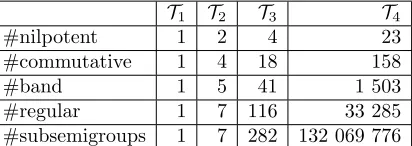
There are only 23 nilpotent subsemigroups of T4up to conjugacy; 5 of them are 1-nilpotent, 7 are 2-nilpotent and 11 are 3-nilpotent. The biggest 3-nilpotent subsemigroup has 6 elements: {[1,1,1,1], [1,1,1,2], [1,1,1,3], [1,1,2,1], [1,1,2,2], [1,1,2,3]}. Note also that the fraction of nilpotent conjugacy classes among all conjugacy classes of subsemigroups ofTn (n= 1,2,3,4) is 1, 0.28, 0.0141, 1.74×10⁻⁷. In other words, at least for the first four values ofn(which may not be a large enough sample), nilpotent semigroups appear to become exceedingly rare. This is in sharp contrast to the situation when enumerating semigroups by order, which yields almost exclusively 3-nilpotent semigroups as the order increases [6]. It is an intriguing question as to whether the fraction of nilpotents continues to decrease when enumerating by degree. It would be very curious indeed if the two methods of “slicing up” the (infinite) set of finite semigroups (by order or by degree) led to the two seemingly contradictory (and ultimately meaningless, as we are simply decomposing a countably infinite set into two infinite subsets) intuitions that “almost all semigroups are 3-nilpotent” and “almost all semigroups are non-nilpotent”.
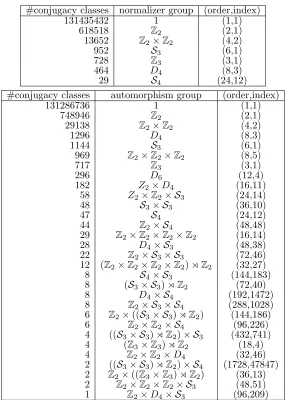
5.5. Symmetries. Automorphism groups are of fundamental interest for any mathematical structure, and for transformation semigroups we have another kind of symmetries corresponding to relabelling points, the normalizer group. For most semigroups inSubS4(T4) these groups are trivial (Table1).
6. Summary and Conclusion
We enumerated and classified all transformation semigroups up to degree 4. The methods developed here, with more concentrated effort and computational power, may be able to enumerate Sub(T5) or at least the subsemigroups of some of its ideals/Rees quotients. However, a better usage of the results would be to investigate the possibility of a more constructive theory of all transformation semigroups. A comprehensive computational survey of more general diagram semigroups is also underway [9].
Acknowledgements. This work was partially supported by the NeCTAR Research Cloud, an initiative of the Australian Government’s Super Science scheme and the Education Investment Fund; and by the EU project BIOMICS (contract number CNECT-ICT-318202).
References
#conjugacy classes normalizer group (order,index)
131435432 1 (1,1)
618518 Z2 (2,1)
13652 Z2×Z2 (4,2)
952 S3 (6,1)
728 Z3 (3,1)
464 D4 (8,3)
29 S4 (24,12)
#conjugacy classes automorphism group (order,index)
131286736 1 (1,1)
748946 Z2 (2,1)
29138 Z2×Z2 (4,2)
1296 D4 (8,3)
1144 S3 (6,1)
969 Z2×Z2×Z2 (8,5)
717 Z3 (3,1)
296 D6 (12,4)
182 Z2×D4 (16,11)
58 Z2×Z2× S3 (24,14)
48 S3× S3 (36,10)
47 S4 (24,12)
44 Z2× S4 (48,48)
29 Z2×Z2×Z2×Z2 (16,14)
28 D4× S3 (48,38)
22 Z2× S3× S3 (72,46) 12 (Z2×Z2×Z2×Z2)o Z2 (32,27)
8 S4× S3 (144,183)
8 (S3× S3)o Z2 (72,40)
8 D4× S4 (192,1472)
8 Z2× S3× S4 (288,1028) 6 Z2×((S3× S3)o Z2) (144,186) 6 Z2×Z2× S4 (96,226) 4 ((S3× S3)o Z2)× S3 (432,741) 4 (Z3×Z3)o Z2 (18,4) 4 Z2×Z2×D4 (32,46) 2 ((S3× S3)o Z2)× S4 (1728,47847) 2 Z2×((Z3×Z3)o Z2) (36,13) 2 Z2×Z2×Z2× S3 (48,51) 1 Z2×D4× S3 (96,209)
Table 1. Normalizer and automorphism groups ofSubS4(T4), withSmallGrouplibrary iden-tification [2].
#subsemigroups #conjugacy classes #isomorphism classes with anti-isomorphism
T0 1 1 1 1
T1 2 2 2 2
T2 10 8 7 7
T3 1 299 283 267 265
[image:10.612.163.449.57.457.2]T4 3 161 965 550 132 069 776 131 852 491 131 851 215
Table 2. Number of subsemigroups of full transformation semigroups.
[2] Hans Ulrich Besche, Bettina Eick, E. A. O’Brien, and E. Zelmanov. A millennium project: Constructing small groups. Interna-tional Journal of Algebra and Computation, 12(5):623, 2002.
[3] G. Bijev and K. Todorov. On the representation of abstract semigroups by transformation semigroups: Computer investigations.
Semigroup Forum, 43(1):253–256, 1991.
[4] Andreas Distler and Tom Kelsey. The monoids of orders eight, nine & ten.Ann. Math. Artif. Intell., 56(1):3–21, 2009. [5] Andreas Distler and Tom Kelsey. The semigroups of order 9 and their automorphism groups.Semigroup Forum, 88(1):93–112,
2014.
[6] Andreas Distler and James D. Mitchell. The number of nilpotent semigroups of degree 3.The Electronic Journal of Combina-torics, 19(2):P51, 2012.
T1 T2 T3 T4
#nilpotent 1 2 4 23
#commutative 1 4 18 158
#band 1 5 41 1 503
#regular 1 7 116 33 285
[image:11.612.205.411.62.135.2]#subsemigroups 1 7 282 132 069 776
Table 3. Number conjugacy classes that contain bands, commutative, and regular semigroups.
(The empty semigroup is not counted.)
[8] James East, Attila Egri-Nagy, and James D. Mitchell.SubSemi– GAP package for enumerating subsemigroups, v0.85, 2017.
https://gap-packages.github.io/subsemi/.
[9] James East, Attila Egri-Nagy, Andrew R. Francis, and James D. Mitchell. Finite diagram semigroups: Extending the computa-tional horizon.arXiv:1502.07150 [math.GR], 2015.
[10] James East, Attila Egri-Nagy, Andrew R. Francis, and James D. Mitchell. Constructing embeddings and isomorphisms of finite abstract semigroups.arXiv:1603.06204 [math.GR], 2016.
[11] Marcel Ern´e and Kurt Stege. Counting finite posets and topologies.Order, 8(3):247–265, 1991.
[12] George E. Forsythe. SWAC computes 126 distinct semigroups of order 4.Proc. Amer. Math. Soc., 6:443–447, 1955.
[13] Olexandr Ganyushkin and Volodymyr Mazorchuk.Classical Transformation Semigroups. Algebra and Applications. Springer, 2009.
[14] The GAP Group.GAP – Groups, Algorithms, and Programming, v4.8.6, 2016.
[15] G. Gomes and J. Howie. On the ranks of certain finite semigroups of transformations.Math. Proc. Cambridge Philos. Soc., 101(3):395–403, 1987.
[16] N. Graham, R. Graham, and J. Rhodes. Maximal subsemigroups of finite semigroups. Journal of Combinatorial Theory, 4(3):203–209, 1968.
[17] Frank Harary and Edgar M. Palmer.Graphical enumeration. Academic Press, New York-London, 1973. [18] Michael A. Harrison. A census of finite automata.Canad. J. Math., 17:100–113, 1965.
[19] Derek F Holt. Enumerating subgroups of the symmetric group.Contemporary Mathematics, 511:33–37, 2010.
[20] J. Howie. Idempotent generators in finite full transformation semigroups.Proc. Roy. Soc. Edinburgh Sect. A, 81(3-4):317–323, 1978.
[21] J. Howie and R. McFadden. Idempotent rank in finite full transformation semigroups. Proc. Roy. Soc. Edinburgh Sect. A, 114(3-4):161–167, 1990.
[22] Nobuko Iwahori and Hirosi Nagao. On the automorphism group of the full transformation semigroups. Proc. Japan Acad., 48:639–640, 1972.
[23] H. J¨urgensen and P. Wick. Die Halbgruppen der Ordnungen≤7.Semigroup Forum, 14(1):69–79, 1977.
[24] Daniel J. Kleitman, Bruce R. Rothschild, and Joel H. Spencer. The number of semigroups of ordern.Proc. Amer. Math. Soc., 55(1):227–232, 1976.
[25] James Mitchell.GAP package Semigroups Version 2.8.0, 2016.https://gap-packages.github.io/Semigroups/. [26] G¨otz Pfeiffer. Counting transitive relations.J. Integer Seq., 7(3):Article 04.3.2, 11, 2004.
[27] Robert J. Plemmons. There are 15973 semigroups of order 6.Math. Algorithms, 2:2–17, 1967. [28] S. Satoh, K. Yama, and M. Tokizawa. Semigroups of order 8.Semigroup Forum, 49(1):7–29, 1994.
[29] J. Schreier and Stanis law Ulam. ¨Uber die automorphismen der permutationsgruppe der nat¨urlichen zahlenfolge.Fundamenta Mathematicae, 28(1):258–260, 1937.
[30] Takayuki Tamura. Notes on finite semigroups and determination of semigroups of order 4.J. Gakugei. Tokushima Univ. Math., 5:17–27, 1954.
[31] Kazutoshi Tetsuya, Takao Hashimoto, Tadao Akazawa, Ryoichi Shibata, Tadashi Inui, and Takayuki Tamura. All semigroups of order at most 5.J. Gakugei Tokushima Univ. Nat. Sci. Math., 6:19–39. Errata on loose, unpaginated sheet, 1955.
[32] Carroll Wilde and Sharon Raney. Computation of the transformation semigroups on three letters.Journal of the Australian Mathematical Society, 14:335–335, 11 1972.
1
Centre for Research in Mathematics, School of Computing, Engineering and Mathematics, University of Western Sydney (Parramatta Campus), Locked Bag 1797, Penrith, NSW 2751, Australia
2
Akita International University, Yuwa, Akita-City, 010-1292, Japan
3
Mathematical Institute, University of St Andrews, North Haugh, St Andrews, Fife, KY16 9SS, Scotland