Houdmont, J., Kerr, R., & Randall, R. (2012). Organizational psychosocial hazard exposures in UK policing: Management Standards Indicator Tool reference values. Policing: An
International Journal of Police Strategies and Management, 35, 182-197. DOI
Abstract
Purpose: There is a paucity of contemporary evidence on the organizational (as opposed to
operational) psychosocial hazard (OPH) exposures of UK police officers. The purpose of this
study is to report on OPH exposures measured via an instrument developed by the UK
government - the Management Standards Indicator Tool - among police officers sampled
from an entire UK force. The study provides reference values for UK police officers’ OPH
exposures, considers these in relation to government exposure targets, and examines the
association between officers’ OPH exposures and perceived work-related stress.
Design/methodology/approach: Police officers (n = 1,729) completed the Management
Standards Indicator Tool which measures perceived exposure to seven psychosocial work
environment dimensions: demands, control, managerial support, peer support, relationships,
role, and change. In addition, a single-item measure of perceived work-related stress was
applied.
Findings: Sector-specific reference values were generated by job role and rank on each of the
seven dimensions assessed by the Indicator Tool. Scores on all seven dimensions were below
government target levels (indicating that scores fell below the 80th percentile in relation to
benchmark data). 46% of police officers reported their work to be very or extremely stressful.
A significant positive correlation (p < .01) was found between scores on each of the seven
psychosocial work characteristics and perceived work-related stress.
Originality/value: This study is the first to report on the assessment of UK police officers’
OPH exposure using the Management Standards Indicator Tool. It provides reference values
that UK forces will find useful for benchmarking and intervention-targeting purposes, and
against which progress in reducing OPH exposures can be assessed.
Key words: Management Standards Indicator Tool, organizational psychosocial hazards,
Organizational psychosocial hazard exposures in UK policing: Management Standards
Indicator Tool reference values
Transactional stress theory conceptualizes work-related stress as a process (Cox and
Griffiths, 2010). This process comprises three elements: (1) antecedent factors, namely
exposure to poor work design, management, and organization (i.e., organizational
psychosocial hazards (OPH)); (2) cognitive perceptual processes that give rise to the
emotional experience of stress; and (3) correlates of that experience, both individual (e.g.,
psychological and physical health outcomes and health-risk behaviours) and organizational
(e.g., absence, impaired organizational commitment and morale, elevated intention to leave).
In the UK, assessment of the first component of this stress process finds support in the
Management Standards for Work-Related Stress, a risk management procedure and toolkit
for the control and prevention of work-related stress delineated by central government
through the agency of the Health and Safety Executive (HSE) (Cousins, et al., 2004; Mackay,
et al., 2004). The Management Standards offer a standardized method by which organizations
can fulfil their legal obligation to assess for psychosocial risk; failure to utilise the
Management Standards (or an equivalent approach) can result in prosecution. To date no
studies have been published on the application of the Management Standards in the policing
sector, resulting in an absence of sector-specific normative data on officers’ OPH exposures
measured in this way.
The overall aim of the current study is to produce reference values on UK police
officers’ OPH exposures measured using the Management Standards approach in order to
facilitate forces’ benchmarking activities. By developing the knowledge corpus on officers’
OPH exposures the study also seeks to present data that might usefully inform sector-wide
exposure to potentially harmful OPHs, and offer a baseline against which progress made in
the reduction of such exposures can be assessed.
Organizational psychosocial hazard exposure research among UK police officers
OPHs are defined as “those aspects of work design and the organization and
management of work, and their social and organizational contexts, which have the potential
for causing psychological, social or physical harm” (Cox, Griffiths, and Rial González, 2000,
p. 14). In the policing context, Shane (2010) defines these as “the niggling aspects of the
work environment that pervades police organizations because of the structural arrangements
and social life inside the organization” (p. 815). A distinction is drawn here between
organizational and operational psychosocial hazards (e.g., exposure to danger). Symonds
(1970) first drew this distinction in his model of the emotional hazards of police work that
has guided much subsequent research and, in the UK policing context, resulted in the
development of two parallel but disproportionate literatures. In the intervening decades
numerous studies have explored UK police officers’ exposure to operational stressors,
especially exposure to traumatic critical incidents (e.g., Alexander and Wells, 1991; Brown
and Fielding, 1993; Brown, Fielding, and Grover, 1999; Mitchell-Gibbs and Joseph, 1996),
while fewer have focused on OPH exposures (e.g., Alexander, et al., 1993; Biggam et al.,
1997; Brown and Campbell, 1990; Brown, Cooper, and Kirkcaldy, 1996, 1999; Brown and
Fielding, 1993; Collins and Gibb, 2003; Cooper, Davidson, and Robinson, 1982; Kirkcaldy,
et al., 1993).
The relative paucity of research concerning UK police officers’ OPH exposures is
surprising given the UK- and officer-specific evidence to suggest that OPHs (a) are reported
more often than operational psychosocial hazards - by a ratio of 4 to 1 (Brown and Campbell,
1990), (b) are perceived as more stressful than operational psychosocial hazards, and (c) may
traumatic operational stressors (Biggam et al., 1997) and routine operational stressors
(Alexander, et al., 1993; Collins and Gibbs, 2003). These findings do not appear to be
peculiar to the UK; studies in Canada, New Zealand, the Netherlands, and the USA have
produced similar results (Brough, 2004; Kop, Euwema, and Schaufeli, 1999; Shane, 2010;
Taylor and Bennell, 2006). It is important to note, however, that care must be taken in the
extrapolation of some non-UK studies to the UK context given the firearm-bearing histories
of the counties in which they were conducted which contrasts with that of the UK (Davidson
and Veno, 1980).
It is also notable that existing research on the assessment of UK police officers’ OPH
exposures was conducted almost exclusively in the 1990s (e.g., Brown and Campbell, 1990;
Brown and Fielding, 1993; Brown, Cooper, and Kirkcaldy, 1994, 1996, 1999). To the best of
our knowledge, only one such study (Collins and Gibbs, 2003) has been published in the
twenty-first century. The applicability of the findings of these aged studies to the
contemporary UK policing context is doubtful given that the nature of policing has changed
considerably in recent times with potential implications for the type and prevalence of OPHs
to which officers are exposed. Collins and Gibb (2003), for example, noted that in the decade
between 1990 and 2000 a number of measures were introduced in an attempt to mitigate the
effects of OPH exposures including employee assistance programmes, improved recruitment
selection, better performance recognition, and equal opportunities and sexual equality
training. Moreover, the extant studies measured OPH exposures in a study-specific manner,
rendering cross-study comparisons difficult, and all were conducted prior to the 2004
introduction of the UK government’s standardized method of OPH exposure assessment: the
Management Standards for Work-Related Stress.
The UK government, through the agency of the Health and Safety Executive (HSE),
introduced the Management Standards for Work-Related Stress in 2004 to assist
organizations in the fulfilment of their legal duty to assess for psychosocial risk
(Cousins, et al., 2004; Mackay, et al., 2004). This duty was initially conveyed in the
European Framework Directive on Health and Safety at Work (Directive 89/391: European
Commission, 1989) that set out a prevention-orientated risk management perspective on
occupational health which was transposed into UK law in the Management of Health and
Safety at Work Regulations 1999.
The Management Standards for Work-Related Stress comprise two key elements.
First, a set of statements of good management practice on seven common OPHs (demands,
control, managerial support, peer support, relationships, role, change) that if not properly
managed can lead to health impairment (Bond, Flaxman, and Loivette, 2006). The second
element is a procedure and toolkit for the assessment and reduction of exposure to these
seven OPHs. To facilitate organizations in their assessments the HSE developed the
Management Standards Indicator Tool (HSE, n.d.a), a 35-item self-report measure of
exposure to each of the seven areas. The Indicator Tool has been shown to have good
psychometric properties (Edwards, et al., 2008) and has been widely adopted by UK
organizations within their risk management activities. Much of the positive uptake of the
approach can be seen as a response to growing awareness among employers of their legal
duty to assess for psychosocial risk using the Management Standards (or equivalent)
approach and the concomitant risk of prosecution that may arise from failure to appropriately
assess such risk. Awareness in these regards has been generated by various national and
European initiatives including the HSE’s Management Standards website and nationwide
road-shows and the European Agency for Safety and Health at Work’s 2008-9 ‘Healthy
scientific literature concerned with the application of the Management Standards Indicator
Tool has developed which has explored its use in a range of organizational contexts.
Large-scale studies (involving samples of N = ≥ 700) have been conducted in the higher education
sector (Kinman and Court, 2010), the prison service (Bevan, Houdmont, and Menear, 2010),
and the health services sector (Kerr, McHugh, and McCory, 2009).
To facilitate the analysis of Indicator Tool responses the HSE recommends their
compilation into an Excel-based Analysis Tool (HSE, n.d.b). This generates a mean score and
a recommendation for action at the item level as well as an aggregate score and
recommendation for each of the seven assessment categories. These recommendations are
presented in relation to benchmark data provided to the HSE by 136 non-police organizations
in the UK. Given the youthful and developing nature of the benchmark dataset, occupational
groups generally acknowledged to involve high levels of stress, such as policing (O’Driscoll
and Brough, 2010), are under-represented, resulting in there being little value in the
comparison of data drawn from a ‘high-stress’ sample against the benchmark dataset and
highlighting the need for sector-specific normative data. Indicator Tool reference data that is
specific to police officers in the UK would usefully empower forces to benchmark
themselves against one another. Given the standardized approach to the assessment of OPH
exposures afforded by the Indicator Tool, sector-specific reference values could also
contribute to the informing of sector-wide psychosocial risk management activities in terms
of the targeting of resources and design of occupational health interventions. Such reference
data would also provide a baseline against which progress in reducing OPH exposures could
be assessed.
Aims of the study
There is a paucity of twenty-first century scientific evidence on UK police officers’
being aged, the existing literature is reliant upon a variety of approaches to data collection.
This hinders cross-study comparisons and thus the benchmarking of forces, as well as the
identification of issues that might warrant sector-wide consideration within a stress
management intervention programme. In response, the purpose of this study is to report on
OPH exposures measured via the UK government’s self-report instrument - the Management
Standards Indicator Tool - among police officers sampled from an entire UK police force.
The study provides reference values for OPH exposures, considers these in relation to
government exposure targets, and examines the association between officers’ OPH exposures
and perceived work-related stress.
The study is important for at least three reasons. It is the first to report on the
assessment of UK police officers’ OPH exposures using the government’s measure that is
likely to be adopted by an increasing number of organizations, including UK police forces, as
awareness grows of employers’ legal duties to assess for psychosocial risk and the manner in
which the Indicator Tool (or equivalent) can facilitate fulfilment of this duty. In this way the
study provides reference values that the UK forces will find useful for benchmarking
purposes. Second, in light of the paucity of contemporary (twenty-first century) research on
UK police officers’ OPH exposures, the development of the knowledge corpus on the nature
and severity of such exposures is of importance since it can usefully help inform force- and
sector-wide psychosocial risk management activities in terms of the targeting of resources
and design of interventions to reduce work-related stress. Third, the reference values will
provide a baseline against which progress in reducing officers’ OPH exposures can be
compared.
Materials and methods
There are 52 geographic police forces in the UK plus a further eight non-geographic
forces (for a full list of forces see www.police.uk) that together employ more than 150,000
officers. The current study was conducted in a large UK geographic police force outside the
metropolitan area of London. The force approached the study authors with a request for
assistance as a response to a force-wide sickness absence problem. Organizational records
showed that in the year ending March 31 2009 sickness absence stood at an average of 8.86
working days for police officers. For the financial year ending March 31 2008 the force’s
sickness absence bill for officers amounted to £17.54 million and equated to 90,984 lost
working days. The main reason given for sickness absence was ‘psychological’.
Selection of participants and procedure
The confidential and anonymous survey was hosted on the force’s intranet. All
serving police officers employed in the first quarter of 2009 (N = 7,393) were invited to
complete the survey. A total of 1,729 completed surveys were returned (23% response rate).
Information on respondents’ age, gender, length of service, rank, and job role is presented in
Table 1. Comparison of the characteristics of respondents with those of the force’s entire
police officer population showed no significant differences. The study was approved by the
University of Ulster Research Ethics Committee.
Measures
A self-report questionnaire was constructed that consisted of three sections:
Demographic and occupational details: Data were collected on age, gender, length of
service, rank, and job role.
Psychosocial work conditions: The 35-item self-report Management Standards
Indicator Tool (HSE, n.d.a) was used to assess exposure to seven dimensions of the
psychosocial work environment that if not properly managed may lead to the impairment of
(sometimes), 4 (often), 5 (always). Low scores are indicative of high (and potentially
harmful) exposures. An example of an item is “I am clear what is expected of me at work.”
The seven sections address job demands (8 items, α = .87), job control (6 items, α = .84),
managerial support (5 items, α = .86), peer support (4 items, α = .81), relationships (4 items,
α = .76), role (5 items, α = .85), and change (3 items, α = .79). The reliability of the
questionnaire was found to be consistent with that achieved in other large-scale studies
(Bevan et al., 2010; Edwards, et al., 2008; Kerr et al., 2009; Kinman and Court, 2010).
Perceived work-related stress: This was measured using a single-item “How stressful
do you find your job?” Responses were given on a four-point Likert scale, from not at all
stressful (4) to extremely stressful (1). Single-item measures offer an expedient approach to
data collection in the organizational context – a benefit that may be particularly valued where
other parts of the questionnaire are relatively lengthy and the researcher wishes to limit the
overall length of the instrument (Bowling, 2005). The approach is also useful where the
objective of the research is to obtain a ‘snapshot’ of a topic rather than detailed diagnostic
information. Although single-item measures of psychological constructs are often assumed to
have low reliability and validity, if the meaning of the construct is clear to the respondent a
single-item approach to measurement may be adequate (Wanous, Reichers, & Hudy, 1997).
These attributes of single-item measures of work-related stress have been demonstrated in a
number of studies in recent years (Calnan, et al., 2004; Elo, Leppänen, and Jahkola, 2003;
Phillips, Sen, and McNamee, 2008; Smith, 2001; Smith, et al., 2000; Smith, et al., 2004;
Wadsworth, et al., 2004), suggesting that this approach to the assessment of work-related
stress might offer an effective and efficient alternative to the more complex case definitions
typically employed by researchers (Houdmont, Cox, and Griffiths, 2010).
To facilitate analysis, Indicator Tool responses were compiled into the Analysis Tool
(HSE, n.d.b). This generates a mean score and a recommendation for action at the item level
as well as an aggregate score and recommendation for each of the seven assessment
categories. Recommendations for action are presented by the Analysis Tool in relation to
benchmark data collected from 136 organizations in the UK. The four categories of
recommendation are: red: urgent action needed (scores fall below the 20th percentile in
relation to benchmark data); yellow: clear need for improvement (scores are below average
but not below the 20th percentile); blue: good, but need for improvement (scores are better
than average but not at, above, or close to the 80th percentile); green: doing very well, need to
maintain performance (scores are above or close to the 80th percentile). In addition, the
Analysis Tool produces an interim target, recommended by the HSE as a reasonable target
for the organization to achieve in 6 months to one year, and a long term target that represents
the value achieved by the top 20% of organizations in the HSE’s benchmark data set.
Results
Organizational psychosocial hazard exposure
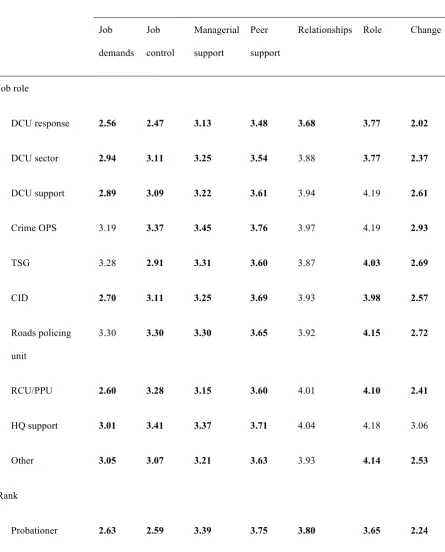
Table 2 gives mean scores by job role and rank on each of the seven OPH dimensions
assessed by the Indicator Tool. For each dimension, scores below the relevant mean score
drawn from the HSE’s benchmark data set are presented in bold type. In addition, the interim
target and long-term target produced by the HSE Analysis Tool are presented.
Demands: Among the seven analysis categories the second lowest overall mean score
was achieved in relation to demands, indicating high levels of exposure (M = 2.90). The job
demands mean score was below the HSE benchmark dataset mean (M = 3.10), and the
dimension was red-lighted by the Analysis Tool with the recommendation ‘urgent action
needed’, indicating that scores fell below the 20th percentile in relation to benchmark data.
score below the HSE benchmark average was found for seven of the 10 job roles and five of
the six job ranks. The scores suggest that, overall, police officers perceived their work
demands to be highly challenging.
Control: An overall mean score of 2.98 was achieved in relation to control, indicating
low levels of control in the execution of work duties. The control mean score was below the
HSE benchmark dataset mean (M = 3.47), and the dimension was red-lighted by the Analysis
Tool with the recommendation ‘urgent action needed’, indicating that scores fell below the
20th percentile in relation to benchmark data. Among the six items on control, the item ‘I
have a choice in deciding what I do at work’ achieved the lowest mean score (2.48). A mean
control score below the HSE benchmark average was found for all job roles and five of the
six job ranks. The scores suggest that across ranks and roles police officers perceived as poor
the amount of control they had over their job.
Managerial support: An overall mean score of 3.25 was achieved in relation to
managerial support received. This was below the HSE benchmark dataset mean (M = 3.46),
and the dimension was red-lighted by the Analysis Tool with the recommendation ‘urgent
action needed’, indicating that scores fell below the 20th percentile in relation to benchmark
data. Among the five items on managerial support, the item ‘I am supported through
emotionally demanding work’ achieved the lowest mean score (2.74). A mean score below
the HSE benchmark average was found all job roles and five of the six job ranks, suggesting
that across ranks and roles police officers perceived as poor the support they received from
managers.
Peer support: An overall mean score of 3.60 was achieved in relation to support
received from peers, below the HSE benchmark dataset average (M = 3.78). The dimension
was red-lighted by the Analysis Tool with the recommendation ‘urgent action needed’,
score below the HSE benchmark average was achieved for each of the 10 job roles and five
of the six ranks, suggesting that across ranks and roles police officers perceived as poor the
support they received from peers.
Relationships: This category of psychosocial hazard was alone among the seven
examined through the Indictor Tool in not being red-lighted by the Analysis Tool, and was
the only dimension to produce a mean score above the HSE benchmark dataset average. An
overall mean score of 3.87 was achieved (HSE benchmark dataset M = 3.85). The dimension
was blue-lighted with the recommendation ‘good, but need for improvement’, indicating that
scores were above average but not yet at, above, or close to the 80th percentile in relation to
benchmark data. The item ‘I am subject to bullying at work’ achieved the highest mean score
of all the 35 Indicator Tool items (indicating the lowest level of potentially harmful
exposure). This score may reflect the hierarchical, structured, and disciplined nature of police
organizations. Nevertheless, the Analysis Tool flagged bullying as an issue requiring
attention given that 209 respondents (12%) reported having always, often or sometimes being
bullied. A mean score below the HSE benchmark average was achieved for only one of the
10 job roles and two of the six ranks, suggesting that overall across ranks and roles police
officers perceived interpersonal relationships at work as being relatively good.
Role: An overall mean score of 4.00 was achieved in relation to job role, below the
HSE benchmark dataset average (M = 4.18). The dimension was red-lighted by the Analysis
Tool with the recommendation ‘urgent action needed’, indicating that scores fell below the
20th percentile in relation to benchmark data. A mean job role score below the HSE
benchmark average was achieved for seven of the 10 job roles and five of the six ranks. The
job role dimension included the item ‘I am clear what my duties and responsibilities are’, one
score was above the 50th percentile but below the 80th in relation to the HSE benchmark
dataset norms.
Change: The change dimension attracted by far the poorest scores among the seven
dimensions examined by the Indicator Tool. An overall mean score of 2.45 was achieved,
below the HSE benchmark dataset average (M = 3.04). The dimension was red-lighted by the
Analysis Tool with the recommendation ‘urgent action needed’, indicating that scores fell
below the 20th percentile in relation to benchmark data. A mean change score below the HSE
benchmark average was achieved for all but one of the job roles and ranks. The item ‘staff are
always consulted about changes at work’ achieved the lowest mean score among the 35
Indicator Tool items (2.11), suggesting that communication about change was particularly
problematic within the organization.
Perceived work-related stress
Work-related stress scores ranged from not at all stressful (n = 112), mildly stressful
(n = 827), very stressful (n = 571), to extremely stressful (n = 231), suggesting that 46% of
police officers found their work very or extremely stressful. A significant positive correlation
(p < .01) was found between scores on each of the seven OPH categories and work-related
stress (Table 3).
Discussion
This study concerned the development of reference values for UK police officers’
organizational (as opposed to operational) psychosocial hazard exposures measured via the
UK government’s standardized instrument: the Management Standards Indicator Tool.
Despite the Management Standards for Work-Related Stress having been in existence since
2004 and the provision of a series of high profile government campaigns concerned with the
promotion of the approach, this is the first study to assess UK police officers’ OPH exposures
showed that police officers’ OPH exposures were above government targets (indicating that
scores fell below the 80th percentile in relation to benchmark data) on each of the seven
dimensions. Furthermore, officers’ reports of OPH exposures on all seven dimensions were
positively correlated with perceived work-related stress.
The finding that police officers’ OPH exposures were higher than the HSE benchmark
dataset mean score on six of the seven psychosocial work environment dimensions is to be
expected given that (a) extant studies have shown that OPH exposures are particularly acute
in police work owing to various structural arrangements, policies, and practices (Shane,
2010) and (b) high-stress occupational groups are under-represented in the HSE benchmark
dataset due to its youthful and developing status. Thus, an imperative can be identified for the
development of sector-specific Management Standards Indicator Tool reference values for
high-stress occupational groups for which the HSE benchmark dataset might represent an
inappropriate comparator.
It is important to note that psychosocial hazard exposure is not necessarily causally
linked to stress-related outcomes; unlike many chemical, biological, and physical hazards,
psychosocial hazard exposure does not by default lead to harm. This is because a
psychosocial work condition might be perceived, for example, as a motivating factor rather
than a threat to well-being. As such, conclusions should not be drawn on the prevalence of
work-related stress in the police force that hosted this study on the basis of data collected via
the Indicator Tool. For this reason, the Indicator Tool was supplemented with a single-item
measure of perceived work-related stress, described by the HSE (2006, p. 16) as providing “a
crude…surrogate indicator of job stressfulness.” This allowed for tentative conclusions to be
drawn on the extent to which OPH exposures were perceived as stressful. Significant positive
correlations were found between each of the seven Indicator Tool analysis categories and
indeed perceived as stressful. The data on perceived work-related stress also provides further
evidence for the status of policing as a high-stress occupation. Almost half (46%) of survey
respondents reported their work to be very or extremely stressful, a remarkably high rate
relative to that typically achieved in nationally-representative workforce surveys that have
used a similar single-item measure with a very stressful cut-off. For example, the
Psychosocial Working Conditions surveys that have been conducted annually in the UK by
the HSE since 2004 have consistently obtained a mean overall prevalence rate of less than
20% (c.f., Houdmont et al., 2010). The identification of policing as a high-stress occupation
highlights the imperative for further research on the causes, consequences, and management
of work-related stress in the UK policing context.
Given the status of the Management Standards Indicator Tool as the UK
government’s recommended instrument by which organizations can fulfil the legal obligation
to assess for psychosocial risk, and the benchmarking opportunities afforded by the use of a
standardized approach to the management of work-related stress, adoption of the instrument
is likely to develop within and between occupational sectors in coming years. As such, the
initial picture of the distribution and intensity of UK police officers’ exposures to potentially
harmful OPHs provided by this study offers an evidence-based foundation upon which to
channel resources at the force and sector level towards the design and implementation of
organizational-level interventions for the control and prevention of work-related stress. Such
interventions have traditionally been neglected due to a preference among police forces for
individual-level interventions targeted at bolstering employees’ coping mechanisms and
remedial employee assistance programmes (Collins and Gibb, 2003; Shane, 2010; Waters and
Ussery, 2007). Furthermore, the reference values provided herein offer a basis against which
In terms of the identification of intervention candidates, the current study found that
reports of exposures on the ‘change’ dimension were by far the worst among the seven
psychosocial work environment dimensions. The three Indicator Tool items associated with
this dimension assessed exposure to insufficient opportunities to question managers about
change at work, insufficient opportunities for consultation about change at work, and lack of
clarity about how imposed change might work out in practice. Research conducted among
UK police officers in the mid 1990s similarly identified communications as being
problematic (Biggam et al., 1997), and Collins and Gibb (2003) identified lack of
consultation and communication among the highest ranked stressors reported by officers.
Taken together, these findings suggest that such issues might be ingrained in the
organizational culture. An ongoing process of change is perhaps inevitable in policing given
the focus on the sector within national politics and the ever-increasing financial pressures
under which it operates. Research on the development of sector-specific effective change
processes, with a particular focus on communication and consultation, might usefully
contribute to the establishment of healthy change processes and result in the reduction of
stress-related problems among police officers.
Limitations and future research directions
Despite the strength afforded to the current study by its large sample and that fact that
all officers employed by the force (as opposed to a sub-sample) were invited to participate,
the research is limited by the low response rate (23%). Although low response rates are
common in self-report survey studies, and appear to occur frequently in large-scale studies
involving the Management Standards Indicator Tool (e.g., Bevan et al., 2010, 29% response
rate; Kerr et al., 2009, 29%; Kinman and Court, 2010, 23%), it is disappointing that the
results can be attributed to just under one quarter of police officers employed by the force. It
However, reassurance can be taken from the fact that no significant differences were found
between respondents and non-respondents in terms of age, gender, tenure, or rank. The
response rate achieved in the current study lends support to Bevan and colleagues’ (2010)
assertion that should the emerging Management Standards literature reveal low Indicator
Tool response rates to be a common problem, research will be warranted to ascertain the
reasons for such and to develop response rate improvement measures.
One of the strengths of the current study was that, in contrast to many previous
studies, all officers, rather a sub-sample, from an entire force were invited to participate,
resulting in the generation of a sample that was representative of officers employed by the
force as a whole. Nevertheless, the reference values presented herein were generated on the
basis of data drawn from a single large urban force and it is possible that the OPH exposures
reported might not be typical of those experienced in small, specialised, or rural forces. As
such, further research is required to extend the normative dataset to ensure that it is
representative of the sector. Given the paucity of research on OPH exposures in policing,
further research is also warranted to examine officers’ exposures beyond the UK.
The Management Standards Indicator Tool examines exposure to a pre-determined
set of seven dimensions of the psychosocial work environment. However, whether it
adequately captures the main OPHs to which UK police officers are exposed remains unclear.
Early research conducted among police officers in the UK identified a range of OPH
exposures that were broadly consistent with the seven areas assessed by the Indicator Tool
(e.g., Biggam et al., 1997; Brown and Campbell, 1990; Cooper, Davidson, and Robinson,
1982). (A recent Australian study similarly confirmed the central importance of demands,
control, and support in the aetiology of work-related stress symptoms among police officers,
suggesting these might be universal OPHs: Noblet, Rodwell and Allisey, 2009). However, the
studies were conducted (Collins and Gibb, 2003), rendering uncertain whether their
contemporary replication would yield similar results. Further research is required to assess
the extent to which the Indicator Tool captures the main OPHs to which UK police officers
are exposed in the contemporary setting; should it be found that the Indicator Tool does not
address the range of OPHs experienced by officers an argument would exist for the
development of a sector-specific supplement to the Indicator Tool.
Given that the primary objective of this study was to provide a description of
exposures at a single point in time, its cross-sectional design is not considered to present a
shortcoming. However, it is important to note that future studies that seek to extend this line
of research by examining the reliability and validity of the Indicator Tool in high-stress
occupational sectors would do well to apply longitudinal designs in order to permit
conclusions on causality in relation to associations between psychosocial work characteristics
and health.
Conclusions
The varied findings of the largely aged scientific knowledge corpus on OPH
exposures among UK police officers have made it difficult to identify key issues that might
warrant intervention at the force or sector level, thereby hindering developments on
exposure-reduction. In this respect the Management Standards Indicator Tool may be a useful
instrument; its focus on a restricted set of key OPHs that appear to be applicable across
sectors, allied with detailed resources provided by the HSE that are designed to facilitate
organizations in the design of appropriate interventions and the fulfilment of their legal duty
to assess for psychosocial risk, may help to break down some of the traditional barriers to
organizational-level psychosocial intervention in the policing context. This study has
provided OPH exposure reference values for UK police officers measured via the Indicator
targeting of interventions, and provide a baseline against which progress in reducing OPH
References
Alexander, D., Walker, L., Innes, G. and Irving, B. (1993), Police Stress at Work, The Police
Foundation, London.
Alexander, D. and Wells, A. (1991), “Reactions of police officers to body handling after a
major disaster: A before and after comparison”, British Journal of Psychiatry, Vol.
159, pp. 547-555.
Bevan, A., Houdmont, J. and Menear, N. (2010), “The Management Standards Indicator Tool
and the estimation of risk”, Occupational Medicine, Vol. 60, pp. 525-531.
Biggam, F., Power, K., Macdonald, R., Carcary, W. and Moodie, E. (1997), “Self-perceived
occupational stress and distress in a Scottish police force”, Work & Stress, Vol. 11,
pp. 118-133.
Bond, F., Flaxman, P. and Loivette, S. (2006), A Business Case for the Management
Standards for Stress, HSE Books, Sudbury.
Bowling, A. (2005), “Just one question: If one question works why ask several?”, Journal of
Epidemiology and Community Health, Vol. 59, pp. 342-345.
Brough, P. (2004), “Comparing the influence of traumatic and organizational stressors on the
psychological health of police, fire, and ambulance officers”, International Journal of
Stress Management, Vol. 11, pp. 227-244.
Brown, J. and Campbell, A. (1990), “Sources of occupational stress in the police”, Work &
Stress, Vol. 4, pp. 305-318.
Brown, J., Cooper, C. and Kirkcaldy, B. (1994), “Impact of pressures on senior police
management in the United Kingdom”, Policing and Society, Vol. 4, pp. 341-352.
Brown, J., Cooper, C. and Kirkcaldy, B. (1996), “Occupational stress among senior police
Brown, J., Cooper, C. and Kirkcaldy, B. (1999), “Stressor exposure and methods of coping
among senior police managers at a time of organisational and management change”,
International Journal of Police Science and Management, Vol. 2, pp. 217-228.
Brown, J. and Fielding, J. (1993), “Qualitative differences and women police officers'
experience of occupational stress”, Work & Stress, Vol. 7, pp. 327-340.
Brown, J., Fielding, J. and Grover, J. (1999), “Distinguishing traumatic, vicarious and routine
operational stressor exposure and attendant adverse consequences in a sample of
police officers”, Work & Stress, Vol. 13, pp. 312-325.
Calnan, M., Wadsworth, E., May, M., Smith, A. and Wainright, D. (2004), “Job strain,
effort-reward imbalance, and stress at work: Competing or complimentary models?”,
Scandinavian Journal of Public Health, Vol. 32, pp. 84-93.
Collins, P. and Gibb, A. (2003), “Stress in police officers: A study of the origins, prevalence,
and severity of stress-related symptoms within a county police force”, Occupational
Medicine, Vol. 53, pp. 256-264.
Cooper, C., Davidson, M. and Robinson, P. (1982), “Stress in the police force”, Journal of
Occupational Medicine, Vol. 24, pp. 30-36.
Cox, T., & Griffiths, A. (2010). “Work-related stress: A theoretical perspective”, in Leka, S.
and Houdmont, J. (Eds.). Occupational health psychology, Wiley-Blackwell, Oxford,
pp. 31-56.
Cox, T., Griffiths, A. and Rial González, E. (2000), Research on work-related stress, Office
for Official Publications of the European Communities, Luxembourg.
Cousins, R., Mackay, C., Clarke, S., Kelly, C., Kelly, P. and McCaig, R. (2004),
“Management standards and work-related stress in the UK: Practical development”,
Davidson, M. and Veno, A. (1980). “Stress and the policeman”, in Cooper, C. and Marshall,
J. (Eds.), White-collar and Professional Stress. Wiley, Chichester.
Edwards, J., Webster, S., Van Laar D. and Easton, S. (2008), “Psychometric analysis of the
UK Health and Safety Executive’s Management Standards work-related stress
Indicator Tool”, Work & Stress, Vol. 22, pp. 96-107.
Elo, A-L., Leppänen, A. and Jahkola, A. (2003) “Validity of a single item measure of stress
symptoms”, Scandinavian Journal of Work, Environment and Health, Vol. 29, pp.
444-451.
European Commission (1989). Council Directive 89/391/EEC. On the Introduction of
Measures to Encourage Improvements in the Safety of Health of Workers at Work,
European Commission, Brussels.
Health and Safety Executive (n.d.a), HSE Management Standards Indicator Tool, Available
at: <http://www.hse.gov.uk/stress/standards/pdfs/indicatortool.pdf> [Accessed 20
April 2010].
Health and Safety Executive (n.d.b.), HSE Management Standards Analysis Tool .153 User
Manual, Available at: <http://www.hse.gov.uk/stress/standards/downloads.htm>
[Accessed 20 April 2010].
Health and Safety Executive (2006), Psychosocial Working Conditions in Great Britain in
2005, HSE Books, Sudbury.
Houdmont, J., Cox., T. and Griffiths, A. (2010), “Work-related stress case definitions and
prevalence rates in national surveys”, Occupational Medicine, Vol. 60.
Kerr, R., McHugh, M. and McCory, M. (2009), “HSE Management Standards and
stress-related work outcomes”, Occupational Medicine, Vol. 59, pp. 574-579.
Kinman, G. and Court, S. (2010), “Psychosocial hazards in UK universities: Adopting a risk
Kirkcaldy, B., Cooper, C., Furnham, A. and Brown, J. (1993), “Personality, job satisfaction
and well-being among public sector (police) managers”, European Review of Applied
Psychology, Vol. 43, pp. 241-248.
Kop, N., Euwema, M. and Schaufeli, W. (1999), “Burnout, job stress and violent behaviour
among Dutch police officers”, Work & Stress, Vol., 13, 326-340.
Mackay, C., Cousins, R., Kelly, P., Lee, S. and McCaig, R. (2004), “Management Standards
and work-related stress in the UK: Policy background and science”, Work and Stress,
Vol. 18, pp. 91-112.
Mitchell-Gibbs, J. and Joseph, S. (1996), “Occupational trauma in the British police:
Preliminary analysis”, Issues in Criminological & Legal Psychology, Vol. 25, pp.
54-58.
Noblet, A., Rodwell, J. and Allisey, A. (2009) “Police stress: The role of the psychological contract and perceptions of fairness”, Policing: An International Journal of Police Strategies and Management, Vol. 32, pp. 613-630.
O’Driscoll, M. and Brough, P. (2010), “Work organisation and health”, in Leka, S. and Houdmont, J. (Eds.), Occupational health psychology, Oxford: Wiley-Blackwell, Oxford, pp. 57-87.
Phillips, S., Sen, D. and McNamee, R. (2008), “Risk factors for work-related stress and
health in head teachers”, Occupational Medicine, Vol. 58, pp. 584-586.
Shane, J. (2010), “Organizational stressors and police performance”, Journal of Criminal
Justice, Vol. 38, pp. 807-818.
Smith, A. (2001), “Perceptions of stress at work”, Human Resource Management Journal,
Vol. 11, pp. 74-86.
Smith, A., Johal, S., Wadsworth, E., Davey Smith, G. and Peters, T. (2000), The Scale of
Perceived Stress at Work: The Bristol Stress and Health at Work Study. Contract
Smith, A., Wadsworth, E., Moss, S. and Simpson, S. (2004), The Scale and Impact of Drug
Use by Workers, HSE Books, Sudbury.
Symonds, M. (1970), “Emotional hazards of police work”, American Journal of
Psychoanalysis, Vol. 30, pp. 155-160.
Taylor, A. and Bennell, C. (2006), “Operational and organisational police stress in an Ontario
police department: A descriptive study”, The Canadian Journal of Police and Security
Services, Vol. 4, pp. 223-234.
Wadsworth, E., Dhillon, K., Shaw, C., Bhui, K., Stansfeld, S. and Smith, A. (2007), “Racial
discrimination, ethnicity and work stress”, Occupational Medicine, Vol. 57, pp.
18-24.
Wanous, J., Reichers, A. and Hudy, M. (1997). “Overall job satisfaction: How good are
single-item measures?”, Journal of Applied Psychology, Vol. 82, pp. 247-252.
Waters, J. and Ussery, W. (2007), “Police stress: History, contributing factors, symptoms,
and interventions”, Policing: An International Journal of Police Strategies and
Table 1
Comparison of Respondents’ Demographic Characteristics with Police Officers employed by the Force as a Whole Respondents n (%) Total staff n (%) Gender Male Female 1,307 (75.6) 422 (24.4) 5,660 (76.6) 1,733 (23.4) Age group 15-20 21-25 26-30 31-35 36-40 3 (0.2) 38 (2.2) 208 (12.0) 239 (13.8) 356 (20.6) 29 (0.4) 369 (5) 1,044 (14.1) 1,143 (15.5) 1,467 (19.8)
41-45 486 (28.1) 1,883 (25.5)
46-50 334 (19.3) 1,216 (16.5)
51-55 42 (2.4) 176 (2.4)
56+ 23 (1.3) 66 (0.9)
0-5 6-10 11-15 16-20 385 (22.3) 222 (12.8) 232 (13.4) 256 (14.8) 2,603 (35.2) 967 (13.1) 927 (12.5) 985 (13.3)
21-25 354 (20.5) 1,093 (14.8)
26-30 254 (14.7) 773 (10.5)
31-35 25 (1.4) 38 (0.5)
36+ 1 (0.1) 7 (0.1)
Rank Probationer Reserve constable Constable Sergeant Inspector
Chief inspector or above
82 (4.7) 75 (4.3) 1,125 (64.6) 309 (17.7) 98 (5.6) 40 (2.3)
6,844 (78.4)a
1,266 (14.5)
427 (4.9)
179 (2.1)
Job roleb
Crime OPS
TSG
CID
Roads policing unit
RCU/PPU
HQ support
Other
252 (14.6)
87 (5.0)
114 (6.6)
76 (4.4)
35 (2.0)
104 (6.0)
237 (13.7)
a Organisational records group the probationer, reserve constable and constable ranks into a single category.
Table 2
Mean scores for psychosocial hazard exposure by job role and rank compared to HSE benchmark data and targets
Psychosocial hazard category
Job
demands Job
control
Managerial
support
Peer
support
Relationships Role Change
Job role
DCU response 2.56 2.47 3.13 3.48 3.68 3.77 2.02
DCU sector 2.94 3.11 3.25 3.54 3.88 3.77 2.37
DCU support 2.89 3.09 3.22 3.61 3.94 4.19 2.61
Crime OPS 3.19 3.37 3.45 3.76 3.97 4.19 2.93
TSG 3.28 2.91 3.31 3.60 3.87 4.03 2.69
CID 2.70 3.11 3.25 3.69 3.93 3.98 2.57
Roads policing
unit
3.30 3.30 3.30 3.65 3.92 4.15 2.72
RCU/PPU 2.60 3.28 3.15 3.60 4.01 4.10 2.41
HQ support 3.01 3.41 3.37 3.71 4.04 4.18 3.06
Other 3.05 3.07 3.21 3.63 3.93 4.14 2.53
Rank
Reserve constable 3.31 2.69 3.17 3.39 3.77 4.07 2.36
Constable 2.92 2.95 3.25 3.63 3.86 3.99 2.42
Sergeant 2.79 3.08 3.13 3.47 3.85 4.04 2.56
Inspector 2.87 3.43 3.36 3.61 4.03 4.05 2.96
Chief inspector or
above
2.60 3.65 3.56 3.84 3.98 4.35 3.39
Overall mean 2.90 2.98 3.25 3.60 3.87 4.00 2.45
HSE benchmark
average
3.10 3.47 3.46 3.78 3.85 4.18 3.04
HSE interim target 3.00 3.34 3.38 3.68 3.90 4.09 2.84
HSE long-term target 3.29 3.72 3.65 3.89 4.04 4.31 3.24
Note. Low scores represent higher levels of exposure to potentially harmful psychosocial job characteristics.
Table 3.
Correlations between organizational psychosocial hazard exposures and work-related stress.
Variables 1 2 3 4 5 6 7
1. Demands
2. Control .48
3. Management support .38 .39
4. Peer support .34 .39 .60
5. Relationships .41 .38 .52 .58
6. Role .36 .39 .39 .39 .42
7. Change .45 .56 .55 .45 .44 .48
8. Work-related stress .61 .39 .37 . 36 .39 .35 .39