jmmce.org Printed in the USA. All rights reserved
583
Development of Fibre Reinforced Cementitious Composite
for Ceiling Application
I.O. Oladele1*, A.D.Akinwekomi1, S. Aribo1, and A.K. Aladenika2
1
Department of Metallurgical and Materials Engineering, Federal University of Technology, Akure, Ondo State, Nigeria.
2
Department of Science Laboratory Technology Rufus Giwa polytechnic Owo, Ondo State, Nigeria
*Corresponding Author: [email protected], [email protected]
ABSTRACT
Natural sponge fibre (Acanthus montanus) was used as reinforcement for ceiling materials in this research work. This fibre, being fairly strong and stiff as well as cheap and plentiful with low energy demand during manufacture, are strong contenders for the reinforcement of cement-based materials. The fibre, whose mass fraction was the variable in this work, was cut down into smaller sizes and mixed with pulverised waste paper, cement and water. The resulting slurry was then poured into rectangular moulds which were compacted until the excess water was expelled and resulting composites became hard. Demoulded samples were left to cure in the open laboratory air for 28 days. Flexural and water absorptivity tests were carried out on the various samples which showed that reinforcement and best mechanical properties were obtained at optimum fibre mass fraction of 4% when compared with the brittle matrix in the absence of reinforcement. These tests confirmed the possible use of sponge fibres as reinforcement in cement matrices for ceiling purposes.
Keywords: Natural sponge fibres, mass fraction, flexural test and water absorptivity test.
1. INTRODUCTION
much neglected is in the realm of housing. The human habitat has become an almost intractable world problem, most especially in the Third World.
Natural organic fibres have a very important role in the alleviation of the housing problem. They not only occur in luxurious abundance in many parts of the world, but can also lead directly to energy savings, conservation of the world’s most scarce resources and protect human and environment. Natural and vegetable plants and fibres have thus a unique irreplaceable role in the ecological cycle. Despite the fact that natural fibres generally have poor mechanical properties compared with synthetic fibres [2], their use as reinforcement material has been adopted by mankind to make straw reinforced huts and other articles [3]. Their natural abundance, plentiful supply, relative cheapness and swift replenishability are the strongest arguments to utilize them in the construction industry [1].
Cement and concrete matrices reinforced with short, discrete or long single/bundles of fibre present exciting and challenging new construction materials. The behaviour and properties of cement-based materials may be better understood, designed, and predicted using a modern approach than was possible on the basis of traditional concrete technology [4]. These materials belong to a group of brittle-matrix composites. The major role of fibres is in delaying and controlling the tensile cracking of the matrix. This controlled multiple cracking reduces deformation at all stress levels, and imparts a well-defined post-cracking and post-yield behaviour. The fracture toughness, ductility and energy absorption capacity of the composite are then substantially improved. These technical benefits can be utilized both in semi-structural elements such as thin sheets, flat sheets, corrugated and cladding panel as well as in load bearing members.
Therefore, the aim of this paper is to make use of natural sponge fibres for the production of ceiling board for the building industry.
2. MATERIALS AND METHODS
The materials required for this research work were all sourced locally. These included fibres from the stem of the natural sponge plant (Acanthus montanus), waste paper, wooden rectangular
moulds, water, cellophane sheets and cement. The fibres from the natural sponge plant (Acanthus
montanus) were cut down into a size range of 35-40mm. This was done to avoid balling problem
during mixing and to facilitate homogeneous mixing of the composite.
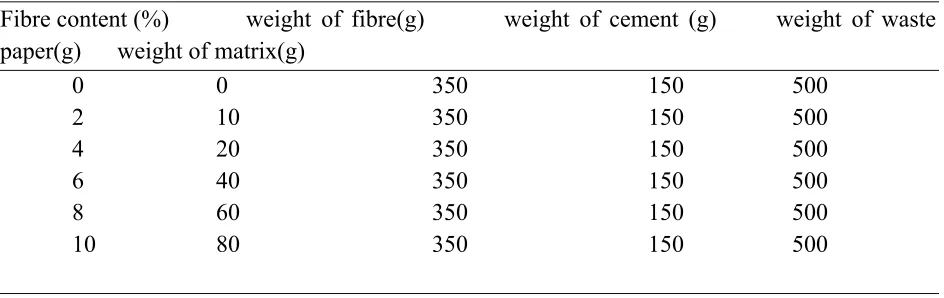
utilized was 500g. The fibre mass fractions, Mf aimed at were Mf= 0, 2,4,6,8 and 10%. This fibre mass fraction was defined as the ratio of fibres to the dry constituents of the matrix (cement and waste paper) by weight [5]. Table 1.0 below gives the matrix and fibre mass compositions utilized for this research work.
Table 1. Matrix and Fibre Mass Compositions.
Fibre content (%) weight of fibre(g) weight of cement (g) weight of waste paper(g) weight of matrix(g)
0 0 350 150 500
2 10 350 150 500
4 20 350 150 500
6 40 350 150 500
8 60 350 150 500
10 80 350 150 500
The weighed masses of pulverised paper, cement, fibre and water were mixed together until homogeneity was achieved. The optimum water/cement ratio for workable mixes was based on the formula proposed by Lasisi et al (1984),
Y= -0.9 + 3.85X
where Y = cement/waste paper ratio X = water/cement ratio
A slight modification was made to this formula to produce slurry with excess water to ensure its good flow. This enabled the composite to take on the shape of the mould cavity, giving it a smooth surface free of voids and air holes. This new formula which was utilized for this research work is as stated below
Y= -0.9 + 0.9625X
Where Y and X still maintain their definitions.
After a homogeneous mixture was obtained, the slurry was poured into the rectangular moulds measuring 610mm X 80mm with a height of 15mm and labelled with the corresponding mass fraction. A 5-ton hydraulic jack was used in compressing the composites for one hour before the compacting pressure was removed. The composites were allowed to cure slowly for twenty- four hours before they were de-moulded. In all eighteen samples were produced, three for each mass faction. All the samples were allowed to cure in the open laboratory air for twenty-eight days before flexural and water absorptivity tests were conducted on them.
2.1 Flexural Test
Flexural test based on the three-point loading principle was carried out on each of the samples from which the flexural load, Ff and strength, σfs, of each sample was obtained.
2.2 Water Absorptivity Test
This test quantifies the water absorptivity of the cement composite. Being a product to be used for ceiling purpose, this test becomes pertinent to measure its response to water leakages from the roof after or during a down-pour. Three samples were cut from each mass fraction, weighed and soaked in water for eight hours. Thereafter, they were removed from water, cleaned, dried, and re-weighed. The obtained data were recorded against each mass fraction and the mean obtained. The percentage water absorptivity was also calculated and recorded against each mass fraction.
3. RESULTS AND DISCUSSION
3.1 Flexural Strength
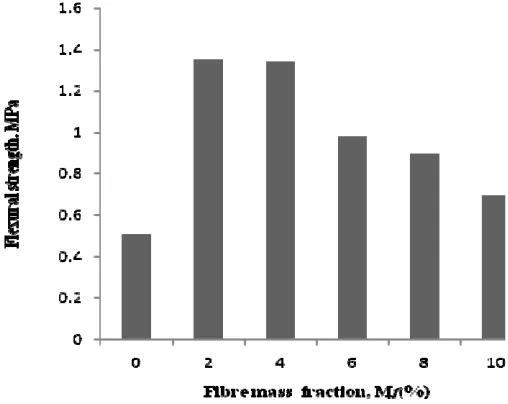
Figure 1: Plot of Flexural Strength against Fibre Mass Fraction
3.2 Flexural Load and Mid-Span Deflection
The flexural load is the maximum load the composite can bear before fracture during flexure/ bend test. Figure 2 depicts the results graphically. The samples with 4% and 2% fibre mass fractions showed excellent ability to withstand the highest load before fracture with values of 23.277N and 21.147N respectively while samples with fibre mass fractions of 6%, 8%, 0% (control) and 10% follow in that order with decreasing load sustainability.
[image:5.612.174.428.63.265.2][image:5.612.180.449.469.674.2]
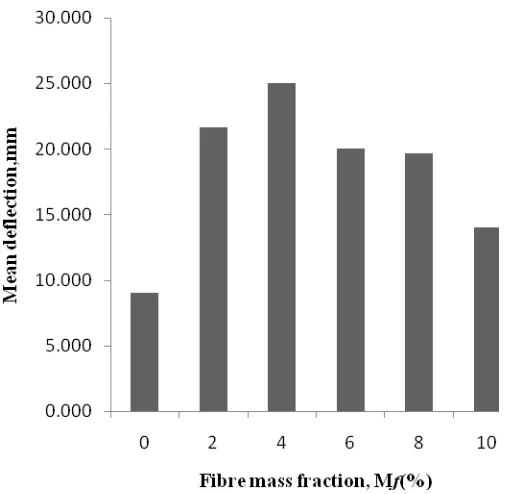
Figure 3 shows the mid-span deflection which is a measure of both the ductility and toughness of each of the samples. The samples with 4% fibre mass fraction showed the greatest deflection with value of 25mm signifying that it possessed the highest ductility. The control had the lowest value of 9mm showing that it had a poor ductility, and hence, most brittle of all the samples.
Figure 3: Plot of Mean Deflection against Fibre Mass Fraction
3.3 Water Absorptivity Test Results
Figure 4 depicts this result graphically. From the results obtained, the control sample (0% Mf)
Figure 4: Plot of PercentageWater Absorptivity against Fibre Mass Fraction
4. CONCLUSION
The results and analyses of the data obtained from this research work show that:
i. Randomly distributed natural vegetable fibres can be used to improve the flexural strength of flat cement composite sheets.
ii. The flexural strength and load of the samples tested increased with increasing fibre mass fraction included in the matrix, reaching a maximum at 4%. A decline was observed in these two properties from fibre mass fraction of 6% to 10%. Therefore, the optimum fibre mass fraction required for strengthening using natural sponge fibre is 4%.
iii. The control sample showed the least response to water absorptivity followed by the samples with 4% fibre mass fraction. All other fibre mass fraction samples absorbed more than half their dry weights of water. This could possibly be due to the presence of air spaces and voids as a result of the increasing fibre content included in the matrix and increasing difficulty experienced during mixing with the addition of upwards of 6% fibre in the matrix.
[image:7.612.179.428.62.290.2]REFERENCES
1 Swamy, R.N. (1990), Vegetable Fibre Reinforced Cement Composites- A False Dream
or a Potential Reality, Proceedings of Second International RILEM Symposium ,1st
edition, Chapman & Hall, London (ed. H.S Sobral), pp. 3-8.
2 Benjamin ,C.T. (1990), Fabrication and Performance of Natural Fiber-Reinforced
Composite Materials”, 35th. International SAMPE Symposium, pp.970-978.
3 Al-Qureshi H.A .(1999), The Use of Banana Fibre Reinforced Composites for the
Development of a Truck Body, Second International Wood and Natural Fibre
Composites Symposium, Kassel/Germany, pp.1-8.
4 Brandt, A.M. (1995), Cement Based Composites: Materials, Mechanical Properties and
Performance, 1st edition, Chapman and Hall, London, pp. 5-60, 77-97.
5 Soroushian, P and Mankunte, S (1990), High Performance Fibre Reinforced Cement
Composites, (eds. H.W. Reinhardt and A.E. Naaman), E and FN Son, London, pp.
84-99.
6 Hussin, M.W. and Zakaria, F. (1990), Prospects For Coconut Fibre- Reinforced Thin
Cement Sheet in the Malaysian Construction Industry, Proceedings of the Second
International RILEM Symposium,1stedition, Chapman & Hall, London (ed. H.S Sobral), pp. 77-80.
7 Lasisi, F and Ogunjimi, B. (1984), Source and Mix Proportions as Factors in
Characteristic Strength of Laterized Concrete, International Journal for Development
Technology, 2:3, pp. 8-13.