O R I G I N A L A R T I C L E
Open Access
It is not good to talk: conversation has a
fixed interference cost on attention
regardless of difficulty
Melina A. Kunar
*, Louise Cole, Angeline Cox and Jessica Ocampo
Abstract
It is well-documented that telephone conversations lead to impaired driving performance. Kunar et al. (Psychon Bull Rev 15:1135–1140, 2008) showed that this deficit was, in part, due to a dual-task cost of conversation on sustained visual attention. Using a multiple object tracking (MOT) task they found that the act of conversing on a hands-free telephone resulted in slower response times and increased errors compared to when participants performed the MOT task alone. The current study investigates whether the dual-task impairment of conversation on sustained attention is affected by conversation difficulty or task difficulty, and whether there was a dual-task deficit on attention when participants overheard half a conversation. Experiment 1 manipulated conversation difficulty by asking participants to discuss either easy questions or difficult questions. The results showed that there was no difference in the dual-task cost depending on conversation difficulty. Experiment 2 showed a similar dual-task deficit of attention in both an easy and a difficult visual search task. Experiments 3 and 4 showed that in contrast to work using a dot tracking and choice reaction time task (Emberson et al., Psychol Sci 21:1383–1388, 2010), there was little deficit on MOT performance of hearing half a conversation, provided people heard the conversations in their native language. The results are discussed in terms of a resource-depleted account of attentional resources showing a fixed conversational-interference cost on attention.
Significance
The impairments of talking on a mobile phone while driv-ing have been well-documented with people showdriv-ing slower response times and making more errors when conversing on a phone compared to when they are silent (e.g. Strayer & Johnston, 2001). There are many compo-nents of driving - one of which is the need to pay attention to the road. Previous work has investigated whether atten-tional tasks on their own are impaired when people engage in the act of conversation (Kunar, Carter, Cohen, &
Horowitz, 2008). The results showed that even in a
single-attention task, speed and accuracy are impaired when the participant converses compared to when they do not. However, it is not yet known whether different types of conversation affect attention differently, with more difficult conversations leading to greater impair-ments. Neither is it known whether the effect of convers-ing causes a fixed impairment in attention regardless of
task difficulty or whether conversation impairs difficult tasks to a greater degree than it does easier ones. We in-vestigated this and showed that conversation has a fixed impairment on attention regardless of conversation or task difficulty. Finally, we showed that there is little im-pairment in a sustained attention task of overhearing half a conversation. Given that mobile phone use is on the rise (Pickrell & Ye,2009) our results are significant in demon-strating that regardless of how easy or difficult people be-lieve a task to be, there is a measurable fixed impairment to attention tasks when engaged in a conversation.
Background
As we go about our daily lives we often perform several tasks simultaneously. Sometimes these two tasks are simple and can be performed together easily (e.g., hum-ming while walking). Other times perforhum-ming two tasks concurrently is much harder and leads to a performance detriment in either or both tasks (e.g., driving while talk-ing on a mobile phone, Strayer & Johnston,2001). These * Correspondence:[email protected]
Department of Psychology, The University of Warwick, Coventry CV4 7AL, UK
performance costs are known as dual-task deficits and have been studied extensively in the laboratory (e.g. Allen, McGeorge, Pearson, & Milne, 2006; Allport, Antonis, & Reynolds,1972; Fougnie & Marois,2006; Kunar, Shapiro, & Humphreys,2006; Pashler & O’Brien,1993).
Recent research into dual-task deficits have investigated the cost of talking on a mobile telephone while driving (e.g., Breim & Hedman, 1995; Strayer & Drews, 2007; Strayer, Drews, & Crouch, 2006; Strayer & Johnston, 2001). It has consistently been found that telephone con-versation leads to impaired driving performance. For ex-ample, Strayer et al. (2006) compared participants who were under the influence of alcohol to those who were talking on a mobile phone. Both groups of participants showed significant impairments in driving performance.
Furthermore, Strayer and Drews (2007) found people
failed to recall objects that they directly viewed more often, showing greater inattentional blindness, when they were involved in a conversation while driving compared to when they were not. Importantly, these effects were not due to motor conflicts of holding a telephone as the dual-task deficit was still observed in conditions where the conversation took place on a hands-free device (Strayer & Johnston, 2001). Clearly, there is a great cost of talking while driving. However, the reason for this cost is not yet fully understood.
One explanation for this conversational impairment is that the act of conversing interferes with attentional pro-cesses. Driving in itself is a task that involves multiple components. For example, in order to successfully ma-nipulate a car, the driver has to check mirrors, steer and manipulate brake/gas pedals all while paying visual at-tention to the road conditions. Given the various sub-tasks, it is unclear which parts of driving are af-fected by the act of conversation. Strayer and Johnston (2001) suggested that as the impairment was not affected by peripheral motor issues, such as holding the phone, then the cost was attentional in its nature. Kunar et al. (2008) directly tested this claim by using a multiple ob-ject tracking (MOT) task designed to measure sustained attention alone (Horowitz et al.,2007; Pylyshyn & Storm, 1988; Wolfe, Place, & Horowitz,2007), without the other added confounds of driving.
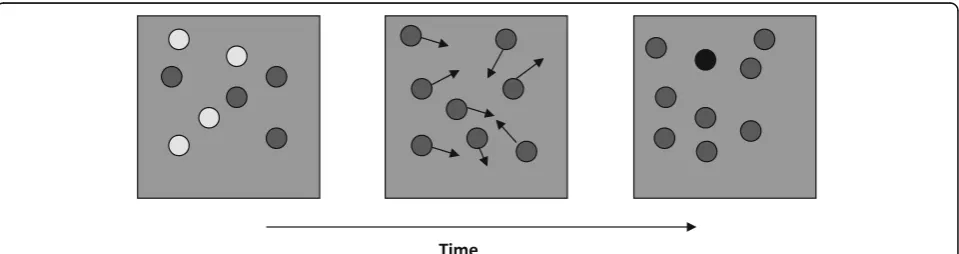
In the MOT task, participants were shown eight disks on a computer screen and asked to track a subset of these disks. Evidence shows that people are usually able to successfully track around four out of eight disks (Cavanagh & Alvarez, 2005, although see Alvarez & Franconeri,2007, who showed that this tracking capacity varied with disk speed and Watson & Kunar,2012, who
determined capacity limits depend on stimulus’
proper-ties). Kunar et al. (2008) asked participants to perform an MOT task on its own and while they were talking on a hands-free telephone and showed that people were
slower and less accurate at responding whilst having a conversation. The data clearly demonstrate that even at-tentional tasks on their own had a dual-task cost when participants were engaged in conversation. We investi-gate the nature of this effect further in the current paper by examining the influence of differing cognitive de-mands and conversation type. In particular, we investi-gate how conversational difficulty and task difficulty affect the dual-task cost of conversation on visual atten-tion. Furthermore, we examined whether there was also a dual-task cost of hearing half a conversation on visual attention. To give an overview of the results we found a decrease in attentional task performance when partici-pants were engaged in a conversation, but minimal dis-ruption on attentional task performance when they listened to a conversation.
Bergen, Medeiros-Ward, Wheeler, Drews, and Strayer (2013) have investigated whether the deficit of conversa-tion occurs due to domain-general or domain-specific reasons. They suggested that the reason for the dual-task cost can be broadly split into two categories. The first category (domain-general) refers to the idea that people have a limited number of attentional re-sources with which to complete all the tasks they need to do. If the tasks being performed concurrently use up more resources than there are available, then perform-ance of one or both of the tasks suffers (e.g., Kahneman, 1973). This theory stipulates that there need not be any overlap in these tasks in terms of modality (e.g., visual or auditory) or processing codes (e.g., manual or verbal) for dual-task interference to occur; instead there is a generalised processing cost leading to a domain-general deficit. The second category (domain-specific) suggests that interference from concurrently performed tasks only occurs when they share common resources. There-fore, there will be greater interference between two vis-ual tasks compared to a visvis-ual and an auditory/speech task. This theory is in line with the multiple resource theory proposed by Wickens (1984, 2002). Bergen et al.
(2013) concluded that different attentional theories
cover different components of driving. For example, braking reaction times (RTs) in a simulated driving test showed a domain-general interference effect, whereas following distance showed a domain-specific interfer-ence effect.
Regardless of which theory accounts for the dual-task
interference effect, both the domain-general and
is, the more difficult a task is the more resources it will use, leaving fewer available for a second task, leading to greater dual-task impairments (e.g., Hitch & Baddeley, 1976; Kahneman, 1973; Sullivan, 1976). We call this a difficulty-dependent account of attentional resources. In relation to sustained attention this would predict that if conversation were to become more difficult, perform-ance on the MOT task would suffer relative to when conversation was easier. Conversely, it has also been suggested that the dual-task deficit occurs because people become so involved in the conversation that they
fail to respond to the competing task (Wickens, 2002;
see also Helleberg & Wickens, 2003). A strong version of this account would suggest an“all or nothing” effect where the mere act of conversing would lead to a fixed delay in responding and would not be modulated by conversation difficulty. We call this theresource-depleted account, where the dual-task interference of conversa-tion on attenconversa-tion leads to a fixed depleconversa-tion of attenconversa-tional
resources, regardless of conversation and/or task
difficulty.
Previous research has looked at the effect of conversa-tion difficulty on simulated driving tasks. Breim and
Hedman (1995) had participants converse in either an
easy or difficult conversation while completing a simu-lated driving task. In the easy condition participants were asked to engage in naturalistic conversation with the experimenter. In the difficult condition participants had to correctly identify if a sentence was logical or not while also recalling the first words of the previous four sentences. The results found that performance in the simulated driving task was worse when participants were involved in the difficult conversation versus the easy conversation. Furthermore, it has been found that per-forming a more difficult word generation task impaired simulated driving and MOT performance compared to performing an easier speech shadowing task (see Strayer & Johnston, 2001 and Kunar et al., 2008, respectively). Evidence from these studies are in favour of a difficulty-dependent account, stating that the more de-manding a task, the more cognitive resources it uses, leaving fewer attentional resources available for subse-quent tasks.
Please note that although the results of the aforemen-tioned studies are informative the types of conversa-tional tasks involved across conditions are very different (e.g., a conversation versus a working memory task in
the study by Breim & Hedman, 1995 and a repeating a
word versus a cognitive word-generation task in Strayer & Johnston, 2001 and Kunar et al.,2008). Furthermore, working memory tasks, shadowing tasks and word gen-eration tasks are not often utilised in everyday speech. Experiment 1 in the present study addresses these issues directly by having both the easy conversation and
difficult conversation conditions based on a series of ques-tions. Not only are the answering of questions more com-mon in everyday speech, they allow the type of conversation to remain constant across the experiment while allowing manipulation of task difficulty. To preview the results, when the type of conversation was controlled for by asking questions in both conditions, a similar dual-task deficit on MOT performance occurred with both the difficult and the easy conversations, in line with a resource-depleted account of attentional resources.
Experiment 2 manipulated the difficulty of the atten-tional task. Here we changed the task to a visual search task, so that the attentional resources needed to complete the task could be easily manipulated (Treisman & Gelade,
1980). Participants completed two visual search tasks
whilst conversing: an easy single-feature task and a more difficult spatial-configuration task. In the easy task, partic-ipants were instructed to look for a red target, T, among green distracter Ls. As the target was different to the distracters by a unique feature (colour) we would expect the RTs in this task to remain stable over set size and produce efficient search slopes of around 0 ms/item (Treisman & Gelade,1980; Watson & Kunar,2010; Wolfe & Horowitz, 2004). In this type of search task the target
“pops out” without the need for attention (Treisman & Gelade, 1980). In the difficult spatial-configuration task participants were asked to look for a white target, T, among white distracter Ls. As the target and distracters were similar to each other in colour and line orientation, participants had to actively search the display, which produced inefficient search slopes, where RTs increased with set size (e.g., Duncan & Humphreys,1989; Kunar & Humphreys, 2006; Kunar, Rich, & Wolfe,2010). Accord-ing to a difficulty-dependent account, as the sAccord-ingle-feature task can be completed pre-attentively (e.g., Treisman & Gelade, 1980), there should be little deficit to this task of having a conversation. However, as the difficult spatial-configuration task requires greater attentional re-sources there should be a dual-task cost of conversation in this task. Conversely, the resource-depleted account pre-dicts a dual-task cost independent of task difficulty, there-fore, according to this account we would expect a dual-task cost in both the easy and difficult search tasks. The results showed that the act of conversing led to a dual-task deficit in both visual search tasks, consistent with a resource-depleted account.
The second part of this paper investigated whether hearing part of a telephone conversation also had similar detrimental effects on sustained attention. Emberson,
Lupyan, Goldstein, and Spivey (2010) previously found
respond to target letters and ignore distracter letters
(Emberson et al., 2010). Participants performed both
these tasks while listening to (a) half a conversation (a
“halfalogue”) comprising speech from one person’s part of a conversation, (b) a dialogue of both people’s parts of a conversation and (c) a monologue where they heard one person’s recap of a conversation. The results showed that performance was impaired in the halfalogue tion compared to the dialogue and monologue
condi-tions. From these results, Emberson et al. (2010)
suggested that overhearing a conversation would also be disruptive to driving and other attentional tasks. We in-vestigate this here by comparing the disruption of hear-ing half a conversation on a sustained visual attention task to that of having a conversation. If a dual-task cost was observed when people heard part of a conversation then this would have implications for the dangers of overhearing passenger conversations when driving. In experiment 3 we had participants perform an MOT task in three conditions: (1) when they were listening to a halfalogue, (2) when they were involved in a conversa-tion and (3) in silence. Experiment 4 more closely repli-cated the conditions used by Emberson et al. (2010) by comparing MOT performance when participants over-heard half a conversation to when they overover-heard a dia-logue between two people. The results showed that provided that the conversation was in a person’s native language, overhearing half a conversation did little to disrupt sustained attention. Taken together the results of
experiments 1–4 showed that, although listening to a
conversation did little to affect attention, engaging in a conversation had a large detrimental effect on atten-tional performance, regardless of conversaatten-tional or task difficulty. We discuss the applied and theoretical impli-cations of these data further in“General discussion”.
Experiment 1
Method Participants
Thirty participants (mean age = 22.1 years, 18/30 female) took part in the experiment. A power analysis using G* Power (Faul, Erdfelder, Lang, & Buchner,2007) with the effect size taken from the original experiment reported in Kunar et al.,2008(experiment 1, which showed a sig-nificant difference in MOT performance between con-versation and no concon-versation conditions, with an effect size = 0.7,α= .05, two-tailed) found that using this num-ber of participants would achieve a power of 0.96 in each of the experiments presented subsequently. All partici-pants had normal or corrected-to-normal vision. Ethical approval for all experiments was obtained from the De-partment of Psychology, University of Warwick ethics board. All participants gave informed consent before taking part in the experiment.
Stimuli and procedure
Displays were generated and responses recorded by cus-tom written computer programmes running on a PC. Stimuli were eight dark grey disks subtending 1° of vis-ual angle at a viewing distance of 57 cm. The back-ground was a uniform light grey.
There were three MOT conditions: a no conversation condition, a difficult conversation condition and an easy conversation condition. For the no conversation condi-tion, at the beginning of each trial participants were pre-sented with a fixation dot at the centre of the computer screen for 1 s. They were then presented with four dark grey disks (the “distracter disks”) and four yellow disks (the “target disks”). These remained on the screen for 1 s before the target disks changed their colour to dark grey (matching the distracter disks). These remained on the screen for 500 ms, at which point all eight disks began to move at a constant speed of 6.7°/s in a ran-domly assigned and unpredictable direction (making sure that the disks never occluded one another). After 3 s the disks stopped moving and one of the eight disks turned red. Participants were asked to respond to whether the red disk was a target or not by pressing one of two keys (“m” if the red disk was the target and“z” if it was the distracter). The red disk was a target in 50 % of trials. Participants were asked to respond as quickly but as accurately as possible and error rates and RTs were recorded.
The difficult conversation and the easy conversation condition were similar to the no conversation condition except that in these conditions participants engaged in a conversation with the experimenter while doing the MOT tasks. The conversation continued over multiple MOT trials to last the length of the entire condition.
Topics of conversation were taken from “The Book of
Questions” (Stock, 1985). Fifteen additional questions, that had been previously judged to be either difficult or easy in a pilot study, were also used. In the difficult con-versation condition, throughout the MOT task partici-pants were asked to respond to a series of questions that were difficult to answer, for example, “if you were able to live to the age of 90 and retain either the body or the mind of a 30-year-old for the last 60 years of your life
which would you want?”. In the easy conversation
par-ticipants were asked a series of questions throughout the MOT condition that were easy to answer, for example,
was quicker than when asked to respond to the first ten questions from the difficult set (64.9 s vs 193.3 s, re-spectively,t(14) = 10.6,p< 0.01,d= 3.418) again indicat-ing that the easy set of questions were easier to answer than the difficult set.1For each condition there were 50 trials per participant. Participants were given a short practice block before each condition and the order of conditions in this experiment (and all subsequent exper-iments) was counterbalanced. Example displays can be seen in Fig.1.
Results and discussion
Trials with RTs less than 200 ms or greater than 4000 ms were removed as outliers (2.5% of the data).
Figure 2 shows the mean correct RTs and Fig. 3
shows the error rates for each condition.
Within-participants analysis of variance (ANOVA) for mean correct RTs showed there to be a main effect of condition, F(2, 58) = 17.1,p< 0.01, ηp2= 0.371. Plannedttests showed
a significant difference between the no conversation and dif-ficult conversation condition,t(29) = 5.1,p< 0.01,d= 0.872, where RTs were slower in the difficult conversation condi-tion compared to the no conversacondi-tion condicondi-tion, and a sig-nificant difference between the no conversation and easy conversation condition, t (29) = 4.5, p< 0.01, d= 0.718, where RTs were slower in the easy conversation condition compared to the no conversation condition. There was no difference in RTs between the easy conversation and difficult conversation condition,t(29) < 1,d= 0.073.
Examining the error rates, within-participants ANOVA showed there to be a main effect of condition,F(2, 58) = 21.7,p< 0.01,ηp2= 0.428. Plannedttests showed a
signifi-cant difference between the no conversation and difficult conversation condition,t(29) = 5.5,p< 0.01,d= 1.10, where more errors were made in the difficult conversation condi-tion compared to the no conversacondi-tion condicondi-tion, and a sig-nificant difference between the no conversation and easy conversation condition, t (29) = 4.7, p< 0.01, d= 0.870, where more errors were made in the easy conversation
condition compared to the no conversation condition. There was a trend for fewer errors to occur in the easy con-versation condition than in the difficult concon-versation condi-tion,t(23) = 1.7,p= 0.09,d= 0.217.
The results were clear. Performance in the MOT task was impaired both in terms of speed and accuracy when people were simultaneously having a conversation. This occurred regardless of whether the content of the con-versation was designed to have participants answer rela-tively difficult questions or simple ones. Comparing both RTs and error rates for the easy and difficult conversa-tion condiconversa-tions we see no modulaconversa-tion of the dual-task deficit in RTs and only a slight increase in error rates in the difficult condition. The data are hard to reconcile with a difficulty-dependent account of attentional re-sources, which would predict that the dual-task deficit would increase with conversation difficulty. Instead the data are in favour of a resource-depleted account where having a conversation leads to a fixed delay in atten-tional response regardless of difficulty.
One could argue that having a difficult conversation could be considered more engaging than having an easier conversation. Perhaps this level of engagement led to an improvement in RTs (as participants might be less prone to having their “mind wander” if they were actively en-gaged), which would counter the disruptive effect of con-versation on MOT performance. Although possible, we believe this to be unlikely as Wickens (2002) proposed that it is theengagingnature of the conversation that leads to the dual-task deficit. They proposed that when participants were actively engaged in a conversation they “dropped” the secondary task entirely (Wickens et al., 2002). Further-more, previous research has shown that asking a partici-pant to be actively engaged in search (opposed to passively searching the display) leads to an impairment in atten-tional performance, rather than an improvement (Smilek, Enns, Eastwood, & Merikle, 2006; see also Lleras & Von Mühlenen, 2004, Olivers & Nieuwenhuis, 2005, Kunar, Watson, Cole, & Cox,2014, Watson, Brennan, Kingstone,
[image:5.595.59.539.575.702.2]& Enns,2010and Kunar, Ariyabandu, & Jami,2016, who showed that actively giving participants a choice led to an increase in RTs and search efficiency). Therefore, if any-thing, having participants be more engaged in a conversa-tion would predict an impairment in performance, rather than an improvement. However, this did not occur. Instead the data are easier to reconcile with a resource-depleted account suggesting that having any type of conversation (easy or difficult), leads to a fixed cost in attention.
Experiment 1 showed a dual-task impairment on MOT performance while participants were simultan-eously engaged in conversation (see also Kunar et al.,
2008). Experiment 2 investigated whether conversation
also impaired performance in visual search. This experi-ment investigated the effect of conversation on two dif-ferent types of search task: one that produced efficient search (the “easy search” condition) and one that pro-duced inefficient search (the“difficult search”condition). Does the disruption of conversation also extend to these tasks and will task difficulty lead to different dual-task impairments when paired with conversation?
Experiment 2
Participants
Thirty participants (mean age = 21.2 years, 21/30 female) took part in the experiment. All had normal or corrected-to-normal vision.
Stimuli and procedure
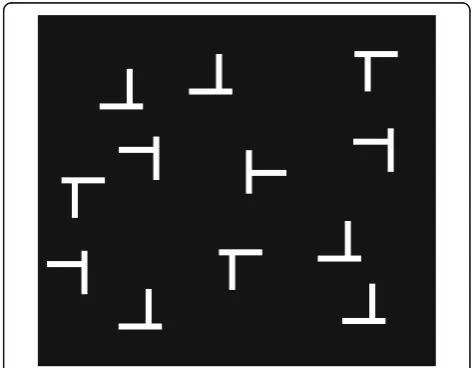
Displays were generated and responses recorded by cus-tom written computer programs running on a PC. The stimuli were rotated Ts and Ls. Each stimulus had a vis-ual angle of 1.7° × 1.7° at a viewing distance of 57 cm and the vertical lines of the Ls were slightly offset from its horizontal line (see Fig.4and Russell & Kunar,2012, for examples of these stimuli). All stimuli were presented on a black background. On each trial, there were either 4, 8 or 12 stimuli presented. The target was present on every trial.
There were two visual search conditions: the easy search condition and the difficult search condition. In the easy search condition participants were asked to search for the target letter of a red T among distracter letters of green Ls. As the target was defined by a unique feature it would require little search and “pop-out” of the search display (Treisman & Gelade,1980). In the dif-ficult search condition participants were still asked to search for the letter T; however, in this condition all the stimuli were white. Given that the target had no defining feature and the fact that there was a great deal of simi-larity between the target and the distracters, these sets of stimuli would result in inefficient search (e.g., Duncan & Humphreys,1989; Wolfe, Cave, & Franzel,1989).
To begin each trial, a blank screen appeared for 500 ms and was followed by a central fixation point for 500 ms. The T and L stimuli were then presented
Fig. 3The proportion of errors for each condition in experiment 1. Error bars represent the standard error
Fig. 4Example display of experiment 2. In the single-feature condition the target T was red and the distracter Ls were green. In the spatial configuration condition all stimuli were white
[image:6.595.57.292.87.238.2] [image:6.595.303.540.510.694.2] [image:6.595.57.293.556.702.2]randomly within an invisible 6 × 6 matrix. All stimuli were presented randomly in one of four orientations (0°, 90°, 180° or 270°) with equal probability. Participants were asked to indicate the direction in which the stem of the target T was pointing, by pressing“m”if the stem faced right and “z” if the stem faced left. Participants were instructed to respond as quickly but as accurately as possible. If no response was made within 10 s, the trial “timed out”and the next trial automatically started. Following a response or time-out, the blank screen was again displayed before the next fixation point and trial. There were 90 trials in each condition (30 for each set size).
Participants completed each visual search (easy and difficult) twice - once on its own and once while con-versing with the experimenter. The conversation was similar to the conversation conditions of experiment 1, except that instead of answering questions participants were asked to engage in a naturalistic conversation with the experimenter whilst completing the visual search task. The conversation topics were not limited; however, the experimenter opened the conversations with topics such as recreational interests, holiday plans and travel preferences. If one topic of conversation naturally ended the researcher started another conversation on a differ-ent topic. Conditions were counterbalanced and RTs and error rates were recorded. Participants were asked to re-spond as quickly but as accurately as possible.
Results and discussion
Trials with RTs less than 200 ms or greater than 4000 ms were removed as outliers (1.2% of the data).
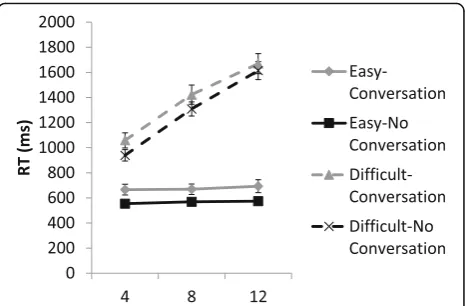
Figure 5 shows the mean correct RTs and Fig. 6 shows
the error rates for each condition. Search slopes are
shown in Table 1. As expected, search in the
single-feature search was efficient (with search slopes close to 0 ms/item), while search in the spatial configur-ation task was inefficient. Mean correct RTs were en-tered into 2 × 2 × 3 ANOVA with main effects of visual search type (easy vs difficult), conversation (conversation vs no conversation) and set size (4, 8 or 12). As expected there was a main effect of visual search type,F(1, 29) = 290.8, p< 0.01, ηp2= 0.909, where RTs for the difficult
search condition were slower than those for the easy search condition. There was a main effect of conversa-tion,F (1, 29) = 12.7, p< 0.01, ηp2= 0.305, where RTs in
the conversation condition were slower than in the no conversation condition and there was a main effect of set size,F(2, 58) = 358.4,p< 0.01,ηp2= 0.925, where RTs
increased with set size. The visual search type × set size interaction was also significant, F (2, 58) = 224.0, p< 0.01, ηp2= 0.885, reflecting that RTs increased with set
size more in the difficult search task than in the easy search task, as expected. Importantly, none of the other
interactions involving conversation were significant (all Fvalues <1.5).
Examining the error rates, 2 × 2 × 3 ANOVA showed there to be a main effect of conversation,F (1, 29) = 10.5, p < 0.01, ηp2= 0.266, where surprisingly there were more
errors in the no conversation than in the conversation con-dition (4.3% vs 2.1%, respectively). There was no main effect of visual search type, F (1, 29) = 1.3, p= 0.27, ηp2= 0.042,
nor was there a main effect of set size, F< 1, ηp2= 0.017.
None of the interactions were significant (allFvalues <1.2, ps> 0.33).
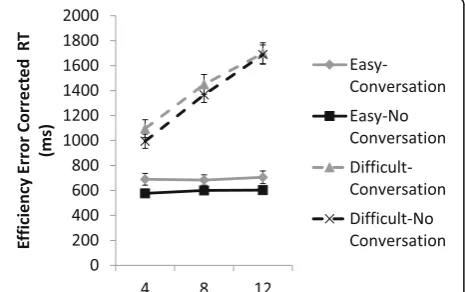
Even though the error rates were low throughout the experiment, as the RTs and error rates showed opposite patterns of results in terms of the effect of conversation, the RTs and error rates were combined to produce one overall measure of Efficiency (RT corrected for error rates). This was calculated by dividing the RT by the proportion of correct responses and is a method to de-termine the overall pattern of results, taking into ac-count both RTs and error rates (Allen, Humphreys, &
Matthews, 2008; Townsend & Ashby, 1983). Figure 7
shows the measure of efficiency for all conditions. The Fig. 5Reaction times (RTs) across set size for each condition in experiment 2. Error bars represent the standard error
[image:7.595.306.539.87.240.2] [image:7.595.306.539.556.705.2]2 × 2 × 3 ANOVA showed there to be a main effect of visual search type,F(1, 29) = 230.2,p< 0.01, ηp2= 0.888,
where efficiency was worse in the difficult search condi-tion than in the easy search condicondi-tion. There was a main effect of conversation, F (1, 29) = 7.4, p< 0.05, ηp2=
0.203, where efficiency was worse in the conversation condition than in the no conversation condition and there was a main effect of set size,F(2, 58) = 313.6,p< 0.01, ηp
2
= 0.915, where efficiency decreased with in-creasing set size. As expected, the visual search type × set size interaction was also significant,F(2, 58) = 217.3, p< 0.01, ηp
2
= 0.882, reflecting that efficiency decreased with set size more in the difficult search task than in the easy search task. Importantly, none of the other
interac-tions involving conversation were significant (all F
values <2.1,ps> 0.14).
The overall pattern of results showed a dual-task def-icit of conversation in both visual search tasks. A difficulty-dependent account would have predicted that as detection of the target in the single-feature task was pre-attentive (Treisman & Gelade, 1980), it would need fewer attentional resources and thus be exempt from the deficit of conversation (or at least show less of a dual-task impairment compared to the difficult condi-tion). However, this was not the case. Instead the results concurred with a resource-depleted account, showing that regardless of task difficulty there was a fixed dual-task cost of having a conversation. Please note that the interference of conversation in both conditions only affected the RTs and did not affect the search slopes.
This suggests that the cost of conversation was due to a delay in the central bottleneck of processing rather than interfering with the mechanism behind the search process. We discuss this further in“General Discussion”. The results from experiment 1 and 2 showed a signifi-cant dual-task cost of conversing on visual attention, re-gardless of conversation or task difficulty. Experiment 3 examined whether a similar dual-task deficit was ob-served when participants only heard half of a conversa-tion (mimicking condiconversa-tions where people were exposed to one side of a mobile phone conversation). Emberson
et al. (2010) identified attentional impairment when
people overheard half a conversation. However, one could argue that the cognitive act of conversing would lead to a greater depletion of attentional resources, as it is a more difficult and complex task than simply listen-ing to a conversation (Kunar et al.,2008; Strayer &
John-ston, 2001). In this case, we would expect a greater
dual-task deficit to occur in the conversation condition compared to overhearing half a conversation.
Experiment 3
Participants
Thirty participants (mean age = 24.2 years, 24/30 female) took part in the experiment. All had normal or corrected-to-normal vision.
Stimuli and procedure
The stimuli and procedure were similar to that of experi-ment 1 except that there were three conditions: a no con-versation condition, a concon-versation condition and a half conversation condition. The no conversation and conver-sation conditions were the same as those in experiment 2. In the half conversation condition, participants heard the researcher engage in a halfalogue whilst completing the MOT task. In this condition the researcher sat in the same room as the participant and engaged in a scripted half conversation, maintaining all of the non-verbal and non-vocal aspects of the conversation such as pauses, sighs, laughter etc. The script for the half conversation condition was created by transcribing half of an actual telephone conversation between friends.
Results and discussion
Trials with RTs less than 200 ms or greater than 4000 ms were removed as outliers (0.4% of the data).
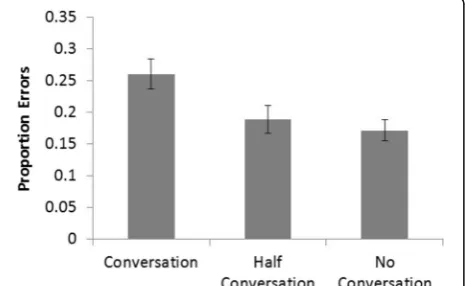
Figure 8 shows the mean correct RTs and Fig. 9 shows
the error rates for each condition. Within-participants ANOVA for mean correct RTs showed there to be a main effect of condition, F (2, 58) = 7.5, p< 0.01, ηp
[image:8.595.57.291.100.168.2]2 = 0.206. Plannedttests showed a significant difference be-tween the half conversation and conversation conditions,t (29) = 3.3,p< 0.01,d= 0.498, where RTs in the conversation condition were slower than in the half conversation Table 1Search slopes for each condition in experiment 2
Condition Search slope (ms/item)
Easy-conversation 3.4
Easy-no conversation 2.6
Difficult-conversation 76.4
Difficult-no conversation 84.4
[image:8.595.58.291.556.702.2]condition. RTs were also slower in the conversation condi-tion compared to the no conversacondi-tion condicondi-tion, t(29) = 2.5,p= 0.02,d= 0.356. There was no significant difference, however, between the half conversation and no conversa-tion condiconversa-tion,t(29) = 1.5,p= 0.16,d= 0.158.
Examining the error rates, within-participants ANOVA showed there to be a main effect of condition,F(2, 58) = 15.8,p< 0.01,ηp2= 0.353. Plannedttests showed a
sig-nificant difference between the half conversation and conversation conditions, t (29) = 3.7, p< 0.01, d= 0.560, where more errors were made in the conversation condi-tion compared to the half conversacondi-tion condicondi-tion. There was also a significant difference between the conversa-tion and no conversaconversa-tion condiconversa-tion,t(29) = 5.2,p< 0.01,
d= 0.805, where more errors were made in the
conversa-tion condiconversa-tion compared to the no conversaconversa-tion condi-tion. However, there was no significant difference between the half conversation and no conversation con-dition,t(29) = 1.3,p= 0.21,d= 0.171.
The results again showed a dual task detriment on MOT performance, in terms of both speed and accuracy,
while participants were engaged in conversation.
However, examining the results of the half conversation condition showed there to be no dual-task detriment in speed or accuracy in comparison to the no conversation condition. Clearly listening to half of a conversation did little to impair performance in a sustained attentional task. These results are inconsistent with those of Ember-son et al. (2010) who found that overhearing half a con-versation was disruptive to a dot tracking and choice RT task. Note that in their experiments, results from the half conversation condition were also compared directly to a dialogue condition where participants overheard a full conversation, rather than participants taking part in a conversation. We replicated these conditions more closely in experiment 4, by examining the effect of over-hearing a dialogue compared to overover-hearing half a con-versation when performing an MOT task.
Experiment 4
Participants
Thirty participants (mean age = 23.3 years and 21/30 female) took part in the experiment. All had normal or corrected-to-normal vision.
Stimuli and procedure
The stimuli and procedure were similar to that of ex-periment 3 except that there were three conditions
in-volved: a no conversation condition, a dialogue
condition and a half conversation condition. The no conversation and half conversation conditions were the same as that in experiment 3, except that the halfalogue was recorded and played to participants through head-phones (the same halfalogue was used in this condition as that in experiment 3). In the dialogue condition, par-ticipants heard a full dialogue of a conversation between two people. Both the halfalogue and dialogue conversa-tions were recorded via an iPhone and played through headphones using Microsoft Windows media software. The use of pre-recorded conversations more closely
rep-licated the methodology of Emberson et al. (2010) who
also used pre-recorded messages. To ensure participants were listening to each conversation they were told that they were going to be asked questions about each con-versation after the dialogue and half concon-versation condi-tions. Directly after each of these conditions participants answered three multiple-choice questions on the content of the conversation. The questions were asked and the answers were recorded by the experimenter.
Results and discussion
One participant was excluded from analysis as they only answered 50% of the multiple-choice questions
cor-rectly.2 Data from the remaining participants showed a
mean accuracy rate of 95% and were analysed further. Trials with RTs less than 200 ms or greater than Fig. 8Reaction times (RTs) for each condition in experiment 3. Error
bars represent the standard error
[image:9.595.57.291.87.237.2] [image:9.595.58.291.558.701.2]4000 ms were removed as outliers (0.5% of the data).
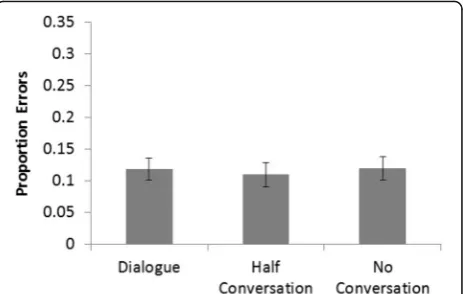
Figure10shows the mean correct RTs and Fig.11shows
the error rates for each condition. Within-participants ANOVA for mean correct RTs in the MOT tasks showed there to be a main effect of condition,F(2, 56) = 3.7,p= 0.03, ηp2= 0.118. Plannedttests showed a sig-nificant difference between the dialogue conversation and the no conversation conditions,t(28) = 2.7,p= 0.01,
d= 0.362, where RTs in the dialogue condition were
slower than in the no conversation condition. RTs were also marginally slower in the half conversation condition compared to the no conversation condition, t(28) = 1.8, p= 0.09, d= 0.285. There was no significant difference, however, between the half conversation and dialogue condition,t(28) = 0.9,p= 0.35, d= 0.120. Examining the error rates, within-participants ANOVA showed there to be no main effect of condition, F (2, 56) = 0.4, p= 0.66,
ηp2= 0.015.
The results are mixed. Although the error rates concur with those of the previous experiment, the RT results conflict with those in experiment 3. In experiment 3 the results showed that there was no effect of overhearing half a conversation compared to the no conversation condition on RTs. However, in experiment 4, there was a trend for RTs to be slower when overhearing half a con-versation compared to hearing no concon-versation. Further-more, RTs in the dialogue condition were slower to those in the no conversation condition, which is differ-ent to the findings of Emberson et al. (2010). There are two possible reasons for the discrepancy in results. The first could be that in experiment 4 people were asked questions about the conversation or half conversations they heard. However, no questions were asked about the half conversation in experiment 3. It could be that the act of listening to the conversation in order to answer questions led to reduced cognitive resources for per-forming the MOT task. Although theoretically plausible we do not believe this to be the case as previous
research has robustly shown that listening tasks do not interfere with attentional performance - even if partici-pants had to answer questions about what they had heard (Kunar et al.,2008; Strayer & Johnston,2001).
The second explanation could be that in experiment 4 there was a higher proportion of participants whose na-tive language was different to that of the conversation (there were 7%3vs 48% of non-native speakers in experi-ments 3 and 4, respectively). This meant that compre-hension of the conversations may have been more difficult for these participants leading to more cognitive resources being used.4This in turn would have led to a reduction of resources available to perform the MOT task in the halfalogue and dialogue conditions and an overall increase in RTs. There is some merit to this hy-pothesis if we break down the results across participants who categorised themselves as native speakers versus those that categorised themselves as non-native speakers in experiment 4 (14 vs 13 participants, respectively - 2 participants declined to categorise themselves and were excluded from further analysis). Looking at participants who reported themselves as native speakers we see that there was no difference in RTs between any of the condi-tions, F (2, 26) = 0.9, p= 0.462, ηp2= 0.063 (829 ms,
771 ms and 795 ms for the dialogue, half and no conver-sation condition, respectively). However, comparing par-ticipants who categorised themselves as non-native speakers we see that there was a difference in RTs across condition,F(2, 26) = 4.35,p= 0.02,ηp2= 0.266 (1064 ms,
1032 ms and 869 ms, for the dialogue, half and no con-versation condition, respectively). For these participants, RTs were slower in the dialogue condition than the no conversation condition, t (12) = 2.5, p= 0.03, d= 0.538, and slower in the half conversation condition than the
no conversation condition, t (12) = 2.6, p= 0.02, d=
0.611. There was no difference in RTs between the dia-logue and half conversation condition, t(12) = 0.45, p=
[image:10.595.307.539.88.235.2]0.7, d= 0.082. The data suggest that for non-native
Fig. 10Reaction times (RTs) for each condition in experiment 4. Error bars represent the standard error
[image:10.595.57.291.554.701.2]speakers there was a cost to RTs of overhearing either the whole or part of a conversation on MOT perform-ance. However, in agreement with experiment 3, when
the conversation was spoken in a person’s native
lan-guage there was little cost of overhearing either the whole or part of a conversation.
General discussion
Previous work has shown a dual-task cost of having people engage in a sustained attentional task while also having a conversation (Kunar et al., 2008). The present data show the robustness of this dual-task detriment of conversation across a variety of conditions. Experiment 1 showed that regardless of whether the conversation content was relatively easy or relatively difficult, both conversation types impaired MOT performance in com-parison to a condition where there was no conversation. Experiment 2 showed that conversing also impaired per-formance in an easy, efficient visual search task as well as in an inefficient search task. Experiments 3 and 4 showed that, unlike previous research using dot tracking and choice RT tasks, there was no dual-task impairment on MOT of overhearing half a conversation on error rates. Furthermore, there was little dual-task impairment on RTs between overhearing half a conversation and having no conversation, provided that the participants listened to a conversation in their native language.
Conversation and difficulty
Our results have important implications for the nature of conversation on performance in attentional tasks. Ex-periment 1 showed that both easy and difficult conversa-tions have similar impact on attentional demands. Wickens (2002), see also Helleberg & Wickens, (2002) suggested that the reason conversation disrupted per-formance on a secondary task is that the act of convers-ing is so engagconvers-ing that participants drop the secondary task altogether. A strong version of this claim would suggest that any conversation, regardless of difficulty would lead to impaired performance of a secondary task. Our results are in favour of this claim supporting a resource-depleted account, whereby the engagement of conversing, regardless of difficulty, impedes performance in attentional tasks.
One could argue that we did not see any difference be-tween the easy and difficult conditions due to a lack of power. For example, there was a hint of a difference in the error rates between the difficult and easy conditions in experiment 1, where there was a marginal effect (29% vs 26%, respectively). However, as the effect size for this comparison was small, we do not believe there is truth in a strong version of this account. Furthermore, any differ-ences between the difficult and easy conditions were not observed in the reaction times, nor in experiment 2 (which
also directly manipulated task difficulty). Last, given that the power level was above 0.95 in all experiments, a lack of power in these experiments seems unlikely. Instead the ex-periments demonstrate that both the easy and difficult
con-versation conditions showed a marked impairment
compared to when no conversation was taking place. Gen-eralising this back to a driving situation, the results clearly indicate that having a conversation, regardless of difficulty level, resulted in a depletion of attention that could have serious consequences on the road.
Furthermore, experiment 2 showed that conversation even had a detrimental effect on tasks that are consid-ered to require very little in the way of attentional re-sources (e.g., the single-feature task). These data are challenging to explain by a difficulty-dependent account which would suggest that as the single-feature task needs very few attentional resources, it should be per-formed well under dual-task conditions with little im-pairment. However, this was not the case. As a dual-task cost was witnessed in both the inefficient and efficient
search tasks the results instead point to a
resource-depleted account, where there was an overall cost of conversing, regardless of task difficulty. When looking at performance in these visual search tasks we can glean some insight into the nature of this conversa-tional interference. According to experiment 2 we see that the deficit of conversation led to an overall RT cost rather than a change to the search slopes. This would suggest that the nature of the conversational interference was due to the psychological refractory period (PRP) as there was an overall additive delay in responding, rather than interference with the actual search mechanisms
(see Levy, Pashler, & Boer, 2006, who also found a
dual-task PRP effect in a simulated driving task). The PRP effect occurs when two signals, requiring response are presented in close temporal proximity to each other (Welford,1952). It is found that response to the second signal is delayed until the response to a first signal has been completed (e.g., Pashler, 1994; Welford, 1952). In the case of our work, people would be delayed in responding to the visual search task whilst they were en-gaged in conversation. Please note that this delay could be dangerous if we extrapolate it back to driving condi-tions. For example, when travelling at the speed of
60 miles/hour a 110 ms delay in response5
could lead to travelling an extra distance of 9.7 ft before braking. This is over half the length of a standard-sized car.
Attentional impact of hearing half a conversation
Previous research has found that listening to half a con-versation (a halfalogue) is more disruptive than hearing a whole conversation or a monologue on a manual dot-tracking task and a choice RT task (Emberson et al.,
nature of hearing half a conversation disrupts these simple attentional tasks. These results are important as there could be consequences for tasks like driving if overhearing a passenger conversation affects sustained attention. How-ever, our results show that this was not the case: although there was strong evidence of an impairment in perform-ance when taking part in a conversation, there was only minimal disruption to MOT performance when partici-pants listened to half a conversation, providing the con-versation was in their native language.6The difference in listeningto a conversation andengagingin a conversation on attention is most likely due to the attentional resources each task requires. Although experiments 1 and 2 showed that the difficulty of the conversation did not affect MOT performance, previous research has shown that having a conversation is a more complex task than just listening to speech (Kunar et al.,2008; Strayer & Johnston,2001). For example, Kunar et al. (2008) found that the cognitive act of generating speech in a word generation task interfered more with attentional processes compared to just listening to a narrative or shadowing a word. Our current research shows that the cognitive act of having a conversation, re-gardless of difficulty, depletes attentional resources more so than overhearing half of other people’s conversations.
Overall, our findings do not concur with those of Emberson et al. (2010), who found disruption of over-hearing half a conversation compared to overover-hearing a whole conversation or no conversation. There are sev-eral potential reasons for this difference. One reason could be that the dot tracking and choice RT tasks used by Emberson et al. (2010) were more sensitive to smaller amounts of distraction compared to the MOT task. For example, there could be circumstances in the MOT task when, although participants were distracted, they would still be able to track the targets with some degree of suc-cess (for example, if the target was far away from other
distractors),7 meaning that the MOT task was less
sus-ceptible to distraction. Alternatively, the difference in re-sults could have been due to the perceptual load of the attentional task. Participants had to track four disks in the MOT task compared to one disk in the dot-tracking task. This difference meant that the MOT task had a higher perceptual load than the task used by Emberson et al. (2010). Previous research has shown that the per-ceptual load of a task effects how many attentional re-sources there are available for processing other stimuli (e.g. Lavie, 1995). If the perceptual load of the task is high (as in the MOT task) then there are fewer atten-tional resources to process the halfalogue and there will be less interference from it. In contrast if the perceptual load is lower (the dot tracking and choice RT task) then there will be extra attentional resources available to process the halfalogue leading to greater interference. It is up to future work to investigate this further, however
the present data give us insight into the boundaries of mobile phone use in sustained attentional tasks, like that of driving. Although talking on a telephone has negative consequences there is no detriment of overhearing half a passenger’s conversation.
Domain-general versus domain-specific accounts
The current data also address the issue of what theory is re-sponsible for the dual-task attentional deficit observed while conversing. Bergen et al. (2013) found, when looking at brak-ing RTs, a domain-general theory best accounted for their re-sults; however, when they looked at following distance they found some evidence for a domain-specific account. Our re-sults can give insight into which theory is responsible for the dual-task deficit of conversation on attention. Across experi-ments a strong and robust dual-task deficit was observed. This occurred even though there was minimal overlap be-tween the modalities of each task: the MOT task required visual resources while the conversation required auditory and speech resources. As a domain-specific account would only predict interference between tasks that shared common resources (e.g. modalities, processing codes etc.) then it is dif-ficult to reconcile these data with a strong version of this ac-count. Instead, we conclude that a domain-general account is theoretically more likely to be responsible for the deficit of conversation on attention.
Implications for attention in road safety and other tasks
the field showing that even the most simplistic of conver-sations can have profound interference effects on tasks that require attention.
Endnotes 1
As there were more questions in the “easy” set than
the “difficult” set we could not make a comparison of
RTs to respond to all questions in each condition.
Therefore, we chose to measure RTs to the first ten questions in each condition as an indicator of difficulty.
2
Note that the pattern of data remained the same if this participant was included in data analysis.
3
Unfortunately, we do not have data for 2 of the par-ticipants and so have excluded them from this statistic: among the remaining 28 participants, 2 were non-native speakers in experiment 3.
4
Note that all participants self-reported having good levels of English (the conversations were all presented in English) and answered the majority of the questions about the conversations correctly. However, it may be that more cognitive resources were needed for those who spoke English as a second language rather than those who spoke it as a first language.
5
This is the average RT delay in the single feature con-dition of experiment 2, when participants were having a conversation
6
Please note that the analysis in experiment 4 compar-ing native and non-native speakers was post hoc and therefore should be handled with caution. However, des-pite this the data from experiment 3 clearly showed there was little disruption of listening to half a conversa-tion on MOT performance.
7
We thank Trafton Drew for this suggestion.
Abbreviations
ANOVA:Analysis of variance; MOT: Multiple object tracking; PRP: Psychological refractory period; RT: Reaction time
Acknowledgements
The authors would like to thank Peter Carr, Annie Lummis and Vivien Hung for their assistance with data collection and Phillip Clarke for assistance with stimuli production.
Availability of data and materials
The datasets supporting the conclusions of this article are available in the Figshare repository,https://doi.org/10.6084/m9.figshare.c.3780965,https:// doi.org/10.6084/m9.figshare.c.3780965.v1
Authors’contributions
MK was the project lead of this research project responsible for designing and programming the experiments, overseeing data collection, final analysis of all data and writing up the results into manuscript form. LC and AC were responsible for data collection and initial analysis of experiment 3. JO was responsible for data collection and initial analysis of experiments 1 and 2. All authors read and approved the final manuscript.
Ethics approval and consent to participate
Full ethical approval for this study was granted by the Department of Psychology Ethics Committee and the Humanities & Social Sciences Research Ethics Committee (Ethical Application Reference 52/16-17) of the University of Warwick. All participants provided written informed consent.
Consent for publication Not applicable.
Competing interests
There are no financial or non-financial competing interests associated with this research.
Publisher’s Note
Springer Nature remains neutral with regard to jurisdictional claims in published maps and institutional affiliations.
Received: 28 June 2018 Accepted: 11 July 2018
References
Allen, H. A., Humphreys, G. W., & Matthews, P. M. (2008). A neural marker of content-specific active ignoring.Journal of Experimental Psychology: Human Perception and Performance,34(2), 286–297.
Allen, R., McGeorge, P., Pearson, D. G., & Milne, A. (2006). Multiple-target tracking: a role for working memory?Quarterly Journal of Experimental Psychology,
59(6), 1101–1116.
Allport, D. A., Antonis, B., & Reynolds, P. (1972). On the division of attention: a disproof of the single channel hypothesis.Quarterly Journal of Experimental Psychology,24(2), 225–235.
Alvarez, G. A., & Franconeri, S. L. (2007). How many objects can you attentively track? Evidence for a resource-limited tracking mechanism.Journal of Vision,
7(13), 14 1–10.
Bergen, B., Medeiros-Ward, N., Wheeler, K., Drews, F. A., & Strayer, D. L. (2013). The crosstalk hypothesis: why language interferes with driving.Journal of Experimental Psychology: General,142, 119–130.
Breim, V., & Hedman, L. R. (1995). Behavioural effects of mobile telephone use during simulated driving.Ergonomics,38(12), 2536–2562.
Cavanagh, P., & Alvarez, G. A. (2005). Tracking multiple targets with multifocal attention.Trends in Cognitive Sciences,9(7), 349–354.
Duncan, J., & Humphreys, G. W. (1989). Visual search and stimulus similarity.
Psychological Review,96, 433–458.
Emberson, L. L., Lupyan, G., Goldstein, M. H., & Spivey, M. J. (2010). Overheard cell-phone conversations: when less speech is more distracting.Psychological Science,21, 1383–1388.
Faul, F., Erdfelder, E., Lang, A.-G., & Buchner, A. (2007). G*Power 3: a flexible statistical power analysis program for the social, behavioral, and biomedical sciences.Behavior Research Methods,39, 175–191.
Fougnie, D., & Marois, R. (2006). Distinct capacity limits for attention and working memory.Psychological Science,17(6), 526–534.
Glassbrenner, D. (2004).Cell phone use on the roads in 2002,Report no. DOT HS-809-580(). Washington, DC: National Highway Traffic Safety Administration. Helleberg, J., & Wickens, C. D. (2003). Effects of data link modality and display
redundancy on pilot performance: an attentional perspective.International Journal of Aviation Psychology,13, 189–210.
Hitch, G. J., & Baddeley, A. D. (1976). Verbal reasoning and working memory.
Quarterly Journal of Experimental Psychology,28, 603–621.
Horowitz, T. S., Klieger, S. B., Fencsik, D. E., Yang, K. K., Alvarez, G. A., & Wolfe, J. M. (2007). Tracking unique objects.Perception & Psychophysics,69(2), 172–184. Kahneman, D. (1973).Attention and effort. Englewood Cliffs: Prentice Hall. Kunar, M. A., Ariyabandu, S., & Jami, Z. (2016). The down side of choice: having a
choice benefits enjoyment but at a cost to efficiency and time in visual search.Attention, Perception and Psychophysics,78, 736–741.
Kunar, M. A., Carter, R., Cohen, M., & Horowitz, T. S. (2008). Telephone conversation impairs sustained visual attention via a central bottleneck.
Psychonomic Bulletin and Review,15(6), 1135–1140.
Kunar, M. A., & Humphreys, G. W. (2006). Object-based inhibitory priming in preview search: evidence from the‘top-up’procedure.Memory & Cognition,
34, 459–474.
Kunar, M. A., Rich, A. N., & Wolfe, J. M. (2010). Spatial and temporal separation fails to counteract the effects of low prevalence in visual search.Visual Cognition,
18, 881–897.
Kunar, M. A., Shapiro, K. L., & Humphreys, G. W. (2006). Top-up search and the attentional blink: a two-stage account of the preview effect in search.Visual Cognition,13, 677–699.
asynchronous dynamic (MAD) search.Visual Cognition.https://doi.org/10. 1080/13506285.2017.1306006.
Kunar, M. A., & Watson, D. G. (2011). Visual search in a multi-element asynchronous dynamic (MAD) world.Journal of Experimental Psychology: Human Perception and Performance,37(4), 1017–1031.
Kunar, M. A., & Watson, D. G. (2014). When are abrupt onsets found efficiently in complex visual search? Evidence from multi-element asynchronous dynamic search.Journal of Experimental Psychology: Human Perception and Performance,40, 232–252.
Kunar, M. A., Watson, D. G., Cole, L., & Cox, A. (2014). Negative emotional stimuli reduce contextual cueing but not response times in inefficient search.The Quarterly Journal of Experimental Psychology,67, 377–393.
Lavie, N. (1995). Perceptual load as a necessary condition for selective attention.
Journal of Experimental Psychology: Human Perception and Performance,21, 451–468.
Levy, J., Pashler, H., & Boer, E. (2006). Central interference in driving: is there any stopping the psychological refractory period?Psychological Science,17(3), 228–234.
Lleras, A., & Von Mühlenen, A. (2004). Spatial context and top-down strategies in visual search.Spatial Vision,17(4–5), 465–482.
Lochner, M. J., & Trick, L. M. (2014). Multiple-object tracking while driving: the multiple-vehicle tracking task.Attention, Perception & Psychophysics,76(8), 2326–2345.
Olivers, C., & Nieuwenhuis, S. (2005). The beneficial effect of concurrent task-irrelevant mental activity on temporal attention.Psychological Science,16(4), 265–269.
Pashler, H. (1994). Dual-task interference in simple tasks: data and theory.
Psychological Bulletin,116(2), 220–244.
Pashler, H., & O’Brien, S. (1993). Dual-task interference and the cerebral hemispheres.Journal of Experimental Psychology: Human Perception & Performance,19(2), 315–330.
Pickrell, T. M., & Ye, T. J. (2009).Driver electronic device use in 2008,Report no. DOT HS-811-184(). Washington, DC: National Highway Traffic Safety
Administration.
Pylyshyn, Z. W., & Storm, R. W. (1988). Tracking multiple independent targets: evidence for a parallel tracking mechanism.Spatial Vision,3(3), 179–197. Russell, N., & Kunar, M. A. (2012). Color and spatial cueing in low prevalence
visual search.The Quarterly Journal of Experimental Psychology,65, 1327–1344. Smilek, D., Enns, J. T., Eastwood, J. D., & Merikle, P. M. (2006). Relax! Cognitive style
influences visual search.Visual Cognition,14, 543–564.
Stock, G. (1985).The book of questions. New York: Workman Publishing. Strayer, D. L., Drews, F., & Crouch, D. (2006). A comparison of the cell phone
driver and the drunk driver.Human Factors,48, 381–391.
Strayer, D. L., & Drews, F. A. (2007). Cell-phone-induced driver distraction.Current Directions in Psychological Science,16(3), 128–131.
Strayer, D. L., & Johnston, W. A. (2001). Driven to distraction: dual-task studies of simulated driving and conversing on a cellular telephone.Psychological Science,12(6), 462–466.
Sullivan, L. (1976). Selective attention and secondary message analysis: a reconsideration of Broadbent’s filter model of selective attention.Quarterly Journal of Experimental Psychology,26, 167–178.
Townsend, J. T., & Ashby, F. G. (1983).The stochastic modeling of elementary psychological processes. Cambridge: Cambridge University Press. Treisman, A. M., & Gelade, G. (1980). Feature-integration theory of attention.
Cognitive Psychology,12, 97–136.
Watson, D. G., & Kunar, M. A. (2010). Visual marking and change blindness: Moving occluders and transient masks neutralize shape changes to ignored objects.Journal of Experimental Psychology: Human Perception and Performance,36, 1391–1405.
Watson, D. G., & Kunar, M. A. (2012). Visual marking: determining the capacity of time-based selection.Journal of Experimental Psychology: Human Perception and Performance,38, 350–366.
Watson, M. R., Brennan, A. A., Kingstone, A., & Enns, J. T. (2010). Looking versus seeing: strategies alter eye movements during visual search.Psychonomic Bulletin & Review,17(4), 543–549.
Welford, A. T. (1952). The“psychological refractory period”and the timing of high-speed performance - a review and a theory.British Journal of Psychology,43, 2–19.
Wickens, C. D. (1984). Processing resources in attention. In R. Parasuraman, & D. R. Davies (Eds.),Varieties of attention, (pp. 63–102). New York: Academic Press.
Wickens, C. D. (2002). Multiple resources and performance prediction.Theoretical Issues in Ergonomic Sciences,4, 1–19.
Wolfe, J. M., Cave, K. R., & Franzel, S. L. (1989). Guided search: an alternative to the feature integration model for visual-search.Journal of Experimental Psychology: Human Perception and Performance,15, 419–433.
Wolfe, J. M., & Horowitz, T. S. (2004). What attributes guide the deployment of visual attention and how do they do it?Nature Reviews Neuroscience,5, 1–7. Wolfe, J. M., Oliva, A., Horowitz, T. S., Butcher, S. J., & Bompas, A. (2002).
Segmentation of objects from backgrounds in visual search tasks.Vision Research,42, 2985–3004.
Wolfe, J. M., Place, S. S., & Horowitz, T. S. (2007). Multiple object juggling: changing what is tracked during extended multiple object tracking.