© 2019, IRJET | Impact Factor value: 7.211 | ISO 9001:2008 Certified Journal | Page 6939
Monument Informatica Application Using AR
Thube Bhavana
1, Bora Tejashri
2, Tanpure Supriya
3, Prof.Bhosale Sachin
41,2,3,4
Dept. of Computer Engineering, Jaihind college,sppu, Maharastra, india
---***---Abstract - Tourism has become an important sector having
an impact on development of country’s economy. For many locales, it is the most important source of welfare. So, in order to guide tourists, there exist many types of tour guide schemes. Among them, traditional guides, paper and mobile based systems are most commonly used for providing tour routes and heritage information for tourists. In the above system tourist needs to visualize what the guide wants to convey about the ancient period or to read the information of the monument. By considering the limitations of above methods, we are proposing an Augmented Reality based Application, which will give tourists an interactive experience by superimposing an informative video, text, images onto the captured view of the monument. This application provides the location of nearby monuments and have ability to identify the monuments positioned close to the user position.Rating is provided in application. The proposed system will be applicable to educational and entertainment industries also.Key Words: Augmented Reality, Computer vision, and
template matching algorithm, Multimedia Information System– Augmented Realities, Image Processing.
1.INTRODUCTION
Augmented reality (AR) is a mixed reality where a virtual or digital object is injected into real world. Augmented reality is related to two terms: mixed reality and computer-mediated reality. Basically uses camera and sensor technology of existing hardware to capture the real world and then uses specialized software to layover an interactive digital element. This paper is based on Augmented Reality technology in which the tourist will be able to see the information as a video, text, images when user points onto the front view of the monument. This will give tourist flexibility to understand the history of the monument with the help of the text, image and video superimposed onto the frame containing that monument. This application provides the location of nearby monuments. This AR based application will provide tourist with varieties of languages like English and Hindi. The images, text will be displayed and video will be played in the specific language that the tourist understands which makes the application more user-friendly and interactive. Rating is provided in application.
2. RELETED
WORK
2.1
Problem Statement
There has been lot of problems regarding visit historical places, picnic points, temples etc. and has no knowledge regarding that place that’s why peoples can hire guide and pay maximum amount to those persons. Hence we implement an Augmented Reality based application that will provide tourists, insights of the monument by superimposing videos on its captured view. Also provide the location of nearby turist places.
3. Template matching Algorithm
Some data mining pre-processing techniques extract feature points such as image, text and video and then used as input data to application. Various approaches have been proposed to extract these monument points from the object. The basic approaches are as follows.
3.1.K-nearest neighbours KNN algorithm:
Here is step by step on how to compute K-nearest neighbours KNN algorithm:
1. Determine parameter K = number of nearest neighbours
2. Calculate the distance between the query-instance and all the training samples
3. Sort the distance and determine nearest neighbours based on the K-th minimum distance
4. Gather the category Y of the nearest neighbours
5. Use simple majority of the category of nearest neighbours as the prediction value of the query instance
Time complexity and optimality of kNN
kNN with preprocessing of training set
© 2019, IRJET | Impact Factor value: 7.211 | ISO 9001:2008 Certified Journal | Page 6940 Testing
kNN without preprocessing of training set
training
Testing
Training and test times for kNN classification is the average size of the vocabulary of documents in the collection.
3.2. Template Based Technique:
In machine learning we are often interested in selecting the best hypothesis (h) given data (d). In a classification problem, our hypothesis (h) may be the class to assign for a new data instance (d).
One of the easiest ways of selecting the most probable hypothesis given the data that we have that we can use as our prior knowledge about the problem Bayes’ Theorem provides a way that we can calculate the probability of a hypothesis given our prior knowledge.
Bayes’ Theorem is stated as:
P(h|d) = (P(d|h) * P(h)) / P(d)
Where
P(h|d) is the probability of hypothesis h given the data d. This is called the posterior probability.
P(d|h) is the probability of data d given that the hypothesis h was true.
P(h) is the probability of hypothesis h being true (regardless of the data). This is called the prior probability of h.
P(d) is the probability of the data (regardless of the hypothesis).
You can see that we are interested in calculating the posterior probability of P(h|d) from the prior probability p(h) with P(D) and P(d|h).
After calculating the posterior probability for a number of different hypotheses, you can select the hypothesis with the highest probability. This is the maximum probable hypothesis and may formally be called the maximum a posteriori (MAP) hypothesis.
This can be written as:
MAP(h) = max(P(h|d))
or
MAP(h) = max((P(d|h) * P(h)) / P(d))
or
MAP(h) = max(P(d|h) * P(h))
The P(d) is a normalizing term which allows us to calculate the probability. We can drop it when we are interested in the most probable hypothesis as it is constant and only used to normalize.
Back to classification, if we have an even number of instances in each class in our training data, then the probability of each class (e.g. P(h)) will be equal. Again, this would be a constant term in our equation and we could drop it so that we end up with:
MAP(h) = max(P(d|h))
This is a useful exercise, because when reading up further on Naive Bayes you may see all of these forms of the theorem.
4. Proposed Work
© 2019, IRJET | Impact Factor value: 7.211 | ISO 9001:2008 Certified Journal | Page 6941 Augmented Reality based application, which will give
tourists an interactive experience by superimposing an informative video ,text ,images onto the captured view of the monument.
System will allow user to get the authenticated information about the monument through a video, text and image format. System will contain information about 3 monuments namely ’Taj Mahal’ etc. and user will be able to see video in desired languages eg English and Hindi. System will augment all the information in form of a video about the monument on the screen so user can interact with virtual information along with actual monument.
Augmenting Monument Information:
i. User will be able to get the monument information by using videos, images, textual information of that monument.
ii. The system will show a video of the history, construction of the monument and information about the people related to the monument.
5. Mathematical Model
Let S be the Whole system which consists:
S= {IP, U, I, D, ip}.
Where,
IP is the input of the system.
Pro is the procedure applied to the system to process the given input.
OP is the output of the system.
1. Registration:
U={U1, U2, U3, ……Un }
U Is the user set that register in our system.
I= { I1, I2, I3, I4,…. In}
I is the set of image that stored in to dataset.
ip= { ip1, ip2, ip3,…. ipn}
ip is the image processing for user given image.
Input: { image}
Output:{ information }
[image:3.595.309.555.142.404.2]6. System Architecture
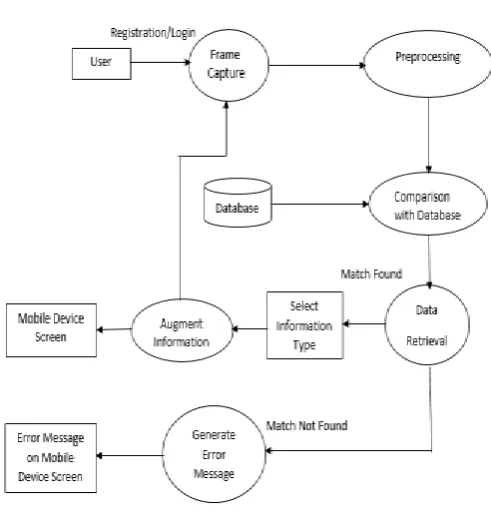
Fig 1: Working of System
The Architecture Model applied to this project contains two main blocks:
User:
– Click View (The System will be an AR based application where the user needs to stand in front of the monument covering the whole view of it. The system will then identify which monument is onto the captured frame. After identifying the valid monument the user need to choose which language the user wants the information and finally the user will be able to see the information in an interactive way e.g. Video, Text, Images)
Admin/System: System Flow Outline:
– Video capturing module: Splits the video into frames.
– Image Transformation module: Transform the image into gray-scale.
– Marker identification module: Identify the marker on the transformed image.
© 2019, IRJET | Impact Factor value: 7.211 | ISO 9001:2008 Certified Journal | Page 6942 – Information retrieval module: Extract the video, text,
Images corresponding to the identified marker.
– Information rendering module: Augment the video, text, Images over the marker
7. Result
© 2019, IRJET | Impact Factor value: 7.211 | ISO 9001:2008 Certified Journal | Page 6943
8. CONCLUSIONS
The system architecture focuses on presenting
information of monuments to tourists in an interactive
way with the help of Augmented Reality. Using this
system the user will be able to get information about
the monument, its history and culture in an visual way,
improving user experience. System provides rating
function for user’s feedback. This system will provide
an authentic replacement to a tourist guide providing
information using text, images, videos depicting
ancient culture of the monument. Location of nearby
monument is also provided by system.
ACKNOWLEDGEMENT
© 2019, IRJET | Impact Factor value: 7.211 | ISO 9001:2008 Certified Journal | Page 6944
REFERENCES
[1] Marco Cavallo, Geoffrey Alan Rhodes, Angus Graeme Forbes, ”Riverwalk: Incorporating Historical Photographs in Public Outdoor Augmented Reality Experiences” 2016 IEEE International Symposium on Mixed and Augmented Reality. [2] N. Jayanthi, S. Indu,”Comparison of Image Matching Techniques” 2017 International Journal of Latest Trends in Engineering and Technology.
[3] Akil H. Sayyad , Santosh A. Shinde ,”Augmented Reality Based Mobile Tour Guide System ” 2016 International Research Journal of Engineering and Technology (IRJET). [4] Alexandru Gherghina, Alexandru-Corneliu Olteanu and Nicolae Tapus ,”A Marker-Based Augmented Reality System for Mobile Devices” 2013 IEEE 4th Experiment@International Conference.