Sequence-dependent attack on peptides by
photoactivated platinum anticancer complexes
†
Christopher A. Wootton, Carlos Sanchez-Cano, Andrea F. Lopez-Clavijo,
Evyenia Shaili, Mark P. Barrow, Peter J. Sadler * and Peter B. O'Connor *
Octahedral platinum(IV) complexes such astrans,trans,trans-[Pt(N3)2(OH)2(pyridine)2] (1) are stable in the
dark, but potently cytotoxic to a range of cancer cells when activated by UVA or visible light, and active in vivo. Photoactivation causes the reduction of the complex and leads to the formation of unusual Pt(II) lesions on DNA. However, radicals are also generated in the excited state resulting from photoactivation (J. S. Butler, J. A. Woods, N. J. Farrer, M. E. Newton and P. J. Sadler, J. Am. Chem. Soc., 2012, 134, 16508–16511). Here we show that once photoactivated,1also can interact with peptides, and therefore proteins are potential targets of this candidate drug. High resolution FT-ICR MS studies show that reactions of1activated by visible light with two neuropeptides Substance P, RPKPQQFFGLM-NH2(SubP)
and [Lys]3-Bombesin, pEQKLGNQWAVGHLM-NH2 (K 3
-Bom) give rise to unexpected products, in the form of both oxidised and platinated peptides. Further MS/MS analysis using electron-capture dissociation (ECD) dissociation pathways (enabling retention of the Pt complex during fragmentation), and EPR experiments using the spin-trap DEPMPO, show that the products generated during the photoactivation of1depend on the amino acid composition of the peptide. This work reveals the multi-targeting nature of excited state platinum anticancer complexes. Not only can they target DNA, but also peptides (and proteins) by sequence dependent platination and radical mechanisms.
Introduction
Diazido platinum(IV) complexes such as trans,trans,trans
-[Pt(N3)2(OH)2(pyridine)2] (1) are promising agents for use in
Photo-Activated Chemotherapy (PACT),1,2which offers potential
temporal and spatial control over their activity,3–5reducing side
effects through unwanted attack on normal tissues.6,7
Complex1(scheme 1) and its analogues exhibit little activity in the dark, yet possess potent antiproliferative activityin vitro
against a wide range of cancer cells upon irradiation with visible light,8and are also activein vivotowards oesophaegeal cancer
aer short time exposures to blue light.9Furthermore, they do
not rely on the conversion of3O2to1O2to kill cancer cells, as
sensitisers used in photodynamic therapy (e.g.based on tetra-pyrroles),10which potentially can allow them to function eff
ec-tively under the hypoxic conditions found in tumors.7,11,12
Complex1is more active than itscisisomer, and not cross resistant with cisplatin.8 Its mechanism of action seems to
involve the platination of DNA by Pt(II) photoproducts, forming
inter-strand DNA cross-links, which are more difficult to repair
than DNA-adducts formed bycis-analogues.11However, radicals
are also generated during irradiation of the complex with visible light.1,6,13,14 Initially it was believed that the mechanism of
photodecomposition of 1 simply involved excitation of the ligand(azide)-to-metal (PtIV) charge-transfer band, with one-electron transfer from each azide ligand giving rise to PtIIand two azidyl radicals which can combine to form three molecules of N2.1However, the detailed photodecomposition pathways are
complex, can lead to the production of azidyl radicals, singlet
Scheme 1 Trans,trans,trans-[Pt(N3)2(OH)2(py)2] (complex 1), the
photo-activatable prodrug used in this study, along with illustrative photo-decomposition pathways leading to PtIIproducts which can
form bonds/inter-strand cross-links on DNA.1
Department of Chemistry, University of Warwick, Gibbet Hill Road, Coventry CV4 7AL, UK. E-mail: [email protected]; [email protected]; Fax: +44 (0)24 76151009; +44 (0)24 765 23819; Tel: +44 (0)24 76151008; +44 (0)24 765 23818 †Electronic supplementary information (ESI) available: Detailed MS data and discussion of effects of Pt on MS/MS fragmentation, as Scheme S1, Tables S1–S14 and Fig. S1–S10. See DOI: 10.1039/c7sc05135b
Cite this:Chem. Sci., 2018,9, 2733
Received 3rd December 2017 Accepted 1st February 2018 DOI: 10.1039/c7sc05135b
rsc.li/chemical-science
Science
EDGE ARTICLE
Open Access Article. Published on 12 February 2018. Downloaded on 2/19/2019 4:31:21 PM.
This article is licensed under a
Creative Commons Attribution 3.0 Unported Licence.
View Article Online
oxygen (even in absence of gaseous O2), nitrenes, and hydroxyl
radicals,1,6,13,14 and depend strongly on the biomolecules
present. For example, loss of N2from a bound azide can lead to
nitrene intermediates which might attack thioethers such as the side-chain of methionine.15 Additionally, the production of
azidyl radicals is quenched in the presence of tryptophan (but not other amino acids such as glycine or tyrosine).14 This
suggests that1might interact with peptides and proteins inside cells, following different photodecomposition pathways depending on their sequences. However, the interaction of photoactivated1with peptides has yet to be studied.
Tandem mass spectrometry (MS/MS) analysis has been successful in studying an array of peptides and proteins while retaining vital post-translational modications (PTM's).16–18
This technique has been used to investigate the interactions of biomolecules with platinum drugs such as cisplatin,19–21
trans-platin,22 oxaliplatin,23 or diiodido–platinum complexes,24 but
also ruthenium,25–28 and organometallic iridium and osmium
complexes.29,30 Electron-based dissociations are particularly
useful when studying metallodrug interactions where the top-down approach has allowed the characterisation of entire protein sequences and the unambiguous determination of multiple binding sites for metallodrugs on various proteins,21,31–33without further chemical modications such as
digestion which can disrupt/dissociate modications. Electron capture dissociation (ECD) MS/MS is particularly effective for PTM analysis due to its non-ergodic character34and its ability to
fragment species without loss of fragile PTM's.35
Herein, we use ultra-high resolution Fourier Transform Ion Cyclotron Resonance Mass Spectrometry (UHR-FT-ICR MS) to study the interaction of trans,trans,trans-[Pt(N3)2
(OH)2(pyridine)2] (1) with two model peptides (neuropeptides);
Substance P, RPKPQQFFGLM-NH2 (SubP), and [Lys]3
-Bomb-esin, pyrQKLGNQWAVGHLM-NH2 (K3-Bom). Both of which
have amidated C-termini. Our experiments show for therst time that photoactivation of1leads to both amino-acid-specic platination and oxygenation of peptides.
Results and discussion
K3-BomandSubPare naturally occurring peptides with a role in some types of cancer;K3-Bomis a known tumour marker,36and
SubPhas elevated levels in several types of cancer cells.37Initial
experiments showed that the use of bright red light during sample preparation and analysis had no effect on1, while low levels of white light induced the photoactivation of the complex. Therefore, all samples were prepared and analysed in darkness or with very low levels of red light, to avoid activation of1prior to irradiation with blue light.
Photoactivation of1in presence ofSubPorK3-Bomwasrst
followed using UV-vis spectroscopy (Fig. S1†). Complex 1
exhibits an intense azide-to-Pt(IV) charge-transfer band (lmax¼
295 nm) which can be used to monitor the photodecomposition of the complex.1SubPhad little apparent effect on the rate of
decomposition of1. However,K3-Bomslowed this process, and induced the formation of a new peak atca.250 nm.
Using nESI-FT-ICR-MS, we analysed reaction mixtures of
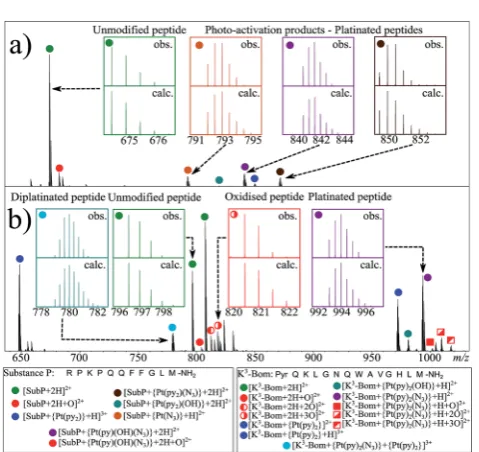
1+SubP and 1+K3-Bom (0.5–1 drug : peptide) irradiated with blue light (463 nm; 30–120 min) to activate1. Peaks for a total of 8 and 12 products were assigned for the reactions of1+SubPand
1+K3-Bom, respectively (Fig. 1, Table S2†). Most can be assigned
to different platinated adducts of the peptides. For the reaction between1+SubP, only mono-platinated adducts were observed, containing the modications {Pt(py)(OH)(N3)}, {Pt(py)2(N3)},
{Pt(N3),}, and {Pt(py)2} with reasonable intensity, and
{Pt(py)2(OH)} at low intensity. However, analysis of the reaction
1+K3-Bomshowed both mono- and di-platinated adducts, con-taining {Pt(py)2}, {Pt(py)2(N3)}, {Pt(py)2(OH)}, and both {Pt(py)2}
and {Pt(py)2(N3)} modications simultaneously.
Interestingly, both unmodied and platinated adducts of the peptides were found to be oxidised when irradiated in presence of 1.SubP species had the addition of one oxygen (by exact mass), while up to three oxygen atoms were found onK3-Bom
species. Similar species were not observed upon irradiation of the peptides in absence of 1, or when 1 + peptide mixtures where not irradiated with blue light.
Photoactivated platination of [Lys]3-Bombesin
Platinum-containingK3-Bomadducts were readily identied in MS and MS/MS spectra by platinum's characteristic isotopic pattern (Fig. 1, inset). Clear peaks for various platinated species can be observed simultaneously, showing release of 1-2 hydroxido ligands and 1-2 azido ligands. Retention of the
Fig. 1 nESI FT-ICR mass spectra of (a) ca.1 mM aqueous complex
1+SubP, and (b) complex 1+K3-Bom reaction mixtures (0.5 : 1 drug : peptide ratio) after 1 and 2 h of irradiation (respectively) with blue visible light (463 nm). Inset; various isotopic patterns for the observed (obs.) and calculated (calc.) species assigned from the mass spectra– showing the influence of platinum on observed isotopic distributions. Greenfilled circles indicate unmodified peptide species, red indicates oxidised species (both peptide and platinated peptides), other colours indicate platinated peptide species with different Pt(II)-based modifications.
Open Access Article. Published on 12 February 2018. Downloaded on 2/19/2019 4:31:21 PM.
This article is licensed under a
[image:2.595.309.549.394.620.2]pyridine ligands during the photoactivation of1correlates well with previous 1H-NMR experiments on model reactions with guanine derivatives,6,11as do products in which one azido ligand
remains bound in the case of the {Pt(py)2(N3)}+modication.6
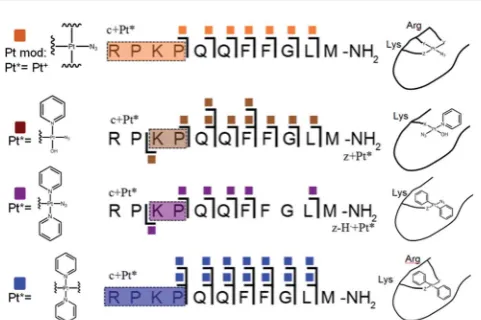
ECD MS/MS analysis of the platinated K3-Bom species is
summarised in Fig. 2. Full assignment lists and ECD MS/MS spectra are in Tables S2–S4 and Fig. S2.†K3-Bom contains
methionine, histidine and lysine residues, all potential S or N donor ligands. Pt(II) complexes are known to bind preferentially
at the S of Met, followed by His N.20,32,38–40Pt–S bonds are usually
strong, and survive harsh pH digestions and high energy gas phase dissociations in tandem MS experiments.20 However,
{Pt(py)2(N3)}+ and {Pt(py)2(OH)}+ modications from
mono-platinatedK3-Bomadducts were unambiguously bound at the His12residue, despite the C-terminal Met.14MS/MS analysis of
[K3-Bom+Pt(py)2]2+ species yielded no sequence-informative
fragments, only ligand and/or amino acid side chain loss peaks. Such behaviour has been attributed to extended cyclic structures which can disrupt usual MS/MS fragmentation.41
However, the presence of metal centres presents unique chal-lenges to MS and MS/MS peptide/protein analysis.41–44
The charged Pt centre altered the ECD MS/MS fragmentation pattern by providing axed charge at the point of interaction (e.g.His11ofK3-Bom), but also enhanced side chain losses of
amino acid groups present. Electron capture at the PtIIcentre/ electron transfer of previously captured electrons on the peptide also caused additional ligand loss from the bound complex and additional fragmentations from amino acid dues, including unique side chain losses from methionine resi-dues (Scheme S1†). CAD MS/MS of platinum complex-containing species caused gas-phase dissociation of the platinum-bound ligands, even at low energies (<5–7 V), creating a reactive PtII centre, which quickly cyclised with available peptide groups and produced uninformative fragmentation spectra.
Still, ECD MS/MS of [K3-Bom+Pt(py)
2+H]3+species produced
abundant backbone fragmentation (Fig. S2c†). This showed simultaneous binding at His12and Met14residues of {Pt(py)
2}
photoproducts, producing a small cyclic region in the modied peptide species.
Photoactivated platination of substance P
UnlikeK3-Bom,SubPcontains no histidine residues, and
pho-toactivation of1+SubPmixture led to loss of a pyridine ligand, producing ({Pt(py)(OH)(N3)} as a major peptide modication;
Fig. 1a and 3). This suggests that all the types of ligands found in1can be released during photoirradiation, and highlights the importance of peptide sequence in determining the pathways followed during photodecomposition.
ECD MS/MS shows that [SubP+{Pt(py)(OH)(N3)}+2H]2+,
[SubP+{Pt(py)2(N3)}+H]2+, [SubP+{Pt(N3)+H]2+, and
[SubP+{Pt(py)2+H}]3+ species are platinated within the four
N-terminal amino acids of the peptide (Fig. 2, Tables S5–7, Fig. S3†). [SubP+{Pt(py)2(OH)}+H]2+species were observed only
at very low intensity at all irradiation times, and reliable MS/MS fragmentation could not be obtained. ECD induced fragmen-tation of the N-terminal region ofSubP(RPKP) is restricted by proline residues,45and the overall structure is held togethervia
the “proline effect”.46 This hampered determination of the
platination sites ofSubP. However, the fragmentation allowed the binding site for1to be located between Lys3and Pro.4
Interestingly, spectra from1+K3-Bommixtures aer different irradiation times (30, 60, 90 or 120 min) always contained the same photoproducts, increasing their overall, but not their relative intensity at longer irradiation times. However, irradia-tion of1+SubPmixtures for different times showed preferential formation of different products at different times. [SubP+Pt(py)(OH)(N3)+2H]2+ was the major product at short
irradiation times, while longer irradiations of1+SubPmixtures led to further ligand release, with [SubP+Pt(N3)+H]2+ species
increasing over time. This suggests that photoreactions of1can continue aer the formation of Pt(II) species.
Methionine and tryptophan oxidation
In addition to peptide platination; an array of oxidised products was also observed following photoactivation of 1. Oxidised peptide species (i.e. [SubP+O+2H]2+, [K3-Bom+O+2H]2+, [K3 -Bom+2O+2H]2+, and [K3-Bom+3O+2H]2+) were further studied
Fig. 3 PlatinatedSubPpeptide species observed and fragmented by ECD MS/MS; coloured squares indicate a modification on the partic-ular fragment. Fully annotated spectra are shown in Fig. S3.†
Fig. 2 PlatinatedK3-Bompeptide species observed and fragmented by ECD MS/MS; coloured squares indicate a modification observed on the particular fragment. These modifications can be readily assigned to single amino acid residues. Fully annotated spectra are shown in Fig. S2.†
Open Access Article. Published on 12 February 2018. Downloaded on 2/19/2019 4:31:21 PM.
This article is licensed under a
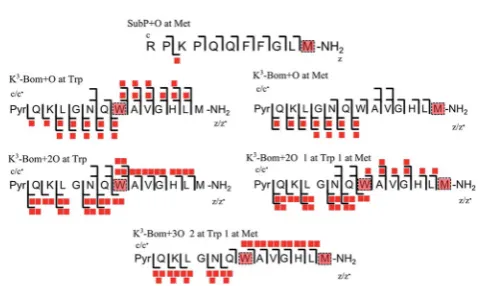
[image:3.595.308.549.528.688.2] [image:3.595.46.288.531.669.2]using FT-ICR-MS and ECD MS/MS (Fig. 4 and S5, Tables S8– S11†). Fragmentation maps revealed that oxidation of the peptides occurs at Met11 for SubP and Met14 and Trp8 for
K3-Bom. Methionine residues in both peptides can be oxidised
to the sulfoxide,47and further to sulfone species.48 However,
MS/MS shows that photoactivation of 1 in presence of the peptidesK3-Bom andSubPled only to the formation of
sulf-oxide species.
Both mono- and di-oxidisedK3-Bomspecies showed a two-product fragment distribution, relating to oxidation at Met14
or Trp8 for mono-oxidised species, and to single oxidation of
both Met14and Trp8residues, or double oxidation of Trp8for
di-oxidised species (Fig. 4, Tables S9–11, Fig. S5b–c†). [K3-Bom+3O+2H]2+species showed both oxidation at Met14and
double oxidation of Trp8 residues. Tryptophan oxidation is
known to give rise to a variety of side-chain modications, which are dependent of the nature of the oxidising agent.49,50
Hydroxy-tryptophan (HTRP) andN-formyl kynurenine(NFK) are
formed when the 5-membered indole ring of tryptophan is attacked by hydroxyl radicals, while kynurenine (KYN) and 3-hydroxy-kynurenine (3OH-KYN) arise from singlet oxygen-induced oxidation (Scheme 2). These reaction products have different mass changes compared to the original amino acid, and can be used to provide insights into the mechanism of the oxidation itself.50
UHR-FT-ICR MS spectra of1+K3-Bommixtures (Fig. 1b) and the corresponding MS/MS spectra (Fig. S2a–d†) show clearly
Fig. 5 EPR spectra showing the radicals trapped by DEPMPO during the photoactivation (with blue visible light) of (a)1(b)1+SubPand (c)
1+K3-Bom. Inset shows simulations of corresponding spectra and the structures of the spin-trapped azidyl radicals (a + b) and oxidised DEPMPO arising from attack by the high concentration of OH radicals producedviaphotoactivation of1withK3-Bom(c).52
Scheme 2 Possible oxidation products arising from 1O
2 (KYN and
3OH-KYN) and radical (HTRP and NFK) oxidation of a tryptophan side-chain50,51along with corresponding calculated mass changes for the modifications. Singlet oxygen induced processes are shown in red, while those induced by hydroxyl radical processes are shown in blue.
Fig. 4 Oxidised peptide species observed and fragmented by ECD MS/MS. Oxidative modifications (indicated by red squares) can be readily located on single amino acid residues (highlighted). Fully annotated tandem mass spectra can be found in the ESI (Fig. S5†).
Open Access Article. Published on 12 February 2018. Downloaded on 2/19/2019 4:31:21 PM.
This article is licensed under a
[image:4.595.46.289.283.426.2]that tryptophan oxidation leads to the formation of HTRP and NFK for the mono and di-oxidised species, respectively (+15.994915 Da and +31.989829 Da mass shis). This suggests that hydroxyl radicals are generated when1is photoactivated in the presence ofK3-Bom, and are responsible for the oxidation of
methionine and tryptophan residues. Electron transfer from an axial hydroxido ligand and an azido ligand to PtIVcan result in
retention of one N3ligand in the PtIIphoto-product (Fig. 1).
Detection of radicals
EPR was used to trap radicals generated during the photo-activation of1,1+SubP, and1+K3-Bom with DEPMPO as the
spin trap (Fig. 5, Table S12, Fig. S6†). Azidyl radicals were trapped during the photoactivation of complex1alone, and also from1+SubPmixtures. However, the EPR spectra obtained from irradiation of1+K3-Bommixtures were dramatically different.
Oxidised adducts of the DEPMPO trap were observed (DEPMPOX, Fig 5c). Such species can be formed by oxidation of DEPMPO-OH adducts,52and arising from the attack by hydroxyl
radicals. These studies therefore conrm that the photoreaction pathways for complex1can therefore not only involve electron transfer from azide ligand to PtIVbut also from an hydroxido ligand to form N3cand HOcradicals.
Effect of free tryptophan on peptide oxidation
Reaction mixtures containingSubP+1+L-TrpandK3 -Bom+1+L-Trp(mol ratio 2 : 1 : 0.13 (peptide : drug : Trp); 31mM Trp) were irradiated with blue light (463 nm) for 60 and 120 min, respectively, min and monitored by nESI-FT-ICR-MS (Table S13, Fig. S7†). Addition of Trp had little effect on the type of species produced and peptide platination observed in the photoreac-tion of SubP+1. However, Trp reduced the level of peptide oxidation by 29% and 95% for non-platinated and platinated-oxidised species, respectively. Trp affected more dramatically the photoreaction of K3-Bom+1 mixtures. Every oxidised and
platinated species was reduced in intensity (except [K3 -Bom+O]2+ and [K3-Bom+3O]2+) by 32–98%. This suggests that the Trp residue inK3-Bomitself could play a role in determining the extent of platination of the peptide.
Conclusions
These studies show for therst time that photoactivation of the diazido PtIV anticancer prodrug 1 can readily lead to a dual attack on peptide amino acids, either oxidation, or platination, or both. Additionally, the amino acid composition can have a dramatic effect on determining the course of the reactions. BothSubPandK3-Bomwere oxidised, platinated, and oxidised and platinated on photoactivation of complex1, but the nature of the bound photoproducts of1and the amino acid residues modied depend on the amino acid composition of the peptide. His12ofK3-Bomwas preferentially platinated, and both pyridine
ligands were retained in all the photoproducts observed, whereas forSubP, a different range of products was observed, and complex 1 released one or two pyridine ligands with apparent binding to Lys,3and Arg1residues. Photoactivation led
to the oxidation of specic sites in both peptides. For SubP
oxidation occurred only at Met,11 whereas for K3-Bom, up to
three stages of oxidation were observed: oxidation at Met14and
a single or double oxidation of the Trp8residue. This is therst
observation of Met and Trp oxidation by this class of photo-activatable platinum anticancer complexes. Trp modication yielded hydroxytryptophan (HTRP) and N-formylkynurenine (NFK) species (Scheme 2), indicating that hydroxyl radicals are responsible for the oxidative attack. Interestingly, oxidation of Trp to NFK is also a critical step in the biological production of NAD+. The dependence of radical generation on the nature of the peptide was further conrmed by EPR spin-trapping.
The role of tryptophan as a redox-active amino acid,53and
the formation of HTRP and NFK species suggest that radical-based processes might play an important role in the mecha-nism of action of this class of PtIVphotoactivated complexes. Such production of oxidative stress may provide some selectivity for attack on cancer cellsversusnormal cells, since cancer cells have malfunctioning mitochondria and are particularly susceptible to redox stress.54–56
Experimental
Substance P, [Lys]3-bombesin, and formic acid were purchased from Sigma Aldrich Company Ltd., Dorset, UK. Low concen-tration Agilent tuning mix was purchased from Agilent Tech-nologies (Santa Clara, CA). Complex 1 was synthesised and characterised as described elsewhere.6 EPR tubes were
purchased from Wilmad Labglass. The spin trap 5-(diethox-yphosphoryl)-5-methyl-1-pyrroline-N-oxide (DEPMPO) was ob-tained from Enzo Life Sciences in high purity. Ultra-pure water was obtained from a Milli-Q UV III system (Milli-Q, Hertford-shire, UK).
Reactions of peptides with 1
Aliquots of aqueous solutions of Substance P (1 mM) and [Lys]3 -Bombesin (1 mM) were mixed with an aqueous solution of1
(250mM) to give solutions of 0.5 : 1 drug : peptide mol ratio. The samples were then irradiated under 463 nm (blue visible) light at 298 K for various times, before being diluted to MS concen-trations (ca.1mM) and either analysed immediately or frozen at 80 C prior to MS analysis. Freshly prepared samples were compared to those frozen for one to several weeks and showed no observable variation in the mass spectra obtained. Reactions involving tryptophan were carried out using similar procedures as above together with the addition of aqueous tryptophan solution (1 mM) to peptide +1solutions to achieve a mol ratio of 0.5 : 1 : 0.125 (drug : peptide : tryptophan),i.e.concentration of tryptophan was 1/8thof drug concentration, as used previously by Butleret al.14
FT-ICR mass spectrometry
Nano-electrospray (nESI) mass spectrometry was performed on a Bruker SolariX Fourier Transform Ion Cyclotron Resonance Mass spectrometer (FT-ICR MS)tted with a 12 tesla actively shielded magnet (Bruker Daltonics, Bremen, Germany).
Open Access Article. Published on 12 February 2018. Downloaded on 2/19/2019 4:31:21 PM.
This article is licensed under a
Aqueous peptide samples (1mM) were spiked with 0.3% formic acid (v/v) to aid ionisation during nESI. Solutions containing1
(including reaction mixtures) were analysedvianESI in Milli-Q water with no added acid.
For ECD MS/MS analysis; the species of interest were isolated in therst quadrupole, externally accumulated in the collision cell for 0.1–7 s and then transferred to the innity cell for Electron Capture Dissociation (ECD) fragmentation and detec-tion. Ions in the innity cell were irradiated with 1.3–1.6 eV electrons from a 1.5 A hollow cathode dispenser for 50–600 ms prior to detection.
MS/MS spectra were internally calibrated using the minimal number of unmodied (peptide spectra) or modied (Pt adduct spectra) c/z ions and the charge reduced species [M +nH]n1+c where possible (species used for calibration are marked). A dual-spray nESI experiment was also conducted using the [K3 -Bom+2H]2+ion and ions from Agilent Tune mix, utilising an in-cell isolation (Multi-CHEF)57and identical ECD parameters to
validate the internal calibration of the MS/MS spectra. Similar standard deviations were found for the ECD fragmentation spectra when calibrated with either fragment ions or with tune-mix peaks (see ESI Fig. S8 and Table S14†). This dual-spray Multi-CHEF ECD approach was also used for some 1 + peptide reaction product ECD spectra to improve the internal calibration (spectra and calibration peaks marked accordingly).
Electron paramagnetic resonance (EPR)
EPR spectra were recorded at ambient temperature on a Bruker EMX (X-band) spectrometer tted with a cylindrical TM110 mode cavity (Bruker 4103TM). Samples were contained in a quartz capillary tube (I.D. 1.0 mm; O.D. 1.2 mm; Wilmad Labglass) sealed with T-Blu Tac®, placed inside larger quartz tubes (O.D. 2.0 mm) to achieve easy and accurate positioning of the sample inside the resonator. Typical key EPR spectrometer settings were modulation amplitude 2.0 G, microwave power 0.63 mW, 1.0 105 receiver gain, conversion time 81.92 ms,
time constant 81.92 ms, sweep width 200 G, and a repeated number of 10 X-scans with a resolution inYof 5 or 9. Spin-trapping experiments were performed on aqueous solutions of the complex with excess of spin trap (1 mM1, 6 mM DEPMPO) in the presence or absence of peptides (1 mM). A visible blue light emitting diode (LED,l¼463 nm, 64 mW cm2) was used as the source of irradiation and placed at a distance of 8.5 cm from the tube in the EPR cavity. Irradiations lasted up to 2 h, each slice corresponding to 14 min of irradiation (10 scans). The TM110 EPR cavity used is equipped with a grid on one side allowing optical access (ca., 50%) transmission. The refractive index of quartz is approximately 1.55; hence at normal inci-dence approximately 5% of the incident light is reected at an air quartz interface. EPR spectra were analysed and simulated using the EASYSPIN soware.58
UV-vis spectroscopy
Aqueous solutions of 1 (60 mM), SubP (120 mM), K3-Bom
(120mM),1(60mM) +SubP(120mM), and1(60mM) +K3-Bom
(120mM) were prepared and irradiated as above, then studied
using a Cary 300 scan UV-visible spectrophotometer (Agilent, California, US). Solutions were analysed in quartz cuvettes (0.5 mL, 1 cm path length), with scanning in the region of 200–800 nm at a rate of 10 nm s1 (600 nm min1), average
time¼0.1 s, data interval 1 nm.
Con
fl
icts of interest
There are no conicts to declare.
Acknowledgements
We thank the EPSRC Warwick Centre for Analytical Science (grant no. EP/F034210/1, and EP/J000302), the European Research Council (grant no. 247450), Bruker Daltonics, War-wick Collaborative Postgraduate Research Scholarships (WCPRS) and the Magnetic Resonance Centre (Warwick University) for EPR support. The authors also thank Mr Cookson K. C. Chiu for helpful discussions.
References
1 J. Pracharova, L. Zerzankova, J. Stepankova, O. Novakova, N. J. Farrer, P. J. Sadler, V. Brabec and J. Kasparkova,
Chem. Res. Toxicol., 2012,25, 1099–1111.
2 N. J. Farrer and P. J. Sadler,Aust. J. Chem., 2008,61, 669. 3 S. Betanzos-Lara, L. Salassa, A. Habtemariam, O. Novakova,
A. M. Pizarro, G. J. Clarkson, B. Liskova, V. Brabec and P. J. Sadler,Organometallics, 2012,31, 3466–3479.
4 K. S. Lovejoy and S. J. Lippard,Dalton Trans., 2009, 10651– 10659.
5 B. S. Howerton, D. K. Heidary, E. C. Glazer, D. K. Heidary and E. C. Glazer, 2012, 3–6.
6 N. J. Farrer, J. a. Woods, L. Salassa, Y. Zhao, K. S. Robinson, G. Clarkson, F. S. Mackay and P. J. Sadler,Angew. Chem., Int. Ed. Engl., 2010,49, 8905–8908.
7 S. B. Brown, E. A. Brown and I. Walker,Lancet Oncol., 2017,5, 497–508.
8 F. S. Mackay, J. A. Woods, H. Moseley, J. Ferguson, A. Dawson, S. Parsons and P. J. Sadler,Chemistry, 2006,12, 3155–3161.
9 A. F. Westendorf, J. A. Woods, K. Korpis, N. J. Farrer, L. Salassa, K. Robinson, V. Appleyard, K. Murray, R. Grunert, A. M. Thompson, P. J. Sadler and P. J. Bednarski,Mol. Cancer Ther., 2012,11, 1894–1904. 10 K. Deng, Z. L. Chen, X. P. Zhou, W. F. Wang, X. X. Yang and
J. Tian,Chin. J. Chem., 2008,26, 202–207.
11 F. S. Mackay, J. A. Woods, P. Heringov´a, J. Kasp´arkov´a, A. M. Pizarro, S. A. Moggach, S. Parsons, V. Brabec and P. J. Sadler,Proc. Natl. Acad. Sci. U. S. A., 2007,104, 20743– 20748.
12 P. J. Bednarski, F. S. Mackay and P. J. Sadler, Anti Canc. Agents Med. Chem., 2007,7, 75–93.
13 A. M. Pizarro and P. J. Sadler,Biochimie, 2009,91, 1198–1211. 14 J. S. Butler, J. A. Woods, N. J. Farrer, M. E. Newton and
P. J. Sadler,J. Am. Chem. Soc., 2012,134, 16508–16511. 15 L. Ronconi and P. J. Sadler,Chem. Commun., 2008, 235–237.
Open Access Article. Published on 12 February 2018. Downloaded on 2/19/2019 4:31:21 PM.
This article is licensed under a
16 C. M. Ryan, P. Souda, S. Bassilian, R. Ujwal, J. Zhang, J. Abramson, P. Ping, A. Durazo, J. U. Bowie, S. S. Hasan, D. Baniulis, W. a. Cramer, K. F. Faull and J. P. Whitelegge,
Mol. Cell. Proteomics, 2010,9, 791–803.
17 S. Yin and J. A. Loo,Int. J. Mass Spectrom., 2011,300, 118– 122.
18 F. Xu, Q. Xu, X. Dong, M. Guy, H. Guner, T. A. Hacker and Y. Ge,Int. J. Mass Spectrom., 2011,305, 95–102.
19 C. S. Allardyce, P. J. Dyson, J. Coffey and N. Johnson,Rapid Commun. Mass Spectrom., 2002,16, 933–935.
20 H. Li, T. Lin, S. L. Van Orden, Y. Zhao, M. P. Barrow, A. M. Pizarro, Y. Qi, P. J. Sadler and P. B. O'Connor,Anal. Chem., 2011, 9507–9515.
21 S. K. Weidt, C. L. Mackay, P. R. R. Langridge-Smith and P. J. Sadler,Chem. Commun., 2007,2, 1719–1721.
22 C. G. Hartinger, Y. O. Tsybin, J. Fuchser and P. J. Dyson,
Inorg. Chem., 2008,47, 17–19.
23 A. E. Egger, C. G. Hartinger, H. Ben Hamidane, Y. O. Tsybin, B. K. Keppler and P. J. Dyson,Inorg. Chem., 2008,47, 10626– 10633.
24 L. Messori, L. Cubo, C. Gabbiani, A. ´Alvarez-Vald´es, E. Michelucci, G. Pieraccini, C. R´ıos-Luci, L. G. Le´on, J. M. Padr´on, C. Navarro-Ranninger, A. Casini and A. G. Quiroga,Inorg. Chem., 2012,51, 1717–1726.
25 A. Casini, C. Gabbiani, E. Michelucci, G. Pieraccini, G. Moneti, P. J. Dyson and L. Messori,J. Biol. Inorg Chem., 2009,14, 761–770.
26 M. Groessl, Y. O. Tsybin, C. G. Hartinger, B. K. Keppler and P. J. Dyson,J. Biol. Inorg Chem., 2010,15, 677–688.
27 M. V. Babak, S. M. Meier, K. V. M. Huber, J. Reynisson, A. A. Legin, M. A. Jakupec, A. Roller, A. Stukalov, M. Gridling, K. L. Bennett, J. Colinge, W. Berger, P. J. Dyson, G. Superti-Furga, B. K. Keppler and C. G. Hartinger,Chem. Sci., 2015,6, 2449–2456.
28 Y. Lin, Y. Huang, W. Zheng, K. Wu, Q. Luo, Y. Zhao, S. Xiong and F. Wang,J. Inorg. Biochem., 2015,146, 44–51.
29 Y. Qi, Z. Liu, H. Li, P. J. Sadler and P. B. O'Connor,Rapid Commun. Mass Spectrom., 2013,27, 2028–2032.
30 C. A. Wootton, C. Sanchez-Cano, H.-K. Liu, M. P. Barrow, P. J. Sadler and P. B. O'Connor, Dalton Trans., 2015, 44, 3624–3632.
31 H. Li, T. Lin, S. L. Van Orden, Y. Zhao, M. P. Barrow, A. M. Pizarro, Y. Qi, P. J. Sadler and P. B. O. Connor,Anal. Chem., 2011,83, 9507–9515.
32 H. Li, Y. Zhao, H. I. A. Phillips, Y. Qi, T.-Y. Lin, P. J. Sadler and P. B. O'Connor,Anal. Chem., 2011,83, 5369–5376. 33 M. Wenzel and A. Casini,Coord. Chem. Rev., 2017,352, 432–
460.
34 R. Zubarev, N. L. Kelleher and F. W. McLafferty,J. Am. Chem. Soc., 1998,7863, 3265–3266.
35 R. A. Zubarev,Curr. Opin. Biotechnol., 2004,15, 12–16. 36 B. Ohlsson, N. Fredang and J. Axelson, Scand. J.
Gastroenterol., 1999,34, 1224–1229.
37 D. Singh, D. D. Joshi, M. Hameed, J. Qian, P. Gasc´on, P. B. Maloof, A. Mosenthal and P. Rameshwar,Proc. Natl. Acad. Sci. U. S. A., 2000,97, 388–393.
38 D. Gibson and C. E. Costello,Eur. J. Mass Spectrom., 1999,
510, 501–510.
39 T. Zhao and F. L. King,J. Am. Soc. Mass Spectrom., 2009,20, 1141–1147.
40 C. G. Hartinger, W. H. Ang, A. Casini, L. Messori, B. K. Keppler and P. J. Dyson,J. Anal. At. Spectrom., 2007,
22, 960.
41 N. Leymarie, C. E. Costello and P. B. O'Connor,J. Am. Chem. Soc., 2003,125, 8949–8958.
42 E. A. Syrstad and F. Turecek,J. Am. Soc. Mass Spectrom., 2005,
16, 208–224.
43 F. Turecek,J. Am. Chem. Soc., 2003,125, 5954–5963. 44 B. Ganisl and K. Breuker,ChemistryOpen, 2012,1, 260–268. 45 K. O. Zhurov, L. Fornelli, M. D. Wodrich, ¨U. a. Laskay and
Y. O. Tsybin,Chem. Soc. Rev., 2013,42, 5014–5030.
46 J. Pan, J. Han and C. H. Borchers,Int. J. Mass Spectrom., 2012,
325–327, 130–138.
47 E. R. Stadtman, H. Van Remmen, A. Richardson, N. B. Wehr and R. L. Levine,Biochim. Biophys. Acta, Proteins Proteomics, 2005,1703, 135–140.
48 A. N. Skvortsov, V. E. Zavodnik, A. I. Stash, V. K. Bel’skii and N. K. Skvortsov,Russ. J. Org. Chem., 2003,39, 170–175. 49 J. E. Plowman, S. Deb-Choudhury, A. J. Grosvenor and
J. M. Dyer,Photochem. Photobiol. Sci., 2013,12, 1960–1967. 50 E. L. Finley, J. Dillon, R. K. Crouch and K. L. Schey,Protein
Sci., 1998,7, 2391–2397.
51 S. W. Taylor, E. Fahy, J. Murray, R. a. Capaldi and S. S. Ghosh,J. Biol. Chem., 2003,278, 19587–19590. 52 J.-L. Cl´ement, B. C. Gilbert, A. Rockenbauer and P. Tordo,J.
Chem. Soc., Perkin Trans. 2, 2001, 1463–1470.
53 C. Shih, A. K. Museth, M. Abrahamsson, A. M. Blanco-Rodriguez, A. J. Di Bilio, J. Sudhamsu, B. R. Crane, K. L. Ronayne, M. Towrie, A. Vlcek, J. H. Richards, J. R. Winkler and H. B. Gray,Science, 2008,320, 1760–1762. 54 J. S. Carew and P. Huang,Mol. Cancer, 2002,1, 9.
55 K. F. Macleod, M. L. Boland, A. H. Chourasia and K. F. Macleod,Front. Oncol., 2013,3, 1–28.
56 M. L. Circu and T. Y. Aw,Free Radical Biol. Med., 2010,48, 749–762.
57 L. J. de Koning, N. M. M. Nibbering, S. L. van Orden and F. H. Laukien,Int. J. Mass Spectrom., 1997,165, 209–219. 58 S. Stoll and A. Schweiger,J. Magn. Reson., 2006,178, 42–55.
Open Access Article. Published on 12 February 2018. Downloaded on 2/19/2019 4:31:21 PM.
This article is licensed under a