Manuscript version: Author’s Accepted Manuscript
The version presented in WRAP is the author’s accepted manuscript and may differ from the published version or Version of Record.
Persistent WRAP URL:
http://wrap.warwick.ac.uk/108516
How to cite:
Please refer to published version for the most recent bibliographic citation information. If a published version is known of, the repository item page linked to above, will contain details on accessing it.
Copyright and reuse:
The Warwick Research Archive Portal (WRAP) makes this work by researchers of the University of Warwick available open access under the following conditions.
© 2018 Elsevier. Licensed under the Creative Commons Attribution-NonCommercial-NoDerivatives 4.0 International http://creativecommons.org/licenses/by-nc-nd/4.0/.
Publisher’s statement:
Please refer to the repository item page, publisher’s statement section, for further information.
Simultaneous Stabilization of Pb and Improvement of Soil Strength using nZVI 1
Abstract 2
This study demonstrates the feasibility of nanoscale Zero-Valent Iron (nZVI) for simultaneous 3
stabilization of Pb and improvement of soil strength via batch experiments. The soil samples 4
were prepared using slurry and pre-consolidation method at nZVI doses of 0.2%, 1%, 5%, and 5
10% (by dry weight). The physicochemical and geotechnical properties of Pb-contaminated 6
soil treated by nZVI were analyzed. The results indicate that the contamination of Pb(Ⅱ) 7
resulted in a notable reduction in the undrained shear strength of soil from 16.85 kPa to 7.25 8
kPa. As expected, the Pb in exchangeable and carbonate-bound fractions decreased 9
significantly with the increasing doses of nZVI. Meanwhile, the undrained shear strength of 10
Pb-contaminated soil enhanced substantially as the increase of nZVI, from 25.83 kPa (0.2% 11
nZVI treatment) to 69.33 kPa (10% nZVI treatment). An abundance of bubbles, generated from 12
the oxidation of nZVI, was recorded. The mechanisms for simultaneous stabilization of Pb and 13
soil improvement primarily include: 1) the precipitation and transformation of Pb-/Fe- hydrated 14
oxides on the soil particles and their induced bounding effects; 2) the increased drainage 15
capability of soil as the occupation of nZVI aggregates and bubbles in the macropores space 16
and 3) the lower soil density derived from the increase in microbubbles retained in the soil. 17
This study is provided to facilitate the application of nZVI in the redevelopment of 18
contaminated soil. 19
20
Keywords: nZVI; lead, contaminated soil; physicochemical property; undrained shear strength 21
1 Introduction 1
Nanoscale Zero-Valent Iron (nZVI) is a well-established nanoparticle that has been used 2
widely in the remediation of contaminated soil and groundwater (Bartke et al., 2018). The 3
purpose of using nZVI is to remove or to stabilize the pollutants so that to reduce the potential 4
threats caused by the pollutants to the ecology (Chen et al., 2017). Considerable endeavors have 5
been made to improve the efficiency of NZVI in field appplication, such as degradation of 6
various pollutants, mobility in subsurface, and revealing the fate and impacts of NZVI on 7
ecology (Huang et al., 2016; Vilardi et al., 2018). 8
Nevertheless, civil engineers consider both the pollutants and the injected nZVI as non-native 9
components of soil. Their concerns stem mainly from the geotechnical properties of remedied 10
contaminated soil because these properties are important in the follow-up construction on the 11
contaminated site or the reuse of contaminated soil, such as backfill at another site. The 12
introduction of nZVI and its derived removal of contaminants in soil could potentially disturb 13
the micro-structures of soil and lead to alteration of its geotechnical properties. This means that 14
the application of nZVI in remediation of contaminated site may pose potential threat to 15
serviceability, and reliability of a facility. Just like the ecological and human health risk posed 16
by contamination, the geoenvironmental risk may break out at some point in the future, 17
considering the high reactivity of nZVI and its long-term effect on the physicochemical 18
properties of soil (Clayton, 2001). Thus, it is significant to investigate the behavior and 19
mechanism of nZVI treatment in changing of geotechnical properties of soil. However, few 20
studies have thoroughly addressed the effects of nZVI in this regard. 21
Most authorities accept that chemical contaminants are capable of changing properties of soil, 22
either by directly changing the chemical or physical state of the soil, or through indirect changes, 23
such as influencing biological activity and groundwater, which in return, modifies its properties 24
(Ma et al., 2018; Xu et al., 2018). Rogers et al. (2004) found that the contamination of Pb2+ and 25
Fe3+ had a significant effect on the initiation and development of the lime-clay reactions during 26
both short-term modification and longer-term solidification. Dror et al. (2015) summarized that 27
chemical properties of pristine soils. Gil-Diaz et al. (2014) concluded that an immobilization of 1
Pb2+ and Zn2+ by nZVI posed no negative effects for physicochemical and biological properties 2
of soil. However, their researches did not reveal the changes in its geotechnical properties 3
associated with their physicochemical counterpart, such as the shear strength of the soil which 4
is the most important parameter in the design of civil engineering projects, neither did it reveal 5
the mechanism of the effects. The reader should note that the changes in physicochemical and 6
biological properties of soil do not always result in significant changes in the its geotechnical 7
properties. For instance, Cuisinier et al. (2011) reported that no evidence showed any impact of 8
chloride on the geotechnical behavior of their tested soils. Nasehi et al. (2016) performed an 9
investigation of the effects of nZVI and nanoscale hydrated lime on the geotechnical 10
characteristics of a diesel-contaminated soil. They suggested that the introduction of nZVI to 11
the diesel-contaminated soil led to an increase in Unconfined Compressive Strength (UCS), 12
maximum dry density, optimum water content, and shear strength parameters. Nevertheless, 13
the mechanism of nZVI in soil improvement remains ambiguous given that oxidation, 14
adsorption, and precipitation may be involved in the removal of diverse contaminants. 15
This study is an investigation of the stabilization of lead by nZVI in a clayey soil and its 16
effects on the geotechnical properties of soil. Particularly, lead (Pb), a heavy metal of well-17
known toxicity, prevalence and responsible for liver and kidney damage, anemia, infertility, 18
and mental retardation among other consequences, is employed as an artificial contaminant 19
(Huang et al., 2018). Different doses of nZVI were added to the Pb-contaminated soil. The 20
mobilization effect on lead ions, physicochemical characterization, and shear strength of the 21
soil were examined to analyze the effects of nZVI on the physicochemical and geotechnical 22
properties of the Pb-contaminated earth. The results of this study can facilitate the application 23
of nZVI in the remediation of contaminated sites where remedied soil will be used as backfill, 24
such as remediation of brownfield and dredged sediment. 25
2 Methodology 26
The researcher collected the soil samples from a construction site in Areia Preta, Macau 1
(N22°12'35.84", E113°33'27.96"). According to the Unified Soil Classification System (USCS, 2
ASTM D2487-17), the Atterberg limits of the preconcerted soil were found to be 61, 32, and 3
29 for the liquid limit, plastic limit, and plasticity index respectively. The particle size 4
distribution, when analyzed by the Malvern Particle Size Analyzer indicated that the D60, D30, 5
and D10 values were 8.5, 3.08, and 1.01 mm respectively. The soil was classified as MH: silt 6
with high plasticity. 7
The slurry and pre-consolidation method was employed to prepare the soil samples 8
(Choudhary et al., 2016). Firstly, the soil was first cut into small chunks and immersed in 9
distilled water for two days, after which the soil fractions were passed through a No. 16 sieve 10
(1 mm opening) to achieve a soil slurry. The water content of the obtained slurry was increased 11
up to twice of the liquid limit with vivid agitation for approximately 10 minutes to obtain a 12
homogeneous state. Subsequently the slurry (approximately 17 kg for each) was subjected to 13
pre-consolidation in a container under an overburden pressure of 200 kPa (Indraratna and 14
Redana, 1998). When the settlement of pre-consolidation was stable (usually took two weeks), 15
soil samples with a height of 84 mm and diameter of 38 mm were trimmed. 16
For the preparation of Pb-contaminated soil, artificial pollutant of lead nitrate (Pb(NO3)2) 17
(AR, powder solid state) at the lead mass ratio of 400 mg/kg (dry soil mass) was added to the 18
soil slurry (the weight of the soil slurry was approximately 120 kg). To achieve a homogeneous 19
state, the spiked soil slurry was mechanically stirred for approximately 10 mins. Then, the 20
spiked slurry was matured for two weeks to achieve equilibrium of adsorption and desorption 21
prior to pre-consolidation or further treatment. As for the preparation of nZVI treated soil 22
samples, 0.2%, 1%, 5%, and 10% (mass ratio of nZVI to the spiked dry soil) nZVI were added 23
respectively to the aged Pb-spiked soil slurry and agitated vividly prior to pre-consolidation. 24
The nZVI was supplied by Shanghai Xiangtian Nano Materials Co., LTD. The average diameter 25
of nZVI used in this study was about 50 nm, with a specific area of 30 m2/g (provided by the 26
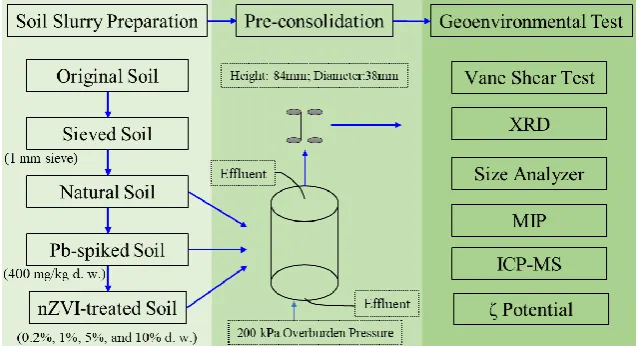
Figure 1 summarizes the experimental procedure. For all the natural, Pb-contaminated and 1
nZVI treated soil samples, sequential extraction procedure, shear strength tests, and 2
characterization were carried out to investigate the mechanism of the effect of nZVI treatment 3
on the physicochemical and geotechnical properties of the treated clayey soil. 4
2.3 Shear Strength of Soil 5
The Laboratory Vane Shear Test (Wykeham Farrance, 27-WF1730) was conducted to 6
evaluate the undrained shear strength of the soil samples, as per the Standard Test Method for 7
Laboratory Miniature Vane Shear Test for Saturated Fine-Grained Clayey Soil (American 8
Society for Testing Material, ASTM D4648/D4648M-13). Particularly, two kinds of vane blade 9
with the same width of 12.7 mm, yet the different heights of 19 mm and 12.7 mm were 10
employed. The rotation rate of the vane during testing was maintained at approximately 6o/min. 11
2.4 Characterization and Testing 12
The mineralogy of the soil was characterized by X-ray diffraction (XRD) on Rigaku 13
Smartlab (anode Cu, in configuration θ/2θ, with an acceleration tension of 45 kV and a current 14
of 200 mA), at a scanning rate of 2.0 °/min. Prior to the XRD test, the soil samples were 15
smashed and crushed into soil chip with a thickness of approximately 0.5 mm after freeze 16
drying for 24 h. The pore structure characteristics of the soil were quantitatively described by 17
Mercury Intrusion Porosimetry (MIP) using a Mercury Porosimeter AutoPore IV 9510 18
(Micromeritics Instruments Co., USA). Before the MIP measurements, the soil samples were 19
dried using the vacuum freeze-drying method for 24 hours. Washburn’s equation was involved 20
to calculate the relationship between the mercury pressure and pore structure characteristics 21
(Abell et al., 1999). The soil particle size distribution was characterized by a laser particle size 22
analyzer (Malvern, Mastersizer 3000) in distilled water solution, assisted by the continuous 23
ultrasound dispersion (40W, 40kHz) and electric mixing (3000 rpm). 24
The availability of Pb in soil samples was analyzed after applying the Modified Sequential 25
Extraction Procedure proposed by Tessier et al. (1979) using Inductively Coupled Plasma Mass 26
Spectrometry (ICP-MS, Agilent 7700X). Soil pH was measured according to the International 27
samples was analyzed by Analytik Jena (Multi N/C 3100 and 1300) after undergoing air drying 1
at 35 °C for 12 hours. Zeta potential and electrical conductivity of soil samples were collected 2
by a zeta potential analyzer using phase analysis light scattering (Brookhaven ZetaPALS) at a 3
soil concentration of 1g/L in distilled water. 4
3 Results and Discussion 5
3.1 Phenomenon and Theory 6
Changes of physicochemical and geotechnical properties of soil are invariably associated 7
with the microscopic change of the soil body. In this study, the specific behavior occurred 8
during the preparation of the soil sample which was recorded to examine the effect of nZVI on 9
the geotechnical properties of soil. 10
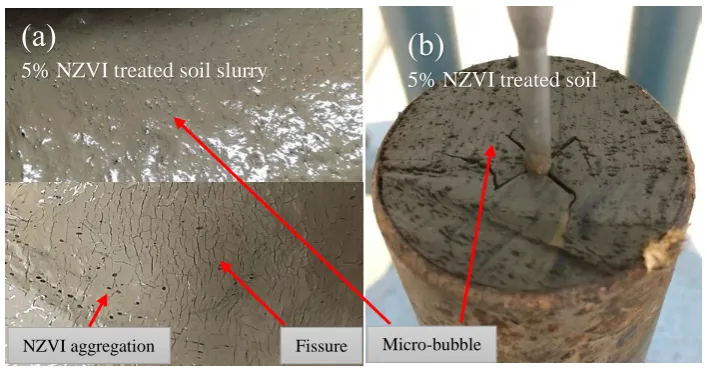
In this study, a mass of bubbles with a size of a few micrometers was observed in the soil 11
slurry after nZVI treatment (before pre-consolidation), as shown in Figure 2. Accordingly, a 12
copious quantity of microbubble prints remained in the soil sample following said process, as 13
shown in Figure 2 (c). For all nZVI-treated soil samples, the phenomena of nZVI aggregations 14
was detected in the wake of acute agitation of the soil slurry and nZVI. The appearance of 15
micro-bubbles and fissures intensified when the dose of nZVI was increased. 16
This specific phenomenon provides unequivocal evidence of the interaction between nZVI 17
and the clay slurry. In fact, this is reasonable because the nanosized Fe0 exhibited a markedly 18
increased extent of corrosion under both the anaerobic and aerobic conditions (Reardon, 1995; 19
Reardon et al., 2008). In an aerobic condition, nZVI is easily oxidized to ferrous iron, with 20
protons being consumed in the process (Li et al., 2006): 21
2𝐹𝑒(𝑠)0 + 4𝐻(𝑎𝑞)+ + 𝑂2(𝑎𝑞)→ 2𝐹𝑒(𝑎𝑞)2+ + 2𝐻2𝑂(𝑙) (1) 22
When oxygen is exhausted or in the absence of oxygen, fresh nZVI tends to experience a 23
rapid oxidation phase upon entering the aqueous phase: 24
𝐹𝑒(𝑠)0 + 2𝐻2𝑂(𝑎𝑞)→ 𝐹𝑒(𝑎𝑞)2+ + 2𝑂𝐻 ·𝑎𝑞+ 𝐻2(𝑔) (2)
25
In this reaction (2), two molecules of water are consumed for every mole of iron corroded. 26
In addition to the ferrous ions and hydrogen gas, hydroxyl ions are also generated which will 1
increase the media pH, while hydrogen ions are consumed. Moreover, if oxygen is sufficient in 2
the slurry, ferrous ions will undergo further oxidative transformation to become ferric ions until 3
the oxygen is exhausted (Lefevre et al., 2016): 4
2𝐹𝑒(𝑎𝑞)2+ + 4𝐻(𝑎𝑞)+ + 𝑂2(𝑎𝑞)→ 2𝐹𝑒(𝑎𝑞)3+ + 2𝐻2𝑂(𝑙) (3)
5
2𝐹𝑒(𝑎𝑞)2+ + 2𝐻2𝑂(𝑎𝑞)→ 2𝐹𝑒(𝑎𝑞)3+ + 2𝑂𝐻(𝑎𝑞)− + 𝐻2(𝑔) (4)
6
Continued corrosion of iron and generation hydroxyl ions lead to saturation and precipitation 7
of Fe(OH)2 on the soil particles in the slurry, itself a relatively insoluble solid phase. In the 8
absence of oxygen (or anoxic conditions) and at low temperatures, Fe(OH)2, is controlled by 9
the pH value of the system but is predicted thermodynamically to convert to magnetite or other 10
iron minerals (Liu et al., 2015): 11
3𝐹𝑒(𝑂𝐻)2(𝑠)→ 𝐹𝑒3𝑂4(𝑠)+ 2𝐻2𝑂(𝑙)+ 𝐻2(𝑔) (5)
12
Based on the previously stated theoretical foundation, the speculated is that iron minerals are 13
formed from ferrous and ferric ions in the aqueous phase of the soil slurry and may precipitate 14
on the soil particles and subsequently bond them together, with nZVI aggregates centralized. 15
Clearly, these micro-bubbles are generated primarily from the oxidation of nZVI in the aqueous 16
phase and are retained in the soil sample. In addition to that, the nitrogen and carbon dioxide, 17
generated by the reduction of nitrate by nZVI and oxidation of natural organic matters in soil, 18
respectively, may also contribute partially to the generation of micro-bubbles (Vilardi and Di 19
Palma, 2017; Vilardi et al., 2017, 2018). The increased the drying shrinkage occurred due to 20
the reduced water content lead to the occurrence of massive fissures grown on the surface of 21
nZVI-treated soil slurry. 22
3.2 Microstructure 23
A laser particle size analyzer was used to quantify the physical changes of soil particle size, 24
as demonstrated in Figure 3. In all cases, the soil particles stuck together in anomalous clumps 25
after undergoing pre-consolidation in the container, with the particle sizes varying from 400 26
of soil particles by lead nitrate led to an increase in clay and silt clay fractions, which reduced 1
the average size of soil particles. Analogously, the introduction of nZVI resulted in a significant 2
decrease in the size of nZVI treated soil particles. The particle size gravitated toward a 3
decreasing value with increasingly large doses of nZVI. The thinking is that the oxidation and 4
the subsequent growth of iron particles from the nano-level to micron level instigated the 5
reduction in particle size. For the 10% nZVI-treated soil sample, the sand fraction in the soil 6
went up to 16%. Such increase can be ascribed to the prevailing of the increased pozzolanic-7
like reaction of the nZVI-induced iron minerals’ precipitation among the soil particles (Nasehi 8
et al., 2016). 9
As already noted, a mass of microbubbles and residual bubble prints were observed. They 10
were generated primarily from the oxidation of nZVI in the aqueous phase, as well as the 11
reduction of nitrate. Actually, for the remediation of the contaminated site by the injection of 12
chemical remediation materials, bubbles are the common coproducts during the mineralization 13
of contaminants, such as those involved in In-situ Chemical Oxidation (ISCO) using hydrogen 14
peroxide (H2O2), Micro-Nano Bubbles (MNBs) and persulfate (Liu et al., 2014). Soil pore 15
characteristics, including the total volume, size distribution, and shape of soil pore spaces are 16
important indicators that determine workability and friability of soil (Munkholm et al., 2016; 17
Obour et al., 2017). However, little is known about the link between remediation-derived soil 18
pore characteristics, and physicochemical and geotechnical properties of soil. 19
To improve the understanding of bubbles and their effect on the geotechnical properties of 20
soil, its pore structure characteristics were quantitatively described by MIP, as shown in Figure 21
4 and Table 1. The results indicate that the pore size diameter of all soil samples mainly ranged 22
from 10 nm to 10 um, which can be classified as mesopore (2-50 nm) and macropore (> 50 nm) 23
(Anovitz and Cole, 2015). The introduction of lead nitrate resulted in an evident increase of 24
average pore diameter, which is in accordance with its appearance (as shown in Figure 2a). 25
When the amount of added nZVI was 0.2% in the mass ratio of dry soil (Pb-contaminated soil), 26
the average pore diameter mushroomed from 90.4 nm to 178.4 nm. Accordingly, a sharp drop 27
decreased, with a corresponding increase in total pore area. Furthermore, the increase in nZVI 1
was met with a reduction in the amount of macropores (>50 nm) and a rise in mesopores (2-50 2
nm). The 10% nZVI-treated soil samples held the highest total pore area. On the other hand, 3
along with the decrease in the amount of macropores and the increase in mesopores, both the 4
density and porosity of nZVI-treated soil samples gradually increased. However, the 0.2% 5
nZVI treated soil samples presented the lowest values of density and porosity among all the 6
samples, while the10% nZVI treated soil sample showed a tiny drop in the values of density 7
and porosity. The speculated theory is that a dynamic equilibrium exists between the decrease 8
in macropores space caused by the occupation of nZVI aggregates and the increase in 9
microbubbles retained in the saturated soil (Soares et al., 2018). 10
3.3 X-ray Diffraction (XRD) 11
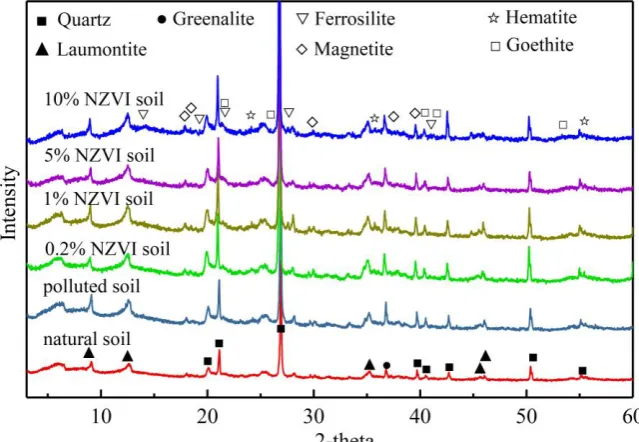
The X-ray diffraction (XRD) patterns of the soil samples are displayed in Figure 5. The 12
selected soil was composed primarily of quartz (PDF#85-1054, ICSD Minerals), laumontite 13
Ca4(Al8Si16O48(H2O)18 (PDF#80-0150, ICSD Minerals), and greenalite Fe6Si4O10(H2O)18 14
(PDF#72-0177, ICSD Minerals). The main characteristic peaks revealed a slight discordance 15
among the soil samples, implying that distortion occurred in the lattice of minerals after the 16
introduction of nZVI. The assumption is that the frameworks of certain mineral crystals were 17
doped by Fe(Ⅱ), Fe(Ⅲ), and Pb(Ⅱ) of larger atomic radius, resulting in the appreciable changes 18
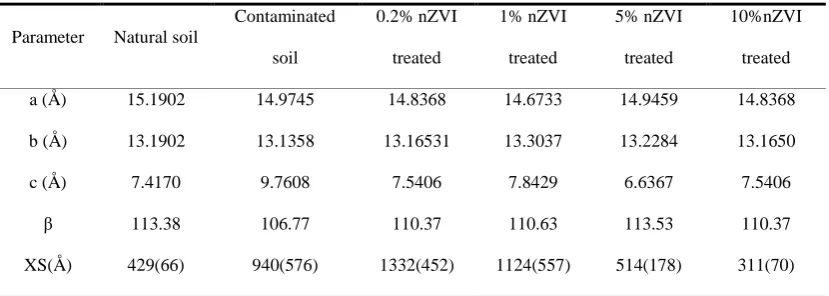
in lattice parameters (Castaldi et al., 2008), as shown in Table 2. Lattice parameters of 19
laumontite mineral in the soil samples altered irregularly with the introduction of lead nitrate 20
as well as the nZVI. A minute difference in weak characteristic peaks can be perceived at 2-21
Theta of 17.8°, 27.6°, 35.7°, and 36.6°, which can be credited to the iron mineral crystals of 22
magnetite Fe3O4 (PDF#89-0950), ferrosilite FeSiO3 (PDF#76-0887, ICSD Minerals), hematite 23
Fe2O3 (PDF#85-0987, ICSD Minerals), and goethite FeOOH (PDF#81-0464) respectively 24
(Huang et al., 2013). The presence of deuterogenic and different iron minerals will constitute 25
the highly-disordered multilayer of amorphous core shell construction on the surface of nZVI 26
and soil particles with a thickness of approximately several nanometers (Arancibia-Miranda et 27
For the nZVI in the oxidation system, on the one hand, the reduction of Pb2+ will be 1
suppressed because of isolation resulting from the multilayer core shell construction (Xue et al., 2
2018). On the other hand, the corrosion byproducts can greatly promote the co-precipitation 3
and adsorption of Pb2+ and improve the stabilization capability of nZVI. However, the 4
characteristic peaks associated with reduced lead and related lead oxides were not clearly 5
presented in the diffractogram of nZVI-treated soil samples, which may have been a 6
consequence of 1) the Pb being of a trace amount in the soil, as well as 2) the crystalline 7
structures of reduced lead and related lead oxides being amorphous. 8
3.4 Metal Immobilization 9
Because heavy metals do not undergo microbial or chemical degradation, the total 10
concentration of these metals persists for a long time after their introduction in soils. The 11
ecological toxicities of heavy metals in soil are primarily controlled by their available fraction 12
because they are readily mobile and bioavailable within the environment and can potentially be 13
taken up by plant roots to enter the food chain (Hou et al., 2013; Roy and Mcdonald, 2015). In 14
this sense, the immobilization of heavy metals in soil offers a promising strategy for achieving 15
the redistribution of contaminants from the solution phase to more geochemically stable phases, 16
thereby reducing their bioavailability and transportation in the environment (Bolan et al., 2014). 17
Many studies have demonstrated the excellent immobilization capacity of nZVI for various 18
heavy metal ions, in both soil and groundwater (Gil-Díaz et al., 2017). The widely accepted 19
thinking is that the mechanism of nZVI for immobilization of Pb in an aqueous system is 20
controlled by a sorption process, reduction of Pb2+ to Pb0, and (co)precipitation (Wang et al., 21
2016; Gil-Diaz et al., 2017). 22
In this study, the effects of nZVI on the immobilization of Pb in soil samples were examined 23
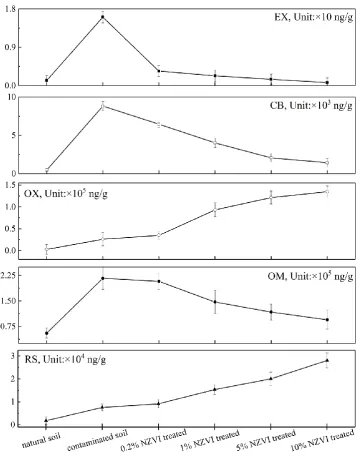
by comparing the distribution of lead in different soil fractions. Figure 6 displays the 24
concentration distribution tendency of the quantity of lead retained in the soil samples. With 25
the introduction of lead nitrate, the lead in the exchangeable (EX), carbonate-bound (CB), 26
organic matter-bound (OM), and the residual (RS) fractions increased significantly, compared 27
EX and CB, was evidently decreased by the introduction of nZVI. Then increasing in the nZVI 1
amount, a diminishing concentration in the EX, CB, and OM fractions was observed. These 2
more easily available fractions have higher leachability and bioaccessibility than others 3
(Alloway, 2013; Zong et al., 2016). Thus, the application of nZVI can effectively immobilize 4
the lead in soil and lower the risk to humans and environmental organisms. By contrast, the 5
lead in Fe/Mn oxides-bound and residual fractions increased when nZVI added. This was 6
reasonable because of the increase in irons, and part of Fe/Mn oxides-bounded lead converted 7
to a more strongly bound complex. Moreover, part of this decomposition of organics, resulting 8
from the introduction of nZVI, may lead to a descending concentration of lead in the organic-9
bound fraction, as shown in Table 1, and subsequently, an increased lead concentration in other 10
fractions. In all cases, most of the volume of lead was bound by organic matter and Fe/Mn 11
oxides, followed by a residual fraction, exchangeable fraction, and carbonate-bound fractions. 12
3.5 Undrained Shear Strength 13
To reveal the variations and features of geotechnical properties of soil, as a consequence of 14
contamination and remediation, was the main objective of this study. In the interests of 15
evaluating the effects of nZVI on the geotechnical properties of soil, undrained vane shear 16
strength (Su) was investigated. The shear strength of a soil is defined as the maximum shear
17
stress that it can sustain under loading (Türkel, 2007). According to Stavi et al. (2016), the 18
moisture content of a soil is a crucial parameter in controlling the shear strength of clays. Figure 19
7 shows the results of vane shear strength together with the corresponding moisture content. 20
The results indicate that the Suof natural soil dropped sharply after the introduction of lead
21
nitrate, from 16.82 kPa to 7.25 kPa. Correspondingly, the moisture content increased from 22
50.78% to 56.89%. Meanwhile, the zeta potential of soil dropped analogously from -16.14 mV 23
to -6.31 mV (Table 1), pointing to a notable decrease in soil stability. This phenomenon may 24
be another signal that explains the obvious decrease of Su.
25
On a positive note, the Su of Pb-contaminated soil was improved remarkably when treated
26
with nZVI. Figure 6 shows us that even the 0.2% amount of nZVI can strengthen the soils’ 27
undrained shear strength from 7.25 kPa to 25.38 kPa. The Suof soil was increased with the rise
in nZVI, but the acceleration rate decreased when the mass ratio of nZVI to dry soil was 10%. 1
Correspondingly, the moisture content of soil exhibited a negative trend to the Suwhen the dose
2
of nZVI treatment was increased from 0.2% to 5%. That is, the soil moisture content decreased 3
with the increasing doses of nZVI. This can be presumably ascribed to the padding of nZVI 4
and its volume expansion by oxidation in the soil pore, which resulted in an extrusion of the 5
water. However, an unexpected situation for the 10% nZVI-treated soil was that a soaring of 6
its moisture content to 55.77%, along with further enhancement of the Suof the soil sample up
7
to 69.33 kPa, was recorded. This can be put down to being a consequence of the changes in 8
both soil constituent and structure. On the one hand, the addition of 10% nZVI is at a high 9
percentage load with the forceful capacity of oxidation reaction to change the soil constituent 10
(Gil-Diaz et al., 2014); the increased water holding capacity can be partially attributed to the 11
generation of iron oxide-hydroxides such as ferrihydrite (Fe5HO8·4H2O), schwertmannite 12
(Fe8O8(OH)6(SO)·nH2O), and goethite (α-FeOOH) (Velimirovic et al., 2018; Zhang et al., 13
2016). On the other, an increase in microbubbles enabled itself to readily adsorb moisture and 14
humidity (Lawrence and Jiang, 2017). Luxurious nZVI may give rise to a hardened soil, making 15
it difficult to drain under the consolidation pressure of 200 kPa and thus contributing to an 16
exceptionally high moisture retaining capacity (Burgess et al., 2016). Furthermore, with regard 17
to the microbubbles and their bubble prints in the soil samples, the presumption was that these 18
micron-level bubble-prints were the residual channeled network of voids for the drainage 19
boundary (Acharya et al., 2015). However, the density and porosity of nZVI-treated soil 20
decreased synchronously. The changes of the soil components by nZVI treatment can be 21
responsible for this abnormal condition. As a rule, low density of a soil is usually associated 22
with low strength (Lawrence and Jiang, 2017). Because of the consuming oxidation of nZVI in 23
the soil, the Pb-contaminated soil turned out to be lightened and firmed. 24
Based on these above discussions, the conclusion can be drawn that the application of nZVI 25
can simultaneously stabilize Pb and improve the soil strength in the short-term, as a result of 26
which it can lower the risks involved in geotechnical engineering (Griffiths et al., 2012). The 27
undrained shear strength can be primarily assigned to the precipitation and transformation of 1
nZVI-induced iron minerals on the soil particles and their bonding together. 2
4 Conclusion 3
The application of nZVI in treating subsurface contaminants should be considered carefully 4
because their intrusion may lead to the changes of geotechnical properties of soil, ultimately 5
inducing potential geoenvironmental risks. In this study, the author investigated the effects of 6
nZVI on the immobilization of lead and the undrained shear strength of soil. The results indicate 7
that the introduction of Pb(Ⅱ) in the natural soil resulted in a visible reduction in shear strength 8
from 16.85 kPa to 7.25 kPa. 9
On a positive note, with the increasing doses of nZVI from 0.2% to10% (dry weight), the 10
shear strength of lead-contaminated soil substantially increased from 25.83 kPa to 69.33 kPa. 11
Moreover, increased dose of nZVI generally lead to increases in particle size (larger than 0.063 12
mm), amount of mesopore (2-50 nm), and decreases in the amount of macropore (>50 nm), 13
moisture content and Pb bound to exchangeable and carbonate fractions. The oxidation of nZVI 14
in the soil slurry gave rise to abundant micro-fissures, and bubbles equally appeared in the soil 15
slurry and were retained in the soil samples, leaving bubble prints. The mechanisms for 16
simultaneous stabilization of Pb and soil improvement can be primarily ascribed to the 17
precipitation and transformation of Pb-/Fe- hydrated oxides on the soil particles and their 18
induced bounding effects. Moreover, the increased drainage capability of soil as the occupation 19
of nZVI aggregates and bubbles retained in the soil also contributed to the soil improvement. 20
Although nZVI aggregations were evident in the soil slurry, the feasibility of nZVI for 21
simultaneous stabilization of Pb and improvement of soil strength is here confirmed. With 22
respect to the wide application of nZVI and the follow-up infrastructure construction on the 23
contaminated site (such as brownfields), the results of this study can facilitate the remediation 24
of metals-contaminated soil and recovery of contaminated soil for civil engineering. However, 25
the long-term effect of nZVI treatment on the geotechnical properties of soil and structural 26
stabilities should be revealed in future study. 27
The authors wish to thank financial supports from the Macau Science and Technology 1
Development Fund (FDCT) (Code: 125/2014/A3), the University of Macau Research Fund 2
(MYRG2015-00112-FST), Shenzhen Peacock Plan (KQTD2016022619584022), Shenzhen 3
basic research plan (JCYJ20160429191638556), and Guangdong Provincial Key Laboratory of 4
Soil and Groundwater Pollution Control, Southern University of Science and Technology. 5
Reference 6
Abell A. B., Willis K. L., Lange D. A., 1999. Mercury Intrusion Porosimetry and Image Analysis of 7
Cement-Based Materials. Journal of Colloid & Interface Science. 211(1), 39-44. 8
https://doi.org/10.1006/jcis.1998.5986. 9
Acharya M. P., Hendry M. T., Martin C. D., 2015. Effect of gas bubbles on pore pressure response in 10
peat beneath a rail. Canadian Geotechnical Journal. 53(5), 765-772. https://doi.org/10.1139/cgj-11
2015-0122. 12
Alloway B. J., 2013. Sources of Heavy Metals and Metalloids in Soils. In: Alloway BJ, editor. Heavy 13
Metals in Soils: Trace Metals and Metalloids in Soils and their Bioavailability. Springer Netherlands, 14
Dordrecht. 11-50. https://doi.org/10.1007%2F978-94-007-4470-7_2. 15
Anovitz L. M., Cole D. R., 2015. Characterization and Analysis of Porosity and Pore Structures. Reviews 16
in Mineralogy & Geochemistry. 80, 61-164. http://doi.org/10.2138/rmg.2015.80.04. 17
Arancibia-Miranda N., Baltazar S. E., Garcia A., Romero A. H., Rubio M. A., Altbir D., 2014. Lead 18
removal by nano-scale zero valent iron: Surface analysis and pH effect. Materials Research Bulletin. 19
59, 341-348. http://doi.org/10.1016/j.materresbull.2014.07.045. 20
ASTM D4648/D4648M-16, 2016. Standard Test Methods for Laboratory Miniature Vane Shear Test for 21
SaturatedFine-Grained Clayey Soil. ASTM International, West Conshohocken, PA. 22
http://doi.org/10.1520/D4648_D4648M-16. 23
ASTM D2487-17, 2017. Standard Practice for Classification of Soils for Engineering Purposes (Unified 24
Soil Classification System). ASTM International, West Conshohocken, PA. 25
http://doi.org/10.1520/D2487-17. 26
Bartke S., Hagemann N., Harries N., Hauck J., Bardos P., 2018. Market potential of nanoremediation in 27
Europe-Market drivers and interventions identified in a deliberative scenario approach. Science of 28
The Total Environment. 619, 1040-1048. http://doi.org/10.1016/j.scitotenv.2017.11.215. 29
Bian R., Cheng K., Zheng J., Liu X., Liu Y., Li Z., et al., 2015. Does metal pollution matter with C 30
retention by rice soil? Scientific reports. 5, 13233. http://doi.org/10.1038%2Fsrep13233. 31
Bolan N., Kunhikrishnan A., Thangarajan R., Kumpiene J., Park J., Makino T., et al., 2014. Remediation 32
of heavy metal(loid)s contaminated soils – To mobilize or to immobilize? Journal of Hazardous 33
Materials. 266, 141-166. https://doi.org/10.1016/j.jhazmat.2013.12.018. 34
Burgess D. T., Kettler R. M., Loope D. B., 2016. The Geologic Context of Wonderstone: A Complex, 35
Outcrop-Scaled Pattern of Iron-Oxide Cement. Journal of Sedimentary Research. 86(5), 498-511. 36
Castaldi P., Santona L., Enzo S,. Melis P., 2008. Sorption processes and XRD analysis of a natural zeolite 1
exchanged with Pb2+, Cd2+ and Zn2+ cations. Journal of Hazardous Materials. 156, 428-434.
2
https://doi.org/10.1016/j.jhazmat.2007.12.040. 3
Chen A., Shang C., Shao J., Zhang J., Huang H., 2017. The application of iron-based technologies in 4
uranium remediation: A review. Science of The Total Environment. 575, 1291-1306. 5
https://doi.org/10.1016/j.scitotenv.2016.09.211. 6
Choudhary K., Indraratna B., Rujikiatkamjorn C., 2016. Pore pressure based method to quantify smear 7
around a vertical drain. Géotechnique Letters 6(3), 1-5. https://doi.org/10.1680/jgele.16.00065. 8
Cuisinier O., Le Borgne T., Deneele D., Masrouri F., 2011. Quantification of the effects of nitrates, 9
phosphates and chlorides on soil stabilization with lime and cement. Engineering Geology. 117, 229-10
235. https://doi.org/10.1016/j.enggeo.2010.11.002. 11
Clayton, C. R. I., 2001. Discussion: Managing geotechnical risk: time for change? Geotechnical 12
Engineering. 155(1), 79-80. https://doi.org/10.1680/geng.2001.149.1.3. 13
Dror I., Yaron B., Berkowitz B., 2015. Abiotic soil changes induced by engineered nanomaterials: A 14
critical review. Journal of Contaminant Hydrology. 181, 3-16. 15
https://doi.org/10.1016/j.jconhyd.2015.04.004. 16
Fridriksson T., Bish David L., Bird Dennis K., 2003. Hydrogen-bonded water in laumontite I: X-ray 17
powder diffraction study of water site occupancy and structural changes in laumontite during room-18
temperature isothermal hydration/dehydration. American Mineralogist. 88(2-3), 277–287. 19
http://dx.doi.org/10.2138/am-2003-2-304. 20
Gil-Díaz M., Alonso J., Rodríguez-Valdés E., Gallego J. R., Lobo M. C., 2017. Comparing different 21
commercial zero valent iron nanoparticles to immobilize As and Hg in brownfield soil. Science of 22
The Total Environment; 584, 1324-1332. https://doi.org/10.1016/j.scitotenv.2017.02.011. 23
Gil-Diaz M. M., Perez-Sanz A., Vicente M. A., Lobo M. C., 2014. Immobilisation of Pb and Zn in Soils 24
Using Stabilised Zero-valent Iron Nanoparticles: Effects on Soil Properties. Clean-Soil Air Water. 25
42, 1776-1784. https://doi.org/10.1002/clen.201300730. 26
Griffiths D. V., Huang J., Fenton G. A., 2012. Risk assessment in geotechnical engineering: Stability 27
analysis of highly variable soils. Geotechnical Special Publication. 90(226), 78-101. 28
https://doi.org/10.1061%2F9780784412138.0004. 29
Hou D., He J., Lü C., Ren L., Fan Q., Wang J., et al., 2013. Distribution characteristics and potential 30
ecological risk assessment of heavy metals (Cu, Pb, Zn, Cd) in water and sediments from Lake 31
Dalinouer, China. Ecotoxicology and Environmental Safety. 93, 135-144. 32
https://doi.org/10.1016/j.ecoenv.2013.03.012. 33
Huang D., Qin X., Peng Z., Liu Y., Gong X., Zeng G., Huang C., Cheng M., Xue W., Wang X., Hu Z., 34
2018. Nanoscale zero-valent iron assisted phytoremediation of Pb in sediment: Impacts on metal 35
accumulation and antioxidative system of Lolium perenne. Ecotoxicology and Environmental Safety. 36
153, 229-237. https://doi.org/10.1016/j.ecoenv.2018.01.060. 37
Huang D., Xue W., Zeng G., Wan J., Chen G., Huang C., Zhang C., Cheng M., Xu P., 2016. 38
Impact on enzyme activities and microbial community diversity. Water Research. 106, 15-25. 1
https://doi.org/10.1016/j.watres.2016.09.050. 2
Huang P., Ye Z., Xie W., Chen Q., Li J., Xu Z. et al., 2013. Rapid magnetic removal of aqueous heavy 3
metals and their relevant mechanisms using nanoscale zero valent iron (nZVI) particles. Water 4
Research. 47, 4050-4058. https://doi.org/10.1016/j.watres.2013.01.054. 5
Indraratna B., Redana I. W., 1998. Laboratory determination of smear zone due to vertical drain 6
installation. Journal of Geotechnical and Geoenvironmental Engineering. 124, 180-184. 7
http://doi.org/10.1061/(ASCE)1090-0241(1998)124:2(180). 8
ISO 10390: 2005. Soil Quality—Determination of pH (ISO 10390: 2005). Available at: 9
https://www.iso.org/standard/40879.html. 10
Lawrence M., Jiang Y., 2017. Porosity, Pore Size Distribution, Micro-structure. In: Amziane S., Collet 11
F. (eds) Bio-aggregates Based Building Materials. 23. https://doi.org/10.1007%2F978-94-024-1031-12
0_2. 13
Lefevre E., Bossa N., Wiesner M. R., Gunsch C. K., 2016. A review of the environmental implications 14
of in situ remediation by nanoscale zero valent iron (nZVI): Behavior, transport and impacts on 15
microbial communities. Science of The Total Environment. 565, 889-901. 16
https://doi.org/10.1016/j.scitotenv.2016.02.003. 17
Li X., Elliott D., Zhang W., 2006. Zero-valent iron nanoparticles for abatement of environmental 18
pollutants: Materials and engineering aspects. Critical Reviews in Solid State and Materials Sciences. 19
31, 111-122. https://doi.org/10.1080/10408430601057611. 20
Liu A., Liu J., Zhang W., 2015. Transformation and composition evolution of nanoscale zero valent iron 21
(nZVI) synthesized by borohydride reduction in static water. Chemosphere. 119, 1068-1074. 22
https://doi.org/10.1016/j.chemosphere.2014.09.026. 23
Liu H., Bruton T. A., Doyle F. M., Sedlak D. L., 2014. In Situ Chemical Oxidation of Contaminated 24
Groundwater by Persulfate: Decomposition by Fe(III)- and Mn(IV)-Containing Oxides and Aquifer 25
Materials. Environmental Science & Technology. 48, 10330. https://doi.org/10.1021/es502056d. 26
Ma F., Wu B., Zhang Q., Cui D., Liu Q., Peng C., et al., 2017. An innovative method for the 27
solidification/stabilization of PAHs-contaminated soil using sulfonated oil. Journal of Hazardous 28
Materials. 344, 742-748. https://doi.org/10.1016/j.jhazmat.2017.11.015. 29
Munkholm L. J., Heck R. J., Deen B., Zidar T., 2016. Relationship between soil aggregate strength, shape 30
and porosity for soils under different long-term management. Geoderma. 268, 52-59. 31
https://doi.org/10.1016/j.geoderma.2016.01.005. 32
Nasehi S. A., Uromeihy A., Morsali A., Nikudel M. R., 2015. Use of nanoscale zero-valent iron to 33
improve the shear strength parameters of gas oil contaminated clay. Geopersia; 5, 161-175. 34
http://dx.doi.org/10.22059/jgeope.2015.56093. 35
Nasehi S. A., Uromeihy A., Nikudel M. R., Morsali A., 2016a. Use of nanoscale zero-valent iron and 36
nanoscale hydrated lime to improve geotechnical properties of gas oil contaminated clay: a 37
comparative study. Environmental Earth Sciences. 75, 1-20. https://doi.org/10.1007/s12665-016-38
Obour P. B., Lamandé M., Edwards G., Sørensen C. G., Munkholm L. J., 2017. Predicting soil 1
workability and fragmentation in tillage: a review. Soil Use and Management. 33, 288-298. 2
https://doi.org/10.1111/sum.12340. 3
Reardon E. J., 1995. Anaerobic Corrosion of Granular Iron-Measurement and Interpretation of Hydrogen 4
Evolution Rates. Environmental Science & Technology. 29, 2936-2945. 5
https://doi.org/10.1021/es00012a008. 6
Reardon E. J., Fagan R., Vogan J. L., Przepiora A., 2008. Anaerobic corrosion reaction kinetics of 7
nanosized iron. Environmental Science & Technology. 42, 2420-2425. 8
https://doi.org/10.1021/es0712120. 9
Rogers C. D. F., Boardman D. I., Glendinning S., 2004. The influences of iron (III) and lead (II) 10
contaminants on lime-stabilised clay. Géotechnique. 54, 467-486. 11
https://doi.org/10.1680/geot.2004.54.7.467. 12
Roy M., Mcdonald L. M., 2015. Metal Uptake in Plants and Health Risk Assessments in Metal‐ 13
Contaminated Smelter Soils. Land Degradation & Development. 26, 785-792. 14
https://doi.org/10.1002/ldr.2237. 15
Soares A., Ramos S., Albergaria T., Delerue-Matos C., 2018. Green zero valent iron nanoparticles 16
dispersion through a sandy column using different injection sequences. Science of The Total 17
Environment. 637, 935-942. https://doi.org/10.1016/j.scitotenv.2018.05.096. 18
Stamatelatou K., Antonopoulou G., Lyberatos G., Luque R., Campelo J., Clark J., 2011. Production of 19
biogas via anaerobic digestion. Handbook of Biofuels Production (Second Edition). 259-301. 20
https://doi.org/10.1016/B978-0-08-100455-5.00010-2. 21
Stavi I., Barkai D., Knoll Y. M., Zaady E., 2016. Livestock grazing impact on soil wettability and erosion 22
risk in post-fire agricultural lands. Science of The Total Environment. 573, 1203-1208. 23
https://doi.org/10.1016/j.scitotenv.2016.03.126. 24
Tessier A., Campbell P. G. C., Bisson M., 1979. Sequential Extraction Procedure for the Speciation of 25
Particulate Trace-Metals. Analytical Chemistry. 51, 844-851. https://doi.org/10.1021/ac50043a017. 26
Türkel S., 2007. Strength properties of fly ash based controlled low strength materials. Journal of 27
Hazardous Materials. 147, 1015-1019. https://doi.org/10.1016/j.jhazmat.2007.01.132. 28
Velimirovic M., Auffan M., Carniato L., Micić Batka V., Schmid D., Wagner S., et al., 2018. Effect of 29
field site hydrogeochemical conditions on the corrosion of milled zerovalent iron particles and their 30
dechlorination efficiency. Science of The Total Environment. 618, 1619-1627. 31
https://doi.org/10.1016/j.scitotenv.2017.10.002. 32
Vilardi G., Di Palma L., 2017. Kinetic Study of Nitrate Removal from Aqueous Solutions Using Copper-33
Coated Iron Nanoparticles. Bulletin of Environmental Contamination and Toxicology 98(3), 359-34
365. https://doi.org/10.1007/s00128-016-1865-9. 35
Vilardi G., Ochando-Pulido J.M., Verdone N., Stoller M., Di Palma L., 2018. On the removal of 36
hexavalent chromium by olive stones coated by iron-based nanoparticles: Equilibrium study and 37
chromium recovery. Journal of Cleaner Production. 190, 200-210. 38
Vilardi G., Verdone N., Palma L.D., 2017. The influence of nitrate on the reduction of hexavalent 1
chromium by zero-valent iron nanoparticles in polluted wastewater. Desalination & Water Treatment 2
86, 252-258. https://doi.org/10.5004/dwt.2017.20710. 3
Vilardi G., Sebastiani D., Miliziano S., Verdone N., Di Palma L., 2018. Heterogeneous nZVI-induced 4
Fenton oxidation process to enhance biodegradability of excavation by-products. Chemical 5
Engineering Journal. 335, 309-320. https://doi.org/10.1016/j.cej.2017.10.152. 6
Wang W., Hua Y. L. , Li S. L., Yan W. L., Zhang W. X., 2016. Removal of Pb(II) and Zn(II) using lime 7
and nanoscale zero-valent iron (nZVI): A comparative study. Chemical Engineering Journal. 304, 8
79-88. https://doi.org/10.1016/j.cej.2016.06.069. 9
Xu G., Ding X., Kuruppu M., Zhou W., Biswas W.. 2018. Research and application of non-traditional 10
chemical stabilizers on bauxite residue (red sand) dust control, a review. Science of The Total 11
Environment. 616, 1552-1565. https://doi.org/10.1016/j.scitotenv.2017.10.158. 12
Xue W., Huang D., Zeng G., Wan J., Zhang C., Xu R., Cheng M., Deng R., 2018. Nanoscale zero-valent 13
iron coated with rhamnolipid as an effective stabilizer for immobilization of Cd and Pb in river 14
sediments. Journal of Hazardous Materials. 341, 381-389. 15
https://doi.org/10.1016/j.jhazmat.2017.06.028. 16
Zhang X. W., Kong L. W., Cui X. L., Yin S., 2016. Occurrence characteristics of free iron oxides in soil 17
microstructure: evidence from XRD, SEM and EDS. Bulletin of Engineering Geology and the 18
Environment. 75: 1493-1503. https://doi.org/10.1007/s10064-015-0781-2. 19
Zong Y. T., Xiao Q., Lu S. G., 2016. Chemical fraction, leachability, and bioaccessibility of heavy metals 20
in contaminated soils, Northeast China. Environmental Science and Pollution Research. 23, 24107-21
24114. https://doi.org/10.1007/s11356-016-7598-9. 22
Figures List: 1
Figure 1. Flow chart of experimental procedure. 2
Figure 2. Features of soil samples: a) appearance of 5% nZVI treated soil slurry (water content: 3
120%, before the pre-consolidation) and b) laboratory vane shear test of 5% nZVI treated soil 4
sample (after unloading from container). 5
Figure 3. Particle size distribution of the soil samples. 6
Figure 4. Pore size distribution of soil samples determined by MIP in the range from 3 nm to 7
360 μm. 8
Figure 5. X-ray diffraction (XRD) patterns of the soil samples. 9
Figure 6. Sequential relative concentration distribution tendency of Pb in the soil samples (EX, 10
exchangeable fraction, ×10 ng/g; CB, carbonate-bound fraction, ×103 ng/g; OX, Fe/Mn oxides-11
bound fraction, ×106 ng/g; OM, organic matter-bound fraction, ×105 ng/g; RS, residual fraction, 12
×104 ng/g). Error bars represent relative standard deviations (n = 2). 13
Figure 7. Undrained shear strength results from laboratory vane shear test and moisture content. 14
Figure 1. Flow chart of experimental procedure. 1
1
Figure 2. Features of soil samples: a) appearance of 5% nZVI treated soil slurry (water 2
content: 120%, before the pre-consolidation) and b) laboratory vane shear test of 5% nZVI 3
treated soil sample (after unloading from container). 4
5
(b)
5% NZVI treated soil
NZVI aggregation
(a)
5% NZVI treated soil slurry
Figure 3. Particle size distribution of the clayey soil under different treatment conditions. 1
Error bars represent relative standard deviations (n = 3). 2
3
Figure 4. Pore size distribution of soil samples determined by MIP in the range 3 nm to 360 4
μm. 5
[image:23.595.143.430.391.614.2]Figure 5. X-ray diffraction (XRD) patterns of the soil samples. 1
Figure 6. Sequential relative concentration distribution tendency of Pb in the soil samples 1
(EX, exchangeable fraction, ×10 ng/g; CB, carbonate-bound fraction, ×103 ng/g; OX, Fe/Mn 2
oxides-bound fraction, ×106 ng/g; OM, organic matter-bound fraction, ×105 ng/g; RS, residual 3
fraction, ×104 ng/g) with error bars representing relative standard deviations (n = 2). 4
Figure 7. Undrained shear strength results of the laboratory vane shear test versus moisture 1
content. 2
Tables list: 1
Table 1. Physicochemical and mechanical properties of clayey soil under different treatment 2
conditions. 3
Table 2. Lattice parameters of the laumontite mineral in soil samples. 4
Table 1. Physicochemical and mechanical properties of clayey soil under different treatment 1
conditions. 2
Item
Natural
Soil
Contaminated
Soil
0.2% nZVI
Treated
1% nZVI
Treated
5% nZVI
Treated
10% nZVI
Treated
Moisture Content /% a 50.8 56.9 49.1 44.4 43.1 55.8
Stabilization Efficiency of Pb2+
in Exchangeable Fraction/%
- - 78.8 85.5 90.8 95.6
Stabilization Efficiency of Pb2+
in Carbonate-bonding Fraction/%
- - 26.7 54.4 76.5 83.8
Degree of Saturation (Sr) /% 98.3 95.1 98.9 91.7 94.4 97.2
Vane Shear Strength /kPa 16.9 7.3 25.8 32.4 59.9 69.3
Total Carbon /mg·kg-1 832.1 808.2 797.9 741.5 724.1 705.4
Standard Deviation of TC /mg·kg-1 1.2 1.5 2.0 2.5 1.7 2.2
pH b 8.05 8.09 8.34 8.23 8.05 8.00
ζ Potential /mV c -16.14 -6.31 -8.06 -11.60 -8.88 -18.10
Electrical Conductivity / mS/cm c 53 46 46 57 95 165
Bulk Density at 0.50 psia /g·cm-3 d 1.4 1.2 1.0 1.2 1.1 1.2
Apparent (Skeletal) Density /g·cm-3 d 2.8 1.9 1.4 1.9 2.0 1.9
Porosity /% d 49.0 38.4 29.7 38.6 42.7 37.6
Total Pore Area/m2·g-1 d 22.7 14.7 6.6 19.0 21.7 27.9
Average Pore Diameter (4V/A) /nm d 66.3 90.4 178.4 69.6 69.1 45.7
Note: 3
a refers to the soil samples after unload from the container;
4
b soil pH was measured using a glass electrode in a 1:5 (volume fraction) suspension of soil in water,
5
according to the “international standard specifies an instrumental method for the routine determination 6
of pH” (ISO 10390: 2005); 7
c Zeta potential and electrical conductivity of soil samples was measured at the soil concentration of 1g/L
8
in distilled water; 9
d Soil density and porosity were calculated by Mercury Intrusion Porosimetry (MIP).
Table 2. Lattice parameters of the laumontite mineral in soil samples. 1
Parameter Natural soil
Contaminated
soil
0.2% nZVI
treated
1% nZVI
treated
5% nZVI
treated
10%nZVI
treated
a (Å) 15.1902 14.9745 14.8368 14.6733 14.9459 14.8368
b (Å) 13.1902 13.1358 13.16531 13.3037 13.2284 13.1650
c (Å) 7.4170 9.7608 7.5406 7.8429 6.6367 7.5406
β 113.38 106.77 110.37 110.63 113.53 110.37
XS(Å) 429(66) 940(576) 1332(452) 1124(557) 514(178) 311(70)
Note: The lattice parameters of laumontite was analyzed using the software of MDI Jade 6.5 and guided 2
by Fridriksson et al. (2003). 3