THE STUDENT ENVIRONMENTAL PROGRAMS FUNCTION AS IN
TRAINING: AN EVALUATION APPROACH OF THE USED METHODOLOGY
School Advisor for Science Teachers in Secondary Education, Regional Educational Directorates of Crete,
Knossos Avenue 6, Postal Code 71306, Heraklion, Crete, Greece
ARTICLE INFO ABSTRACT
The basic
students Environmental Programs of Greek Secondary Education Education Programs, so these programs
research sub
development of the critical capacity of trainees, innovative elements of the program, ensuring active involvement of trainees, analysis of local/topical /
Research Method was Case Study with Content Analysis of archival material of the student environmental programs that
Heraklion prefecture
Copyright ©2015 Maria Kalathaki. This is an open access article distributed under the Creative Commons Att distribution, and reproduction in any medium, provided the original work is properly cited.
INTRODUCTION
Lisbon Strategy established qualifications of a key priority for European and national education and training policies, with the focus on transparency. Work in this area has been taken forward more tangibly by the development and implementation of European tools and principles – based on learning outcomes – that are designed to remove geographical, institutional and sectoral barriers to education and training and so promote access to, progress in, and the valuing and recognition of learning. This includes the work on the European Qualifications Framework (EQF) and National Qualification Frameworks (NQFs), the European Credit System for VET (ECVET), quality assurance, Europass and the validation of non-formal and informal learning (CEC, 2009, Europass, 2011). In the period up to 2020, the primary goal of European cooperation is to support the further development of education and training systems in the Member States which aimedat ensuring: (a) the personal, social and professional fulfilment of all citizens; (b) sustainable economic prosperity and employability, whilst promoting democratic values
cohesion, active citizenship, and intercultural dialogue (CEU, 2009). For the training, in order to assess
achievements, is demanded planning and organising tests, giving feedback to support the learners’
*Corresponding author: Maria Kalathaki,
School Advisor for Science Teachers in Secondary Education, Regional Educational Directorates of Crete, Kn
Postal Code 71306, Heraklion, Crete, Greece.
ISSN: 0975-833X
Available online at http://www.journal
Article History:
Received 07th December, 2014 Received in revised form 10th January, 2015
Accepted 07th February, 2015
Published online 31st March,2015
Key words:
Environmental Education, In-school Teachers’ Training, Educational Methodology, Program Evaluation.
RESEARCH ARTICLE
STUDENT ENVIRONMENTAL PROGRAMS FUNCTION AS IN-SCHOOL TEACHERS’ SELF
TRAINING: AN EVALUATION APPROACH OF THE USED METHODOLOGY
*Maria Kalathaki
School Advisor for Science Teachers in Secondary Education, Regional Educational Directorates of Crete,
Avenue 6, Postal Code 71306, Heraklion, Crete, Greece
ABSTRACT
basic research question of this survey was the assessment whether students Environmental Programs of Greek Secondary Education
Education Programs, so these programs could function as in-school teachers’ training programs. The research sub-queries referred at self-directed learning,
inter/multi-development of the critical capacity of trainees, innovative elements of the program, ensuring active involvement of trainees, analysis of local/topical /of personal interest o
Research Method was Case Study with Content Analysis of archival material of the student environmental programs that were materialized during the school year 2005
Heraklion prefecture.
is an open access article distributed under the Creative Commons Attribution License, which distribution, and reproduction in any medium, provided the original work is properly cited.
Lisbon Strategy established qualifications of a key priority for European and national education and training policies, with the focus on transparency. Work in this area has been taken forward more tangibly by the development and implementation based on learning outcomes that are designed to remove geographical, institutional and sectoral barriers to education and training and so promote access to, progress in, and the valuing and recognition of he work on the European Qualifications Framework (EQF) and National Qualification Frameworks (NQFs), the European Credit System for VET (ECVET), quality assurance, Europass and the validation of (CEC, 2009, Europass, In the period up to 2020, the primary goal of European further development of education and training systems in the Member States which aimedat (a) the personal, social and professional fulfilment of b) sustainable economic prosperity and democratic values, social rcultural dialogue (CEU, For the training, in order to assess the learning achievements, is demanded planning and organising tests,
School Advisor for Science Teachers in Secondary Education, Regional Educational Directorates of Crete, Knossos Avenue 6,
continuous interesting, knowing occupational field, related legislation and regulations, assessment principles, tools techniques, being able to use and develop efficient evaluation/assessment tools, have communicative and interpersonal skills (Kapsalis
trainers also contribute to teaching vocational ethics and ‘virtues’ such as punctuality, orderline
et al., 2009). Trainers face a number of challenges linked to the general youth culture and to the educational world focusing on the importance of recruitment and retention. The trainers should be able to establish, maintain and manage relations with partners and other external stakeholders (schools, enterprises etc). The trainers must keep a close relation to their professional area in order to keep themselves updated on developments in their field and to be able to include these in the training curriculum.
In addition, assessment of key competences needs to be supported more by the systems in the immediate school environment, in the form of personal learning plans for individuals and school assessment plans for the institutions, or other planning mechanisms which perform th
CEC (2009). This is particularly important when competences such as literacy and numeracy are integrated across the curriculum, or when cross-curricular work promotes several competences within the same activity. According to
Bueno et al. (2011), teachers’ necessary abilities to do scientific inquiry, that are usually
environmental issues, are to identify
answered through scientific, investigation, design and conduct a scientific investigation, use appropriate tools and techniques
Available online at http://www.journalcra.com
International Journal of Current Research
Vol. 7, Issue, 03, pp.14103-14111, March, 2015
INTERNATIONAL
z
SCHOOL TEACHERS’
SELF-TRAINING: AN EVALUATION APPROACH OF THE USED METHODOLOGY
School Advisor for Science Teachers in Secondary Education, Regional Educational Directorates of Crete,
Avenue 6, Postal Code 71306, Heraklion, Crete, Greece
whether of the used methodology in the students Environmental Programs of Greek Secondary Education if meets the methodology of Adult school teachers’ training programs. The -disciplinary approach of the issues, development of the critical capacity of trainees, innovative elements of the program, ensuring of the personal interest of learners’ issues. The Research Method was Case Study with Content Analysis of archival material of the student materialized during the school year 2005-2006 in Gymnasiums of
ribution License, which permits unrestricted use,
, knowing occupational field, related legislation and regulations, assessment principles, tools and , being able to use and develop efficient evaluation/assessment tools, have communicative and Kapsalis and Papastamatis, 2000). The trainers also contribute to teaching vocational ethics and ‘virtues’ such as punctuality, orderliness and tidiness (Volmari face a number of challenges linked to the general youth culture and to the educational world focusing on the importance of recruitment and retention. The trainers should be able to establish, maintain and manage relations with al stakeholders (schools, enterprises etc). The trainers must keep a close relation to their professional area in order to keep themselves updated on developments in their field and to be able to include these in
essment of key competences needs to be supported more by the systems in the immediate school environment, in the form of personal learning plans for individuals and school assessment plans for the institutions, or other planning mechanisms which perform the same function CEC (2009). This is particularly important when competences such as literacy and numeracy are integrated across the curricular work promotes several competences within the same activity. According to
Epinosa-(2011), teachers’ necessary abilities to do scientific inquiry, that are usually demanded in the environmental issues, are to identify questions that can be answered through scientific, investigation, design and conduct se appropriate tools and techniques
to gather, analyse and interpret data, develop descriptions, explanations, predictions and models, using evidence, think critically and logically to make the relationships between evidence and explanation, recognizeand analyse alternative explanations and predictions, communicate scientific procedure and explanations, use mathematics in all aspects of scientific inquiry. In a Pan-Hellenic survey of Greek Pedagogical Institute (MPE, 2010), for the training needs of teachers, the vast majority assessed negatively the content, the methodology, the organization and the educators of the training programs that they had attended in the past and pointed to the lack of connection between theory and teaching practice. The implementation of voluntary school activities with students, like School Programs of Environmental Education (SPEE), enables teachers to test in the classroom, on the small scale of a program, alternative pedagogical and methodological approaches without the stress of the formal evaluation and restricts of the didactic subjects, books and curriculum (Kyrdi, 2011). This research is interested in checking whether the methodological design that is followed in the SPPE meets the methodologies of Environmental Education (EE) and Adult Education (AE) and see whether the SPPE contribute to the in-school self-training of teachers involved, by using effective training methods. In final analysis will check whether SPPE constitute programs of AE.
MATERIALS AND METHODS
The research question was concerned if the assessment of the methodology used in the student environmental Programs as methodology of the adult education, is suitable for the in-school teachers’ self-training. The Research Method was Case Study with Content Analysis (Cohen and Manion, 1994; Bird et al., 1999; Iosifidis, 2003) of archival material of the SPEE that were materialized during the school year 2005-2006 in Gymnasiums of Heraklion prefecture. The research sample consisted of archival material of 22 Application Forms (AFs) with corresponding 22 Final Reports (FRs) in printed and electronic form. The SPEE was divided into two groups: the group A consisted of 8 programs that had been approved for funding by the Aegean University and group B of the rest 14 programs. All the AFs of the programs had the same pattern (title, aims, method, activities, evaluation, schedule, budget, names of participating students and teachers), fulfilled the template of Greek Ministry of Education. The FRs did not had a template, but there were collections of the produced materials in the programs, such as texts, interviews, songs, music, photos, videos. For triangulation, the used multiple sources of data collection, combined qualitative and quantitative analysis, as AFs, FRs, texts of teachers assessment of the programs, other surveys in Greek and international Environmental Education (Bell, 1997; Vergidis, 2000). For the evaluation approach of the studied programs utilized the Evaluation Tool for the Greek Environmental Teachers’ Training Programs (Kalathaki, 2015) consisting of 40 criteria to the archival material of the student environmental programs in order to asses if the methodology that used in the students Environmental Programs of Greek Secondary Education meets the methodology of AE Programs, so these programs function as in-school teachers’ training programs. The formulated research sub-queries were A. Self-directed learning, B.
Inter/multi-disciplinary approach of the issues, C. Development of the critical capacity of trainees, D. Innovative elements of the program, E. Ensuring the active involvement of trainees, F. Analysis of local/topical /of personal interest of learners’ issues.
The organization of the research categories addressed to the basic questions preferred not to be encoded by using a known software for the classification of the recording unit in general categories of meaning because did not used the same recording unit for the classification of all the survey data, and the variety and diversity of meanings contained and assigned to the educational texts differentiated and could not be distinguished through such programs.
The scoring of criteria was 0-4 in a five-point scale, based on the contents of the archive data. 0: no evidence to satisfy the criterion.1: limited, weak link to the Adult Education methodology, 2: moderate, 3: substantial, strong satisfaction, 4: the design and implementation of the program coincided with the Adult Education Programs’, so the program judged effective for the in-school teachers’ training in environmental issues. Recurring readings of AFs and FRs were focused on that phrases and points that answer the research questions and scored the criteria. Thereafter, the scoring criteria entered into special databases in EXCEL, separately for the group A and B of the SYPs and in total of the Final Reports for statistical analysis per criterion. SYP-A and SYP-B compared with the p-values of the non-parametric test Wilcoxon & Mann-Whitney.Wherever the p-value is < 0.05, there is statistically significant difference.
RESULTS
The used method in the majority of the SPEE is the project, known as research essay (Frey, 2005), although not mentioned in all AFs and FRs. The results of the research question of the pedagogic and teaching methods, techniques and educational tool used in SPEE are presented in Tables 1,2,3,4. Table 1 shows the results of the answers of the research sub-queries A, B and C.
A. Self-directed learning
Learners-centred philosophy: The learner centred character
is very keen in all studied programs, for this they got high scores in this criterion.
Building on the experience of learners: The learners’
experience, especially adults’, can be used in many areas of the program. It may be related to the same topic of the program, to the ICTs, the conditions of their participation in the groups, their general education, the environmental style of life, their social life etc, which all are required and can become useful in a SPEE. The classroom management strategies and tools are not only something to be learned in the courses, but also something that need to be acquired through experience in the classroom (Kang and Nickel, 2012). When designing the programs, as reflected in the SYP-A and SYP-B does not seem to be given special attention in using the experiences of students in the educational objectives, which is why the scores showed wide variation.
Table 1.ContentAnalysisofthe School Environmental Programs regarding the Selection of Pedagogic and Teaching Methods, Techniques and Educational Conditions by scoring evaluation criteria of the research sub-queries A (Self-directed learning), B (Inter/multi-disciplinary approach of the issues), C (Development of the critical capacity of trainees). Display of % Relative
Frequencies (up) and Frequencies (down) of the programs in the rating scale of 0-4
Sub-queries No of Criterion/ Grading Scale PROJECT PROPOSALS (SYP-A) (n=8)
PROJECT PROPOSALS (SYP-B) Group A (n=8) / Group B (n=14)
FINAL REPORTS (FRs) n=22
0 1 2 3 4 0 1 2 3 4 0 1 2 3 4
A
1 0,0
0 0,0 0 12,5 1 0,0 0 87,5 7 12,5 1 0,0 0 0,0 0 0,0 0 25,0 2 42,9 6 0,0 0 14,3 2 62,5 5 42,9 6 9,1 2 4,5 1 18,2 4 9,1 2 59,1 13
2 0,0
0 0,0 0 12,5 1 25,0 2 62,5 5 0,0 0 0,0 0 0,0 0 35,7 5 37,5 3 21,4 3 0,0 0 21,4 3 62,5 5 21,4 3 0,0 0 27,3 6 18,2 4 27,3 6 27,3 6
3 25,0
2 25,0 2 0,0 0 0,0 0 50,0 4 0,0 0 0,0 0 75,0 6 50,0 7 0,0 0 28,6 4 25,0 2 14,3 2 0,0 0 7,1 1 9,1 2 22,7 5 13,6 3 22,7 5 31,8 7
4 50,0
4 25,0 2 0,0 0 0,0 0 25,0 2 0,0 0 7,1 1 75,0 6 85,7 12 25,0 2 0,0 0 0,0 0 7,1 1 0,0 0 0,0 0 72,7 16 13,6 3 4,5 1 0,0 0 9,1 2
5 25,0
2 50,0 4 12,5 1 0,0 0 12,5 1 0,0 0 7,1 1 100,0 8 92,9 13 0,0 0 0,0 0 0,0 0 0,0 0 0,0 0 0,0 0 31,8 7 27,3 6 13,6 3 4,5 1 22,7 5
B 1 0,0
0 12,5 1 0,0 0 25,0 2 62,5 5 0,0 0 0,0 0 0,0 0 7,1 1 50,0 4 35,7 5 0,0 0 42,9 6 50,0 4 14,3 2 0,0 0 0,0 0 36,4 8 31,8 7 31,8 7 C
1 0,0
0 0,0 0 25,0 2 12,5 1 62,5 5 0,0 0 0,0 0 12,5 1 7,1 1 25,0 2 35,7 5 12,5 1 21,4 3 50,0 4 35,7 5 0,0 0 9,1 2 13,6 3 36,4 8 40,9 9
2 62,5
5 12,5 1 0,0 0 0,0 0 25,0 2 0,0 0 7,1 1 100,0 8 71,4 10 0,0 0 21,4 3 0,0 0 0,0 0 0,0 0 0,0 0 9,1 2 13,6 3 31,8 7 22,7 5 22,7 5
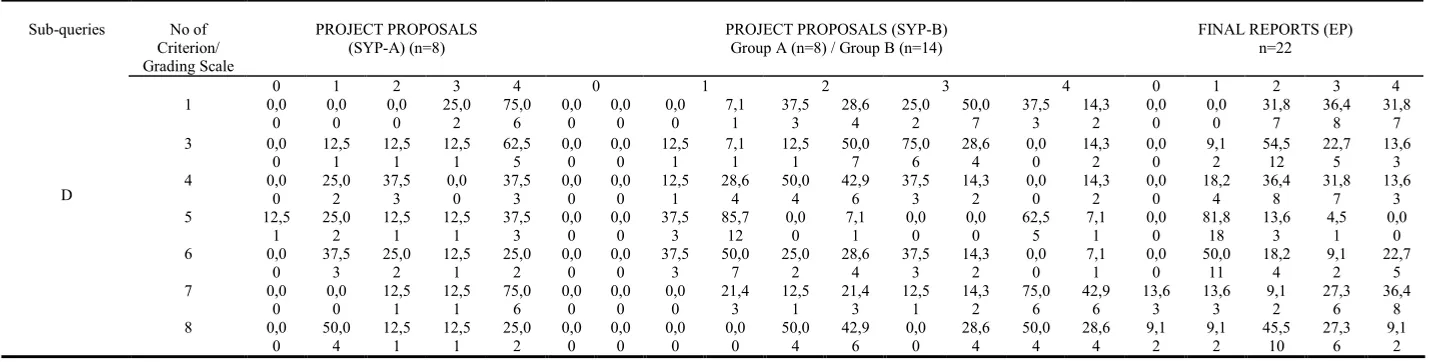
Table 2. Content Analysis of the School Environmental Programs regarding the Selection of Pedagogic and Teaching Methods, Techniques and Educational Conditions by scoring evaluation criteria of the research sub-queries D (Innovative Elements). Display of % Relative Frequencies (up) and Frequencies (down) of the programs in the rating scale of 0-4
Sub-queries D No of Criterion/ Grading Scale PROJECT PROPOSALS (SYP-A) (n=8)
PROJECT PROPOSALS (SYP-B) Group A (n=8) / Group B (n=14)
FINAL REPORTS (EP) n=22
0 1 2 3 4 0 1 2 3 4 0 1 2 3 4
1 0,0
0 0,0 0 0,0 0 25,0 2 75,0 6 0,0 0 0,0 0 0,0 0 7,1 1 37,5 3 28,6 4 25,0 2 50,0 7 37,5 3 14,3 2 0,0 0 0,0 0 31,8 7 36,4 8 31,8 7
3 0,0
0 12,5 1 12,5 1 12,5 1 62,5 5 0,0 0 0,0 0 12,5 1 7,1 1 12,5 1 50,0 7 75,0 6 28,6 4 0,0 0 14,3 2 0,0 0 9,1 2 54,5 12 22,7 5 13,6 3
4 0,0
0 25,0 2 37,5 3 0,0 0 37,5 3 0,0 0 0,0 0 12,5 1 28,6 4 50,0 4 42,9 6 37,5 3 14,3 2 0,0 0 14,3 2 0,0 0 18,2 4 36,4 8 31,8 7 13,6 3
5 12,5
1 25,0 2 12,5 1 12,5 1 37,5 3 0,0 0 0,0 0 37,5 3 85,7 12 0,0 0 7,1 1 0,0 0 0,0 0 62,5 5 7,1 1 0,0 0 81,8 18 13,6 3 4,5 1 0,0 0
6 0,0
0 37,5 3 25,0 2 12,5 1 25,0 2 0,0 0 0,0 0 37,5 3 50,0 7 25,0 2 28,6 4 37,5 3 14,3 2 0,0 0 7,1 1 0,0 0 50,0 11 18,2 4 9,1 2 22,7 5
7 0,0
0 0,0 0 12,5 1 12,5 1 75,0 6 0,0 0 0,0 0 0,0 0 21,4 3 12,5 1 21,4 3 12,5 1 14,3 2 75,0 6 42,9 6 13,6 3 13,6 3 9,1 2 27,3 6 36,4 8
8 0,0
0 50,0 4 12,5 1 12,5 1 25,0 2 0,0 0 0,0 0 0,0 0 0,0 0 50,0 4 42,9 6 0,0 0 28,6 4 50,0 4 28,6 4 9,1 2 9,1 2 45,5 10 27,3 6 9,1 2
[image:3.842.66.793.319.500.2]Table 3.ContentAnalysisofthe School Environmental Programs regarding the Selection of Pedagogic and Teaching Methods, Techniques and Educational Conditions by scoring the evaluation criteria of the research sub-queries E (Ensure the Active Participation of the Trainees). Display of % Relative Frequencies (up) and Frequencies (down)
of the programs in rating scale of 0-4
Sub-queries
E
No of Criterion/ Grading Scale
PROJECT PROPOSALS (SYP-A) (n=8)
PROJECT PROPOSALS (SYP-B) Group A (n=8) / Group B (n=14)
FINAL REPORTS (EP) n=22
0 1 2 3 4 0 1 2 3 4 0 1 2 3 4
1 0,0
0 25,0 2 0,0 0 25,0 2 50,0 4 0,0 0 0,0 0 25,0 2 14,3 2 37,5 3 42,9 6 0,0 0 21,4 3 37,5 3 21,4 3 0,0 0 9,1 2 36,4 8 40,9 9 13,6 3
2 0,0
0 25,0 2 12,5 1 0,0 0 62,5 5 0,0 0 0,0 0 62,5 5 21,4 3 12,5 1 35,7 5 0,0 0 28,6 4 25,0 2 14,3 2 9,1 2 9,1 2 18,2 4 9,1 2 54,5 12
3 0,0
0 0,0 0 0,0 0 25,0 2 75,0 6 0,0 0 7,1 1 25,0 2 14,3 2 37,5 3 42,9 6 12,5 1 7,1 1 25,0 2 28,6 4 9,1 2 4,5 1 18,2 4 22,7 5 45,5 10
4 0,0
0 12,5 1 37,5 3 12,5 1 37,5 3 0,0 0 7,1 1 62,5 5 21,4 3 0,0 0 28,6 4 37,5 3 28,6 4 0,0 0 14,3 2 0,0 0 18,2 4 9,1 2 36,4 8 36,4 8
5 0,0
0 25,0 2 0,0 0 50,0 4 25,0 2 0,0 0 7,1 1 37,5 3 28,6 4 12,5 1 28,6 4 25,0 2 14,3 2 25,0 2 21,4 3 31,8 7 9,1 2 9,1 2 31,8 7 18,2 4
6 0,0
[image:4.842.30.800.300.410.2]0 50,0 4 12,5 1 0,0 0 37,5 3 0,0 0 7,1 1 12,5 1 57,1 8 37,5 3 14,3 2 0,0 0 0,0 0 50,0 4 21,4 3 4,5 1 36,4 8 18,2 4 18,2 4 22,7 5
Table 4.ContentAnalysisofthe School Environmental Programs regarding the Selection of Pedagogic and Teaching Methods, Techniques and Educational Conditions by scoring evaluation criteria of the research sub-queries F (Emphasis on Analyzing Local and Current Issues or/and of Personal Interest of the Trainees). Display of % Relative Frequencies (up) and Frequencies
(down) of the programs in the rating scale of 0-4
Sub-queries F No of Criterion/Grading Scale PROJECT PROPOSALS (SYP-A) (n=8)
PROJECT PROPOSALS (SYP-B) Group A (n=8) / Group B (n=14)
FINAL REPORTS (EP) n=22
0 1 2 3 4 0 1 2 3 4 0 1 2 3 4
1 0,0
0 12,5 1 62,5 5 0,0 0 25,0 2 0,0 0 0,0 0 0,0 0 50,0 7 37,5 3 21,4 3 0,0 0 14,3 2 62,5 5 14,3 2 4,5 1 27,3 6 27,3 6 13,6 3 27,3 6
2 0,0
0 12,5 1 25,0 2 12,5 1 50,0 4 0,0 0 7,1 1 25,0 2 42,9 6 37,5 3 28,6 4 0,0 0 21,4 3 37,5 3 0,0 0 0,0 0 31,8 7 4,5 1 27,3 6 36,4 8
3 0,0
0 100,0 8 0,0 0 0,0 0 0,0 0 0,0 0 0,0 0 62,5 5 42,9 6 37,5 3 21,4 3 0,0 0 14,3 2 0,0 0 21,4 3 0,0 0 50,0 11 13,6 3 9,1 2 27,3 6
4 0,0
0 12,5 1 12,5 1 0,0 0 75,0 6 0,0 0 0,0 0 0,0 0 14,3 2 75,0 6 14,3 2 0,0 0 21,4 3 25,0 2 50,0 7 0,0 0 9,1 2 18,2 4 36,4 8 36,4 8
Table 5. P-valuesper sub-queries to which be camenon-parametrictest Wilcoxon W. & Mann-Whitney U. If P-value is < 0.05, there is statistically significant difference
RESEARCH QUESTION RESEARCH SUB-QUERIES p-values
Selection of Pedagogic and Teaching Methods, Techniques and Educational Resources in the School Environmental Teachers’ Training Programs
A. Self-directedlearning 0,070
B.Inter/multi-disciplinary approach of the issues 0,059
C. Development ofthe critical capacityof trainees 0,920
D. Innovative elements of the program 0,570
E. Ensuringthe active involvementof trainees 0,042
F. Analysisoflocal/topical /of personalinterest of learners’ issues 0,238
[image:4.842.118.733.440.513.2]In SYP-A scores were much higher since 7 out of 8 programs were evaluated in the two highest levels of the grading scale.
Self-directed organization and structuring of the content
and the process: According to the principles of lifelong
learning expressed in the Lisbon Summit , the “Education and Training Program 2010” (EU, 2006), educators become guides, consultants and mediators to assist and empower learners, who as far as possible, are themselves responsible for their education. Active learning also requires motivation for learning, judgment, and ability to learn. A small number of the programs promotes self-directed learning, as a large proportion of those got low scores.
Decision on the selection of learning methods: The report of
the International Commission on Education for the 21st century "Learning the treasure within", which was addressed to UNESCO in 1996 (Delor, 1996, UNESC, 2004), highlighted the need for education for a democratic and sustainable future, identified four structural axes of education which are learning to know, learning to do, learning to live and work together, and learning to exist. In the studied programs, the decision on methods of learning does not seem to left to the students. Almost all studied programs were deficient in their design and materialization regarding the selection of the learning methods.
Self-evaluation: The self-evaluation as part of the educational
process is referred to a limited extent in AFs and FRs. Indicative case was that of SYP-B of the program B-11 where the self-assessment and meta-cognition of students and teachers expressed through ancient Greek quotes such as “goods painstakingly acquired”, “business with pleasure” and so on.
B.Inter/multi-disciplinary approach of the issues
Adult education and environmental education promote the interdisciplinary, multidisciplinary, holistic approach of the
objects of the programs:The multidisciplinary and
interdisciplinary treatment of the program subject leverages knowledge of the Natural Sciences and Humanities as taught in the school lessons. In Program B-10 the interdisciplinary approach was achieved through the courses of curriculum Math, History, Biology, Geology, Literature, etc. The promotion of interdisciplinary and holistic approach of the issues became clear from the objectives, methodology, partnerships, planned actions and activities in both types of AFs and FRs. Half of the SYP-B and slightly more of SYP-A (62.5%) got rating 4. There were not programs of no interdisciplinary approaching the issue.
C. Development of the critical capacity of trainees
Cultivation of critical thinking through specially selected activities and educational techniques appeared to be particularly promoted in the programs.
Awareness of the mechanisms of creation, termination and
evaluation of a problem: Each environmental program should
help learners to discover the symptoms and real causes of environmental problems (EMP, 2007). The score of this criterion in all types of archival material presented gradient with the highest level enhanced.
Promote learning how to learn and develop the ability of
meta-cognition: Educators, apart from the scientific
knowledge, must have also pedagogical and social cognition. The pedagogical knowledge ensures the transmission of scientific knowledge, and learns to others of how to learn (Kapsalis and Papastamatis, 2000). This criterion had much difficulty in rating because the promotion of the meta-cognition capacity contained slightly in a small portion of the objectives, although it is not easy to identify a target and entry it in the systematic categories proposed by University of the Aegean (Bloom and Krathwohl, 1991). Data for the answer of this criterion are concealed most to cultivation of the skill of problem solving. Only in one program, meta-cognition was mentioned, but not in the objectives but in the evaluation. The scores were low in all AFs and FRs.
D. Innovative elements of the program
The need of training courses on innovative teaching methods has expressed repeatedly by the Greek teachers during the lasts decades as it is admissible that the implementation of innovative actions adds new knowledge in the subject matter and acquaintance with alternative teaching methods and approaches, develops skills of cooperation with students, colleagues, parents, social organizations, planning and design, adoption of a different model teacher and, finally, shapes attitudes and beliefs (Tsetsilas, 2006; Roussou, 2007; Mpagakis, 2007). The results of rating of the following criteria are presented in Table 2.
Exploiting diverse of learning environments, methods,
activities: Almost all programs designed and developed their
activities in a variety of learning environments, areas not confined to school. Taking students outside the classrooms for more than a sports game is already stepping outside the curriculum box (Johnston, 2009). In SYP-A, the score of this criterion was very high as there were specific field for filling in the AF, which were missing from the AF of SYP-B.
Innovation in topic selection: Almost all SPEE were quite
innovative in terms of subject matter, inasmuch 17 issues were rated as very innovative (77%), most of them belonged to group B.
Innovative methods (i.e. narrative, project work, heuristic,
manipulation, combination of methods): In 1997, in the
World Conference of UNESCO for the Environment (UNESC, 2004), was given special attention to strengthening and eventual reorienting teacher education programs in innovative practices, particularly with regard to the identification and dissemination of experience onto them. Support should be given to the interdisciplinary teaching methodologies and the evaluation of the effectiveness of the educational programs. The studied programs used innovative teaching methods but not as many as it expected because of the innovative character of the EE. The AFs do not include wide variety of innovative methods, and finally, it did not change during the implementation of the program, as it becomes clear from the FRs. Only a small number of programs got high scores. 18 SYP-B took points 2 and 3 (82%), the correspondence rate was significantly lower in the SYP-A (25%).The most common
14107 International Journal of Current Research, Vol. 7, Issue, 03, pp.14103-14111, March,2015
innovative methods listed in the programs are the projects, literature research, field study, internet use, collaborations with specialists. EE at schools seems to be implemented, in a very high degree, by traditional methods (discussion, arts, lectures) which fostered mainly by the one-way transfer of knowledge and limited to the level of environmental knowledge, ie education about the environment (Mpatsi, 2006). The positive is that teachers transfer their innovative methods of EE in the courses that they teach (Roussou, 2007).
Innovative techniques (i.e. lecture, roundtable seminar,
working groups, peer learning):Of the educational
techniques, those reinforcing active participation is the internships, case study, role play, questions and answers, debate, avalanche, brainstorming, presentations in working groups (UNECE, 2005). The educational/training techniques used in the SPEE are the working groups, discussion, assignments, questionnaires, laboratories, ICTs, lectures, case studies, simulation and role-playing, as Katarahia (2007) also mentioned. The scoring of this criterion is analogue to the previous one.
Promoting intercultural education: Promoting intercultural
education was checked on the basis of the definition given by the Karountzou (2007). The term of intercultural is used to indicate a dialectical relationship, a dynamic process of interaction, mutual recognition and cooperation between people of different national and immigrant groups. It necessarily imply interaction, reciprocity and genuine solidarity.
There was no evidence for promotion of intercultural education in the aims and activities of the studied SPEE. Most SYP-B were judged significant deficiencies on cultivating this dimension of EE; the half of SYP-A scored with 3 and 4, potentially as consequence of the specific field for filling the local, national and international dimensions of the program issue, where could detect evidence of interculturalism. Also, from the point of view that by intergenerational education, the culture of past generations transferred to the current, we can say that there is an intercultural education as listed in A-1-SYP-A. Should not be ignored that it opens the doors of schools in different cultural environments in the global web, as referred in the SYP-A of the program A-4.
Developing partnerships with other programs, educational
centres and environmental networks: The studied programs
do not appear development connections with other programs of school partnerships via the networks that support the Centres of Environmental Education. There were reports that the schools are members of networks with related issues to the programs, but there were no reference of partnerships with other schools belonging to these networks.
Outdoor activities (visits, environmental pathways, field
work, social actions): The traditional model of knowledge
transfer has been deemed ineffective, especially in adult education because it undermines critical thinking and does not encourage outsourcing views and feelings. According to Freire and Shor (1987), the experience is the basis of learning, with practice and action as substantial element of it. However, it is sufficient and promising that the outside classroom activities,
which are designed and eventually carried out during the implementation of the program, are many.
Promotion of the components of SD (caring
environment-solidarity-social justice, etc): In 1997, at the World
Conference of UNESCO, EE refocused the adoption of the broader term "Education for Environment and Sustainability" at all levels of education. The concept of sustainability includes, apart from the ecological, also social problems such as poverty, overpopulation, feeding, democracy and human rights (Chawla, 1998). In this Conference identified education as one of the pillars of sustainability, along with the law, economics and technology. But it is remarkable that the studied programs did not often mention the SD and sustainability although it is a request of our days and evolutional direction of EE. The scores of this criterion concentrated at low scales in all types of the archival material.
E. Ensuring the active involvement of trainees
The results of rating the criteria of these sub-queries are presented in Table 3.
Developing of a sense of participation-awareness-alert in
problem solving by the trainees: Τhe environmental problems
and their resolution did not dealt extensively the SPEE, even they were the topic of the programs, also the program design was not based on problem solving. Developing a sense of participation, awareness and alertness to solve the problem stems indirectly from the AFs and from references in the FRs. Half the SYP-A and 6 of the 22 SYP-B (27%), designed in such a way as to sensitize to a high degree of pupils, and to encourage participation and vigilance in solving the problem. Neither the FRs showed considerable awareness and participation in problem solving. Exceptions were the programs B-4, B8 and B-14 with the subjects of the problem of electronic garbage, stray animals and water. According to Frangoulis (2003), the effectiveness of the educational programs is particularly important if we take into account the view of Rogers that most of persons learns not from school but from free participation in activities associated with a revealing content, and which are close to their interests and experiences.
Active involvement of the participants in all phases of the
decision making: Programs, as designed, broadly promote the
participation of learners in the phases of adoption. The scores of AFs were moderate but those of FRs were particular encouraging.
Working with team-cooperative spirit: The team cooperative
spirit better revealed in the FRs, as 45.5% of them scored with grade 4. Kosmidis et al. (2005) referred to the value of team cooperative spirit which helps environmental teams into discussions, exchange of ideas, formulation of different aspects, better organization of the thoughts and concerns of educators, implementation and testing improvement practices, recording and using all reflections.
Securing conditions, in pedagogical and didactic level, for
foundation of the disposal for lifelong learning: As lifelong
learning deemed the process that focuses on the opportunities and learning procedures which are supported by many social
institutions of formal and non-formal education, training systems, families, companies and media (Vergidis, 2000; Kokkos, 2005; Karalis, 2008), all citizens need to acquire knowledge, skills and abilities and continuously update those holding through lifelong education and training (EU 2006). The foundation of lifelong learning does not referred directly in the AFs and FRs, except in A3 program, but can be assessed indirectly from the nature of the objectives which were specified in the creation of an informed citizen. The score of SPEE varied in this criterion, suggesting moderate assurance requirements in pedagogical and didactic level of the foundation for lifelong learning. The 40.9% (N = 9) of SYP-B enlisted in both lower grading scale, unlike SYP-A assigned to the same level only one program (12.5%). The FRs gave more positive results since the corresponding percentage dropped to 18.2% and 36.4% entered the gross gradient.
Customizing teaching and learning by using of PCs,
libraries etc: Individual learning is achieved through
computers, literature investigating on internet, in libraries and through personal actions and tasks undertaken by each student in group that belongs. Under this consideration, relatively well seems to be promoted the design of both groups of programs, as the scores were relatively high.
Undertaking initiatives dealing with issues (self-motivated):
Mean scores ranged modest, as half SYP-A and SYP-B poorly cultivate the skill of initiatives to address issues. The FRs did not differentiate remarkable the picture, as only 22.7% of them (N=5) scored 4. The teacher T5, indicating that achieved the self-motivation of students, wrote “It's remarkable the responsibility with which the students act outside the strict environment of the classroom and how the so-called indifferent students actively participate in the groups in order to succeed their goals”.
F. Analysisoflocal/topical /of personal interest of learners’ issues
In the AF of SYP-A there is a separate field which lists local, national and global dimension of the issue, this is absent from the form of SYP-B. This is a reason of the poor analysis of the local, national and global dimensions of the program issue in SYP-B. Table 4 shows the results of the criteria scoring of this sub-queries. One of the main challenges of teaching is making the nationally or provincially mandated curriculum interesting and relevant to the lives of their pupils (Mckeown, 2012). Teachers strive to connect learning to real-life contexts. Teaching about sustainability issues that confront the local community using participatory teaching/learning techniques engage students in ways that traditional teaching and rote learning do not. Pedagogies now associated with ESD are action oriented and participatory. They empower learners to explore challenges to the sustainability of their communities, find solutions, and implement them in a cooperative manner.
Emergence of personal experiences: Do not made accurate
reports highlighting personal experiences in AFs, but it is evident in FRs, describing personal experiences, experiences from the program or existing. The FRs revealed more details on
this issue since 40.9% (N = 9) was placed in the two highest grading scales.
Engagement of the local community: The SPΕE must involve
the local community in various activities but were hardly basic orientation of those studied. The relevant elements of the design in AFs are limited while in FRs are more.
Global dimension of local issues: All programs showed
significant deficiencies in this criterion. Each EE program should examines the broad environmental issues from local, national, regional and international point of view so students can deepen the environmental conditions prevailing in other geographical areas (EMP, 2007).
Exploitation of the program results on personal and local
level: In SYP-A, a significant percentage, 75% (N = 6) seem to
draw a high degree of project results in a personal and local scale, in SYP-B the score varied. The teacher T4 submits his opinion “I also think that such programs and activities help in making the school a centre of culture, space of exchange ideas, open into society, sensitive to environmental issues, pedagogy and ethic”.
Conclusion
As concluded from the results above, in several fields, SPEE train adequately the teachers involved. Certainly, although the SPEE offer the opportunity of using many innovative educational methods and techniques, those are studied not exploit them at so high degree as one might expect. The studied SPEE ensure the active participation of learners, satisfying the basic characteristic of AE programs by ensuring cultivation of team working spirit, developing a sense of participation and alertness to environmental problems and relatively well founded disposition to lifelong learning. The SPEE are designed to develop practical and theoretical education to the students and training to the involved teachers, although no clear distinction of them there was in the structure of their content, as provided of the AE programs. There were selected innovative pedagogical and teaching methods as well as original instructional materials similar to those normally found in the AE programs. The involvement of teachers with innovations in teaching and learning, makes them more effective in the lessons they teach. They practice in the use of modern techniques, escaping from the traditional.
In comparing the AFs of SYP-A and SYP-B with p-values of the non-parametrictest Wilcoxon and Mann-Whitney, regarding on which criteria satisfied more, p-valuein the whole research object of active participation of learners in the implementation phases of the programs was 0,042, giving primacy to SYP-A (Table 5). Where p-value is < 0.05, there is statistically significant difference. This prevalence of the most thorough and well designed SYP-A, those which got funding from the Aegean University, confirms that the proper design of SPEE that satisfies the principles of EE and AE, can contributing considerably to the professional improvement of teachers undertake their implementation, as Roussou (2007) and Scott (2007) consider. Τhe criterion of team working spirit showed the most statistically significant difference (p-value=0,016), suggesting that there is a need of teachers and
14109 International Journal of Current Research, Vol. 7, Issue, 03, pp.14103-14111, March,2015
students to escape from the traditional teaching way, to try new ways of teaching and learning in a team frame, supporting each other. On selecting teaching methods, and educational resources/training tool there was no statistically significant difference between the two types of AF in terms of providing innovative elements at various levels of the educational process but there was at the criteria referred to exploiting diverse areas, methods and activities and in the selection of the theme of the program (p-value=0,006 and 0,000 respectively) with privacy to SYP-A. The specific character of transformative teaching and the use of innovative approaches and methodologies is based on the assertion that the ‘learner’ cannot benefit from them in the course of a traditional ‘information transfer’ or simply by receiving descriptive information about the new methods (Savelava et al., 2010). Educators need to create new educational settings based on the active interaction with their learners, and in doing this, mutually ‘live’ and ‘act’ these new ideas in collaboration with other participants of the learning process (classmates, schoolmates, members of learning groups, etc.).
REFERENCES
Bagakis, G. 2011. (eds) Statutory and new forms of training. Looking for synergies and best practices, Agency of Teacher Training (OEPEK), ISBN 978-960-99912-8-5 Bell, J. 1997. Methodological design of Pedagogic and social
Research, Gutenberg Publications, Athens
Bird, M., Hammersley, Μ., Gomm, R. and Woods, P.1999. Educational Research in Action, Translation into Greek by Frangou E under the title Educational Research in Practice-study manual. Patras.
Bloom, B.S. and Krathwohl, D.R. 1991. Taxonomy of learning objectives. Volumes A & B (Taxonomy of Educational Objectives). Translation into Greek by Al. Lambraki-Paganou, Thessaloniki
CEC, 2009. Key competences for a changing world. Progress towards the Lisbon objectives in education and training, Analysis of implementation at the European and national levels, Commission of the European Communities, Brussels, 25.11.2009. SEC (2009) 1598. COM 640
CEU, 2009. Council Conclusions on a strategic framework for European cooperation in education and training ("ET 2020") 2941th Education, Youth and Culture, Council of the European Union, Council meeting, Brussels, 12 May Chawla, L. 1998. Significant Life Experiences Revisited: a
Review of Research on Sources of Environmental Sensitivity, Journal of Environmental Education, 29(3) 11-21.
Cohen, L. and Manion, L. 1994. Research Methods in Education (4th edn), London: Routledge
Delor, J. 1996. Learning: the treasure within, Report to Unesco of the International Commission on the Education for the Twenty-first Century, UNESCO
EMP, 2007. Training material for the Seminar of Teachers and Education Officials on Environmental Education, EPEAEKII, Writing Team with coordinator Koutsopoulos K., National Technical University of Athens
Epinosa-Bueno J.S., Labastida-Pina D. V., Padilla-Martínez K. and Garritz A. 2011. Pedagogical Content Knowledge of Inquiry: An Instrument to Assess It and Its Application to
High School In-Service Science Teachers, US-China Education Review, ISSN 1548-6613, May 2011, Vol. 8, No. 5, 599-614
EU, 2006. "Education and Training 2010" Official Journal C 79 of European Union01.04.2006)
http://europa.eu/scadplus/leg/el/cha/c10241.htm 14-7-2007 Europass, 2011. Opening doors to learning and working in
Europe available on 25-01-2011 at
http://europass.cedefop.europa.eu/europass/home/hornav/Introd uction.csp?loc=en_GB
Frangoulis, I. 2003. Lifelong Education and Environmental Education in Teaching, Editions Papazisis, Athens
Freire, P. and Shor, I. 1987. A Pedagogy for liberation, Bergin and Carvey, Connecticut, USA
Frey, K. 2005. Method Project, a form of collective work in the school as theory and practice, translated by I. Malliou K., Publisher Kyriakidis and Brothers, Thessaloniki
Iosifidis, Th. 2003. Analysis of Qualitative data in Social Sciences, Kritiki Publications, Athens
Kalathaki, M. 2015.. Evaluation tool for teachers’ training projects of Environmental Education, International Journal of Education, Macrothink Institute, ISSN 1948-5476, 2015, Vol. 7, No 1
Kang, H. W. and Nickel, M. Many pieces of the puzzle: a collaborative process of becoming a teacher, Journal of Case Studies in Education, available on 17/8/13 at http://www.aabri.com/manuscripts/11885.pdf
Kapsalis, A. and Papastamatis, A. 2000. Adult Education, Vol B, Adult Teaching, University publications, University of Macedonia, Department of Educational and Social Policy, Thessaloniki
Karalis Th. 2008. The Adult Education in the modern Greek reality, website of Greek Open University, available on 29/1/2008 at http://class.eap.gr/QuickPlace/ekp64/Page Library
Karountzou, G. 2007. Education for sustainable development. Environmental Education and Intercultural Education. Pedagogical approaches With Common Features, 3rd Congress of PEEKPE on Education for Sustainability and Environmental Education: Society-Economy-Environment-Culture, 9-11 November, Athens
Katarahia, S. 2007. Investigation of educational needs of secondary school teachers on Education Environmental Education of the Prefecture of Piraeus, Thesis, Greek Open University, Patras
Kokkos, A. 2008. Adult education in Europe and Greece. Determining the scope, trends, policies. Available on
01/29/2008 at the website
http://class.eap.gr/QuickPlace/ekp64/PageLibrary
Kosmidis, P., Bagakis, C., Cretan, E. and Kaloudiotis, S. 2005. Investigation of professional development educational program implementation in Action Research in Environmental Education, 1st Conference Schools Project of Environmental Education, Korinthia, Greece, September 23-
Kyrdi, K. 2011. Educational potential of voluntary Programs School Activities, in Bagakis G. (2011) (eds) Statutory and new forms of training. Looking for synergies and best practices, Agency of Teacher Training (OEPEK), ISBN 978-960-99912-8-5
Mageswary, K., Zurida, I. and Norita, M. 2011. Greening a Chemistry Teaching Methods Course at the School of Educational Studies, Universiti Sains Malaysia, Journal of Education for Sustainable Development 2011 5: 197, http://jsd.sagepub.com/content/5/2/197
Mckeown, R. 2012. Teacher Education 1992 and 2012 : Reflecting on 20 Years, Journal of Education for Sustainable Development 6: 37
Mpatsi, Th. 2007. Environmental Education and Teachers. Environmental Education and Teachers, A case study of the Primary Schools teachers of Rethymnon prefecture. Thesis, Open University, Patra
Rousou, S. 2007. Materialization of the optional programs in the schools of Primary and secondary education and their contribution to the professional development of the teachers. The view of the teacher. Thesis, Open University of Greece, Patra.
Savelava, S., Savelau, D. and Bakhnova, Cary, M. 2010. Practicing ESD at School: Integration of Formal and Nonformal Education Methods Based on the Earth Charter (Belarusian Experience). Journal of Education for Sustainable Development 4:2: 259–269 Downloaded from http://jsd.sagepub.com/content/4/2/259 on December 28, 2012
Scott, W. 2007, Goodfellow M. and Andrew-Power K. (editors), Raising standards: making sense of the sustainable schools agenda, Specialist Schools and Academies Trust, London
Tsetsilas, I. 2006. Record of training needs of teachers and design training programs: The case study of a school unit of Primary Education with model DION, Thesis, Patras UNECE, 2005. UNECE Strategy for Education for Sustainable
Development, Vilnius, 17-18 March
UNESC, 2004. Draft UNECE Strategy for Education for Sustainable Development, Addendum, Background, 2nd Regional Meeting on Education for Sustainable Development, Rome, 15-16 July 2004, cep/ac.13/2004/8/add.1, 18May 2004, Economic Commission for Europe Committee on Environmental Policy
Vergidis, D. 2000. Lifelong Education and Educational Policy, in: Continuing Education and Lifelong Learning: Experience and Greek perspective, Path, Athens
Volmari, K., Helakorpi, S. and Frimodt, R. 2009. Competence Framework for Vet Professions, Handbook for practitioners, Finnish National Board of Education and Editors, ISBN 978-952-13-4118-2 (pdf), Vammalan Kirjapaino Oy, Sastamala
*******
14111 International Journal of Current Research, Vol. 7, Issue, 03, pp.14103-14111, March,2015