1 The feasibility and acceptability of a novel Anxiety in Bipolar Disorder (AIBD) intervention
compared to treatment as usual: A randomised controlled trial
Steven H. Jones1*, Dawn Knowles1, Elizabeth Tyler1, Fiona Holland2, Sarah Peters3, Fiona Lobban1,
Brian Langshaw4, Claire Hilton1, Rita Long1, Kay Gantt5, Rebecca Owen3, Chris Roberts2, Lisa Riste6
1 Spectrum Centre for Mental Health Research, Faculty of Health and Medicine, Lancaster University, Lancaster, Lancashire UK
2 Institute of Population Health, Faculty of Biology, Medicine and Health, University of Manchester, Manchester, Greater Manchester, UK
3 Division of Psychology and Mental Health, Faculty of Biology, Medicine and Health, University of Manchester, Manchester, Greater Manchester, UK
4 Talking Solutions, Alexandra Park, St Helens, UK
5 South Wes Yorkshire Partnership, NHS Foundation Trust, Wakefield, UK
6 Centre for Primary Care, Faculty of Biology, Medicine and Health, University of Manchester, Manchester, Greater Manchester, UK
Institutions at which work performed: Lancaster University
University of Manchester
Correspondence:
Steven Jones Spectrum Centre for Mental Health Research, C76 Furness Bldg, Division of Health Research, Faculty of Health and Medicine, Lancaster University, Bailrigg, Lancaster, Lancashire, LA1, 4YW, UK
Email: [email protected] Telephone: +44 (0) 1524 593382 Fax: N/A
Short Title: Anxiety in BD intervention trial
2 Background: Comorbid anxiety is common in bipolar disorder (BD) and associated with worse clinical outcomes including increased suicidality. Despite effective psychological treatments for anxiety, research into treating anxiety in BD is underdeveloped. This paper describes a novel psychological intervention to address Anxiety in context of Bipolar Disorder (AIBD).
Methods: Adults with BD and clinically significant anxiety symptoms were randomised to AIBD plus treatment as usual (TAU) or TAU alone. AIBD offered 10 sessions of psychological therapy using a formulation-based approach. Feasibility and acceptability was evaluated through recruitment, retention, therapy attendance, alliance, fidelity and qualitative feedback. Clinical outcomes were assessed at baseline, 16, 48 and 80 weeks: interim assessments of relapse at 32, 64 weeks. Results: Seventy-two participants were recruited with 88% retention to 16 and 74% to 80 weeks (similar between arms). Therapy participants attended 𝑥̅ 7.7 (SD 2.8) sessions. Therapeutic alliance and therapy fidelity were acceptable. Qualitative interviews indicated participants valued integrated support for anxiety with BD, and coping strategies. Some suggested a longer intervention period. Clinical outcomes were not significantly different between arms up to 80 weeks follow-up. Conclusions: AIBD is feasible and acceptable but lack of impact on clinical outcomes indicates adaptations are required. These are discussed in relation to qualitative feedback and recent literature published since the trial completed.
1.INTRODUCTION
Comorbid anxiety is common in BD (12-month prevalence 32- 53%; McIntyre et al. 2006, Otto et al. 2006): lifetime 60- 90%; Merikangas et al. 2007, Sala et al. 2012) and linked to worse clinical outcomes, including higher relapse, worse medication side- effects, poorer psychosocial function and higher suicidality (Otto, Simon et al. 2006, Simon et al. 2007, Goes et al. 2012, Goldeberg and Fawcett 2012, Sala, Goldstein et al. 2012).
Despite the importance of anxiety in BD, development of effective psychological treatment is
3 A key question in developing treatment approaches to anxiety comorbidity is whether to target anxiety diagnoses or symptoms. The latter was chosen here for 3 reasons: i) anxiety disorders tend to be highly comorbid, especially in BD (Provencher, Hawke et al. 2011) and multiple separate interventions for specific anxiety disorders would be inefficient. ii) Anxiety-related distress in BD often doesn’t fit neatly within an anxiety diagnostic category (Provencher, Hawke et al. 2011, Hampshire 2014). iii) Anxiety disorders typically share key elements, including interference with functioning and subjective feelings of anxiety, worry and tension (Barlow et al. 2010).
The aim of this study was to test the feasibility and acceptability of the Anxiety in Bipolar Disorder (AIBD) intervention using an RCT design.
2. METHODS
This study was preregistered (ISRCTN: 84288072), reviewed and approved by UK NHS Ethics (REC ref: 10/H1015/83) with a published research protocol (Jones et al. 2013).
2.1 Trial design
A rater-blind individually randomised controlled trial comparing <=10 sessions of integrated CBT for anxiety in BD (AIBD), plus treatment as usual (TAU), compared with TAU alone: conducted across seven NHS trusts in the North West of England. A nested qualitative study explored feasibility and acceptability.
Participants were randomised by an independent clinical trials unit (MAHSC CTU 9) with randomly- sized permuted blocks minimised on gender, number of previous mood episodes (depression and mania: <7, 8-19 or >20) and current anxiety (HAM-A score: 0-17, 18-24 or >25).
To ensure blindness, researchers were housed separately from therapists and had no involvement in randomisation or post-randomisation data. Trial participants were instructed to avoid disclosing treatment arm. Unblindings were recorded and an alternate blind RA allocated.
2.2 Recruitment
Participants were recruited (June 2011-May 2012) from NHS mental health and primary care services and voluntary groups. Advertisements in local media, and at NHS and non-NHS sites aimed to
maximise participant access. All participants provided written informed consent. 2.3 Inclusion/exclusion criteria
Inclusion criteria: i) DSM-IV (SCID) verified BD diagnosis (First et al. 1997); ii) Current significant anxiety (HADS-A >= 8; Zigmond and Snaith 1983)); iii) Ability to provide informed consent; iv) > = 18 years.
Exclusion criteria: i) Current mood mixed episode (or last four weeks); ii) Current suicidal ideation with intent.
2.4 Intervention
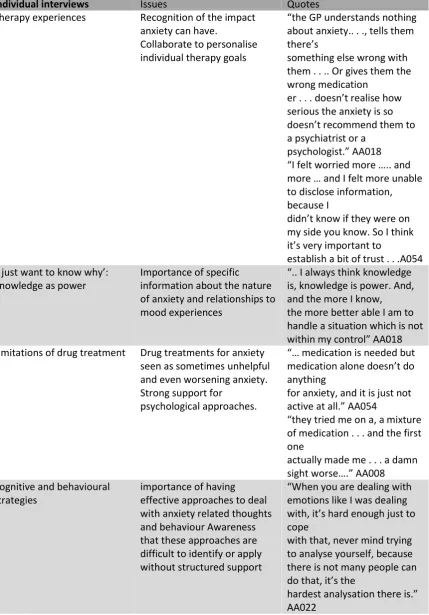
4 on what type of support people wanted in relation to their experiences of anxiety. Key themes and topics with illustrative quotes are presented in Table 1. In line with the results of these interviews and focus groups, AIBD was developed to be sensitive to the potential impact of anxiety and to offer information and structured psychological support to address collaboratively agreed personalised therapy goals. AIBD was offered flexibly in terms of location (client’s home or clinical setting according to client preference) and session duration, with sessions supported by client workbooks including client therapy record and anxiety recovery plans, lived experience accounts of anxiety and BD and information about additional resources and support. Specific CBT strategies were drawn from best practice guidance from NICE in relation anxiety and BD available during the period of AIBD development (2010-2011 NICE 2004, 2005a,b, 2006).
Important AIBD elements include flexible engagement, reviewing of positive experiences and coping as well as difficulties, and a flexible formulation-driven approach to individual therapy plan
development. The individualised formulation-driven approach took into account level of
engagement and motivation and explored links between anxiety and bipolar experiences, including issues around functioning, to elicit personally valued treatment goals. On the basis of this
information, consideration was given to the client’s key anxiety concerns and which of these to target as goals within therapy. The specific intervention plan in each case was guided by the individual formulation, and incorporated appropriate cognitive behavioural strategies focussed on addressing anxiety experiences and consequent behaviour. This included CBT to facilitate adaptive approaches to dealing with anxiety and where appropriate addressing the impact of depressed or elevated mood on these issues as well. Typically the CBT approach included learning more about the nature of their anxiety symptoms and developing coping strategies for dealing with them using CBT techniques including graded exposure/interoceptive exposure, relaxation and breathing techniques, cognitive restructuring, behavioural experiments, thought monitoring/challenge and adaptive problem solving. Where it was clear that mood instability and relapse were strongly associated with anxiety difficulties, mood-monitoring techniques, detection of early warning signs for problematic mood changes and coping strategies in relation to these early warning signs regularisation of routine and mood related problem-solving strategies were also a feature of therapy. The information from all phases was finally drawn into an anxiety recovery plan highlighting key challenges for the client and which techniques they have selected to be useful in addressing them (including strategies already successfully used by the client and new strategies developed in therapy). The relative emphasis between anxiety and mood strategies varied between clients based on their individual goals and formulation. Table 2 provides a brief summary of therapy progress for two illustrative clients. This approach differs from UP in being specifically developed for, and with, individuals with bipolar disorder, with a strong focus on individual formulation, a flexible personalised approach to relative emphasis of the intervention stages, incorporation of mood relapse prevention approaches if required and omission of mindfulness as an intervention strategy (as this is not currently
recommended by NICE in relation anxiety or depression).
(Table 2 AIBD phases; relative emphasis depended on individual goals and formulation). 2.5 Therapists
5 2.6 Primary Feasibility and Acceptability Outcomes
Feasibility and acceptability of AIBD were evaluated in terms of levels of recruitment into the trial, retention of participants in both arms of the study, treatment fidelity, assessed by the Cognitive Therapy Scale-Revised version (CTS-R; Blackburn et al. 2001) and the AIBD Fidelity Scale (available from authors on request), therapeutic alliance (Work Alliance Inventory, WAI-S ; Tracey and Kokotovic 1989) and therapy attendance and client evaluation.
2.7 Qualitative interviews
A nested qualitative study was conducted with 17 therapy participants (purposively sampled on age and gender, HADS-A score at recruitment, number of sessions attended, previous relapse history) to explore subjective experiences of AIBD.
2.8 Clinical Outcomes
Face-to-face assessments were conducted at initial interview (to confirm diagnosis), baseline, 16, 48 and 80 weeks: interim telephone assessments 32 and 64 weeks. Observer-ratings were obtained at each assessment. Self-report measures not obtained at interim assessments.
Primary clinical outcome was impact of AIBD on observer- and self-reported anxiety (Hamilton Anxiety Rating Scale, HAM-A; Hamilton 1959, Shear et al. 2001: State-Trait Anxiety Inventory, STAI; Spielberger 1983), time to relapse and symptoms of mania and depression (SCID for DSM-IV Longitudinal Interval Follow-up Evaluation, SCID LIFE; Keller et al. 1987, First, Spitzer et al. 1997); Hamilton Depression Rating Scale (Hamilton 1960) and Bech-Rafaelsen Mania Scale, MAS (Bech et al. 1978).
Additional clinical outcomes were personal recovery (Bipolar Recovery Questionnaire, BRQ; Jones et al. 2013); Quality of Life (Quality of Life in Bipolar Disorder Scale, QoL.BD; Michalak et al. 2010), and functioning (Personal and Social Performance Scale, PSP; Morosini et al. 2000).
2.9 Data analysis
Primary outcome information on recruitment and retention levels, therapy fidelity, alliance,
acceptability and completion were all summarised with descriptive statistics. Sample characteristics including baseline mood and anxiety were reported.
The clinical and functional outcome measures were analysed using the methods that would be employed in a full trial. The intention-to-treat principle was employed throughout. For the time to relapse survival analyses, covariates were treatment arm, gender, number of previous bipolar episodes (8-20 and more than 20, both versus 1-7) and baseline HAM-A total in a cox regression model.
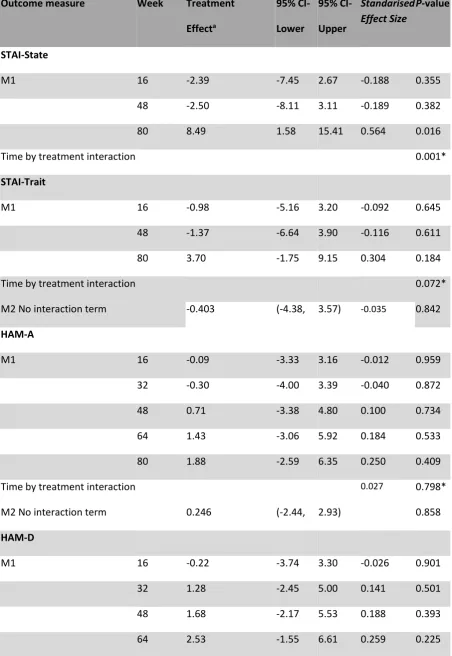
6 repeat measure model but allows for missing data at some time points, enabling subjects with incomplete data to be included in the analysis. The normality assumption of these models was checked using a normal probability plot of model residuals. A model with a discrete time by
treatment interaction was fitted to estimate the treatment effect and the 95% confidence interval at each follow-up time point (Model 1). If there was no interaction at the 5% level based on a Wald test, the interaction term was omitted and the overall treatment effect was estimated from this simpler model (Model 2). The same covariates described above were used for these models, additionally adjusting for baseline value of the outcome. A baseline response by discrete time interaction term was also included.
Qualitative interviews were audio-recorded, transcribed verbatim and thematically analysed to explore participants’ experiences of AIBD (Braun and Clarke 2006). Themes were compared against the data using a constant comparative approach by a multidisciplinary panel (CH, SP, LR, SJ, RL). Interviews were conducted until thematic saturation was achieved.
3 RESULTS 3.1 Participants
Participants were mainly white British females with a chronic course of BD, (>70% had over 20 mood episodes at baseline, Table 3) aged over 40 years (AIBD 𝑥̅= 45.5, SD = 10.7; TAU 𝑥̅= 42.9, SD = 16.6). The majority had a Bipolar I diagnosis (n = 62, 86%), were either divorced or never married (n = 48, 67%) and parents (n = 42, 58%). Although most participants had at least commenced further
education (n = 55, 76%), only a minority were in employment (n = 28, 39%). Of those not in work, the majority were in receipt of sickness/disability benefits (n = 23 of 44, 52%). Comparing AIBD with TAU the only substantial differences were in relationship status (twice as many married or cohabiting in AIBD), employment (approximately 10% more AIBD participants in work) and referral source (two-thirds of referrals in AIBD were self-referrals compared with one third of TAU).
At baseline, consistent with HADS-A screening, 85% of participants met criteria for at least one current anxiety disorder; Generalised Anxiety Disorder (GAD) and social phobia were the most common (Table 2). More AIBD participants met criteria for two or more anxiety disorders (59% vs. 40%).Rates of Social Phobia, Agoraphobia, Post-Traumatic Stress Disorder(PTSD), Panic ±
Agoraphobia, and Specific Phobia were all numerically higher in AIBD versus TAU.
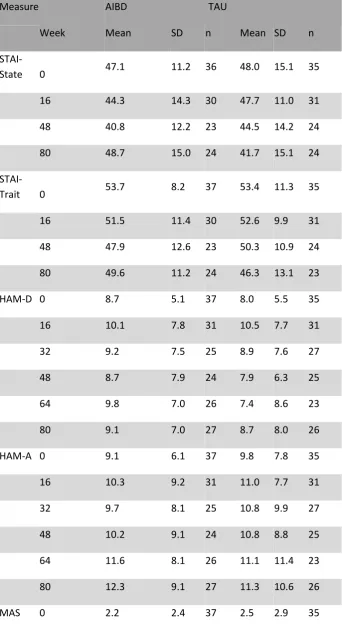
STAI-S and STAI-T scores at baseline (Table 6) were elevated compared with general populations and anxiety group norms1 (Spielberger 1983): HAM-A scores were in the normal range.
Observer-rated measures scores (indicated very mild depression HAM-D(Hamilton 1960))
(Zimmerman et al. 2013) and extremely low mania scores (MAS) (Bech 2012) at baseline, both arms.
1 General population (means; STAI-S, 35.88-36.03; SD, 10.52-11.07: STAI-T 35.03-35.06; SD, 8.88-9.31) and
7 Personal recovery scores were higher at baseline than in a previous RCT for BD (Jones et al. 2015). Quality of life (QoL-BD) is similar to that reported in the measure development paper (Michalak, Murray et al. 2010), personal and social functioning (PSP) indicates no more than mild impairment in functioning (Morosini, Magliano et al. 2000).
3.2 Primary Outcomes
3.2.1 Feasibility and acceptability
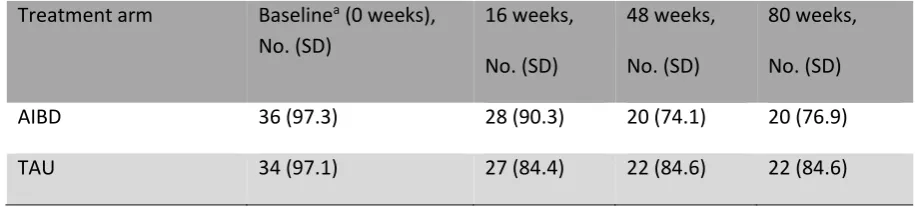
Figure 1 presents recruitment and retention rates according to CONSORT criteria (Schulz et al. 2010). Of 122 people screened, 14 declined, 9 were uncontactable and 27 did not meet study inclusion criteria. Of 72 randomised participants, 32 (44%) were recruited by clinician referral. Twenty-five AIBD participants came via self-referral (62.5%), compared to 15 (37.5%) TAU (see Table 3). Recruitment target was met (n = 72; 59% of those screened for eligibility). Retention was 88% (n = 63) to end of therapy (16 weeks), 78% (n = 56) to 32-week follow-up, 75% (n = 54) to 48- and 64-week follow-up, and 74% (n = 53) to 80-64-week follow-up (feasibility target 75% ± 10% to 80 64-weeks (Jones, McGrath et al. 2013). Retention rates at least as high in TAU as in AIBD (Figure 1). Measure completion rates for retained participants varied from 97% at baseline to 79% at 80 weeks (Table 4). Single unblindings were reported in seven AIBD and four TAU participants: an alternate blinded-RA was allocated in each case. Two participants lost to follow-up died during the final follow-up period for reasons unrelated to the trial.
Mean AIBD attendance was 7.7 (SD = 2.8); two participants attended zero session, 84% (n = 31) attended >=4 sessions and 59% (n = 22) attended 9-10 sessions.
Adherence to the therapy protocol and CTS-R were independently assessed for 26 randomly selected therapy recordings across early (sessions 1-2), mid (sessions 4-5) and late (sessions 7-10) phases. Adherence to the treatment protocol was 77.65% (SD 10.33) across the above phases. CTS-R mean was 47.1 (SD = 5.03); above threshold criteria for CBT competence of 36 (Keen and Freeston 2008) and consistent across sessions; early, 𝑥̅ =47.5,SD = 5.74, mid, 𝑥̅ =47.4 SD = 5.24,late, 𝑥̅ =46.1 SD = 3.76).
Therapeutic alliance was assessed after sessions 3 and 10 with complete data from 23 clients at session 3 (𝑥̅ =71.22, SD 9.20) and 16 at session 10 (𝑥̅= 72.88, SD 9.62): therapist ratings were obtained for 23 clients at session 3 (Mean 65.78, SD 7.52) and 15 at session 10 (𝑥̅ = 70.89, SD 6.45). Ratings at both stages were higher than reported in previous psychological intervention studies of complex psychological problems including BD (Davidson et al. 2006, Jones, Smith et al. 2015) 3.2.1.1. Client ratings of therapy
8 3.2.1.2 Qualitative interview findings (see Table 5 for illustrative quotes)
Participants indicated they valued the intervention in contrast with previous forms of support received. They identified benefits of treating anxiety and BD together in contrast with previous experiences of having these problems addressed separately. AIBD is relatively brief; several participants found this helpful in providing a clear structure and personally-identified targets. However, others wished therapy had been longer, although without specifying omissions from therapy as delivered. Coping strategies learnt in AIBD were helpful in: i) overcoming anxiety-based social isolation and functional limitations; and ii) increasing confidence in dealing with BD.
3.3 Secondary self- and observer-reported outcome measures
Key clinical outcomes were anxiety symptoms, sub-syndromal mood symptoms, (see Table 6-7) and time to relapse (Figures 2-4). The treatment by time interaction was significant for STAI-State but not STAI-Trait, with the lower scores at weeks 16 and 48, in AIBD vs TAU, although not by week 80. Observer-rated anxiety (HAM-A), depression (HAM-D) and mania (MAS) remained low throughout in both arms; significant treatment by time effects for MAS only with higher score at 48 weeks and lower at 80 weeks for AIBD.
37% (n=13) of TAU and 43% (n=16) of AIBD had a relapse of either mania or depression by 48-week follow-up, and 49% (n =17) of TAU and 59% (n=22) of AIBD by 80 weeks. Neither these nor
differences for mania or depression alone were significant.
There were trends toward significant interactions between time and treatment group for personal recovery (BRQ) and personal and social performance (PSP) but not quality of life (QoL.BD): patterns suggested improvements in in AIBD at 16 weeks versus TAU for BRQ and to 48 weeks for QoL.BD. Effect sizes for all comparisons are small-medium.
4 DISCUSSION
9 85% of participants met criteria for anxiety disorders. Mood symptoms were low throughout and participants were relatively high functioning on personal recovery, quality of life and personal and social functioning measures. Participants attended 77% of AIBD sessions offered, indicating a significant commitment to AIBD. Several previous BD therapy trials didn’t specify attendance rates (Lam et al. 2003, Scott, Paykel et al. 2006). Meyer reported 14.5% of therapy participants attended < 80% of sessions, the majority whom attended < 50% (Meyer and Hautzinger 2012). More specific data indicated individual recovery therapy attendance of 78% of sessions (Jones, Smith et al. 2015). Thus, AIBD attendance rates are comparable with the published literature. Acceptable therapeutic alliance and therapy fidelity were achieved. Client ratings of therapy usefulness and likelihood of recommending therapy were high (average >9/10 in both cases) but available for only 21 of 37 AIBD participants and so not definitive. In-depth qualitative interviews indicated the participants valued AIBD, linked to improvements in both symptoms and functioning in a number of clients. Some participants wanted a longer intervention, although others were happy with it as delivered.
The trial was not powered to test impact of AIBD on clinical outcomes and effect size estimates were imprecise and largely non-significant. Self-reported anxiety (STAI-S) indicated potential
improvements in anxiety to 48, but not 80 weeks post-baseline. In contrast, observer-rated anxiety (HAM-A) was low throughout the trial. This discrepancy is potentially important for further trial development. Based on the screening data, the reports of therapy clients and the self-report measurements, it seems possible HAM-A underestimated perceived anxiety.
Observer measures indicated low depression (HAM-D) and mania (MAS) consistent with recruitment of euthymic participants and remained throughout follow-up.
Personal recovery (BRQ) but not personal and social functioning (PSP) improved more rapidly for participants in AIBD during therapy, whilst Qol.BD was numerically improved to 48 weeks but gains were not sustained at later follow-up.
Mood relapse rate was lower than that reported by Meyer (64.5% at 80 weeks; (Meyer and
Hautzinger 2012) and Lam (75% at 30 months; Lam, Hayward et al. 2005) and comparable to Scott et al (52% at 18 months; Scott, Paykel et al. 2006). Although numerically higher in AIBD arm, the hazard ratio did not approach statistical significance.
Overall the current findings support the feasibility and acceptability of the trial design and the AIBD intervention. However it is important to acknowledge the lack of signal overall for the trial based on current findings. This suggests building on evidence for the importance of the integrated approach to anxiety in BD with an intervention revised to address potential factors impacting on efficacy, as indicated by qualitative feedback and by the wider literature emerging since completion of the trial. The most obvious trial for comparison with the present study is that of Ellard and colleagues, given their specific focus on addressing anxiety in BD through the use of UP (Ellard, Bernstein et al., 2017). There are several factors that may account for the difference in outcome findings. Although both have more female and predominantly white participants, it is not possible to compare clinical
10 Ellard for which it was a continuous variable. The advantage of the discrete time approach is that it provides estimates of the treatment effect at each assessment point adjusted for baseline covariates and is superior to separate analysis of covariance at each time-point, as information is shared across time-points supporting a missing at random assumption. Finally, it is unclear from their description whether the baseline assessment is included as a predictor or a response in their model.
Our findings can also be usefully interpreted in light of outcomes from the Systematic Treatment Enhancement Program for Bipolar Disorder (STEP-BD) STEP-BD study which explored the impact of lifetime anxiety disorder comorbidity on outcome from structured psychological therapy. In particular whether this moderated the relationship with clinical recovery in response to structured psychotherapy (cognitive behaviour therapy, family focussed therapy or interpersonal and social rhythm therapy) compared to a three session control condition of collaborative care for depressed BD participants (Deckersbach, Peters et al. 2014). Participants with one lifetime anxiety disorder showed greater improvement in response to structured therapy compared to collaborative care. This difference was not apparent for those with no lifetime history or with more than one lifetime anxiety diagnosis. This moderation affect appeared to be linked with the much poorer response of those with lifetime anxiety to the collaborative care intervention compared to those with no lifetime history (49% vs 62% recovery ) rather than a differential response to structured psychotherapy (66% vs 64% recovery). This report did not indicate anything about responses patterns in relation to anxiety symptomatology or functional outcomes. These findings with respect to participants with BD and current depression require further prospective exploration including study of wider samples including those outside current mood episodes. A review of the effectiveness in general of
psychological therapy for anxiety in bipolar spectrum disorders concluded that CBT including anxiety components may improve anxiety symptoms in cyclothymia among other bipolar spectrum
conditions but that development of both psychological models and treatment protocols specific to anxiety in bipolar disorder are a priority (Stratford, Cooper et al., 2015).
There is accumulating evidence that individuals with BD typically respond to psychological therapy better when delivered earlier in the course of their disorder. This has been reported in relation to CBT and group psychoeducation and is consistent with recent positive outcomes for a trial of
recovery focused therapy for recent onset BD (Jones, Smith et al. 2015; Scott, Paykel et al., 2006) It is therefore possible that focussing the intervention in the future more clearly on individuals with more recent BD onset might lead to stronger clinical effects. Although we considered post-hoc additional exploratory analysis of the relationships between severity and outcome in the current sample, we concluded that this would be inappropriate with relatively small participant group, consistent with recent CONSORT guidance (Eldridge, Chan et al, 2016).
Strengths included comprehensive participant assessment, extensive follow-up post-intervention and use of mixed methods to explore participants’ therapy experiences.
11 consistent with NICE guidance interventions for anxiety (NICE 2011). More robust clinical outcomes might be obtained by opting for more restrictive inclusion criteria particularly with respect to duration of BD course. If successful, a definitive trial employing a revised version of the AIBD intervention would provide a timely addition to therapeutic options for BD consistent with the importance of anxiety in NICE BD guidelines (NICE 2014).
REFERENCES
Barlow, D. H., Ellard, K. K., Fairholme, C. P., Farchione, T. J., Boisseau, C. L., Allen, L. B. & Ehrenreich-May, J. T. (2010). Unified protocol for the transdiagnostic treatment of emotional disorders:
Workbook. New York, NY, Oxford University Press.
Bech, P. (2012). The Bech-Rafaelsen Mania Scale (MAS). Clinical psychometrics. London, Wiley Bech, P., Rafaelsen, O. J., Kramp P & Bolwig TG (1978). The mania rating scale: scale construction and inter-observer agreement. Neuropharmacology, 17(6), 430-431.
Blackburn, I. M., James, I. A., Milne, D. L., Baker, C., Standart, S., Garland, A. & Reichelt, F. K. (2001). The revised cognitive therapy scale (CTS-R): psychometric properties. Behavioural and Cognitive Psychotherapy, 29, 431–446.
Braun, V. & Clarke, V. (2006). Using thematic analysis in psychology. Qualitative Research in Psychology, 3, 77-101.
Brewin, C. R. & Bradley, C. (1989). Patient preferences and randomized clinical trials. British Medical Journal, 299(6694), 313-315.
Colom, F., Reinares, M., Pacchiarotti, I., Popovic, D., Mazzarini, L., Martinez-Aran, A., Torrent, C., Rosa, A., Palomino-Otiniano, R., Franco, C., Bonnin, C. M. & Vieta, E. (2010). Has number of previous episodes any effect on response to group psychoeducation in bipolar patients? A 5-year follow-up post hoc analysis. Acta Neuropsychiatrica 22(2), 50-53.
Covin, R., Ouimet, A. J., Seeds, P. M. & Dozois, D. J. (2008). A meta-analysis of CBT for pathological worry among clients with GAD. Journal of Anxiety Disorders, 22(1), 108-116.
Davidson, K., Norrie, J., Tyrer, P., Gumley, A., Tata, P., Murray, H. & Palmer, S. (2006). The effectiveness of cognitive behavior therapy for borderline personality disorder: Results from the borderline personality disorder study of cognitive therapy (BOSCOT) trial. Journal of Personality Disorders, 20(5), 450-465.
Deckersbach, T., A. T. Peters, L. Sylvia, A. Urdahl, P. V. Magalhaes, M. W. Otto, E. Frank, D. J.
Miklowitz, M. Berk, G. Kinrys and A. Nierenberg (2014). Do comorbid anxiety disorders moderate the effects of psychotherapy for bipolar disorder? Results from STEP-BD. American Journal of Psychiatry 171(2), 178-186.
Eldridge, S. M., Chan, C. L., Campbell, M. J., Bond, C. M., Hopewell, S., Thabane. L., Lancaster, G. A. on behalf of the PAFS consensus group (2016). CONSORT 2010 statement: extension to randomised pilot and feasibility trials. British Medical Journal, 355, i5239.
Ellard K. K., Bernstein, E. E., Hearing, C., Baek, J. H., Sylvia, L. G., Nierenberg, A. A., Barlow, D. H., Deckersbach, T. (2017). Transdiagnostic treatment of bipolar disorder and comorbid anxiety using the Unified Protocol for Emotional Disorders: A pilot feasibility and acceptability trial. Journal of Affective Disorders, 219, 209-221.
First, M. B., Spitzer, R. L., Gibbon, M. & Endicott, J. (1997). Structured Clinical Interview for DSM-IV Axis 1 Disorders, (SCID-I). Washington, DC, American Psychiatric Press.
Goes, F. S., McCusker, M. G., Bienvenu, O. J., MacKinnon, D. F., Mondimore, F. M., Schweizer, B., National Institute of Mental Health Genetics Initiative Bipolar Disorder Consortium, DePaulo, J. R. J. & Potash, J. B. (2012). Co-morbid anxiety disorders in bipolar disorder and major depression: familial aggregation and clinical characteristics of co-morbid panic disorder, social phobia, specific phobia and obsessive-compulsive disorder. Psychological Medicine, 42, 1449–1459.
12 Hamilton, M. (1959). The assessment of anxiety states by rating. British Journal of Medical
Psychology, 32, 50–55.
Hamilton, M. (1960). A rating scale for depression. Journal of Neurology Neurosurgery and Psychiatry, 23, 56-62.
Hampshire, K. (2014). The nature and experience of anxiety in bipolar disorder. Unpublished doctoral dissertation, Lancaster University.
Jones, S., McGrath, E., Hampshire, K., Owen, R., Riste, L., Roberts, C., Davies, L. & Mayes, D. (2013). A randomised controlled trial of time limited CBT informed psychological therapy for anxiety in bipolar disorder. BMC Psychiatry, 13.
Jones, S., Mulligan, L. D., Higginson, S., Dunn, G. & Morrison, A. P. (2013). The bipolar recovery questionnaire: psychometric properties of a quantitative measure of recovery experiences in bipolar disorder. Journal of Affective Disorders, 147, 34-43.
Jones, S. H., Smith, G., Mulligan, L. D., Lobban, F., Law, H., Dunn, G., Welford, M., Kelly, J., Mulligan, J. & Morrison, A. P. (2015). Recovery-focused cognitive-behavioural therapy for recent-onset bipolar disorder: randomised controlled pilot trial. British Journal of Psychiatry, 206(1), 58-66.
Keen, A. J. & Freeston, M. H. (2008). Assessing competence in cognitive-behavioural therapy. British Journal of Psychiatry, 193(1), 60-64.
Keller, M. B., Lavori, P. W., Friedman, B., Nielsen, E., Endicott, J., McDonald-Scott, P. & Andreasen, N. C. (1987). The Longitudinal Interval Follow-up Evaluation. A comprehensive method for assessing outcome in prospective longitudinal studies. Archives of General Psychiatry, 44(6), 540-548.
Lam, D., Watkins, E. R., Hayward, P., Bright, J., Wright, K., Kerr, N., Parr-Davis, G. & Sham, P. (2003). A randomized controlled study of cognitive therapy for relapse prevention for bipolar affective
disorder: outcome of the first year. Archives of General Psychiatry, 60(2), 145-152.
Lam, D. H., Hayward, P., Watkins, E. R., Wright, K. & Sham, P. (2005). Relapse prevention in patients with bipolar disorder: cognitive therapy outcome after 2 years. American Journal of Psychiatry, 162(2), 324-329.
McIntyre, R. S., Soczynska, J. K., Bottas, A., Bordbar, K., Konarski, J. Z. & Kennedy, S. H. (2006). Anxiety disorders and bipolar disorder: a review. Bipolar Disorders, 8(6), 665–676.
Merikangas, K. R., Akiskal, H. S., Angst, J., Greenberg, P. E., Hirschfeld, R. M., Petukhova, M. & et al (2007). Lifetime and 12-month prevalence of bipolar spectrum disorder in the National Comorbidity Survey replication. Archives of General Psychiatry, 64, 543-552.
Meyer, T. D. & Hautzinger, M. (2012). Cognitive behaviour therapy and supportive therapy for bipolar disorders: relapse rates for treatment period and 2-year follow-up. Psychological Medicine, 42(7), 1429-1439.
Michalak, E. E., Murray, G. & Crest BD (2010). Development of the QoL.BD: a disorder specific scale to assess quality of life in bipolar disorder. Bipolar Disorders, 12(7), 727-740.
Morosini, P. L., Magliano, L., Brambilla, L., Ugolini, S. & Pioli, R. (2000). Development, reliability and acceptability of a new version of the DSM-IV Social and Occupational Functioning Assessment Scale (SOFAS) to assess routine social functioning. Acta Psychiatrica Scandinavia, 101(4), 323-329.
NICE (2004). Clinical guidelines for the management of anxiety. London, National Institute for Clinical Excellence.
NICE (2005a). Obsessive-compulsive disorder: Core Interventions in the treatment of obsessive-compulsive disorder and body dysmorphic disorder. Clinical Guideline 31. London, National Institute for Health and Care Excellence.
NICE (2005b). Post-traumatic stress disorder: The management of PTSD in adults and children in primary and secondary Care. Clinical Guideline 26. London, National Institute for Health and Care Excellence.
NICE (2011). Generalised anxiety disorder in adults: Management in primary, secondary and community care CG 113. London.
13 Otto, M. W., Simon, N. M., Wisniewski, S. R., Miklowitz, D. J., Kogan, J. N., Reilly-Harrington, N. A., Frank, E., Nierenberg, A. A., Marangell, L. B., Sagduyu, K. & et al (2006). Prospective 12-month course of bipolar disorder in out-patients with and without comorbid anxiety disorders. British Journal of Psychiatry, 189, 20–25.
Provencher, M. D., Hawke, L. D. & Thienot, E. (2011). Psychotherapies for comorbid anxiety in bipolar spectrum disorders. Journal of Affective Disorders, 133(3), 371-380.
Sala, R., Goldstein, B. I., Morcillo, C., Liu, S. M., Castellanos, M. & Blanco, C. (2012). Course of comorbid anxiety disorders among adults with bipolar disorder in the US population. Psychiatry Research, 46(7), 865-872.
Schulz, K. F., Altman, D. G. & Moher, D. (2010). CONSORT 2010 Statement: updated guidelines for reporting parallel group randomised trials. BMC Medicine, 8, 18.
Scott, J., Paykel, E., Morriss, R., Bentall, R., Kinderman, P., Johnson, T., Abbott, R. & Hayhurst, H. (2006). Cognitive-behavioural therapy for severe and recurrent bipolar disorders: Randomised controlled trial. British Journal of Psychiatry, 188, 313-320.
Shear, M. K., Vander Bilt, J., Rucci, P., Endicott, J., Lydiard, B., Otto, M. W., Pollack, M. H., Chandler, L., Williams, J., Ali, A. & Frank, D. M. (2001). Reliablity and validity of a structured interview guide for the Hamilton Anxiety Rating Scale (SIGH-A). Depression and Anxiety, 13, 166–178.
Simon, N. M., Pollack, M. H., Ostacher, M. J., Zalta, A. K., Chow, C. W., Fischmann, D., Demopulos, C. M., Nierenberg, A. A. & Otto, M. W. (2007). Understanding the link between anxiety symptoms and suicidal ideation and behaviors in outpatients with bipolar disorder. Journal of Affective Disorders, 97(1-3), 91-99.
Spielberger, C. D. (1983). State-Trait Anxiety Inventory (Form Y). S. Palo Alto, CA, US, Consulting Psychologists Press.
StataCorp. (2015). Stata Statistical Software: Release 14. College Station, TX: StataCorp LP
Stratford, H. J., Cooper, M. J., Simplicio, M. D., Blackwell, S. E. & Holmes, E. A. (2015). Psychological therapy for anxiety in bipolar spectrum disorders: A systematic review. Clinical Psychology Review, 35, 19-34.
Tracey, T. J. & Kokotovic, A. M. (1989). Factor structure of the working alliance inventory. Psychological Assessessment, 1, 207–210.
Zigmond, A. S. & Snaith, R. P. (1983). The hospital anxiety and depression scale. Acta Psychiatrica Scandinavia, 67(6), 361-370.
Zimmerman, M., Martinez, J. H., Young, D., Chelminski, I. & Dalrymple, K. (2013). Severity
14 Table 1. Summary treatment development information from individual interviews and focus groups
Individual interviews Issues Quotes
Therapy experiences Recognition of the impact anxiety can have.
Collaborate to personalise individual therapy goals
“the GP understands nothing about anxiety.. . ., tells them there’s
something else wrong with them . . .. Or gives them the wrong medication
er . . . doesn’t realise how serious the anxiety is so doesn’t recommend them to a psychiatrist or a
psychologist.” AA018 “I felt worried more ….. and more … and I felt more unable to disclose information, because I
didn’t know if they were on my side you know. So I think it’s very important to
establish a bit of trust . . .A054 ‘I just want to know why’:
Knowledge as power
Importance of specific information about the nature of anxiety and relationships to mood experiences
“.. I always think knowledge is, knowledge is power. And, and the more I know, the more better able I am to handle a situation which is not within my control” AA018 Limitations of drug treatment Drug treatments for anxiety
seen as sometimes unhelpful and even worsening anxiety. Strong support for
psychological approaches.
“… medication is needed but medication alone doesn’t do anything
for anxiety, and it is just not active at all.” AA054
“they tried me on a, a mixture of medication . . . and the first one
actually made me . . . a damn sight worse….” AA008 Cognitive and behavioural
strategies
importance of having effective approaches to deal with anxiety related thoughts and behaviour Awareness that these approaches are difficult to identify or apply without structured support
“When you are dealing with emotions like I was dealing with, it’s hard enough just to cope
with that, never mind trying to analyse yourself, because there is not many people can do that, it’s the
hardest analysation there is.” AA022
15
Content Information and support in
relation to both BD and anxiety
Recognition of the positive emotions associated with overcoming challenging situations and providing support to address these Genuine collaboration around treatment targets and
potential outcomes Opportunities for family or key clinician to attend key sessions to support change
“If a therapist is aware of the bipolar running alongside the anxiety erm they’ll probably get less
frustrated, and there might be tools that they can help . . .” P006
“There’d be nothing wrong in you saying ‘this is how I want this
to go’. And someone else might want it to go a different way and they’d be able to negotiate it at
that time rather that it being built.” P001
“Yeah. But it has to be my set of goals. Not you coming in and saying ‘Right I want you to be mood
free . . . in 6 weeks’ time’.” P002
Support materials Flowcharts/work sheets to self-monitor progress in therapy and as a post therapy resource
Engaging support materials including lived experience accounts and links to other resources/organisations
“…and the worksheets as well, you know, when I was in the mood, even though a couple of weeks
later it might not felt like it was working again, you can . . . keep going back to it”. P004 “But in a manual you can go back in to tap in and tap out of, I think it’s a good idea. …. So if you can keep going back to it ‘cause we don’t always get the computer up”. P005 Barrier and facilitators Importance of timely access
to therapy
Support for time limited approach deliverable by a range of disciplines to minimise waiting lists.
“Yes, getting through the GP to get the referrals there is not an awful lot of places now and waiting
lists are ridiculously long.” P004
“We’d want you to be able to quantify it at the end of your 10 weeks or whatever and say well this is what you expected to get out of it. Did you or didn’t you?” P007
17 Table 2. Phases of Treatment of AIBD
Phase Focus/Content ‘Sarah’ ‘James’
1 Introducing the anxiety approach
Psychoeducation regarding thoughts feelings and behaviour links relevant to anxiety and bipolar disorder
Psychoeducation regarding thoughts feelings and behaviour links relevant to anxiety and bipolar disorder
2 Collecting information about current and historical anxiety/mood and functioning
10 year history of BD starting at University, 3 year history of panic attacks
27 year history of BD starting with major depression and overdose following relationship break down, 6 year history GAD and social phobia symptoms
3 Identifying anxiety related therapy goals
Primary goal reduction in panic attacks
Primary goal to improve
management of anxiety and improve social life
4 Initial formulation of relationships between anxiety/mood
experiences and progress towards recovery goals
Had isolated herself to avoid triggers of mania and became more anxious about leaving home. Panic triggered on seeing an ex-colleague when had seen her when ill. Began to recur without obvious triggers. At first sign of panic symptoms would return home and lie down.
Increasingly avoidant of social contact and relationships. Although feels lonely much of the time he found social activities anxiety provoking and was concerned this will would escalate uncontrollably and cause a mood episode. Believed mood fluctuations always likely to lead to mood episode.
5 Identifying and applying CBT techniques to facilitate positive coping with anxiety
Examination of thoughts, feelings and behaviours linked to leaving feared situations provided rationale for graded exposure and behavioural experiments.
Trained in relaxation and breathing techniques, applied in situ in social situations outside the home. Record of anticipated vs actual outcomes and impact of this on anxiety related cognitions and mood
6 Identification and application where appropriate of CBT techniques enabling positive coping with mood instability
Amended early warning signs and coping plan to remove avoidance items
18 7 Development and
completion of anxiety recovery plan
Progressed through hierarchy from being able to view old colleagues on facebook to visiting her old work place and meeting an ex-colleague for a cup of tea. Anxiety recovery plan summarised key messages from therapy and longer term plans for self-management
Improved understanding of mood variation and confidence in managing anxiety. This led to increased social activities with a plan that includde key messages from therapy and longer term plans for self-management
8 Sharing lessons from therapy with key stakeholders (clinician and/or carer)
Anxiety recovery plan shared in joint session with Sarah and her family
19 Table 3. Baseline sociodemographic and clinical characteristics of clinical sample
Characteristic AIBD, N = 37
No. (%)
TAU, N = 35
No. (%) Gender
Male 13 (35.1) 10 (28.6)
Female 24 (64.9) 25 (71.4)
Ethnicity
White British 33 (89.2) 32 (91.4)
Other white 0 1 (2.9)
Asian other 0 1 (2.9)
British Asian 2 (5.4) 1 (2.9)
Not stated 2 (5.4) 0
Number of previous episodes
≤7 4 (10.8) 3 (8.6)
8-19 7 (18.9) 6 (17.1)
20+ 26 (70.3) 28 (74.3)
Bipolar Status
Bipolar I 31 (83.8) 31 (88.6)
Bipolar II 6 (16.2) 4 (11.4)
Marital Status
Married or cohabiting 17 (45.9) 7 (20.0)
Divorced/annulled/separated 9 (24.3) 13 (37.1)
Never married 11 (29.7) 15 (42.9)
Number of children
0 15 (40.5) 15 (42.9)
1 7 (18.9) 4 (11.4)
20 Education
Year 7-11 (No GCSE) 3 (8.1) 0
GCSEs or equivalent 6 (16.2) 8 (22.9)
Further or higher education not completed
7 (18.9) 4 (11.5)
Further/ higher or postgraduate education completed
21 (56.7) 23 (65.7)
Working
No 21 (56.8) 23 (65.7)
Yes 16 (43.2) 12 (34.3)
Source of referral
NHS 12 (37.5) 20 (62.5)
Self 25 (62.5) 15 (37.5)
No. current anxiety disorders
0 5 (13.5) 6 (17.1)
1 10 (27.0) 15 (42.9)
>= 2 22 (59.4) 14 (40.0)
Current anxiety disorders
Social Phobia 12 (32.4) 9 (25.7)
Agoraphobia 6 (16.2) 4 (11.4)
GAD 19 (51.4) 18 (51.4)
PTSD 10 (27.0) 7 (20.0)
Panic +/- Agoraphobia 9 (24.3) 6 (17.1)
OCD 5 (13.5) 6 (17.1)
21 Table 4. Completion of measures by trial arm and assessment timepoint
Treatment arm Baselinea (0 weeks), No. (SD)
16 weeks, No. (SD)
48 weeks, No. (SD)
80 weeks, No. (SD)
AIBD 36 (97.3) 28 (90.3) 20 (74.1) 20 (76.9)
TAU 34 (97.1) 27 (84.4) 22 (84.6) 22 (84.6)
22 Table 5. Post Therapy qualitative interview findings
Theme Illustrative quote
Intervention value ‘And it is the only therapy I have had in all my... I have had anxiety since I was what, about 15 and that is the only thing that worked for me was that CBT [SIC] therapy.’ (AN003)
Benefits of treating anxiety and BD together
‘Normally people do them separately and trying to put them together when you are ill is just... not easy at all… if you have got them separate it's like skirting round each issue, but putting them together …….. a person that deal with them all, and will go slowly over everything so you know what to expect, it is so much better, definitely.’ (AN007)
Treatment duration ‘it was 10 sessions, and that were it, but the 10 sessions meant that the goals that were laid out at session one, those were the goals that were worked at, and those were the goals that were achieved by the end and that is a far better way of working.’ (AN001)
‘I remember thinking I didn't want them to come to an end. But I couldn't have told you, or couldn't have
probably pinpointed aspects that I needed more to cover I think I was just... gaining so much that I kind of felt maybe there was more to gain as well you know if I had carried on.’ (AN008)
“it's good when you have the sessions but once they finish you feel, I felt like lost, and CBT is ok during treatment but long term, putting it into practice day to day, you know it's difficult to remember instantly all the tips, and that.” (AN006)
Benefits of coping strategies
‘it has been crippling for me over the years. I have had a number of breakdowns, and each time it's always been the anxiety that has kept me prisoner in my own home, it has stopped me from socialising, and progressing so this time, I have healed better and with coping strategies that have allowed me to do things, a lot quicker than before.’ (AN008)
23 it... and through this study, now I own it and I control it... I...
24 Table 6. Summary of Continuous Clinical Outcome Measures by time in AIBD and TAU groups
Measure AIBD TAU
Week Mean SD n Mean SD n
STAI-State 0 47.1 11.2 36 48.0 15.1 35
16 44.3 14.3 30 47.7 11.0 31
48 40.8 12.2 23 44.5 14.2 24
80 48.7 15.0 24 41.7 15.1 24
STAI-Trait 0 53.7 8.2 37 53.4 11.3 35
16 51.5 11.4 30 52.6 9.9 31
48 47.9 12.6 23 50.3 10.9 24
80 49.6 11.2 24 46.3 13.1 23
HAM-D 0 8.7 5.1 37 8.0 5.5 35
16 10.1 7.8 31 10.5 7.7 31
32 9.2 7.5 25 8.9 7.6 27
48 8.7 7.9 24 7.9 6.3 25
64 9.8 7.0 26 7.4 8.6 23
80 9.1 7.0 27 8.7 8.0 26
HAM-A 0 9.1 6.1 37 9.8 7.8 35
16 10.3 9.2 31 11.0 7.7 31
32 9.7 8.1 25 10.8 9.9 27
48 10.2 9.1 24 10.8 8.8 25
64 11.6 8.1 26 11.1 11.4 23
80 12.3 9.1 27 11.3 10.6 26
25
16 2.1 2.5 31 2.2 2.1 31
32 1.5 2.9 25 2.6 4.1 27
48 3.4 5.0 24 2.0 3.0 25
64 2.9 3.3 26 3.7 4.9 23
80 2.4 3.7 27 4.8 5.8 26
BRQ 0 2,107 374 36 2,161 405 34
16 2,248 411 31 2,146 401 27
48 2,326 374 21 2,351 480 23
80 2,318 379 20 2,398 497 23
PSP 0 73.16 10.13 37 71.77 12.40 35
16 73.68 12.64 31 71.52 12.02 31
48 74.91 14.95 23 72.83 15.20 24
80 71.12 13.56 25 78.14 16.02 22
QoL BD 0 142.6 28.4 36 150.5 36.7 34
16 147.0 31.8 30 143.7 30.6 31
48 157.1 31.2 21 153.1 32.3 23
26 Table 7. Repeated measures analyses of anxiety, mood and functional outcomes
Outcome measure Week Treatment
Effecta
95% CI- Lower
95% CI- Upper
Standarised Effect Size
P-value
STAI-State
M1 16 -2.39 -7.45 2.67 -0.188 0.355
48 -2.50 -8.11 3.11 -0.189 0.382
80 8.49 1.58 15.41 0.564 0.016
Time by treatment interaction 0.001*
STAI-Trait
M1 16 -0.98 -5.16 3.20 -0.092 0.645
48 -1.37 -6.64 3.90 -0.116 0.611
80 3.70 -1.75 9.15 0.304 0.184
Time by treatment interaction 0.072*
M2 No interaction term -0.403 (-4.38, 3.57) -0.035 0.842
HAM-A
M1 16 -0.09 -3.33 3.16 -0.012 0.959
32 -0.30 -4.00 3.39 -0.040 0.872
48 0.71 -3.38 4.80 0.100 0.734
64 1.43 -3.06 5.92 0.184 0.533
80 1.88 -2.59 6.35 0.250 0.409
Time by treatment interaction 0.027 0.798*
M2 No interaction term 0.246 (-2.44, 2.93) 0.858
HAM-D
M1 16 -0.22 -3.74 3.30 -0.026 0.901
32 1.28 -2.45 5.00 0.141 0.501
48 1.68 -2.17 5.53 0.188 0.393
27
80 0.91 -2.68 4.49 0.092 0.620
Time by treatment interaction 0.861*
M2 No interaction term 0.980 (-1.46, 3.42) 0.131 0.431
MAS
M1 16 0.05 -1.04 1.14 0.022 0.928
32 -0.63 -2.25 1.00 -0.176 0.450
48 1.84 -0.26 3.94 0.449 0.086
64 -0.89 -3.20 1.42 -0.216 0.449
80 -2.14 -4.64 0.36 -0.442 0.094
Time by treatment interaction 0.032*
BRQ
M1 16 138.40 -33.06 309.80 0.341 0.114
48 -22.90 -199.90 154.10 -0.053 0.800
80 -86.80 -269.10 95.80 -0.195 0.352
Time by treatment interaction 0.063*
M2 No interaction term 47.4 (-93.1 187.9) 0.111 0.508 PSP
M1 16 1.00 -4.35 6.35 0.089 0.715
48 0.27 -7.07 7.60 0.022 0.943
80 -8.16 -15.48 -0.83 -0.541 0.029
Time by treatment interaction 0.072*
M2 No interaction term 1.22 -5.51 3.05 -0.088 0.574 QoLBD
M1 16 4.92 -8.69 18.53 0.158 0.479
48 2.81 -12.20 17.81 0.088 0.714
80 -4.62 -21.19 11.95 -0.131 0.585
28 M2 No interaction term 3.55 -8.95 16.04 0.578 0.108
29 FIGURE LEGENDS
Figure 1. Recruitment and retention
Figure 2. Kaplan-Meier estimates of time to first depression or mania-type bipolar episode Figure 3. Kaplan-Meier estimates of time to first depression-type bipolar episode