Joint Image-Text Hashing for Fast Large-Scale
Cross-Media Retrieval Using Self-Supervised
Deep Learning
Gengshen Wu, Jungong Han, Zijia Lin,
Member, IEEE,
Guiguang Ding, Baochang Zhang, and Qiang Ni,
Senior Member, IEEE
Abstract—Recent years have witnessed the promising future of hashing in the industrial applications for fast simi-larity retrieval. In this paper, we propose a novel supervised hashing method for large-scale cross-media search, termed Self-Supervised Deep Multimodal Hashing (SSDMH), which learnsunified hash codes as well as deep hash functions for different modalities in a self-supervised manner. With the proposed regularized binary latent model, unified bina-ry codes can be solved directly without relaxation strategy while retaining the neighborhood structures by the graph regularization term. Moreover, we propose a new discrete optimization solution, termed asBinary Gradient Descent, which aims at improving the optimization efficiency to-wards real-time operation. Extensive experiments on three benchmark datasets demonstrate the superiority of SSDMH over state-of-the-art cross-media hashing approaches.
Index Terms—Cross-Media Retrieval, Deep learning, Regularized Binary Latent Model.
I. INTRODUCTION
W
ITH the explosive growth of multimedia content, such as text, image/video, and audio, cross-media retrieval is becoming increasingly attractive, which allows users to get the results with various media types by submitting one query of any media type. In the context of big data, we need retrieval algorithms that are able to accurately search in large-scale datasets, and meanwhile, ensure the costs related to the processing overhead and storage requirements do not grow with the quantity of the data being produced.Hashing, which represents the high-dimensional data with the compact binary codes, has drawn a considerable attention in the field of similarity retrieval for its low memory con-sumption (binary representation) and fast retrieval speed (bit-wise XOR calculation). These properties make the hashing
Manuscript received June 30, 2018; revised August 15, 2018; ac-cepted September 9, 2018. This research was supported by the Royal Society Newton Mobility Grant (IE150997).
Gengshen Wu, Jungong Han and Qiang Ni are with School of Com-puting and Communications, Lancaster University, Lancaster, LA1 4YW, UK (e-mail:{gengshen.wu, jungong.han, q.ni}@lancaster.ac.uk).
Zijia Lin is with Microsoft Research Asia, Beijing, 100080, China (e-mail: [email protected]).
Guiguang Ding is with School of Software, Tsinghua University, Bei-jing, 100084, China (e-mail: [email protected]).
Baochang Zhang is with Beihang University, Beijing, 100085, China (e-mail: [email protected]). The corresponding authors are Jun-gong Han and Baochang Zhang.
technique a widely used industrial solution for many applica-tions [1]–[7], where the systems that have been commercial-ized include Shazam hashing/fingerprinting for music identifi-cation [8], Philips video hashing for broadcast monitoring [9] and Civolution SyncNow for cross-media search [10].
Regarding cross-media hashing, one of the main challenges is how to tackle the semantic gaps within different modali-ties. Most existing methods, both in unsupervised [11]–[13] and supervised [14]–[17] manners, concentrate on learning a common latent space for the multimodal data during the training process such that the heterogeneity among modalities can be minimized [11], [15]. Specifically for unsupervised methods, Ding et al. [11] adopt collective matrix factoriza-tion in modelling relafactoriza-tions among different modalities, where unified binary codes are being learned via quantizing real-valued unified latent space. To deal with large quantization errors in [11], Wang et al. [13] improve the objective function to solve unified binary codes directly. However, they both fail to preserve the neighborhood structures of the original data, thus compromising the retrieval performance. Although some promising results have been achieved by the previous unsu-pervised methods, the overall performance is still far below satisfactory from the view of the real-world applications. It is commonly believed that a considerable performance gain can be obtained in supervised methods with aid of dedi-cated supervision information (e.g, semantic labels, affinity matrix) [1]. A semantic pooling approach is proposed by Chang et al. [18], where the relevance of each segment in untrimmed videos is evaluated by semantic saliency and then those shots are prioritized accordingly based on their saliency scores to make the final analysis with the ordering information exploited by an isotonic regularizer. Generally, the correlations among different modalities can be enhanced from the label information for unified hash codes in the Hamming space. For example, Lin et al. [15] introduce the probability distribution to learn unified hash codes with the semantic affinities. While Xu et al. [16] improve the quality of hash codes by means of the label information in shallow linear classifier. However, all the above methods employ a two-step like scheme in learning hash code, which inevitably yields suboptimal results.
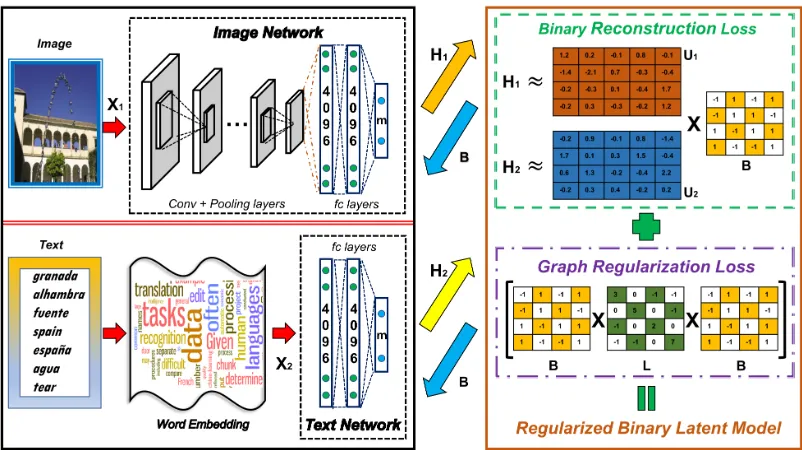
Fig. 1. The overview of our Self-Supervised Deep Multimodal Hashing. There are three subsections in the training process: deep feature learning (left), deep hash function learning (middle) and regularized binary latent representation learning (right). Specifically, the regularized binary latent model consists of two loss terms: binary reconstruction loss and graph regularization loss. The yellow arrows indicate the deep feature learning. The blue arrows show the iterative directions when learning deep hash functions with the guidance of the unified binary codeB. Better viewed in color.
al. [20], where the feature and semantic correlation across modalities are jointly maximized. While another work from Cao et al. [21] employs a metric-based approach to train the visual semantic fusion network with cosine hinge loss. However, the label information is not fully exploited and the performance compromises because of the noisy anno-tations. Subsequently, Li et al. [22] suggest another auto-encoder framework for unsupervised cross-modal hashing, which reconstructs the original features from the joint binary representation without considering the similarity relations. Jiang and Li [23] adopt a negative log likelihood criterion in an end-to-end deep framework, where the similarity structure between real-valued representations is retained. However, such similarity preservation is only performed on approximated hash codes with NO restrictions on binary codes in the training process.
As discussed above, we summarize three major limitations in the existing cross-modal hashing schemes as follows. First-ly, solving the discrete-constrained objective function usually undergoes a two-step procedure. At the relaxation step, su-pervised information is exploited to guide continuous hash codes learning, which are converted into binary codes by using rounding technology at the second step. Such a two-stage solution yields large quantization errors, which will be further magnified after the iterative code learning. Moreover, feature learning and bianrization are viewed as two independent steps in most previous methods, thus giving rise to suboptimal results. Last but no least, supervision knowledge cannot be fully explored in the code generation, as well as the hash function learning, which limits the improvement space of the hash code quality. The situation gets even worse when inaccurate or incomplete labels are provided [15], [16], [24]– [26]. Obviously, the retrieval performance would be heavily
affected by those drawbacks, thus preventing the existing methods from mass deployment in the industrial applications. To address the above issues, we propose a novel super-vised cross-modal hashing method, termed asSelf-Supervised DeepMultimodal Hashing (SSDMH), which integrates deep learning and regularized binary latent representation model jointly in a unified framework. Specifically, the discrete-constrained objective function is optimized directly without relaxation, and the deep hash functions are built via engaging deep feature learning with code learning in a self-supervised manner. The framework of SSDMH is illustrated in Fig. 1 and the corresponding contributions are summarized as follows:
1) The matrix factorization based supervised cross-modal hashing method is proposed to incorporate the deep feature learning and binarization seamlessly into a unified deep learning framework, where the deep hash functions are being built in a self-supervised manner via projecting the original features from various modalities into a common binary space.
2) A novel regularizedbinarylatent model is proposed during the code learning, where the discrete unified binary codes can be solved without relaxation and the weights of dif-ferent modalities are optimized dynamically. Particularly, to make the most advantage of supervision knowledge, we propose to minimize the graph regularization loss, which explicitly preserves the neighborhood structures of the original data and is prone to produce the discriminative hash codes.
TABLE I
THENETWORKCONFIGURATIONS FORTWOMODALITIES.
Modality Layer Description
Image conv1−conv5 Follow the same configuration as AlexNet [27] f c6I,f c7I,f cb I 4096-d, 4096-d,m-d
Text f c6T,f c7T,f cb T 4096-d, 4096-d,m-d
the optimization speed dramatically, in contrast to the traditional bit-by-bit fashions.
The reminder of the paper is organized as follows. We elaborate the proposed SSDMH in Section II. Experimental results along with data analysis are provided in Section III. Finally, the proposed method is concluded in Section IV.
II. PROPOSEDMETHOD
Fig. 1 illustrates the basic structure of the proposed SS-DMH, where the sub procedures are described concisely as: we extract the deep features from the corresponding deep networks and then utilize those features to generate the unified binary representation via a novel regularized binary latent model. After that, the learnt binary code is adopted as ‘su-pervision information’ to re-train the previous deep networks, which exhibits the idea of the self-supervised manner. Those processes can be repeated iteratively to obtain the deep hash functions finally. In the next subsections, we will elaborate the proposed SSDMH in details.
A. Problem Definition
Without loss of generality, we use image and text to explain the proposed method. Assuming that the multimodal dataset contains n training instances, which is denoted as
O = {Xi}2i=1, i = {1,2}. Each instance has features from
the image and text modality, which is represented by X1 =
{xj1}n
j=1 andX2 ={xj2}
n
j=1, respectively. Consequently, we
usexj1∈Rd1 to denote the feature vector or the raw pixels of
the j-th image and xj2 ∈ Rd2 represents the feature vector
of the j-th text, where d1 and d2 (usually d1 6= d2) are
the dimensionalities. The affinity matrix Sn×n ∈ [0,1] is also provided as the supervision information, which measures the similarity between data points. In the proposed SSDMH, the aim is to learn the deep hash functions Fi(Xi; Θi) that binarize the training data from two modalities into a set of unified binary codesB={bi}ni=1∈ {−1,+1}m×n, such that
the similarities in the original spaces can be preserved. m
denotes the code length, Xi are the input streams to those deep networks for two modalities. Here, the deep network parameters including weights and biases are uniformly defined as Θi.
B. Deep Architecture
Considering the favorable feature expressive ability and the deployment flexibility1, we adopt AlexNet and Multi-Layer
Perceptrons (MLP) as the feature modelers for the image
1The model sizes for AlexNet and MLP are<240MB and<90MB after training, which are affordable on most portable devices.
and textual modalities, as shown in Fig. 1. For the purpose of making the networks compatible to the application, the last fully-connected (fc) layers of the original networks are replaced with the new bottleneck layers (f cb I andf cb T) comprising m hidden units to facilitate the network training afterwards.T anhfunction is added at the end of the last layers as the activation function to make the outputs fall into[−1,1]. The network configurations are summarized in Table I. In this paper, the deep architectures not only provide the deep features (e.g.Hi ∈R4096×n fromf c7 I andf c7 T) in learning the
unified binary representation, but also act as the deep hash functionsFi(Xi; Θi)to generate hash codes for new queries.
C. Regularized Binary Latent Model
In the hash code learning, we propose a novel regularized binary latent representation model to generate the unified binary code B for two modalities. Particularly, the proposed model consists of two loss terms: binary reconstruction loss
and graph regularization loss. We formulate the objective function of the proposed model as below:
min
B,Ui,αi
2
X
i=1
αγi(kHi−UiBk2F+βT r(BLB
T)), (1)
whereβ andγare balance parameters.γis a positive number controlling the weight of each modality while β estimates the impact of the loss term in (1). Hi ∈ R4096×n are
the deep features extracted from f c7 I and f c7 T layers, Ui∈R4096×mare the latent factor matrices,L∈Rn×nis the
Laplacian matrix.αi(αi >0) are the weight factors for two modalities separately and satisfy P2
i=1αi = 1. T r(.) is the trace norm. Those terms are elaborated in the next subsections.
1) Binary Reconstruction Loss: As shown in (1), the first term measures the reconstruction losses from their latent common binary representation B to the deep features Hi, which shares similar idea with CMFH [11]. However, it differs from [11] in two aspects. Firstly, CMFH adopts a two-step approach in generating the unified binary representation, which solves thereal-valued latent common spaceV∈Rm×n first
and binarizes it afterwards, as shown in the top part of (2). This inevitably yields the large quantization errors, no matter which rounding schemes are used [13], [15]. However, this problem can be avoided in the proposed model by solving the binary code directly as the bottom of (2).
min
Ui,V
αkH1−U1Vk2F + (1−α)kH2−U2Vk2F
⇒ min
Ui,B,αi
2
X
i=1
αγikHi−UiBk2F.
(2)
Moreover, the modality weight is set empirically in CMFH (e.g. α = 0.5 ), while the weights αi are optimized dy-namically in the proposed model. It is more sensible for the important modality to hold the dominant position in the optimization [13], [28].
binary code [29]. Particularly, the spectral graph problem can be formulated as:
1 2
n
X
i=1
n
X
j=1
kbi−bjk2FSij=T r(BLBT), (3)
where S∈Rn×n represents the semantic affinity matrix that can be derived from manual scoring [15],sij = 1ifxi1andx
j
2
share the same label and otherwise 0.Dis the diagonal matrix whose entries are the column sum ofS, i.e.,Dii =Pnj=1Sij. The Laplacian matrixL can be calculated asL=D−S. D. Deep Hash Function Learning
Having obtained the unified binary representation B, the next step is to train the deep hash models 2 Fi(Xi; Θi)with Euclidean loss layers, which aims at projecting the original features from different views into the common binary space. This strategy integrates the learning processes of deep feature and hash function in a self-supervised manner, thus predicting the discriminative hash code for new query instance in the testing stage [5]. The problem is formulated as:
min
Θi 2
X
i=1
kFi(Xi; Θi)−Bk2F. (4) Particularly, Euclidean distances are minimized between the outputs of the deep networks and the unified binary code B, while the network parametersΘi can be updated through the back-propagation with Stochastic Gradient Descent (SGD). It is worth noting that the original images or features (i.e,Xi) are fixed and used as the input streams for the deep architecture to facilitate the network training.
E. Objective Function and Optimization
By combining (1) and (4), the overall objective function of SSDMH is written as below:
min
Θi,B,Ui,αi 2
X
i=1
αγi(kHi−UiBk2F+βT r(BLB
T))
+λ 2
X
i=1
kFi(Xi; Θi)−Bk2F,
(5)
whereB∈ {−1,+1}m×n. The proposed objective function is a NP-hard problem and cannot be solved directly because of the binary constraints. Subsequently, we adopt an alternating strategy to solve (5), where the involved parameters are optimized iteratively by the following steps.
1) Ui-Step: Firstly, by fixing all other variables except for Ui, (5) is reduced as:
min
Ui
2
X
i=1
αγikHi−UiBk2F, s.t. B∈ {−1,+1}
m×n. (6)
Then we calculate the derivation of (6) with respect to Ui and the closed-form solution ofUican be obtained by setting the derivation as 0:
Ui=HiBT(BBT)−1. (7)
2Other predictive models like linear classifier and kernel logistic re-gression can also be applied here [13], [15], we will leave those in the future research.
2) B-Step: Then, with all variables fixed butBas the only argument, (5) is re-written as:
min
B 2
X
i=1
αγi(kHi−UiBk2F+βT r(BLB
T))
+λ 2
X
i=1
kFi(Xi; Θi)−Bk2F, s.t. B∈ {−1,+1} m×n.
(8)
Then we can expand (8) to:
min
B 2
X
i=1
αγi(T r(BTUTi UiB−2BTUTiHi) +βT r(BLBT))
+λ 2
X
i=1
T r(BBT−2BTFi(Xi; Θi))
= min
B kG
TBk2
F−2T r(BTQ) +T r(BKB T
),
(9)
whereG= [pαγ1U1;
p
αγ2U2]T,K=Pi2=1αγiβL+ 2λIn,
Q = P2
i=1(α
γ iU
T
iHi +λFi(Xi; Θi)). Following discrete cyclic coordinate descent (DCC) [30], we denote bT as the
j-th row ofB, andB0 the matrix ofBexcludingb. Similarly, letgT be thej-th row ofG,G0be the matrix ofGexcluding
g andqT be thej-th row of Q, then we have
min
b (g TG0T
B0−qT)b+bTKb= min
b p
Tb+bTKb,
s.t. p= (B0TG0g−q)∈Rn, B0∈ {−1,+1}m−1×n.
(10)
Obviously, the above equation can be considered as the classical Binary Quadratic Programming (BQP) problem in most previous papers and it can be optimized via solving each entry of b sequentially (flip one entry per time) as described in some coordinate descent based methods [24], [30], [31]. However, those methods usually suffer from the slow convergence issues, especially for the cases with long code. In this paper, we propose a new solution calledBinary Gradient Descent (BGD), which is detailed in the following paragraphs, to accelerate the convergence in optimizing (10). Suppose that the current value ofbisb0 and the new value b1 can be obtained by adding an offset∆tob0, namelyb1= b0+ ∆. We substitute b0 and b1 into (10), the deviation L
between the values of (10) is calculated as follows:
L=bT1Kb1+pTb1−bT0Kb0−pTb0
= (b0+ ∆)TK(b0+ ∆) +pT(b0+ ∆)−bT0Kb0−pTb0
= 2∆TKb0+ ∆TK∆ +pT∆
= ∆TK∆ + (2Kb0+p)T∆.
(11)
Since there is only one entry with the value3 of−2or2in∆,
then we have ∆TK∆ = 4Kj,j, wherej is the index for the entry that is non-zero in∆. Thus, (11) can be reformed as:
L= 4diag(K) + (2Kb0+p)T∆, (12)
3The position of−2or2in∆is based on the corresponding entry in
b0so as to change−1to1with2or1to−1with−2. All the rest entries
wherediag(K)preserves the diagonal elements ofK. There-fore, the deviation Lmust be negative if we try to find b1 to
make the objective function descent and it can be obtained by calculating another vector hregarding each entry in b0as:
h= 4δ+ (2Kb0+p)d, (13)
where δis the column vector of all diagonal elements of K,
denotes the entry-wise multiplication of the vector, and d
satisfies: 1) if thej-th entry ofb0is1, thendj =−2; 2) if the
j-th entry inb0 is−1, thendj= 2. The optimization process will be completed if the smallest value in his non-negative, otherwise we only retain the value of the corresponding entry in d, and set other entries to0 to obtain ∆. After getting b1
with ∆ +b0, we updateb0 above and recalculate the new ∆
accordingly. Essentially, the proposed method flips all the en-tries by repeating the above computations and selects the entry that is most likely to make the objective function descend in a monotonic discrete manner. As observed from the experiments, it usually requires n/2 updates on the entries such that the objective function descends. The proposed BGD only needs
1 iteration to make (10) descent with faster converging speed compared to the later cases that require at least n iterations, thus obtaining the local optimal solution efficiently.
3) αi-Step: With other parameters fixed except forαi, we formulate (5) as below:
min
αi 2
X
i=1
αγiEi, s.t. αi>0, (14)
whereEi =kHi−UiBk2F+βT r(BLB
T). Subsequently, the
Lagrange function of (14) can be formulated as:
2
X
i=1
αγiEi−µ(
2
X
i=1
αiγ−1), (15)
whereµis the Lagrange multiplier. TakingP2
i=1αi = 1into consideration, the optimal solution ofαi is derived as:
αi=
(1/Ei)
1 γ−1
P2
i=1(1/Ei)
1 γ−1
. (16)
4) Θi-Step: When fixing all other parameters but Θi, the objective function (5) is reduced to
min
Θi 2
X
i=1
kFi(Xi; Θi)−Bk2F, s.t. B∈ {−1,+1}
m×n, (17)
where the deep hash functions Fi(Xi; Θi) can be solved by optimizing the network parameters Θi under the guidance of the unified binary code via mini-batch back-propagation [5]. Repeating the above optimization processes until convergence, the deep hash functions can be learned and deployed for the large-scale multimodal retrieval application. When giving new query instancesXqi ∈ O/ , the new hash codes can be obtained by calculating sign(Fi(X
q
i; Θi)). The proposed SSDMH is summarized in Algorithm 1.
Algorithm 1. Self-Supervised Deep Multimodal Hashing
Input: Original featureXi, code lengthm, parametersβ and
γ, affinity matrix S. Randomly initialize binary code B, latent matrices Ui and deep parameters Θi. Set weights
αi= [0.5,0.5],i={1,2}.
Output: Deep hash functionsFi(Xi; Θi);
1: forT = 1 to 5do
2: Extract the feature matricesHifromf c7 I andf c7 T layers of two deep networks, respectively;
3: fort= 1to 5 do
4: Update the latent factor matricesUi by (7);
5: Update the unified hash code Bby (8)∼(13);
6: Update the weight factors αi by (16);
7: end for
8: Update the network parameters Θi by (17);
9: end for
10: return Fi(Xi; Θi);
F. Computational Complexity
The computational complexity of SSDMH is composed of two parts: learning binary code and deep hash function. However, it is not straightforward to calculate the complex-ity for network training, which depends on many external conditions. Regarding the regularized binary latent model, the computational complexity is O(d2n+dn) during each
optimization iteration and d = max{d1, d2, m}. In total,
the training complexity is O((d2n+dn)t), where t is the
maximum iteration (less than5) in updating the binary code.
III. EXPERIMENT
In this section, extensive experiments are conducted on three datasets to evaluate the performance of the proposed SSDMH.
A. Dataset Descriptions
The Wiki [32] dataset is made up of 2,866 image-text pairs collected from Wikipedia. Each image is represented by a 128-dimensional SIFT feature vector and a 10-128-dimensional topic vector is given to describe the text. These pairs contain 10 semantic categories and each pair is manually assigned to one of them. All data pairs are split into the training (2,173) and query (693) sets. The MIRFlickr [33] dataset collects 25,000
instances from Flickr, which are annotated by at least one of 24 provided labels. A 100-dimensional SIFT descriptor is provided to represent each image, while the text is expressed as a 500-dimensional tagging vector. We randomly select2,000
TABLE II
MAP RESULTS FOR’IMAGE→TEXT’AND’TEXT→IMAGE’ TASKS ONTHREEDATASETS ATVARIOUSCODELENGTHS(BITS) WHENUSING
DIFFERENTMETHODS. THEBESTPERFORMANCE ISSHOWN INBOLDFACE.
Task Method Wiki MIRFlickr NUS-WIDE
16 32 64 128 16 32 64 128 16 32 64 128
IMH [12] 0.219 0.222 0.224 0.213 0.591 0.593 0.588 0.601 0.616 0.612 0.603 0.576
DBRC [22] 0.278 0.283 0.291 0.302 0.554 0.59 0.597 0.607 0.621 0.629 0.632 0.639
RFDH [13] 0.369 0.373 0.377 0.388 0.674 0.718 0.742 0.766 0.659 0.707 0.742 0.764
DCMH [23] 0.264 0.269 0.279 0.284 0.732 0.747 0.748 0.752 0.584 0.603 0.612 0.623
Image→Text CAH [20] 0.242 0.248 0.253 0.261 0.688 0.705 0.708 0.715 0.509 0.542 0.567 0.582
SCMFH [11] 0.284 0.294 0.299 0.305 0.651 0.654 0.655 0.664 0.495 0.499 0.506 0.624
DisCMH [16] 0.375 0.394 0.395 0.392 0.72 0.727 0.721 0.732 0.683 0.758 0.775 0.764
SePHkm[15] 0.399 0.405 0.408 0.412 0.763 0.769 0.773 0.776 0.739 0.75 0.761 0.767
SSDMH 0.421 0.436 0.446 0.451 0.797 0.801 0.808 0.823 0.803 0.809 0.821 0.834
IMH [12] 0.489 0.495 0.472 0.473 0.553 0.583 0.592 0.603 0.608 0.615 0.604 0.578
DBRC [22] 0.594 0.608 0.613 0.621 0.596 0.599 0.605 0.613 0.634 0.648 0.646 0.658
RFDH [13] 0.619 0.626 0.646 0.65 0.655 0.692 0.701 0.711 0.616 0.645 0.677 0.704
DCMH [23] 0.621 0.628 0.648 0.658 0.733 0.745 0.749 0.753 0.639 0.656 0.661 0.678
Text→Image CAH [20] 0.373 0.386 0.393 0.402 0.661 0.674 0.694 0.722 0.514 0.545 0.584 0.608
SCMFH [11] 0.635 0.641 0.656 0.664 0.682 0.703 0.716 0.726 0.569 0.612 0.657 0.684
DisCMH [16] 0.676 0.662 0.663 0.654 0.747 0.758 0.75 0.759 0.652 0.736 0.75 0.749
SePHkm[15] 0.664 0.696 0.695 0.702 0.727 0.731 0.748 0.743 0.686 0.695 0.709 0.711
SSDMH 0.716 0.735 0.737 0.745 0.833 0.836 0.843 0.852 0.815 0.821 0.833 0.836
Finally, 2,000 image-tag pairs are randomly picked up as the queries and the rest pairs are used for training. Each pair is labeled with at least one of the 10 concepts and two image-tag pairs are considered to be similar if one of labels matched.
B. Experiment Settings
We compare the proposed SSDMH with some ex-tremely competitive works published previously, including IMH [12], RFDH [13], DBRC [22], DCMH [23], CAH [20], SCMFH4 [11], DisCMH [16] and SePH
km [15] in the ex-periments. For the fair comparison, the identical training and query sets are utilized in the performance evaluation and the best results are reported by adopting and tuning the suggested parameters in their papers. Regarding the evalu-ation metrics, we generally adopt two widely-used criteria in the multimodal retrieval: Mean Average Precision (MAP) and Precision-Recall (PR) curve, as the main metrics in the following experiments [11], [15]. The number of top returned instances is set to50when calculating MAP. In this paper, we focus on two cross-media retrieval tasks: ‘Image Query versus Text database’ (Image→Text) and ‘Text Query versus Image database’ (Text→Image).
Following the settings in [11], [12], [15], the whole training set for the Wiki dataset is utilized in generating the unified binary representation. While for the other two benchmarks,
5,000instances are randomly sampled from their training sets to produce the binary code. For fair comparison, instead of using the original image features (e.g. SIFT), the 4096-d deep feature vectors are extracted from the fc7 layer of the pre-trained AlexNet for those non-deep methods (e.g. RFDH [13], SePHkm [15]) during the code learning. For the parameter settings in the semantic binary latent model, γ,β andλ are
4We adopt the supervised version of CMFH in the comparison.
set to 5, 1 and 1, respectively. The maximum iteration t is set to 5in updating the binary code. When building the deep hash functions, the original image pixels and their tagging vectors are kept fixed and employed as the inputs to those deep networks for two modalities, respectively. We adopt SGD optimizer in the network training with the basic learning rates
0.0001and0.01for the image and text modality, respectively. The batch sizes are fixed as 512 and they take 10epochs at most until the networks converge. In this paper, we construct the deep architectures using Caffe [35]. The codes for the above prior arts are implemented by MATLAB 2014a on an Ubuntu 14.04 LTS machine, which is configured with Intel Core i7-6700k CPU, 64GB RAM and NVIDIA 1080i GPU.
C. Results and Analysis
1) Architecture Investigation: In this section, we first in-vestigate the impact of each loss term in the regularized binary latent model on the multimodal retrieval performance. Particularly, two different cases are analyzed: SSDMHbrl and SSDMHbrl+grl, wherebrlandgrlare shorts forbinary
recon-struction lossandgraph regularization lossrespectively. Here, SSDMHbrl is realized by settingβ as0 during the optimiza-tion. We report the MAP results on three datasets at128 bits
TABLE III
MAP RESULTS ATTHECODELENGTH OF128 WHENINVOLVING
VARIOUSLOSSTERMSDEPLOYED INTHEPROPOSEDMETHOD:
SSDMHbrlANDSSDMHbrl+grl.
Method Task Dataset
Wiki MIRFlickr NUS-WIDE
SSDMHbrl Image→Text 0.408 0.745 0.774
Text→Image 0.703 0.767 0.802
SSDMHbrl+grl Image→Text 0.451 0.823 0.834
0 0.2 0.4 0.6 0.8 1 Recall
0.2 0.4
Precision
Wiki: Image -> Text @ 128 bits
SSDMH SePH km DisCMH RFDH DBRC SCMFH DCMH IMH CAH
(a) Wiki: Image→Text
0 0.2 0.4 0.6 0.8 1
Recall 0.2 0.4 0.6 0.8 Precision
Wiki: Text -> Image @ 128 bits
SSDMH SePH km DisCMH RFDH DBRC SCMFH DCMH IMH CAH
(b) Wiki: Text→Image
0 0.2 0.4 0.6 0.8 1
Recall 0.4 0.6 0.8 1 Precision
MIRFlickr: Image -> Text @ 128 bits SSDMH SePHkm DisCMH RFDH DBRC SCMFH DCMH IMH CAH
(c) MIRFlickr: Image→Text
0 0.2 0.4 0.6 0.8 1
Recall 0.4 0.6 0.8 1 Precision
MIRFlickr: Text -> Image @ 128 bits
SSDMH SePHkm DisCMH RFDH DBRC SCMFH DCMH IMH CAH
(d) MIRFlickr: Text→Image
0 0.2 0.4 0.6 0.8 1
Recall 0.2 0.4 0.6 0.8 1 Precision
NUS-WIDE: Image -> Text @ 128 bits
SSDMH SePH km DisCMH RFDH DBRC SCMFH DCMH IMH CAH
(e) NUS-WIDE: Image→Text
0 0.2 0.4 0.6 0.8 1
Recall 0.2 0.4 0.6 0.8 1 Precision
NUS-WIDE: Text -> Image @ 128 bits
SSDMH SePH km DisCMH RFDH DBRC SCMFH DCMH IMH CAH
(f) NUS-WIDE: Text→Image
Fig. 2. The Precision-Recall curves at 128 bits on three datasets.
in Table III. As can be seen, the worst performance has been achieved by SSDMHbrl without any supervision information. With the graph regularization loss involved, SSDMHbrl+grl improves the MAP values by approximately3.4%∼8.5%on two retrieval tasks, implying the importance of preserving the neighborhood structure within the original data in the hash code learning.
2) Overall Comparisons with Baselines: To validate the superiority of the proposed SSDMH, we compare it with the state-of-the-arts and report the MAP results at various code lengths on three datasets, as shown in Table II. Generally, the proposed SSDMH outperforms all baselines in terms of MAP on two retrieval tasks. Specifically, regarding ‘Image→Text’ tasks, the MAP values from SSDMH are3.9%,4.7%and6.7%
higher than those achieved by the most competitive baselines at the code length of 128 on Wiki, MIRFlickr and NUS-WIDE, respectively. While for ‘Text→Image’ task, the gaps have increased to 4.3%,9.3%and 8.7%. When dealing with the short codes (e.g. 16, 32 bits), SSDMH still achieves the best performance showing the great potential of SSDMH on wide deployment in the industrial applications. Moreover, we also plot the PR curves at 128 bits when using those methods on three datasets, as shown in Fig. 2. It can be seen the curves of the proposed SSDMH are always at the top of the figures, which comply with the results in Table II.
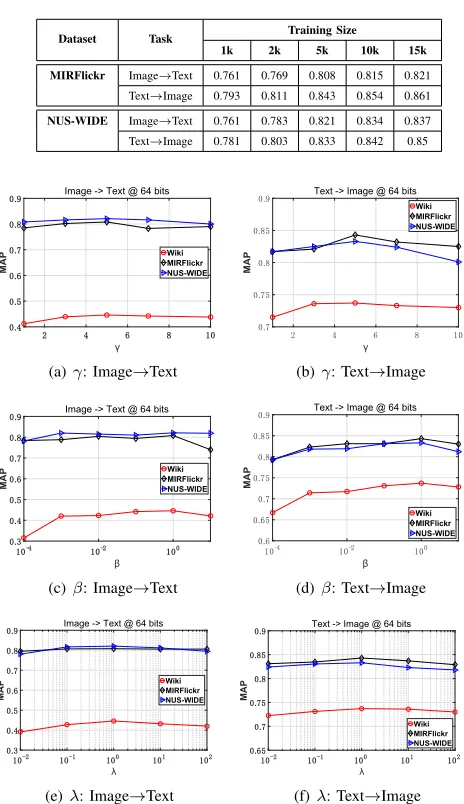
3) Effect of Training Size: Moreover, the variations on the MAP results are evaluated when using different amount of data points in the code learning, as shown in Table IV. Specifically, we report the results on MIRFlickr and NUS-WIDE at64bits
TABLE IV
EFFECT OFTRAININGSIZE ONMIRFLICKR ANDNUS-WIDEATTHE
CODELENGTH OF64.
Dataset Task Training Size
1k 2k 5k 10k 15k
MIRFlickr Image→Text 0.761 0.769 0.808 0.815 0.821 Text→Image 0.793 0.811 0.843 0.854 0.861
NUS-WIDE Image→Text 0.761 0.783 0.821 0.834 0.837 Text→Image 0.781 0.803 0.833 0.842 0.85
2 4 6 8 10
γ 0.4 0.5 0.6 0.7 0.8 0.9 MAP
Image -> Text @ 64 bits
Wiki MIRFlickr NUS-WIDE
(a)γ: Image→Text
2 4 6 8 10
γ 0.7 0.75 0.8 0.85 0.9 MAP
Text -> Image @ 64 bits
Wiki
MIRFlickr NUS-WIDE
(b)γ: Text→Image
10-4 10-2 100 β 0.3 0.4 0.5 0.6 0.7 0.8 0.9 MAP
Image -> Text @ 64 bits
Wiki MIRFlickr NUS-WIDE
(c)β: Image→Text
10-4 10-2 100
β 0.6 0.65 0.7 0.75 0.8 0.85 0.9 MAP
Text -> Image @ 64 bits
Wiki
MIRFlickr NUS-WIDE
(d)β: Text→Image
10-2 10-1 100 101 102
λ 0.3 0.4 0.5 0.6 0.7 0.8 0.9 MAP
Image -> Text @ 64 bits
Wiki MIRFlickr NUS-WIDE
(e) λ: Image→Text
10-2 10-1 100 101 102
λ 0.65 0.7 0.75 0.8 0.85 0.9 MAP
Text -> Image @ 64 bits
Wiki MIRFlickr NUS-WIDE
[image:7.612.319.551.83.485.2](f)λ: Text→Image
Fig. 3. MAP versusγ,βandλat 64 bits on three datasets.
on two retrieval tasks. As can be seen, the MAP values keep increasing with more data points employed in the initial stage and tend to converge after the size of 10,000. It is worth pointing out that SSDMH still achieves competitive results when limited data points (e.g., 5,000) available.
4) Parameter Sensitivity Analysis: We further analyze the retrieval performance variations from adjusting the hyper-parameters in the code learning. By fixing the code length to 64 bits in the experiments, we plot the MAP variations in Fig. 3 when altering γ, β and λ. As can be seen, the MAP results have minor changes when varying the parameters, which indicates that SSDMH is not very sensitive to the hyper-parameters. Moreover, the empirical values ofγ,β andλare close to the optimal settings in the figures and they can make great contribution in yielding superior retrieval performance.
1 2 3 4 5 Number of Iterations 100
102
104
Objective Function Value
Wiki@128 bits
MIRFlickr@128 bits
NUS-WIDE@128 bits
(a)
1 2 3 4 5
Number of Iterations 0
20 40 60 80
Euclidean Loss
Wiki:Image->Text
Wiki:Text->Image
MIRFlickr:Image->Text
MIRFlickr:Text->Image
NUS-WIDE:Image->Text
NUS-WIDE:Text->Image
(b)
Fig. 4. (a) Objective function values after each iteration (t) when solving the unified binary code at 128 bits; (b) Euclidean losses after every iteration (T) when learning the deep hash functions at 128 bits.
Wiki MIRFlickr NUS-WIDE
Dataset
0 0.2 0.4 0.6 0.8 1 1.2
Time
BGD
One Entry
1.18
0.79
0.12 0.16
0.25
0.04
Fig. 5. Time costs (in seconds) in optimizing one row of the unified binary code at 128 bits on three datasets when using BGD and One Entry [30] separately.
in the code learning, while the deep hash functions for two modalities can be built efficiently after 3∼5 iterations.
6) BGD versus One Entry: We further compare the effi-ciency of the proposed BGD and One Entry (namely flipping one entry per time) [30], where the latter one denotes the most representative method in the discrete optimization [24], [31]. As can be observed from Fig. 5, the proposed BGD costs much shorter time, averagely over 80%, against One Entry in solving one row of the unified binary code at 128 bits, thus accelerating the code optimization dramatically. Although some recent papers [24], [36] make minor changes during the discrete optimization, they all utilize the same entry flipping strategy as One Entry. There is no evidence showing that such efficiency issue could be alleviated in their methods.
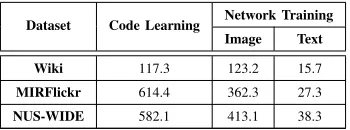
7) Training Efficiency: Finally, the training costs of the proposed SSDMH at 128 bits on three datasets are reported in Table V. There are two main sub processes: code learning and network training, during the optimization in each loop. As can be seen, the optimization for each loop can be done within 18 minutes for most cases. Considering the proposed SSDMH usually converges within T = 5 loops for one code length, the total optimization costs less than 1.5 hours while the values for other cases of short codes are far below.
IV. CONCLUSION
This paper has provided an industrial solution for fast large-scale cross-media retrieval. Specifically, a novel self-supervised deep multimodal hashing method, SSDMH, is presented, where the deep feature learning and the semantic binary code learning are integrated in a unified framework.
TABLE V
TIMECOSTS(INSECONDS)INTHETRAININGPROCESSES OF
SSDMHONTHREEDATASETS AT128 BITSFORONELOOP(T).
Dataset Code Learning Network Training Image Text Wiki 117.3 123.2 15.7
MIRFlickr 614.4 362.3 27.3
NUS-WIDE 582.1 413.1 38.3
Particularly, by solving the discrete constrained objective function in an alternating manner, the unified binary code can be generated directly without relaxation. Moreover, the semantic affinity matrix is utilized in the code learning with the neighborhood structure of original data preserved. Besides, Binary Gradient Descent is proposed toacceleratethe discrete optimization. Extensive experiments on three datasets demon-strate the superiority over several state-of-the-art baselines.
REFERENCES
[1] K. Wang, Q. Yin, W. Wang, S. Wu, and L. Wang, “A comprehensive
survey on cross-modal retrieval,” arXiv preprint arXiv:1607.06215,
2016.
[2] Y. Gao, M. Wang, R. Ji, X. Wu, and Q. Dai, “3-d object retrieval
with hausdorff distance learning,” IEEE Transactions on industrial
electronics, vol. 61, no. 4, pp. 2088–2098, 2014.
[3] W. Hu, G.-P. Liu, and H. Zhou, “Web-based 3-d control laboratory
for remote real-time experimentation,”IEEE Transactions on Industrial
Electronics, vol. 60, no. 10, pp. 4673–4682, 2013.
[4] Z. Stejic, Y. Takama, and K. Hirota, “Relevance feedback-based image retrieval interface incorporating region and feature saliency patterns as
visualizable image similarity criteria,”IEEE Transactions on Industrial
Electronics, vol. 50, no. 5, pp. 839–852, 2003.
[5] F. Shen, Y. Xu, L. Liu, Y. Yang, Z. Huang, and H. T. Shen, “Unsuper-vised deep hashing with similarity-adaptive and discrete optimization,” IEEE Transactions on Pattern Analysis and Machine Intelligence, 2018. [6] Q. Wang, J. Wan, and Y. Yuan, “Deep metric learning for crowdedness
regression,” IEEE Transactions on Circuits and Systems for Video
Technology, 2017.
[7] Q. Wang, Z. Yuan, Q. Du, and X. Li, “Getnet: A general end-to-end 2-d cnn framework for hyperspectral image change detection,” IEEE Transactions on Geoscience and Remote Sensing, DOI 10.1109/T-GRS.2018.2849692, pp. 1–11, 2018.
[8] A. Wanget al., “An industrial strength audio search algorithm.” inIsmir,
vol. 2003, pp. 7–13. Washington, DC, 2003.
[9] J. Oostveen, T. Kalker, and J. Haitsma, “Feature extraction and a
database strategy for video fingerprinting,” inInternational Conference
on Advances in Visual Information Systems, pp. 117–128. Springer, 2002.
[10] J. Han and G. C. Langelaar, “Method and device for generating finger-prints of information signals,” Jan. 18 2018, uS Patent App. 15/301,554. [11] G. Ding, Y. Guo, J. Zhou, and Y. Gao, “Large-scale cross-modality
search via collective matrix factorization hashing,”IEEE Transactions
on Image Processing, vol. 25, no. 11, pp. 5427–5440, 2016.
[12] J. Song, Y. Yang, Y. Yang, Z. Huang, and H. T. Shen, “Inter-media hashing for large-scale retrieval from heterogeneous data sources,” in
ACM SIGMOD ICMD, pp. 785–796. ACM, 2013.
[13] D. Wang, Q. Wang, and X. Gao, “Robust and flexible discrete hashing
for cross-modal similarity search,”TCSVT, 2017.
[14] M. M. Bronstein, A. M. Bronstein, F. Michel, and N. Paragios, “Data fusion through cross-modality metric learning using similarity-sensitive
hashing,” in Computer Vision and Pattern Recognition (CVPR), 2010
IEEE Conference on, pp. 3594–3601. IEEE, 2010.
[15] Z. Lin, G. Ding, M. Hu, and J. Wang, “Semantics-preserving hashing
for cross-view retrieval,” in Proceedings of the IEEE Conference on
Computer Vision and Pattern Recognition, pp. 3864–3872, 2015. [16] X. Xu, F. Shen, Y. Yang, and H. T. Shen, “Discriminant cross-modal
hashing,” inProceedings of the 2016 ACM on International Conference
[image:8.612.53.287.61.157.2] [image:8.612.351.526.93.158.2][17] J. Tang, K. Wang, and L. Shao, “Supervised matrix factorization hashing
for cross-modal retrieval,” IEEE Transactions on Image Processing,
vol. 25, no. 7, pp. 3157–3166, 2016.
[18] X. Chang, Y.-L. Yu, Y. Yang, and E. P. Xing, “Semantic pooling for
complex event analysis in untrimmed videos,”IEEE transactions on
pattern analysis and machine intelligence, vol. 39, no. 8, pp. 1617– 1632, 2017.
[19] Y. Wei, Y. Zhao, C. Lu, S. Wei, L. Liu, Z. Zhu, and S. Yan, “Cross-modal
retrieval with cnn visual features: A new baseline,”IEEE transactions
on cybernetics, vol. 47, no. 2, pp. 449–460, 2017.
[20] Y. Cao, M. Long, J. Wang, and H. Zhu, “Correlation autoencoder hashing
for supervised cross-modal search,” inProceedings of the 2016 ACM on
International Conference on Multimedia Retrieval, pp. 197–204. ACM, 2016.
[21] Y. Cao, M. Long, J. Wang, Q. Yang, and P. S. Yu, “Deep visual-semantic
hashing for cross-modal retrieval,” inProceedings of the 22nd ACM
SIGKDD International Conference on Knowledge Discovery and Data Mining, pp. 1445–1454. ACM, 2016.
[22] X. Li, D. Hu, and F. Nie, “Deep binary reconstruction for cross-modal
hashing,”arXiv preprint arXiv:1708.05127, 2017.
[23] Q.-Y. Jiang and W.-J. Li, “Deep cross-modal hashing,”arXiv preprint
arXiv:1602.02255, 2016.
[24] Y. Luo, Y. Yang, F. Shen, Z. Huang, P. Zhou, and H. T. Shen, “Robust
discrete code modeling for supervised hashing,” Pattern Recognition,
vol. 75, pp. 128–135, 2018.
[25] Q. Wang, G. Zhu, and Y. Yuan, “Statistical quantization for similarity
search,”Computer Vision and Image Understanding, vol. 124, pp. 22–
30, 2014.
[26] Q. Wang, J. Gao, and Y. Yuan, “A joint convolutional neural networks
and context transfer for street scenes labeling,”IEEE Transactions on
Intelligent Transportation Systems, 2017.
[27] A. Krizhevsky, I. Sutskever, and G. E. Hinton, “Imagenet classification
with deep convolutional neural networks,” inAdvances in neural
infor-mation processing systems, pp. 1097–1105, 2012.
[28] M. Luo, X. Chang, Z. Li, L. Nie, A. G. Hauptmann, and Q. Zheng,
“Simple to complex cross-modal learning to rank,” Computer Vision
and Image Understanding, vol. 163, pp. 67–77, 2017.
[29] W. Liu, J. Wang, S. Kumar, and S.-F. Chang, “Hashing with graphs,” in ICML, pp. 1–8, 2011.
[30] F. Shen, C. Shen, W. Liu, and H. Tao Shen, “Supervised discrete
hashing,” inCVPR, pp. 37–45, 2015.
[31] F. Shen, X. Zhou, Y. Yang, J. Song, H. T. Shen, and D. Tao, “A fast
op-timization method for general binary code learning,”IEEE Transactions
on Image Processing, vol. 25, no. 12, pp. 5610–5621, 2016.
[32] N. Rasiwasia, J. Costa Pereira, E. Coviello, G. Doyle, G. R. Lanckriet, R. Levy, and N. Vasconcelos, “A new approach to cross-modal
multime-dia retrieval,” inProceedings of the 18th ACM international conference
on Multimedia, pp. 251–260. ACM, 2010.
[33] M. J. Huiskes and M. S. Lew, “The mir flickr retrieval evaluation,” in ACM Multimedia, pp. 39–43. ACM, 2008.
[34] T.-S. Chua, J. Tang, R. Hong, H. Li, Z. Luo, and Y. Zheng, “Nus-wide: a real-world web image database from national university of singapore,” inProceedings of the ACM international conference on image and video retrieval, p. 48. ACM, 2009.
[35] Y. Jia, E. Shelhamer, J. Donahue, S. Karayev, J. Long, R. Girshick, S. Guadarrama, and T. Darrell, “Caffe: Convolutional architecture for
fast feature embedding,” in ACM Multimedia, pp. 675–678. ACM,
2014.
[36] J. Gui and P. Li, “R 2 sdh: Robust rotated supervised discrete hashing,” inProceedings of the 24th ACM SIGKDD International Conference on Knowledge Discovery & Data Mining, pp. 1485–1493. ACM, 2018.
Gengshen Wuis currently a Ph. D. candidate with School of Computing and Communications at Lancaster University, Lancaster, UK. Previ-ously, he obtained his M.Sc. degree from the University of Sheffield, Sheffield, UK.
Jungong Han is a senior lecturer with the School of Computing and Communications at Lancaster University, Lancaster, U.K and was with the Department of Computer Science at Northumbria University, UK. Previously, he was a senior scientist (2012-2015) with Civolution Technology (a combining synergy of Philips CI and Thomson STS), a research staff (2010-2012) with the Centre for Mathematics and Computer Science, and a researcher (2005-2010) with the Technical University of Eindhoven in Netherlands.
Zijia Linreceived his B.Sc. degree (2011) from School of Software, Tsinghua University, and Ph.D. degree (2016) from Department of Com-puter Science and Technology in the same cam-pus. He is currently associate researcher in Big Data Mining Group of Microsoft Research Asia (MSRA). His research interests include multime-dia information retrieval and machine learning.
Guiguang Ding received his Ph.D degree in electronic engineering from Xidian University, China, in 2014. He is currently an associate professor of School of Software, Tsinghua University. He has published 80 papers in major journals and conferences, including the IEEE TIP, TMM, TKDE, SIG IR, AAAI, ICML, IJCAI, CVPR, and ICCV. His current research centers on the area of multimedia information retrieval, computer vision and machine learning.
Baochang Zhangreceived the B.S., M.S., and Ph.D. degrees in computer science from the Harbin Institute of Technology, Harbin, China, in 1999, 2001, and 2006, respectively. He is cur-rently an Associate Professor with the Science and Technology on Aircraft Control Laboratory, School of Automation Science and Electrical Engineering, Beihang University, Beijing, China.