
Optimizing the perceived value in use of integrated software solutions in a B2B context : a case study on the social domain of Dutch Local Governments
99
0
0
Full text
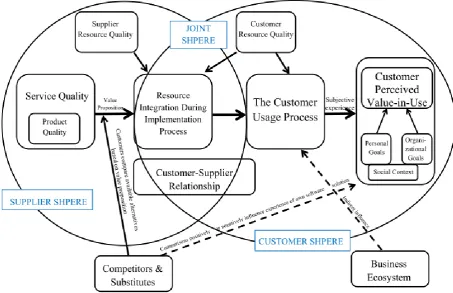
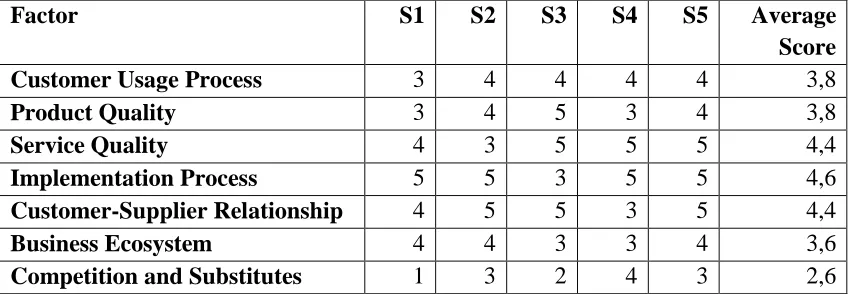
(2) Master Thesis: Optimizing the perceived value-in-use of integrated software solutions in a B2B context Danique Sterenborg. Management Summary The Dutch welfare state system is financially unsustainable in the long run and calls for change. Therefore, previously central government tasks in the field of WMO, Jeugdwet and Participatiewet have been decentralized to local governments in 2015. This means that today, municipalities are responsible for youth care, employment & income, people suffering from long-term illness, and elderly people. In fact, it is a transformation from the welfare state system towards a system in which every citizen contributes and becomes more responsible for taking care of their own welfare and of those people surrounding them. Thereby the local governments take a facilitating role in connecting the ecosystem members. The transition requires municipalities to develop new processes and adjust their existing processes towards it, along with more intensive collaboration among municipalities and institutions in the social domain. An integrated software solution that connects the chain partners and allows centralized documentation would support municipalities to efficiently and effectively manage their new tasks and responsibilities. Following Service-Dominant Logic, a supplier should develop a thorough understanding of customer perceived value-in-use of software solutions and find strategies to optimize value-in-use, in order to be superior to competitors. As this research focuses on the organizational level of value-in-use, the value-in-use perceived by the customer organization (the municipality) is studied. The research objective of this study is threefold: (1) synthesize the current state of knowledge on value creation and value-in-use in the software industry, (2) provide insights on which factors influence the value-in-use of software solutions, and (3) how software suppliers could use value propositions to optimize the perceived value-in-use of their products and services within the social domain of Dutch local governments. This led to the following central research question: How can suppliers optimize the perceived value-inuse of integrated software solutions by customer organizations within the social domain of Dutch local governments? Based on an extensive literature review and a case study at a Dutch software supplier organization consisting of 17 interviews, the concept of value-in-use has been defined and explained and the following six factors influential to value-in-use have been identified: (1) service and product quality, (2) implementation process, (3) customer usage process, (4) customer-supplier relationship, (5) business ecosystem, and (6) competitors and substitutes. Furthermore, a conceptual model has been derived from the six influential factors which also elucidates the different roles of supplier and customer in the value creation process. Overall, customers tend to view the customer usage process, product quality and business ecosystem to 2.
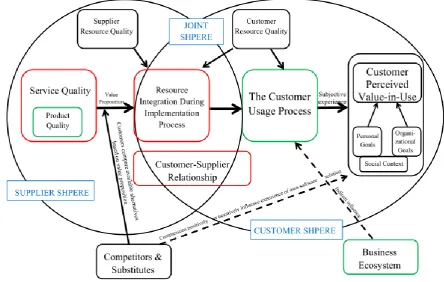
(3) Master Thesis: Optimizing the perceived value-in-use of integrated software solutions in a B2B context Danique Sterenborg. be of higher influence on value-in-use, while suppliers tend to view the service quality, implementation process and the customer-supplier relationship to be of higher influence on customer perceived value-in-use. Finally, three different municipality types based on attitude towards the decentralization and resulting coping strategy have been identified, which are proactive standalone municipalities, municipal cooperations, and reactive municipalities. The attitude and response strategy tend to be largely determined by (1) municipality size and available budget, (2) degree to which municipalities are challenged by the new tasks and responsibilities in the social domain, and (3) incentive to excel and willingness to change and innovate. As a piece of management advice, the results of this study highlight that managers should be aware that, by definition, the customer is in charge of the value creation process during usage of the software solution, and that the supplier organization only has limited influence on this process. Furthermore, managers should focus on the aspects of value-in-use that customers consider to be most influential, which are the customer usage process, product quality and the functionality of the business ecosystem. Although the supplier cannot directly control the customer usage process or the business ecosystem, it can do its best to facilitate the customer to achieve the optimal outcomes out of it. This could for example be done by offering a very intuitive software design which guides the users through clearly defined process stages. Concerning the business ecosystem, the supplier could take initiative to set up more collaborations among chain partners in the social domain or bring (potential) chain partners together in information meetings or events. In addition, managers should recognize the different needs of different types of customer organizations and adjust their value propositions in a way suitable for each type of municipality in order to optimize the respective value-in-use. To illustrate, for proactive standalone municipalities, the value proposition could be more appealing to customers if it contains the opportunity of collaboration, co-creation and innovation. Reactive municipalities are more internally focused organizations and are likely more attracted by value propositions that focus on software solution quality and service quality. The municipal cooperations cooperate with peers and probably favor value propositions containing the possibility of easy establishment of connections with other (existing) software systems, along with product and service quality.. 3.
(4) Master Thesis: Optimizing the perceived value-in-use of integrated software solutions in a B2B context Danique Sterenborg. Foreword This thesis, “Optimizing the perceived value-in-use of integrated software solutions in a B2B context”, is written as a graduation assignment of the Master of Science in Business Administration at the University of Twente in Enschede. The report starts off with an extensive literature review on the concepts of value-in-use and the co-creation of value. Based on a single-case study at a supplier of software solutions, it is assessed how customers experience the value-in-use of software solutions and how software suppliers can use value propositions to optimize the customer perceived value-in-use of software solutions within the social domain of Dutch local governments. This research has been conducted in collaboration with software supplier Topicus Overheid BV, Enschede. During the entire research process, I have received guidance and support from multiple employees at Topicus Overheid all of whom I want to extend my sincere gratitude. In particular, I would like to thank Frank Helmich and Harald Dannenberg who supervised me throughout the process. During the research process, I also received guidance from my supervisor, Michel Ehrenhard, from the University of Twente. I would like to especially thank Michel Ehrenhard for all help and guidance, but also for the tips and interesting ideas he shared with me. I would also like to thank my assessor, Raymond Loohuis, for his guidance and support throughout the entire graduation process. A substantial part of the research is based on interviews with Dutch local governments and employees of Topicus Overheid. In total, 17 in-depth interviews have been conducted. I greatly appreciate the time and effort spent to participate in the interviews as well as the openmindedness and honest opinions the interviewees offered me. Therefore, I would also like to thank all interviewees for their great contribution to this thesis. I hope you enjoy your reading.. Danique Sterenborg Enschede, 24th of August 2017. 4.
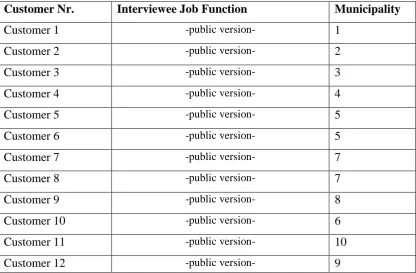
(5) Master Thesis: Optimizing the perceived value-in-use of integrated software solutions in a B2B context Danique Sterenborg. Content Management Summary .............................................................................................................. 2 Foreword .................................................................................................................................... 4 List of Figures ............................................................................................................................ 7 List of Tables .............................................................................................................................. 8 1. Introduction ............................................................................................................................ 9 1.1 Research Background ....................................................................................................... 9 1.2 Research Objective and Research Questions .................................................................. 11 1.3 Research Approach ........................................................................................................ 11 1.7 Case Study Organization: Topicus ................................................................................. 12 1.8 Academic Relevance ...................................................................................................... 14 1.9 Practical Relevance ......................................................................................................... 15 1.10 Outline of the Thesis..................................................................................................... 16 2. Theoretical Framework ........................................................................................................ 17 2.1 Ambiguity of Value Terminology and Concepts ........................................................... 17 2.2 A Paradigm Shift: From Goods-Dominant Logic towards Service-Dominant Logic .... 19 2.3 Value-in-Use ................................................................................................................... 22 2.4 Customer Solutions & Value Creation in Business Ecosystems .................................... 24 2.5 Assessing Value-in-Use in a Solutions Context ............................................................. 26 2.5.1 Individual vs. Collective Value-in-Use.................................................................... 28 2.5.2 Service and Product Quality .................................................................................... 29 2.5.3 Integration Process of Supplier Resources and Customer Resources ...................... 30 2.5.4 Customer Usage Process .......................................................................................... 31 2.5.5 The Customer-Supplier Relationship ....................................................................... 32 2.5.6 The Business Ecosystem .......................................................................................... 32 2.5.7 Competition and Substitute Products ....................................................................... 33 3. Methodology ........................................................................................................................ 34 3.1 Research Design ............................................................................................................. 34 3.2 Interviews ....................................................................................................................... 35 3.2.1 Interviewee Selection Method ...................................................................................... 35 3.2.2 The Semi-Structured Interview Method .................................................................. 38 3.2.3 Interview Coding Method ........................................................................................ 39 3.2.4 Interview Data Quality ............................................................................................. 39 5.
(6) Master Thesis: Optimizing the perceived value-in-use of integrated software solutions in a B2B context Danique Sterenborg. 3.2.5 Transcripts and Audio Records of the Interviews .................................................... 40 3.3 Data Collection and Data Analysis ................................................................................. 40 4. Results .................................................................................................................................. 41 4.1. Value-in-Use of Software Solutions From a Customer Perspective ......................... 41. 4.1.1 Goals and Expectations of Software Solutions in the Social Domain ..................... 41 4.1.2 Product and Service Quality .................................................................................... 45 4.1.3 The Implementation Process .................................................................................... 46 4.1.4 The Customer Usage Process ................................................................................... 48 4.1.5 The Customer-Supplier Relationship ....................................................................... 51 4.1.6 The Business Ecosystem .......................................................................................... 53 4.1.7 Competition and Substitutes .................................................................................... 54 4.1.8 Conceptual Model of the Factors Influential on Customer Perceived Value-in-Use ..................................................................................................................... 56 4.2. Customer vs. Supplier Perspective on Value-in-Use................................................. 58. 4.3 The Municipality’s Attitude and its Influence on Value-in-Use .................................... 62 4.3.1 Proactive vs. Reactive Municipalities ..................................................................... 62 4.3.2 Implications of Municipality Attitude for Perceived Value-in-Use......................... 68 5. Discussion and Conclusion .................................................................................................. 71 5.1 Key Findings and Contributions to Theory .................................................................... 71 5.2 Limitations and Recommendations for Future Research ............................................... 75 5.3 Managerial Implications ................................................................................................. 76 6. Research Ethics .................................................................................................................... 78 References ................................................................................................................................ 79 Appendices ............................................................................................................................... 87 Appendix I – Differences between GD logic and SD logic ................................................. 87 Appendix II – Supplier and Customer Perspectives on Factors Influential on Customer Perceived Value-in-Use ........................................................................................................ 88 Appendix III – Municipality Characteristics Data ............................................................... 89 Appendix IV – Overview of the Propositions ...................................................................... 96. 6.
(7) Master Thesis: Optimizing the perceived value-in-use of integrated software solutions in a B2B context Danique Sterenborg. List of Figures Figure Figure 1: Software Solution TOP Integrates the Chain within the Social Domain of. Page 14. Local Governments. Figure 2: The Value Creation Spheres.. 37. Figure 3: Conceptual Model of the Factors Influential on Customer Perceived. 57. Value-in-Use. Figure 4: Conceptual Model of the Most Influential Factors on Value-in-Use. 59. According to Customer and Supplier Perspective. 7.
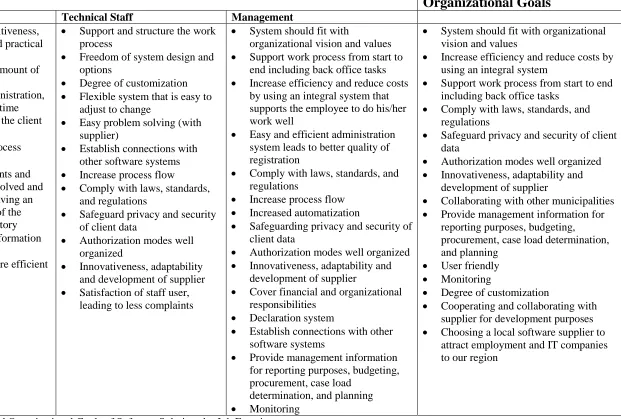
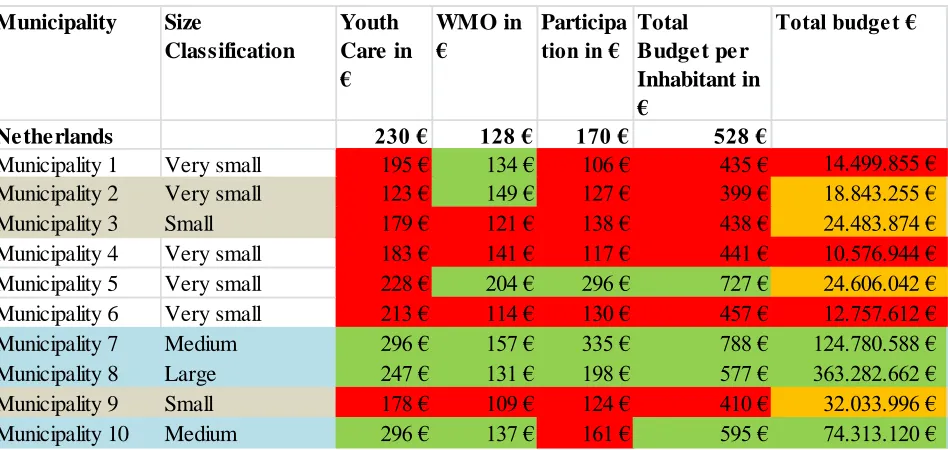
(8) Master Thesis: Optimizing the perceived value-in-use of integrated software solutions in a B2B context Danique Sterenborg. List of Tables Table. Page. Table 1: The Ten Foundational Premises of S-D Logic. 21. Table 2: Definitions of Value-in-use. 23. Table 3: Overview Customer Interviewees. 36. Table 4: Local Districts Participants – Demographics. 37. Table 5: Overview Supplier Organization Interviewees. 37. Table 6: Personal and Organizational Goals of Software Solutions by Job Function. 44. Table 7: Summary of Key Characteristics of Proactive and Reactive Municipalities. 67. in the Social Domain Table 8: Supplier Perspective on Factors Influential on Customer Perceived. 88. Value-in-Use by Relative Importance Table 9: Customer Perspective on Factors Influential on Customer Perceived. 88. Value-in-Use by Relative Importance Table 10: Budget for the Social Domain per Municipality. 89. Table 11: Growth by Population per Municipality. 90. Table 12: Political Orientation per Municipality Based on Elections of 2017 and. 91. 2012 Table 13: Unemployment, Persons with Financial State Support and Participation. 92. per Municipality Table 14: Number of Inhabitants with Mental Health Care, Home Nursing and. 93. Long-term Care per Municipality Table 15: Single-Parent Households, Number of Inhabitants with Youth Care,. 94. Juvenile Probation, Teen Moms, and Reported Child Abuse per Municipality Table 16: Registered Criminality per Municipality. 95. 8.
(9) Master Thesis: Optimizing the perceived value-in-use of integrated software solutions in a B2B context Danique Sterenborg. 1. Introduction 1.1 Research Background After World War II, the Netherlands created a welfare state system. In such a system, the state is responsible for the welfare of its citizens in terms of healthcare, social welfare, employment and income. The related costs are mainly covered through tax income. However, as the Dutch society is aging and birth rates decline, the taxable income from the workforce decreases. At the same time, costs rise due to higher life expectancies and corresponding increased demand in healthcare and social care over a longer time period. As a result, the Dutch welfare state system is financially unsustainable and thus calls for change (Ehrenhard, Muntslag & Wilderom, 2012). Therefore, a decentralization of government responsibilities to local. governments. has. taken. place. (Ministerie. van. Binnenlandse. Zaken. en. Koninkrijksrelaties, 2014). The decentralization in 2015 concerned the transition of WMO, Jeugdwet and Participatiewet to the social domain of Dutch local governments. This indicates that since 2015, Dutch local governments are responsible for youth care, employment & income, people suffering from long-term illness, and elderly people (Rijksoverheid, 2017). The objective of the decentralization is to save costs while maintaining the level of society’s welfare by appealing on selfreliance and participation of citizens in society. Therefore, each municipality receives a budget from the Dutch government, and is responsible for the allocation and spending of the budget. At the time the social domain was under the government’s control, persons or families with complex problems (so called “multi-problem families”) had to cooperate with a number of different organizations in order to receive the help and support they needed. Accordingly, at each organization they also had to explain their problems anew and deal with registrations and formalities. This puts an additional pressure of rules and regulations on these people. The decentralization aims at reducing the pressure of rules and regulations for citizens with complex problems by providing a single point of contact for all issues they are dealing with within the boundaries of the social domain. This is summarized in the phrase “1 family, 1 plan, 1 supervisor” which means that – in each case where there are issues in social, health or financial matters – there should be a plan on a family level which is supervised by one professional and his/her team (Rijksoverheid, 2017). In sum, the decentralization concerns a transformation from the traditional Dutch welfare state system towards a system in which 9.
(10) Master Thesis: Optimizing the perceived value-in-use of integrated software solutions in a B2B context Danique Sterenborg. every citizen contributes and becomes more responsible for taking care of their own welfare and of those people surrounding them. Thereby, the Dutch local governments take a facilitating role in connecting the ecosystem members. In fact, the Netherlands is not the only country that is redefining government tasks and responsibilities. Governments from all over the world are looking for ways to better support citizen and reduce costs while at the same time stimulating innovation in order to spur economic growth. It challenges governments to engage stakeholders and solve societal problems by utilizing new methods, practices and new government models. A trend arises towards so-called lean governments, which aims at reducing the complexity of the public sector by simplifying and streamlining organizational structures and processes, while at the same time stimulating innovation by mobilizing stakeholders (Janssen & Estevez, 2013; Ehrenhard et al., 2012). However, the new tasks and responsibilities in healthcare, welfare, employment and income, combined with a pressure to reduce costs, initially forms a challenge to Dutch local governments. In order to fulfil these new tasks and responsibilities, local governments have to develop new processes and adjust their existing processes towards it. This translates into more active participation of citizens and local governments operating more closely to their citizens as facilitators (Wijnhoven, Ehrenhard & Kuhn, 2015). For example, with local district teams of social workers who support households that face problems in upbringing their children or in financial matters. As a result, some previously back office tasks, such as the allocation of social care or healthcare, will become front office tasks performed by the local district teams. Some processes may be outsourced, and local governments will likely cooperate on a regional level for procurement to save costs. Furthermore, overall operating efficiency has to be increased due to the tight set budgets that are made available by the government. In order to achieve higher efficiency, the entire chain of institutions and organizations in the social domain has to cooperate more closely and needs to be better connected. Managing these changes successfully requires software that supports the new systems and processes. As a result, the decentralization means a new business opportunity for software suppliers. Software suppliers can extent their existing customer base and increase sales by developing software solutions that help Dutch local governments manage their new tasks and responsibilities more easily while integrating the chain to reach higher efficiently levels and better collaboration. However, in order to know how to deliver software of superior value to its customers and create competitive advantage over its competitors, it is essential for 10.
(11) Master Thesis: Optimizing the perceived value-in-use of integrated software solutions in a B2B context Danique Sterenborg. software suppliers to develop a thorough understanding of the concept of value-in-use and how value propositions can be used to optimize customer perceived value-in-use of software solutions in the social domain of Dutch local governments.. 1.2 Research Objective and Research Questions The research objective of this study is threefold: (1) synthesize the current state of knowledge on value creation and value-in-use in the software industry, (2) provide insights on which factors influence the value-in-use of software solutions, and (3) how software suppliers could use value propositions to optimize the perceived value-in-use of their products and services within the social domain of Dutch local governments. Central Research Question: How can suppliers optimize the perceived value-in-use of integrated software solutions by customer organizations within the social domain of Dutch local governments? Subquestions: 1. What is the value-in-use of integrated software solutions within the social domain of local governments in the Netherlands? a. How do customers view value-in-use of software solutions? b. How do suppliers of software solutions view customer perceived value-in-use? 2. Which factors influence the customer perceived value-in-use of software solutions? 3. How can software solution suppliers adjust their value propositions in order to optimize the perceived value-in-use?. 1.3 Research Approach As a foundation to this research, a systematic literature review on the concepts of value creation and value-in-use has been conducted through the lens of the Service-Dominant Logic. In order to gain a more holistic understanding of how value is being created and how value-in-use arises, a single-case study is undertaken at the Dutch software supplier Topicus Overheid, which provides chain-integrating software solutions for the social domain of Dutch local governments. Furthermore, it was chosen to study value-in-use on an organizational level, and thus, a focus was drawn to the supplier-customer relationship. Based on the 11.
(12) Master Thesis: Optimizing the perceived value-in-use of integrated software solutions in a B2B context Danique Sterenborg. knowledge gained from the literature review, factors that are influential to value-in-use are identified and propositions are formulated. Based on the findings from the theoretical framework, the concept of value-in-use and its influential l factors have been discussed in 17 semi-structured interviews with (1) Topicus Overheid’s customers, which are employees (e.g. information manager, functional IT analyst or IT consultant) at Dutch municipalities, as well as (2) employees of different professional expertise of Topicus Overheid. Based on the case study results, the propositions formulated in the theoretical framework have been confirmed, adjusted, or rejected. Furthermore, a conceptual model of the factors influential to customer perceived value-in-use has been developed, three different types of municipalities have been identified, and suggestions are given with respect to the value propositions for the different municipality types.. 1.7 Case Study Organization: Topicus Topicus is an innovative Dutch software supplier that is founded in 1998 and has more than 700 employees. The company has offices in Amsterdam, Leiden, Deventer, Zwolle, Groningen and Enschede. Topicus offers software solutions for four different sectors: Education, Healthcare, Finance, Government, and Legal. Topicus is known for its focus on chain integration, use of SaaS applications, and desire to deliver smart software solutions to today’s fast-changing economy that improve the lives of citizens and society as a whole. In particular, Topicus strives for improving education, increasing transparency in finance, better access to healthcare and healthy relationships of citizens with their local governments. Therefore, Topicus designs software solutions that enhance citizens ability of control and also provides citizens the opportunity to increase selfreliance (Topicus, 2017). The Government division, Topicus Overheid, is the case study organization that is being studied in this research. According to Topicus’ view, institutions and organizations are not stand-alone entities. Rather, they are part of a whole chain. Based on its accumulated knowledge and experience in software, Topicus integrates institutional and organizational chains in order to improve its functionality and better fulfil the desirabilities and needs of chain stakeholders. Optimizing. 12.
(13) Master Thesis: Optimizing the perceived value-in-use of integrated software solutions in a B2B context Danique Sterenborg. the exchange of information among the entire chain by using smart software solutions is what Topicus aims to do (Topicus, 2017). Topicus offers most of its software solutions in form of Software-as-a-Service (SaaS), also known as Software on Demand. SaaS is a type of cloud computing service delivery model (Marston et al., 2011). With SaaS, the client has on-demand access to the software applications they need on a cloud infrastructure via a web browser. The cloud infrastructure including the network, servers, operating systems and the application software is hosted by the supplier (Chou, 2015). This eliminates the need to install and run the application on the client’s hardware (Marston et al., 2011). Basically, the client only subscribes for an application without the need to buy, install and maintain the software. The supplier assures quality of service as the supplier is the responsible party for the maintenance, application upgrades and backups of the software services (Yang et al., 2015). Examples of SaaS include Google Apps and Salesforce.com (Laudon & Laudon, 2012). Topicus has demonstrated to be a reliable and solid partner in the field of software solutions. A few examples to illustrate: . Over 4200 schools use the ParnaSys system for primary education. . Topicus organizes the declarations for over 4000 general practitioners. . The digital dossier JGZ (KD+) has a market share of 40%. . Incumbent banks such as ING and Rabobank use software of Topicus for mortgages and credits. In response to the decentralization of WMO, Jeugdwet and Participatiewet in 2015 (Rijksoverheid, 2017), Topicus launched the Government division (Topicus Overheid). This division currently has about 35 employees and is located in Enschede. Topicus Overheid developed the Topicus Overheid Platform, shortly TOP, which assists Dutch local governments to perform their new tasks in the social domain. TOP delivers software for the entire process of intake to making support plans, including the procurement of healthcare from providers and handling declarations. TOP enables information sharing among all organizations, institutions, and persons involved while ensuring a secured exchange of 13.
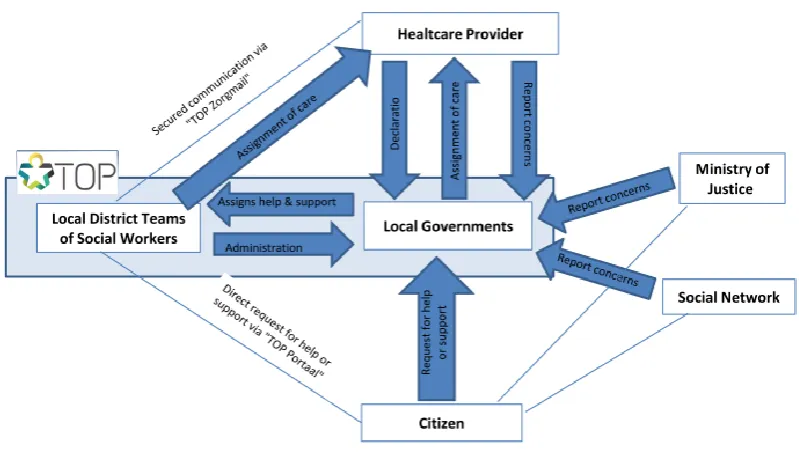
(14) Master Thesis: Optimizing the perceived value-in-use of integrated software solutions in a B2B context Danique Sterenborg. information. In addition, TOP increases the automatization of processes and lowers the burden of administration (no more double administration), which in turn enables a better and faster handling of processes. In addition, Topicus easily makes connections with other (existing) systems of other suppliers whom – based on degree of authorization – can also work in the integral system. To date, TOP is implemented at over 60 Dutch local governments of different sizes and spread across the entire nation. Figure 1 below shows a conceptualization of how TOP integrates the chain in the social domain of local governments. As can be derived from the figure, the main stakeholders are Dutch citizen, local district teams of social workers, healthcare providers, local government employees, Topicus’ software engineers, as well as the social network of the citizen in question.. Figure 1: Software Solution TOP Integrates the Chain within the Social Domain of Local Governments.. 1.8 Academic Relevance This exploratory and empirical study contributes to the academic field of research into value-in-use and customer perceptions of software solutions in a B2B setting. In prior research, value-in-use is usually discussed at an abstract level, while empirical investigations on software solutions from a customer perspective are scant. As recognized by Jaakkola & Hakanen (2013), much of the research in the field of solutions relies on suppliers' perceptions of the value that could be accrued by customers, rather than investigations based on the 14.
(15) Master Thesis: Optimizing the perceived value-in-use of integrated software solutions in a B2B context Danique Sterenborg. customers' actual value perception (i.e. Vargo & Lusch, 2004; 2008) or experience of value (Schembri, 2006; Helkkula, Kelleher & Pihlström, 2012). Throughout an extensive literature review of recent articles published in top-tier scientific journals about the topics of value-inuse, co-creation of value, and S-D logic, the current state-of-the-art in this research field has been synthesized. Furthermore, the literature review reveals several factors (see section 2.5) that are related to customer perceived value-in-use. However, none of the reviewed studies covers all factors identified in the current research, and besides that, the studies originate from different contexts, industries and nations (e.g. customer solutions or manufacturing; a study conducted in China). The contribution of this study is threefold. First, all identified factors in literature related to customer perceived value-in-use have been synthesized. Second, the existence and importance of the identified factors influential to customer perceived value-inuse of software solutions has been empirically investigated. And third, to the researcher’s best knowledge, this is the first empirical study on the value-in-use of software solutions from an organizational perspective in the specific context of local governments.. 1.9 Practical Relevance Besides the academic relevance, this study also carries practical relevance to suppliers of software solutions – and in particular to case study organization Topicus Overheid. As pointed out by Helander & Ulkuniemi (2012), high-technology industries have often been accused of being too engineering and technology driven during the development of new products and services, while paying insufficient attention to the customer experience. As a result, the supplier’s perspective of customer perceived value-in-use of their products and services may significantly deviate from the customer’s perspective and experience, ultimately leading to lower levels of customer satisfaction and a decreased competitive advantage (Gummerus, 2013). In addition, due to the complex and abstract nature of integrated software solutions, developing an understanding of customer needs might also be more challenging than in more traditional industries such as retail. The context-dependent nature of value has been emphasized in literature (e.g. Vargo, Maglio, & Akaka, 2008; Schembri, 2006; Edvardsson, Tronvoll & Gruber, 2011; Vargo & Lusch, 2016). By focusing on the software solutions industry within the context of the social domain of Dutch local governments, this study especially provides useful insights for managers within this specific domain, and likely also to software supplying organizations in general. This study offers managers the insights necessary to develop a greater understanding of customer perceived value-in-use of software 15.
(16) Master Thesis: Optimizing the perceived value-in-use of integrated software solutions in a B2B context Danique Sterenborg. solutions, and delivers suggestions how value propositions can be adjusted in order to enhance the customer perceived value-in-use.. 1.10 Outline of the Thesis The thesis is structured as follows. Chapter 1 concerns the Introduction, wherein the background to the research, research objective and research questions, research approach, a case study organization description, as well as the academic and practical relevance of the study are given. In Chapter 2, the Theoretical Framework is presented covering the topics of (1) value terminology and concepts, (2) service-dominant logic, (3) value-in-use, and (4) customer solutions and value creation in business ecosystems. Chapter 3 is about the Methodology and describes the research design, the methods applied for data collection and data analysis, as well as how and why the interview participants have been selected. Subsequently, in Chapter 4, the Results are discussed and the propositions formulated in the theoretical framework are revisited. Finally, in Chapter 5, the Conclusion is presented along with managerial implications, limitations of the research, and suggestions for future research.. 16.
(17) Master Thesis: Optimizing the perceived value-in-use of integrated software solutions in a B2B context Danique Sterenborg. 2. Theoretical Framework 2.1 Ambiguity of Value Terminology and Concepts “The primary pursuit of business is creating and maintaining value” (Sirmon, Hitt, & Ireland, 2007, p. 273). This makes value an important factor in corporate decision-making, especially because managers, in general, tend to undertake or invest in projects that yield maximization of customer value (Chou, 2015; Gummerus, 2013). So, understanding what value is and which processes are underlying value creation is essential for managers. Furthermore, due to its importance in business, value creation is a central concept in management and organizational literature. As such, one would assume that value creation is a well-understood concept to both managers and researchers. However, this is not the case. In marketing literature, there is no consensus and several competing conceptualizations of customer value exist (Gummerus, 2013; Lepak, Smith & Taylor, 2007). Also, many published studies take the abstract concept of (business) value for granted and do not investigate how it is defined, used across different industries or how it is measured. As a result, the concept of value is applied and measured in many different ways. For instance, some studies use return on investment as a measurement of value, whereas others measure value through the aspect of perceived customer value (Alahyari, Svensson & Gorschek, 2017). The different conceptualizations of value can be traced to the heterogeneous nature of the parties or targets for which value is created as well as the potential sources or creators of value, both depending on the type of business being considered. Besides, value creation refers both to the content and process of new value creation (Lepak, Smith & Taylor, 2007). Thus, value appears to be a rather complex construct which “has been discussed and debated since Aristotle” (Vargo, Maglio & Akaka, 2008, p. 146). In its traditional form, value is understood in terms of profit generation (Alahyari, Svensson & Gorschek, 2017). Similarly, Cronk and Fitzgerald (1999, p. 45) define value as the “worth, desirability or utility of a thing” and state that what constitutes a certain value for an individual depends on many different factors. Furthermore, Zeithaml (1988, p. 14) argues, “value is the customer’s overall assessment of the utility of a product based on perceptions of what is received and what is given”. In marketing literature, value is often conceptualized as the subjective perception of the trade-off between benefits and sacrifices – which might be both monetary and nonmonetary (Ravald & Grönroos, 1996; Slater, 1997). Non-monetary benefits might include delivery time, personal interaction and service support, while non-monetary sacrifices can include effort, time and energy spent (Helander & Ulkuniemi, 2012). 17.
(18) Master Thesis: Optimizing the perceived value-in-use of integrated software solutions in a B2B context Danique Sterenborg. Valuation, in turn, is an “economic process that identifies the value of actions in an organization” (Chou, 2015, p. 74). Bowman & Ambrosini (2000) argued that in an organizational context, value consists of two components, namely perceived use value and exchange value. First, perceived use value is determined by the customer based on their perceptions or experience regarding the usefulness or quality of the offered product or service in relation to their needs. Thus, use value is subjective and purchase decisions are based on the consumer’s expected surplus from the offering. The monetary value is the amount the customer is willing to pay for the product or service. Secondly, exchange value relates to the monetary amount realized at the point of sale for the perceived use value (Bowman & Ambrosini, 2000; Lepak, Smith & Taylor, 2007). This view implies that organizations create potential perceived use value and capture exchange value (Adner & Kapoor, 2010). Organizations that offer a higher expected consumer surplus of use value than its competitors – resulting in a higher willingness to pay – likely capture higher exchange values. These terms are also referred to as value-in-exchange and value-in-use in literature (Vargo and Lusch, 2004; 2006, Vargo, Maglio & Akaka, 2008; Ballantyne & Varey, 2006; Grönroos & Voima, 2013; Macdonald, Kleinaltenkamp & Wilson, 2016; Marcos-Cuevas et al., 2016). Ritala et al. (2013, p. 5) propose the following definition of value creation: “the collaborative processes and activities of creating value for customers and other stakeholders”. Lepak, Smith & Taylor (2007, p. 182) argue that the two definitions of value – use value and exchange value – introduced by Bowban & Ambrosini (2000) in the previous section “suggest that value creation depends on the relative amount of value that is subjectively realized by a target user (or buyer) who is the focus of value creation […] and that this subjective value realization must at least translate into the user’s willingness to exchange a monetary amount for the value received”. Furthermore, value capture, also referred to as value appropriation, refers to “the individual firm-level actualised profittaking; that is, how firms eventually pursue to reach their own competitive advantages and to reap related profits” (Ritala et al., 2013, p. 5). Although value capture usually concerns an individual firm-related activity, it is also possible for firms to collaboratively capture value (Adner & Kapoor, 2010; Ritala et al., 2013). Adner and Kapoor (2010) argued that value creation precedes value capture. Moreover, following Lepak, Smith & Taylor (2007), value creation and value capture should be viewed as distinct processes, since the source that creates a value increment may or may not be able to capture the value in the long run. Instead, value created by one source or at one level of analysis might be captured at another, which is referred to as value slippage. For value creation activities to endure, two important economic 18.
(19) Master Thesis: Optimizing the perceived value-in-use of integrated software solutions in a B2B context Danique Sterenborg. conditions may be necessary. First, the monetary amount exchanged must exceed the producer’s resources spent – such as money, time, effort, etc. – of creating the value in question. Second, the monetary amount that a customer will exchange is based on the perceived performance difference between the new value that is created from the product or service at hand, and the customer’s closest alternative. In general, without these excesses, neither the customer nor the creator of value would be inclined to repeatedly engage in these activities in the long run (Lepak, Smith & Taylor, 2007). As indicated before, the concept of value is applied and measured in many different ways, and several attempts to create conceptualizations of value have emerged (Grönroos & Voima, 2013; Gummerus, 2013). Early studies tended to conceptualize value on an individual level by assessing value through (1) a Benefits-Sacrifice Framework in which the perceived customer value is determined by a trade-off of benefits and sacrifices or costs which a customer has to incur over time (Zeithaml, 1988; Slater 1997; Vargo & Lusch, 2004; Eggert & Ulaga, 2002), or (2) Means-Ends Models (Woodruff 1997; Gutman 1982; Zeithaml, 1988) wherein value is assessed in terms of product attributes and its consequences in use. In more recent studies, a shift can be observed towards a more holistic and experiential perspective that traces value in to customer experiences (e.g., Schembri, 2006; Payne et al, 2008; Heinonen et al., 2010; Helkkula et al, 2012; Grönroos & Voima, 2013; Ranjan & Read, 2016). Indeed, as pointed out by Helander & Ulkuniemi (2012, p. 27), the current understanding of value as a subjective construct based on customer perceived value, makes it very difficult to measure the created value since “the value created by the supplier is in the end measured in the mind of the customer”. This shift towards measuring value in terms of customer experiences appears to be in line with the paradigm shift from the goods-dominant logic towards the service-dominant logic, which will be described in the following section.. 2.2 A Paradigm Shift: From Goods-Dominant Logic towards Service-Dominant Logic Organizations are increasingly shifting from a goods-dominant logic (G-D logic) towards a service-dominant logic (S-D logic). These two logics differ in the way value and value creation is viewed. The traditional G-D logic refers to ‘value-in-exchange’ (Bowman & Ambrosini, 2000; Vargo & Lusch, 2004; Lepak, Smith & Taylor, 2007), and focuses on the exchange of operand resources (Constantin & Lusch, 1994; Vargo et al., 2008). Operand resources are “resources on which an operation or act is performed to produce an effect” 19.
(20) Master Thesis: Optimizing the perceived value-in-use of integrated software solutions in a B2B context Danique Sterenborg. (Vargo & Lusch, 2004, p. 2), such as tangible goods. Differently, operant resources are resources “which are employed to act on operand resources (and other operant recourses)” (Vargo & Lusch, 2004, p. 2). Operant resources are often invisible and intangible and produce effects, like knowledge and skills as well as organizational core competences or processes. Operant resources typically are dynamic and infinite, unlike operand resources which are static and finite. Since G-D logic considers operand resources as primary to the organization, and views operant resources (such as technology and services) as tools to convert operand resources into units of output, it assumes that value is embedded in products created and services performed by the firm (Vargo & Lusch, 2004; 2008; Vargo, Maglio & Akaka, 2008). Typically, these products and services are standardized and firms compete on price and economies of scale (Vargo & Lusch, 2008). From this traditional perspective, the roles of producers and customers are distinct and value creation occurs inside firm, assuming that the firm is in control of value creation (Grönroos & Voima, 2013). For example, the concept of the value chain by Porter (1980), symbolizes the unilateral role of the firm as a creator of value. Herein the firm is the producer of value whereas the customer is a consumer of value and does not take part in the value creation process (Prahalad & Ramaswamy, 2004). The new logic, S-D logic, was introduced by Vargo & Lusch (2004) and is based on ten foundational premises (see Table 1). Opposed to G-D logic, S-D logic focuses on the action of operant resources upon other resources, and value arises from the “beneficial application of operant resources, which are sometimes transmitted through operand resources or goods” (Vargo, Maglio & Akaka, 2008, p. 148). This logic emphasizes the potential for co-creation of value through combined efforts and sharing of knowledge and resources between customers, suppliers, and other stakeholders, but the actual value is always determined by the beneficiary, which is the customer (Vargo, Maglio & Akaka, 2008; see FP 10 in Table 1). The roles of customers and producers are not distinct, but through the integration of resources value is co-created jointly and reciprocally (Vargo, Maglio & Akaka, 2008; Gummerus, 2013). Indeed, the role of the customer has changed from isolated to connected, from unaware to informed, and from passive to active (Prahalad and Ramaswamy 2004). Typical for this logic are continuous exchange processes and the development of dyadic relationships among customer and supplier (Ballantyne & Varey, 2006; Vargo & Lusch, 2008; 2004). S-D logic focuses more on the customer experience and is tied to the value-in-use concept (Vargo & Lusch, 2004; 2008; Vargo et al., 2008; Schembri, 2006), which is discussed in further detail in section 2.3. 20.
(21) Master Thesis: Optimizing the perceived value-in-use of integrated software solutions in a B2B context Danique Sterenborg. A further distinction between G-D logic and S-D logic can be found in the conceptualization of service. First, G-D logic assumes value to be embedded in products and economic exchange is based on units of output. Thereby, service is viewed as a type of intangible good that supplements operand resources. However, in S-D logic service is defined as “the application of competences (knowledge and skills) for the benefit of another party” (Vargo & Lusch, 2008, p. 257), and the fundamental unit of (economic) exchange are specialized skills and knowledge (see FP1). Sometimes, goods are involved to convey competences (e.g. as a distribution mechanism for service provision; see FP3) but the essential source of value creation lies in services (i.e. competences, knowledge, skills) and not in the goods. Thus, in S-D logic, operant resources are viewed as primary as they are the producers of effects. In sum, G-D logic considers services as (somewhat inferior to goods) units of output, while S-D logic views service as a process of doing something for another party. As a result, the locus of value creation moves from the producing firm towards collaborative processes and co-creation between market actors. Thus, S-D logic represents a shift in logic of exchange and primacy of resources, not just a shift in type of product that is under investigation (Vargo & Lusch, 2008). Schembri (2006) delivered an elaboration on the first eight foundational premises by Vargo & Lusch (2004) and argues that the assumptions underlying the foundational premises are implicitly based on the rationalistic philosophy of G-D Logic. Some more recent studies (i.e. Schembri & Sandberg, 2002; Schembri, 2006; Sandström et al., 2008; Helkkulla et al 2012; Ranjan & Read, 2016) highlight the importance of the customer’s value experience. Appendix A shows an overview of the differences among G-D logic and S-D logic. FP1 FP2 FP3 FP4 FP5. Foundational Premise The application of specialized skills and knowledge is the fundamental unit of exchange. Indirect exchange masks the fundamental unit of exchange. Goods are distribution mechanisms for service provision. Knowledge is the fundamental source of competitive advantage. All economies are service economies.. FP6 FP7 FP8 FP9. The customer is always a co-creator of value. The enterprise can only make value propositions. A service-centered view is customer oriented and relational. Organizations exist to integrate and transform micro-specialized competences into complex services that are demanded in the marketplace. FP10 Value is always uniquely and phenomenologically determined by the beneficiary. Table 1: The Ten Foundational Premises of S-D Logic (Vargo & Lusch, 2004; 2006; Vargo, Maglio & Akaka, 2008).. 21.
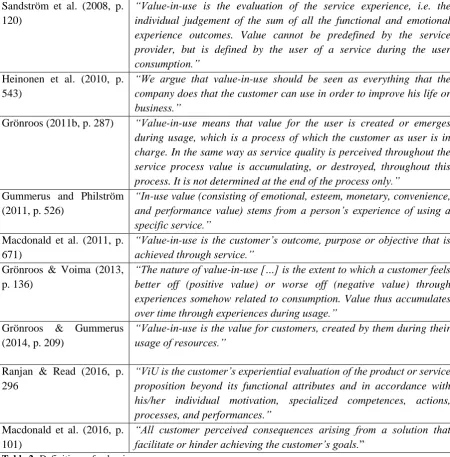
(22) Master Thesis: Optimizing the perceived value-in-use of integrated software solutions in a B2B context Danique Sterenborg. 2.3 Value-in-Use Value-in-use is strongly connected to S-D logic. Table 2 shows several definitions of value-in-use. In its most general form, value-in-use concerns the value that arises for the customer during the usage process of a product or service – which is a process the customer is in charge of, not the firm. Thus, value-in-use is driven by the customer’s usage process and the resulting customer experience determines the value of that product and/or service (e.g. Vargo & Lusch, 2004; Ballantyne & Varey, 2006; Schembri, 2006; Sandström et al.,2008; Grönroos, 2011b; Gummerus and Philström, 2011; Helkkula, 2012; Gummerus, 2013; Grönroos & Gummerus, 2014; Ranjan & Read, 2016). Indeed, this implies that the firm can only make value propositions and create potential value-in-use (Vargo & Lusch, 2004; Ballantyne & Varey, 2006; Sandström et al., 2008; Grönroos & Voima, 2013; Skålén et al, 2015), as operand resources cannot have embedded value because they only contain value to the extent they serve customer’s needs (Ballantyne & Varey, 2006). However, sometimes the value-in-use of operant resources is transmitted through operand resources (Vargo & Lusch, 2004; Sandström et al., 2008). Ballantyne & Varey (2006, p. 334-335) define value propositions as “reciprocal promises of value, operating to and from suppliers and customers seeking an equitable exchange”. Thus, in the value co-creation process, the supplier has a facilitating role for delivering potential value-in-use, and the customer is the operant resource that actually creates and determines value-in-use (Grönroos, 2011a; Normann and Ramírez 1993). Thus, as stated by Skålén et al. (2015) value propositions should be evaluated from the customer’s perspective of value creation and experience of value through services. Moreover, value-in-use is not a constant concept, but rather concerns continuous exchange processes between the customer and the firm, and value is accumulated over time (Grönroos, 2011b; Grönroos & Voima, 2013; Gummerus, 2013; Grönroos & Gummerus, 2014). Some authors attach value-in-use to functional outcomes (Payne and Holt, 2002; Sandström et al., 2008; Macdonald et al., 2011), whereas others emphasize customer goals (Flint, Woodruff, & Garial, 1997; Payne and Holt, 2002; Ranjan & Read, 2016; Macdonald et al., 2016) or benefits (Vargo & Lusch, 2004; Heinonen et al., 2010). Overall, the concept indicates that the customer’s value perception is subjective and determined by experiences, learning, and the evaluation of processes and interactions with the supplier organization (Ballantyne & Varey, 2006; Schembri, 2006; Grönroos & Voima, 2013; Helkkula et al., 2012; Gummerus, 2013). Thus, with value-in-use, value is created through continuous processes that integrate resources rather than by units of firm output (Vargo et al., 2008). Following Ranjan 22.
(23) Master Thesis: Optimizing the perceived value-in-use of integrated software solutions in a B2B context Danique Sterenborg. & Read (2016), value-in-use is comprised of three elements: experience, personalization, and relationship. First, experience is derived from the customer’s linking of the products and services provided by the supplier across their physical, cognitive, and affective dimensions during the usage process. Second, personalization refers to the “uniqueness of the actual or perceived use process, the value being contingent on individual characteristics” (Ranjan & Read, 2016, p. 294). Personalization thus offers the possibilities of reconfigurations or cultural reshaping of the process. Finally, relationship includes the joint, reciprocal and iterative processes between the customer and the supplier. A positive relationship and collaborations tend to result in customer empowerment, which in turn yield higher levels of value-in-use (Ranjan & Read, 2016). According to Vargo & Lusch (2004), service companies that seek to be successful need to understand customer value as value-in-use and focus on the seller-buyer relationship in order to receive the highest value-in-exchange. Section 2.5 explains how value-in-use can be assessed. Synthesizing the existing definitions in literature, this research proposes the following all-encompassing definition of value-in-use:. A customer perceives and determines value of products and services on the basis of value-in-use. Value-in-use is accumulated or destroyed over time based on subjective experiences throughout the customer’s usage process in achieving a certain predefined goal or functional outcome. Since it is the customer who is in charge of the value creation process during the customer usage process, the supplier can only make value propositions and create potential value-in-use. However, the continuous exchange processes between customer and supplier allow the supplier to indirectly contribute to the customer’s value creation process. Author(s): Flint, Woodruff, & Garial (1997, p. 170). Definition of Value-in-use: “Value in use reflects the use of the product or service in a situation to achieve a certain goal or set of goals.”. “Value-in-use, as the name suggests is a functional outcome, a goal purpose or objective that is served directly through product consumption.” Vargo & Lusch (2004, p. “Value is perceived and determined by the consumer on the basis of 7) ‘value in use’. Value results from the beneficial application of operant resources sometimes transmitted through operand resources. Firms can only make value propositions.” Ballantyne & Varey (2006, “We see value-in-use as the enactment of the value propositions that p. 344) buyers and sellers express. The firm can only make value propositions (offerings), since it is the customer who determines value and coproduces it. This means that exchange value for the customer includes the estimated value-in-use of any goods exchanged.” Payne and Holt (2002, p. 162). 23.
(24) Master Thesis: Optimizing the perceived value-in-use of integrated software solutions in a B2B context Danique Sterenborg. Sandström et al. (2008, p. “Value-in-use is the evaluation of the service experience, i.e. the 120) individual judgement of the sum of all the functional and emotional experience outcomes. Value cannot be predefined by the service provider, but is defined by the user of a service during the user consumption.” Heinonen et al. (2010, p. “We argue that value-in-use should be seen as everything that the 543) company does that the customer can use in order to improve his life or business.” Grönroos (2011b, p. 287) “Value-in-use means that value for the user is created or emerges during usage, which is a process of which the customer as user is in charge. In the same way as service quality is perceived throughout the service process value is accumulating, or destroyed, throughout this process. It is not determined at the end of the process only.” Gummerus and Philström “In-use value (consisting of emotional, esteem, monetary, convenience, (2011, p. 526) and performance value) stems from a person’s experience of using a specific service.” Macdonald et al. (2011, p. “Value-in-use is the customer’s outcome, purpose or objective that is 671) achieved through service.” Grönroos & Voima (2013, “The nature of value-in-use […] is the extent to which a customer feels p. 136) better off (positive value) or worse off (negative value) through experiences somehow related to consumption. Value thus accumulates over time through experiences during usage.” Grönroos & Gummerus “Value-in-use is the value for customers, created by them during their (2014, p. 209) usage of resources.” Ranjan & Read (2016, p. “ViU is the customer’s experiential evaluation of the product or service 296 proposition beyond its functional attributes and in accordance with his/her individual motivation, specialized competences, actions, processes, and performances.” Macdonald et al. (2016, p. “All customer perceived consequences arising from a solution that 101) facilitate or hinder achieving the customer’s goals.” Table 2: Definitions of value-in-use. 2.4 Customer Solutions & Value Creation in Business Ecosystems The increasingly dispersed nature of specialised knowledge and the networked nature of technology development causes organizations to be increasingly interdependent in their business and innovation activities (Adner and Kapoor, 2010; Kapoor & Agarwal, 2017). As a consequence to the rising trends of specialization, outsourcing and the knowledge intensiveness prevalent in many industries, suppliers frequently seek to differentiate by developing solutions to complex customer processes (Jaakkola & Hakanen, 2013). Cusumano et al. (2015) define solutions as combinations of products and services that are tailored to the needs of a particular customer. Furthermore, Friend & Malshe (2016) highlight the time 24.
(25) Master Thesis: Optimizing the perceived value-in-use of integrated software solutions in a B2B context Danique Sterenborg. horizon aspect by considering solutions as ongoing, relational processes of defining, meeting and supporting a customer’s evolving needs, while Macdonald et al. (2016) emphasize the collaborative aspect by defining solutions as combinations of supplier-customer processes and resources through a joint resource integration process. Integrated solutions, in turn, are defined as “bundles of products and/or services that meet customer specific needs and are assumed to offer greater potential for value creation than the individual components would have alone” (Jaakkola & Hakanen, 2013, p. 47). Worm et al. (2017, p. 2) summarize that “solutions represent innovative custom combinations of goods and services geared to outcomes relevant to B2B customers”, and distinguish four specific traits of solutions. First, solutions are created based on a supplier’s understanding of customer requirements. Second, solutions are customized to the customer’s activities and/or processes. Third, solutions are delivered through an output-based performance contract based on customer-specified metrics. Fourth, suppliers provide post-deployment support. Moreover, Worm et al. (2017) state that customer solutions are different from other goods-service combinations as solutions are designed around customer activities and/or processes rather than around supplier processes. In addition, solutions cause a fundamental shift in the supplier’s value proposition because the supplier is not only committed to deploying resources and performing activities, but rather takes on responsibility to achieve specific outcomes that are defined by the customer (Worm et al., 2017). The increased interdependence of organizations indicates that “value is no longer created in isolation” (Ritala et al., 2013, p. 3) and that value is more and more often cocreated within a network of organizations that collaborate and compete in different or even the same markets (Ritala et al., 2013). This implies that the locus of value creation has shifted from focal firms towards business ecosystems (Kapoor & Agarwal, 2017). The concept of business ecosystems has emerged to shed light on the increased interdependence of organizations in their business and innovation activities (Ritala et al., 2013; Kapoor & Agarwal, 2017). According to Gomes et al. (2016), value creation is related to innovation ecosystems, while value capture is related to business ecosystems. The concept of business ecosystem was originally coined by Moore (1993, p. 4) who defined it as follows: “In a business ecosystem, companies coevolve capabilities around a new innovation: they work cooperatively and competitively to support new products, satisfy customer needs, and eventually incorporate the next round of innovations”. The interdependent and interconnected actors are the customers, agents and channels, sellers of complementary products and services, suppliers, and the organization itself. More recently, Kapoor & Agarwal (2017, p. 1) 25.
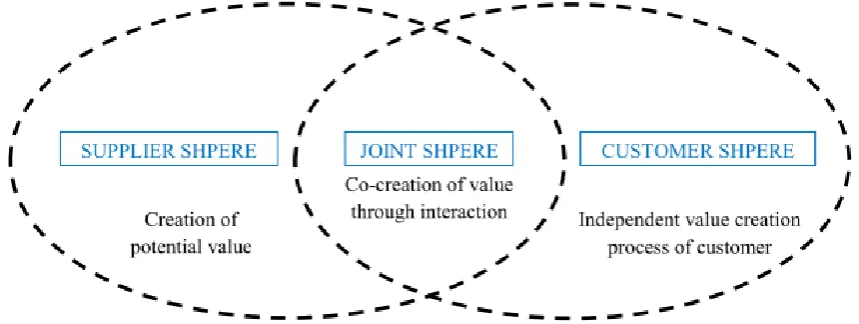
(26) Master Thesis: Optimizing the perceived value-in-use of integrated software solutions in a B2B context Danique Sterenborg. state that business ecosystems are “characterized by a firm that orchestrates the functioning of the ecosystem by providing a platform and setting the rules for other firms to leverage the platform and offer complementary products to the users”. Furthermore, Kapoor & Agarwal (2017, p. 3) argue that ecosystem complexity – the degree of “interdependence in the ecosystem based on the number of unique components that interact with a complementor’s product” – influences the sustainability of the supplier’s (i.e. complementor’s) superior performance in value creation. Namely, high ecosystem complexity implies high technological interdependence among the supplier’s products (e.g. platform architecture and applications) and components of the customer and/or other suppliers in the ecosystem. As a result, the supplier is required to constantly optimize its products based on changes within the ecosystem in order to maintain the functioning and performance of the ecosystem (Kapoor & Agarwal, 2017). The concept of business ecosystems has been adopted in research in fast moving industries such as ICT and electronics (Ritala et al., 2013). Similar or overlapping constructs of business ecosystems are organizational networks, or clusters, and value networks (i.e. Lusch, Vargo & Tanniru, 2010; Ehrenhard, Kijl & Nieuwenhuis, 2014; Allee, 2008).. 2.5 Assessing Value-in-Use in a Solutions Context In prior literature, value is often viewed as a function purely of quality and price. Thereby, quality is determined by the anticipated or realized benefits of a product or service, while price is generalized to costs or sacrifices made by the customer (Zeithaml, 1988). However, as indicated in the previous sections, the concept of value-in-use is more complex. S-D logic emphasizes that the customer determines value and is a co-creator of value (FP10 and FP6), while firms can only make value propositions (FP7) and thus are creators of potential value. In its facilitating role, the firm exists to integrate and transform competences into complex services that are demanded in the marketplace (FP9; Vargo & Lusch, 2004; 2006; Vargo, Maglio & Akaka, 2008; Grönroos & Voima, 2013). The different roles of service provider and customer in the value co-creation process and the accompanying complexity are illustrated by Grönroos & Voima (2013). In their research, Grönroos & Voima (2013) define three value creation spheres (Figure 2). First, in the provider sphere, the provider has the facilitating role of creating potential value, which the customer can later convert into actual value-in-use. Here, the firm is in charge of the relevant 26.
(27) Master Thesis: Optimizing the perceived value-in-use of integrated software solutions in a B2B context Danique Sterenborg. processes such as design, development, manufacturing, delivery, front-office and back-office processes, in order to produce resources and processes to be offered for the customer’s use. Next, in the joint sphere, the customer is in charge of value creation. However, through a dialogical process of direct interactions, the provider may influence the customer’s value creation process and serve as a co-creator. Since the value spheres are dynamic, the boundaries of in particular the joint sphere can be moved. For instance, the provider may invite the customer to participate in the development- or design-process of new product development, or active customers may also cross the boundary into the provider sphere give input regarding improvements of products and services. If no direct interactions occur and the customer independently creates the value-in-use, the provider only is a facilitator of potential value. Third, in the customer sphere, the customer creates value as value-in-use independently of the provider. The customer’s value creation process might also be influenced by other network actors or the customer’s surrounding ecosystem, beyond the reach of control of the provider. The value creation process throughout the spheres is not necessarily a linear process. Value may be created in the different spheres at different periods of time or in different sequences (Grönroos & Voima, 2013). Since this research focuses on the value-in-use of software solutions perceived by the customer organization, the end user – that is the citizen – is not included in Figure 2 below or further analyses. However, it would be possible to include the citizen on the right side of the model.. Figure 2: The Value Creation Spheres (adjusted from Grönroos & Voima, 2013).. The three value creation spheres clarify that the customer not just assesses or determines value, but actually creates value through a longitudinal and experiential process of usage. Thus, the customer is in charge of the experiential value creation process and may 27.
(28) Master Thesis: Optimizing the perceived value-in-use of integrated software solutions in a B2B context Danique Sterenborg. invite the service provider to join this process as a co-creator of value, while the provider is in control of the production process and can invite the customer to join it as a co-creator (Grönroos & Voima, 2013; Schembri, 2006; Gummerus, 2013). It becomes clear that there is no direct relationship between the proposed quality by the supplier and the customer perceived value (e.g. Macdonald et al, 2016). Instead, the proposed quality-perceived value relationship is influenced by several factors. Throughout the literature review, the following factors have been identified and will be discussed in the following subsections: (1) product and service quality, (2) the integration process which involves both supplier and customer resources, (3) customer usage process, (4) customer-supplier relationship, (5) the business ecosystem and (6) the presence of substitute offerings. The supplier only influences product and service quality and the supplier’s resources. The customer influences the customer usage process, customer resource quality, and the perceived value-in-use is based on individual and organizational goals. The integration process, customer-supplier relationship and business ecosystem functionality are shared processes among customer and supplier. It becomes clear that several aspects that determine the customer’s perceived value-in-use are outside the suppliers range of control. Given the heterogeneity of customer’s value perceptions (Macdonald et al., 2016) and experiences (Schembri, 2006; Sandström et al, 2008; Helkkula, 2012), also the complexity of formulating suitable value propositions becomes apparent (Skålén et al., 2015). Besides, the nature of value is context-dependent (Vargo, et al., 2008; Edvarson et al., 2011; Helkkula, 2012; Vargo & Lusch, 2016).. 2.5.1 Individual vs. Collective Value-in-Use The relationship between quality and value (Zeithaml, 1988) can be conceptually underpinned by goal theory (see Woodruff 1997). Goal theory suggests that individuals have both their own individual goals as well as shared, collective goals. Moreover, individuals have goal hierarchies and individual and collective goals can be interconnected. As a result, valuein-use can be traced to both individual outcomes and collective outcomes on an organizational level (Ulaga and Eggert, 2006; Epp & Price, 2011; Meynhardt et al., 2016). To illustrate, managers can perceive multiple dimensions of both collective value-in-use constructs which relate to the goals of the organization, as well as individual value-in-use constructs that relate to the individual’s personal role and interests. Besides the fulfilment of goals, customer perceived value-in-use is also influenced by the customer’s interpretation of the goal 28.
(29) Master Thesis: Optimizing the perceived value-in-use of integrated software solutions in a B2B context Danique Sterenborg. fulfilment, and the individual customer experience during usage of the product or service or during co-creation processes (Schembri, 2006; Sandström et al., 2008; Helkkula, 2012; Gummerus, 2013). The heterogeneity of how customers judge solutions can be traced to the different goals individuals and organizations strive for, along with their experiences of value. As highlighted by Helkkula et al. (2012, p. 67) “Value in the experience is individually intrasubjective and socially intersubjective” and “Value in the experience emerges from individually determined social contexts”. This means that the context for the customer experienced value is not determined by the service supplier, but rather by the customer’s individual environment, which forms the basic reference for a customer’s sensemaking of value. Furthermore, individuals tend to make sense of value in the experience based on subjective preferences or what is considered socially beneficial (Helkkula et al., 2012). Therefore, it is important for suppliers to recognize the dynamic interplay and interconnectivity of the customer’s individual and collective goals in a social context order to prevent mismatches to occur between the designed solution and customer’s expectations (Macdonald et al., 2016; Helkkula et al., 2012). Besides that, value-in-use also may be experienced and perceived differently by different people within the same customer organization (Vargo & Lusch, 2016; Gummerus, 2013; Sandström et al., 2008). Although value in business markets has often been viewed as a function of organizational goals (Ulaga & Eggert, 2006), value-in-use requires also an assessment of the customer experience, and the interconnectivity of individual and collective goals.. Proposition 1a: The value-in-use of software solutions is determined based on interconnected individual and organizational goals which change over time and tend to be organized in goal hierarchies. Proposition 1b: The value-in-use of software solutions is determined by subjective customer experiences.. 2.5.2 Service and Product Quality Traditionally quality has been understood in terms of anticipated or realized benefits of a product or service (Zeithaml, 1988). Thereby, product and service quality have been identified as antecedent to value (Woodruff 1997; Zeithaml 1988). However, solutions are more than just the sum of product and service components as solutions solve business 29.
Figure
+7
Outline
Interviews
The Customer Usage Process
Competition and Substitutes
Customer vs Supplier Perspective on Value-in-Use
Proactive vs Reactive Municipalities
Implications of Municipality Attitude for Perceived Value-in-Use
Key Findings and Contributions to Theory
Research Ethics
Overview of the Propositions
Related documents
Here data will be converted into binary which will be plain text and converted into cipher text to hide data. Here steganography is used to encrypt so as to hide
Despite the fact that pre-committal proceedings involve interpreters in many more cases, that last for many more days and present a lot more challenges, the
Our work is to establish a design model of the photovoltaic generator based on the energy behavior of the load: the internal charge of the refrigerator, the real
A COMPARISON OF MOLAR MORPHOLOGY FROM EXTANT A COMPARISON OF MOLAR MORPHOLOGY FROM EXTANT CERCOPITHECID MONKEYS AND PLIOCENE PARAPAPIO FROM CERCOPITHECID MONKEYS AND
The paper assessed the challenges facing the successful operations of Public Procurement Act 2007 and the result showed that the size and complexity of public procurement,
Assessing the Impact of Biodiversity Conservation in the Management of Maize Stalk Borer (Busseola f
Field experiments were conducted at Ebonyi State University Research Farm during 2009 and 2010 farming seasons to evaluate the effect of intercropping maize with
Pertaining to the secondary hypothesis, part 1, whether citalopram administration could raise ACTH levels in both alcohol-dependent patients and controls, no significant
Administration of Citrullus lanatus fruit extract did not affect serum sodium, chloride, bicarbonate, calcium and creatinine levels of Wistar rats.. However, a
