Integrating a
warehouse management system
A feasibility study
Bachelor Thesis
Industrial Engineering and Management
III
Bachelor Thesis Industrial Engineering and Management
Integrating a warehouse management system
A feasibility study
Author
R.J. Wienk (Ruben)
University of Twente
Schmits Chemical Solutions
Drienerlolaan 5
Bedrijvenpark Twente 48
7522 NB, Enschede
7602 KB, Almelo
Supervisor University of Twente
Supervisors Schmits
Dr. D.M. Yazan
M. Zweers
IV
Preface
In front of you lies my bachelor thesis “Integrating a Warehouse Management System”,
which is a feasibility study I performed at the company Schmits Chemical Solutions. With the completion of this research, I am graduating my bachelor study Industrial Engineering and Management at the University of Twente.
First, I want to thank the employees of Schmits for giving me the opportunity to perform my bachelor thesis at their company. Above all Miechel Zweers for supervising my research at the company and his involvement in my project. Also, the other employees for helping me with my questions and making me feel welcome at the company.
Second, I want to thank Devrim Yazan, my supervisor from the University of Twente. Despite his busy schedule, he was able to find time for me to discuss my approach and progress of the thesis. I also want to thank Guido van Capelleveen for being the second reader for this thesis.
Finally, I want to thank my family for their full support during my bachelor study. And my fellow student Wilco Nieuwenhuis, for providing me useful feedback on my thesis and being always open for discussions regarding the bachelor thesis.
I hope you will enjoy reading my report!
V
Management summary
Background
Schmits is a company active in the chemical industry that provides chemical solutions to its customers. Currently, inventory is managed in the ERP system of the company by
processing written reports on inbound, outbound and production flows of materials in the warehouse. It can concluded that this procedure is inefficient and prone to human errors. There is need for a system that can support warehouse management with a more automated approach for inventory control and tracking and tracing, so the company is thinking about investing in a warehouse management system. In this way, Schmits can automate more of their management processes in the factory and improve their inventory management.
However, the company does not have enough insights yet on the properties of these system, how to incorporate such a system in the organization and its effect on the relevant
management processes. In this research I gave the company advice on this matter, so they are better prepared when meeting with potential suppliers of these system in the future and a well-informed investment can be made.
Research approach
In the first step of my research, I performed a literature study to assess what the
functionalities are of warehouse management systems and what the possibilities are for the company in this field. Also, I attended two meetings with potential suppliers of these systems. With this information as input, I conducted interviews with the involved parties about the possible functionalities to set priorities and formulate requirements for the system using the MoSCoW method.
After the requirements for the system were set, I used business process modelling to illustrate the current and the proposed new situation in the factory. The processes in the factory are separated in two diagrams. The first starts at an incoming order and ends when all required raw materials for the order are procured and stocked in the warehouse. The second diagram follows the production steps where the raw materials are transformed in the end product until the product is picked up and distributed to the customer. With these
diagrams, the differences in the process flow and data flow between the current and new situation can be depicted, so that the impact of a warehouse management system on the process in the factory can be analyzed and conclusions can be drawn.
Based on this analysis, an end advice is formulated that gives insights in important considerations for the company when a future investment in a warehouse management system is made. The advice is divided in system specific considerations and management considerations.
Advice
System considerations
• From observations at the company, it came forward that the warehouse operations at Schmits are various and differ a lot per order. In order to adopt a warehouse
management systems that guides the workers through each warehouse management operation step, a degree of flexibility is needed from the system. Also, the WMS must
VI
information. If these systems complement each other well, administration can be further automated. In order to establish flexibility and communication with the ERP system in the WMS, the system must be partly customized and configured to the specific procedures at the company. This results in additional development costs for the supplier, so a good balance have to be found in this, where the system is flexible and falls within the budget of Schmits.
• There are two aspects where practical experience of experts in this field of work is required and theoretical research is not sufficient to give the company clear advice. First, there is the consideration about the hardware implementation of the system: it must be possible to scan materials while on a forklift as well as with hand scanners. Which solution is the most practical here can better be determined by suppliers of these systems in cooperation with Schmits. Second, it must be considered which objects to include in the inventory control. It is obvious that the inventory levels raw materials and finished products will be monitored by the system, but it might also be possible to include the various packaging materials of the finished products. The practical feasibility of this possibility may be determined by the suppliers.
• During the interviews at the company, it came forward that there were some practical difficulties expected during the execution of a slotting method, which allocates the materials over the warehouse systematically. A warehouse management system can function properly without such a functionality and it could always be added after the rest of the system is established in the company.
Management considerations
• When a warehouse management system is implemented in the company, the manual administration of paper documents will be replaced by direct administration in the system. This will result in a shift of work for the factory managers, a new task for them is to monitor the execution of the WMS during processes in the factory. This
monitoring is important, because the factory workers get much more responsibility in this situation, since they can directly change data in the system. Especially in the early phase of the implementation of the system, when workers are not yet acquainted with the new methods, monitoring is crucial.
• A second importation management consideration is how make everyone involved committed to adopt the system in their way of working. New technologies can face
some resistance in company’s sometimes, when employees are used to a certain
way of working. Therefore training of personnel is essential to get acquaintance with the system. An additional way of creating commitment to the WMS is with ‘theme
weeks’. Schmits works with this method to pay extra attention to a certain subject for
a couple of weeks based on KPI’s. It may be a good idea to designate theme weeks
to the execution of the warehouse management system. In this way, everybody is involved in the process and disagreements can be settled during weekly evaluations.
• A good cooperation with suppliers of materials can support the utilization of the warehouse management system. During the business model analysis, it came forward that a confirmation of receiving goods is convenient for the WMS to already generate barcodes and location slots. But also, if data sharing is possible between the companies, Schmits can possibly use the barcodes of the supplier, which is more efficient and saves work.
VII
Table of Contents
Preface ... IV Management summary ... V Definitions of terms ... IX
1. Introduction ... 1
1.1 About Schmits ... 1
1.2 Problem identification ... 2
1.3 Core problem and problem cluster ... 3
1.4 Norm and reality ... 3
1.5 Stakeholder analysis ... 4
1.6 Scope of the research ... 5
1.7 Assessment of validity ... 5
1.8 Research approach and deliverables ... 6
1.9 Research questions... 7
2. Theoretical framework ... 8
2.1 Warehouse Management Systems ... 8
2.2 Requirement selection method ... 8
2.3 Business process modelling ... 9
3. Formulation of requirements of the warehouse management system ...12
3.1 Literature study ...12
3.1.1 Possible functionalities of the system ...12
3.1.2 Automatic identification and data capture ...14
3.2 Evaluation of possible functionalities by management team ...15
3.3 Results of interviews and formulation of requirements ...17
4. Analysis of current and new situation ...19
4.1. Current situation ...19
4.2. Proposed new situation ...24
VIII
4.4. Conclusion ...30
5. Advice ...32
5.1. System considerations ...32
5.2 Management considerations ...33
5.3 Restrictions and suggestions for further research ...34
References ...35
Appendix ...37
Appendix A: Systematic literature review ...37
Appendix B: Report on meetings with warehouse management system suppliers ...40
Appendix C: Report on interviews ...42
IX
Definitions of terms
• ERP system: Abbreviation for enterprise resource planning. A software system used by companies to manage and integrate all important parts of their businesses. It can integrate for instance planning, sales, finance and inventory purchase.
• WMS: Abbreviation for warehouse management system. It is a more specific software system in comparison with an ERP and is mainly focused on controlling and
managing warehouse operations from the time materials enter the warehouse until they move out.
• IBC is short for intermediate bulk container. IBC’s are used to store liquids and have
1
1. Introduction
1.1 About Schmits
Schmits Chemical Solutions is a business to business company located in Almelo that is active in the textile and cleaning industry as a partner for custom-made solutions. For the textile and non-woven industry, the company produces mostly self-developed coatings that can add extra characteristics to the fabric, like flame retardant or water-repellent coatings. For the cleaning industry they supply industrial cleaning products. Schmits is very flexible for their customers in terms of lead times and their product packaging volumes, which can vary between small flacons and whole tank trucks.
Schmits has a factory, consisting of a warehouse, a production facility and a loading dock. The chemical products are produced in large production kettles according to mostly self-developed product recipes. Schmits also has their own bottling lines for filling their product in flacons. The warehouse halls store a wide range of raw materials for these productions, but there is also a hall where the finished products are stored. In these halls, there must be dealt with chemical safety restrictions that come with, for instance, explosive and corrosive
[image:10.595.70.530.401.705.2]materials.
2
1.2 Problem identification
The company’s turnover has grown significantly over the last couple of years and the production and logistics departments are striving to keep their processes under control. At the moment, the warehouse management operations of Schmits are not running optimal. There are multiple problems that arise when the management processes are observed. Firstly, the allocation of raw materials over the places in the warehouses are done manually. The chemicals are assigned a place in the warehouse by using standard places for each material. The question is if this way of working is the most practical and efficient, because there might be systems that can allocate the materials in a more optimal way.
The second problem is that the allocated raw materials are not linked to their assigned places in the warehouse with a track and trace barcode system. The location code must be written down on the delivery receipt and can be manually put into the ERP system, but only one location code can be linked to a material. So, if a material has multiple locations in the warehouse, there is only one location code of the material in the system. This leads to a poor traceability and a relatively big margin of error.
What also came forward is that currently the exact amount of chemicals used in production processes are written on the production report during production and the inventory level is updated manually in the ERP system by one of the production managers afterwards. Sometimes there is confusion about the way the factory workers note the used amounts on the report, which can lead to misinterpretations and human errors. Also, some time passes before these production reports are processed in the system, so the inventory levels are not up to date.
Due to the poor traceability and the margins of error, it can happen that production processes are delayed because chemicals cannot be found quickly or are not even in stock. This can have big impacts on relations with the customer, if delayed production results in delayed delivery to customers. It can be concluded that the procedure in the warehouse is inefficient and could have a more systematic and automated approach.
3
1.3 Core problem and problem cluster
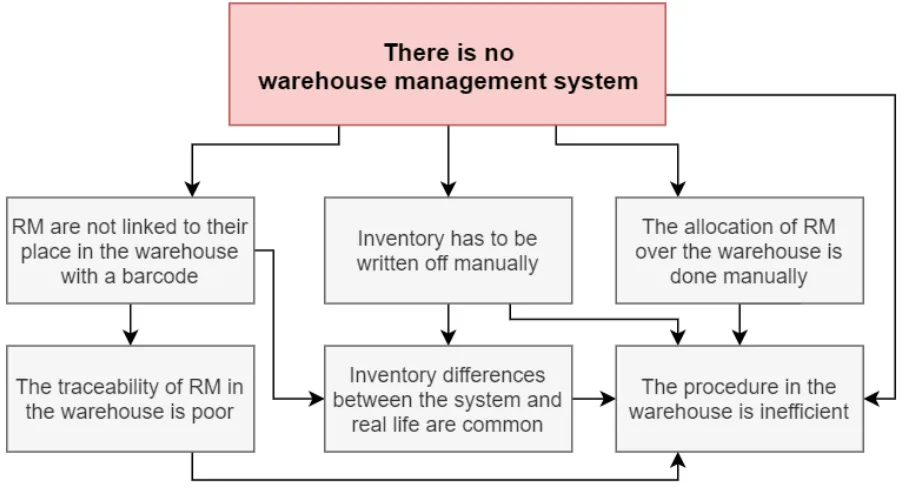
From the problem identification, a problem cluster can be derived, which is a helpful tool for identifying the core problem. It is mapped on causality and the eventual core problem is directly or indirectly the cause of all problems in the cluster. (Heerkens & Winden, 2012) The core problem is marked with red.
[image:12.595.72.524.305.549.2]From the problem cluster and problem identification can be concluded that the core problem of the company is: There is no all-embracing warehouse management system. The goal of this research is not going to be to solve this problem, because the company must make an investment in such a system themselves. However in this assignment, an underlying aspect of the core problem will be solved: there are not enough insights on how to integrate a warehouse management system in the company and what the properties of these systems can be. I will give the company advice on this matter, so they are better prepared when meeting with potential suppliers of these system in the future and a well-informed investment can be made.
Figure 1.2: The problem cluster
1.4 Norm and reality
4
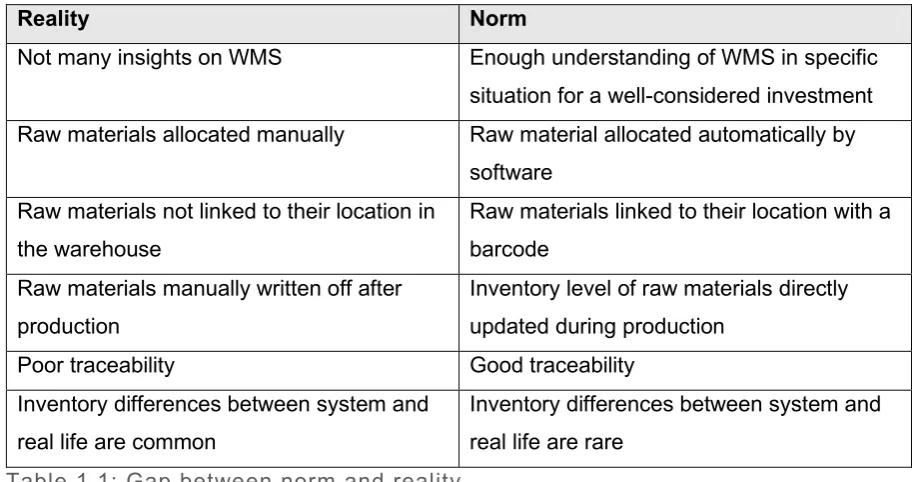
Besides the gap of insights in a WMS, more gaps between norm and reality can be observed from specific warehouse management processes. These gaps will not be resolved by my research, but hopefully by the functionalities of a WMS. See the table below.
Reality Norm
Not many insights on WMS Enough understanding of WMS in specific situation for a well-considered investment Raw materials allocated manually Raw material allocated automatically by
software Raw materials not linked to their location in
the warehouse
Raw materials linked to their location with a barcode
Raw materials manually written off after production
Inventory level of raw materials directly updated during production
Poor traceability Good traceability Inventory differences between system and
real life are common
[image:13.595.68.528.143.384.2]Inventory differences between system and real life are rare
Table 1.1: Gap between norm and reality
1.5 Stakeholder analysis
For the stakeholder analysis, the factory managers and all departments in the organization that have anything to do with the research must be considered. The technical director is my supervisor from the company and the person responsible if it comes to an integration of a warehouse management system in the future. The factory manager and assistant factory manager are the employees that are dealing with most of warehouse management
processes at the moment. Currently these tasks are mostly manual, with help from the ERP system. When a warehouse management system gets implemented however, many of their administrative tasks, like processing delivery receipts and production reports in the system, will not be necessary anymore.
The two foremost departments of importance for the research are the logistics and production department. The logistics department takes care of all inbound and outbound logistics from the company. The production department allocates the inflowing raw materials over the warehouse, picks it up when it is needed for production and notes the amount of material used, so that the inventory level in the ERP system can be updated. These activities involve many warehouse management processes, so the departments will be dealing quite a lot with the WMS, will it be integrated. The most important stakeholders in these two
departments are the logistics coordinator and the production coordinators. But also the regular workers in these departments must be taken into account, because they could give insights in difficulties and experiences during a working day.
5
they have quite some knowledge about possible functionalities of the system and the effect on management processes in the warehouse. During the bachelor thesis, I could join two exploratory meetings with potential suppliers of the system and the technical director of Schmits. These meetings and the resulting quotations for Schmits were very helpful input for my thesis and gave me more practical insights, in addition to the theoretical literature. The report on these meetings can be found in appendix B.
1.6 Scope of the research
As already described at the research approach and the analysis of the core problem, the focus of this thesis is to provide advice to the company for implementing a warehouse management system in the future. In order to deliver well-considered advice in a 10-week-timeframe, which is the indicated length of the thesis, boundaries for the research must be set. Therefore, some aspects are treated below that will not be included in this research. In the first place, quantitative data collection and data analysis to measure warehouse performance are not part of this thesis. This is because there is currently no hardware, like handheld barcode scanners, used in the warehouse to document information. Therefore, the ERP system of the company cannot provide useful data to formulate KPIs that measure warehouse performance. The identified problems cannot be quantified and are based on interviews and observations at the company. So, the advice for the company will be qualitative and not quantitative by nature.
Secondly, the research is focused only on the supply chain within the walls of the company, the warehouse processes. So, the procurement process and the demand forecasting of the company, that might also contribute to warehouse performance, are not addressed in detail in this thesis. This is because these functions are more the responsibility of the company’s
ERP system, and not that of the eventual warehouse management system.
1.7 Assessment of validity
In the micro lectures of Hans Heerkens (2015), validity is classified in three different types: internal validity, construct validity and external validity. Firstly, internal validity must be considered, for this type of validity the biggest threats are deprivation and unrepresentative sampling. Because the functionalities a warehouse management system adds to the company might feel as a deprivation of tasks for some employees. For instance, when the system takes over administrative tasks that are usually executed by workers.
Unrepresentative sampling might occur during conducted interviews at the company. If it is the case that more talks are done with workers that are easy to talk to, their viewpoint might be taken into account too much. So, it is important that I have talks with everybody involved and consider every viewpoint, without getting biased.
6
Finally, external validity must be taken into account. The threat here is that the research on the company and its situation are too unique to apply to other studies. Especially the environmental circumstances and the time are unique, because the company has a
production facility next to their warehouse where the emphasis is on specific processes. This also has effects on the choice of a WMS, since the company needs specific requirements for their system.
1.8 Research approach and deliverables
In order to give the company well-considered advice on integrating a warehouse
management system for their particular situation, requirements for the design of the system will be formulated. This starts by doing a literature study, where similar cases or articles on the functionalities of warehouse management systems will be examined. From this, a list of
potential functionalities is defined that could be suitable for the company’s production
warehouse. This list is used as input for interviews with employees of the company to find out what their opinions are on how each functionality fits their way of working and if some
functions must be prioritized. From the results of the interviews, requirements can be formulated for the warehouse management system, ranked on priority. A method that helps with formulating prioritized requirements is discussed in chapter 2.2.
After the requirements are drawn up, the current situation of management processes in the warehouse and the proposed new situation with a WMS will be modelled and analyzed. This will be done by using business process modelling, which illustrates the business processes of a company graphically. The theoretical framework for this is discussed in chapter 2.3. First, the current situation in the warehouse will be modelled and with the help of the
formulate requirements of the system the new situation will be sketched also. In this way, the current and new situation can be compared and the change in process flows can be depicted graphically. To map these processes accurately, it is important that there is a clear
understanding of the warehouse management processes of the company. So, talks must be held with different people in the organization. The meetings with suppliers of warehouse management system could also give clear insights on how the management processes in the warehouse will change when a warehouse management system is implemented, since they have experience with automated information systems.
Finally, qualitative advice is given to the company, based on the main takeaways of the research. This advice gives the company insights in important considerations when a future investment in a warehouse management system is made.
The research approach described above can be best classified as a qualitative case study, because all the information for the research will be derived from literature and interviews at the company, which are examples of qualitative research methods.
So, to summarize the deliverables in bullet points:
• Formulation of WMS requirements with priorities
• Business process modelling of the current situation and proposed new situation
• Analysis of business process models
7
1.9 Research questions
By answering this main research question, I can give the company suitable advice, so that they are better prepared when their investment process starts in the future. The question is quite broad, because it answers the question how the system will be shaped as well as how the system will affect the management processes in the warehouse and production facility. In order to answer this broad main research question well, these two aspects are divided in two sub questions that will be answered first.
Sub questions:
1. Which functionalities of a warehouse management system are applicable to the particular situation of Schmits?
This sub question will be answered by using literature study, which can be found in chapter 3. It should provide a list of possible functionalities for the WMS that can help solving the identified problems in the warehouse. The literature study is already partly done in the
systematic literature review, the more general research question answered there was: Which functionalities can be implemented in a warehouse management system? This review can be found in appendix A. Besides the literature as input, the meetings with suppliers of WMSs also gives me useful information about the possibilities with these systems, a report on these meetings can be found in appendix B.
2. How will a warehouse management system affect the flow of management processes in the warehouse?
As already described at the research approach, interviews at the company and meetings with suppliers will form the input for business process models. But first, literature study is done on a business process modelling technique. With this technique, the current and proposed new situation will be depicted graphically. It will give a clear overview on the alterations of
management processes in the warehouse and production facility, which will answer the sub question in detail. These steps can be found in chapter 4.
Main research question:
8
2. Theoretical framework
2.1 Warehouse Management Systems
A warehouse management system (WMS) is an information system that supports stock management and administration in the warehouse. It is used to increase the performance of the warehouse by supporting the management processes systematically. Because of the higher degree of automation in the warehouse, manual administrative tasks are reduced, resulting in less chance of human errors and accurate inventory levels. (Apak, Tozan, & Vayvay, 2016)
WMS covers functionalities for managing and controlling the flow of goods within the
warehouse only and therefore it operates always in combination with an Enterprise Resource Planning (ERP system), which takes. The basic configuration is that an order is handed over from the ERP system to the WMS, where in turn the necessary warehouse operations for the order are executed. (Van Den Elsen, 2017) After these operations are performed, the output data collected by the WMS is then shared with the ERP, so that the systems are
synchronized. Schmits already works with an ERP system called Blending from the company Infor, which is a specialized system for companies in the chemical industry. So, it is of
importance that the WMS can connect with this system and can work alongside it. One of the main findings in the literature was that the applications of warehouse
management systems are becoming more various. The traditional scope of the systems is expanding, and more and more new functionalities are being developed. Therefore, it is interesting to investigate the various possibilities in a WMS. For a deeper analysis about the functionalities of these systems and the suitability for the specific warehouse of Schmits, see chapter 3.1.
2.2 Requirement selection method
For selecting the requirements of the Warehouse Management System, a literature study and meetings with system suppliers will be used as input for a list of possible functionalities. Then interviews will be held with stakeholders in the organization to assess their viewpoints on how each possible functionality fits to the warehouse of Schmits.
To formulate possible functionalities into requirements for the system, the MoSCoW method is a helpful tool that sets priorities. (Mulder, 2017) It originates from software development projects where it is used as a prioritization framework for timebox projects. In these timebox projects, the deadline is fixed, so the focus must be on the most important requirements of the software. By giving ranked priorities to each requirement of the software, there is more clearness between the developers and the management of the company about the intention of the project.
9
• ‘Must haves’ are the requirements that the end-result has to satisfy. These are not negotiable and are essential for the system.
• ‘Should haves’ are much desired requirements with high priority. However, they are
not critical to launch and the end product can be usable without them.
• ‘Could haves’ requirements can be considered when it falls within the time or budget
constraints. They are desirable but not necessary and are also known as ‘Nice to
haves’, so they are more a wish than a requirement for the system.
• ‘Won’t haves’ are functionalities that are out of scope of the current project but may
be included in a future project.
So after the interviews, the list of possible functionalities will be ranked as requirements according to this method. In this way, Schmits can give a potential supplier of the warehouse management system in the future a clear indication on what the priorities for the system are, see chapter 3.3 for the results.
2.3 Business process modelling
For mapping the current and proposed new situation with a warehouse management system, business process modelling will be used. Business process modeling is a general term for capturing the business processes of an enterprise graphically in diagrams.
Aguilar-Savén (2004) defines that ‘a business process is the combination of a set of activities within an enterprise with a structure describing their logical order and dependence whose objective is to produce a desired result. Business process modelling enables a common understanding and analysis of a business process.’ In other words, business process modelling can provide helpful insights in sets of activities in a company, by graphically capturing these sets. In this way, improvement points can be recognized and processes can be improved.
According to Atieh et al (2016), Business Process Model and Notation (BPMN) is a fitting tool for modelling the situations with and without a WMS, because it provides accessible
diagrams that are easily to understand for everyone involved in the organization. The BPMN has established itself as the standard method for depicting business processes in diagrams. The first version was developed about fifteen years ago and it is a revision of previous used methods for business process modelling. (Zur Muehlen & Recker, 2008) The method
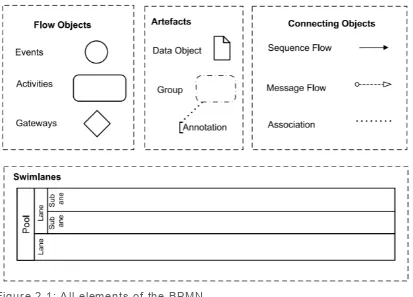
contains a great variety of modelling elements, so it can be applied in all sorts of businesses. The elements that can be used in the BPMN diagrams are divided into four basic categories: flow objects, artefacts, connecting objects and swimlanes. (Weske, 2012)
• Flow objects are the basic units that are used to build the business processes and give them shape; they are separated in activities, events and gateways. Activities represent the tasks performed during the business process. Triggers and
• Artefacts show additional information about the business processes and serve for information purposes only; examples are data objects and groups. Data objects depict paper documents or electronic information that is input or output from a
10
• Connecting objects connect the building blocks of the diagram with each other. There are three types of connection flows: sequence flows, message flows and
associations. Sequence flows are used to model the flow objects direction from one activity to the other, while message flows represent the information stream between different departments, or swimlanes. Associations connects artefacts with other elements in the business process and is most of the time used for illustrating the data flow of the process.
• Swimlanes represent organizational entities like departments or specific functions. By modelling flow objects in a lane, it can be graphically depicted which organizational entity is responsible for performing the task.
[image:19.595.75.488.282.579.2]In appendix D, an overview can be found of all BPMN elements that are used in the business process diagrams of this thesis.
Figure 2.1: All elements of the BPMN
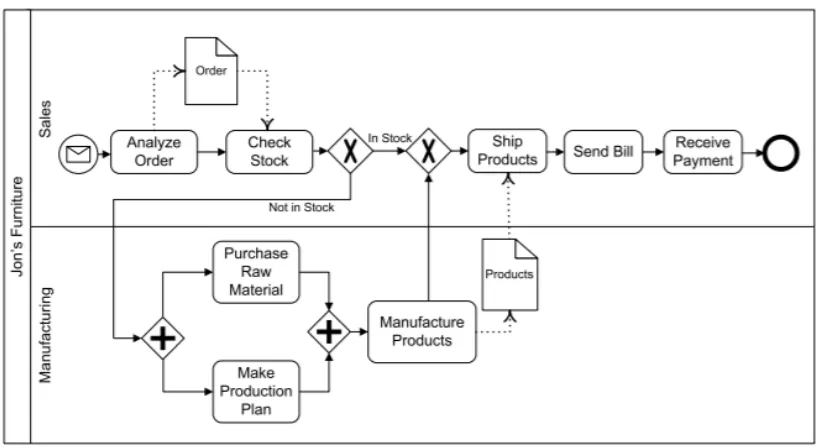
The figure below is an example of business processes mapped with the use of BPMN method. Here it can be seen that the swimlanes are used to separate organizational
11
Figure 2.2: Example of a business process represented with BPMN
12
3. Formulation of requirements of the
warehouse management system
3.1 Literature study
In this section, literature study will be performed on the functionalities of warehouse management systems (WMS). After studying literature about the properties of warehouse management systems, potential functionalities can be defined that could fit the specific case of Schmits. Also, exploratory meetings with two potential suppliers of a WMS gave many insights on the properties of these system, so these will also be included in this study. With this literature study the first sub question can be answered: Which functionalities of a warehouse management system are applicable to the particular situation of Schmits?
With this literature study as input, interviews can be conducted under the stakeholders to get their opinions on how each functionality fits in the organization and where the priorities lay. Based on these results, a decision can be made on what the priorities are for the
requirements of the warehouse management system.
3.1.1
Possible functionalities of the system
To place the functionalities of warehouse management systems in perspective, it is important to understand the different applications of the system. According to Van Den Elsen (2017), a WMS adds value to three types of organizations: stockholding warehouses, warehouses with crossdocking operations and warehouses with value-added operations. The last type fits the warehouse of Schmits, because they create value by transforming raw materials into
products in their production tanks. The first two types are however warehouses that are only storing and distributing goods, so it is important to keep in mind that many functionalities are focused on these types of warehouses and are therefore not interesting for the production warehouse of Schmits.
Most of the modern literature about warehouse management systems, still use the classification of Dusseldorp (1996) to make a distinction between WMSs. (Ramaa, Subramanya, & Rangaswamy, 2012) (Faber, 2015) It makes a distinction between three groups of WMSs: basic, advanced and controlled WMS.
• A basic WMS supports stock and location control only, so the support is primarily on inventory management and track and tracing. The generated warehouse management information is simple and focuses on throughput of products.
• An advanced WMS can process activities and resources to assess the flow of goods through the warehouse. It focuses mainly on throughput, stock and capacity analysis
• A controlled or complex WMS can further optimize a warehouse, or a group of
13
It is the question if the additional functionalities of a complex WMS really add value to the warehouse of Schmits, because these functions are more associated with stockholding or crossdocking operations, where the emphasis is more on logistical flows and no production takes place.
Rogers (2011) elaborates further on basic and advanced WMSs and has a lot of similarities with the classification of Dusseldorp (1996). It states that a basic WMS supports the
everyday functions that are the basis for warehousing: receiving, directed put away, order fulfillment planning, picking and packing, and shipping the order. While an advanced WMS may also support:
• Inventory management: the WMS can constantly update inventory based on the planning and it can adjust the inventory of materials when an amount is used in a
production process. In this way, the inventory level is real time and if a material is running out of stock, it can give a signal to reorder the material. This can potentially fix one of the problems in the problem cluster, because inventory is currently updated manually in the system after production and this functionality might result in less administrative work and less chance of human errors. Besides inventory of chemicals, the inventory of packaging materials, like drums or flacons, can be monitored.
• Cycle counting: instead of drawing up all inventory once or twice a year, cycle counting makes a distinction between materials with high and low use rates and scrap factors, and assesses the frequency it should be counted. So for instance, a material with a high use rate and scrap factor, should be counted much more than a slow-moving material. Resulting in an effective continuous count program. (Piasecki, 2017)
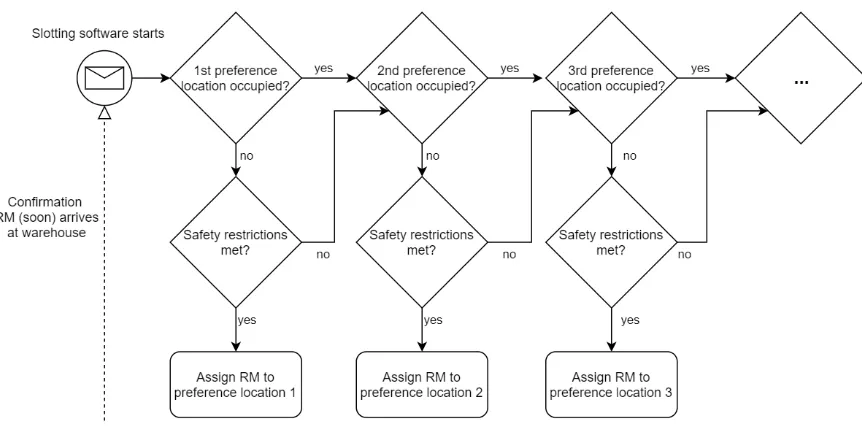
• Slotting: Slotting software makes an optimal allocation of materials over the warehouse, basically by assigning the most frequently used materials to the most easy accessible places. This tool can be used for raw materials as well as finished products. Schmits currently uses standard places for most of their materials and the workers can pick these materials very fast based on experience. So for them, it might not be fitting if the location of materials over the warehouse is changing all the time. A potential supplier of a WMS for Schmits explained during a meeting that a slotting method with more standard places suits small production warehouses like Schmits better, see appendix B. This method is executed by assigning ranked preference locations to all materials. It works as follows: a raw material needs to be stored in the warehouse and the system checks if the first preference location is occupied. If it is unoccupied, the system checks if the safety restriction regarding the material and the surrounding chemicals that are explosive, corrosive or toxic are not exceeded. If not, the material is assigned to the location. If the first location is occupied it checks the second location and follows the same procedure. This policy goes on until the system finds the first preference location that is unoccupied and where the safety restrictions are met, see the flowchart below in figure 3.1. However, the system works best if the preference locations are updated frequently and are
14
Figure 3.1: Flowchart of slotting software that works with preference locations
• Automatic data collection: because of the handheld devices that are used for the implementation of a WMS, a variety of data can be automatically collected and it is important to determine on beforehand how to make the most of this data. For instance, it is possible to measure productivity of individuals and the user responsible when a faulty product is reported. It is important however to remember that all workers must have their own user account in order to trace data back to individuals. The data could also give technical insights from the warehouse, like the percentage of pallet utilization and production tank occupation.
3.1.2
Automatic identification and data capture
Besides the additional functionalities, the foundation of the warehouse management system, the track and trace functionality and its different applications must be researched. For
tracking and tracing, different kinds of automatic identification and data capture (AIDC) technology are used. AIDC is important to consider, because it is the infrastructure for most of the functions of the WMS, like data collection and inventory management. Barcodes and QR codes are examples of this technology that are well-known, but also radio frequency identification (RFID) is a possible tool for data capture. RFID is a technology that uses radio frequency waves to provide data transmission between a label and a reader. Instead of the other technologies, RFID labels can be read simultaneously and without being in the line of sight of the reader, however the technology is much more costly and complex than standard barcode technology, so the question is whether the advantages outweigh the disadvantages of the system.
15
edge over a barcode system. (Campbell, 2018) So, a barcode track and trace system is the most fitting AIDC technology for the situation of Schmits, it has a cost-advantage over RFID
and the complexity of RFID is not necessary in the company’s compact production
warehouse.
[image:24.595.72.239.333.464.2]There are also different barcodes to consider: a distinction can be made between 1D or 2D barcodes. The main difference between the traditional barcode and 2D barcodes is that the latter can store much more information than the former. However, during a meeting with a supplier of a track and trace system came forward that 1D barcodes are sufficient for the situation of Schmits, see appendix B. This is because the barcodes are used to link a place in the warehouse to a certain material that is placed there, where a small set of numbers or letters is enough to capture the required data in the system. 2D barcodes can also capture this data, but these codes are accompanied with more complex barcode scanners and printers, which are obviously more expensive. Also, 2D barcodes can be scanned from all angles, which is a drawback while working in a crowded warehouse with many barcodes, because it can happen that adjacent barcodes are accidentally scanned. Concludingly, it is not necessary to make use of a more expensive 2D barcode method and a 1D barcode method will suffice for the amount of data storage needed.
Figure 3.2: Examples of a 1D and a 2D barcode
3.2 Evaluation of possible functionalities by management
team
16
During the interviews, each possible functionality will be explained so that the aspects are all clear for the subjects. Then the MoSCoW method is defined, where the functionality must be
classified in ‘Must haves’, ‘Should haves’, ‘Could haves’ and ‘Won’t haves’. In this way, the
subjects can classify their priorities for the system, based on the fit to the situation of Schmits and the expected advantage the functionality could give. Besides this prioritization method, the subjects will get room to explain their viewpoints, which can be input for the
argumentation of the requirements. The functionalities that will be measured are:
• Inventory management: for this functionality, the focus will particularly be on the ability to adjust the inventory level of a chemical systematically during production. According to a meeting with a supplier of WMSs, see appendix B, it was possible to link the weight system of a forklift truck to the system. In this way, the difference in weight on the fork of the truck can be adopted by the system to update the inventory of the material. Inventory replenishment functionalities will not be discussed in the interview, because this is already adopted in the company’s ERP system.
• The track and trace functionality with a barcode system will also be discussed in these interviews. In earlier exploratory interviews, it already came forward that this is
a ‘Must have’ for the system. But it is nevertheless important to discuss because
there might be ideas on application of barcodes in the warehouse. For instance, the production tanks can be labeled with a barcode, so that it is registered which tank is used for which production batch. It is also interesting to consider the method for labelling the materials and products. Most likely, a barcode printer is necessary at the logistic department for labelling the incoming goods.
• Cycle counting will be explained as a systematic way of continuous counting of materials. It may be a very fitting tool for Schmits, because there is a lot of diversity in the chemicals in terms of use rates and scrap factors. Also, quite a lot of materials for third parties are stored in the warehouse, for which keeping track of the inventory regularly is obligatory. And Schmits stores dual use goods for which strict regulations are set in terms of inventory reporting. Dual use goods are chemicals that can also be used in the military industry, for instance for chemical weapons. The cycle counting tool relies on the track and trace system, because it provides the input for the locations to check when doing cycle counting.
• Slotting software that is based on preference locations is the most applicable to the situation of Schmits, so this interpretation will be used in the interviews. See figure 3.1 and the explanation at 3.1.1, for an interpretation of this method.
17
3.3 Results of interviews and formulation of requirements
The report of the interviews and an extensive explanation on how the MoSCoW priorities of the requirements are established can be found in appendix C.Real time inventory management
An improved inventory control with reliable inventory levels is one of the main incentives to possibly invest in a warehouse management system for Schmits. At the moment, inventory is updated in the system based on handwritten notes of the production workers. It came
forward during the interviews that this leads to misunderstandings and human errors. Also, processing the inventory updates is not done directly after production, resulting in inventory levels that are not up to date. Resolving these misunderstandings and establishing a real time inventory is a main priority for the warehouse management system. So, this requirement is a must have for the WMS according to the subjects.
Track and trace system in the warehouse
Together with real time inventory management, a track and trace functionality is regarded as the most important requirement of the warehouse management system. When it is executed properly, Schmits will not have issues with its traceability in the warehouse anymore. Also, many other functionalities of a WMS will rely on the location codes of the track and trace system, like cycle counting and the slotting tool. Therefore, it is a crucial part of a WMS and a must have for the system.
Slotting function
A slotting function that allocates the incoming raw materials systematically over the
warehouse, is regarded as an interesting functionality that could further professionalize the operations in the warehouse. Because currently, the allocation is done manually and it lacks a systematic approach. There are however some doubts about the practical implementation of this function; the goods in the warehouse are stored in different packaging sizes and the pallet locations also differ in size. So, some practical difficulties with optimally utilizing the warehouse space are expected. Formulating proper slotting software for this requires an extensive preparation and it is suggested that this functionality could be added after the implementation of a warehouse management system. The functionality is conceived as a requirement of high importance, but the system can properly work without it, so a slotting tool is a should have requirement for the system.
Cycle counting
It came forward during the interviews that stocktaking is an activity that is easily neglected when the company is facing a busy production schedule. Therefore, it is agreed that a cycle counting tool, with calculated counting frequencies for each chemical, is an interesting functionality for the system. It is however not regarded as a priority for the company and not as a core functionality of the system. So, cycle counting can be classified as a ‘could have’
requirement for the system. Automatic data collection
Many interesting applications of data came forward during the interviews and the more extensive explanation of this can be found in appendix C. Firstly, labor tracking of individuals
18
can be used to estimate production times for the production planning, based on past
experiences. Also, KPI’s can be formulated that can give technical insights on the warehouse performance, for instance percentages of pallet utilization and production kettle occupation can be deduced from data.
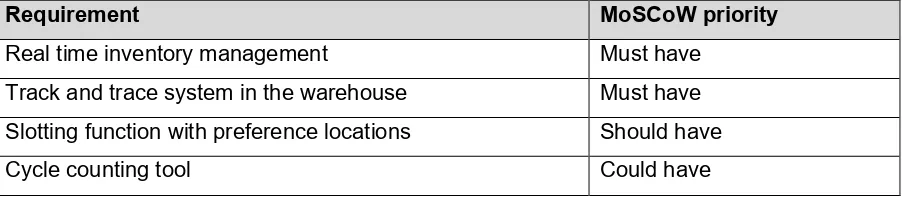
Requirement MoSCoW priority Real time inventory management Must have
[image:27.595.74.525.182.281.2]Track and trace system in the warehouse Must have Slotting function with preference locations Should have Cycle counting tool Could have
Table 3.1: Prioritized requirements for the system using the MoSCoW method
For modelling the process flow in the new situation, the must have and should have
19
4. Analysis of current and new
situation
4.1.
Current situation
In this section the current situation is sketched of relevant management processes in the warehouse. To map these processes accurately and make a good comparison with a sketched situation with a warehouse management system, models are made by using the Business Process Model and Notation, which is discussed in the theoretical perspective section. A free online modelling tool is used for this called draw.io, which has a special BPMN template. For an explanation of all symbols used in the BPMN language, see appendix D. For a list of all abbreviations used in the models, see table 4.1 on page 21. It is difficult to create a model that applies for all production orders of Schmits, because they make many different products for which the management processes in the factory can differ. For example, Schmits stores chemicals for third parties where they only deliver the service of transforming these chemicals into an end product. In a process like that, the company is not responsible for the procurement of chemicals and the administration of inventory is done differently. Therefore, the diagrams are created with the most standard process flow in mind, where Schmits is a traditional supplier of products.
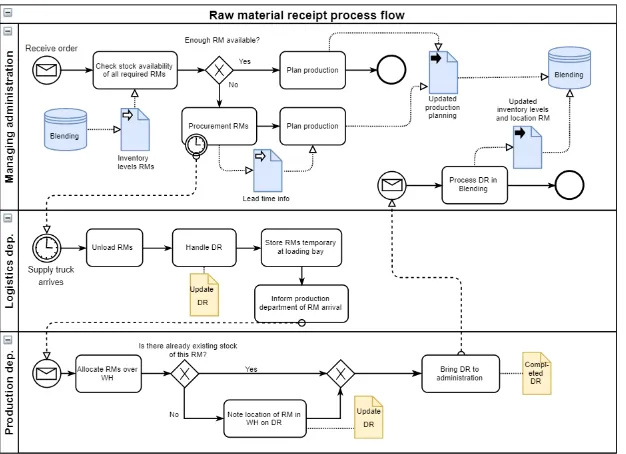
The current situation in the factory is separated in two BPMN diagrams: the raw material receipt process and the production and outbound process. The first process flow starts with an incoming order and ends where all raw materials are stored in the warehouse and
awaiting for production. The second process flow starts from the beginning of production and ends when the finished product is transported, and the order is finished. The two diagrams are extensively explained below.
1. The raw material receipt process
This trigger for the start of this model is an incoming product order of a customer. When the order arrives, the managing administration of the factory and warehouse checks the stock availability of the raw materials that are required for the product order in the company’s ERP system, Blending. If the stock is sufficient for production, the production can be put in the production planning and this process is ended. If the stock is not sufficient, raw material procurement activities are executed, this set of activities is external to the relevant model and is therefore not described in detail. However, the procurement can retrieve information about the raw material lead times, this can be used to plan a production activity in the production planning. From this, it can be concluded that the used production strategy is Make to Order: production starts after the order is received.
20
easier. This allocation over the warehouse is based on standard places for most of the chemicals and a large warehouse for additional bulk storage, but they must also satisfy the safety constraints of corrosive, explosive and toxic chemicals. When the raw materials are assigned to their locations, the locations of the chemicals are noted on the delivery receipt if there is no existing stock of the chemical in the warehouse. This is because the ERP system can store only one location code for each chemical, so if there is existing stock the chemical is already linked to a location in the system.
After the storage of the materials in the warehouse, the completed delivery receipt will be brought to the administration to be processed. The delivered quantity and the location code are added in Blending and subsequently the process is ended.
2. Production and outbound process
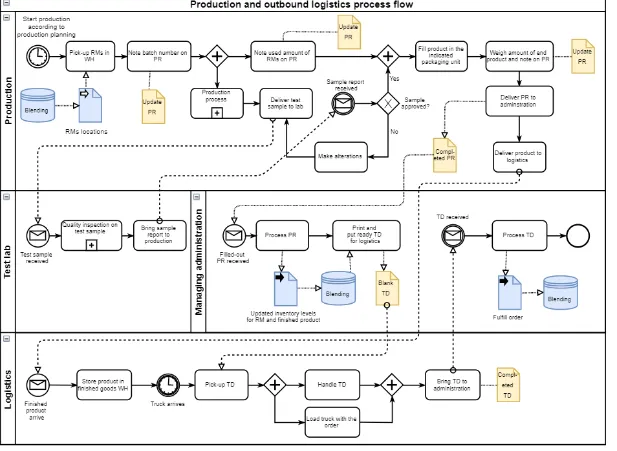
This process flow starts when the production is started, in accordance with the production planning. The production report is taken from the planning board and the materials are picked up in the warehouse with a forklift truck. The material locations may have to be checked in the system by the managing administration, if there are location codes linked to the products. The batch number of the materials are noted on the production report, so that it is traceable which batch of raw material went in which production. Then the production process starts, which differs a lot between products. During the production, the exact amount of used materials and the production kettle are noted down on the production report for administration. When the production process is finished, a test sample must be tapped off the tank and brought to the test lab. Here takes a quality inspection of the production batch place, where the sample must satisfy certain margins of, for instance pH level and dry matter content. When the sample is not approved by the lab, certain alterations must be made on the production batch and another sample must be tested.
When it is approved, the chemical can be filled in the prescriptive packaging, which can vary between small bottles and IBC’s. After filling, the amount of end product can be assessed and noted down on the production report. Also, the packaging materials have an inventory level in the system, so this must be noted down also after the filling process. When the filling is done, the production report will be sent to the administration for processing and the product is delivered to logistics where it is stored in the finished goods warehouse until the transportation arrives.
Meanwhile, the filled-out production report is processed at the managing administration, where the exact quantities of used raw materials and end product are adjusted in the ERP
system’s inventory. Also, the packing list is printed out and sent to logistics, so that
everything is ready for transportation.
21 Abbreviation Written in full Meaning
RM Raw material All incoming chemicals and materials for production.
DR Delivery receipt A document signed by the company to indicate that they have received the inbound goods WH Warehouse
PR Production report
“Productieverslag”
A document with the recipe and all prescriptive steps of a certain production for production workers.
TD Transport documents Contains transport information for outbound products accepted by carrier.
22
23
Figure 4.2: The current production and
24
4.2.
Proposed new situation
In this section, two BPMN diagrams are made of the management process flow in the new situation, with a warehouse management system, to compare it with the existing situation. Conclusions can be drawn on what the biggest changes are in the warehouse management process and what the implications for Schmits are. In this way, the second research question can be answered: How will a warehouse management system affect the flow of management processes in the warehouse?
In the new situation with a WMS, the same separated processes are used as the current situation: the Raw material receipt process and the Production and outbound logistics process. The new processes are explained below, with emphasis on changes in the diagrams in comparison with the current situation. For both processes, the WMS has a separate lane, this gives convenience in recognizing the function of the system in each activity.
1. Raw material receipt process
The first part of the new process is identical to the current situation: an incoming product order of a customer arrives, and the stock availability is checked of the required raw
materials. If the stock is not sufficient, procurement must be done before the production can take place and the process continues.
In the new situation, the warehouse management system has to know which materials will soon be delivered on beforehand. Therefore, a confirmation from the supplier is required about the materials what they will deliver. With this information, which is also called an advanced shipment notification, the warehouse management system can generate unique barcodes and assign location slots in the warehouse for the goods, so that the receipt of the goods is well-prepared and structured. This sub process is called the WMS receiving goods process and is depicted below.
Figure 4.3: the sub process of receiving goods by the WMS in detail
25
significant anymore for the process, so it is left out of the model. Meanwhile, the labels are printed by the barcode printer and are put on the packaging of the goods. Then the goods can be stored on and linked to their assigned place in the warehouse. When the material is stored on the right place, it is confirmed by the WMS and the inventory and location is updated in the system. The updated amount of inventory also has to be communicated with the ERP system, so the WMS exchange this information in turn with the ERP, which is also the last event of this process.
2. Production and outbound logistics process
Just like the current situation, the production process flow starts according to the production planning. The warehouse management system receives the production details and required materials from the ERP system. The WMS then knows where to picks these materials up and the worker is guided by the hand terminal to the respective locations. When a material is picked up from the warehouse with the forklift, it will be scanned with the hand terminal to confirm that the right material is collected. Also, its weight will be checked with the forks of the truck, so that the start weight is known.
When all materials are collected the production process can start. This is represented as a sub process which can be seen below. First the used production kettle is scanned. Then the steps of the production report are followed precisely. During these steps the exact amounts of materials used can be registered with the hand terminal by taking the difference between the start weight and the end weight of the material. After all chemicals are added to the kettle in accordance with the production report, the leftover materials will be placed back at their original spot in the warehouse. The leftovers are linked to their location again and their quantities will be updated in the system. If a material is not placed back in this process, the system can assume the whole packaging is used and the location slot is released as unoccupied again.
Figure 4.4: the sub process of production in detail
26
in this diagram to keep it comprehensive. If the test sample satisfies the quality requirements, the production batch can be filled in the ordered packaging units. After the filling, the quantity of finished product can be added to and the used packaging units removed from the
inventory in the system with the hand terminal. The remaining task for the production workers is to deliver the finished products to the logistics department for the outbound procedure. When the finished products arrive at the logistics department, they are labeled with a
barcode. Then the products are stored and linked to a place in the finished goods warehouse with the barcode. The warehouse for finished goods is not so big as the warehouses of raw materials, because most of the products are manufactured with the Make-to-Order
production strategy where products are not stored for a long time. Since this warehouse is relatively small and no difference can be made between products with high and low use rate, it is probably not necessary to use slotting software here for assigning locations to the
products. But the workers can just link the pallets to a free spot with the hand terminal. When the truck arrives to pick up the order, the products are collected from the warehouse. All outgoing products are scanned again to register their outbound distribution and are loaded in the truck. When the outbound distribution is registered and completed, the order is fulfilled in the system and the inventory of the finished products is updated.
27
28
29
4.3.
Comparison of current and new situation
Raw Material receipt process
The proposed new process starts identical to the current situation, but it changes a lot when the goods arrive at the warehouse. The first change is the need of confirmation of shipment from the supplier. This is needed because at the moment it occurs sometimes that suppliers only deliver a part of the ordered materials and that the remaining part is backordered. If there is no insight in the exact delivered number of pallets, the WMS receiving goods process, see figure 4.4, will not be performed accurately. Because when a supplier only delivers a part of the order, the WMS will assign too much location slots to the delivery and will generate too many barcode files.
There are multiple changes at the logistic department for this process. The first step after unloading the goods is labeling all pallets or other entities with a barcode. In between these tasks, handling the delivery receipt may still be a task for the logistics department to confirm right delivery for all parties involved. But it will not be needed for the administration of the delivered goods, since the WMS takes care of this.
The storing of goods in the warehouse also changes a lot in the new situation. The most obvious change is that the system assigns location slots for every arriving pallet, so the workers are guided by the instructions of the system. Also, the goods are not temporarily stored at the loading bay anymore and the responsibility of storing the goods is shifted from the production to the logistics department. It is currently done by production workers,
because they can trace the ingredients of a production recipe better if they store all materials themselves. In the new situation, however, all materials are linked to their place with a location code and the production workers are guided to their place by the hand terminal. So, the traceability is much better and it is no longer beneficiary for production workers to store the materials themselves. It seems more logical to assign this task to the logistic workers than to the production workers, so that logistics is in charge for the storage and distribution of the goods, while production is responsible for the value-added activities.
The last main change is the output data from this process. When a pallet is linked to the right spot at the warehouse, a confirmation is sent to the WMS and the inventory level and
location of the material gets updated in the system automatically. Then there should be a connection between the WMS and the ERP system to synchronize this updated information. This differs from the current situation where administration of the delivery receipt takes place afterwards by the factory managers, directly into the ERP system.
Production and outbound logistic process
30
number is not necessary anymore, because the materials can be traced back by the WMS with the barcode.
The differences in the production process can be seen in figure 4.5: instead of writing the used amounts and production kettle down on the production report, they are directly
registered with the scanner and updated in the system. Also, when the leftover materials of production are placed back, the location slots are updated. If a material is not placed back, it is assumed it is fully used and the slot will be marked as unoccupied again.
After the quality control is passed, the products will be filled in the right packaging. Where in the current situation the end product and used packaging is noted on the production report, it is in the new situation directly registered with the hand terminal.
In the new situation at the logistic department, the pallets or entities of finished product are labeled with a barcode upon arrival and are linked to a location in the finished goods warehouse. When the truck arrives, the products are picked up with help from the hand terminal. So, it is basically the track and trace procedure that distinguishes the new from the current situation here. But another difference is that the outgoing products are scanned during the loading of the truck, so that the order is regarded as fulfilled and the inventory of the products is reduced. In the current situation, this part is done by the factory managers based on the transport documents.
4.4.
Conclusion
In this section, conclusion will be drawn up based on the comparison of the two situations. Which will answer the second sub question: How will a warehouse management system affect the flow of management processes in the warehouse? Also, it will be assessed if the gap between norm and reality that should be filled by the warehouse management system, is resolved in the proposed new situation.
It can be concluded, when comparing the current process flow with the new process flow, that especially the administrative and management activities in the warehouse change a lot. These activities are in the new situation directed by the WMS instead of handwritten
paperwork. The activities are for instance the arrival, storage, pick up, production and shipping processes. By handling these activities, the WMS provides a clear procedure for a more systematic approach of handling incoming and outflowing goods in the warehouse. But besides providing and generating information, it collects a lot of information throughout the process flow. This is in the current situation mostly done by written documents: the delivery receipt, production report and transport documents. But in the new situation, these documents are not used anymore for administration in the system, because of the direct access to the system for workers. This will likely result in a reduction of time spent on administrative work by the factory managers. Besides this, the automatic collection of data gives useful insights in the performance of the warehouse and production facility if KPI’s are
formulated. In appendix C, more possible applications of data collection are discussed that came forward during the interviews at the company.
31
required operations in the warehouse and production facility. The ERP system in turn
receives all data collected during processes in the factory, particularly the inventory levels of materials and products and the receiving and shipping information are of importance for the ERP system.
The roles of the departments in the warehouse will also change when a WMS is integrated. In the sketched situation, the task of allocating the incoming goods over the warehouse is shifted from the production to the logistics department. Besides, the workers in the factory will get much more responsibility. Since the hand terminals enables them to directly change things in the system, like inventory levels, where normally a factory manager is involved. Perhaps it is wise to assign a supervisor in the factory that has the task to monitor the application of the WMS by the workers.
The sketched situation with a warehouse management system reaches the norm of all warehouse management processes that are described in table 1.1:
• Raw material allocated automatically by software.
• Raw materials linked to their location with a barcode.
• Inventory level of raw materials directly updated during production.
• Good traceability in the warehouse.
• Inventory differences between system and real life are rare.
32
5. Advice
In this end advice, the main takeaways of the research are used to give the company insights in important considerations when a future investment in a warehouse management system is made. These takeaways are mostly acquired from the analysis of the business process models of the current and new situation. But also the literature study and the formulation of requirements gave helpful information for the company. The advice will be separated into system specific and management considerations. The first should be discussed and decided with close cooperation with the supplier, the latter is more for Schmits to decide. After this, the restrictions of the research are discussed to define what could be investigated further on this topic.
5.1.
System considerations
Firstly, the system must give a certain degree of flexibility to execute all various operations in the factory. So that all operations can be carried out as usual without being restricted by the system. In order to set up a warehouse management system that can function flexible, it is most likely that the system has to be partly customized to the procedures of Schmits. This customization requires more development time of the software supplier, which results in more costs. Therefore, it is important that a good balance is found in this, where the system is flexible and falls within the budget of Schmits.
One of these company-specific configurations is the connection with the ERP system of the company, Blending. It is key for a proper functioning warehouse management system, because the systems must communicate both ways to synchronize information, which is most of the times accomplished by sharing data files between the system. When this is done correctly, the systems complement each other and the warehouse administration is further automated.
Another point of attention, when specifying the way of working with the system, is the scan method. In some cases, workers are driving on the forklift when a barcode scan confirmation is required, so it must be analyzed what type of equipment can be installed on the forklifts and how this is combined with the application of hand scanners. Suppliers can judge this technical specification better because of their practical experience and they can make a decision based on this.
A particular outcome of the interviews was that a slotting method is a good way to further professionalize the warehouse, but it will likely create some practical difficulties and challenges if it is not implemented correctly. That is why the question rises if the slotting method will be added to the system directly or in the long run. As described in the interviews, the system can function without slotting software and it can be added after the rest of the system is established in the organization. In this way, the challenges can be dealt with in a less hectic environment.
The last system consideration is the width of the system in terms of controlling inventory levels. While this research is mainly focused on inventory control of raw materials and finished products, the inventory of packaging materials could also be monitored by the