http://wrap.warwick.ac.uk
Original citation:
Jarvis, Stephen A., 1970-, Poria, S. and Morgan, R. G. (1995) Experiences of teaching
large-scale functional programming. In: Hartel , Pieter H. and Plasmeijer, Rinus, (eds.)
Funtional Programming Languages in Education : First International Symposium, FPLE
'95 Nijmegen, The Netherlands, December 4–6, 1995 Proceedings. Lecture Notes in
Computer Science, Volume 1022 . Springer-Verlag, pp. 103-119.
Permanent WRAP url:
http://wrap.warwick.ac.uk/60956
Copyright and reuse:
The Warwick Research Archive Portal (WRAP) makes this work by researchers of the
University of Warwick available open access under the following conditions. Copyright ©
and all moral rights to the version of the paper presented here belong to the individual
author(s) and/or other copyright owners. To the extent reasonable and practicable the
material made available in WRAP has been checked for eligibility before being made
available.
Copies of full items can be used for personal research or study, educational, or not-for
profit purposes without prior permission or charge. Provided that the authors, title and
full bibliographic details are credited, a hyperlink and/or URL is given for the original
metadata page and the content is not changed in any way.
Publisher’s statement:
"The final publication is available at Springer via
http://dx.doi.org/10.1007/3-540-60675-0_41
"
A note on versions:
The version presented here may differ from the published version or, version of record, if
you wish to cite this item you are advised to consult the publisher’s version. Please see
the ‘permanent WRAP url’ above for details on accessing the published version and note
that access may require a subscription.
Understanding LOLITA: Experiences in
Teaching Large Scale Functional Programming
Stephen A. Jarvis1, Sanjay Poria2and Rick G. Morgan2
1
Oxford University Computing Laboratory, Wolfson Building,
Parks Road, Oxford, England.
2
Dept of Computer Science, Durham University,
South Road, Durham, England.
[email protected] [email protected]
Abstract.
LOLITA is a large scale natural processing system written in the functional language Haskell. It consists of over 47,000 lines of codewritten over 180 dierent modules. There are currently 20 people
work-ing on the system, most of whom are Ph.D. students. The majority of
research projects involve the development of an application which is
writ-ten around a semantic network; the knowledge representation structure
at the core of the system. Because of the type of various applications,
developers often join the team with little or no functional programming
experience. For this reason the task of teaching these developers to the
level required to implement their respective applications, requires
teach-ing at various levels of abstraction. The strategy chosen means that each
researcher only needs to be taught at the particular level of abstraction at
which they work. These abstractions give rise to the notion of a domain
specic sublanguage; that is a programming style in which a dierent
language is created for each desired level of abstraction. In this paper
we show how functional languages provide the necessary framework to
enable these sublanguages to be created.
1
Introduction
The LOLITA (Large-scale Object-based Linguistic Interactor Translator and Analyser) system [2] is a state of the art natural language processing system, able to grammatically parse, semantically and pragmatically analyse, reason about, and answer queries on complex texts, such as articles from the nancial pages of quality newspapers. Written in the pure, lazy functional programming language Haskell [5], it consists of over 47,000 lines of source code [3] (excluding comments).
The semantic network, which is the system's central data structure, contains over 90,000 nodes, allowing more than 100,000 inected word forms. Begun in 1986, when the language Miranda3 was used, the system is being developed by the Laboratory for Natural Language Engineering at the University of Durham,
3
currently involving a team of approximately twenty developers. In June 1993 the LOLITA system was demonstrated to the Royal Society in London.
LOLITA is an example of a large system which has been developed in alazy
functional language purely because it was felt that this was the most suitable type of language to use. It is important to note the distinction between this development, where the choice of lazy functional languages is incidental, and projects which are either initiated as experimentsin lazy functional languages or have a vested interest in the use of lazy functional languages. There are many examples of the latter, the FLARE project [14], the Glasgow [11], and Chalmers [3] compilers; there are substantial examples of the former, the LOLITA project is one of the larger of these developments [3].
2
The LOLITA Natural Language Processing System
Many Natural Language Processing (NLP) systems have been built to solve specic problems. These systems are restricted, either in the particular task they perform or the domain in which they work. The aim with LOLITA is to produce a general, domain-independent knowledge representation and reasoning system.
LOLITA's core consists of a language independent representation for natural language in the form of an inheritance based Semantic Network; SemNet (see [8] for a more in-depth discussion). Statements are represented as a collection of nodes and arcs, signifying concepts and relationships respectively. This rep-resentation provides a rich and expressive formalism for any natural language sentence.
The core system can parse complex text, conduct semantic and pragmatic analyses of the resulting parse graphs/trees and add the relevant conclusions to SemNet. The system can also answer natural language (NL) interrogations about the knowledge held in the network by generating natural language from SemNet.
Built around this core are the various applications shown in Figure 1. An example of one of the applications is template generation. This involves the identication of relevant information contained within ordinary text such as newspaper articles. The relevant information is presented using a template. The template contains various slots which act as eld headings, whose bodies are lled in according to the content of the original text. For example a suitable template for meetings might contain the slots: participants, when and where. LOLITA identies the information to ll these slots.
3
Teaching Functional Languages
Query
Dialogue
Translation
Tutor
Chinese
LOLITA
CORE
[image:4.595.200.378.111.297.2]Template
Generation
Fig. 1. A diagram showing the various applications built around the LOLITA core.
by abduction from the network. Consequently the backgrounds of researchers in the team varies greatly, from linguistics and mathematics to computer science and economics.
As expected, the programming experience of people coming into the team varies greatly from those who have no programming experience, people who have experience of imperative languages to those who are procient functional programmers. In addition some developers have no experience of simple mathe-matical notions.
Since most projects in the team involve implementing some application it is important to teach functional programming such that each person is adequately equipped to implement their component.
One possibility is that, all developers on the project are brought up to the same level of functional programming expertise. This would require teaching all aspects of functional languages. On a project this scale, such an approach has proved to be infeasible because of the problems caused by varying backgrounds and abilities of the various developers.
Instead the approach taken is to try and minimise the amount of teaching that needs to be done by teaching functional programming at various abstract levels. It will be shown that functional programming languages provide features which enable these levels of abstraction to be created.
3.1 Problems of Teaching Functional Programming
languages (also of logic based languages), is that the user declaratively describes
what the function does but nowhow the function computes. Put in other words they try to abstract away from the more concrete representation of the various structures required to compute the result, to a more abstract notion of compu-tation.
The problem which arises in teaching the various personnel is to nd a bal-ance between teaching a minimal amount such that the particular person may implement their application and teaching an adequate amount such that the implementation is ecient. Whereas there is a temptation to teach as little as possible and at a level of abstraction that the person will be working at, it is o-set with the need to teach low level issues such as compiler details and models of reduction, to understand where ineciencies typically occur. It is essential that the teaching must nd the correct balance between the two on a large project. Consequently tools have been developed to enable this. One example of such a tool is a proling tool [9] [7] which enables users working at the subsequent levels of abstraction to monitor the time eciency of the code easily without requiring an in depth knowledge of other parts of LOLITA and Haskell system.
4
A Development Hierarchy for Functional Programmers
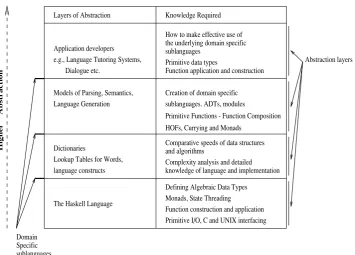
From our experience the natural solution to nding a balance between teaching at the right level of abstraction and detail of ecient implementation is to develop a hierarchy of programmers. This hierarchy has naturally developed into the levels shown in Figure 2.
The gure shows abstractions created by developers at various levels in the hierarchy, together with typical levels of expertise. People at each level will pro-vide support to those higher up (either by creating abstractions or providing tools). An abstraction at the lower level in the hierarchy may hide developers from primitive I/O operations and access to other parts of the system imple-mented inCorC++.
In the rest of this paper we explain why certain features of functional lan-guages are particularly suited to the creation of these levels of abstraction.
5
Suitability of Functional Languages
We use particular examples as a case studies, but stress that this abstraction approach can also be applied more generally. This section looks more specically at aspects of functional languages which provide us with the desirable features mentioned above.
H
ig
h
er
A
b
st
ra
ct
io
n
Domain
Specific
sublanguages
Layers of Abstraction
Application developers
e.g., Language Tutoring Systems,
Dialogue etc.
Language Generation
Creation of domain specific
HOFs, Currying and Monads
Dictionaries
language constructs
Knowledge Required
Models of Parsing, Semantics,
Lookup Tables for Words,
sublanguages. ADTs, modules
Primitive Functions - Function Composition
Abstraction layers
The Haskell Language
Primitive I/O, C and UNIX interfacing
Defining Algebraic Data Types
Monads, State Threading
Function construction and application
How to make effective use of
the underlying domain specific
sublanguages
Primitive data types
Function application and construction
Comparative speeds of data structures
and algorithms
[image:6.595.112.468.112.367.2]Complexity analysis and detailed
knowledge of language and implementation
Fig. 2.A diagram showing the various levels of abstraction that exist. The col-umn on the left shows the layers of abstraction, based on the Haskell language, at which applications are developed. People developing at lower layers support those at higher layers by providing tools and/or creating a level of abstraction. The second columns shows the knowledge that those working at each level re-quire. Each level of abstraction can be bridged by the use of a DSS. The real power of Functional Languages lies in the way in which the boundaries between these levels of abstraction can be drawn.
types of detail (e.g. eciency or how the grammar is used to actually produce a parse) but they are concerned with the eects of these grammar rule variations. For such a person we wish to create a dierent type of abstraction to a person who is working at the level of the natural language dictionary where ecient word lookup is paramount for the eective working on the system.
5.1 Domain Specic Sublanguages
work, or using a language which does not allow us to express ourselves directly in terms of this domain, and has already been designed and implemented with wider goals in mind.
A solution which lies somewhere between these two extremes is provided by the use of what we call Domain Specic Sublanguages (DSS). We build such languages as collections of Haskell types, operators and functions, and so in a sense they are not a new language at all. However, they are designed in such a way that the programs written using them, not only look unlike \normal" haskell programs, but correspond closely to the important concepts in the domain in which our problem lies. So for example we provide a domain specic sublanguage for writing grammars which hides any details of how the grammar might be used to actually parse sentences.
We will illustrate with case studies that if well dened, a domain specic sub-language can appear to the programmer to be a new sub-language specially tailored to the required level of abstraction. We also try to show that lazy functional programming languages are ideal candidates to enable the creation of these sub-languages.
5.2 Case Study 1: The LOLITA Grammar
Perhaps the best example of a DSS currently in the LOLITA system is the NL grammar. This may be because DSS's are particularly suited to domains which rely on large numbers of rules which have similar structure. An example of one such grammar rule is shown in Figure 3.
> reported_sentence :: Parser > reported_sentence
> = prephrases > +++
> sentence &? excl_mark >> exclamN > +++
> sentence & ques_mark >> questN
Fig. 3. An example of one of LOLITA's grammar rules. exclamN and questN
specify the labels to be placed on the resulting parse tree nodes, as well as the feature aspects (such as number and tense).
Although this rule is Haskell code it has a close correspondence with the standard formalisms for describing grammars. For example Figure 4 shows the grammar rule shown in Figure 3 in a more traditional BNF (Backus Naur Form).
reported_sentence = prephrases |
sentence ?excl_mark | sentence ques_mark
Fig. 4.The grammar rule in 3 in BNF form.
This example fully exploits the powerful abstraction mechanisms provided by functional languages by providing a DSS. The example above is a particularly good case because:
{ The mapping from original BNF grammar to the domain specic language is particularly natural.
{ The domain is totally enclosed. The user of such a language has not been given any opportunity to revert to the full complexity of Haskell.
{ We have moved away from Haskell specic details like how to combine and apply functions to totally syntactic issues of how to combine terminal and non-terminal symbols. Combining such symbols requires only a simplied view of complex functional programming aspects such as the type system (see Section 8).
5.3 Case Study 2: The Semantic Parser
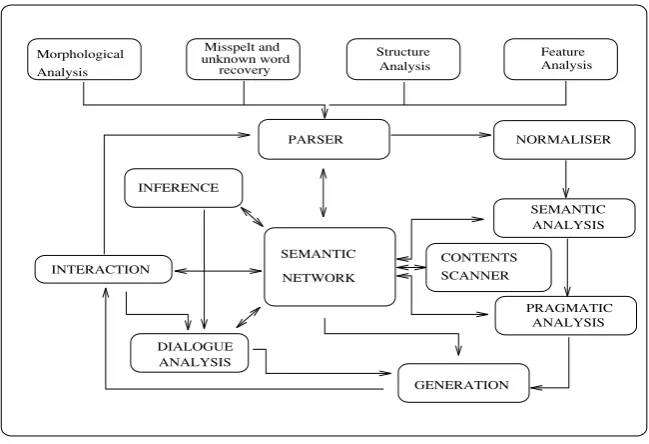
The semantic parser is a central feature of the LOLITA system (see Figure 5).
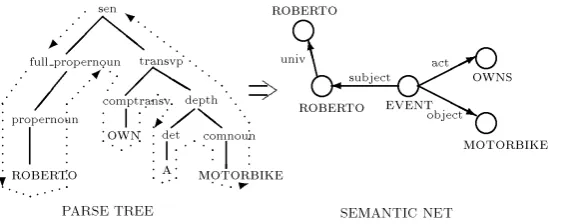
The input to the semantic parser is a syntactic parse tree built at a previous phase in the system. The output from the semantic parser is the corresponding semantic network structure. The fundamental task therefore is the transforma-tion from the parse tree structure to the semantic network data type. Consider for example the parse tree representing the sentence \Roberto owns a motor-bike", and its conversion to the corresponding piece of semantic network, shown in Figure 6.
Each node in the parse tree is labelled with its grammatical construct. For instance the root node of the parse tree is labelled with sen, representing the complete sentence structure. Each of these labels has a corresponding semantic rule which transforms the parse tree structure into the semantic network struc-ture. Rather than coding these rules directly, we have dened a language which is used to specify these rules in an abstract way. This language has been modied as our comprehension of what is required by semantic analysis has changed and developed.
Two types of semantic rule are used, one for parse tree leaves and the other for branches. The parse tree leaf rules are represented by the abstract data type (ADT) `leaf rule' and are given as part of the denition of a functionmeta leaf
GENERATION
PARSER
SEMANTIC
NETWORK
INTERACTION
NORMALISER
SEMANTIC
ANALYSIS
PRAGMATIC
ANALYSIS
INFERENCE
Morphological
Analysis
unknown word
recovery
Structure
Analysis
Feature
Analysis
DIALOGUE
ANALYSIS
Misspelt and
[image:9.595.164.489.115.337.2]CONTENTS
SCANNER
Fig. 5.A diagram showing the components of the LOLITA core.
the parse tree branch rules are represented by the ADT `branch rule' and are given as part of the denition of a function meta branch.
meta_leaf :: ParseTreeLabel -> LeafRule meta_branch :: ParseTreeLabel -> BranchRule
The semantic representation of a binary node in the parse tree is mainly de-termined compositionally according to its label and the semantics of the subtrees below it. Taking the transvpnode of Figure 6 as an example, the left subtree produces the concept of ownership and the right subtree produces the concept of a particular (but unspecied) motorbike. The fact that these are linked by a
transvpbranch means that the `ownership' must be an action and the motorbike must be an object. This rule is specied as follows:
> meta_branch "transvp" > = labelboth Act Obj
Although the rule for transvpcan dene the semantic representation for a node entirely in terms of the semantic representation of the subtrees, other rules must take into account contextual information such as the set of referents4 that are available. It must also be possible to mark points in the parse tree which may correspond to new nodes in the semantic network as well as points which may
4
k
k
k
k
k
c
c
c
%
%
%
b
b
b
#
# c
c
...
...
H
H
H
H
j
*
. . . . . . . . . . . . . . . . . . . . . . . . . . . . . . . . . . . . . . . . . . . . . . . . . . . . . . . . . . . . . . . . . . . . . . .. . . .... .. . . . . . . . . ... . . .:
..?
. . . . . . . . . .
. . . . . . . . . ./
. . . . . . .}
. . . . . . . . . . . . . . .C
CCO
senfullprop ernoun
prop ernoun ROBERTO transvp comptransv depth det A comnoun MOTORBIKE OWN
PARSE TREE SEMANTIC NET
sub ject OWNS
MOTORBIKE ROBERTO EVENT
act ROBERTO
univ
[image:10.595.154.435.146.258.2]ob ject
Fig. 6.An example of the task of the semantic parser part of LOLITA. The input (a parse tree) is transformed into a section of semantic network (the knowledge representation structure).
be referred to later in the text. To provide these facilities, additional operators and functions are provided.
The operator compose combines two rules and applies the rst rule to the result obtained from the application of the second (it is the semantic rule equiv-alent of function composition). The following example creates a branch-rule for proper nouns by combining three smaller rules:labelLeft,newnodeandaddref.
> meta_branch "full_propernoun" > = addref `compose` > newnode object `compose` > labelLeft Univ
This rule species the semantics forfull propernounas a unique new ob-ject node related to the semantics of the left subtree by the universal link (as indicated in Figure 6, full propernounbranches contain no right subtree). It also ensures that this new node is available as a referent (this would be used in the sentence \Roberto owns a motorbike and he cleans it almost every day"). The new node is necessary here to distinguish between the unique `ROBERTO' being talked about in the example and the universal concept of `ROBERTO'.
This short example illustrates how we use domain specic sublanguages to create a level of abstraction.
althoughBranchRuleandLeafRuleare implemented as functions, the semantic rule writer, need have no knowledge of the higher order aspects of Haskell needed to implement`compose`.
Abstract types therefore provide a framework for creating domain specic sublanguages and as we see in this example, there may be one or many abstract types needed to implement a domain specic sublanguage.
6
Supporting Domain Specic Sublanguages
Although declarative languages provide an abstraction away from the machine representation this is precisely what is needed for some tasks in a diverse system such as LOLITA which has many components.
The user is shielded from the complexity of the solution. For example, for a long time it was thought that the grammar of the system was adequately written. However, it was not until we obtained a graphical tool to display parse graphs (a graph of all possible parse trees of a sentence) that it was realised that parsing contributed a signicant amount to the space problem that was being encountered. It was later found to be a problem caused by the way in which the rules had been written.
It was soon realised that people were required to support the development of the system at the lowest level indicated in the hierarchy. This has lead to the development of debugging[4] and proling tools [9] as Ph.D. projects. These developers need to be aware of all the details of functional languages including graph reduction techniques, program optimisations and transformations carried out by the compiler. Part of their object is to shield people who develop com-ponents higher up in the programming hierarchy from implementation issues, and also to present debugging and proling information at the required level of abstraction, (rather then at lower levels). Without these techniques it is not possible to monitor the complexity behaviour of the programs at higher levels of abstraction without detailed knowledge, hence defeating the object of creating DSS's. These projects are looked at in more detail.
6.1 Debugging Domain Specic Sublanguages
Since each developer works at a particular level of abstraction and is not expected to know details of the mechanism underlying the particular DSS, aspects such as debugging code can present a problem. In the case of an error one of two possible cases has occured:
1. Either, the error has occured at the abstract level at which the developer is working (e.g. a DSS function applied to illegal arguments), or,
2. the error has occured at some lower level.
A class of run-time error which was found to be occurring frequently in developers code was the exception errortype. An exception error is one which results in termination of the program and the printing of an error message. Examples of this type of error in Haskell are
Fail: head{PreludeList}: head []
which results from passing the list head function an empty list and
Fail: (!!){PreludeList}: index too large
which occurs when the list indexing operator is passed a subscript which is outside the bounds of the list. These exception errors give the applications pro-grammer no indication of whereabouts in the program the error occurred. In particular the errors are displayed with reference to the lowest level in the sys-tem; the list function dened in the standard prelude.
This is a problem as functions such asheadand the list indexing operator are used many times in many dierent parts of LOLITA. Previously, this problem had been approached by providing a customised version of each function capable of generating an exception error for each module. This new version of the function would report the name of the module when it generated an exception error. However simply knowing the name of the module in which the exception was generated is not sucient|the error causing the exception error to be generated may be in a function which called the exception-generating one, or even some way back in a chain of functions each calling the other with the exception-generating function at the very end of the chain. Reporting errors in this way is of no use in the determination of errors at the level of a domain specic sublanguage.
The distinguished path debugging tool allows the display of chains of func-tions, termeddistinguished paths. The path displayed is the route taken through the dependency graph of the functions in the program. The tool works by trans-forming each function to take an extra parameter, a representation of the dis-tinguished path, which is built up from one function call to the next. When an exception error is encountered, the value of this extra parameter is displayed. Unlike the previous method of debugging such errors, which involved altering the source code by hand, the tool works automatically by transforming each source module.
6.2 Proling Domain Specic Sublanguages
During the development of the LOLITA system attention has been paid to the eciency of the code. A large amount of time has been spent proling the system with both the Glasgow cost centre proler [10], part of GHC, and also the York heap proler [12] [13], supplied with the Chalmers haskell compiler. Improve-ments to the overall system achieved through the use of the prolers have been in the order of 35%.
The proling task requires the parts of the code that the programmer is interested in to be identied. This process can take place automatically, the compiler will select functions, modules or constructors to prole at compile time, or alternatively this selection can be made by hand, by annotating the code.
Using hand annotated code to identify functions for proling it is possible to prole the functions of the domain specic sublanguage abstract data types. Perhaps more importantly it is possible for the applications programmer to shield themselves from the lower level functions in the system by proling just the modules in which they program.
The analysis of the proling results may be limited if the programmer is unaware of precise details relating to the functional language. For instance they may not understand why a space leak manifests itself or why functions are not evaluated lazily when this is the aim. However, the proling results do allow them to compare and contrast dierent implementations of their application functions and to see which appears to be more ecient.
Work has been done at Durham to develop a proling tool which provides the programmer with detailed proling information in an interactive post-processing environment5. A modied version of the Glasgow Haskell Compiler produces proling results based on stacksof functions. These stacks are used to recreate the function graph. The programmer can interact with functions in this call-graph to gather costs at dierent levels in the program. Since the proling costs are recorded in this stack form, the inheritance of costs to high levels in the call-graph is accurate; no statistical averaging is used for shared functions.
6.3 Optimising Domain Specic Sublanguages
One of the drawbacks with the domain specic sublanguage approach is the lack of any facilities to provide o-line processing of the sublanguage. Such a scheme would become particularly important in situations where the code in which the domain specic sublanguage is written could be optimised and transformed at compile time. The development of the grammatical analysis oers a typical ex-ample of where this would have been useful.
In order to achieve ecient parsing of natural language, a number of trans-formations were performed on the original grammar to make it largely deter-ministic [1]. The grammar was originally coded in its deterdeter-ministic form but this was found to destroy the structure of the grammar and it became dicult to
5
maintain. It was therefore decided that the transformations should be applied to the grammar.
The transformations were were performed by a three stage process. First, the original Haskell form of the grammar was parsed, secondly the transformations were applied, and nally the results of the transformations were built using the parsing ADT with additional deterministic constructs contained within it. Using the ADT to code the source of the grammar meant that the grammar could be tested without having to wait for the transformations to be applied. Given that the transformations typically took three hours, this made the maintenance of the grammar far more practical. The eciency of the untransformed grammar meant that it could not be applied to long and complex sentences; however it could be applied to suciently small sub-parts.
The current situation could be considerably improved if the compiler were able to provide a mechanism to perform the stages of grammar transformations as part of the compilation process. The grammar operators could then be im-plemented as constructors which would build a data structure representing the grammar (this contrasts with the present implementation in which grammar op-erators are functions). Supposing this was represented by the type NewParser:
> data NewParser = NewParser :+++ NewParser | > NewParser :>> ParserName |
etc.
The parsefunction which actually performs the parsing would then have the type:
> parse:: NewParser -> Input -> Output
and would be implemented as
> parse p i = (transformGrammar p) i
The functiontransformGrammarwould produce the actual parsing function, and would be evaluated at compile time.
7
Support for the Construction of Domain Specic
Sublanguages
It is certainly possible to use this domain specic sublanguage approach in other languages. Most modern languages provide facilities for the creation of abstrac-tion data types { these are essential to the use of DSS's as they prevent the user of the sublanguage from accessing the implementation of the types used in the sublanguage directly. The ability to dene operators with specied precedence and associativity is also provided in other languages.
However, certain features of functional languages make them particularly suitable for the implementation of DSS's. These are:
Higher-Order Functions. In the use of domain specic sublanguages, the pro-grammer will often apply a function to a value without realising that these values are also functions. For example in Figure 3,+++and>>are thus higher order functions as they take values of type Parseras parameters. The re-sult of using this form of representation is to make functions written using these abstract types easier to write and clearer to read. They enable a more natural mapping between the original rules the user may wish to enter and the form that Haskell the created Haskell sublanguage will accept.
Lazy Evaluation. Once an abstraction into a DSS is created it needs to be interfaced to the rest of the system. Lazy evaluation provides an essential mechanism that enables this integration [6]. For example, consider the con-ditional functioncondtaken from the Generator DSS of LOLITA
> cond :: GenCond -> Gen -> Gen -> Gen > sayEvent
> = cond hasObject > sayObject > sayNothing
The functioncondevaluates either its second or third argument depending upon the value of the rst. In a strict language an interface to this function is not practical because it requires the evaluation of both thethenand else
parts of the conditional.
Another example can be found in the parser. A typical piece of grammar will look like:
> paragraph = sentence & (empty +++ paragraph) >> parLabel
8
Teaching and Domain Specic Sublanguages
We have presented a methodology for the development of large scale functional systems. This consists of:
{ The various Domain Specic Sublanguages which make up the system; the case studies presented show examples of these.
{ Tools which make these abstractions practical. These include the proling, debugging and potentially the optimisation of domain specic sublanguages.
Consequently, this presents a structured paradigm for teaching of functional programming. Developers are taught an application specic DSS, Typically this means teaching a greatly simplied functional language typically consisting of the functions available at the application specic DSS (with relevant types), together with:
1. basic function denitions: (un)guarded expressions. . . ,
2. associated typing rules: (f::t, simplied view of type system excluding as-pects such as currying,
3. function application,
4. simple module interfaces -module X (f1: : : fn) where import...
This avoids teaching advanced aspects of functional programming such as algebraic data types, higher order functions, monads and interfacing to other languages. . . .
Also we gain the normal benets given by abstract data types. Common functional programming ideas such as list comprehension and currying can be hidden from the application programmer. The amount of actual Haskell that needs to be taught is therefore only a small subset of the actual language.
At an optimal level in the system a developer need only know the functions of the supporting domain specic sublanguage and Haskell operations such as function application which enables them to combine these functions for their own development. Even powerful ideas like higher order functions can be hidden from the programmer because they are explicitly built into the domain specic sublanguage.
It must be stressed that although the strategy is to teach a minimal amount (i.e. the DSS and those constructs listed above only), often developers will teach themselves a greater range of features. However, examples where developers have only learned the provided sublanguage do exist.
9
Conclusion
where the full complexity of the language is used at all levels in the code. Hence our developers do not have to show prociency at all levels in programming techniques. Although it may seem desirable to have all developers showing pro-ciency in programming techniques at all levels of functional languages, it has been found to be infeasible in large project such as the ours. This arises mainly as a result of the scale of the project, tight time constraints on teaching, and the varying abilities and backgrounds of the members joining the team.
In choosing our own natural syntax and hiding levels of detail in an ADT we are able to create a domain specic sublanguage for a particular task. The approach we have developed has a number of well established traits:
{ Flexibility| By using a sublanguage of Haskell, the syntax and semantics of the language may be changed simply. This is something that has frequently occurred within the development of the LOLITA system.
{ Power | These domain specic sublanguages are extremely useful when we can nd an appropriate set of constructions that cover all of rules we want to describe without becoming overly complex. However, we do nd in a substantial rule set that there are often some rules which need special treatment. In our approach it is easy to revert to the full power of Haskell (and lose some abstraction at isolated points). In the external language ap-proach, this would be far more dicult to achieve, and either requires the special construction of \one o " primitives, or some facility to interface with a more powerful language.
{ Scale | The overheads in setting up new language tools mean that the external approach is really only feasible for substantial rule sets. The internal approach has a very small overhead and is thus applicable to much smaller rule sets.
The development of the LOLITA system over a number of years, by a number of people with mixed programming experience, has given us a large amount of functional programming experience. The signicance of this work highlights not only how, features of functional languages alleviate the burden of teaching a wide spectrum of functional techniques to developers of large-scale real world system, but also, with the need for developing advanced programming tools, where such a scheme fails.
Acknowledgements
Our thanks to Dave Nettleton and Paul Callaghan for reading earlier drafts of this paper.
References
1. N. Ellis, R. Garigliano, and R. Morgan. A new transformation into
deterministi-cally parsableform for natural language grammars. InProceedings of 3rd
2. R. Garigliano. LOLITA: Progress report 1. Technical Report 12/92, School of
Engineering and Computer Science, University of Durham, 1992.
3. A. Gill and P. Wadler. Real world applications of functional programs.
http://www.dcs.gla.ac.uk/fp/realworld.html.
4. J. Hazan and R. Morgan. The location of errors in functional programs. Lecture
Notes in Computer Science, 749:135{152, 1993.
5. P. Hudak, S. Peyton Jones, P. Wadler, et al. Report on the Programming Language
Haskell Version 1.2, 1992.
6. J. Hughes. Why fuctional programming matters.The Computer Journal, 32, 1989.
7. S. Jarvis. Proling large-scale lazy functional programs. PhD thesis, Durham
University,forthcoming.
8. D. Long and R. Garigliano. Reasoning by Analogy and Causality: A model and
application. Articial Intelligence. Ellis Horwood, 1994.
9. R. G. Morgan and S. A. Jarvis. Proling large-scale lazy functional programs. In
Proceedings of the Conference on High Performance Functional Computing,
Den-ver, USA., April 1995.
10. S. L. Peyton Jones. Implementing lazy functional programs on stock hardware:
the spineless tagless g-machine. Journal of Functional Programming, 2:127{202,
1992.
11. S. L. Peyton Jones et al. The Glasgow Haskell Compiler: a technical overview. In
Framework for Information Technology Technical Conference, Keele, 1993.
12. C. Runciman and D. Wakeling. Heap proling of a lazy functional compiler. In
J. Launchbury and P. Sansom, editors,Functional Programming. Springer-Verlag,
1992.
13. C. Runciman and D. Wakeling. Heap proling for lazy functional programs.
Jour-nal of FunctioJour-nal Programming, 3, April 1993.
14. C. Runciman and D. Wakeling. Applications of Functional Programming. UCL
Press, 1995.