R. Meyer
J. Köhler
A. Homburg
Explosives
Explosives. Sixth Edition. Rudolf Meyer, Josef Köhler, Axel Homburg
Rudolf Meyer
Josef Köhler
Axel Homburg
Explosives
Sixth, Completely
Dr. Rudolf Meyer (†)
(formerly: WASAG Chemie AG, Essen, Germany) Josef Köhler
Fronweg 1
A-4784 Schardenberg Dr.-Ing. Axel Homburg c/o Dynamit Nobel GmbH Kaiserstr. 1
D-53839 Troisdorf
This book was carefully produced. Nevertheless, authors and publisher do not warrant the information contained therein to be free of errors. Readers are advised to keep in mind that statements, data, illustrations, procedural details or other items may inad-vertently be inaccurate.
First Edition 1977
Second, Revised and Extended Edition 1981 Third, Revised and Extended Edition 1987 Fourth, Revised and Extended Edition 1994 Fifth, Completely Revised Edition, 2002 Sixth, Completely Revised Edition, 2007
Library of Congress Card No.: Applied for. British Library Cataloguing-in-Publication Data
A catalogue record for this book is available from the British Library. Bibliographic information published by the Deutsche Nationalbibliothek
Die Deutsche Nationalbibliothek lists this publication in the Deutsche Nationalbibliografie; detailed bibliographic data are available in the Internet at <http://dnb.d-nb.de>
© Wiley-VCH Verlag GmbH, Weinheim, 2007 ISBN 978-3-527-31656-4
Printed on acid-free paper.
All rights reserved (including those of translation in other languages). No part of this book may be reproduced in any form – by photoprinting, microfilm, or any other means – nor transmitted or translated into machine language without written permission from the publishers. Registered names, trademarks, etc. used in this book, even when not specifi-cally marked as such, are not to be considered unprotected by law.
Composition: Typomedia, Ostfildern Printing: betz-druck GmbH, Darmstadt
Bookbinding: Litges & Dopf Buchbinderei GmbH, Heppenheim Cover Design: Wolfgang Scheffler, Mainz
Preface
The sixth English edition of “Explosives” which is now available can look back over a history of 30 years since it was first published. On the initiative of its main author Dr. Rudolf Meyer (who regrettably died in 2000), the first copy of the German version of “Explosivstoffe”, which had become known far beyond the borders of German-speaking countries, was first translated in 1977. It was also Dr. Rudolf Meyer, who in 1961, in his function of Technical Director of the German company WASAG Chemie AG, gave new impetus to the company brochure to achieve its present form.
The preparation of all the current German and English editions have a closely-knit history with the Fraunhofer Institut für chemische Techno-logie (ICT, formerly the Institut für Chemie der Treib- und Explosiv-stoffe with its head offices in Pfinztal/Berghausen near Karlsruhe, Germany. This institute was initially founded by Dr. Karl Meyer, Dr. Rudolf Meyer’s elder brother in 1957, as part of the Technische Hochschule, Karlsruhe, and was extended later on.
We regret to say that while this sixth edition was under preparation, the Assistant Technical Director of ICT, Dr. Fred Volk, (1930–2005) passed away.
Immediately after obtaining his doctorate in chemistry in 1960, Dr. Fred Volk joined the ICT, which had then just been built in Pfinztal, where he worked closely with Dr. Karl Meyer. The main focus of his research within the area of explosive analysis was on the use of thin-layer chromatography and mass spectrometry as well as on calculat-ing thermodynamic energies used in explosive and combustion proc-esses. The many key words and the related articles in “Explosives” dealing with theoretical and thermodynamic performances were pains-takingly checked, or written by Dr. F. Volk himself, each time before a new edition was printed.
As an addition to the previous edition of “Explosives”, this book in-cludes even more information on new explosive formulations.
Dr. Alfred Kappl has provided information and text materials on Fuel Air and Thermobaric explosives, and Dr. Robert Bickes (Sandia Na-tional Labs, USA) has contributed an article about Semiconductor Bridge Igniters (SCB). The special department II.3 (Dr. Thomas Leh-mann, Dr. Silke Schwarz and Dr. Dietrich Eckhardt) of the Deutsche Bundesanstalt für Materialforschung und -prüfung (German Federal Institute for Material Testing and Research, BAM) has also contributed important notes and references on the subjects of hazardous sub-stances and testing procedures.
and Prof. Dr. P. Elsner, Dr. S. Kelzenberg, Dr. Th. Keicher, Dr. N. Eisenreich, Dr. K. Menke, Dr. H. Krause, Dr. M. Hermann, and Dr. P. B. Kempa deserve particular mention for their generous contributions. The authors would particularly like to thank their colleagues mentioned above for their contributions and for providing valuable comments. Due to reductions and restructuring in the explosives industry, which has sometimes resulted in a complete loss of former product and company names used over decades, a range of names used in the past has not been included in this edition.
As an addition a CD containing a demo version of the ICT-Database of Thermochemical Values and information about the ICT-Thermody-namic-Code ist attached to the book. The full version of the database contains detailed information of more than 14,000 substances, includ-ing structure formulae, oxygen balance, densities and enthalpies of formation. The Code may be used for calculating properties of for-mulations like the heat of explosion or specific impulse of explosives, propellants or pyrotechnics. Both programs, updated regularly, are available by the Fraunhofer ICT.
Among these may be mentioned Dr. B. Eulering (WASAG Chemie, Essen), Dipl.-Ing. W. Franke (BAM, Berlin), Dipl.-Ing. H. Grosse † (WASAG Chemie), Dr. E. Häusler † (BICT), Dr. R. Hagel (Ruag Ammo-tec, Fürth), Dr. H. Hornberg † (ICT), Dr. H. Krebs (BAM, Berlin), Dr. G. Kistner (ICT), Prof. Dr H. Köhler † (Austron), Dr. A. Kratsch (Rheinme-tall Industrie GmbH), Dip.-Ing. H. Krätschmer, Dr. K. Meyer † (ICT), Prof. Dr.-Ing. K. Nixdorff (BW University, Hamburg), Dr. K. Redecker, Dr. H. J. Rodner (BAM, Berlin), Dr. J. F. Roth † (DNAG, Troisdorf), Prof. Dr. H. Schubert (ICT), Prof. Dr. M. Steidinger (BAM, Berlin), Dipl.-Ing. G. Stockmann (WNC-Nitrochemie), Dr. G. Traxler (ORS Wien), Mr. R. Varosh (RISI, USA), Mr. J. Wraige (Solar Pyrotechnics, GB), Mrs. Christine Westermaier and Dr. R. Zimmermann (BVS, Dortmund). We hope that the large number of people who remain unmentioned will also feel that they share in this expression of thanks.
The authors also wish to thank the publishers, the WILEY-VCH Verlag GmbH Company, and in particular Mrs. K. Sora, Mrs. R. Dötzer and Mrs. D. Kleemann, for the most pleasant co-operation in the produc-tion and printing of this book.
The publishers and authors continue to welcome suggestions and communications of any kind. We hope that our book will remain an important reference work and a quick source of information in this edition as well.
From the preface of previous editions:
“Explosives” is a concise handbook covering the entire field of ex-plosives. It was preceded by the booklet “Explosivstoffe” published in 1932 by WASAG, Berlin, and by the handbook of industrial and military explosives published by WASAG-CHEMIE in 1961 under the same name.
The book contains about 500 entries arranged in alphabetical order. These include formulas and descriptions of about 120 explosive chem-icals, about 60 additives, fuels, and oxidizing agents, and a 1500-entry subject index.
The objective of the book is to provide fundamental information on the subject of explosives not only to experts but also to the general public. The book will therefore, apart from industrial companies and research facilities concerned, be found useful in documentary centers, transla-tion bureaus, editorial offices, patent and lawyer offices, and other institutions of this nature.
The properties, manufacturing methods, and applications of each substance are briefly described. In the case of key explosives and raw materials, the standard purity specifications are also listed.
The asymmetric margins are provided for entries and marginal notes of the reader.
Instructions for the thermodynamic calculations of the performance parameters of high explosives, gun propellants, and rocket propellants are given in somewhat greater detail. The basic thermodynamic data will be found in the extensive synoptic tables. They are based on the metric system; conversion from the English or the U.S. system can be made using the conversion tables on the back flyleaf. The front flyleaf contains a glossary of the terms denoting the characteristics of ex-plosive materials in six languages.
The standard temperature selected for the energy of formation and enthalpy of formation data is 25 °C = 298.15 K. The elementary form of carbon was taken to be graphite (and not diamond, as before). The numerical values of the energies of formation (which, as known, appear both in the relevant entry and in the tables) are the optimum molar values found in the enthalpy tables of Volk, Batheltand Kuthe: “Thermochemische Daten von Raketentreibstoffen, Treibladungspul-vern sowie deren Komponenten”, published by the Institut für Chemi-sche Technologie (ICT), D-76327 Pfinztal-Berghausen 1972.
The US experts in rocket-techniques* and the Institute of Makers of Explosives** published glossaries on the definition and explanations of technical terms. Parts of them have been incorporated in the text.
* Published as appendix 4 of the Aerospace Ordnance Handbook by Pollard, F. B.and Arnold, J. H. Prentice Hall Inc., 1966
The book is not intended as a systematic presentation of the science of explosives. Interested readers are referred to the many excellent publications on the subject, which are available in English (see, for example, the books by M. A. Cook) and the now nearly complete encyclopedia covering the whole explosive field, edited by Seymour M. Kaye(formerly by Basil T. Fedoroff†: “Encyclopedia of Explosives and Related Items”). Users of explosives should consult the “Blaster’s Handbook” of DU PONT Inc., which is by far the best book on the subject.
A comprehensive list of literature references will be found at the end of the book.
Atomic Weights
aluminium Al 26.982 lead Pb 207.19
antimony Sb 121.75 lithium Li 6.939
barium Ba 137.34 magnesium Mg 24.312
boron B 10.811 maganese Mn 54.938
calcium Ca 40.08 mercury Hg 200.59
carbon C 12.011 oxygen O 15.999
cerium Ce 140.12 phosphorus P 30.974
chlorine Cl 35.453 potassium K 39.102
chromium Cr 51.996 selenium Se 78.96
copper Cu 63.54 silicon Si 28.086
fluorine F 18.998 sodium Na 22.990
iodine J 126.904 strontium Sr 87.62
mass: kg g oz. Ib.
kilogram: 1 kg = 1 1000 35.274 2.2046
grain: 1 gr. = 6.4799 · 10–5 6.4799 · 10–2 2.2857 · 10–3 1.4286 · 10– 4
ounce: 1 oz. = 2.8350 · 10–2 28.350 1 6.25 · 10–2
troy ounce*) = 3.11035 · 10–2 31.1035 1 6.8572 · 10–2
pound:) 1 lb. = 4.5359 · 10–1 453.59 16 1
short ton: 1 sh. t. = 907.18
metric ton: 1 t = 1000 = 1.1023 sh. t.
* usual for noble metals.
length: m In. ft. yd.
meter: 1 m = 1 39.370 3.2808 1.0936
Inch: 1 in. = 2.54 · 10–2 1 8.3333 · 10–2 2.7778 · 10–2
foot: 1 ft. = 3.048 · 10–1 12" 1 3.3333 · 10–1
yard: 1 yd. = 9.144 · 10–1 36 3 1
mile: 1 ml. = 1609.3 63 360 5280 1760
area: m2 cm2 in2 ft2
square meter: 1 m2= 1 104 1550.0 10.764
square inch: 1 in2= 6.4516 · 10– 4 6.4516 1 6.9444 · 10–3
square foot: 1 ft.2= 9.2903 · 10–2 929.03 144 1
acre: 1 A.2= 4046.9 ≈ 0,4 ha
volume l gal in3 ft3
liter 1 l = 1 2.1997 · 10–1 61.024 3.5315 · 10–2
milliliter: = cubic
centimeter: 1 ml =
1 cm3= 10–3 2.2007 · 10– 4 6.1024 · 10–2 3.5315 · 10–5
cubic inch: 1 in3= 1.6387 · 10–2 3.6063 · 10–3 1 5.787 · 10– 4
fluid ounce: 1 oz fl = 2.8413 · 10–2 6.2528 · 10–3 1.7339 1.003 · 10–2
liquid pint: 1 pt = 5.68 · 10–1 1.25 · 10–1 34.662 2.006 · 10–2
liquid quart: 1 qt = 2 pt = 1.136 2.5 · 10–1 69.323 4.012
gallion: 1 gal = qt = 4.544 1 277.29 0.1605
cubic foot: 1 ft3= 28.317 6.2317 1728.0 1
dry barrel: 1 bbl dry = 115.63 23.447 7056.2 4.0833
force: N kp ib (wt)
Newton = 105Dyn 1 N = 1 1.0197 · 10–1 2.2409 · 10–1
Kilopond 1 kp = 9.8067 1 2.2046
pressure bar kp/cm 2 Atm. p. s . I.
bar = 10 Newton per cm
2: 1 bar = 1 1.0197 0.98692 14.504 ph ysical a tmosphere:
1 Atm. =
1.01325 1.0332 1 1 4.696 tec hnical a tmosphere: 1 kp/cm 2= 0 .98067 1 0.96784 14.223 w a ter column:
10 m =
0.98064
0.99997
0.96781
14.223
pound per square inc
h:
1 p
. s
. l. or lb/in
2=
6
.8947 · 10
–2
7.0307 · 10
–2
6.8046 · 10
–2
1
pound per square f
oot:
1 p
. s
. ft. or lb/ft
2=
4
.7880 · 10
–4
4.8824 · 10
–4
4.7254 · 10
–4
6.9444 · 10
–3 energy: kJ kcal mt l a tm l bar Jo
ule = meter
-Newton:
1 J = 1 m N =
1
0
–3
2.3884 · 10
–4
1.0197 · 10
–4
9.8687 · 10
–3
10
–2
kilojoule:
1 kJ =
1
2.3884 · 10
–1
1.0197 · 10
–1
9.8687
10
kilocalorie:
1 kcal =
4.1868
1
4.2694 · 10
–1
41.319
4
1.869
meter
-ton (1000 kp):
1 mt =
9 .8067 2.3423 1 96.782 9 8.069 liter -a tmosphere: 1 l a tm =
1.0133 · 10
–1
2.4202 · 10
–2
1.0333 · 10
–2 1 1 .0133 liter -bar :
1 l bar =
1
0
–1
2.3885 · 10
–2
1.0197 · 10
–2
9.8687 · 10
–1
1
kilow
a
tt-houre:
1 kWh =
3
600
859.85
367.10
3.5528 · 10
–5
3.6 · 10
5 hor se-pow er -houre: 1
PS h =
2
647.8
632.42
270
2.6131 · 10
–5
2.6478 · 10
5 g as-equa tion-factor : R
· °K · Mol =
8.313 · 10
–3
1.9858 · 10
–3
8.478 · 10
–4
8.204 · 10
–2
8.313 · 10
–2
british ther
mal unit:
1 BTU =
1
.055
2.520 · 10
–1
1.076 · 10
–1 10.41 10.55 specific impulse: kp s kp = s kp s kp Ns kp = m s kp s kp = lb (wt) s lb (wt) = s 1 1 9.8067 kp s kg = lb (wt) s lb 1 1 9.8067 Ns kg = m s
1.0197 · 10
–1
1.0197 · 10
–1
Abel Test
This test on chemical stability was proposed by Abelin 1875. The test parameter determined is the time after which a moist potassium iodide starch paper turns violet or blue when exposed to gases evolved by one gram of the explosive at 180°F (82.2 °C).
In commercial nitroclycerine explosives, for example, this coloration only develops after 10 minutes or more. In a more sensitive variant of the method, Zinc iodide – starch paper is employed.
The Abel test is still used in quality control of commercial nitrocellu-lose, nitroclycerine and nitroglycol, but is currently no longer employed in stability testing of propellants.
Acceptor*)
Empfängerladung; charge r ´eceptrice
A charge of explosives or blasting agent receiving an impulse from an exploding WDonorcharge.
Acremite
This is the name given by the U.S. inventor Acreto his mixture of about 94 % ammonium nitrate with 6 % fuel oil. This mixture was at first prepared in a primitive manner by the users themselves to obtain a very cheap explosive for open pit mining under dry conditions. As
WANFOthe material has widely displaced the conventional cartridged explosives.
Actuator
Mechanical device operated by a solid propellant.
Adiabatic
Processes or phenomena assumed to occur in a closed system without energy exchange with the surroundings.
adiabatic flame temperature
The temperature obtained by thermodynamics calculations for the products of combustion of energetic materials neglecting energy loss to the surroundings.
* Text quoted from glossary.
1 Adiabatic
Explosives. Sixth Edition. Rudolf Meyer, Josef Köhler, Axel Homburg
isobaric adiabatic flame temperature
Adiabatic flame temperature attained under constant pressure condi-tions.
isochoric adiabatic flame temperature
Adiabatic flame temperature attained under constant volume condi-tions
adiabatic temperature
The temperature attained by a system undergoing a volume or pres-sure change in which no heat enters or leaves the system.
Adobe Charge
Auflegerladung; p ´etardage
Synonymous with WMud Cap
ADR
Abbreviation for “Accord Europ ´een Relatif au Transport des March-andises Dangereuses par Route” (European Agreement Concerning the international Carriage of Dangerous Goods by Road). It is based on the Recommendations on the Transport of Dangerous Goods Model Regulations (United Nations).
Aerozin
A liquid fuel for rocket engines, which is composed of 50 % anhydrous hydrazine and 50 % asym-dimethylhydrazine.
AGARD
Abbreviation for the NATO Advisory Group for Aeronautical Research and Development.
Airbag
Gasgeneratortypes of generators. Both types are manufactured nearly exclusively in series production and were built in cars starting 1975. Mainstream applications of restraint systems in almost every car started in 1990. The first type is based on pure pyrotechnicfor gas generation to fill the bag with hot gas. The second type is also known as hybrid design, where a gas is stored under high pressure. It acts as cold gas source since there is no need for this gas to be generated pyrotechnically. Most types of hybridgenerators have a pyrotechnic heating charge to prevent excess cooling to undesired low temperatures. Both basic types of gas generator for airbags are used for driver, passenger, side and head airbags. Their diagrammatic construction is shown in Fig. 1 and Fig. 2.
In the hybridsystem the pre-pressurized gas (nitrogen, argon/helium or pure helium) is stored in high pressure containers fitted with a bursting membrane. Opening this membrane by pyrotechnic means allows the gas to flow out into the airbag. The cooling of the expanding gas is compensated or even over-compensated by a pyrotechnic charge. Since the total amount of pyrotechnic mixture is small in quantitative terms, the prescribed threshold values of the toxic impuri-ties contained in the working gas can be adhered to relatively easily. This fact in addition to the ideal temperature of the working gas is the main advantage of hybridgas generators. The disadvantages are the large weight, the subjection to the Pressure Vessel Regulation and the high noise level that occurs when the sealing disk opens, because initially the full gas pressure is present.
The unique feature of almost all pyrotechnical gas generatorsis the concentric assembly of three different chambers with different designs corresponding to their pressure conditions and functions. The inner-most chamber with the highest pressure resistance contains the ig-niter unit consisting of a plug, squib and booster charge. Depending on the generator construction a pre-ignition unit may also be installed, whose task is to ignite the pyrotechnic mixture without electric current in case of high temperatures, which could occur in case of a fire. During normal electrical ignition the thin resistance wire of the igniter is heated and the ignition train started. The booster charge normally used is boron / potassium nitrate. The hot gases and particles gen-erated by this charge enter the concentrically arranged combustion chamber and ignite the pyrotechnic main charge. Both chambers are designed for pressures up to 40 MPa. The pyrotechnic main charge consists generally of compressed pellets which generate the working gas and slag residues by a combustion process. The products leave the combustion chamber through nozzles and enter the low pressure region of the filter compartment, where the slag is removed from the gas flow. The filter compartment is equipped with various steel filters and deflector plates. The resulting gas flows through the filter com-partment apertures into the bag.
The basic task of a gas generator is to provide sufficient non-toxic gas within approximately 25 ms to inflate the airbag to the specification pressure. The first pyrotechnic mixture used in airbag gas generators was based on sodium azide. Sodium azide reacts with oxidising agents, which bond chemically the remaining sodium as the nitrogen is liberated. Established oxidisers are the alkali and alkaline earth nitrates, metal oxides (e. g. CuO, Fe2O3), metal sulfides (MoS2) and sulphur. If necessary slag forming agents (e. g. SiO2, aluminosilicates) were also added.
The consequence of advance in environmental awareness was that the toxic sodium azide has to be replaced despite pure nitrogen generation, lower reaction temperatures and greater long-term stabil-ity. Another factor against sodium azide was the relative low specific gas yield and the unsolved disposal procedure for this type of pyro-technic mixture.
1. Ignition chamber 7. Nozzle holes 2. Igniter unit 8. Filter chamber 3. Pre-ignition unit 9. Filter
4. Nozzle holes 10.Deflector plate
[image:18.411.100.315.57.260.2]5. Gas mixture 11.Filter chamber apertures 6. Combustion chamber 12.Gas generator housing
Fig. 1. Sectional diagram of a pyrotechnical gas generator for airbags
1. Hybrid generator housing 2. Igniter
3. Pyrotechnic mixture 4. High-pressure vessel 5. Sealing disk
6. Filter pack
[image:18.411.100.235.292.549.2]7. Pressure measurement device
Fig. 2. Sectional diagram of a hybrid gas generator for airbags
8 7 4 3 1 2 5 6
9
11
10
9
12
7
1
4
5
6
2 3
40 ms to inflate the airbag to the specification pressure. From the mid-seventies to the mid-nineties the vast majority of gas mixtures in pyrotechnic gas generators were based on sodium azide. Sodium azide reacts with oxidising agents that bond chemically to the resulting sodium as the nitrogen is liberated. Established oxidisers include the alkali and alkaline earth nitrates, metal oxides (e. g. CuO, Fe2O3), metal sulphides (e. g. MoS2) and sulphur. If necessary, slag forming agents (e. g. SiO2, aluminosilicates) are also added.
The consequence of advances in environmental awareness is that gas mixtures containing azide are to be replaced because of the toxicity of their sodium azide, and this in spite of lower reaction temperature, purer nitrogen yield and greater long-term stability. However, one factor against sodium azide is that the correct disposal of unused gas mixtures throughout the world, which arise on a scale of thousands of tons per year, has not yet been guaranteed.
With regard to azide-free gas mixtures, there have been numerous patents and initial applications since the early nineties. These new gas mixtures generate more gas per gram (gas yields from gas mixtures containing NaN3: 0.30–0.35 l/g) and thus enable smaller and to some extent a more lightweight construction of the gas generators.
They can be classified into three categories:
1. High-nitrogen organic compounds (C, H, O, N) are combined with inorganic oxidisers:
The fuels are, for example, 5-aminotetrazole, azodicarbonamide,
WGuanidine nitrate, WNitroguanidine, dicyandiamide, W Triamino-guanidine nitrate and similar compounds, as well as salts of, for example, 5-nitrobarbituric acid, urea derivatives and also nitra-mines and similar compounds. The oxidisers are, for example, alkali or alkaline earth nitrates, WAmmonium, alkali or alkaline earth perchlorates and metal oxides.
Gas yield of these mixtures: 0.50–0.65 l/g.
2. Cellulose nitrate in combination (gelation) with nitrate esters of polyols (plus WStabilisers and plasticizers), e. g. NC/NGL (W Ni-troglycerine) or NC/EDDN (WEthylenediamine dinitrate).
Because of the unfavourable oxygen balance, it is necessary to secondary oxidise (e. g. with Hopcalite) to avoid excess CO forma-tion. Despite favourable raw materials costs, the unfavourable stor-age stability, see below, must be noted here.
Gas yield of the mixture: 0.8–0.9 g/l (not including the secondary oxidation).
ates and chlorates with additional assistance from metal oxides. This enables any formation of NOx to be excluded.
Gas yield of the mixture: 0.5–0.6 l/g.
The gas mixtures are usually manufactured by grinding and blending the raw materials, which after a pre-compacting step are pressed into pellets or disks on (rotary table) presses, after which they are weighed out. Gas mixtures containing WNitrocelluloseare moulded after gelati-nising in the usual way.
The fact that the transition from gas mixtures containing azide to ones free from azide is not simple is attributable to the following problems (a) The considerably higher combustion temperatures impose higher
demands on both the gas generator housing and on the airbag. (b) The cooling curve of the combustion gases is steeper and must be
taken into account.
(c) Condensation/filtration of the liquid/solid slag components is more difficult because of the temperature (fine dust problem).
(d) Gas mixtures containing nitrocellulose can cause difficulties in the long-term temperature test (400 hours at 107 °C, specification weight loss: < 3 %) and during temperature cycling storage (W ex-udation).
(e) The long-term stability of the various azide-free gas mixtures is not yet sufficiently known.
(f) Despite an equilibrated oxygen balance, there is a tendency dur-ing the combustion of organic substances for toxic gases to be formed as by-products, although these are limited as follows: Effluent Gas Vehicle Level Limit Driverside Limit
Chlorine (Cl2) 5 ppm 1.7 ppm
Carbon monoxide (CO) 600 ppm 200 ppm
Carbon dioxide (CO2) 20,000 ppm 6,700 ppm
Phosgene (CoCl2) 1 ppm 0.33 ppm
Nitric Oxide (NO) 50 ppm 16.7 ppm
Nitrogen Dioxide (NO2) 20 ppm 60.7 ppm
Ammonia (NH3) 150 ppm 50 ppm
Hydrogen Chloride (HCl) 25 ppm 8.3 ppm
Sulphur Dioxide (SO2) 50 ppm 16.7 ppm
Hydrogen Sulphide (H2S) 50 ppm 16.7 ppm
Benzene (C6H6) 250 ppm 83.3 ppm
Hydrogen Cyanide (HCN) 25 ppm 8.3 ppm
Formaldehyde (HCHO) 10 ppm 3.3 ppm
In the case of the azide-free gas mixtures, there is currently no recognisable trend towards any particular fuel, since the size of the market entails a large range of variants with different requirements.
For example liquid gas generators are described in which carbon-free compounds are used and which can also be reacted to form working gases without any slag, e. g. systems consisting of hydrazine/hydra-zine nitrate.
Air Blast
Druckwelle; onde de choc
The airborne acoustic or shock wave generated by an explosion
WDetonation, WFuel Air Explosives, WThermobaric Explosives.
Air Loaders
Blasgeräte; chargeurs pneumatiques
Air loaders serve to charge prilled WANFOblasting agents into bore-holes. If the free-running prills cannot be charged by pouring, e. g. horizontal boreholes, boreholes with neglectable slope or boreholes with small diameters, they can be introduced by air loaders. This is done by loading the charge into a pressurized vessel and applying an air pressure of about 0,4 MPa (4 atm); a valve at the lowest point of the machine, which can be controlled from the borehole to be filled, leads to a long hose; when the valve is opened, a stream of air containing the explosive charge in suspension, is sent through it into the borehole. Other, portable machines work on the injector principle.
Akardite I
diphenylurea; Diphenylharnstoff; diph ´enylur ´ee
colorless crystals
empirical formula: C13H12N2O
energy of formation: –117.3 kcal/kg – 490.6 kJ/kg enthalpy of formation: –138.2 kcal/kg –578.2 kJ/kg oxygen balance: –233.7
nitrogen content: 13.21 % density: 1.276 g/cm3
Akardite I serves as WStabilizer for gunpowders, in particular for
WDouble Base Propellants.
Specifications
melting point: at least 183 °C = 361°F
moisture: not more than 0.2 %
ashes: not more than 0.1 %
chlorides: not more than 0.02 %
pH value: at least 5.0
acid, n/10 NaOH/100 g:
not more than 2.0 cm3
Akardite II
methyldiphenylurea; Methyldiphenylharnstoff; N-m ´ethyl-N’, N’diph ´enylur ´ee
colorless crystals
empirical formula: C14H14N2O molecular weight: 226.3
energy of formation: –90.5 kcal/kg = –378.5 kJ/kg enthalpy of formation: –112.7 kcal/kg = – 471.5 kJ/kg oxygen balance: –240.4 %
nitrogen content: 12.38 %
Akardite II is an effective WStabilizerfor double base gunpowders
Specifications
same as for Akardite I, except
melting point: at least 170–172 °C = 338–342°F
Akardite III
ethyldiphenylurea; Ethyldiphenylharnstoff; N- ´ethyl-N’, N’-diph ´enylur ´ee
colorless crystals
empirical formula: C15H16N2O molecular weight: 240.3
energy of formation: –128.5 kcal/kg = –537.7 kJ/kg
enhalpy of formation: –151.9 kcal/kg = –635.5 kJ/kg oxygen balance: –246.3 %
nitrogen content: 11.65 %
Akardite III is an effective WStabilizer for double base propellants. Both Akardite II and Akardite III are gelatinizers as well as W Stabi-lizers.
Specifications
same as for Akardite I, exept
melting point: at least 89 °C = 192°F
Alginates
Salts of alginic acid which are capable of binding 200–300 times their own volume of water. They are added as swelling or gelling agents to explosive mixtures in order to improve their resistance to moisture, and to WSlurriesto increase viscosity.
Alex
Alex is an Waluminum powder formed by explosion of electrically heated aluminum wires in inert atmospheres with particle sizes be-tween 50 and 200 nm. Due to a passivation layer of a thickness between 2 to 4 nm a substantial amount of the particles is already converted to alumina the formation of which should be avoided by in-situ coating. In addition to the diffusion controlled oxidation at lower temperatures, a partial oxidation of the particles can occur by a fast chemically controlled reaction. Alex can increase the burning rate of solid composite rocket propellants up to a factor of 2. An increase of detonation velocity is not confirmed but Alex might improve Wair blast
or fragment velocities of some high explosives.
All Fire
Mindestzündstrom; amp `erage minime d’amorcage
Minimum current that must be applied to an igniter circuit for reliable ignition of the primer-charge without regard to time of operation.
Aluminum Powder
Aluminiumpulver; poudre d’aluminum
Aluminum powder is frequently added to explosives and propellants to improve their performance. The addition of aluminium results in con-siderable gain in heat of explosion because of the high heat of formation of aluminia (1658 kJ/mole, 16260 kJ/kg) leading to higher temperatures of the fumes. Aluminium not reacted in the detonation front might be oxidized atmospheric oxygen to induce “post-heating” in the fume zone and to increase the Wair blast or even to initiate a delayed secondary explosion.
Widely used mixtures of explosives with aluminum powder include
WAmmonals, WDBX, WHBX-1, WHexal, WMinex, WMinol, WTorpex,
WTrialenes, WTritonal and Hexotonal. In addition underwater explo-sives often contain aluminium powders.
The performance effect produced by aluminum powder is frequently utilized in WSlurries, also in WComposite Propellants.
Important characteristics of aluminum powders are shape and grain size of the powder granules. Waxed and unwaxed qualities are mar-keted. Propellant formulations often prescribe systematically varied grain sizes for obtaining optimal densities.
Amatex
A pourable mixture of trinitrotoluene, ammonium nitrate and RDX
Amatols
Pourable mixtures of ammonium nitrate and trinitrotoluene of widely varying compositions (40:60, 50:50, 80:20). The composition 80:20 may be loaded e.g. into grenades using a screw press (extruder).
Ammonals
Compressible or pourable mixtures containing ammonium nitrate and aluminum powder; the pourable mixtures contain WTNT
Ammongelit 2; 3
Trade names of ammonium nitrate – nitroglycol-based gelatinous explosives distributed in Germany and exported by ORICA and WASAGCHEMIE.
Ammongelit Density
g/cm3 Weight Strength%
2 1.45 88
Ammon-Gelit TDF
Trade names of ammonium nitrate – nitroglycol-based gelatinous ex-plosives distributed in Germany and exported by WASAGCHEMIE. Ammon-Gelit TDF, a safehandling, gelatinous ammonium nitrate ex-plosive, is, due to its similar properties, an alternative to W Wasag-Gelit 2 and it is manufactured without any nitrous aromatic compo-nents (WDNT, WTNT).
Ammonium Azide
Ammoniumazid; azoture d’ammonium
(NH4)N3
colorless crystals molecular weight: 60.1
energy of formation: +499.0 kcal/kg = +2087.9 kJ/kg enthalpy of formation: +459.6 kcal/kg = +1922.8 kJ/kg oxygen balance: –53.28
nitrogen content: 93.23 % density: 1.346 g/cm3
Ammonium azide is prepared by introducing a solution of ammonium chloride and sodium azide into dimethylformamide at 100 °C.
The solvent is then drawn off in vacuum.
Owing to its high vapor pressure, this compound has not yet found any practical application.
Vapor pressure:
Pressure Temperature
millibar °C °F
1.3 29.2 84.6
7 49.4 121.0
13 59.2 138.6
27 69.4 157.0
54 80.1 176.2
80 86.7 188.1
135 95.2 203.4
260 107.7 225.9
530 120.4 248.7
1010 133.8 272.8
Ammonium Chloride
Ammoniumchlorid; chlorure d’ammonium
NH4Cl
colorless crystals molecular weight: 53.49
energy of formation: –1371.6 kcal/kg = –5738.9 kJ/kg
enthalpy of formation: –1404.9 kcal/kg = –5878.1 kJ/kg
oxygen balance: – 44.9 % nitrogen content: 26.19 %
sublimation point: 335 °C = 635°F
Ammonium chloride serves as a partner component to alkali nitrates in the so-called inverse salt-pair (ion-exchanged) explosives (W Per-mitted Explosives).
Specifications
net content: at least 99.5 %
moisture: not more than 0.04 %
glow residue: not more than 0.5 %
Ca; Fe; SO4: NO3: not more than traces
pH value: 4.6– 4.9
Ammonium Dichromate
Ammoniumdichromat; dichromate d’ammonium
(NH4)2Cr2O7
orange red crystals molecular weight: 252.1
energy of formation: –1693.1 kcal/kg = –7083.9 kJ/kg enthalpy of formation: –1713.1 kcal/kg = –7167.4 kJ/kg oxygen balance: ± 0 %
nitrogen content: 11.11 % density: 2.15 g/cm3
Ammonium dichromate decomposes on heating, but is not an ex-plosive. It is a component of pyrotechnical charges, and is an effective additive which is introduced into ammonium nitrate-based propellants in order to catalyze the decomposition reaction.
Ammonium dinitramide
Ammoniumdinitramid; ADNempirical formula: H4N4O4 molecular weight: 124.06
energy of formation: –259.96 kcal/kg = –1086.6 kJ/kg enthalpy of formation: –288.58 kcal/kg = –1207.4 kJ/kg oxygen balance: +25.8 %
nitrogen content: 45.1 %
volume of explosion gases: 1084 l/kg heat of explosion
(H2O liq.): 3337 kJ/kg (H2O gas): 2668 kJ/kg specific energy: 843 kJ/kg density: 1.812 g/cm3 at 20 °C
melting point: 93.5 °C (decomposition at 135 °C and above)
impact sensitivity: 4 Nm friction sensitivity: 64 N
the most powerful nitration reagents such as nitronium tetrafluorobor-ate or dinitrogen pentoxide. Other methods pass via the direct nitration of ammonia with dinitrogen pentoxide to a mixture of ADN and W Am-monium Nitrateor the nitration of ammonium sulfamate with nitric acid to a mixture of ADN and ammomium hydrogensulfate. On the basis of its good WOxygen Balanceand high WEnthalpy of Formation, ADN appears to be attractive as a halogen-free oxidising agent for solid rocket propellants and is currently the subject of intensive studies.
Ammonium Nitrate
Ammoniumnitrat; nitrate d’ammonium; AN
NH4NO3
colorless crystals molecular weight: 80.0
energy of formation: –1058.3 kcal/kg = – 4428.0 kJ/kg enthalpy of formation: –1091.5 kcal/kg = – 4567.0 kJ/kg oxygen balance: +19.99 %
nitrogen content: 34.98 %
volume of explosion gases: 980 l/kg heat of explosion
(H20 liq.): 593 kcal/kg = 2479 kJ/kg (H20 gas): 345 kcal/kg = 1441 kJ/kg melting point: 169.6 °C = 337.3°F lead block test: 180 cm3/10 g deflagration point:
begins decomposition at melting point, complete at 210 °C = 410°F
impact sensitivity: up to 5 kp m = 50 Nm no reaction friction sensitivity:
up to 36 kp = 353 N pistil load no reaction critical diameter of steel sleeve test: 1 mm
Ammonium nitrate is hygroscopic and readily soluble in water (the saturated solution contains about 65 % NH4NO3). Transitions from one polymorph to another take place at 125.2 °C, 84.2 °C, 32.3 °C and -16.9 °C. The product shows a great tendency to cake. The difficulties therefore involved are avoided by transformation into WPrills. Ammo-nium nitrate is marketed as dense prills and as porous prills. Both can be introduced in industrial explosives after milling except WANFO
blasting agents, which need unmilled porous prills.
Ammonium nitrate is the most important raw material in the manu-facture of industrial explosives. It also serves as a totally gasifiable oxygen carrier in rocket propellants.
Phase Stabilized Ammonium Nitrate PSAN and Spray Crystallized Ammonium Nitrate SCAN are special qualities provided by ICT.
Specifications
net content (e.g. by
N-determination): at least 98.5 %
glow residue: not sandy,
and not more than 0.3 %
chlorides, as NH4Cl:
not more than 0.02 %
nitrites: none
moisture: not more than 0.15 %
Ca; Fe; Mg: not more than traces
reaction: neutral
Abel test at 82.2 °C = 180°F:
at least 30 min.
pH: 5.9+0.2
solubles in ether:
not more than 0.05 %
unsolubles in water:
not more than 0.01 %
acidity, as HNO3:
not more than 0.02 %
Specifications for prills
boric acid 0.14+0.03 %
density of grain: at least 1.50 g/cm3
bulk density: at least 0.8 g/cm3
Ammonium Nitrate Explosives
Ammonsalpeter-Sprengstoffe; explosifs au nitrate d’ammonium
Ammonium nitrate explosives are mixtures of ammonium nitrate with carbon carriers such as wood meal, oils or coal and sensitizers such as WNitroglycolor WTNTand WDinitrotoluene. They also may con-tain WAluminum Powder toimprove the WStrength. Such mixtures can be cap-sensitive. The non-cap-sensitive ones are classed as
WBlasting agents.
Mixtures of porous ammonium nitrate prills with liquid hydrocarbons, loaded uncartridged by free pouring or by means of WAir Loadersare extensively used under the name WANFO blasting agents.
The resistance to moisture of powder-form ammonium nitrate ex-plosives and blasting agents is low, but can be improved by addition of hydrophobic agents (e.g. calcium stearate). The densities of the pow-ders are about 0.9–1.05 g/cm3.
Higher density and better water resistance are obtained using gelat-inous ammonium nitrate explosives. They are based on ammonium nitrate and 20– 40 % gelatinized nitroglycol or a nitroclycerine-nitrogly-col mixture. The German Ammongelites also contain low-melting TNT-dinitrololuene mixtures. Ammonium nitrate gelatins have widely re-placed the elder sodium nitratenitroclycerine gelignites. The density of the gelatinous explosives is about 1.5–1.6 g/cm3.
Water-containing ammonium nitrate mixtures with fuels are known as
WSlurriesand WEmulsion Slurries
Many permitted explosives are ammonium nitrate in powder form or gelatinous explosives with added inert salts such as sodium chloride or potassium chloride which reduce their explosion temperature.
Ammonium Nitrate Emulsion
ANEIntermediate for WEmulsion (blasting) explosives. These emulsions are non sensitized and are intended to produce an emulsion (a blast-ing) explosive only after further processing prior to use. Emulsions typicallyconsist of ammonium nitrate (partly replaced by other in-organic nitrate salts), water, fuel and emulsifier agents.
Ammonium Perchlorate
Ammoniumperchlorat; perchlorate d’ammonium; APC
NH4ClO4
colorless crystals molecular weight: 117.5
energy of formation: –576.5 kcal/kg = –2412.0 kJ/kg enthalpy of formation: –601.7 kcal/kg = –2517.4 kJ/kg oxygen balance: +34.04 %
nitrogen content: 11.04 %
volume of explosion gases: 799 l/kg
heat of explosion (H2O liq.): 471 kcal/kg = 1972 kJ/kg density: 1.95 g/cm3
melting point: decomposition on heating lead block test: 195 cm3/10 g
deflagration point: 350 °C = 662°F impact sensitivity: 1.5 kp m = 15 N m
Ammonium perchlorate is prepared by neutralizing ammonia by perchloric acid. It is purified by crystallization.
Ammonium perchlorate is the most important oxygen carrier for
WComposite Propellants. Unlike alkali metal perchlorates, it has the
advantage of being completely convertible to gaseous reaction prod-ucts.
Table 1. Specifications
Grade A
Grade B
Grade C
net content: at least 99.0 % 99.0 % 98.8 %
water-insolubles:
not more than 0.03 % 0.01 % 0.25 %
bromates, as NH4BrO3:
not more than 0.002 % 0.002 % 0.002 %
chlorides, as NH4Cl:
not more than 0.15 % 0.10 % 0.15 %
chromates, as K2CrO4:
not more than 0.015 % 0.015 % 0.015 %
iron, as Fe:
not more than 0.003 % 0.003 % 0.003 %
residue from sulfuric acid fuming:
not more than 0.3 % 0.3 % 0.3 %
moisture: not more than 0.08 % 0.05 % 0.08 %
surface moisture:
not more than 0.020 % 0.015 % 0.020 %
ash, sulfated:
not more than 0.25 % 0.15 % 0.45 %
chlorate as NH4ClO3:
not more than 0.02 % 0.02 % 0.02 %
Na and K: not more than 0.08 % 0.05 % 0.08 %
Ca3(PO4)2: none none 0.15-0.22 %
pH: 4.3–5.3 4.3–5.3 5.5–6.5
Granulation classes
Class 1 – Through 420 and 297 micron sieve, retained on 74 micron sieve.
Class 2 – Through 297 micron sieve. Class 3 – Through 149 micron sieve.
Class 4 – 50 to 70 % through 210 micron sieve.
Class 5 – Through 297 micron sieve, retained an 105 micron sieve. Class 6 – 89 to 97 % through 297 micron sieve.
Class 7 – 45 to 65 % through 420 micron sieve.
Ammonium Picrate
ammonium-2,4,6-trinitrophenolate; Ammonpikrat; picrate d’ammon-ium; explosive D
yellow crystals
empirical formula: C6H6N4O7 molecular weight: 246.1
energy of formation: –355.0 kcal/kg = –1485.2 kJ/kg enthalpy of formation: –375.4 kcal/kg = –1570.7 kJ/kg oxygen balance: –52.0 %
nitrogen content: 22.77 %
volume of explosion gases: 909 l/kg heat of explosion
(H2O liq.): 686 kcal/kg = 2871 kJ/kg (H2O gas): 653 kcal/kg = 2732 kJ/kg density: 1.72 g/cm3
melting point: 280 °C = 536°F (decomposition) lead block test: 280 cm3/10 g
detonation velocity:
7150 m/s = 23 500 ft/s at r= 1.6 g/cm3 deflagration point: 320 °C = 608°F
impact sensitivity: at 2 kp m = 19 N m no reaction Ammonium picrate is soluble in water, alcohol and acetone, and is practically insoluble in ether. It is prepared by saturating an aqueous solution of picric acid with ammonia; a red form is formed first which passes into the stable yellow form in the presence of water vapor, on prolonged storage or by recrystallization from water. Ammonium pi-crate has been employed as an explosive in military charges.
Amorces
This term denotes very small priming plates utilized in children’s toys. They contain an impact-sensitive mixture of potassium chlorate and red phosphorus.
The French word “amorce” means all of initiating or inflaming devices.
Andex 1, ML
Trade names of WANFOexplosives marketed in Germany by MSW-CHEMIE, and ORICA Germany GmbH (formerly DYNAMIT NOBEL) in 25-kg carton packs or in containers of about 900 kg capacity. Andex 2 contains a small percentage of rock salt.
Andex 1:
bulk density: 0.9 g/cm3 weight strength: 75 %
ANFO
An abbreviation for ammonium nitrate fuel oil, a blasting agent com-posed of ammonium nitrate and liquid hydrocarbons. The application technique of these mixtures has now become very much easier owing to the fact that the material, which has a strong tendency to agglom-eration, is commercially produced as porous prills. These are granules solidified from the liquid melt, sufficiently porous to take up about 6 % of the oil, which is the amount needed to produce oxygen balance. The nitrate, and the explosive produced from it retain their free flowing capacity. (see also WAcremite)
The explosive must be utilized in the form of a continuous column, and must be ignited by a powerful primer. This means that it must be poured loose (not as cartridges) into the borehole, or else blown into it with an WAir Loader.
Its manufacture is very cheap, and may even take place on continuous mixers an wheels. The material has now almost completely replaced conventional explosives in cartridge form in open-pit mining and in potash mining.
density: 0.9 g/cm3 weight strength: 75 %
“Heavy Anfo” is a 50/50-mixture of Anfo and WEmulsion Slurries – which has higher loading densities than poured Anfo alone.
APU
(Auxiliary Power Unit) – Propellant-powered device used to generate electric or fluid power.
Aquarium Test
The parameter which is measured in this test is the pressure of underwater explosion. Lead or copper membranes are employed, and the membrane deformation as a function of the performance of the explosive and of the distance from the explosion site is estimated. The measuring apparatus, consisting of piston and anvil, resembles the
Kastbrisance meter. An alternative technique is to measure the de-formation of diaphragms or copper discs accommodated inside an air-containing vessel such as a can.
In addition to the mechanical method described there are also electro-mechanical measuring techniques in which the impact pressure is recorded by an oscillograph with the aid of a piezoquartz crystal. The measurements can be carried out in natural waters. A basin, made of steel concrete and bulkhead steel, has a buffering floor made of foamed polystyrene. Air is blown in along the bulkhead walls for damping purposes, so that an “air curtain” is formed.
WUnderwater Detonations.
Argon Flash
Argon-Blitz; ´eclair par d ´etonation dans l’argon
The intensity of the light appearing during a detonation is caused, primarily by compression of the surrounding air.
If the air is replaced by a noble gas such as argon, the light intensity increases considerably. The duration of the flash is only as long as that of the explosion, i.e., of the order of a few ms.
The recently developed ultra-short flash lamps work on the principle of detonation of an explosive in an argon medium. They are particularly suited to the illumination of detonation processes, since the detonation moment of the lamp can be accurately adjusted to the course of the detonation of the test specimen.
The intensity of the method can be considerably increased and the explosion time considerably reduced if the shock wave travelling from the explosive through the argon medium is reflected. This can be achieved by interposing a mass, which may be very small, such as an 0.2 mm-thick acetate foil, as an obstacle. The same effect can also be produced by using curved glass, such as a watch glass.
Armor Plate Impact Test
solid targets. The explosive is charged into the test projectile and is fired from a “gun” against a steel plate. The impact velocity which causes the charge to detonate is determined. The test description:
WSusan Test.
Armstrong Blasting Process
This is an extraction method in the USA in coal mining. The highly Compressed (700–800 atm) air in the borehole is suddenly released by means of so-called blasting tubes equipped with bursting discs. The compressed air is generated underground by special compressors (Walso Gas Generators).
A similar method has received the name Airdox. The bursting ele-ments in the blasting tubes have a different construction; the com-pressed air utilized in the method can be generated overground and distributed over a network of ducts.
ARRADCOM
US Army Armament Research and Development Command; Picatinny Arsenal Dover, New Jersey, USA
Center for research, development, approval and documentation on weapons and military materials.
ASTROLITE
Stochiometric mixture from hydrazine and ammonium nitrate. It was a spin off from the US-rocket program in the 60’s. Like in 19thcentury Sprengel (WSprengel Explosives) already suggested, two non ex-plosive components become cap sensitive after being mixed. Astrolite G and Astrolite A/A-1-5 (with 20 % aluminium additive) are called also “liquid land mine” or “binary explosive”. The explosive strength of such mixtures is very high (see also WHydan) and exceeds in certain aspects even Nitroglycol. Detonation velocity of Astrolite G: 8600 m/s and Astrolite A/A-1-5: 7800 m/s.
Audibert Tube
Audibert-RohrThis testing apparatus, which was first proposed by Audibert and
front face open, in the tube and is packed tightly on all sides with coal dust. An incandescent spiral is placed in the cartridge opening; if the material is difficult to ignite (e.g. inverse salt-pair permissibles) the spiral is covered with a flammable igniter mixture. The tube is then closed by a perforated plate. The parameter measured is the minimum hole diameter at which the initiated deflagration arrives at the bottom of the cartridge.
In a modification of the method two cartridges placed coaxially one an top of the other are tested.
Aurol
T-Stoff; IngolinConcentrated (88–86 %) hydrogen peroxide. It is employed in liquid fuel rocket engines as WOxidizeror, after catalytic decomposition, as
WMonergol. For its explosive properties, see Haeuseler, Explosiv-stoffe 1, pp. 6–68 (1953).
AUSTROGEL G1/G2
Austrogel G1 and Austrogel G2 are a blasting cap sensitive gelatinous explosives. They do not contain any nitroaromatic compounds (WDNT
or WTNT). The main ingredients are ammonium nitrate, nitroglycole and combustibles. Austrogel G1 and G2 may be used above and under ground. Austrogel G1 and G2 is also qualified very well as booster charge for low sensitive explosives such as WANFO and other not cap sensitive explosives, and its manufactured by the Austin Powder GmbH, Austria (formerly Dynamit Nobel Wien)
AUSTROGEL G1: AUSTROGEL G1:
density: 1,5 g/cm3 1,45 g/cm3
oxygen balance: +4,0 % +3,5 %
gas volume: 891 l/kg 881 l/kg
specific energy: 1020 kJ/kg 1064 kJ/kg
velocity of detonation: 6000 m/s 6200 m/s (steel tube confinement 52/60/500 mm)
Average Burning Rate
Mittlere Abbrandgeschwindigkeit; vitesse moyenne de combustion
The arithmetic mean (statistical average) burning rate of pyrotechnic or propellants at specific pressures and temperatures. Dimension – length/time or mass/time.
Azides
Azide; azoturesAzides are salts of hydrazoic acid (N3H). Alkali metal azides are the most important intermediates in the production of WLead Azide.
Sodium azide is formed by the reaction between sodium amide
(NaNH2) and nitrous oxide (N2O). Sodium amide is prepared by in-troducing gaseous ammonia into molten sodium.
Ballistic Bomb
closed vessel; ballistische Bombe; bombe pour essais ballistiques
(WBurning Rate)
The ballistic bomb (pressure bomb, manometric bomb) is used to study the burning behavior of a WGunpowderor WPropellantcharge powder. It consists of a pressure-resistant (dynamic loading up to about 1000 MPa (10 000 bar) hollow steel body that can be bolted together and has a hole to adapt a piezoelectric pressure transducer. The pressure pin the bomb is measured as a function of time t. As a rule, studies of powder in the pressure bomb are carried out in comparison with a powder of known ballistic performance. They are very useful both in the development of powders and in production monitoring.
If the dynamic liveliness L (= 1/pmax * dlnp/dt) is determined as a function of p/pmaxfrom the primary measured signal, then for a defined powder geometry the parameters characterising its burn-up, the linear burning rate ˙e(WBurning Rate) and the pressure exponent acan be determined. Pressure bomb shots of the same powder at different charge densities d(= mass mc of powder/volume VBof the pressure vessel) enable the specific covolume hof the combustion gases from the powder and the force f (powder force) of the powder to be determined in addition. From these, if the WHeat of Explosion QExof the powder is known, the value of the average adiabatic coefficient æ
(= 1 + f/QEx) of the combustion gases, which is of interest for the ballistic performance, can be derived.
Since the combustion gases of powders satisfy Abel’s equation of state to a good approximation, it is possible by using the auxiliary parameters (rc) density of the powder)
D: = mc/(VB* rc) ‘normalised charge density’ (1) x: = (1 – hrc) * D/(1 – D) ‘real gas correction term’ (2) F: = frcD/(1 – D) ‘characteristic pressure’ (3) to write the relationship between the pressure p in the manometric bomb and the burnt volume proportion zof the powder as
24 Azides
Explosives. Sixth Edition. Rudolf Meyer, Josef Köhler, Axel Homburg
z(p/pmax) = p/pmax/{1 + x(1 – p/pmax)} (4) and
p(z) = F* z/ (1 + xz). (5)
Accordingly, the maximum gas pressure achieved at the end of burn-up (z = 1) is calculated as
pmax= F/ (1 + x). (6)
The dynamic liveliness Lis calculated from
L= SV(0)(0)* f(z) * ˙e(ppref) ref *
[
p pref
]
a–1* 1 + x
(1 + xz)2 (7)
S(0)/V(0) is the ratio of the initial surface area to the initial volume of the powder,
f(z) is the shape function of the powder, which takes account of the geometrical conditions (sphere, flake, cylinder, N-hole powder) during the burn-up (f(z) = current surface area / initial surface area)
˙e(pref) is the linear burning rate at the reference gas pressure pref pref is the reference gas pressure and
a is the pressure exponent, which for many powders is close to 1.
To evaluate Eq. (7), zshould be replaced by p/pmaxusing Eq. (4). Figure 3 shows the time profile of the pressure in the manometric bomb for a typical 7-hole powder. Initially the pressure is increasingly steep, since burn-up takes place more quickly the higher the pressure and in addition the burning surface of the powder becomes greater as
Fig. 3. Pressure-time graph p = f(t)
the burn-up progresses (progressive burn-up). Towards the end of the burn-up the pressure profile levels out rapidly because the burning surface area of the powder becomes drastically smaller as soon as approx. 88 % of the powder has been burnt.
Figure 4, which shows the calculated profile of the dynamic liveliness as a function of p/pmax, again reflects essentially the shape of the form function for p/pmax > 0.2 (see Fig. 5). On the other hand for small values of p/pmax, the dependence on pa-1 resulting for a = 0.9 is dominant. The kink in the shapes of the form function and the dynamic Fig. 5. Shape function pf the powder as a function of the current surface area relative to the initial surface area
Fig. 4. Dynamic liveliness as a function of p/pmax
Fig. 6. Ballistic mortar.
liveliness at p/pmax= 0.87 (disintegration of the powder granules into slivers) is greatly rounded off in the measured curves, because not all of the granules burn up at exactly the same time and small differences in geometry always arise (manufacturing tolerances)
Ballistic Mortar
ballistischer Mörser, mortier ballistique
An instrument for comparative determinations of the performance of different explosives. A mortar, provided with a borehole, into which a snugly fitting solid steel projectile has been inserted, is suspended at the end of a 10 ft long pendulum rod. Ten grams of the explosive to be tested are detonated in the combustion chamber. The projectile is driven out of the mortar by the fumes, and the recoil of the mortar is a measure of the energy of the projectile; the magnitude determined is the deflection of the pendulum. This deflection, which is also known as weight strength, is expressed as a percentage of the deflection pro-duced by blasting gelatine, arbitrarily taken as 100. Also, relative values referring to the deflection produced by TNT are listed, espe-cially for explosives of military interest.
This method, which is commonly employed in English-speaking coun-tries, and which is suited for the experimental determination of the
work performed by the explosive, has now been included in the list of standard tests recommended by the European Commission for the Standardization of Explosive Testing.
An older comparison scale is “grade strength”, which determines the particular explosive in standard “straight” dynamite mixtures (the mix-tures contain ungelatinized nitroglycerine in different proportions, so-dium nitrate and wood or vegetable flour (WDynamites) which gives a pendulum deflection equal to that given by the test material. The percentage of nitroglycerine contained in the comparitive explosive is reported as grade strength.
The grade strength percentage is not a linear indicator of the perform-ance of the explosive; the performperform-ance of a 30 % dynamite is more than half of the performance of a 60 % dynamite, because the fuel-oxidizer mixtures as well as nitroglycerine also contribute to the gas-and heat-generating explosive reaction.
For comparison of weight strength values with other performance tests and calculations WStrength.
Ball Powder
Kugelpulver, Globularpulver; poudre sph ´erique
Ball powder is a propellant with ball-shaped particles, produced by a special method developed by Mathieson(USA). A concentrated solu-tion of nitrocellulose in a solvent which is immiscible with water (e.g., ethyl acetate) is suspended in water by careful stirring, so that floating spheres are formed. The solution is warmed at a temperature below the boiling point of the solvent, and the latter gradually evaporates and the floating spheres solidify.
Since the spherical shape is unfavorable from internal ballistical con-siderations (very degressive), follows, a thorough WSurface Treat-ment, the purpose of which is to sheathe the faster-burning core by a slower-burning shell.
BAM
Bundesanstalt für Materialforschung und -prüfung
Unter den Eichen 87, D-12200 Berlin (www.bam.de)
Federal Institute for Materials Research and Testing (including ex-plosives). BAM sensitivity tests: WFriction Sensitivity WHeat Sensitiv-ity and WImpact Sensitivity.
BAM is the German competent Authority for the dangerous goods of Class 1 and Notified Body in Compliance with EU Directive 93/15.
Baratols
Pourable TNT mixtures with 10–20 % barium nitrate.
Barium Chlorate
Bariumchlorat; chlorate de barium
Ba(ClO3)2· H2O
colorless crystals molecular weight: 322.3
energy of formation: –789.3 kcal/kg = –3302.3 kJ/kg enthalpy of formation: –799.4 kcal/kg = –3344.6 kJ/kg oxygen balance: +29.8 %
density: 3.18 g/cm3
melting point: 414 °C = 779°F
Barium chlorate and WBarium Perchlorateare used in pyrotechnical mixtures using green flames.
Barium Nitrate
Bariumnitrat; nitrate de barium: BN
Ba(NO3)2
colorless crystals molecular weight: 261.4
energy of formation: –898.2 kcal/kg = –3758.1 kJ/kg enthalpy of formation: –907.3 kcal/kg = –3796.1 kJ/kg oxygen balance: +30.6 %
nitrogen content: 10.72 % density: 3.24 g/cm3
melting point: 592 °C = 1098°F
component in green flame pyrotechnicals and in ignition mixtures (with
WLead Styphnate). For the specification see Table 1.
Barium Perchlorate
Bariumperchlorat; perchlorate de barium
Ba(ClO4)2· 3H2O
colorless crystals molecular weight: 390.3 oxygen balance: +32.8 % density: 2.74 g/cm3
melting point: 505 °C = 941°F
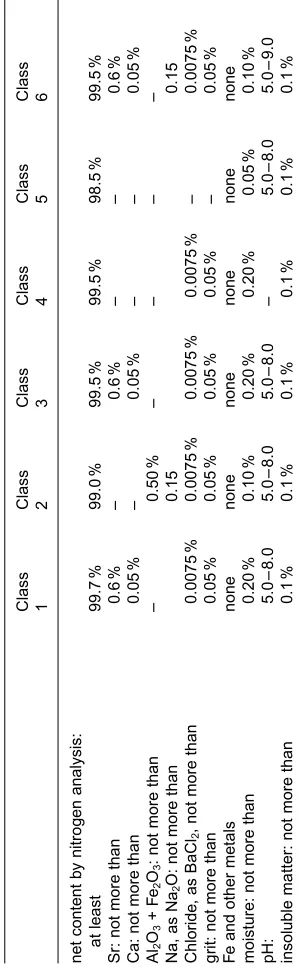
Ta ble 2. Specifica tions Class 1 Class 2 Class 3 Class 4 Class 5 Class 6
net content b
y nitro g en analysis: a t least 99.7 % 99.0 % 99.5 % 99.5 % 9 8.5 % 99.5 % Sr
: not more than
0.6 % – 0.6 % – – 0.6 %
Ca: not more than
0.05 % – 0.05 % – – 0 .05 % Al2 O3 + F e2 O3
: not more than
– 0.50 % – – – –
Na, as Na
2
O: not more than
0.15
0.15
Chloride
, as BaCl
2
, not more than
0.0075 % 0 .0075 % 0.0075 % 0.0075 % – 0.0075 % g
rit: not more than
0.05 % 0.05 % 0.05 % 0.05 % – 0.05 % F e
and other metals
none none none none none none
moisture: not more than
0.20 % 0.10 % 0.20 % 0.20 % 0 .05 % 0.10 % pH: 5.0 – 8 .0 5.0 – 8 .0 5.0 – 8.0 – 5 .0 – 8.0 5.0 – 9.0 insoluble ma tter
: not more than
[image:43.411.105.256.63.549.2]An oxidizer in propellant formulations and for WPyrotechnical Com-positions.
Barricade
Schutzwall; merlon, ´ecran
Barricades are grown-over earth embankments erected for the protec-tion of buildings which may be endangered by an explosion. The overgrown height of the barricade must be at least one meter above the building to be protected. The required safety distances between explosive manufacture buildings or storage houses can be halved if the houses are barricaded.
Base-Bleed Propellants
Gas generating elements inserted in the bottom of projectiles. The generated gas fills the subathmosperic pressure behind the projectile.
Base Charge
Sekundärladung; charge de base de d ´etonateur
The main explosive charge in the base of a blasting cap, an electric blasting cap, or a non-electric delay cap.
Bazooka
A shaped-charge anti-tank weapon first used by the Americans in the Second World War; WShaped Charges.Its operating method is identi-cal with that of the “Panzerfaust” developed in Germany at that time.
B-Black Powder
Sprengsalpeter; poudre noir au nitrate de soude
is a WBlack Powdermixture which contains sodium nitrate instead of potassium nitrate. It is marketed and utilized in the form of com-pressed cylinder-shaped grains, 25 and 30 mm of diameter, with a central hole 5 mm in diameter.
Bengal Fireworks
WPyrotechnical Compositions.
Benzoyl Peroxide
Benzoylperoxid; peroxyde de benzoyle
colorless crystals
empirical formula: C14H10O4 molecular weight: 242.1 oxygen balance: –191.6 %
melting and deflagration point: 107 °C = 225°F impact sensitivity: 0.5 kp m = 5 N m
friction sensitivity: at 12 kp = 120 N pistil load decomposition: at 24 kp = 240 N pistil load crackling critical diameter of steel sleeve test: 10 mm
Benzoyl peroxide is sparingly soluble in water and alcohol, but soluble in ether, benzene and chloroform. It can be prepared by reaction of benzoyl chloride with sodium peroxide.
The explosion strength of the product is low, but its sensitivity relatively high.
The organic peroxides serve as catalysts for polymerization reactions. They must be wetted or phlegmatized (WPhlegmatization) for trans-portation and handling.
Benzoyl peroxide can also be used as a bleaching agent for oils and fats.
Bergmann-Junk Test
A method, developed by Bergmannand Junk in1904, for testing the chemical stability of nitrocellulose; it was also subsequently employed for testing single-base powders. The test tube, which contains the specimen being tested, and which is equipped with a cup attachment, is heated at 132 °C = 270.4°F for two hours (nitrocellulose) or five hours (single base powders). At the end of the heating period the sample is extracted with water, and the test tube filled to the 50-ml mark with the water in the cup. The solution is filtered, and the content of nitrous oxides is determined by the Schulze-Tiemannmethod on an aliquot of the filtrate.
employed, since differing volumes of water are required to fill the tube up to the mark in gelled and porous powders.
Siebert suggested the use of H2O2rather than water as the absorption medium in 1942. He also suggested that the employed apparatus should be redesigned, to avoid gas losses which occur when the cup attachment is taken off. In the new design, the cup is replaced by a large (over 50 ml) attachment resembling a fermentation tube, which need not be taken off during the extraction of the sample. In this way quantitative determination of the liberated No, even in large amounts, becomes possible.
Siebertalso suggested that the total acidity be determined by titration against N/100 NaOH, in the presence of Tashiro’s indicator. In this manner WDouble Base Propellantscan also be tested as well; the test is carried out at 115 °C, the duration of heating being 8 or 16 hours depending on the nitroglycerine content of the sample (or of similar products, e.g. WDiethyleneglycol Dinitrate).
Bichel Bomb
Bichel-Bombe; bombe Bichel
Used to study the composition and WVolume of Explosion Gases.It consists of a heavy steel case sealed by a screw cap. The construc-tion withstands the dynamic shock of a detonating explosive sample. The gas developed can be vented by a valve in the screw cap for measurement of volume and for gas analysis.
The WLead Block Testhas been used for the same purpose: the block is sealed hermetically by a plug, and held in position by a steel construction. After detonation of the explosive sample in the block, the gas content has been vented by a special sealed drilling tool.
For the evaluation of the specific gas volume by computing W Thermo-dynamic Calculation of Decomposition Reactions.
BICT
Bundesinstitut für Chemisch-Technische Untersuchungen
German Federal institute for testing of and research on propellants and explosives for military purposes.
Since 01. 04. 97 the name of this institute has been changed “Wehr-wissenschaftliches Institut für Werk-, Explosiv- und Betriebsstoffe (WI-WEB)” (= Defence Scientific for Construction Materials, Explosives and Operating Materials).
Billet
Monolithic charge of solid propellant of any geometry; term usually applied to a formed propellant prior to final shaping (WGrain).
Binder
Compositions that hold together a charge of finely divided particles and increase the mechanical strength of the resulting propellant grain when it is consolidated under pressure. Binders are usually resins, plastics, or asphaltics, used dry or in solution (WEnergetic Binders).
BITA
Abbreviation denotation for an aziridine curing agent in WComposite Propellants;it has the following structure:
empirical formula: C21H27O3N3 molecular weight: 369.24 density: 1.00 g/cm3
Bi-trinitroethylnitramine
Di (2,2,2-trinitroethyl)nitramin; di-trinitro ´ethylnitramine; BTNENA,
HOX =High Oxygen Explosive
empirical formula: C4H4N8O14 molecular weight: 388.1
energy of formation: +2.8 kcal/kg = +11.9 kJ/kg enthalpy of formation: –17.0 kcal/kg = –71.2 kJ/kg oxygen balance: +16.5 %
nitrogen content: 28.80 %
volume of explosion gases: 693 l/kg