Overview for the Second Shared Task on Language Identification in
Code-Switched Data
Giovanni Molina, Nicolas Rey-Villamizar, Thamar Solorio
Dept. of Computer Science University of Houston
Houston TX, 77004
{gemolinaramos,nrey}@uh.edu [email protected]
Fahad AlGhamdi, Mahmoud Ghoneim, Abdelati Hawwari, Mona Diab
Dept. of Computer Science George Washington University
Washington DC, 20052
{fghamdi,mghoneim,abhawwari,mtdiab}@gwu.edu
Abstract
We present an overview of the second shared task on language identification in code-switched data. For the shared task, we had code-switched data from two different language pairs: Modern Standard Arabic-Dialectal Arabic (MSA-DA) and Spanish-English (SPA-ENG). We had a total of nine participating teams, with all teams submitting a system for SPA-ENG and four submitting for MSA-DA. Through evaluation, we found that once again language identification is more difficult for the language pair that is more closely related. We also found that this year’s systems performed better overall than the sys-tems from the previous shared task indicating overall progress in the state of the art for this task.
1 Introduction
With the First Shared Task on Language Identifica-tion in Code-Switched Data we managed to raise awareness and shine a spotlight on the difficult prob-lem of automatic processing of Code-Switched (CS) text. This year our goal is not only to maintain re-search interest in the problem, but also to bring in new ideas to tackle it. With the continuing growth of social media usage, it is more likely to find CS text and thus the problem becomes more relevant.
Code-switching is a linguistic phenomenon where two or more languages are used interchangeably in either spoken or written form. It is important to
study and understand CS in text because any ad-vancement in solving the problem will positively contribute to other NLP tasks such as Part-of-Speech tagging, parsing, machine translation, among oth-ers. In order to achieve this, we organized this year’s shared task with the intention of providing our peers with new annotated data, to further develop a univer-sal annotation scheme for CS text and most signifi-cantly to motivate high quality research.
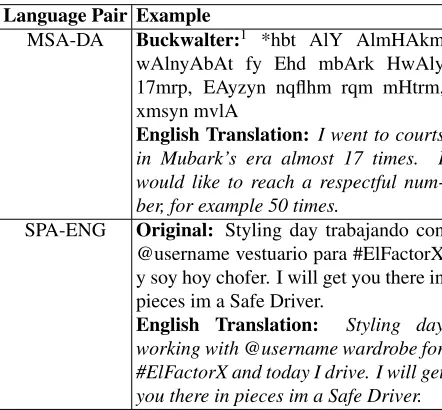
Language Pair Example
MSA-DA Buckwalter:1 *hbt AlY AlmHAkm
wAlnyAbAt fy Ehd mbArk HwAly 17mrp, EAyzyn nqflhm rqm mHtrm, xmsyn mvlA
English Translation: I went to courts in Mubark’s era almost 17 times. I would like to reach a respectful num-ber, for example 50 times.
SPA-ENG Original: Styling day trabajando con @username vestuario para #ElFactorX y soy hoy chofer. I will get you there in pieces im a Safe Driver.
[image:1.612.311.532.406.611.2]English Translation: Styling day working with @username wardrobe for #ElFactorX and today I drive. I will get you there in pieces im a Safe Driver. Table 1:Twitter code-switched data examples.
This shared task covers two different language pairs and is focused on social media data obtained
1We use the Buckwalter encoding to present all the Arabic
data in this paper: It is an ASCII only transliteration scheme, representing Arabic orthography strictly one-to-one.
from Twitter. The language pairs used this time are Spanish-English (SPA-ENG) and Modern Standard Arabic-Dialect Arabic (MSA-DA). These languages are widely used around the world and are good ex-amples of language pairs that are easily interchanged by the speakers. Participants are tasked with predict-ing the correct language label for each token in the unseen test sets.
We provide a full description of the shared task in the following section and we talk about related work in section 3. The data sets used for the task are described in section 4, followed by an overview of the submitted systems in section 5. Finally, we show the results, lessons learned and conclusion in sections 6, 7 and 8, respectively.
2 Task Description
Similar to the first edition, the task consists of la-beling each token/word in the input test data with one out of 8 labels: lang1, lang2, fw, mixed, unk,
ambiguous, other and named entities (ne). The
la-bels fw and unk were added in this edition of the shared task and are derived from tokens that used to be labeled asother. Thelang1, lang2labels cor-respond to the two languages in the language pair, for example with SPA-ENG, lang1would be ENG
and lang2 would be SPA. The fw label is used to
tag tokens that belong to a language other than the two languages in the language pair. Themixed la-bel is used to tag words composed of code-switched morphemes, such as the word ubereando (’driving for Uber’) in SPA-ENG. Theunklabel is used to tag tokens that are gibberish or unintelligible. The
am-biguouslabel is used to tag words that could be
la-beled as either language in the language pair and the context surrounding the word is not enough to deter-mine a specific language, for example the wordais a determiner in English and a preposition in Spanish and it can be hard to tell which language it belongs to without the surrounding context. The other la-bel is used to tag usernames, emoticons, symbols, punctuation marks, and other similar tokens that do not represent words. Lastly, thene label is used to tag named entities, which are proper nouns and must be identified correctly in order to properly conduct an analysis of CS data. This is due to the fact that named entities are usually kept the same even as
lan-guages switch. Named entities are problematic even for human annotators and require a lot of work, in-cluding defining absolute and correct guidelines for annotation.
In Table 1 we show examples of code-switched tweets that are found in our data. We have posted the annotation guidelines for SPA-ENG, but it can be generalized to the MSA-DA language pair as well. This is possible because we want to have a univer-sal set of annotation labels that can be used to cor-rectly annotate new data with the least amount of error possible. We keep improving the guidelines to accommodate findings from the previous shared task as well as new relevant research.
3 Related Work
The earliest work on CS data within the NLP com-munity dates back to research done by Joshi (1982) on an approach to parsing CS data. Following work has been described in the First Shared Task on Lan-guage Identification in Code-Switched Data held at EMNLP 2014 (Solorio et al., 2014). Since the first edition of the task, new research has come to light involving CS data.
There has been work on language identification of different language pairs in CS text, such as im-provements on dialect identification in Arabic (Al-Badrashiny et al., 2015) and detection of intra-word CS in Dutch and dialect varieties (Nguyen and Cornips, 2016). There has also been work on POS tagging and parsing such as parsing of bilin-gual code-switched text (Vilares et al., 2015a), POS tagging of Hindi-English CS social media text (Se-quiera et al., 2015; Jamatia et al., 2015) and shal-low parsing of Hindi-English CS social media text (Sharma et al., 2016). Another area where there has been some new research work is in sentiment anal-ysis, such as emotion detection in Chinese-English code-switched texts (Lee and Wang, 2015) and sen-timent analysis on Spanish-English Twitter posts (Vilares et al., 2015b).
Standard Arabic or Egyptian Colloquial Arabic. The research goal was to describe the code switching phenomena situation found in this Egyptian twitter community.
We also had contributions of new CS corpora, such as a collection of Arabic-Moroccan Darija so-cial media CS data (Samih and Maier, 2016), a collection of Turkish-German CS tweets ( ¨Ozlem C¸etino˘glu, 2016), a large collection of Modern Stan-dard Arabic and Egyptian Dialectal Arabic CS data (Diab et al., 2016) and a collection of sentiment annotated Spanish-English tweets (Vilares et al., 2016). Other work includes improving word align-ment and MT models using CS data (Huang and Yates, 2014), improving OCR in historical docu-ments that contain code-switched text (Garrette et al., 2015), the definition of an objective measure of corpus level complexity of code-switched texts (Gamb¨ack and Das, 2016) and (Begum et al., 2016) presented an annotation scheme for annotating the pragmatic functions of CS in Hindi-English code-switched tweets. There is still more research to be done involving CS data, and we hope this second edition of the shared task will help motivate further research.
4 Data Sets
The data for the shared task was collected from Twit-ter. We decided to use Twitter because it has a large user base from a multitude of countries and this pro-vides a good space to find code-switched data. Twit-ter also provides an API which makes it easier to crawl and collect data. However, there are limita-tions to the amount of data that can be collected and restrictions to how we can share data.
Language Pair Training Development Test
MSA-DA 8,862 1,117 1,262 (1,258) SPA-ENG 8,733 1,857 18,237 (10,716)
Table 2:Data set statistics for SPA-ENG and MSA-DA.
In Table 2 we show the statistics for the data sets used in the shared task. These statistics were taken at the moment the data was released, but they can change with time due to tweets becoming unavail-able. To account for this limitation, we used the maximum amount of tweets that all participants had in common after submission of the test data, which
we show in parenthesis.
4.1 SPA-ENG
For SPA-ENG, we used the training and test cor-pora from the EMNLP 2014 shared task as this year’s training corpus and development corpus, re-spectively. However, the previous shared task did not have the same labels we are using this year. We had in-lab annotators follow a simple mapping pro-cess: they went through all the tokens previously la-beled asotherthat are not usernames, emoticons or symbols and either changed them tofw,unkor kept them as other. The annotators used the annotation guidelines posted on the shared task website to make the decisions required for the mapping.
We made improvements to the quality of the data with the help of our in-lab annotators. We performed quality checks for label inconsistencies by manually looking at the labels of word types that had more than one label and changing them to the correct one if needed. We also verified and fixed the tokeniza-tion of the data to remove single whitespaces that appeared as tokens and to correctly tokenize emoti-cons and other symbols.
Building the new test corpus consisted of first finding code-switched data and secondly annotating the data. Finding code-switched tweets is not an easy task, so we followed a series of steps to help us locate a good amount of code-switched tweets. First, similar to the previous task, we selected geographi-cal areas where there is a strong presence of bilin-gual speakers, specifically Miami and New York. Secondly, we performed a search within these areas for popular Spanish language radio stations with ac-tive Twitter accounts. Then, we selected the Twitter accounts of radio stations that code-switched in their tweets and collected them. From here, we looked for code-switched tweets within the accounts of users that are followed by and that follow the radio sta-tions and collected them as well. Finally, we exam-ined the accounts of users that interact with these users and check for code-switched tweets. In to-tal, we obtained tweets from 21 users and a total of 61,943 tweets.
from the previous shared task and then annotating our test data with the language label. We then used a pattern matching algorithm with regular expres-sions to label tokens withother. Following that, we ranked our word types by token frequency score and selected the top thousand most frequent words and manually verified the labels and fixed them where necessary. We then propagated this to the entire data set and separated the affected tokens and considered them as annotated. Next, we took the rest of the unannotated data set and used CrowdFlower to an-notate it. We used a subset of the training corpus (one that contained roughly equally distributed to-kens for each label) as our gold data for quality con-trol within the crowd-sourcing task. After the first round of annotation was completed, we took tokens with a confidence score under 0.75 and resubmit-ted them to CrowdFlower in an attempt to improve the quality of the tags. Finally, we manually went through the most frequent tokens that had more than one label assigned and verified them to get rid of in-consistencies and further improve the quality. This whole process of annotation cost us roughly $1,100, which comes out to about $0.02 per tweet. In or-der to have the best possible quality in the data, we first selected the top 35K tweets ranked by overall tweet confidence, which was taken to be the lowest confidence among the tokens for that tweet. From here we selected all the code-switched tweets and 10k monolingual tweets. This became the official test data set for the shared task. We later decided to remove tweets that contain URLs in them for consis-tency with the training and development corpora as they did not contain URLs. This is the subset of test data that we end up using to rank the participating systems.
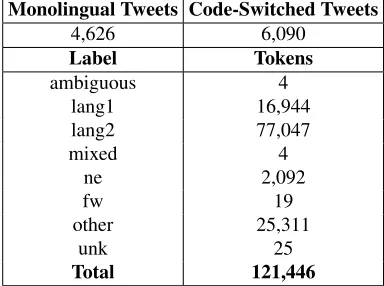
In Table 3 we show the statistics of the data set used to evaluate the participating systems. This in-cludes only the tweets that all the participants man-aged to crawl from Twitter, and it is not the complete data set.
4.2 MSA-DA
For the MSA-DA language pair, the Egyptian di-alect is used as the Arabic didi-alect, EGY. We com-bined the Train, Test-1, and Test-2 corpora that we used in the EMNLP 2014 shared task to create the new training and development corpora. The data
Monolingual Tweets Code-Switched Tweets
4,626 6,090
Label Tokens
ambiguous 4 lang1 16,944 lang2 77,047
mixed 4
ne 2,092
fw 19
other 25,311
unk 25
[image:4.612.326.518.62.205.2]Total 121,446
Table 3:Test Data statistics for SPA-ENG.
was crawled and collected from Twitter. We per-form a number of quality checks on the old data to overcome any issues that the participants may face. One of these checks is that all the old tweets are re-crawled from Twitter to reduce the percentage of missing tweets. The missing tweets and the tweets that contained white spaces were removed. This step was performed as a validation step. After the valida-tion step, we accepted and published 9,979 Tweets (8,862 tweets for the training set, and 1,117 tweets for the development set).
Pub-lic Figure whose CS percentage in his/her tweets is more than 35%. We used the improved version of the Arabic Tweets Token Assigner which is made available through the shared task website3 to avoid
the misalignment issues and guarantee consistency. Two Egyptian native speakers were asked to per-form the annotation. They were trained to get in-volved with the project’s concepts and related lin-guistic issues to increase their productivity and ac-curacy. Our Annotation team used two types of CS tag-sets: a) a rich version which is Arabic dialects oriented and it is used in our lab; and, b) a reduced CS tag-set which is consistent. The two tag-sets are mappable to each other (we mapped our tag set to the six tags). In our annotation, we used lang1to represent MSA, andlang2for Egyptian words,
am-biguouswhen the context cant help decide if a word
is MSA or DA, and foreign word (fw) for non-Arabic word even it is in Arabic script or Latin script. To manage the annotation quality, the annotations were checked when initially performed and then checked again at the end of the task. The Inter-Annotator Agreement (IAA) was measured by using 10% of the total number of data to ensure the performance and agreement among annotators. A specialist lin-guist carried out adjudication and revisions of accu-racy measurements. We approached a stable Inter Annotator Agreement (IAA) of over 90% pairwise agreement.
Monolingual Tweets Code-Switched Tweets
1,044 214
Label Tokens
ambiguous 117 lang1 5,804 lang2 9,630
mixed 1
ne 2,363
fw 0
other 2,743
unk 0
[image:5.612.86.281.462.609.2]Total 20,658
Table 4:Test Data statistics for MSA-DA.
Table 4 shows the statistics of the MSA-DA test set used to evaluate the participating systems. It con-tains only the tweets that all the participants man-aged to crawl from Twitter, and it’s not the complete
3http://care4lang1.seas.gwu.edu/cs2/call.html
data set.
5 Survey of Shared Task Systems
This year we received submissions from nine differ-ent teams, which is two more teams than the previ-ous shared task. All teams participated in the SPA-ENG task, while four teams also participated in the MSA-DA task. There was a wide variety of system architectures ranging from simple rule based sys-tems all the way to more complex machine learning implementations. Most of the systems submitted did not change anything in the implementation to tackle one language pair or the other, which implies that the participants were highly interested in building language independent systems that could be easily scaled to multiple language pairs.
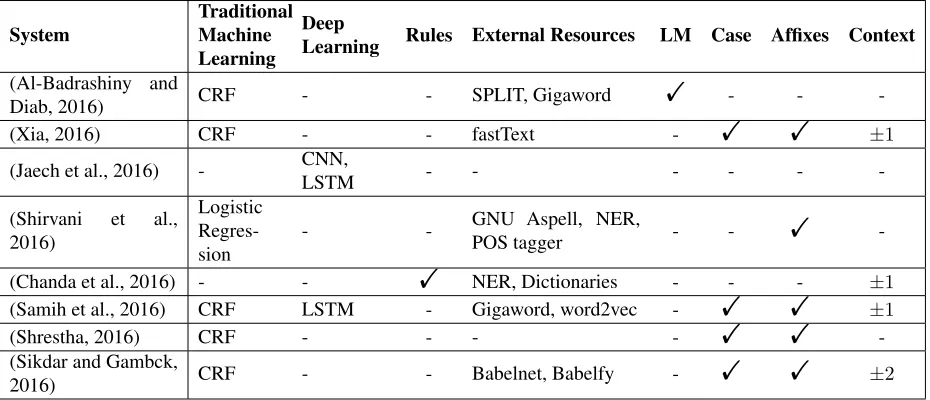
In Table 5 we show a summary of the the ar-chitectures of the systems submitted by the partic-ipants. All teams, with the exception of (Chanda et al., 2016), used some sort of machine learning al-gorithm in their systems. The alal-gorithm of choice by most participants was the Conditional Random Fields (CRF). This is no surprise since CRFs fit the problem nicely due to the sequence labeling na-ture of the task as it was evidenced in the high per-formance by CRFs achieved in the previous shared task.
A new addition this year is the use of deep learn-ing algorithms by two of the participants. Deep learning is now much more prevalent in NLP than it was two years ago when the previous shared task was held. (Jaech et al., 2016) used a convolu-tional neural network (CNN) to obtain word vectors which are then fed as a sequence to a bidirectional long short term memory recurrent neural network (LSTM) to map the sequence to a label. The sys-tem submitted by (Samih et al., 2016) used the out-put of a pair of LSTMs along with a CRF and post-processing to obtain the final label mapping. These systems are perhaps more complex than traditional machine learning algorithms, but the trade off for performance is evident in the results.
fea-System TraditionalMachine Learning
Deep
Learning Rules External Resources LM Case Affixes Context
(Al-Badrashiny and
Diab, 2016) CRF - - SPLIT, Gigaword ! - -
-(Xia, 2016) CRF - - fastText - ! ! ±1
(Jaech et al., 2016) - CNN,LSTM - - -
-(Shirvani et al., 2016)
Logistic
Regres-sion -
-GNU Aspell, NER,
POS tagger - - !
-(Chanda et al., 2016) - - ! NER, Dictionaries - - - ±1
(Samih et al., 2016) CRF LSTM - Gigaword, word2vec - ! ! ±1
(Shrestha, 2016) CRF - - - - ! !
-(Sikdar and Gambck,
[image:6.612.72.537.61.261.2]2016) CRF - - Babelnet, Babelfy - ! ! ±2
Table 5:Summary of the architectures of the systems submitted.
tures used in some of the systems were language models, word case information (Title, Uppercase, Lowercase), affixes and surrounding context.
6 Results
Same as the previous shared task, we used the fol-lowing metrics to evaluate the submitted systems: Accuracy, Precision, Recall and F-measure. We use regular F-measure to rank the systems at the tweet level and the weighted average F-measure to rank the systems at token level to account for the imbal-anced distribution of the labels.
To evaluate the systems, we first took the subset of tweets that all participants had in common to provide a fair comparison among them. We designed a sim-ple lexicon-based baseline system by taking only the lexicon for lang1, lang2 from the training corpus. We labeled symbols, emoticons, usernames, punctu-ation marks and URLs as other. If we find an unseen token or have a tie, we assign the majority class la-bel. We compare the results of all participants to this baseline.
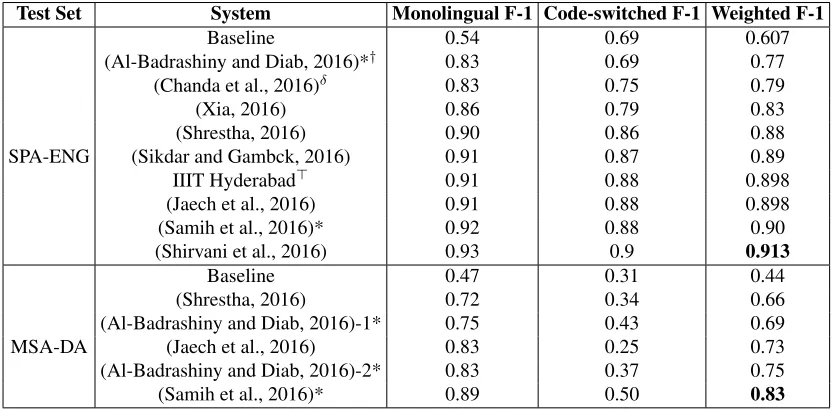
To calculate the performance of the systems at the tweet level, we use the predicted token level infor-mation to determine if a tweet is code-switched or monolingual. If the tweet has at least one token from each language (lang1, lang2), then it is labeled a code-switched. Otherwise, the tweet is labeled as monolingual. Table 6 shows the tweet level results for all submitted systems in both language pairs,
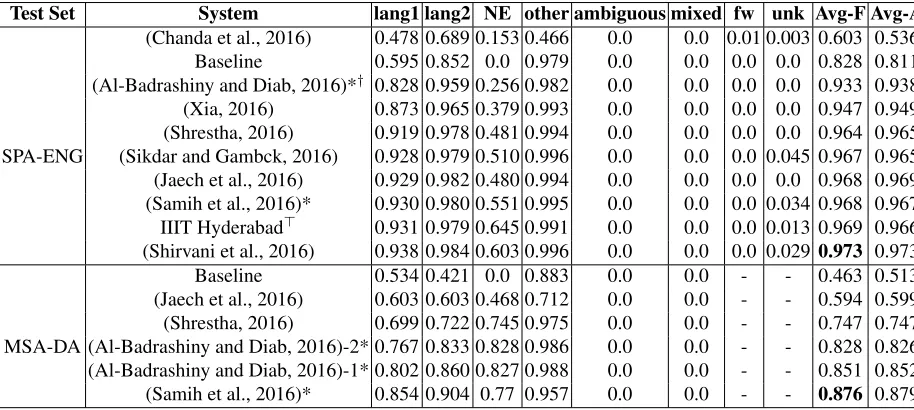
ranked by the average weighted f-measure. We can see that the best performing systems in SPA-ENG perform better than the best performing systems in MSA-DA, which indicates that this is a more diffi-cult task for the MSA-DA language pair as both lan-guages are closely related, as opposed to SPA-ENG. In Table 7 we show the token level results for all submitted systems. We report the F-measure for each class and the weighted average F-measure, Avg-F, which we used to rank the systems. From the results, we can see that the least difficult class to predict is theotherclass, where most systems ob-tained an F-measure over 97%. We can also discern that for the classes with a minority amount of tokens
(ambiguous, mixed, fw, unk) were the hardest to
pre-dict, with most systems obtaining an F-measure of 0%. This is to be expected as we only had a small number of samples in our training and test data and in the case of the MSA-DA data set, there were no samples forfworunk. Precisely because of the small amount of samples for these classes, the results do not affect in a significant way the weighed averaged F-measure score used to rank the systems. However, it is still important to correctly predict these classes in order to make a more thorough analysis of CS data.
Test Set System Monolingual F-1 Code-switched F-1 Weighted F-1
Baseline 0.54 0.69 0.607
(Al-Badrashiny and Diab, 2016)*† 0.83 0.69 0.77
(Chanda et al., 2016)δ 0.83 0.75 0.79
(Xia, 2016) 0.86 0.79 0.83
(Shrestha, 2016) 0.90 0.86 0.88 SPA-ENG (Sikdar and Gambck, 2016) 0.91 0.87 0.89 IIIT Hyderabad> 0.91 0.88 0.898
(Jaech et al., 2016) 0.91 0.88 0.898 (Samih et al., 2016)* 0.92 0.88 0.90 (Shirvani et al., 2016) 0.93 0.9 0.913
Baseline 0.47 0.31 0.44
[image:7.612.95.513.60.265.2](Shrestha, 2016) 0.72 0.34 0.66 (Al-Badrashiny and Diab, 2016)-1* 0.75 0.43 0.69 MSA-DA (Jaech et al., 2016) 0.83 0.25 0.73 (Al-Badrashiny and Diab, 2016)-2* 0.83 0.37 0.75 (Samih et al., 2016)* 0.89 0.50 0.83
Table 6: Tweet level performance results. We ranked the systems using the weighted average F-measure, Weighted-F1. A ’†’
denotes a late submission. A ’*’ denotes systems submitted by co-organizers of the shared task. A ’δ’ denotes the participant submission is missing a small number of tokens from one tweet. A>denotes the participant did not submit a system description.
1.3% higher than the second best system (Samih et al., 2016). At the token level, all but one system out-performed the baseline. The best performing sys-tem was also (Shirvani et al., 2016) with an Avg-F-measure of 97.3%, which is 0.4% higher than the second best performing system (IIIT Hyderabad).4
For MSA-DA, all the submitted systems outper-form the baseline at the tweet level by at least 20%. At tweet level, (Samih et al., 2016) achieved 83%, which the highest Avg-F-measure. The second high-est Avg-F-measure was achieved by (Al-Badrashiny and Diab, 2016)-2. Their Avg-F-measure was 75%. At the token level, all systems beat the baseline by at least 7%. Also, (Samih et al., 2016) succeed in achieving the highest Avg-F-measure which is 87.6%. citegwu:16-2 and (Al-Badrashiny and Diab, 2016)-1 achieve the second and the third best per-forming systems, with Avg-F-measures of 85.1%, 82.8%, respectively.
It is not easy to determine overall winners be-cause not all participants submitted a system for both language-pairs. However, for the SPA-ENG data set the system by (Shirvani et al., 2016) was the best performing at both the tweet and token level evaluations. On the other hand, the system by (Samih et al., 2016) was the best performing at both tweet and token level for the MSA-DA data set.
4The participants did not submit a system description.
7 Lessons Learned
This year we had to deal with the same issues we en-countered with Twitter, including data loss and shar-ing restrictions. However, we decided to cope with these issues as we found it harder to identify other sources of data where we could easily search and find samples of code-switched text.
In the process of annotation, we believe that pre-annotating the data using our previous data as train-ing helps speed up the process of in-lab annotations and thus reduces the amount of data that has to be annotated through crowd-sourcing. We took several measures to ensure we obtained high quality data from crowd-sourcing, but it still proves to be a chal-lenge and we obtain a fair amount of noise. The problem is exacerbated in the MSA-DA set due to the fact that there is inherently considerable amount of data overlap due to homographs between the two varieties of the language. Also, a big part of the errors made by crowd-sourcing annotators involve named entities, probably because the annotators do not take the context into account in an effort to be fast and collect money quickly.
Test Set System lang1 lang2 NE other ambiguous mixed fw unk Avg-F Avg-A
(Chanda et al., 2016) 0.478 0.689 0.153 0.466 0.0 0.0 0.01 0.003 0.603 0.536 Baseline 0.595 0.852 0.0 0.979 0.0 0.0 0.0 0.0 0.828 0.811 (Al-Badrashiny and Diab, 2016)*† 0.828 0.959 0.256 0.982 0.0 0.0 0.0 0.0 0.933 0.938
(Xia, 2016) 0.873 0.965 0.379 0.993 0.0 0.0 0.0 0.0 0.947 0.949 (Shrestha, 2016) 0.919 0.978 0.481 0.994 0.0 0.0 0.0 0.0 0.964 0.965 SPA-ENG (Sikdar and Gambck, 2016) 0.928 0.979 0.510 0.996 0.0 0.0 0.0 0.045 0.967 0.965 (Jaech et al., 2016) 0.929 0.982 0.480 0.994 0.0 0.0 0.0 0.0 0.968 0.969 (Samih et al., 2016)* 0.930 0.980 0.551 0.995 0.0 0.0 0.0 0.034 0.968 0.967 IIIT Hyderabad> 0.931 0.979 0.645 0.991 0.0 0.0 0.0 0.013 0.969 0.966
[image:8.612.72.529.60.265.2](Shirvani et al., 2016) 0.938 0.984 0.603 0.996 0.0 0.0 0.0 0.029 0.973 0.973 Baseline 0.534 0.421 0.0 0.883 0.0 0.0 - - 0.463 0.513 (Jaech et al., 2016) 0.603 0.603 0.468 0.712 0.0 0.0 - - 0.594 0.599 (Shrestha, 2016) 0.699 0.722 0.745 0.975 0.0 0.0 - - 0.747 0.747 MSA-DA (Al-Badrashiny and Diab, 2016)-2* 0.767 0.833 0.828 0.986 0.0 0.0 - - 0.828 0.826 (Al-Badrashiny and Diab, 2016)-1* 0.802 0.860 0.827 0.988 0.0 0.0 - - 0.851 0.852 (Samih et al., 2016)* 0.854 0.904 0.77 0.957 0.0 0.0 - - 0.876 0.879
Table 7:Token level performance results. We ranked the systems using the weighted average F-measure, Avg-F. A ’-’ indicates that there were no tokens labeled under this class in the test data set. A ’†’ denotes a late submission. A ’*’ denotes systems submitted
by co-organizers of the shared task. A ’δ’ denotes the participant submission is missing a small number of tokens from one tweet. A>denotes the participant did not submit a system description.
Another thing we have in mind is to further improve our code-switched tweet evaluation by taking into account the predicted positions of the code-switch points instead of just labeling the tweets as CS or monolingual.
8 Conclusion
We had a very successful second shared task on lan-guage identification on code-switched data. We re-ceived submissions from 9 different teams, up from 7 teams in the previous task. Overall, this year’s sys-tems achieved a higher level of performance when compared to previous shared task. This is a good in-dicator of a higher understanding and interest in the problem. We also see that the results of the previous shared task influenced the decisions the participants made when designing their systems, as evidenced by the majority of the systems relying on a CRF for se-quence labeling. In contrast to the previous shared task, we received submissions that used deep learn-ing algorithms and techniques, which shows that the participants are thinking of different ways to take on the problem. On the other end, we had one rule-based system that didn’t perform as well as the oth-ers and perhaps is an indicator that machine learning is definitely the baseline architecture to use for lan-guage identification in CS data.
In contrast to the previous shared task, the results are more consistent between token/tweet level per-formance, with the same teams ranking first at both levels of the same language pair. This is an indica-tion that there were less errors made, leading to less confusion of the CS points. Also different from the previous task, this year we only looked at two differ-ent language pairs, but we maintain that these two pairs are a good representation of CS occurrences.
We have shown that there is great interest in re-searching language identification on code-switched data and we have provided a competitive shared task that will help push forward the development of sys-tems and corpora with the goal of improving our un-derstanding of code-switching.
Acknowledgments
References
Mohamed Al-Badrashiny and Mona Diab. 2016. A system for the code-switching workshop shared task 2016. In Proceedings of The Second Workshop on Computational Approaches to Code Switching. Mohamed Al-Badrashiny, Heba Elfardy, and Mona Diab.
2015. Aida2: A hybrid approach for token and sen-tence level dialect identification in arabic. CoNLL 2015, page 42.
Rafiya Begum, Kalika Bali, Monojit Choudhury, Koustav Rudra, and Niloy Ganguly. 2016. Functions of code-switching in tweets: An annotation framework and some initial experiments. In Nicoletta Calzolari (Con-ference Chair), Khalid Choukri, Thierry Declerck, Sara Goggi, Marko Grobelnik, Bente Maegaard, Joseph Mariani, Helene Mazo, Asuncion Moreno, Jan Odijk, and Stelios Piperidis, editors, Proceed-ings of the Tenth International Conference on Lan-guage Resources and Evaluation (LREC 2016), Paris, France, may. European Language Resources Associa-tion (ELRA).
Arunavha Chanda, Dipankar Das, and Chandan Mazum-dar. 2016. Anonymous submission for emnlp 2016 coswitching workshop shared task: System de-scription. InProceedings of The Second Workshop on Computational Approaches to Code Switching. Mona Diab, Mahmoud Ghoneim, Abdelati Hawwari,
Fa-had AlGhamdi, Nada AlMarwani, and Mohamed Al-Badrashiny. 2016. Creating a large multi-layered representational repository of linguistic code switched arabic data. In Nicoletta Calzolari (Conference Chair), Khalid Choukri, Thierry Declerck, Sara Goggi, Marko Grobelnik, Bente Maegaard, Joseph Mariani, He-lene Mazo, Asuncion Moreno, Jan Odijk, and Stelios Piperidis, editors, Proceedings of the Tenth Interna-tional Conference on Language Resources and Evalu-ation (LREC 2016), Paris, France, may. European Lan-guage Resources Association (ELRA).
Bj¨orn Gamb¨ack and Amitava Das. 2016. Compar-ing the level of code-switchCompar-ing in corpora. In Nico-letta Calzolari (Conference Chair), Khalid Choukri, Thierry Declerck, Sara Goggi, Marko Grobelnik, Bente Maegaard, Joseph Mariani, Helene Mazo, Asuncion Moreno, Jan Odijk, and Stelios Piperidis, editors,Proceedings of the Tenth International Confer-ence on Language Resources and Evaluation (LREC 2016), Paris, France, may. European Language Re-sources Association (ELRA).
Dan Garrette, Hannah Alpert-Abrams, Taylor Berg-Kirkpatrick, and Dan Klein. 2015. Unsupervised code-switching for multilingual historical document transcription. InProceedings of the 2015 Conference of the North American Chapter of the Association for
Computational Linguistics: Human Language Tech-nologies, pages 1036–1041.
Fei Huang and Alexander Yates. 2014. Improving word alignment using linguistic code switching data. In EACL, pages 1–9.
Aaron Jaech, George Mulcaire, Mari Ostendorf, and Noah A. Smith. 2016. A neural model for language identification in code-switched tweets. In Proceed-ings of The Second Workshop on Computational Ap-proaches to Code Switching.
Anupam Jamatia, Bj¨orn Gamb¨ack, and Amitava Das. 2015. Part-of-speech tagging for code-mixed english-hindi twitter and facebook chat messages. In Proceed-ings of Recent Advances in Natural Language Process-ing Hissar, Bulgaria, Sep 79 2015, page 239248. Aravind K Joshi. 1982. Processing of sentences with
intra-sentential code-switching. InProceedings of the 9th conference on Computational linguistics-Volume 1, pages 145–150. Academia Praha.
Zo¨e Kosoff. 2014. Code-switching in egyptian arabic: A sociolinguistic analysis of twitter. Al-Arabiyya: Jour-nal of the American Association of Teachers of Arabic, 47(1):83–99.
Sophia Yat Mei Lee and Zhongqing Wang. 2015. Emo-tion in code-switching texts: Corpus construcEmo-tion and analysis.ACL-IJCNLP 2015, page 91.
Dong Nguyen and Leonie Cornips. 2016. Automatic detection of intra-word code-switching. ACL 2016, page 82.
¨Ozlem C¸etino˘glu. 2016. A turkish-german code-switching corpus. In Nicoletta Calzolari (Conference Chair), Khalid Choukri, Thierry Declerck, Sara Goggi, Marko Grobelnik, Bente Maegaard, Joseph Mariani, Helene Mazo, Asuncion Moreno, Jan Odijk, and Ste-lios Piperidis, editors, Proceedings of the Tenth In-ternational Conference on Language Resources and Evaluation (LREC 2016), Paris, France, may. Euro-pean Language Resources Association (ELRA). Younes Samih and Wolfgang Maier. 2016. An
arabic-moroccan darija code-switched corpus. In Nicoletta Calzolari (Conference Chair), Khalid Choukri, Thierry Declerck, Sara Goggi, Marko Grobelnik, Bente Mae-gaard, Joseph Mariani, Helene Mazo, Asuncion Moreno, Jan Odijk, and Stelios Piperidis, editors, Pro-ceedings of the Tenth International Conference on Language Resources and Evaluation (LREC 2016), Paris, France, may. European Language Resources As-sociation (ELRA).
Royal Sequiera, Monojit Choudhury, and Kalika Bali. 2015. Pos tagging of hindi-english code mixed text from social media: Some machine learning experi-ments. InICON 2015 Proceedings.
Arnav Sharma, Sakshi Gupta, Raveesh Motlani, Piyush Bansal, Manish Shrivastava, Radhika Mamidi, and Dipti M. Sharma. 2016. Shallow parsing pipeline -hindi-english code-mixed social media text. In Pro-ceedings of the 2016 Conference of the North Ameri-can Chapter of the Association for Computational Lin-guistics: Human Language Technologies, pages 1340– 1345, San Diego, California, June. Association for Computational Linguistics.
Rouzbeh Shirvani, Mario Piergallini, Gauri Shankam Gautam, and Mohamed Chouikha. 2016. System sub-mission for language identification in spanish-english codeswitching. InProceedings of The Second Work-shop on Computational Approaches to Code Switch-ing.
Prajwol Shrestha. 2016. Codeswitching detection via lexical features in conditional random fields. In Pro-ceedings of The Second Workshop on Computational Approaches to Code Switching.
Utpal Sikdar and Bjrn Gambck. 2016. Language iden-tification in code-switched text using conditional ran-dom fields and babelnet. InProceedings of The Sec-ond Workshop on Computational Approaches to Code Switching.
Thamar Solorio, Elizabeth Blair, Suraj Maharjan, Steven Bethard, Mona Diab, Mahmoud Ghoneim, Abdelati Hawwari, Fahad AlGhamdi, Julia Hirschberg, Alison Chang, and Pascale Fung. 2014. Overview for the First Shared Task on Language Identification in Code-Switched Data. InProceedings of The First Workshop on Computational Approaches to Code Switching, held in conjunction with EMNLP 2014., pages 62–72. David Vilares, Miguel A Alonso, and Carlos
G´omez-Rodr´ıguez. 2015a. One model, two languages: training bilingual parsers with harmonized treebanks. arXiv preprint arXiv:1507.08449.
David Vilares, Miguel A Alonso, and Carlos G´omez-Rodrıguez. 2015b. Sentiment analysis on mono-lingual, multilingual and code-switching twitter cor-pora. In6th Workshop On Computational Approaches To Subjectivity, Sentiment And Social Media Analysis WASSA 2015, page 2.
David Vilares, Miguel A. Alonso, and Carlos G´omez-Rodr´ıguez. 2016. En-es-cs: An english-spanish code-switching twitter corpus for multilingual senti-ment analysis. In Nicoletta Calzolari (Conference Chair), Khalid Choukri, Thierry Declerck, Sara Goggi, Marko Grobelnik, Bente Maegaard, Joseph Mariani, Helene Mazo, Asuncion Moreno, Jan Odijk, and Ste-lios Piperidis, editors, Proceedings of the Tenth
In-ternational Conference on Language Resources and Evaluation (LREC 2016), Paris, France, may. Euro-pean Language Resources Association (ELRA). Meng Xuan Xia. 2016. Codeswitching language