Overview for the First Shared Task on
Language Identification in Code-Switched Data
Thamar Solorio
Dept. of Computer Science University of Houston
Houston, TX, 77004
Elizabeth Blair, Suraj Maharjan, Steven Bethard
Dept. of Computer and Information Sciences University of Alabama at Birmingham
Birmingham, AL, 35294
{eablair,suraj,bethard}@uab.edu
Mona Diab, Mahmoud Gohneim, Abdelati Hawwari, Fahad AlGhamdi
Dept. of Computer Science George Washington University
Washington, DC 20052
{mtdiab,mghoneim,abhawwari,fghamdi}@gwu.edu
Julia Hirschberg and Alison Chang
Dept. of Computer Science Columbia University New York, NY 10027
[email protected] [email protected]
Pascale Fung
Dept. of Electronic & Computer Engineering Hong Kong University of Science and Technology
Clear Water Bay, Kowloon, Hong Kong
Abstract
We present an overview of the first shared task on language identification on code-switched data. The shared task in-cluded code-switched data from four lan-guage pairs: Modern Standard Arabic-Dialectal Arabic (MSA-DA), Mandarin-English (MAN-EN), Nepali-Mandarin-English (NEP-EN), and Spanish-English (SPA-EN). A to-tal of seven teams participated in the task and submitted 42 system runs. The evalua-tion showed that language identificaevalua-tion at the token level is more difficult when the languages present are closely related, as in the case of MSA-DA, where the prediction performance was the lowest among all lan-guage pairs. In contrast, the lanlan-guage pairs with the higest F-measure where SPA-EN and NEP-EN. The task made evident that language identification in code-switched data is still far from solved and warrants further research.
1 Introduction
The main goal of this language identification shared task is to increase awareness of the outstanding challenges in the automated processing of Code-Switched (CS) data and motivate more research in
this direction. We define CS broadly as a commu-nication act, whether spoken or written, where two or more languages are being used interchangeably. In its spoken form, CS has probably been around ever since different languages first came in contact. Linguists have studied this phenomenon since the mid 1900s. In contrast, the Natural Language Pro-cessing (NLP) community has only recently started to pay attention to CS, with the earliest work in this area dating back to Joshi’s theoretical work proposing an approach to parsing CS data (Joshi, 1982) based on the Matrix and Embedded language framework. With the wide-spread use of social me-dia, CS is now being used more and more in written language and thus we are seeing an increase in pub-lished papers dealing with CS. We are specifically interested in intrasentential code switched phenom-ena. As a result of this task, we have successfully created the first set of annotated data for several language pairs with a coherent set of labels across the languages. As the shared task results show, CS poses new research questions that warrant new NLP approaches, and thus we expect to see a sig-nificant increase in NLP work in the coming years addressing CS phenomena in data.
The shared task covers four language pairs and is focused on social media data. We provided par-ticipants with annotated data from Twitter for the
language pairs: Modern Standard Arabic-Arabic dialects (MSA-DA), Mandarin-English (MAN-EN), NEP-EN (NEP-(MAN-EN), and SPA-EN (SPA-EN). These language pairs represent a good variety in terms of language typology and relatedness among pairs. They also cover languages with different rep-resentation in terms of number of speakers world wide. Participants were asked to make predictions on unseen Twitter data for each language pair. We also provided participants with test data from a “surprise genre” with the objective of assessing the robustness of language identification systems to genre variation.
2 Task Description
The task consists of labeling each token/word in the input file with one of six labels:lang1,lang2, other,ambiguous,mixed, and named entitiesNE. Thelang1,lang2labels refer to the two languages addressed in the subtask, for example for the lan-guage pair MSA-DA,lang1would be an MSA and lang2is DA. Theothercategory is a label used to tag all punctuation marks, emoticons, numbers, and similar tokens that do not represent actual words in any of the given languages. Theambiguouslabel is for instances where it is not possible to assign a language with certainty, for example, a lexical form that belongs to both languages, appearing in a context that does not indicate one language over the other. Themixedcategory is for words composed of CS morphemes, such as the word snapchateando ‘to chat’ from SPA-EN, the word overaifrom NEP-EN, or the wordhayqwlwn1‘they will say’, from
MSA-DA, where the ‘ha’ is a DA future morpheme and the stem ‘yqwlwn’ is MSA.TheNE label is included in this task in an effort to allow for a more focused analysis of CS data with the exclusion of proper nouns. NEs have a very different behavior than most other words in a language vocabulary and thus from our perspective they need to be iden-tified to be handled properly.
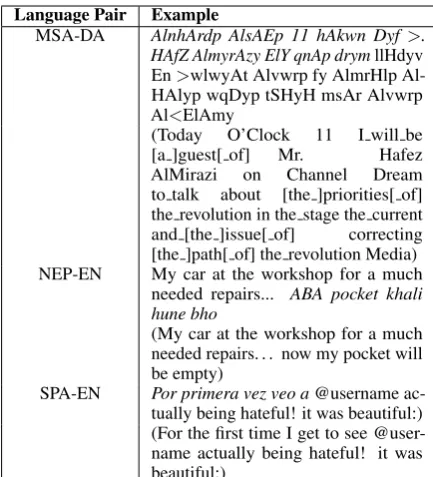
Table 1 shows Twitter examples taken from the training data. The annotation guidelines are posted on the workshop website2. We post the ones used
for SPA-EN as for the other language pairs the only differences are the examples provided.
1We use Buckwalter transliteration scheme http://
www.qamus.org/transliteration.htm
2http://emnlp2014.org/workshops/
CodeSwitch/call.html
Language Pair Example
MSA-DA AlnhArdp AlsAEp 11 hAkwn Dyf>. HAfZ AlmyrAzy ElY qnAp drymllHdyv En>wlwyAt Alvwrp fy AlmrHlp Al-HAlyp wqDyp tSHyH msAr Alvwrp Al<ElAmy
(Today O’Clock 11 I will be [a ]guest[ of] Mr. Hafez AlMirazi on Channel Dream to talk about [the ]priorities[ of] the revolution in the stage the current and [the ]issue[ of] correcting [the ]path[ of] the revolution Media) NEP-EN My car at the workshop for a much
needed repairs... ABA pocket khali hune bho
(My car at the workshop for a much needed repairs. . . now my pocket will be empty)
SPA-EN Por primera vez veo a@username ac-tually being hateful! it was beautiful:) (For the first time I get to see @user-name actually being hateful! it was beautiful:)
Table 1: Examples of Twitter data used in the shared task.
3 Related Work
In the past, most language identification research has been done at the document level. Some re-searchers, however, have developed methods to identify languages within multilingual documents (Singh and Gorla, 2007; Nguyen and Do˘gru¨oz, 2013; King and Abney, 2013). Their test data comes from a variety of sources, including web pages, bilingual forum posts, and jumbled data from monolingual sources, but none of them are trained on code-switched data, opting instead for a monolingual training set per language. This could prove to be a problem when working on code-switched data, particularly in shorter samples such as social media data, as the code-switching context is not present in training material.
One system tackled both the problems of switching and social media in language and code-switched status identification (Lignos and Marcus, 2013). Lignos and Marcus gathered millions of monolingual tweets in both English and Spanish in order to model the two languages, and used crowd-sourcing to annotate tens of thousands of Span-ish tweets, approximately 11% of which contained code-switched content. This system was able to achieve 96.9% word-level accuracy and a 0.936 F-measure in identifying code-switched tweets.
[image:2.595.307.524.60.299.2]Marcus’ research, is readily available. Even in their data, the percentage of code-switched tweets was barely over a tenth of the total test data. There have been other corpora built, particularly for other language pairs such as Mandarin-English (Li et al., 2012; Lyu et al., 2010), but the amount of data available and the percentage of code-switching data within that data are not up to the standards of other areas of the natural language processing field. With this in mind, we sought to provide corpora for mul-tiple language pairs, each with a better distribution of code-switching phenomena.
4 Data Sets
Most of the data for the shared task comes form Twitter. However, we also collected and annotated data from other social media sources, including Facebook, web forums, and blogs. These additional sources of data were used as the surprise data. In this section we describe briefly the corpora curated for the shared task.
Language-pair Training Test Surprise
MAN-EN 1000 313 n/a
MSA-DA 5,838 2332, 1,777 12,017 NEP-EN 9,993 3,018 (2,874) 1,087 SPA-EN 11,400 3,060 (1,626) 1,102
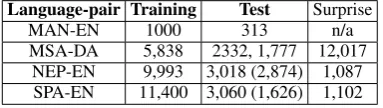
Table 2: Statistics of the shared task data sets per language pairs. The numbers are according to what was actually annotated, numbers in parenthe-sis show what the participating systems were able to crawl from Twitter. The Surprise genre comes from various sources, other than Twitter.
Table 2 shows some statistics about the differ-ent datasets used in this task. We strive to provide dataset sizes that would allow a robust analysis of results. However, an unexpected challenge was the rate at which tweets became unavailable. Dif-ferent language pairs had difDif-ferent attrition rates with SPA-EN being the most affected language and MSA-DA and NEP-EN the least affected. Note that we provided two test datasets for MSA-DA. Since we separated the data on a per user basis, the first test set had a highly skewed distribution. The second test set was distributed to participants to allow a comparison with a data set having a class distribution more similar to the training set.
4.1 SPA-EN data
Developing the corpus involved two primary steps: locating code-switching tweets and using
crowd-sourcing to annotate their tokens with language tags. A small portion of the tweets were annotated in-lab and this was used as the gold data for quality control in the crowdsourcing annotation.
To avoid biasing the data used in this task, we used a two step process to select the tweets: first we identified CS tweets by doing a keyword search on Twitter’s API. We selected a few frequently used English words and restricted the search to tweets identified by Twitter as Spanish from users in Cali-fornia and Texas. An additional set of tweets was then collected by using frequent Spanish words in an all English tweet, from users in the same loca-tions. We filtered these tweets to remove tweets containing URLs, duplicates, spam tweets and retweets.
In-lab annotators labeled the filtered tweets using the guidelines referenced above. From this set of labeled data we then ranked the users in this set by the percentage of CS tweets. We selected the 12 most prolific CS users and then pulled all of their available tweets. These 12 users contributed the tweets used in the shared task. The tweets were labeled using CrowdFlower3. After analyzing the
number and content distribution of the tweets, the SPA-EN data was split into a 11,400 tweet training set and a 3,014 tweet test set.
The SPA-EN Surprise Genre (SPA-EN-SG) in-cluded Facebook comments from the Veteranas community4 and the Chicanas community5 and
blog data from the Albino Bean6. Data was
col-lected using Python scripts that implemented the Beautiful Soup library and the third-party Python Facebook SDK (for Blogger and Facebook respec-tively). Post and comment IDs were used to tify Facebook posts, and URLs were used to iden-tify Blogger posts. The collected posts were format-ted to match those collecformat-ted from Twitter. In-lab annotators were used to annotate approximately 1K tokens. All the data we collected in this manner was released as surprise data to all participants.
4.2 NEP-EN data
The collection of NEP-EN data followed a simi-lar approach to that of SPA-EN. We first focused on finding users that switched frequently between
3http://www.crowdflower.com/ 4https://www.facebook.com/
VeteranaPinup
5https://www.facebook.com/pages/
Chicanas/444483772293893
[image:3.595.86.278.360.414.2]Nepali and English. In addition, the users must not be using Devnagari script as done by Nepalese to write Nepali, but must have used its Roman-ized form. We started by manually reading tweets from some of our Nepali friends. We then crawled their followers who corresponded with them using code-switched tweets or replies. We found that a lot of these users were regular code-switchers themselves. We repeated the same process with the followers and collected nearly 30 such users. We then collected about 2,000 tweets each from these users using the Twitter API. We filtered out all the retweets and the tweets with URLs, following the same process that was used for SPA-EN.
For the surprise test data, we crawled code-switched data from Facebook comments and posts. We found that most Nepalese comments had a rich amount of code-switched data. However, we could not crawl their data because of privacy issues. Nev-ertheless, we could crawl data from public book pages. We identified some public Nepali Face-book pages where anyone could comment. These pages include FM, news and public figures’ public Facebook pages. We crawled the latest 10 feeds from these public pages using the Facebook API and gathered about 12,000 comments and posts for the shared task.
Initially, we sought out help from Nepali gradu-ate students at the University of Alabama at Birm-ingham to annotate 100 tweets (1739 tokens). We gave the same annotation file to two annotators to do the annotation. We found that they agreed with an accuracy of 95.34%. These tweets were then re-viewed and used as initial gold data in Crowdflower to annotate the first 1000 tweets. The annotation job was enabled only in Nepal and Bhutan. We disabled India, even though people living in some regions of India (Darjeeling, Sikkim) also speak and write in Nepali, as most spammers were com-ing from India. We then ran two batches of 5000 tweets and one batch of 3000 tweets along with the initial 1,000 tweets as the gold data. This NEP-EN data was then split into a 9,993 tweet training set and a 2,874 tweet test set. No Twitter user appeared in both sets.
4.3 MAN-EN data
The MAN-EN tweets were collected from Twitter with the Twitter API. Users were selected from lists of most followed Twitter accounts in Taiwan (where Mandarin Chinese is the official language).
These users’ tweets were checked for Mandarin En-glish bilingualism and added to our data collection if they contained both languages.
The next round of usernames came from the lists of users that our original top accounts were following. The tweets written by this new set of users were then examined for Mandarin English code switching and stored as data if they matched the criteria.
The jieba tokenizer7 was used to segment the
Mandarin sections of the tweets and compute off-sets of each segment. We format the code switch-ing tweets into columns includswitch-ing language type, labels, and offsets. Named entities were labeled manually by a single annotator.
The data was split by user into 1000 tweets for training and 313 for testing. No MAN-EN surprise data for the current shared task.
4.4 MSA-DA data
For the MSA-DA language pair, we selected Egyp-tian Arabic (EGY) as the Arabic dialect. We har-vested data from two social media sources: Twitter [TWT] and Blog commentaries [COM]. The TWT data served as the main gold standard data for the task where we provided fully annotated data for Training/Tuning and Test. We provided two TWT data sets for the test data that exemplified different tag distributions. The COM data set comprised only test data and it served as the Arabic surprise data set.
To reduce the potential of TWT data attrition from users deleting their accounts or tweets, we selected tweets that are less prone to deletion and/or change. Thereby we harvested tweets by a select set of Egyptian Public Figures. The percentage of deleted tweets and deactivated accounts among those users is significantly lower if we compare it to the tweets crawled from random Egyptian users.
We used the “Tweepy” library to crawl the time-lines of 12 Public Figures. Similar to other lan-guage pairs, we excluded all re-tweets, tweets with URLs, tweets mentioning other users, and tweets containing Latin characters. We accepted 9,947 tweets, for each we extracted the tweet-id and user-id. Using these IDs, we retrieved the tweets text, tokenized it and assigned character offsets. To guar-antee consistency and avoid any misalignment is-sues, we compiled the full pipeline into the “Arabic Tweets Token Assigner” package which is made
available through the workshop website8.
For COM, we selected 6723 commentaries (half MSA and half DA) from “youm7”9
commen-taries provided by the Arabic Online Commentary Dataset (Zaidan and Callison-Burch, 2011). The COM data set was processed (12017 total tokens) using the same pipeline created for the task. We also provided the participants with the data format-ted with character offsets to maintain consistency across data sets in the Arabic subtask.
The annotation of MSA-DA language pair data is based on two sets of guidelines. The first set is a generic set of guidelines for code switching in general across different language pairs. These guidelines provide the overarching framework for annotating code switched data on the morpholog-ical, lexmorpholog-ical, syntactic, and pragmatic levels. The second set of guidelines is language pair specific. We created the guidelines for the Arabic language specifically. We enlisted the help of 3 annotators in addition to a super annotator, hence resulting in 4 annotators overall for the whole collection of the data. All the annotators are native speakers of Egyptian Arabic with excellent proficiency in MSA. The super annotator only annotated 10% of the overall data and served as the adjudicator. The annotation process was iterative with several repe-titions of the cycle of training, annotation, revision, adjudication until we approached a stable Inter An-notator Agreement (IAA) of over 90% pairwise agreement.
5 Survey of Shared Task Systems
We received submissions from seven different teams. Each participating system had the freedom to submit responses to any of the language pairs covered in the shared task. All seven participants submitted system responses for SPA-EN, making this language pair the most popular in this shared task and MAN-EN the least popular.
All but one participating system used a machine learning algorithm or language models, or even a combination of both, as part of their configuration. A couple of the participating systems used hand-crafted rules of some sort, either at the intermediate steps or as the final post-processing step. We also observed a good number of systems using exter-nal resources, in the form of labeled monolingual
8http://emnlp2014.org/workshops/
CodeSwitch/call.html
9An Egyptian newspaper,www.youm7.com
corpora, language specific gazetteers, off the shelf tools (NE recognizers, language id systems, or mor-phological analyzers) and even unsupervised data crawled from the same users present in the data sets provided. Affixes were also used in some form by different systems.
The architecture of the different systems ranged from a simple approach based on frequencies of character n-grams combined in a rule-based system, to more complex approaches using word embed-dings, extended Markov Models, and CRF autoen-coders. The majority of the systems that partici-pated in more than one language pair did little to no customization to account for the morphological dif-ferences of the specific language pairs beyond lan-guage specific parameter-tuning, which probably reflects participants’ goal to develop a multilingual id system.
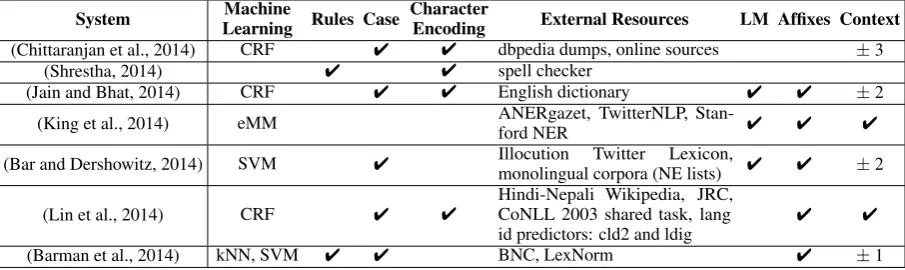
Due to the presence of the NE label, several systems included a component for NE recognition where there was one available for the specific lan-guage. In addition, many systems also included case information. One unexpected finding from the shared task was that no participating system tried to embed in their models some form of lin-guistic theory or framework about CS. Only one system made an explicit reference to CS theories (Chittaranjan et al., 2014) in their motivation to use contextual information, which can be considered as a loose embedding of CS theory. While system performance was competitive (see next section), there is still room for improvement and perhaps some of that improvement can come out of adding this kind of knowledge into the models. Lastly, we were surprised to see that not all systems made use of character encoding information, even though for Mandarin-English that would have been a strong indicator. In Table 3 we present a summary high-lighting some of the design choices of participating systems.
6 Results
We used the following evaluation metrics: Accu-racy, Precision, Recall, and F-measure. We use F-measure to provide a ranking of systems. In the evaluation at the tweet level we use the standard f-measure. For the evaluation at the token level we use instead the average weighted f-measure to account for the highly imbalanced distribution of classes.
pre-System Learning Rules CaseMachine CharacterEncoding External Resources LM Affixes Context
(Chittaranjan et al., 2014) CRF 4 4 dbpedia dumps, online sources ±3
(Shrestha, 2014) 4 4 spell checker
(Jain and Bhat, 2014) CRF 4 4 English dictionary 4 4 ±2
(King et al., 2014) eMM ANERgazet, TwitterNLP, Stan-ford NER 4 4 4
(Bar and Dershowitz, 2014) SVM 4 Illocutionmonolingual corpora (NE lists)Twitter Lexicon, 4 4 ±2 (Lin et al., 2014) CRF 4 4 Hindi-Nepali Wikipedia, JRC,CoNLL 2003 shared task, lang
id predictors: cld2 and ldig 4 4
[image:6.595.73.526.64.199.2](Barman et al., 2014) kNN, SVM 4 4 BNC, LexNorm 4 ±1
Table 3: Comparison of shared task participating system algorithm choices. CRF stands for Conditional Random Fields, SVM for Support Vector Machines and LM for Language Models.
dictions on tweets submitted by all teams. All systems were compared to a simple lexicon-based baseline. The lexicon was gathered from the train-ing data for classeslang1andlang2only. Emoti-cons, punctuation marks, usernames and URLs are by default tagged asother. In the case of a tie or a new token, the baseline system assigns the majority class for that language pair.
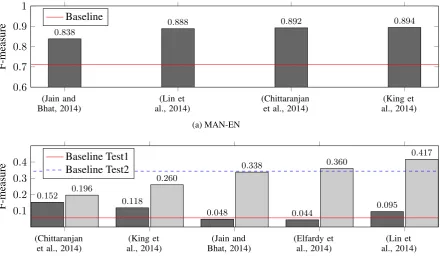
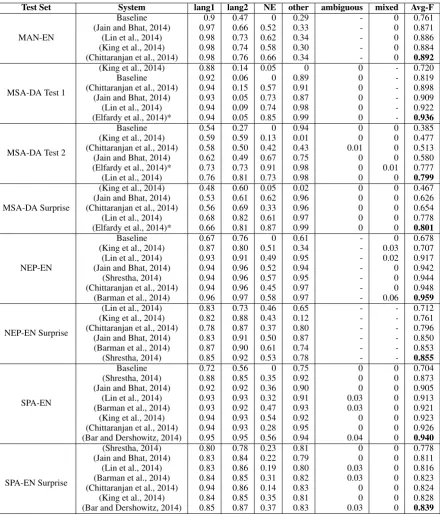
Figure 1 shows prediction performance on the Twitter test data for each language pair at the tweet level. The system predictions for this task are taken directly from the individual token predictions in the following manner: if the system predictions for the same tweet contain at least one tag from each language (lang1 and lang2), the tweet is labeled as code-switched, otherwise it is labeled as mono-lingual. As illustrated, each language pair shows different patterns. Comparing the systems that par-ticipated in all language pairs, there is no clear winner across the board. However, (Chittaranjan et al., 2014) was in the top three places in at least one test file for each language pair. Table 4 shows the results at the token level by label. Here again the figures show F-measure per class label and the last column is the weighted average f-measure (Avg-F). One of the few general trends on these results is that most participating systems were not able to correctly identify the minority classes “ambiguous” and “other”. There are only few instances of these labels in the training set and some test sets did not have one of these classes present. The impact on final system performance from these classes is not significant. However, to study CS patterns we will need to have these labels identified properly.
The MAN-EN pair received four system re-sponses and all four of them reached an F-measure
>80% and outperformed the simple baseline by a
considerable margin. We expected this language pair to be the easiest one for the shared task since each language uses a different encoding script. A very rough but accurate distinction between Man-darin and English could be achieved by looking at the character encoding. However, according to the system descriptions provided, not all systems used encoding information. The best performing systems for MAN-EN are (King et al., 2014) and (Chittaranjan et al., 2014). The former slightly outperformed the latter at the Tweet level (see Fig-ure 1a) task while the opposite was true at the token level (see Table 4 rows 4 and 5).
(Jain and
Bhat, 2014) al., 2014)(Lin et (Chittaranjanet al., 2014) al., 2014)(King et 0.6
0.7 0.8 0.9 1
0.838 0.888 0.892 0.894
F-measure
Baseline
(a) MAN-EN
(Chittaranjan
et al., 2014) al., 2014)(King et Bhat, 2014)(Jain and (Elfardy etal., 2014) al., 2014)(Lin et 0.1
0.2 0.3 0.4
0.152 0.118
0.048 0.044 0.095
0.196 0.260
0.338 0.360
0.417
F-measure
Baseline Test1 Baseline Test2
(b) MSA-DA. Dark gray bars show performance on Test1 and light gray bars show performance for Test2
(King et
al., 2014) al., 2014)(Lin et Bhat, 2014)(Jain and (Shrestha,2014) (Chittaranjanet al., 2014) (Barman etal., 2014) 0.8
0.9
1 0.952 0.962 0.972 0.974 0.975 0.977
F-measure
Baseline
(c) NEP-EN
(Shrestha,
2014) al., 2014)(King et (Chittaranjanet al., 2014) (Barman etal., 2014) Bhat, 2014)(Jain and al., 2014)(Lin et Dershowitz,(Bar and 2014) 0.6
0.7 0.8 0.9 1
0.634
0.703 0.753 0.754
0.783 0.793 0.822
F-measure
Baseline
[image:7.595.82.523.64.320.2](d) SPA-EN
Figure 1: Prediction results on language identification at the tweet level. This is a binary task to distinguish between a monolingual and a CS tweet. We show performance of participating systems using F-measure as the evaluation metric. The solid line shows the lexicon baseline performance.
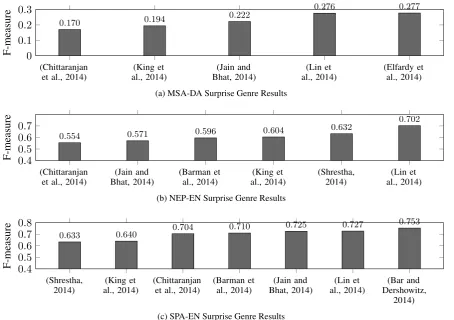
differences in prediction performance in both gen-res. In all cases the Avg. F-measure was higher on the Twitter test data than on the surprise genre. Although the surprise genre is too small to draw strong conclusions, all language pairs with surprise
genre test data showed a decrease in performance of around 10%.
most systems. For example the word for “he” was frequently mislabeled by at least one system. In most of the cases systems were predicting EN as label when the target language was SPA. Cases like this were even more prone to errors when these words fell in the CS point, as in this tweet: ni el headerhehecho(I haven’t even done the header). Tweets like this one, with just one token from the other language, were difficult for most systems. Named entities were also frequent sources of error, especially when they were spelled with lower cases letters.
By far the hardest language pair in this shared task was MSA-DA, as anticipated. Especially when considering the typological similarities between MSA and DA. This is mainly due to the fact that DA and MSA are close variants of one another and hence they share considerable amount of lexical items. The shared lexical items could be simple cognates of one another, orfaux amiswhere they are homographs or homophones, but have com-pletely different meaning. Both categories con-stitute a significant challenge. Accordingly, the baseline system had the lowest performance from all language pairs in both test sets. We note chal-lenges in this language pair on each linguistic level where CS occurs especially for the shared lexical items.
On the phonological level, DA writers tend to mimic the MSA script for DA words even if they are pronounced differently. For example: “heart” is pronounced in DAAloband in MSA asqalobbut commonly written in MSA as “qalob” in DA data. Also many phonological differences are in short vowels that are underspecified in written Arabic, adding another layer of ambiguity.
On the morphological level, there is no avail-able morphological analyzer avail-able to recognize such shared words and hence they are mostly misclassi-fied. Language identification for MSA-DA CS text highly depends on the context. Typically some Ara-bic variety word serves as a marker for a context switch such asmElh$ for DA ormn∗for MSA. But if shared lexical items are used, it is challenging to identify the Arabic variant. An example from the training data isqlbmeaning eitherheartas a noun orchangeas a verb in the phraselw qlb mjrm, corresponding to ‘If the heart of a criminal’ or ‘if he changes into a criminal’. These challenges ren-der language identification for CS MSA-DA data far from solved as evident by the fact that the
high-est scoring system reached an F-measure of only 41.7% in Test2 for CS identification. Moreover, this is the only language pair where at least one system was not able to outperform the baseline and in the case of Test2 only one system (Lin et al., 2014) outperformed the baseline.
Test Set System lang1 lang2 NE other ambiguous mixed Avg-F
MAN-EN
Baseline 0.9 0.47 0 0.29 - 0 0.761
(Jain and Bhat, 2014) 0.97 0.66 0.52 0.33 - 0 0.871
(Lin et al., 2014) 0.98 0.73 0.62 0.34 - 0 0.886
(King et al., 2014) 0.98 0.74 0.58 0.30 - 0 0.884
(Chittaranjan et al., 2014) 0.98 0.76 0.66 0.34 - 0 0.892
MSA-DA Test 1
(King et al., 2014) 0.88 0.14 0.05 0 0 - 0.720
Baseline 0.92 0.06 0 0.89 0 - 0.819
(Chittaranjan et al., 2014) 0.94 0.15 0.57 0.91 0 - 0.898
(Jain and Bhat, 2014) 0.93 0.05 0.73 0.87 0 - 0.909
(Lin et al., 2014) 0.94 0.09 0.74 0.98 0 - 0.922
(Elfardy et al., 2014)* 0.94 0.05 0.85 0.99 0 - 0.936
MSA-DA Test 2
Baseline 0.54 0.27 0 0.94 0 0 0.385
(King et al., 2014) 0.59 0.59 0.13 0.01 0 0 0.477
(Chittaranjan et al., 2014) 0.58 0.50 0.42 0.43 0.01 0 0.513
(Jain and Bhat, 2014) 0.62 0.49 0.67 0.75 0 0 0.580
(Elfardy et al., 2014)* 0.73 0.73 0.91 0.98 0 0.01 0.777
(Lin et al., 2014) 0.76 0.81 0.73 0.98 0 0 0.799
MSA-DA Surprise
(King et al., 2014) 0.48 0.60 0.05 0.02 0 0 0.467
(Jain and Bhat, 2014) 0.53 0.61 0.62 0.96 0 0 0.626
(Chittaranjan et al., 2014) 0.56 0.69 0.33 0.96 0 0 0.654
(Lin et al., 2014) 0.68 0.82 0.61 0.97 0 0 0.778
(Elfardy et al., 2014)* 0.66 0.81 0.87 0.99 0 0 0.801
NEP-EN
Baseline 0.67 0.76 0 0.61 - 0 0.678
(King et al., 2014) 0.87 0.80 0.51 0.34 - 0.03 0.707
(Lin et al., 2014) 0.93 0.91 0.49 0.95 - 0.02 0.917
(Jain and Bhat, 2014) 0.94 0.96 0.52 0.94 - 0 0.942
(Shrestha, 2014) 0.94 0.96 0.57 0.95 - 0 0.944
(Chittaranjan et al., 2014) 0.94 0.96 0.45 0.97 - 0 0.948
(Barman et al., 2014) 0.96 0.97 0.58 0.97 - 0.06 0.959
NEP-EN Surprise
(Lin et al., 2014) 0.83 0.73 0.46 0.65 - - 0.712
(King et al., 2014) 0.82 0.88 0.43 0.12 - - 0.761
(Chittaranjan et al., 2014) 0.78 0.87 0.37 0.80 - - 0.796
(Jain and Bhat, 2014) 0.83 0.91 0.50 0.87 - - 0.850
(Barman et al., 2014) 0.87 0.90 0.61 0.74 - - 0.853
(Shrestha, 2014) 0.85 0.92 0.53 0.78 - - 0.855
SPA-EN
Baseline 0.72 0.56 0 0.75 0 0 0.704
(Shrestha, 2014) 0.88 0.85 0.35 0.92 0 0 0.873
(Jain and Bhat, 2014) 0.92 0.92 0.36 0.90 0 0 0.905
(Lin et al., 2014) 0.93 0.93 0.32 0.91 0.03 0 0.913
(Barman et al., 2014) 0.93 0.92 0.47 0.93 0.03 0 0.921
(King et al., 2014) 0.94 0.93 0.54 0.92 0 0 0.923
(Chittaranjan et al., 2014) 0.94 0.93 0.28 0.95 0 0 0.926
(Bar and Dershowitz, 2014) 0.95 0.95 0.56 0.94 0.04 0 0.940
SPA-EN Surprise
(Shrestha, 2014) 0.80 0.78 0.23 0.81 0 0 0.778
(Jain and Bhat, 2014) 0.83 0.84 0.22 0.79 0 0 0.811
(Lin et al., 2014) 0.83 0.86 0.19 0.80 0.03 0 0.816
(Barman et al., 2014) 0.84 0.85 0.31 0.82 0.03 0 0.823
(Chittaranjan et al., 2014) 0.94 0.86 0.14 0.83 0 0 0.824
(King et al., 2014) 0.84 0.85 0.35 0.81 0 0 0.828
[image:9.595.80.521.60.579.2](Bar and Dershowitz, 2014) 0.85 0.87 0.37 0.83 0.03 0 0.839
Table 4: Performance results on language identification at the token level. A ‘-’ indicates there were no tokens of this class in the test set. We ranked systems using weighted averaged f-measure (Avg-F). The “*” marks the system by (Elfardy et al., 2014). This system was not considered in the ranking for the shared task as it was developed by co-organizers of the task.
7 Lessons Learned
Among the things we want to improve for future shared tasks is the issue of data loss due to re-moval of tweets or users deleting their accounts. We decided to use Twitter data to have a relevant corpus. However, the trade-off is the lack of rights to distribute the data ourselves. This is not just a
(Chittaranjan
et al., 2014) al., 2014)(King et Bhat, 2014)(Jain and al., 2014)(Lin et (Elfardy etal., 2014) 0
0.1 0.2 0.3
0.170 0.194 0.222
0.276 0.277
F-measure
(a) MSA-DA Surprise Genre Results
(Chittaranjan
et al., 2014) Bhat, 2014)(Jain and (Barman etal., 2014) al., 2014)(King et (Shrestha,2014) al., 2014)(Lin et 0.4
0.5 0.6 0.7
0.554 0.571 0.596 0.604 0.632
0.702
F-measure
(b) NEP-EN Surprise Genre Results
(Shrestha,
2014) al., 2014)(King et (Chittaranjanet al., 2014) (Barman etal., 2014) Bhat, 2014)(Jain and al., 2014)(Lin et Dershowitz,(Bar and 2014) 0.4
0.5 0.6 0.7 0.8
0.633 0.640 0.704 0.710 0.725 0.727
0.753
F-measure
[image:10.595.77.532.63.383.2](c) SPA-EN Surprise Genre Results
Figure 2: Prediction results on language identification at the document level for the surprise genre. This is a binary task to distinguish between a monolingual and a code-switched text. We show performance of participating systems using F-measure as the evaluation metric.
Using crowdsourcing for annotating the data is a cheap and easy way for generating resources. But we found out that even when following best prac-tices for quality control, there was a substantial amount of noise in the gold data. We plan to con-tinue working on refining the annotation guidelines and quality control processes to reduce the amount of noise in gold annotations.
8 Conclusion
This is the first shared task on language identifica-tion in CS data. Yet, the response was quite positive as we received 42 system runs from seven different teams, plus submissions for MSA-AD from a sub group of the task organizers (Elfardy et al., 2014). The systems presented are overall robust and with interesting differences from one another. Although we did not see a single system ranking in the top places across all language pairs and tasks, we did see systems showing robust performance indicat-ing some level of language independence. But the results are not consistent at the tweet/document
level. The language pair that proved to be the most difficult for the task was MSA-DA, where the lexi-con baseline system was hard to beat even with an F-measure of 47.1%.
This shared task showed that language identifica-tion in code-switched data is still an open problem that warrants further investigation. Perhaps in the near future we will see systems that embed some form of linguistic theory about CS and maybe that would result in more accurate predictions.
Acknowledgments
We would like to thank all shared task partici-pants. We also thank Brian Hester and Mohamed Elbadrashiny for their invaluable support in the development of the gold standard data and analy-sis of results. We also thank the in-lab annotators and the CrowdFlower contributors. This work was partly funded by NSF under awards 1205475 and 1205556.
References
Kfir Bar and Nachum Dershowitz. 2014. Tel Aviv Uni-versity system description for the code-switching workshop shared task. InProceedings of the First Workshop on Computational Approaches to Code-Switching, Doha, Qatar, October. ACL.
Utsab Barman, Joachim Wagner, Grzegorz Chrupala, and Jennifer Foster. 2014. DCU-UVT: Word-level language classification with code-mixed data. In Proceedings of the First Workshop on Computa-tional Approaches to Code-Switching, Doha, Qatar, October. ACL.
Gokul Chittaranjan, Yogarshi Vyas, Kalika Bali, and Monojit Choudhury. 2014. A framework to label code-mixed sentences in social media. In Proceed-ings of the First Workshop on Computational Ap-proaches to Code-Switching, Doha, Qatar, October. ACL.
Heba Elfardy, Mohamed Al-Badrashiny, and Mona Diab. 2014. AIDA: Identifying code switching in informal Arabic text. In Proceedings of the First Workshop on Computational Approaches to Code-Switching, Doha, Qatar, October. ACL.
Naman Jain and Riyaz Ahmad Bhat. 2014. Language identification in codeswitching scenario. In Pro-ceedings of the First Workshop on Computational Approaches to Code-Switching, Doha, Qatar, Octo-ber. ACL.
A. Joshi. 1982. Processing of sentences with in-trasentential code-switching. In J´an Horeck´y, editor, COLING-82, pages 145–150, Prague, July.
Ben King and Steven Abney. 2013. Labeling the lan-guages of words in mixed-language documents us-ing weakly supervised methods. InProceedings of the 2013 Conference of the North American Chap-ter of the Association for Computational Linguis-tics: Human Language Technologies, pages 1110– 1119, Atlanta, Georgia, June. Association for Com-putational Linguistics.
Levi King, Eric Baucom, Tim Gilmanov, Sandra K¨ubler, Dan Whyatt, Wolfgang Maier, and Paul Ro-drigues. 2014. The IUCL+ system: Word-level language identification via extended Markov models.
In Proceedings of the First Workshop on Computa-tional Approaches to Code-Switching, Doha, Qatar, October. ACL.
Ying Li, Yue Yu, and Pascale Fung. 2012. A Mandarin-English code-switching corpus. In Nico-letta Calzolari, Khalid Choukri, Thierry Declerck, Mehmet U˘gur Do˘gan, Bente Maegaard, Joseph Mar-iani, Jan Odijk, and Stelios Piperidis, editors, Pro-ceedings of the Eighth International Conference on Language Resources and Evaluation (LREC-2012), pages 2515–2519, Istanbul, Turkey, May. European Language Resources Association (ELRA). ACL An-thology Identifier: L12-1573.
Constantine Lignos and Mitch Marcus. 2013. Toward web-scale analysis of codeswitching. In 87th An-nual Meeting of the Linguistic Society of America. Chu-Cheng Lin, Waleed Ammar, Chris Dyer, and Lori
Levin. 2014. The CMU submission for the shared task on language identification in code-switched data. InProceedings of the First Workshop on Com-putational Approaches to Code-Switching, Doha, Qatar, October. ACL.
D.C. Lyu, T.P. Tan, E. Chng, and H. Li. 2010. SEAME: a Mandarin-English code-switching speech corpus in South-East Asia. InINTERSPEECH, volume 10, pages 1986–1989.
Dong Nguyen and A. Seza Do˘gru¨oz. 2013. Word level language identification in online multilingual com-munication. InProceedings of the 2013 Conference on Empirical Methods in Natural Language Process-ing, pages 857–862, Seattle, Washington, USA, Oc-tober. Association for Computational Linguistics. Prajwol Shrestha. 2014. An incremental approach for
language identification in codeswitched text. In Pro-ceedings of the First Workshop on Computational Approaches to Code-Switching, Doha, Qatar, Octo-ber. ACL.
Anil Kumar Singh and Jagadeesh Gorla. 2007. Identifi-cation of languages and encodings in a multilingual document. InProceedings of ACL-SIGWAC’s Web As Corpus3, Belgium.