Using character overlap to improve language transformation
Sander Wubben Tilburg University
P.O. Box 90135 5000 LE Tilburg The Netherlands [email protected]
Emiel Krahmer Tilburg University
P.O. Box 90135 5000 LE Tilburg The Netherlands [email protected]
Antal van den Bosch Radboud University Nijmegen
P.O. Box 9103 6500 HD Nijmegen
The Netherlands
Abstract
Language transformation can be defined as translating between diachronically dis-tinct language variants. We investigate the transformation of Middle Dutch into Mod-ern Dutch by means of machine transla-tion. We demonstrate that by using char-acter overlap the performance of the ma-chine translation process can be improved for this task.
1 Introduction
In this paper we aim to develop a system to para-phrase between diachronically distinct language variants. For research into history, historical lin-guistics and diachronic language change, histori-cal texts are of great value. Specifihistori-cally from ear-lier periods, texts are often the only forms of in-formation that have been preserved. One prob-lem that arises when studying these texts is the difference between the language the text is writ-ten in and the modern variant that the researchers who want to study the texts know and speak them-selves. It takes a great deal of deciphering and in-terpretation to be able to grasp these texts. Our aim is to facilitate scholars such as historians who do not possess extensive knowledge of Middle Dutch who are studying medieval texts. We do this by at-tempting to generate literal translations of the sen-tences in the text into modern language. In par-ticular we focus on the task of translating Middle Dutch to modern Dutch. The transformation be-tween language variants, either synchronically or diachronically, can be seen as a paraphrase and a translation task, as it is often impossible to catego-rize two languages as either variants or different languages.
We define Middle Dutch as a collection of closely related West Germanic dialects that were spoken and written between 1150 and 1500 in the
area that is now defined as the Netherlands and parts of Belgium. One of the factors that make Middle Dutch difficult to read is the fact that at the time no overarching standard language existed. Modern Dutch is defined as Dutch as spoken from 1500. The variant we investigate is contempo-rary Dutch. An important difference with regular paraphrasing is the amount of parallel data avail-able. The amount of parallel data for the vari-ant pair Middle Dutch - Modern Dutch is sev-eral orders of magnitude smaller than bilingual parallel corpora typically used in machine trans-lation (Koehn, 2005) or monolingual parallel cor-pora used for paraphrase generation by machine translation (Wubben et al., 2010).
We do expect many etymologically related words to show a certain amount of character overlap between the Middle and Modern variants. An example of the data is given below, from the work ’Van den vos Reynaerde’ (‘About Reynard the Fox’), part of the Comburg manuscript that was written between 1380-1425. Here, the first text is the original text, the second text is a modern translation in Dutch by Walter Verniers and a translation in English is added below that for clarity.
“Doe al dat hof versamet was, Was daer niemen, sonder die das, Hine hadde te claghene over Reynaerde, Den fellen metten grijsen baerde.”
“Toen iedereen verzameld was, was er niemand -behalve de das-die niet kwam klagen over Reynaert, die deugniet met zijn grijze baard.”
“When everyone was gathered, there was noone -except the badger-who did not complain about Reynaert, that rascal with his grey beard.”
We can observe that although the two Dutch texts are quite different, there is a large amount of character overlap in the words that are used. Our aim is to use this character overlap to compen-sate for the lower amount of data that is available. We compare three different approaches to trans-late Middle Dutch into Modern Dutch: a standard Phrase-Based machine translation (PBMT) ap-proach, a PBMT approach with additional prepro-cessing based on Needleman-Wunsch sequence alignment, and a character bigram based PBMT approach. The PBMT approach with preprocess-ing identifies likely translations based on character overlap and adds them as a dictionary to improve the statistical alignment process. The PBMT ap-proach based on character bigrams rather than translating words, transliterates character bigrams and in this way improves the transformation pro-cess. We demonstrate that these two approaches outperform standard PBMT in this task, and that the PBMT transliteration approach based on char-acter bigrams performs best.
2 Related work
Language transformation by machine translation within a language is a task that has not been stud-ied extensively before. Related work is the study by Xu et al. (2012). They evaluate paraphrase sys-tems that attempt to paraphrase a specific style of writing into another style. The plays of William Shakespeare and the modern translations of these works are used in this study. They show that their models outperform baselines based on dictionar-ies and out-of-domain parallel text. Their work differs from our work in that they target writing in a specific literary style and we are interested in translating between diachronic variants of a lan-guage.
Work that is slightly comparable is the work by Zeldes (2007), who extrapolates correspondences in a small parallel corpus taken from the Modern and Middle Polish Bible. The correspondences are extracted using machine translation with the aim of deriving historical grammar and lexical items. A larger amount of work has been published about spelling normalization of historical texts. Baron and Rayson (2008) developed tools for research in Early Modern English. Their tool, VARD 2, finds candidate modern form replacements for spelling variants in historical texts. It makes use of a
dictionary and a list of spelling rules. By plug-ging in other dictionaries and spelling rules, the tool can be adapted for other tasks. Kestemont et al. (2010) describe a machine learning approach to normalize the spelling in Middle Dutch Text from the 12th century. They do this by converting the historical spelling variants to single canonical (present-day) lemmas. Memory-based learning is used to learn intra-lemma spelling variation. Al-though these approaches normalize the text, they do not provide a translation.
More work has been done in the area of trans-lating between closely related languages and deal-ing with data sparsity that occurs within these lan-guage pairs (Hajiˇc et al., 2000; Van Huyssteen and Pilon, 2009). Koehn et al. (2003) have shown that there is a direct negative correlation between the size of the vocabulary of a language and the accuracy of the translation. Alignment models are directly affected by data sparsity. Uncommon words are more likely to be aligned incorrectly to other words or, even worse, to large segments of words (Och and Ney, 2003). Out of vocabulary (OOV) words also pose a problem in the trans-lation process, as systems are unable to provide translations for these words. A standard heuristic is to project them into the translated sentence un-translated.
Various solutions to data sparsity have been studied, among them the use of part-of-speech tags, suffixes and word stems to normalize words (Popovic and Ney, 2004; De Gispert and Marino, 2006), the treatment of compound words in translation (Koehn and Knight, 2003), translit-eration of names and named entities, and advanced models that combine transliteration and transla-tion (Kondrak et al., 2003; Finch et al., 2012) or learn unknown words by analogical reason-ing (Langlais and Patry, 2007).
letter-based system. However, a combined sys-tem performs marginally better in terms of BLEU scores.
Tiedemann (2009) shows that combining character-based translation with phrase-based translation improves machine translation quality in terms of BLEU and NIST scores when trans-lating between Swedish and Norwegian if the OOV-words are translated beforehand with the character-based model.
Nakov and Tiedemann (2012) investigate the use of character-level models in the translation be-tween Macedonian and Bulgarian movie subtitles. Their aim is to translate between the resource poor language Macedonian to the related language Bul-garian, in order to use Bulgarian as a pivot in or-der to translate to other languages such as English. Their research shows that using character bigrams shows improvement over a word-based baseline.
It seems clear that character overlap can be used to improve translation quality in related languages. We therefore use character overlap in language transformation between two diachronic variants of a language.
3 This study
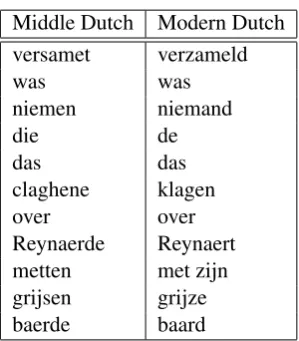
In this study we investigate the task of translating from Middle Dutch to Modern Dutch. Similarly to resource poor languages, one of the problems that are apparent is the small amount of parallel Middle Dutch - Modern Dutch data that is avail-able. To combat the data sparseness we aim to use the character overlap that exists between the Mid-dle Dutch words and their Modern Dutch counter-parts. Examples of overlap in some of the words given in the example can be viewed in Table1. We are interested in the question how we can use this overlap to improve the performance of the transla-tion model. We consider three approaches: (A) Perform normal PBMT without any preprocess-ing, (B) Apply a preprocessing step in which we pinpoint words and phrases that can be aligned based on character overlap and (C) perform ma-chine translation not to words but to character bi-grams in order to make use of the character over-lap.
We will first discuss the PBMT baseline, fol-lowed by the PBMT + overlap system and the character bigram PBMT transliteration system in Section 4. We then describe the experiment with human judges in Section 6, and its results in
Sec-tion 7. We close with a discussion of our results in Section 8.
Middle Dutch Modern Dutch versamet verzameld
was was
niemen niemand
die de
das das
claghene klagen
over over
Reynaerde Reynaert metten met zijn grijsen grijze
[image:3.595.342.492.92.263.2]baerde baard
Table 1: Examples of character overlap in words from a fragment of ’Van den vos Reynaerde’
4 Language transformation Models
4.1 PBMT baseline
For our baseline we use the Moses software to train a phrase based machine translation (PBMT) model (Koehn et al., 2007). In general, a statistical machine translation model normally finds a best translation E˜ of a text in language F for a text in language E by combining a translation model P(F|E)with a language modelP(E):
˜
E=arg max
E∈E∗P(F|E)P(E)
In phrase-based machine translation the sen-tenceFis segmented into a sequence ofIphrases during decoding. Each source phrase is then trans-lated into a target phrase to form sentence E. Phrases may be reordered.
execute GIZA++ with standard settings and we optimize using minimum error rate training with BLEU scores. The Moses decoder is used to gen-erate the translations.
4.2 PBMT with overlap-based alignment
Before using the Moses pipeline we perform a preprocessing alignment step based on character overlap. Word and phrase pairs that exhibit a large amount of character overlap are added to the par-allel corpus that GIZA++ is trained on. Every time we find a phrase or word pair with large overlap it is added to the corpus. This helps bias the align-ment procedure towards aligning similar words and reduces alignment errors. To perform the pre-processing step we use the Needleman-Wunsch algorithm (Needleman and Wunsch, 1970). The Needleman-Wunsch algorithm is a dynamic pro-gramming algorithm that performs a global align-ment on two sequences. Sequence alignalign-ment is a method to find commonalities in two (or more) sequences of some items or characters. One of-ten used example is the comparison of sequences of DNA to find evolutionary differences and sim-ilarities. Sequence alignment is also used in lin-guistics, where it is applied to finding the longest common substring or the differences or similari-ties between strings.
The Needleman-Wunsch algorithm is a se-quence alignment algorithm that optimizes a score function to find an optimal alignment of a pair of sequences. Each possible alignment is scored ac-cording to the score function, where the alignment giving the highest similarity score is the optimal alignment of a pair of sequences. If more than one alignment yields the highest score, there are multiple optimal solutions. The algorithm uses an iterative matrix to calculate the optimal solu-tion. All possible pairs of characters containing one character from each sequence are plotted in a 2-dimensional matrix. Then, all possible align-ments between those characters can be represented by pathways through the matrix. Insertions and deletions are allowed, but can be penalized by means of a gap penalty in the alignment.
The first step is to initialize the matrix and fill in the gap scores in the top row and leftmost column. In our case we heuristically set the values of the scores to +1 for matches, -2 for mismatches and -1 for gaps after evaluating on our development set. After initialization, we can label the cells
in the matrix C(i, j) where i = 1,2, ..., N and j = 1,2, ..., M, the score of any cell C(i, j) is then the maximum of:
qdiag = C(i−1, j−1) +s(i, j) qdown = C(i−1, j) +g
qright = C(i, j−1) +g
Here, s(i, j) is the substitution score for let-tersi andj, andg is the gap penalty score. If i and j match, the substitution score is in fact the matching score. The table is filled this way recur-sively, filling each cell with the maximum score of the three possible options (diagonally, down and right). After this is done, an optimal path can be found by performing a traceback, starting in the lower right corner of the table and ending in the upper left corner, by visiting cells horizontally, vertically or diagonally, but only those cells with the highest score. After this process we end up with an alignment.
We use the Needleman-Wunsch algorithm to find an optimal alignment of the Middle Dutch - Modern Dutch sentence pairs. We regard each line as a sentence. In case of rhyming text, a frequent phenomenon in Middle Dutch text, lines are usually parts of sentences. We then consider each line a string, and we try to align as many characters and whitespaces to their equivalents in the parallel line. We split the aligned sentences in each position where two whitespaces align and we consider the resulting aligned words or phrases as alignments. For each aligned word or phrase pair we calculate the Jaccard coefficient and if that is equal or higher than a threshold we add the aligned words or phrases to the training material. We heuristically set this threshold to 0.5. By using this method we already can find many-to-one and one-to-many alignments. In this way we help the GIZA++ alignment process by biasing it towards aligning words and phrases that show overlap. Ta-ble 2 illustrates this process for two lines.
4.3 Character bigram transliteration
Middle Dutch: hine hadde+ ++te claghene over Reynaerde ,
Modern Dutch: di+e ++niet kwam klag+en+ over Reynaer+t ,
Jaccard 0.4 0.14 0 0.63 1 0.70 1
Middle Dutch: +den fe++llen met++ten grijsen baerde .
Modern Dutch: die+ deugniet met zijn grijze+ baard+ .
[image:5.595.72.472.58.160.2]Jaccard 0.50 0.09 0.50 0.71 0.8 1
Table 2: Alignment of lines with Jaccard scores for the aligned phrases. A + indicates a gap introduced by the Needleman Wunsch alignment.
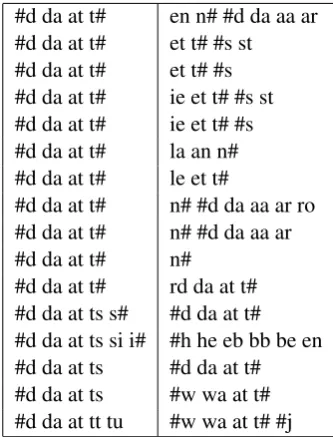
OOV-words and use the benefits of character over-lap more directly in the MT system, we build a translation model based on character bigrams, similar to (Nakov and Tiedemann, 2012). Where they use this approach to translate between closely related languages, we use it to translate between diachronic variants of a language. The sentences in the parallel corpus are broken into charac-ter bigrams, with a special characcharac-ter representing whitespaces. These bigrams are used to train the translation model and the language model. An ex-ample of the segmentation process is displayed in Table 3. We train an SRILM language model on the character bigrams and model sequences of up to 10 bigrams. We then run the standard Moses pipeline, using GIZA++ with standard settings to generate the phrase-table and we use the Moses decoder to decode the bigram sequences. A num-ber of sample entries are shown in Table 4. As a final step, we recombine the bigrams into words. The different sizes of the Phrase-table for the dif-ferent approaches can be observed in Table 5.
original segmented Hine #H Hi in ne e# hadde #h ha ad dd de e#
te #t te e#
claghene #c cl la ag gh he en ne e# over #o ov ve er r#
Reynaerde #R Re ey yn na ae er rd de e#
, #, ,#
Table 3: Input and output of the character bigram segmenter
5 Data Set
Our training data consists of various Middle Dutch literary works with their modern Dutch transla-tion. A breakdown of the different works is in
#d da at t# en n# #d da aa ar #d da at t# et t# #s st #d da at t# et t# #s #d da at t# ie et t# #s st #d da at t# ie et t# #s #d da at t# la an n# #d da at t# le et t#
#d da at t# n# #d da aa ar ro #d da at t# n# #d da aa ar #d da at t# n#
[image:5.595.332.499.211.430.2]#d da at t# rd da at t# #d da at ts s# #d da at t# #d da at ts si i# #h he eb bb be en #d da at ts #d da at t# #d da at ts #w wa at t# #d da at tt tu #w wa at t# #j
Table 4: Example entries from the character bi-gram Phrase-table, without scores.
system lines
PBMT 20,092
PBMT + overlap 27,885
[image:5.595.318.512.483.541.2]character bigram transliteration 93,594
Table 5: Phrase-table sizes of the different models
Table 6. All works are from the Digital Library of Dutch Literature1. “Middle Dutch” is a very broad definition. It encompasses all Dutch language spo-ken and written between 1150 and 1500 in the Netherlands and parts of Belgium. Works stem-ming from different centuries, regions and writers can differ greatly in their orthography and spelling conventions. No variant of Dutch was considered standard or the norm; Middle Dutch can be con-sidered a collection of related lects (regiolects, di-alects). This only adds to the problem of data
[image:5.595.78.286.523.636.2]sparsity. Our test set consists of a selection of sentences from the Middle Dutch work Beatrijs, a Maria legend written around 1374 by an anony-mous author.
source text lines date of origin Van den vos Reynaerde 3428 around 1260 Sint Brandaan 2312 12th century Gruuthuuse gedichten 224 around 1400 ’t Prieel van Trojen 104 13th century Various poems 42 12th-14th cent. Table 6: Middle Dutch works in the training set
Middle Si seide: ’Ic vergheeft u dan. Dutch Ghi sijt mijn troest voer alle man Modern Ze zei: ’ik vergeef het je dan. Dutch Je bent voor mij de enige man PBMT Ze zei : ’ Ik vergheeft u dan .
[image:6.595.81.279.122.188.2]Gij ze alles in mijn enige voor al man PBMT + Ze zei : ’ Ik vergheeft u dan . Overlap dat ze mijn troest voor al man Char. Bigram Ze zeide : ’ Ik vergeeft u dan . PBMT Gij zijt mijn troost voor alle man Middle Dat si daer snachts mochte bliven. Dutch ’Ic mocht u qualijc verdriven,’ Modern omdat ze nu niet verder kon reizen. Dutch ’Ik kan u echt de deur niet wijzen,’ PBMT dat ze daar snachts kon bliven . ’ Ik kon u qualijc verdriven , ’ PBMT + dat ze daar s nachts kon blijven . Overlap ’ Ik kon u qualijc verdriven , ’ Char. Bigram dat zij daar snachts mocht blijven . PBMT ’ Ik mocht u kwalijk verdrijven ,
Table 7: Example output
6 Experiment
In order to evaluate the systems, we ran an exper-iment to collect human rankings of the output of the systems. We also performed automatic evalu-ation.
6.1 Materials
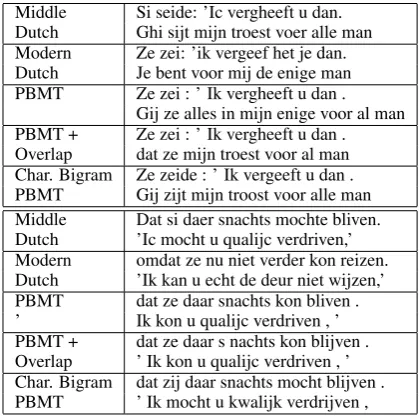
Because of the nature of our data, in which sen-tences often span multiple lines, it is hard to eval-uate the output on the level of separate lines. We therefore choose to evaluate pairs of lines. We ran-domly choose a line, and check if it is part of a sensible sentence that can be understood without more context. If that is the case, we select it to in-clude in our test set. In this way we select 25 pairs of lines. We evaluate the translations produced by the three different systems for these sentences. Ex-amples of the selected sentences and the generated corresponding output are displayed in Table 7.
6.2 Participants
The participants in this evaluation study were 22 volunteers. All participants were native speakers of Dutch, and participated through an online in-terface. All participants were adults, and 12 were male and 10 female. In addition to the 22 partici-pants, one expert in the field of Middle Dutch also performed the experiment, in order to be able to compare the judgements of the laymen and the ex-pert.
6.3 Procedure
The participants were asked to rank three different automatic literal translations of Middle Dutch text. For reference, they were also shown a modern (of-ten not literal) translation of the text by Dutch au-thor Willem Wilmink. The order of items to judge was randomized for each participant, as well as the order of the output of the systems for each sen-tence. The criterium for ranking was the extent to which the sentences could be deciphered and un-derstood. The participants were asked to always provide a ranking and were not allowed to assign the same rank to multiple sentences. In this way, each participant provided 25 rankings where each pair of sentences received a distinct rank. The pair with rank 1 is considered best and the pair with 3 is considered worst.
system mean rank 95 % c. i. PBMT 2.44 (0.03) 2.38 - 2.51 PBMT + Overlap 2.00 (0.03) 1.94 - 2.06 char. bigram PBMT 1.56 (0.03) 1.50 - 1.62
Table 8: Mean scores assigned by human subjects, with the standard error between brackets and the lower and upper bound of the 95 % confidence in-terval
7 Results
7.1 Human judgements
[image:6.595.76.286.236.444.2]PBMT PBMT + overlap
char. bigram PBMT
X2
2.05 2.59 1.36 16.636**
2.77 1.82 1.41 21.545**
2.50 1.27 2.23 18.273**
1.95 1.45 2.59 14.273**
2.18 2.36 1.45 10.182**
2.45 2.00 1.55 9.091*
2.91 1.77 1.32 29.545**
2.18 2.27 1.55 6.903*
2.14 2.00 1.86 0.818
2.27 1.73 2.00 3.273
2.68 1.68 1.64 15.364**
2.82 1.95 1.23 27.909**
2.68 2.09 1.23 23.545**
1.95 2.55 1.50 12.091**
2.77 1.86 1.36 22.455**
2.32 2.23 1.45 9.909**
2.86 1.91 1.23 29.727**
2.18 1.09 2.73 30.545**
2.05 2.09 1.86 0.636
2.73 2.18 1.09 30.545**
2.41 2.27 1.32 15.545**
2.68 2.18 1.14 27.364**
1.82 2.95 1.23 33.909**
2.73 1.95 1.32 21.909**
[image:7.595.79.283.63.444.2]2.91 1.77 1.32 29.545**
Table 9: Results of the Friedman test on each of the 25 sentences. Results marked * are significant atp < 0.05 and results marked ** are significant atp <0.01
variance, but was not significant, so no corrections had to be applied. Planned pairwise comparisons were made with the Bonferroni method. The mean ranking can be found in Table 8 together with the standard deviation and 95 % confidence interval. We find that participants ranked the three systems differently,F(2,42) = 135,604, p < .001, ηp2 = .866. All pairwise comparisons are significant at p < .001. The character bigram model receives the best mean rank (1.56), then the PBMT + Over-lap system (2.00) and the standard PBMT system is ranked lowest (2.44). We used a Friedman test to detect differences across multiple rankings. We ran the test on each of the 25 K-related samples, and found that for 13 sentences the ranking pro-vided by the test subjects was equal to the mean ranking: the PBMT system ranked lowest, then the
PBMT + Overlap system and the character bigram system scored highest for each of these cases at p < .005. These results are detailed in Table 9. When comparing the judgements of the partici-pants with the judgements of an expert, we find a significant medium Pearson correlation of .65 (p < .001) between the judgements of the expert and the mean of the judgements of the participants. This indicates that the judgements of the laymen are indeed useful.
7.2 Automatic judgements
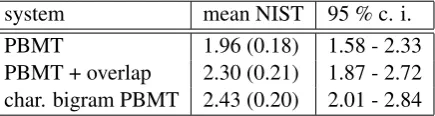
In order to attempt to measure the quality of the transformations made by the different systems au-tomatically, we measured NIST scores by compar-ing the output of the systems to the reference trans-lation. We do realize that the reference translation is in fact a literary interpretation and not a literal translation, making automatic assessment harder. Having said that, we still hope to find some effect by using these automatic measures. We only re-port NIST scores here, because BLEU turned out to be very uninformative. In many cases sentences would receive a BLEU score of 0. Mauchly‘s test for sphericity was used to test for homogeneity of variance for the NIST scores, and was not signifi-cant. We ran a repeated measures test with planned pairwise comparisons made with the Bonferroni method. We found that the NIST scores for the dif-ferent systems differed significantly (F(2,48) = 6.404, p < .005, η2p = .211). The average NIST scores with standard error and the lower and up-per bound of the 95 % confidence interval can be seen in Table 10. The character bigram translit-eration model scores highest with 2.43, followed by the PBMT + Overlap model with a score of 2.30 and finally the MT model scores lowest with a NIST score of 1.95. We find that the scores for the PBMT model differ significantly from the PBMT + Overlap model (p < .01) and the charac-ter bigram PBMT model (p < .05), but the scores for the PBMT + Overlap and the character bigram PBMT model do not differ significantly. When we compare the automatic scores to the human as-signed ranks we find no significant Pearson corre-lation.
8 Conclusion
system mean NIST 95 % c. i. PBMT 1.96 (0.18) 1.58 - 2.33 PBMT + overlap 2.30 (0.21) 1.87 - 2.72 char. bigram PBMT 2.43 (0.20) 2.01 - 2.84
Table 10: Mean NIST scores, with the standard error between brackets and the lower and upper bound of the 95 % confidence interval
by using character overlap in the two variants. We described one approach that helps the alignment process by adding words that exhibit a certain amount of character overlap to the parallel data. We also described another approach that translates sequences of character bigrams instead of words. Reviewing the results we conclude that the use of character overlap between diachronic variants of a language is beneficial in the translation process. More specifically, the model that uses character bigrams in translation instead of words is ranked best. Also ranked significantly better than a stan-dard Phrase Based machine translation approach is the approach using the Needleman-Wunsch al-gorithm to align sentences and identify words or phrases that exhibit a significant amount of char-acter overlap to help the GIZA++ statistical align-ment process towards aligning the correct words and phrases. We have seen that one issue that is encountered when considering the task of lan-guage transformation from Middle Dutch to Mod-ern Dutch is data sparseness. The number of lines used to train on amounts to a few thousand, and not millions as is more common in SMT. It is therefore crucial to use the inherent character over-lap in this task to compensate for the lack of data and to make more informed decisions. The char-acter bigram approach is able to generate a trans-lation for out of vocabulary words, which is also a solution to the data sparseness problem. One area where the character bigram model often fails, is translating Middle Dutch words into Modern Dutch words that are significantly different. One example can be seen in Table 7, where ’mocht’ is translated by the PBMT and PBMT + Overlap systems to ’kon’ and left the same by the charac-ter bigram translicharac-teration model. This is probably due to the fact that ’mocht’ still exists in Dutch, but is not as common as ’kon’ (meaning ’could’). another issue to consider is the fact that the char-acter bigram model learns charchar-acter mappings that are occurring trough out the language. One
exam-ple is the disappearing silent ’h’ after a ’g’. This often leads to transliterated words of which the spelling is only partially correct. Apparently the human judges rate these ’half words’ higher than completely wrong words, but automatic measures such as NIST are insensitive to this.
We have also reported the NIST scores for the output of the standard PBMT approach and the two proposed variants. We see that the NIST scores show a similar patterns as the human judge-ments: the PBMT + Overlap and character bigram PBMT systems both achieve significantly higher NIST scores than the normal PBMT system. How-ever, the PBMT + Overlap and character bigram PBMT models do not differ significantly in scores. It is interesting that we find no significant corre-lation between human and automatic judgements, leading us to believe that automatic judgements are not viable in this particular scenario. This is perhaps due to the fact that the reference transla-tions the automatic measures rely on are in this case not literal translations but rather more loosely translated literary interpretations of the source text in modern Dutch. The fact that both versions are written on rhyme only worsens this problem, as the author of the Modern Dutch version is often very creative.
We think techniques such as the ones described here can be of great benefit to laymen wishing to investigate works that are not written in contem-porary language, resulting in improved access to these older works. Our character bigram translit-eration model may also play some role as a com-putational model in the study of the evolution of orthography in language variants, as it often will generate words that are strictly speaking not cor-rect, but do resemble Modern Dutch in some way. Automatic evaluation is another topic for future work. It would be interesting to see if an automatic measure operating on the character level correlates better with human judgements.
References
Alistair Baron and Paul Rayson. 2008. VARD 2: A tool for dealing with spelling variation in historical corpora. InProceedings of the Postgraduate Confer-ence in Corpus Linguistics, Birmingham, UK. Aston University.
A. De Gispert and J. B. Marino. 2006. Linguistic
knowledge in statistical phrase-based word
align-ment. Natural Language Engineering, 12(1):91–
Andrew Finch, Paul Dixon, and Eiichiro Sumita. 2012. Rescoring a phrase-based machine transliteration system with recurrent neural network language
mod-els. InProceedings of the 4th Named Entity
Work-shop (NEWS) 2012, pages 47–51, Jeju, Korea, July. Association for Computational Linguistics.
Jan Hajiˇc, Jan Hric, and Vladislav Kuboˇn. 2000.
Ma-chine translation of very close languages. In
Pro-ceedings of the sixth conference on Applied natural language processing, pages 7–12. Association for Computational Linguistics.
Mike Kestemont, Walter Daelemans, and Guy
De Pauw. 2010. Weigh your
words—memory-based lemmatization for Middle Dutch. Literary
and Linguistic Computing, 25(3):287–301, Septem-ber.
Philipp Koehn and Kevin Knight. 2003. Feature-rich statistical translation of noun phrases. InACL ’03: Proceedings of the 41st Annual Meeting on Asso-ciation for Computational Linguistics, pages 311– 318, Morristown, NJ, USA. Association for Compu-tational Linguistics.
Philip Koehn, Franz Josef Och, and Daniel Marcu.
2003. Statistical phrase-based translation. In
Proceedings of the 2003 Conference of the North American Chapter of the Association for Computa-tional Linguistics on Human Language Technology-Volume 1, pages 48–54. Association for Computa-tional Linguistics.
Philipp Koehn, Hieu Hoang, Alexandra Birch, Chris C. Burch, Marcello Federico, Nicola Bertoldi, Brooke Cowan, Wade Shen, Christine Moran, Richard Zens, Chris Dyer, Ondrej Bojar, Alexandra Constantin, and Evan Herbst. 2007. Moses: Open source toolkit for statistical machine translation. InACL. The As-sociation for Computer Linguistics.
P. Koehn. 2005. Europarl: A parallel corpus for statis-tical machine translation. InMT summit, volume 5.
Grzegorz Kondrak, Daniel Marcu, and Kevin Knight. 2003. Cognates can improve statistical translation
models. InHLT-NAACL.
Philippe Langlais and Alexandre Patry. 2007. Trans-lating unknown words by analogical learning. In
EMNLP-CoNLL, pages 877–886. ACL.
Preslav Nakov and J¨org Tiedemann. 2012. Combin-ing word-level and character-level models for ma-chine translation between closely-related languages. InProceedings of the 50th Annual Meeting of the As-sociation for Computational Linguistics (Volume 2: Short Papers), pages 301–305, Jeju Island, Korea, July. Association for Computational Linguistics.
S. B. Needleman and C. D. Wunsch. 1970. A general method applicable to the search for similarities in the amino acid sequence of two proteins.Journal of molecular biology, 48(3):443–453, March.
Franz Josef Och and Hermann Ney. 2003. A
sys-tematic comparison of various statistical alignment
models. Computational Linguistics, 29(1):19–51.
Maja Popovic and Hermann Ney. 2004. Towards the use of word stems and suffixes for statistical
ma-chine translation. InLREC. European Language
Re-sources Association.
Andreas Stolcke. 2002. SRILM - an extensible
lan-guage modeling toolkit. In In Proc. Int. Conf. on
Spoken Language Processing, pages 901–904, Den-ver, Colorado.
J¨org Tiedemann. 2009. Character-based PSMT for
closely related languages. In Llu´ıs Marqu´es and
Harold Somers, editors, Proceedings of 13th
An-nual Conference of the European Association for Machine Translation (EAMT’09), pages 12 – 19, Barcelona, Spain, May.
Gerhard B Van Huyssteen and Sul´ene Pilon. 2009.
Rule-based conversion of closely-related languages:
a dutch-to-afrikaans convertor. 20th Annual
Sympo-sium of the Pattern Recognition Association of South Africa, December.
David Vilar, Jan-Thorsten Peter, and Hermann Ney.
2007. Can we translate letters? In Second
Work-shop on Statistical Machine Translation, pages 33– 39, Prague, Czech Republic, jun. Association for Computational Linguistics.
Sander Wubben, Antal van den Bosch, and Emiel Krahmer. 2010. Paraphrase generation as
mono-lingual translation: Data and evaluation. In
B. Mac Namee J. Kelleher and I. van der Sluis,
ed-itors, Proceedings of the 10th International
Work-shop on Natural Language Generation (INLG 2010), pages 203–207, Dublin.
Wei Xu, Alan Ritter, Bill Dolan, Ralph Grishman, and
Colin Cherry. 2012. Paraphrasing for style. In
COLING, pages 2899–2914.
Amir Zeldes. 2007. Machine translation between lan-guage stages: Extracting historical grammar from a
parallel diachronic corpus of Polish. In Matthew