Harappan Shell Industry: An Overview*
V H Sonawane**
(Received 22 October 2017)
Abstract
The objective of this paper is to understand the Harappan shell working technology from some of the Harappan settlements in Gujarat, excavated by the Department of Archaeology and Ancient History of the Maharaja Sayajirao University of Baroda. Shell artefacts form an important assemblage of the Harappan material culture. The popularity of shell objects among the Harappans was reflected through their wide distribution throughout the Harappan domain. Since the source areas for such suitable marine shells are restricted to a few shallow coasts and inlets, the enterprising Harappans used a wide trade network to search for suitable raw materials. Among the three major source regions of marine gastropods exploited by the Harappans, the Gulf of Kachchh and Gulf of Khambhat form most important and distinct area besides that of Somani Bay and the Oman coast. Only a few species such as Turbinella pyrum, Chicoreus ramosus, Fesciolaria trapezium, etc were actually used for manufacture of shell objects like bangles, ladles, inlays, beads, pendants, rings, figurines, instruments besides some miscellaneous objects. Apart from a variety of utilitarian shell commodities a large amount of shell industry waste comprising of columellae, lip margins and micro fractions recovered from several Harappan sites suggest prominent role played by this particular marine wealth in the life of the Harappan community. Recovery of whetstones, tapering cylindrical stones and copper saw blades, chisels suggested their association in different stages of manufacturing process of shell objects.
Key words: Bhīmgaja Tālāv, Chicoreus ramosus, Columella, Gastropod, Kachchh, Pindara, Poshitra, Turbinella pyrum.
* Presented at History of Science Seminar, Technology During Harappan Period, organised by Professor Vasant Shinde on 15th
September 2017 at Indian National Science Academy, New Delhi.
**403, Subhadra Greens, Surya Vilas Society, Behind Gotri Police Station, Gotri, Vadodara-390021, Email: vhsonawane@ rediffmail.com
1. INTRODUCTION
Technology can be defined as the conscious processing of raw materials in an organized manner to produce a desired and functionally oriented object. It forms an important aspect of culture, as it gauges the economic and social developments of a society during its various phases.
About 5,000 years ago during the Harappan times, a momentous cultural transition began which generated new needs and resources. This was accompanied by a significant increase in technological innovation. Harappan civilization
254 INDIAN JOURNAL OF HISTORY OF SCIENCE
natural resources were largely responsible for the growth, expansion and long survival of the Harappan culture. Indus valley, unlike Mesopotamia, by and large is devoid of basic raw materials to meet some of their needs on its own. However, the Harappans could evolve a magnificent civilization mainly because of their expansionist tendency towards resource areas situated far apart. The discovery of Harappan settlement at Shortugai in Badakashan province of northern Afghanistan for lapis lazuli, Balakot on the Somani Bay for marine gastropods, the Cholistan region for copper, limestone hills in Sukur Rohari for flint/chert and Manda in Jammu and Kashmir for timber are some of the explicit indicators of their hunt for procuring the desired raw material. The penetration of Harappans further south in to Gujarat demonstrates a similar enterprising character for exploiting rich deposits of semi – precious stones and marine gastropods (Sonawane, 1992, pp. 155-156).
2. HARAPPAN SHELL WORKING
Shell artefacts form an important assemblage of the Harappan material culture. Popularity of shell objects among the Harappans was reflected through their wide distribution throughout the Harappan domain. Since the source areas for such suitable marine shells are restricted to a few shallow coasts and inlets, the enterprising Harappans used a wide trade network to search for suitable raw materials. Among the three major source regions of marine gastropods exploited by the Harappans, the Gulf of Kachchh and Gulf of Khambhat form most important and distinct area besides that of Somani Bay and the Oman coast. Although many different species of marine and fresh water mollusc have been reported from most of the Harappan sites, only few species such as Turbinella pyrum, Chicoreus ramosus, Fesciolaria trapezium, Lambis truncata, Puglina buchephala,
Tivela damaoides etc were actually used for
manufacture of shell objects like bangles, ladles,
inlays, beads, pendants, rings, figurines, instruments besides some miscellaneous objects. Apart from a variety of utilitarian shell commodities a large amount of shell industry waste comprising of columellae, lip margins and micro fractions recovered from several Harappan sites suggest prominent role played by this particular marine wealth in the life of the Harappan community. Recovery of whetstones, tapering cylindrical stones, copper saw blades and chisels though rare, suggested their association in different stages of manufacturing process of shell objects. Based on the archaeological data gathered from Harappan sites like Lothal, Rangpur, Surkotada, Kuntasi, Nageshwar, Nagwada, Sikarpur, Kanmer, Dholavira etc particularly from Gujarat, it can be inferred that these settlements were involved in processing of shell objects as specialized craft activity centres or workshops. Some of these settlements particularly sites like Nageshwar and Bagasra located on the Gulf of Kachchh, seem to have been geared towards the supply of raw material and finished products for trade to intra-regional and inter-regional markets. In spite of variation in craft activities carried out at different sites, the manufacturing technology remained quite standardized throughout the Harappan domain which helps us to reconstruct some of the salient features of the Harappan shell industry.
One of the objectives of this paper is to understand the production and types of shell artefacts found in the archaeological context particularly from the Harappan settlements excavated by the Department of Archaeology and Ancient History of the Maharaja Sayajirao University of Baroda, in Gujarat, based on the first hand information in primary context (Fig. 1).
2.1 Nageshwar
an edge of a large 12 square kilometre perennial sweet water lake known as Bhīmgajatālāv. It is situated 17 kilometres northeast of Dwarka, between Pindara and Poshitra bays on the southern coast of the Gulf of Kachchh (Fig. 2) in Okhamandal tāluka of Jamnagar District,
[image:3.612.144.468.113.365.2]Saurashtra (Hegde et al., 1992). A major portion of this site which originally seems to have measured 145 x 100 metres was destroyed prior to the excavation by digging of pits by local earthwork contractors during the construction of an earthen dam on the north western edge of the Fig. 1. Map of Gujarat showing major excavated Harappan sites
[image:3.612.148.468.496.719.2]256 INDIAN JOURNAL OF HISTORY OF SCIENCE
lake. A preliminary survey carried out thereafter at the site revealed a variety of Mature Harappan artefacts and ample evidence of a flourishing shell industry based on locally available marine gastropods (Bhan and Kenoyer, 1980-81).
Nageshwar, therefore, becomes the first exclusive Harappan shell-working site in India, like Balakot in Pakistan. Anticipating comparable results at Nageshwar, systematic and intensive surface survey and excavation in the surviving area of the mound were undertaken by a team of archaeologists including the present writer. An analysis of the relics, it was hoped, would enable us to reconstruct the sequential stages in the transformation of the marine shells from Pindara and Poshitra bays into ornaments and utilitarian objects.
2.1.1 Surface Survey
Successful surface surveys in other research projects encouraged us to perform a similar exercise at Nageshwar. The surveys were carried out to analyse important questions such as the presence or absence of sub-surface remains, extent of the site, intra-site growth patterns, location of functionally distinct areas, and overall
function of the settlement. The earlier earthwork had created dumps and pits, and brought to the surface artefacts like potsherds, shell fragments, grinding stones, whetstones, and rubble stone walls. This unique situation helped us in conducting the surface survey, as the artefacts had been left more or less in their original context.
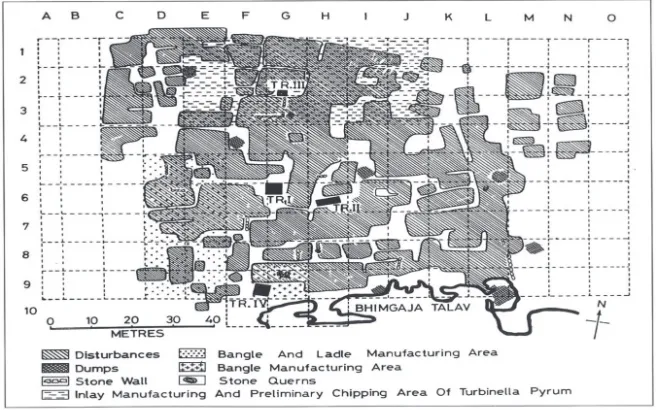
The entire site was put on a grid plan of 10 × 10 metres square (Fig. 3). Each square was examined for artefacts and craft indicators. On the basis of this survey, we delineated four different localities within the site where shells were processed. One such area was near the north western periphery of the mound. Here, the Harappan shell workers would have chipped
Turbinella pyrum as a preliminary stage to
[image:4.612.142.472.526.731.2]perforating the tip of the apex of the gastropod so that the internal septa could be loosened. These hollow shells would then be sawed into rough circlets. However, the manufacturing waste of subsequent stages was not recovered from this area. This implies that, as in Mohenjodaro, the hollow shells were sawn elsewhere. Ethnographic parallels of shell-working in Bengal also indicate that the task of sawing the malodorous shell was done in a segregated area, away from the site of habitation.
A second concentration of shell material was found close to the northern side of the settlement. A special type of debris consisting of the waste products of inlay work, together with a few finished and unfinished inlay pieces, was recovered. From these, it was inferred that inlay pieces might have been produced here from the shell waste.
A third concentration of shells is located on the south western boundary of the site, towards the lake. In this part of the mound, Chicoreus
ramosus waste, discarded during ladle making,
and sawn shell sections used in the manufacture of ladles were recovered. This waste may also have been produced when workers made bangles from
murex. Murex is easily identifiable by the
unperforated sawn shell apexes and interior portions available in the area.
The fourth concentration was a dump, spread in an area of 1.3 × 1 metres, consisting of 714 sawn columellae, 430 outer margins of lips, and 11 apex portions of Turbinella pyrum (Fig. 4). These fragments are similar to those made when shells are cut for bangles. Both the outer lip portion and columella of Turbinella pyrum were found here, for further processing into beads and inlay. However, the absence of inlays, beads, or their waste in this dump suggests that only bangles were manufactured in this area. The discarded
shell fragments found in a neat pile were most likely saved to be taken to another workshop, to be reworked into beads and inlay pieces. Kenoyer, who has the experience of working at Nageshwar as well as at Mohenjodaro is of the opinion that the quantity of columellas found in this dump at Nageshwar are much more than those reported from the entire site of Mohenjodaro (Kenoyer, 1984). This is a very significant observation and points towards the intensity of shell manufacturing being carried out at this small rural Harappan site. The subsequent excavation in the nearby area revealed another neatly preserved heap of 413 columella of Turbinella pyrum on a rammed floor, further substantiated the above observation. Inferences drawn on the basis of analytical study of surface site scatters were supported by the material remains recovered from two trenches during the subsequent excavation carried out at the site
[image:5.612.126.487.116.289.2]Based on a comparative study of ceramics and radiocarbon dates available from other sites, the Harappan shell-working settlement at Nageshwar may be assigned to the second half of the 3rd millennium BCE. The presence of a cubical agate weight, terracotta triangular cakes, toy cart frames, wheels, and bangles, besides a few carnelian, faience, and steatite beads also support this date for Nageshwar.
258 INDIAN JOURNAL OF HISTORY OF SCIENCE
2.1.2 Shell Industry
The position of a five-fathom line in the Pindara and Poshitra bays indicates that the sea is very shallow here along the coastline. The analysis of gastropods recovered from Nageshwar indicated that Turbinella pyrum shells collected for bangle making were mostly obtained from deep waters of the sea. Such shells are devoid of bore holes. The preference for such shells, though the process of their acquisition was time consuming and laborious, reflects on the aesthetic taste of the bangle manufacturing craftsmen of Nageshwar. On the contrary the gastropods found near the shore and the coral reefs are often interlaced with boreholes made by organisms like the diona sponge. Majority of Chicoreus ramosus shells used for ladle and bangle making show wormholes, which suggests that they were collected from rocky areas and coral reefs at low tide. It appears that the craftsmen may have used boats to collect fresh gastropods from deep waters of the sea. To make the boats, they may have used a 4–5 metre tall, thick, tough, hollow, tubular aquatic plant known as baru (Sorghum hallpensis), which even today grows in abundance in the BhīmgajaTālāv (Fig. 5). Baru is buoyant and ideal for crafting small seafaring vessels, as has been demonstrated by Thor Heyerdahl through his successful Tigris expedition (Heyerdahl, 1981). Such vessels, apart from collecting shells, might
also have been used for transporting raw material as well as finished goods to markets in the Indus delta and beyond. In the 3rd millennium BCE,
because of high sea level, the Great Rann and Little Rann of Kachchh formed an inlet of the Arabian Sea. This inlet directly connected the Indus delta with the Gulf of Kachchh and was more like a lake – it was calm, placid, and safe for small rafts. This direct link between Nageshwar and the Indus delta was perhaps responsible for the success of the Harappan craftsmen at Nageshwar.
A large collection of finished shell bangle pieces and their debitage suggests that basically Nageshwar was a bangle manufacturing centre. Most of the finished bangles have a chevron (V) motif. Bangles with this mark have been reported from almost all sites associated with the Harappan culture. The shell workers used special stone tools to finish the bangles such as whetstones with smooth-shallow circular depressions, and tapering cylindrical stones, varying in diameter from 4 to 7 centimetres, meant for smoothening and polishing sharp-cuts on shell bangles, have been reported from the site.
[image:6.612.129.489.568.731.2]All this data allowed the excavation team to reconstruct some of the salient features of Nageshwar’s shell industry. A group of divers must have been engaged in collecting shells from the sea. These shells were then passed on to specialist craftsmen to make various shell objects. The
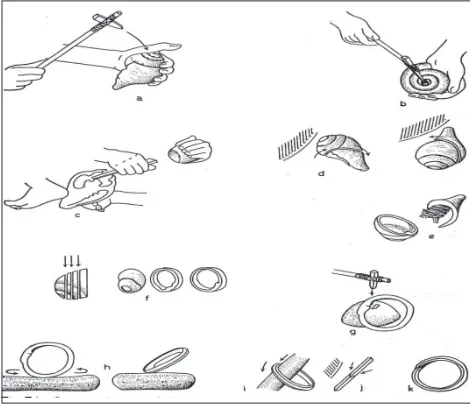
finished products – bangles, for example – underwent several stages of manufacturing, from preliminary chipping for perforation of the apex
of Turbinella pyrum, loosening of internal septa,
cutting into rough circlets, grinding and polishing, to the final incision of the chevron motif (Fig. 6). Beside bangles, a considerable quantity of ladles made from Chicoreus ramosus was obtained from Nageshwar. In ladle making also, all the exterior spins were first sawn or chipped off. A diagonal cut was then made from the top of the main whorl extending around both sides of the shell and eventually reaching the narrow anterior end. Thereafter, a handle was formed by making two parallel longitudinal cuts from the anterior tip towards the main body whorl and thus a rough ladle was detached from the body of the shell. By repeating the same process on the remaining half of the shell, a second but smaller ladle could also be produced (Fig. 7). Likewise, waste fragments, particularly the outer lip of Turbinella pyrum and fragments of Chicoreus ramosus were used to make various flat geometric inlay decorations for wooden door frames, furniture, and perhaps even for clay plastered house walls.
The main body of data obtained from the Nageshwar excavation thus suggests that the
proximity of bays rich in a particular variety of marine gastropods, availability of sweet water round the year in an area where the subsoil water is brackish, a margin of fertile soil along the border of Bhīmgaja Tālāv for agriculture, and the thick growth in the lake of the aquatic plant used to make small seafaring vessels, appear to have sustained the Harappan shell-working community for a considerable period of time (Sonawane, 2004, p.20).
2.2 Bagasra
Gola Dhoro, the Harappan mound at
[image:7.612.314.552.114.349.2]Bagasra (23°03′30′′ N and 70°37′10′′ E) located on the south eastern coast of the Gulf of Kachchh in Maliya Taluka of Rajkot district, Gujarat, is another most important Mature Harappan settlement (Sonawane et al., 2003). It is hardly a kilometre from the present seashore, making it a coastal settlement in the real sense. This fortified settlement was well placed to exploit the natural resources such as marine gastropods and semi-precious stones available in the vicinity of the site. Significantly, the economy of this settlement was Fig. 6. Sequential stages of shell bangle manufacture from
[image:7.612.62.297.521.723.2]T. pyrum gastropods
260 INDIAN JOURNAL OF HISTORY OF SCIENCE
based on craft production and trade in ornamental and utilitarian items. Shell working was one of the most vigorously pursued craft activities at the site. Several fragments of shell bangles of different sizes and cross sections, ladles, inlays, beads, pendants, rings, and a large amount of shell waste such as pieces of shell columella, lip margins, and micro-fractions have been reported from the site during the large scale excavations carried out from 1996 -2005. A large number of intact Turbinella
pyrum shells have been found stored in various
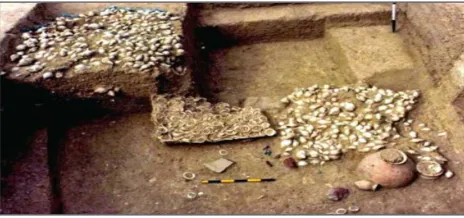
localities within the walled area of the settlement. Therefore, it is apparent that there were specific workshops at the site specializing in the manufacture of shell objects. The excavation at one of the workshops revealed a shell cutting area between the two huge piles of unused Turbinella
pyrum shells. Preliminary observations of these
two shell piles revealed that one of them had hundreds of the shells that were either undersized or worm-eaten. This indicates that the shell-cutters of Bagasra separated shells as per their quality. It appears that, unlike Nageshwar, the shell cutters were perhaps not personally involved in the seasonal collection of shells. Tidal mud flats in the vicinity of Bagasra, may have been the source of edible shells and smaller gastropods; but the larger ones must have been sourced from the coral reefs of the Jamnagar coast. One of the workshops found in a roughly rectangular structure revealed several sawn shell circles, unpolished and polished bangles mostly of Turbinella pyrum (Fig. 8).
Bangles are the most popular craft item and are generally made from Turbinella pyrum
shells, having sub- triangular or pentagonal cross section and a prominent Chevron “V” mark. They show great variation in their diameter as well as in their breadth. In addition to these a few very broad bangles with ribbed decoration are found in the excavation. They are 2.5 to 3 cm broad and interestingly one of these shows a faintly incised chevron like pattern on it. Other species of gastropods found at the site are Chicoreus
ramosus, Fasciolaria trapezium and Lambis sp .Of
these, the first three are believed to have been used for making bangles, ladles and inlay pieces (Fig. 9). Although a few finished and broken ladles were recovered, there are no indications of ladle manufacture from Chicoreus ramosus at the site. One of the large shells found in a clay bin shows a very fine saw cut mark passing diagonally round the shell, probably marked for sawing off a circlet. The recovery of ground and exhausted pieces of columella along with one tubular drill waste and a few ring blanks clearly suggest that some amount of reprocessing of Turbinella pyrum columella must have been carried out at the settlement, on a small scale.
Large, pear-shaped, black-slipped jars, which are believed to have been used by the Harappans for overseas transportation of goods and bear graffiti in Harappan script, have been discovered at Bagasra. Similar vessels with graffiti have been reported from a number of 3rd
[image:8.612.316.550.117.210.2] [image:8.612.64.296.622.731.2]millennium BCE Bronze Age sites in the Oman peninsula. Clay-matching analysis of the black-slipped jars found in Oman by French archaeologists has indicated that these jars have Fig. 8. Shell workshop at Bagasra
their origin in the Indian subcontinent. Hence the black-slipped jar sherds discovered at Bagasra are indicators of the trade contact of the Harappans with the Oman peninsula.
2.3 Nagwada
The archaeological site of Nagwada (23°18′ N and 71°42′ E) is situated on a sand dune, locally known as Godh, in the jurisdiction of Nagwada village in Dasada Tāluka of Surendranagar District in North Gujarat . It is one of the major Harappan settlements excavated from 1985 to 1989, located on the eastern margin of the Little Rann of Kachchh (Hegde et al. 1988; 1990).Though the site was primarily engaged in stone bead making, but it has brought to light ample evidence for the production of specific shell objects also. The shell industry at Nagwada revealed a range of shell artefacts and their manufacturing waste. No workshop such as that of Bagasra was recovered from this site. Basically, three species of marine gastropods appear to have been exploited by the shell cutters of Nagwada include Turbinella pyrum, Puglina buchephala
and Chicoreus ramosus. A variety of shell artefacts
have been discovered in different stages of production. From the available data, it appears that only cutting and polishing of shell objects was carried out here, and primary dressing of gastropods was done elsewhere. Unlike Nageshwar, debris such as the apex and lip margins of gastropods was not found at Nagwada. Here too, the most common shell products were bangles made from Turbinella pyrum gastropods. The sequence and technique of manufacture of bangles and ladles more or less remained the same as has been discussed earlier. The site has also revealed a large number of simple as well as multiple grooved rings and their associated manufacturing waste. Here the craft indicators of ring production are higher than those reported from any other Harappan site in India and Pakistan. In addition to manufacture of bangles
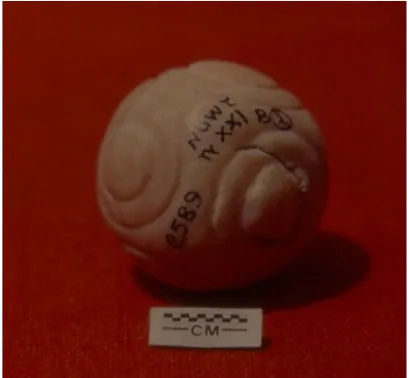
and rings, a large number of shell items were reported from Nagwada. These include button seals, broken handle of a ladle, a pendent and beads. However, the most fascinating discovery is a solid spherical object, made of Turbinella
pyrum columella decorated with a set of incised
double concentric circles on six sides (Fig 10). Such objects have not been reported from any other Indian site prior to this, but similar discoveries have been made in Mohenjodaro and other sites in Pakistan. Recently Dholavira has also yielded identical fascinating shell objects, which may be compared with the Nagwada find. Recovery of chisel and sawblade of copper during the excavations at Nagwada, though rare, suggested their association in different stages of manufacturing process of shell objects. For further details on shell working at Nagwada refer exhaustive article by Bhan and Gowda (2003).
3. CONCLUSION
[image:9.612.328.533.117.306.2]Similar evidences of shell working has been reported from other Harappan sites such as Shikarpur, Kuntasi, Lothal, Rangpur, Surkotada, Dholavira and other sites in Gujarat suggesting the importance of this craft in the Harappan economy in general and Gujarat in particular. There are ample archaeological and historical
262 INDIAN JOURNAL OF HISTORY OF SCIENCE
evidences to show continuity for the manufacture and use of shell ornaments during the subsequent cultural periods of Indian history. However, at present the tradition of producing bangles and other ornaments from Turbinella pyrum is found surviving in the Bengali speaking regions of Eastern India only. This situation provides a unique glimpse of what apparently was a more widespread custom during the Early Historic and Medieval periods. The tribal women of Santhal and Bhil communities wear conch bangles for their protective qualities and they can be worn by even unmarried girls. Hindu women, however, only wear these bangles after marriage. These bangles are known as shakapola. Wearing shell bangles is considered as the saubhāgya lakaa.
The practice of wearing shell ornaments is not only confined to women but men often wear a simple conch shell finger ring or tie an amulet of shell around their arm (Kenoyer, 1983, pp. 306-399). Thus the custom of wearing shell ornaments retained the age old tradition in keeping the shell industry alive (Sonawane, 2011).
BIBLIOGRAPHY
Bhan, K K and Kenoyer, J M. Nageshwar, an Industrial Centre of Chalcolithic Period, Purātattva 12 (1980– 81):115-20
Bhan, K K and Gowda, Dakshayini. Shell working at Nagwada (North Gujarat) with Special Reference to Shell Industries of the Harappan tradition in Gujarat, Man and Environmenr, 28.2 (1981):51-80.
Hegde, K T M; Bhan, K K; Sonawane, V H; Krishnan, K and Shah, D R. Excavation at Nageshwar, Gujarat: A Harappan Shell Working Site on the Gulf of Kutch,
Maharaja Sayajirao University Archaeology Series No. 18, Baroda, 1992.
Hegde, K T M; Sonawane, V H; Shah, D R; Bhan, K K; Ajithprasad, P; Krishnan, K and Prathapchandran, S. Excavation at Nagwada-1986 and 1987: A Preliminary Report, Man and Environment 10 (1988):55-65. Hegde, K T M; Sonawane, V H; Bhan, K K; Ajithprasad, P
and Krishnan, K. Excavation at Nagwada-1987-88: A Preliminary Report, in N. C. Ghosh and Subrata Chakrabarti (ed), Adaptation and Other Essays: Proceedings of the Archaeological conference, 1988, Research Publications,Vishva-Bharti, Santiniketan, 1990, pp. 191-195.
Heyerdahl, T. The Tigris Expedition, New York, 1981. Kenoyer, J M. Shell Working Industries of the Indus
Civilization: An Archaeological and Ethnographic Perspective, Ph.D. Dissertation, University of California at Barkeley, 1983.
Kenoyer, J M. Shell Industries at Mohenjo-daro, Pakistan, in Interim Report, Vol. 1 (M Jansen and G Urban, eds), Aachen:RWTH-IsMEO, Rome, 1984, pp. 99-115. Sonawane, V H. Fresh Light on the Specialised Crafts of
the Harappans in Gujarat, in V. N. Misra (ed), The Eastern Anthropologist (Indus Civilizatiin Special Number) 45.1-2, (1992):155-72.
Sonawane, V H. Nageshwar: A Centre of Harappan Shell Craft in Saurashtra, Marg, 55:3 (2004):15-25. Sonawane, V H. The Harappan Scenario in Gujarat,
Proceedings of the International seminar on How Deep are the Roots of Indian Civilization? An Archaeological and Historical Perspective, Vivekananda International Foundation, New Delhi, 2011, pp. 202-22.