ORIGINAL RESEARCH
Evaluation of Cervical Myelopathy Using
Apparent Diffusion Coefficient Measured by
Diffusion-Weighted Imaging
T. Sato T. Horikoshi A. Watanabe M. Uchida K. Ishigame T. Araki H. Kinouchi
BACKGROUND AND PURPOSE: Intramedullary high signal intensity on T2-weighted imaging was fre-quently observed in patients with CSM, although this finding does not well correlate with severity or prognosis of CSM. Instead of this nonquantitative information, another measure for CSM is desired. The work was focused primarily on assessing the relationships between ADC values and clinical and radiologic severity for the diagnosis of CSM.
MATERIALS AND METHODS:The relationship between ADC values measured in the spinal cord at 322 intervertebral levels of 66 patients and clinical factors were analyzed.
RESULTS: ADC values in the spinal cord significantly increased with the degree of spinal cord compression and decreased with time after decompression surgery. Patients with higher ADC values had lower preoperative JOA scores and tended to show poorer clinical recovery.
CONCLUSIONS:ADC values appear to indicate the severity of spinal cord compression and clinical recovery after decompression surgery, so spondylotic myelopathy may partly be predicted preopera-tively by using ADC values.
ABBREVIATIONS:CSM ⫽ cervical spondylotic myelopathy; JOA ⫽ Japanese Orthopaedic Association
C
SM is the most common cause of spinal cord dysfunction in the middle-aged and elderly population. CSM is caused by chronic compression of the spinal cord by surrounding bony or ligamentous structures. Surgical decompression is generally considered if the symptoms affect daily life, but early surgical intervention is thought to be more effective. There-fore, early detection may be the key to minimize postoperative sequelae.Neuroimaging methods, usually axial and sagittal MR im-aging, can provide reliable information about spinal cord compression, and more than half of patients with CSM show intramedullary high signal intensity on T2-weighted imag-ing,1mainly in the spinal gray matter, but the exact mecha-nism remains unclear.1-10Kinetic factors of the spine should also be taken into account, so detection of high T2 signal in-tensity in the spinal cord of patients with CSM but no prom-inent spinal cord compression on MR imaging implies the presence of compression during spinal movement. However, the absence of high intensity does not exclude the presence of myelopathy or pathologic changes.6Patients with high T2 sig-nal intensity areas especially in multiple segments often had poorer outcome3,4but not always,7and patients with persis-tent high T2 signal intensity after decompression surgery achieved clinical recovery similar to that in patients with re-duced high intensity. Therefore, such T2 signal-intensity
changes might reflect both reversible and irreversible patho-logic changes,2but the relationship between this signal inten-sity change and clinical severity or improvement remains un-clear. Detection of myelopathic changes before any T2 signal-intensity increase could provide a useful way to screen for subclinical myelopathic disorders and to evaluate the severity of myelopathy.11
ADC measured by DWI provides information about the microstructural characteristics of water diffusion in biologic tissue.8ADC is proportional to the local tissue water mobility, which is strongly affected by molecular viscosity, membrane permeability between the intracellular and extracellular com-partments, and the directionality of structures that impede or enhance water mobility.12ADC values increase in the presence of damage to the tissue microvasculature and subsequent va-sogenic edema,13because edema reduces the viscosity of inter-stitial fluid and increases extracellular volume. Reduced cell volume after neuronal loss or cystic degeneration of the spinal cord will result in an overall increase in ADC because water molecules move more freely in the extracellular space than in the intracellular space.
An increased ADC value was reported to relate to internal changes in the early stages of chronic spinal cord compression, with higher sensitivity than T2-high intensity.14
The present study investigated our hypothesis that ADC measured by DWI of the spinal cord can provide objective and reliable indications of the severity of CSM, by evaluating the relationship between ADC values and other clinical factors.
Materials and Methods
This prospective study included 66 consecutive patients in our clinic with CSM who were candidates for decompression surgery with DWI from January 2007 to June 2008. DWI was planned before surgery, 7
Received March 7, 2011; accepted after revision May 28.
From the Departments of Neurosurgery (T.S., T.H., A.W., M.U., H.K.) and Radiology (K.I., T.A.), Interdisciplinary Graduate School of Medicine and Engineering, University of Yama-nashi, Chuo, YamaYama-nashi, Japan.
Please address correspondence to Takashi Sato, MD, Department of Neurosurgery, Inter-disciplinary Graduate School of Medicine and Engineering, University of Yamanashi, 1110 Shimokato, Chuo, Yamanashi 409-3898, Japan; e-mail: [email protected]
days after surgery in the early postoperative stage, and⬎6 months after surgery in the follow-up stage.
This study was approved by the institutional review board of the Interdisciplinary Graduate School of Medicine and Engineering, Uni-versity of Yamanashi.
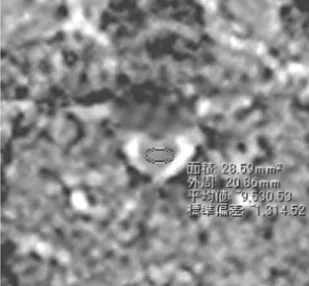
MR imaging was performed with a 1.5T system (Signa Excite; GE Healthcare, Milwaukee, Wisconsin) and 3-mm-thick sections on an axial spin-echo single-shot echo-planar system. DWI was obtained by using the array spatial sensitivity encoding technique with the follow-ing conditions: reduction factor⫽2, TR⫽14,000 ms, TE⫽81.9 ms, FOV⫽24⫻24 cm, image matrix⫽128⫻128, 6 noncolinear gra-dient directions, andb⫽1000 s/mm2. Mean ADC was calculated in regions of interest placed in the center of the spinal cord at the C2–3, C3– 4, C4 –5, C5– 6, and C6 –7 intervertebral levels on ADC map im-ages. The regions of interest covered most of the cross-section of the spinal cord excluding the CSF space (Fig 1). The mean of ADC values in the 5 intervertebral levels and the maximum value were used for patient-based analysis. Segments with severe signal-intensity loss due to artifacts or with an undetermined spinal cord due to severe defor-mity were excluded.
Spinal cord compression was graded on the basis of axial spin-echo MR imaging of the intervertebral levels and categorized as fol-lows: type 0, preservation of CSF surrounding the spinal cord and no spinal cord compression; type I, no visualization of CSF space ventro-dorsal to the spinal cord but no deformity of the spinal cord; type II, mild deformity of the spinal cord caused by compression; and type III, marked deformity (flattening) of the spinal cord (Fig 2). The most severe compression type in each patient was used for analysis. In-tramedullary high T2 signal intensity was defined as a high-intensity area in the spinal cord observed in both axial and sagittal images.
Neurologic status was assessed with the JOA scoring system for CSM (On-line Table) before and 6 months after surgery. The recovery rate of the JOA score was calculated by using the following formula: (postoperative JOA score⫺preoperative JOA score / 17⫺ preoper-ative JOA score)⫻100.15
The relationships between the ADC value and preoperative JOA score, the JOA score recovery rate, the compression grade, and the presence of intramedullary high T2 signal intensity were assessed. The analysis was also applied to limited patients treated with French-door laminoplasty by using a ceramic spacer inserted between laminae. This method required no metal apparatus, which causes considerable artifacts on DWI. These patients were followed up with MR imaging for⬎6 months because the MR imaging signal intensity is frequently obscured in patients with anterior fusion with metal cages. The
Mann-WhitneyUtest or a pairedttest was used for statistical exam-ination, and aPvalueⱕ.05 was significant.
Results
Preoperative MR imaging was performed in 66 patients (42 men and 24 women) from 40 to 87 years of age (mean, 65.8⫾11.3 years). MR imaging was performed in 59 pa-tients in the early postoperative stage and in 48 papa-tients in the follow-up stage. Segments with severe signal-intensity loss due to artifacts or with an undetermined spinal cord due to severe deformity were excluded. Consequently, 72 segments were excluded from the postoperative assess-ment. Finally, MR images were analyzed for 322 segments of 66 patients in the preoperative stage, 272 segments of 59 patients in the early postoperative stage (mean, 6.88⫾2.61 days), and 213 segments of 48 patients in the follow-up stage (mean, 7.65⫾2.41 months). Thirty-five patients with laminoplasty were successively followed with MR imaging for⬎6 months after surgery.
Radiologic Factors and ADC Values
ADC values were measured twice independently by 2 examin-ers, and excellent reproducibility was obtained with a correla-tion coefficient of 0.949 (P⬍.0001).
Preoperative ADC values ranged from 0.315 ⫻10⫺3 to 1.891⫻10⫺3mm2/s (mean, 0.813⫾0.254⫻10⫺3mm2/s). The mean ADC value was 0.723⫾0.191⫻10⫺3mm2/s in the early postoperative stage and 0.691⫾0.145⫻10⫺3mm2/s in the follow-up stage, showing a significant difference between the preoperative and the follow-up stages (P⬍.0001) (Table 1).
The grading of spinal cord compression was as follows: 140 type 0 segments, 75 type I, 74 type II, and 33 type III. ADC values tended to increase with cord compression, and a signif-icant difference was seen between type 0 and other types. ADC values decreased after surgery in all types except type III. Ac-cordingly, the differences in ADC values between types were reduced in the follow-up stage except between types 0 and II (Table 1).
Intramedullary high T2 signal intensity was detected in 48 segments preoperatively, and occurrence increased with the severity of compression (Table 2). The mean ADC value in the segments with high T2 signal intensity was 1.002⫾0.305⫻ 10⫺3mm2/s, and it was significantly higher than in those with-out high T2 signal intensity at 0.775⫾0.126⫻10⫺3mm2/s. The mean ADC value was significantly decreased in the fol-low-up stage, even in the segments with high T2 signal inten-sity, and no significant difference was found between groups with and without high T2 signal intensity in the follow-up stage (Table 3).
Neurologic Status and ADC values
The mean preoperative JOA score of patients was 11.1⫾3.6. The JOA score tended to decrease with the severity of com-pression and was significantly different between types I and III before surgery (Table 4). The mean JOA score significantly increased after surgery in all types. Recovery rates in the early postoperative stage tended to reflect the severity of preopera-tive spinal compression, but no significant difference was found. Patients with intramedullary high T2 signal intensity Fig 1.Axial view of DWI. The mean ADC was calculated in the region of interest. The
region of interest covered most of the cross-section of spinal cord, excluding the CSF space.
SPINE
ORIGINAL
[image:2.594.92.247.45.188.2]had lower preoperative JOA scores, which were related to lower JOA recovery rates in the early postoperative stage (Ta-ble 4).
Patients with a preoperative ADC value ofⱖ0.9⫻10⫺3
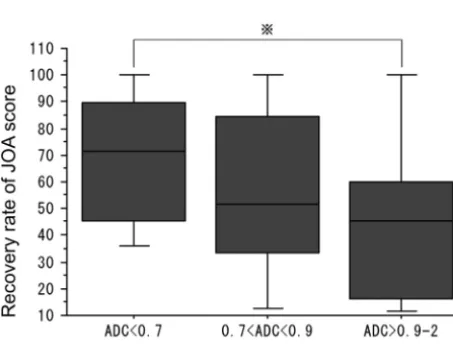
mm2/s showed significantly lower preoperative JOA scores than those with preoperative ADC values of⬍0.9 ⫻10⫺3 mm2/s (Fig 3). A relationship was found between preoperative ADC values and postoperative JOA scores or recovery rates. Among the 35 patients with laminoplasty, patients with a pre-operative ADC of⬍0.7⫻10⫺3mm2/s had a better recovery rate than patients with a preoperative ADC ofⱖ0.9⫻10⫺3 mm2/s. However, the difference was not significant (Fig 4).
We also evaluated the relationship between the maximum ADC values of each patient and other clinical factors. How-ever, there was no significant difference.
Discussion
[image:3.594.133.453.44.345.2]The present study demonstrated the relationship between the degree of spinal compression and the increase of ADC values Fig 2.Grades of spinal cord compression on MR imaging. Type 0 indicates no compression; type 1, disappearance of CSF space; type 2, mild compressive deformity of spinal cord; and type 3, marked deformity (flattening) of the spinal cord.
Table 1: Chronologic changes of mean ADC values in each compression type
Type Preoperative Stage
Postoperative Stage (1 wk)
Follow-Up Stage (6 mo)
0 0.704⫾0.142 (n⫽140) 0.692⫾0.134 (n⫽114) 0.648⫾0.143 (n⫽84)a
I 0.833⫾0.228 (n⫽75)b 0.807⫾0.171 (n⫽63)c 0.676⫾0.093 (n⫽49)d
II 0.939⫾0.330 (n⫽74)b 0.880⫾0.238 (n⫽67)e 0.763⫾0.150 (n⫽57)f,g
III 0.948⫾0.289 (n⫽33)b 0.908⫾0.197 (n⫽28)h 0.791⫾0.153 (n⫽23)
Total 0.813⫾0.254 (n⫽322) 0.723⫾0.191 (n⫽272) 0.691⫾0.145 (n⫽213)i
Note:—Values are expressed as mean (⫻10⫺3 mm2/s). a
P⫽.01 versus type 0 in the preoperative stage.
bP⬍.0001 versus type 0 in the preoperative stage. c
P⫽.0008.
dP⫽.0015 versus type I in the preoperative stage. e
P⬍.0001.
fP⫽.004 versus type 0 in the follow-up stage. g
P⫽.009 versus type II in the preoperative stage.
hP⫽.005 versus type 0 in the postoperative stage. i
P⬍.0001 versus total value in the preoperative stage.
Table 2: Type of spinal cord compression and occurrence of high T2 signal intensity
Type ISI (⫹)
0 (n⫽140) 8 (5.7%)
I (n⫽75) 8 (10.7%)
II (n⫽74) 14 (18.9%)a
III (n⫽33) 18 (54.5%)b
Total (n⫽322) 48/322 (14.9%)
Note:—ISI indicates increased signal intensity.
a
P⫽.004.
[image:3.594.51.536.392.472.2] [image:3.594.54.286.580.644.2]in patients with CSM. Similarly, an increase of ADC values was measured by using a pulse-field gradient multishot echo-pla-nar imaging sequence in a small series of patients with spinal narrowing.13Previous studies of spinal lesions have indicated that the ADC value measured by DWI has superior sensitivity to intramedullary high signal intensity on T2-weighted MR imaging for the detection of CSM14,16and that ADC values were higher in a narrowed spinal canal compared with a nor-mal one.16
[image:4.594.57.534.61.115.2]Chronic ischemia of the spine is speculated to cause in-creased permeability of the cell membrane. In addition, chronic compression of the spine is suggested to cause changes in the CSF circulation in the subarachnoid space and cause the fluid to enter the spinal parenchyma, resulting in the forma-tion of microcysts.9Chronic compression may lead to changes in the myelin of the spinal cord, and edematous change may occur in the early stage of spondylosis.17Therefore, increased Table 3: Chronologic changes of mean ADC values in high T2 signal intensity
Preoperative Stage
Postoperative Stage (1 wk)
Follow-Up Stage (6 mo)
ISI (⫹) 1.002⫾0.305 (n⫽48) 0.905⫾0.255 (n⫽41) 0.782⫾0.147 (n⫽32)a
ISI (⫺) 0.775⫾0.126 (n⫽274)b 0.760⫾0.178 (n⫽231)c 0.674⫾0.141 (n⫽181)d
Total 0.813⫾0.254 (n⫽322) 0.723⫾0.191 (n⫽272) 0.691⫾0.145 (n⫽213)
Note:—ISI indicates increased signal intensity. Values are expressed as mean (⫻10⫺3mm2/s). a
P⫽.02 versus ISI(⫹) group in the preoperative stage.
bP⬍.0001 versus ISI(⫹) group in the preoperative stage. c
P⫽.001 versus ISI(⫹) group in the postoperative stage.
[image:4.594.51.534.177.294.2]dP⬍.0001 versus ISI(⫺) group in the preoperative stage.
Table 4: Chronologic changes of mean JOA score and compression group and high T2 signal intensity
Preoperative Postoperative (1 wk)
Recovery
Rate Follow-Up (6 mo)
Recovery Rate
Type 0 13.7⫾2.75 (n⫽4) 16.8⫾0.35 (n⫽3) 83.4⫾23.5 17 (n⫽2) 100
Type I 14.1⫾3.50 (n⫽8) 15.9⫾2.17 (n⫽7)a 75.5⫾28.4 17 (n⫽4)b 100
Type II 11.1⫾3.44 (n⫽27) 14.1⫾2.58 (n⫽25)c 57.5⫾29.8 14.9⫾2.16 (n⫽21)d 72.7⫾31.4
Type III 9.9⫾3.47 (n⫽27)e 13.2⫾3.36 (n⫽24)f 50.3⫾28.6 16.1⫾1.50 (n⫽21)g 84.3⫾19.1
Total 11.0⫾3.6 (n⫽66) 14.0⫾2.9 (n⫽59) 15.7⫾1.9 (n⫽48)
ISI(⫺) 11.9⫾3.54 (n⫽34) 15.2⫾1.95 (n⫽30)h 66.2⫾27.6 16.4⫾0.97 (n⫽20)i 86.6⫾21.6
ISI(⫹) 10.2⫾3.65 (n⫽32) 13.1⫾3.28 (n⫽29)j,k 49.2⫾29.9l 15.5⫾1.85 (n⫽28)m 77.6⫾28.2
Total 11.0⫾3.6 (n⫽66) 14.0⫾2.9 (n⫽59) 15.7⫾1.9 (n⫽48)
Note:—ISI indicates increased signal intensity. Values are expressed as means.
aP⫽.02. b
P⫽ ⬍.0001 versus type 1 in the preoperative state.
cP⫽.003. d
P⫽.02 versus type II in the preoperative stage.
eP⫽.007. f
P⫽.0002.
gP⫽.0001 versus type III in the preoperative stage. h
P⫽.0001.
iP⫽.0002 versus ISI(⫺) group in the preoperative state j
P⫽.009 versus the ISI(⫺) group in the postoperative stage.
kP⫽.004. l
P⫽.04 versus the ISI(⫺) group.
mP⫽.0001 versus ISI(⫹) in the preoperative stage.
Fig 3.The relationship between preoperative JOA scores and ADC values in all patients.
Patients with ADC values ofⱖ0.9⫻10⫺3mm2/s had lower JOA scores (P⫽.0085). Fig 4.Recovery rates of JOA scores and preoperative ADC values in 18 patients followed
for⬎6 months. Patients with an ADC of⬍0.7⫻10⫺3mm2/s tended to show better
recovery rates than those with an ADC of 0.9⫻10⫺3
mm2
[image:4.594.306.533.401.581.2] [image:4.594.53.279.408.578.2]ADC values suggest the presence of pathologic changes caused by chronic compression.
The present study found decreases in ADC values after de-compression of compressive myelopathy, which may imply that increased ADC values can be reversed, probably due to increased water in the extracellular space of the spinal cord. If the increase in ADC values is exclusively caused by cystic de-generation of the gray matter, such improvement seems quite likely. However, the mechanism of changes in ADC values must be complex, and more study is necessary.
On the other hand, a significant decrease of ADC values after decompression was not proved in type III. This may be due to irreversible change in the spinal cord in this type.
Clinical grades were significantly related to the preopera-tive ADC values in the present study, and patients with ADC values ofⱖ0.9 ⫻10⫺3mm2/s had lower preoperative JOA scores. Compression grades and the presence of high T2 signal intensity were also related to preoperative clinical grades. High T2 signal intensity was proved to be a predictive factor for a poorer recovery rate during the short postoperative period, but the correlation between preoperative ADC values and JOA recovery rate was not clear.
Aota et al14reported that ADC decreased in the level of maximal cord compression and increased in the adjacent area. We adopted the mean ADC value of 5 intervertebral levels, and consequently, such signal-intensity change might be underes-timated. They speculated that a reduced ADC value might be caused by vascular compromise with cellular swelling as the initial change in the spinal cord. The contour of the spinal cord was sometimes difficult to trace on an ADC map at maximal compression. If the ADC of surrounding structures such as bone or ligaments is contaminated, the ADC value may be apparently decreased, though such a decrease was not ob-served in our study.
Patients with laminoplasty and ADC values of⬍0.7⫻10⫺3 mm2/s tended to have better recovery rates than those with ADC values ofⱖ0.9⫻10⫺3mm2/s. These results suggest that measurement of preoperative ADC values can predict the functional outcome of patients with CSM. Lack of informa-tion about direcinforma-tional diffusivities in our study may make the relationship obscure, and further study by using directional diffusivities parallel and perpendicular to the cord may be nec-essary to confirm the conclusion.
Early detection of pathologic changes of the spinal cord is important to improve the surgical outcomes of patients with spondylosis. ADC values may be one of the diagnostic meth-ods to evaluate CSM.
Conclusions
We reported that ADC values were valuable factors for inter-pretation of the clinical severity of patients with CSM. ADC values tended to increase with cord compression and to de-crease after decompressive surgery. ADC values may indicate the severity of spinal cord compression and may predict clin-ical recovery after decompression surgery for spondylotic myelopathy.
References
1. Takahashi M, Yamashita Y, Sakamoto Y, et al. Chronic cervical cord compression: clinical significance of increased signal intensity on MR imag-ing.Radiology1989;173:219 –24
2. Bucciero A, Vizioli L, Carangelo B, et al.MR signal enhancement in cervical spondylotic myelopathy: correlation with surgical results in 35 cases.J Neu-rosurg Sci1993;37:217–22
3. Chen J, Lyu K, Lee T, et al.Intramedullary high signal intensity on T2-weighted MR images in cervical spondylotic myelopathy: prediction of prog-nosis with type of intensity.Radiology2001;221:789 –94
4. Ferna´ndez de Rota JJ, Meschian S, Ferna´ndez de Rota A, et al.Cervical spondy-lotic myelopathy due to chronic compression: the role of signal intensity changes in magnetic resonance images.J Neurosurg Spine2007;6:17–22 5. Haupts M, Hann J.Further aspects of MR-signal enhancements in correlation
to clinical and cerebrospinal fluid (CSF) findings. Neuroradiology 1988;30:545– 46
6. Mamata H, Jolesz F, Maier S.Apparent diffusion coefficient and fractional anisotropy in spinal cord: age and cervical spondylosis-related changes.J Magn Reson Imaging2005;22:38 – 43
7. Matsumoto M, Toyama Y, Ishikawa M, et al.Increased signal intensity of the spinal cord on magnetic resonance images in cervical compressive myelopathy: does it predict the outcome of conservative treatment?Spine (Phila Pa 1976)2000;25:677– 82
8. Schaefer PW, Grant PE, Gonzales RG.Diffusion-weighted MR imaging of the brain.Radiology2000;217:331– 45
9. Fischbein NJ, Dillon WP, Cobbs C, et al.The “presyrinx” state: is there a re-versible myelopathic condition that may precede syringomyelia?Neurosurg Focus2000;8:E4
10. Suri A, Chabbra R, Mehta V, et al.Effect of intramedullary signal changes on the surgical outcome of patients with cervical spondylotic myelopathy.Spine J2003;3:33– 45
11. Matsuda Y, Miyazaki K, Tada K, et al.Increased MR signal intensity due to cervical myelopathy: analysis of 29 surgical cases.J Neurosurg1991;74:887–92 12. Ries M, Jones R, Dousset V, et al.Diffusion tensor MRI of the spinal cord.Magn
Reson Med2000;44:884 –92
13. Castillo M, Arbelaez A, Fisher LL, et al.Diffusion-weighted imaging in patients with cervical spondylosis.Int J Neuroradiol1999;5:79 – 85
14. Aota Y, Niwa T, Uesugi M, et al.The correlation of diffusion-weighted mag-netic resonance imaging in cervical compression myelopathy with neurologic and radiologic severity.Spine2008;33:814 –20
15. Hirabayashi K.Expansive open-door laminoplasty for cervical spondylotic myelopathy.Jpn J Surg1978;32:1159 – 63
16. Demir A, Ries M, Moonen C, et al.Diffusion-weighted MR imaging with ap-parent diffusion coefficient and apap-parent diffusion tensor maps in cervical spondylotic myelopathy.Radiology2003;229:37– 43