Proceedings of the 57th Annual Meeting of the Association for Computational Linguistics, pages 6525–6538 6525
Distilling Translations with Visual Awareness
Julia Ive1, Pranava Madhyastha2 and Lucia Specia2
1DCS, University of Sheffield, UK
2Department of Computing, Imperial College London, UK
{pranava,l.specia}@imperial.ac.uk
Abstract
Previous work on multimodal machine transla-tion has shown that visual informatransla-tion is only needed in very specific cases, for example in the presence of ambiguous words where the textual context is not sufficient. As a conse-quence, models tend to learn to ignore this in-formation. We propose a translate-and-refine approach to this problem where images are only used by a second stage decoder. This ap-proach is trained jointly to generate a good first draft translation and to improve over this draft by (i) making better use of the target language textual context (both left and right-side con-texts) and (ii) making use of visual context. This approach leads to the state of the art re-sults. Additionally, we show that it has the ability to recover from erroneous or missing words in the source language.
1 Introduction
Multimodal machine translation (MMT) is an area of research that addresses the task of translat-ing texts ustranslat-ing context from an additional modal-ity, generally static images. The assumption is that the visual context can help ground the mean-ing of the text and, as a consequence, generate more adequate translations. Current work has fo-cused on datasets of images paired with their de-scriptions, which are crowdsourced in English and then translated into different languages, namely the Multi30K dataset (Elliott et al.,2016).
Results from the most recent evaluation cam-paigns in the area (Elliott et al., 2017; Barrault et al., 2018) have shown that visual information can be helpful, as humans generally prefer trans-lations generated by multimodal models than by their text-only counterparts. However, previous work has also shown that images are only needed in very specific cases (Lala et al., 2018). This is also the case for humans. Frank et al. (2018)
(see Figure 1) concluded that visual information is needed by humans in the presence of the fol-lowing: incorrect or ambiguous source words andgender-neutral wordsthat need to be marked for gender in the target language. In an experi-ment where human translators were asked to first translate descriptions based on their textual con-text only and then revise their translation based on a corresponding image, they report that these three cases accounted for 62-77% of the revisions in the translations in two subsets of Multi30K.
Ambiguities are very frequent in Multi30K, as in most language corpora. Barrault et al. (2018) shows that in its latest test set, 358 (German) and 438 (French) instances (out of 1,000) contain at least one word that has more than one translation in the training set. However, these do not always represent a challenge for translation models: of-ten the text context can easily disambiguate words (see baseline translation in Figure4(a)); addition-ally, the models are naturally biased to generate the most frequent translation of the word, which by definition is the correct one in most cases.
The need to gender-mark words in a target language when translating from English can be thought of as a disambiguation problem, except that the text context is often less telling and the frequency bias plays ends up playing a bigger role (see baseline translation in Figure4(c)). This has been shown to be a common problem in neural machine translation (Vanmassenhove et al.,2018; Font and Costa-Juss`a, 2019), as well as in areas such as image captioning (Hendricks et al.,2018) and co-reference resolution (Zhao et al.,2018).
Incorrect source words are common in
EN: Three children in football uniforms are playing football. DE: Drei Kinder in Fußballtrikots spielen Fußball.
PE: Drei Kinder in Footballtrikots spielen Football.
(a)Ambiguouswordfootballtranslated assoccer(Fußball)
EN: A baseball player in a black shirt just tagged a player in a white shirt.
DE: Ein Baseballspieler in einem schwarzen Shirt f¨angt einen Spieler in einem weißen Shirt. PE: Eine Baseballspielerin in einem schwarzen Shirt f¨angt eine Spielerin in einem weißen
Shirt.
(b)Gender-neutralwordplayertranslated as male player (Spieler)
EN: A woman wearing a white shirt works out on an elliptical machine. DE: Eine Frau in einem weißen Shirt trainiert auf einem Crosstrainer. PE: Eine Frau in einem weißen Pullover trainiert auf einem Crosstrainer.
[image:2.595.81.507.66.377.2](c)Inaccurate Englishwordshirtinstead ofsweaterorpullover
Figure 1: Examples of lexical and gender ambiguity, and inaccurate English description where post-edits (PE) required the image to correct human translation from English (EN) to German (DE).
required for out of vocabulary (OOV) words, i.e. correct words that are unknown to the model.
We propose an approach that takes into account the strengths of a text-only baseline model and onlyrefinesits translations when needed. Our ap-proach is based on deliberation networks (Xia et al.,2017) to jointly learn to generate draft trans-lations and refine them based on left and right side target context as well as structured visual informa-tion. This approach outperforms previous work.
In order to further probe how well our models can address the three problems mentioned above, we perform a controlled experiment where we minimise the interference of the frequency bias by masking ambiguous and gender-related words, as well as randomly selected words (to simulate noise and OOV). This experiment shows that our multi-modal refinement approach outperforms the text-only one in more complex linguistic setups.
Our main contributions are: (i) a novel ap-proach to MMT based on deliberation networks and structured visual information which gives state of the art results (Sections3.2and5.1); (ii) a frequency bias-free investigation on the need for visual context in MMT (Sections 4.2 and 5.2); and (iii) a thorough investigation on different
vi-sual representations for transformer-based archi-tectures (Section3.3).
2 Related work
MMT: Approaches to MMT vary with regards to how they represent images and how they in-corporate this information in the models. Initial approaches use RNN-based sequence to sequence models (Bahdanau et al., 2015) enhanced with a single, global image vector, extracted as one of the layers of a CNN trained for object classifica-tion (He et al.,2016), often the penultimate or fi-nal layer. The image representation is integrated into the MT models by initialising the encoder or decoder (Elliott et al.,2015;Caglayan et al.,2017; Madhyastha et al.,2017); element-wise multipli-cation with the source word annotations (Caglayan et al., 2017); or projecting the image representa-tion and encoder context to a common space to ini-tialise the decoder (Calixto and Liu,2017).Elliott and K´ad´ar(2017) andHelcl et al. (2018) instead model the source sentence and reconstruct the im-age representation jointly via multi-task learning.
(Bahdanau et al., 2015) on the output of the last convolutional layer of a CNN (Xu et al., 2015). The layer represents the activation of K dif-ferent convolutional filters on evenly quantised N ×N spatial regions of the image. Caglayan et al.(2017) learn the attention weights for both source text and visual encoders, while Calixto et al.(2017);Delbrouck and Dupont(2017) com-bine both attentions independently via a gating scalar, and Libovick´y and Helcl (2017); Helcl et al.(2018) apply a hierarchical attention distribu-tion over two projected vectors where the attendistribu-tion for each is learnt independently.
Helcl et al.(2018) is the closest to our work: we also use a doubly-attentive transformer architec-ture and explore spatial visual information. How-ever, we differ in two main aspects (Section 3): (i) our approach explores additional textual con-text through a second pass decoding process and uses visual information only at this stage, and (ii) in addition to convolutional filters we use object-level visual information. The latter has only been explored to generate a single global representation (Gr¨onroos et al., 2018) and used for example to initialise the encoder (Huang et al., 2016). We note that translation refinement is different trans-lation re-ranking from a text-only model based on image representation (Shah et al.,2016;Hitschler et al.,2016;Lala et al.,2018), since the latter as-sumes that the correct translation can already be produced by a text-only model.
Caglayan et al. (2019) investigate the impor-tance and the contribution of multimodality for MMT. They perform careful experiments by us-ing input degradation and observe that, specially under limited textual context, multimodal models exploit the visual input to generate better transla-tions.Caglayan et al.(2019) also show that MMT systems exploit visual cues and obtain correct translations even with typographical errors in the source sentences. In this paper, we build upon this idea and investigate the potential of visual cues for refining translation.
Translation refinement: The idea of treating machine translation as a two step approach dates back to statistical models, e.g. in order to im-prove a draft sentence-level translation by explor-ing document-wide context through hill-climbexplor-ing for local refinements (Hardmeier et al.,2012). It-erative refinement approaches have also been pro-posed that start with a draft translation and then
predict discrete substitutions based on an attention mechanism (Novak et al., 2016), or using non-autoregressive methods with a focus on speeding up decoding (Lee et al., 2018). Translation re-finement can also be done through learning a sep-arate model for automatic post-editing (Niehues et al.,2016;Junczys-Dowmunt and Grundkiewicz, 2017;Chatterjee et al.,2018), but this requires ad-ditional training data with draft translations and their correct version.
An interesting approach is that of deliberation networks, which jointly train an encoder and first and second stage decoders (Xia et al.,2017). The second stage decoder has access to both left and right side context and this has been shown to im-prove translation (Xia et al.,2017;Hassan et al., 2018). We follow this approach as it offers a very flexible framework to incorporate additional infor-mation in the second stage decoder.
3 Model
We base our model on the transformer archi-tecture (Vaswani et al., 2017) for neural ma-chine translation. Our implementation is a multi-layer encoder-decoder architecture that uses the
tensor2tensor1(Vaswani et al.,2018) library. The encoder and decoder blocks are as follows:
Encoder Block (E): The encoder block com-prises of 6layers, with each containing two sub-layers of multi-head self-attention mechanism fol-lowed by a fully connected feed forward neural network. We follow the standard implementation and employ residual connections between each layer, as well as layer normalisation. The output of the encoder forms the encoder memory which consists of contextualised representations for each of the source tokens (ME).
Decoder Block (D): The decoder block also comprises of 6 layers. It contains an additional sublayer which performs multi-head attention over the outputs of the encoder block. Specifically, decoding layer dli is the result of a) multi-head
attention over the outputs of the encoder which in turn is a function of the encoder memory and the outputs from the previous layer: AD→E =
f(ME, dli−1) where, the keys and values are the
encoder outputs and the queries correspond to the decoder input, and b) the multi-head self attention
1https://github.com/tensorflow/
which is a function of the generated outputs from the previous layer:AD=f(dli−1).
3.1 Deliberation networks
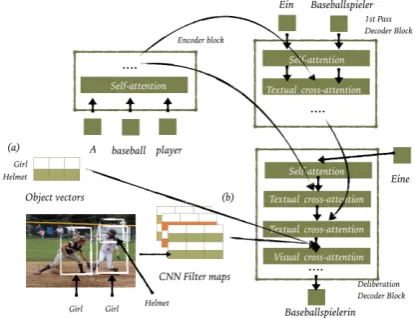
Deliberation networks (Hassan et al., 2018; Xia et al.,2017) build on the standard sequence to se-quence architecture to add an additional decoder block (in our case, with3 layers – see Figure2). The additional decoder (also referred to as second-pass decoder) is conditioned on the source and sampled outputs from the standard transformer de-coder (the first-pass dede-coder). More concretely, the second-pass decoder (D0) at layerd0l consists ofAD0 ,A
D0→E,AD0→D, where,AD0 andAD0→E
is similar to the standard deliberation architec-ture multi-head attention over the encoder memory and self attention respectively while, AD0
→D is
the multi-head attention over outputsOdfrom the
first-pass decoder (D) (AD→E = f(Od, d
0
li−1)).
2
In our experiments, we obtain samples as a set of translations from the first-pass decoder using beam-search. Given a translation candidate, Od
[image:4.595.75.283.413.572.2]consists of the first-pass decoder’s hidden layer be-fore softmax concatenated with the embeddings of the resultant words.
Figure 2: Our deliberation architecture: The second-pass decoder is conditioned on the source and samples output from the first-pass decoder. The second-pass de-coder has access to (a) the object based features repre-sented by embeddings, or (b) spacial image features.
3.2 Multimodal transformer & deliberation
Our multimodal transformer models follow one of the two formulations below for conditioning trans-lations on image information:
2In the implementation we used, the deliberation network trains 345M parameters, as compared to the Transformer with 210M parameters.
Additive image conditioning (AIC): A pro-jected image vector is added to each of the out-puts of the encoder. The projections matrices are parameters that are jointly learned with the model.
Attention over image features (AIF): The model attends over image features, as in Helcl et al. (2018), where the decoder block now contains an additional cross-attention sub-layer AD0
→V which attends to the visual information
(V). The keys and values correspond to the visual information.
Within the deliberation network framework, based on the previously discussed observation (Section1) that images are only needed in a small number of cases, we propose to add visual cross-attention only to the second-pass decoder block (see Figure2).
3.3 Image features
Motivated by previous work that indicates the importance of structured information from im-ages (Caglayan et al., 2017; Wang et al., 2018; Madhyastha et al., 2018), we focus on structural forms of image representations, including the spa-tially aware feature maps from CNNs and infor-mation extracted from automatic object detectors.
Spatial image features: We use spatial feature maps from the last convolutional layer of a pre-trained ResNet-50 (He et al., 2016) CNN-based image classifier for every image.3 These feature maps contain output activations for various filters while preserving spatial information. They have been used in various vision to language tasks in-cluding image captioning (Xu et al., 2015) and multimodal machine translation (Section 2). Our formulation for the integration of these features into the deliberation network is shown in Figure2, setup (b). We use the the AIF setup and refer to models that use the representation asatt.
Object-based image features: We use a bag-of-objects representation where the objects are obtained using an off-shelf object detec-tor (Kuznetsova et al., 2018) based on the Open Images dataset. This representations is a sparse
545-dimensional vector with the frequency of each (545) given object in an image. This is inspired by previous research that investigates the potential of object-based information for vision to language tasks (Mitchell et al.,2012;Wang et al.,2018). We
3Provided at http://statmt.org/wmt18/
use the the AIC setup and refer to models that use the representation assum.
Object-based embedding features: The bag-of-objects representations makes it hard to ex-ploit object-to-object similarity, since visual rep-resentations of different objects can be very dif-ferent. To mitigate this, we propose a simple ex-tension using bag-of-objectembeddings. We rep-resent each object using the pre-trained GLoVe-based (Pennington et al., 2014) 50-dimensional word vectors for their categories (e.g. woman). We use the the AIF based setup and refer to mod-els that use the representation as obj (Figure 2 setup (a)).
4 Experimental settings
4.1 Data
We build and test our MMT models on the
Multi30K dataset (Elliott et al., 2016). Each image in Multi30K contains one English (EN) description taken from Flickr30K (Young et al., 2014) and human translations into German (DE), French (FR) and Czech (Specia et al., 2016; El-liott et al.,2017;Barrault et al.,2018). The dataset contains 29,000 instances for training, 1,014 for development, and 1,000 for test. We only exper-iment with German and French, which are lan-guages for which we have in-house expertise for the type of analysis we present. In addition to the official Multi30K test set (test 2016), we also use the test set from the latest WMT evaluation com-petition, test 2018 (Barrault et al.,2018).4
4.2 Degradation of source
In addition to using the Multi30K dataset as is (standard setup), we probe the ability of our models to address the three linguistic phenom-ena where additional context has been proved im-portant (Section 1): ambiguities, gender-neutral words and noisy input. In a controlled experi-ment where we aim to remove the influence of fre-quency biases, we degrade the source sentences by masking words through three strategies to replace words by a placeholder: random source words, ambiguous source words and gender unmarked source words. The procedure is applied to the train, validation and test sets. For the resulting dataset generated for each setting, we compare models having access to text-only context versus
4The pre-processed datasets provided by the organisers were used without additional pre-processing.
additional text and multimodal contexts. We seek to get insights into the contribution of each type of context to address each type of degradation.
Random content words In this setting (RND) we simulate erroneous source words by randomly dropping source content words. We first tag the entire source sentences using the spacy
toolkit (Honnibal and Montani, 2017) and then drop nouns, verbs, adjectives and adverbs and re-place these with a defaultBLANK token. By fo-cusing on content words, we differ from previ-ous work that suggests that neural machine trans-lation is robust to non-content word noise in the source (Klubiˇcka et al.,2017).
Ambiguous words In this setting (AMB), we rely on the MLT dataset (Lala et al.,2018) which provides a list of source words with multiple trans-lations in the Multi30k training set. We replace ambiguous words with the BLANK token in the source language, which results in two language-specific datasets.
Person words In this setting (PERS), we use the Flickr Entities dataset (Plummer et al.,2017) to identify all the words that were annotated by humans as corresponding to the category per-son.5 We then replace such source words with the
BLANKtoken.
The statistics of the resulting datasets for the three degradation strategies are shown in Table1. We note thatRNDandPERSare the same for lan-guage pairs as the degradation only depends on the source side, while forAMBthe words replaced de-pend on the target language.
setup % sent. avg. blanks per sent.
RND 100 1.5
AMBDE 83 2
AMBFR 77 1.8
[image:5.595.347.489.548.606.2]PERS 92 1.6
Table 1: Statistics of datasets after applying source degradation strategies
4.3 Models
Based on the models described in Section 3 we experiment with eight variants: (a) baseline transformer model (base); (b) base with AIC
(base+sum); (c) base with AIF using spacial (base+att) or object based (base+obj) image features; (d) standard deliberation model (del); (e) deliberation models enriched with image infor-mation:del+sum,del+attanddel+obj.
4.4 Training
In all cases, we optimise our models with cross entropy loss. For deliberation network models, we first train the standard transformer model un-til convergence, and use it to initialise the encoder and first-pass decoder. For each of the training samples, we follow (Xia et al.,2017) and obtain a set of10-best samples from the first pass decoder, with a beam search of size10. We use these as the first-pass decoder samples. We use Adam as opti-miser (Kingma and Ba,2014) and train the model until convergence.6
test 2016 test 2018
model M B M B
DE
MMT(Helcl et al.,2018) 53.1 38.4 -
-base 54.5 36.4 45.0 26.5
base+sum 54.2 35.9 45.0 26.4
base+att 54.5 36.9 45.3 27.2
base+obj 54.5 36.4 45.0 26.7
del 55.5* 37.7 46.3* 27.7
del+sum 55.2* 37.3 46.3* 27.7
del+att 55.1* 37.2 46.1* 27.4
del+obj 55.6* 38.0 46.5* 27.6
FR
MMT(Helcl et al.,2018) 75.0 60.6 -
-base 73.7 59.0 56.4 37.0
base+sum 73.9 59.2 56.6 37.1
base+att 73.5 58.7 56.1 36.2
base+obj 72.9 57.3 55.8 36.3
del 74.6* 60.1 57.2* 37.8
del+sum 74.3* 59.6 56.9* 37.2
del+att 73.7† 59.2 56.3† 36.9
del+obj 74.4* 59.8 57.0* 37.4
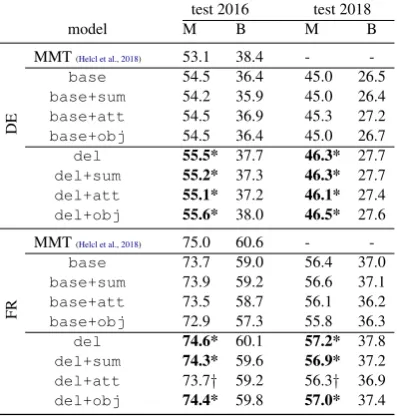
Table 2: Results for the test sets 2016 and 2018. M denotesMETEOR, B –BLEU; * marks statistically sig-nificant changes forMETEOR(p-value≤0.05) as com-pared tobase,†– as compared todel. Bold high-lights statistically significant improvements. We report previous state of the art results for multimodal models from (Helcl et al.,2018).
5 Results
In this section we present results of our exper-iments, first in the original dataset without any
6
We built on the tensor2tensorimplementation of deliberation nets in https://github.com/ustctf/ delibnetusing thetransformer bigparameters with a learning rate of 0.05 with 8K warmup steps for both the first and the second-pass decoders, and early stopping with the pa-tience of 10 epochs based on the validationBLEUscore.
source degradation (Section 5.1) and then in the setup with various source degradation strategies (Section5.2).
5.1 Standard setup
Table2shows the results of our main experiments on the 2016 and 2018 test sets for French and German. We use Meteor (Denkowski and Lavie, 2014) as the main metric, as in the WMT tasks (Barrault et al., 2018). We compare our trans-former baseline to transtrans-former models enriched with image information, as well as to the delibera-tion models, with or without image informadelibera-tion.
We first note that our multimodal models achieve the state of the art performance for trans-former networks (constrained models) on the English-German dataset, as compared to (Helcl et al., 2018). Second, our deliberation models lead to significant improvements over this base-line across test sets (average ∆METEOR = 1,
∆BLEU= 1).
Transformer-based models enriched with im-age information (base+sum, base+att and
base+obj), on the other hand, show no ma-jor improvements with respect to the base per-formance. This is also the case for delibera-tion models with image informadelibera-tion (del+sum,
del+att, del+obj), which do not show sig-nificant improvement over the vanilla deliberation performance (del).
However, as it has been shown in the WMT shared tasks on MMT (Specia et al., 2016; El-liott et al.,2017;Barrault et al.,2018), automatic metrics often fail to capture nuances in transla-tion quality, such as, the ones we expect the vi-sual modality to help with, which – according to human perception – lead to better translations. To test this assumption in our settings, we performed human evaluation involving professional transla-tors and native speakers of both French and Ger-man (three annotators).
The annotators were asked to rank randomly selected test samples according to how well they convey the meaning of the source, given the image (50 samples per language pair per annotator). For each source segment, the annotator was shown the outputs of three systems: base+att, the current MMT state-of-the-art (Helcl et al.,2018),deland
[image:6.595.84.283.320.529.2]EN: Two men work under the hood of a white race car.
base+att: Zwei M¨anner arbeiten unter der Motorhaube eines weißen Rennens. del: Zwei M¨anner arbeiten unter der Motorhaube eines weißen Autos. del+obj: Zwei M¨anner arbeiten unter der Motorhaube eines weißen Rennwagen. DE: Zwei M¨anner arbeiten unter der Haube eines weißen Rennautos.
(a)base+atttranslatesrace carwithRennen(race),delwithAuto(car) anddel+objwithRennwagen(race car).
Objects: land, vehicle, car, wheel
EN: A young child holding an oar paddling a blue kayak in a body of water.
base+att: Un jeune enfant tenant une rame dans un kayak bleu.
del: Un jeune enfant tenant une rame dans un kayak bleu sur un plan d’eau. del+obj: Un jeune enfant tenant une rame dans un kayak bleu pagayant
sur un plan d’eau.
FR: Un jeune enfant avec une rame pagayant dans un kayak bleu sur un plan d’eau.
(b)deland del+objtranslatein a body of waterwithsur un plan d’eau (on a body of water), missing inbase+att. del+objtranslates the wordpaddlingwithpagayant(paddling).Objects: paddle, canoe
Figure 3: Examples of improvements ofdelanddel+objoverbase+attfor test set 2016 for French and German. Underlined words represent some of the improvements.
were judged incomprehensible.
Following the common practice in WMT (Bo-jar et al.,2017), each system was then assigned a score which reflects the proportion of times it was judged to be better or equal other systems.
Table 3 shows the human evaluation results. They are consistent with the automatic evaluation results when it comes to the preference of hu-mans towards the deliberation-based setups, but show a more positive outlook regarding the addi-tion of visual informaaddi-tion (del+objoverdel) for French.
lang base+att del del+obj
DE 0.35 0.62 0.59
FR 0.41 0.6 0.67
Table 3: Human ranking results: normalised rank (micro-averaged). Bold highlights best results.
Manual inspection of translations suggests that deliberation setups tend to improve both the gram-maticality and adequacy of the first pass outputs. For German, the most common modifications per-formed by the second-pass decoder are substitu-tions of adjectives and verbs (for test 2016, 15% and 12% respectively, of all the edit distance oper-ations). Changes to adjectives are mainly gram-matical, changes to verbs are contextual (e.g., changing laufentorennen, both verbs mean run, but the second refers to running very fast). For
French, 15% of all the changes are substitutions of nouns (for test 2016). These are again very contextual. For example, the French word
tra-vailleur (worker) is replaced byouvrier (manual
worker) in the contexts where tools, machinery or buildings are mentioned. For our analysis we used againspacy.
The information on detected objects is partic-ularly helpful for specific adequacy issues. Fig-ure 3demonstrates some such cases. In the first case, the base+att model misses the transla-tion ofrace car: the German wordRennen trans-lates only the wordrace.delintroduces the word
car(Auto) into the translation. Finally,del+obj
correctly translates the expressionrace car( Ren-nwagen) by exploiting the object information. For French, del translates the source partin a body
of water, missing from the base+att
transla-tion. del+objadditionally translated the word
paddlingaccording to the detected object Paddle.
5.2 Source degradation setup
[image:7.595.83.505.74.144.2]improve-RND AMB PERS
test 2016 test 2018 test 2016 test 2018 test 2016 test 2018
model M B M B M B M B M B M B
DE
base 45.6 27.1 37.7 20.0 48.4 30.1 38.9 21.0 47.0 28.6 40.3 22.2
del 44.6* 25.1 36.8* 18.1 47.7 29.0 38.0* 19.0 47.5 29.0 40.9 22.0
del+sum 45.7† 27.2 38.1† 19.9 46.9*† 27.9 37.2*† 18.7 48.1* 29.8 41.1* 22.4 del+obj 46.5*† 28.1 39.0*† 20.7 49.8*† 31.3 40.0*† 21.3 48.1* 29.4 41.6*† 23.4
FR
base 59.3 43.4 46.3 28.1 66.4 51.2 49.2 30.4 63.9 48.6 50.3 31.7
del 61.0* 45.3 47.1* 28.4 67.3* 52.2 50.2* 31.3 64.5* 49.3 51.2* 32.4
del+sum 60.4* 44.4 47.5* 29.3 67.7* 52.8 50.4* 31.5 65.0* 49.7 51.1* 32.1
[image:8.595.89.508.62.183.2]del+obj 61.3* 45.4 47.9*† 29.4 67.7* 52.6 50.5* 31.7 65.0* 49.5 50.9* 32.2
Table 4: Results for the test sets 2016 and 2018 for the three degradation configurations:RND,AMBandPERS. M denotesMETEOR, B –BLEU; * marks statistically significant changes as computed forMETEOR(p-value≤0.05) as compared tobase,†– as compared todel. Bold highlights statistically significant improvements overbase.
ments over base for all setups. Moreover, for
RNDandAMB, it shows statistically significant im-provements over del. However, especially for
RND andAMB,del anddel+sumare either the same or slightly worse thanbase.
For French, all the deliberation models show statistically significant improvements over base
(average ∆METEOR = 1, ∆BLEU = 1.1), but the image information added todelonly improve scores significantly for test 2018RND.
This difference in performances for French and German is potentially related to the need of more significant restructurings while translating from English into German.7 This is where a more com-plexdel+objarchitecture is more helpful. This is especially true forRND andAMB setups where blanked words could also be verbs, the part-of-speech most influenced by word order differences between English and German (see the decreasing complexity of translations fordelanddel+obj
for the example (c) in Figure4).
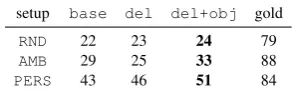
To get an insight into the contribution of differ-ent contexts to the resolution of blanks, we per-formed manual analysis of examples coming from the English-German base, del and del+obj
setups (50 random examples per setup), where we count correctly translated blanks per system.
The results are shown in Table5. As expected, they show that theRNDandAMBblanks are more difficult to resolve (at most 40% resolved as com-pared to 61% forPERS). Translations of the ma-jority of those blanks tend to be guessed by the
7
English and French are both languages with the subject– verb–object (SVO) sentence structure. German, on the other hand, can have subject–object–verb (SOV) constructions. For example, a German sentenceGestern bin ich in London gewe-sen(Yesterday have I to London been) would need to be re-structured toYesterday I have been to Londonin English.
setup base del del+obj gold
RND 22 23 24 79
AMB 29 25 33 88
PERS 43 46 51 84
Table 5: Results of human annotation of blanked trans-lations (English-German). We report counts of blanks resolved by each system, as well as total source blank count for each selection (50 sentences selected ran-domly).
textual context alone (especially for verbs). Im-age information is more helpful forPERS: we ob-serve an increase of 10% in resolved blanks for
del+obj as compared to del. However, for
PERSthe textual context is still enough in the ma-jority of the cases: models tend to associate men with sports or women with cooking and are usu-ally right (see Figure4example (c)).
The cases where image helps seem to be those with rather generic contexts: see Figure 4 (b) where enjoying a summer day is not associated with any particular gender and make other mod-els choosehomme(man) orfemme(woman), and only base+obj choosesenfant (child) (the op-tion closest to the reference).
In some cases detected objects are inaccurate or not precise enough to be helpful (e.g., when an ob-ject Person is detected) and can even harm correct translations.
6 Conclusions
[image:8.595.343.491.256.303.2]EN: Three farmers harvest rice out in a rice field.
base: Drei Bauern ernten sich mit einem Reisfeld. del: Drei Bauern ernten Reis mit einem Reisfeld. del+obj: Drei Bauern ernten sich mit einem Reishut auf. DE: Drei Farmer ernten Reis auf einem Feld.
(a) Example of a blank resolved by the textual context forAMB:fieldtranslated asReisfeld(rice field) bybase. del+obj incorrectly translated the blank intoReishut(rice hat) due to detected objects.Objects: person, clothing, mammal
EN: The boy is outside enjoying a summer day. base: L’homme profite d’une journ´ee d’´et´e. del: La femme profite d’une journ´ee d’´et´e. del+obj: L’enfant profite d’une journ´ee d’´et´e.
FR: Le garc¸on est dehors, profitant d’une journ´ee d’´et´e.
(b) Example of a blank resolved by the multimodal context forPERS. The textual context is too generic anddel+objuses the detected objects to correctly translateboyintol’enfant(child).Objects: clothing, face, tree, boy, jeans
EN: Dirt biker makes a sloping turn in a forest during the fall. base: Gel¨andemotorradfahrer macht in einem Wald eine Kurve.
del: Gel¨andemotorradfahrer macht in einem Herbst w¨ahrend Zuschauer eine Kurve.
del+obj: Gel¨andemotorradfahrer macht in einem Herbst eine Kurve. DE: Ein offroad-biker f¨ahrt im Herbst durch eine steile Kurve.
(c) Example of a blank resolved by the textual context for PERS. biker correctly translated into the Masc. form
Gel¨andemotorradfahrer(dirt biker) bybase.Objects: person, tree, bike, helmet
Figure 4: Examples of resolved blanks for test set 2016. Underlined text denotes blanked words and their transla-tions. Object field indicates the detected objects.
to better results than the previous state of the art. Adding visual information, and in particu-lar structural representations of this information, proved beneficial when input text contains noise and the language pair requires substantial restruc-turing from source to target. Our findings sug-gest that the combination of a deliberation ap-proach and information from additional modali-ties is a promising direction for machine transla-tion that is robust to noisy input. Our code and pre-processing scripts are available athttps://
github.com/ImperialNLP/MMT-Delib.
Acknowledgments
The authors thank the anonymous reviewers for their useful feedback. This work was supported by the MultiMT (H2020 ERC Starting Grant No. 678017) and MMVC (Newton Fund Institutional Links Grant, ID 352343575) projects. We also thank the annotators for their valuable help.
References
Dzmitry Bahdanau, Kyunghyun Cho, and Yoshua Ben-gio. 2015. Neural machine translation by jointly learning to align and translate. In Proceedings of International Conference on Learning Representa-tions (ICLR).
Lo¨ıc Barrault, Fethi Bougares, Lucia Specia, Chi-raag Lala, Desmond Elliott, and Stella Frank. 2018.
Findings of the third shared task on multimodal ma-chine translation. InProceedings of the Third Con-ference on Machine Translation: Shared Task Pa-pers, pages 304–323. Association for Computational Linguistics.
Ondˇrej Bojar, Rajen Chatterjee, Christian Federmann, Yvette Graham, Barry Haddow, Shujian Huang, Matthias Huck, Philipp Koehn, Qun Liu, Varvara Logacheva, Christof Monz, Matteo Negri, Matt Post, Raphael Rubino, Lucia Specia, and Marco Turchi. 2017. Findings of the 2017 conference on machine translation (WMT17). InProceedings of the Second Conference on Machine Translation, pages 169–214. Association for Computational Lin-guistics.
Weijer. 2017. LIUM-CVC submissions for WMT17 multimodal translation task. InProceedings of the Second Conference on Machine Translation, pages 432–439. Association for Computational Linguis-tics.
Ozan Caglayan, Pranava Madhyastha, Lucia Specia, and Lo¨ıc Barrault. 2019. Probing the need for visual context in multimodal machine translation. In Pro-ceedings of the 2019 Conference of the North Amer-ican Chapter of the Association for Computational Linguistics: Human Language Technologies, Vol-ume 1 (Long and Short Papers), pages 4159–4170, Minneapolis, Minnesota. Association for Computa-tional Linguistics.
Iacer Calixto and Qun Liu. 2017. Incorporating global visual features into attention-based neural machine translation. InProceedings of the 2017 Conference on Empirical Methods in Natural Language Pro-cessing, pages 992–1003. Association for Compu-tational Linguistics.
Iacer Calixto, Qun Liu, and Nick Campbell. 2017.
Doubly-attentive decoder for multi-modal neural machine translation. InProceedings of the 55th An-nual Meeting of the Association for Computational Linguistics (Volume 1: Long Papers), pages 1913– 1924. Association for Computational Linguistics.
Rajen Chatterjee, Matteo Negri, Raphael Rubino, and Marco Turchi. 2018. Findings of the WMT 2018 shared task on automatic post-editing. In Proceed-ings of the Third Conference on Machine Transla-tion, Volume 2: Shared Task Papers, pages 723–738, Belgium, Brussels. Association for Computational Linguistics.
Jean-Benoit Delbrouck and St´ephane Dupont. 2017.
An empirical study on the effectiveness of images in multimodal neural machine translation. In Proceed-ings of the 2017 Conference on Empirical Methods in Natural Language Processing, pages 910–919. Association for Computational Linguistics.
Michael Denkowski and Alon Lavie. 2014. Meteor universal: Language specific translation evaluation for any target language. InProceedings of the EACL 2014 Workshop on Statistical Machine Translation.
Desmond Elliott, Stella Frank, Lo¨ıc Barrault, Fethi Bougares, and Lucia Specia. 2017. Findings of the second shared task on multimodal machine transla-tion and multilingual image descriptransla-tion. In Proceed-ings of the Second Conference on Machine Trans-lation, Volume 2: Shared Task Papers, pages 215– 233, Copenhagen, Denmark. Association for Com-putational Linguistics.
Desmond Elliott, Stella Frank, and Eva Hasler. 2015.
Multi-language image description with neural se-quence models.CoRR, abs/1510.04709.
Desmond Elliott, Stella Frank, Khalil Sima’an, and Lu-cia SpeLu-cia. 2016. Multi30k: Multilingual english-german image descriptions. In5th Workshop on Vi-sion and Language, pages 70–74, Berlin, Germany.
Desmond Elliott and `Akos K´ad´ar. 2017. Imagination improves multimodal translation. InProceedings of the Eighth International Joint Conference on Natu-ral Language Processing (Volume 1: Long Papers), pages 130–141. Asian Federation of Natural Lan-guage Processing.
Joel Escud´e Font and Marta R. Costa-Juss`a. 2019.
Equalizing gender biases in neural machine trans-lation with word embeddings techniques. CoRR, abs/1901.03116.
Stella Frank, Desmond Elliott, and Lucia Specia. 2018.
Assessing multilingual multimodal image descrip-tion: Studies of native speaker preferences and translator choices. Natural Language Engineering, 24(3):393413.
Stig-Arne Gr¨onroos, Benoit Huet, Mikko Kurimo, Jorma Laaksonen, Bernard Merialdo, Phu Pham, Mats Sj¨oberg, Umut Sulubacak, J¨org Tiedemann, Raphael Troncy, and Ra´ul V´azquez. 2018. The MeMAD submission to the WMT18 multimodal translation task. InProceedings of the Third Confer-ence on Machine Translation: Shared Task Papers, pages 603–611. Association for Computational Lin-guistics.
Christian Hardmeier, Joakim Nivre, and J¨org Tiede-mann. 2012. Document-wide decoding for phrase-based statistical machine translation. In Proceed-ings of the 2012 Joint Conference on Empiri-cal Methods in Natural Language Processing and Computational Natural Language Learning, pages 1179–1190. Association for Computational Linguis-tics.
Hany Hassan, Anthony Aue, Chang Chen, Vishal Chowdhary, Jonathan Clark, Christian Feder-mann, Xuedong Huang, Marcin Junczys-Dowmunt, William Lewis, Mu Li, et al. 2018. Achieving hu-man parity on automatic Chinese to English news translation.CoRR, abs/1803.05567.
Kaiming He, Xiangyu Zhang, Shaoqing Ren, and Jian Sun. 2016. Deep residual learning for image recog-nition. In Proceedings of the IEEE conference on computer vision and pattern recognition, pages 770– 778.
Jinˇdrich Helcl, Jinˇdrich Libovick´y, and Dusan Varis. 2018. CUNI system for the WMT18 multimodal translation task. InProceedings of the Third Confer-ence on Machine Translation: Shared Task Papers, pages 616–623. Association for Computational Lin-guistics.
Lisa Anne Hendricks, Kaylee Burns, Kate Saenko, Trevor Darrell, and Anna Rohrbach. 2018. Women also snowboard: Overcoming bias in captioning models. In Computer Vision – ECCV 2018, pages 793–811. Springer International Publishing.
translation. InProceedings of the 54th Annual Meet-ing of the Association for Computational LMeet-inguistics (Volume 1: Long Papers), pages 2399–2409, Berlin, Germany. Association for Computational Linguis-tics.
Matthew Honnibal and Ines Montani. 2017. spacy 2: Natural language understanding with bloom embed-dings, convolutional neural networks and incremen-tal parsing. To appear.
Po-Yao Huang, Frederick Liu, Sz-Rung Shiang, Jean Oh, and Chris Dyer. 2016. Attention-based multi-modal neural machine translation. InProceedings of the First Conference on Machine Translation, pages 639–645. Association for Computational Linguis-tics.
Marcin Junczys-Dowmunt and Roman Grundkiewicz. 2017. An exploration of neural sequence-to-sequence architectures for automatic post-editing. In Proceedings of the Eighth International Joint Conference on Natural Language Processing (Vol-ume 1: Long Papers), pages 120–129. Asian Feder-ation of Natural Language Processing.
Diederik Kingma and Jimmy Ba. 2014. Adam: A method for stochastic optimization. International Conference on Learning Representations.
Filip Klubiˇcka, Antonio Toral, and V´ıctor M S´anchez-Cartagena. 2017. Fine-grained human evaluation of neural versus phrase-based machine translation. The Prague Bulletin of Mathematical Linguistics, 108(1):121–132.
Alina Kuznetsova, Hassan Rom, Neil Alldrin, Jasper Uijlings, Ivan Krasin, Jordi Pont-Tuset, Shahab Ka-mali, Stefan Popov, Matteo Malloci, Tom Duerig, et al. 2018. The open images dataset v4: Uni-fied image classification, object detection, and vi-sual relationship detection at scale. arXiv preprint arXiv:1811.00982.
Chiraag Lala, Pranava Swaroop Madhyastha, Carolina Scarton, and Lucia Specia. 2018. Sheffield sub-missions for WMT18 multimodal translation shared task. InProceedings of the Third Conference on Ma-chine Translation, Volume 2: Shared Task Papers, pages 630–637, Belgium, Brussels. Association for Computational Linguistics.
Jason Lee, Elman Mansimov, and Kyunghyun Cho. 2018. Deterministic non-autoregressive neural se-quence modeling by iterative refinement. In Pro-ceedings of the 2018 Conference on Empirical Meth-ods in Natural Language Processing, pages 1173– 1182. Association for Computational Linguistics.
Jinˇdrich Libovick´y and Jinˇdrich Helcl. 2017.Attention strategies for multi-source sequence-to-sequence learning. InProceedings of the 55th Annual Meet-ing of the Association for Computational LMeet-inguis- Linguis-tics (Volume 2: Short Papers), pages 196–202, Van-couver, Canada. Association for Computational Lin-guistics.
Pranava Madhyastha, Josiah Wang, and Lucia Specia. 2017. Sheffield MultiMT: Using object posterior predictions for multimodal machine translation. In Proceedings of the Second Conference on Machine Translation, pages 470–476. Association for Com-putational Linguistics.
Pranava Swaroop Madhyastha, Josiah Wang, and Lu-cia SpeLu-cia. 2018. End-to-end image captioning ex-ploits multimodal distributional similarity. CoRR, abs/1809.04144.
Margaret Mitchell, Jesse Dodge, Amit Goyal, Kota Ya-maguchi, Karl Stratos, Xufeng Han, Alyssa Men-sch, Alex Berg, Tamara Berg, and Hal Daume III. 2012. Midge: Generating image descriptions from computer vision detections. InProceedings of the 13th Conference of the European Chapter of the As-sociation for Computational Linguistics, pages 747– 756, Avignon, France. Association for Computa-tional Linguistics.
Jan Niehues, Eunah Cho, Thanh-Le Ha, and Alex Waibel. 2016. Pre-translation for neural machine translation. In Proceedings of COLING 2016, the 26th International Conference on Computational Linguistics: Technical Papers, pages 1828–1836. The COLING 2016 Organizing Committee.
Roman Novak, Michael Auli, and David Grangier. 2016. Iterative refinement for machine translation. CoRR, abs/1610.06602.
Jeffrey Pennington, Richard Socher, and Christopher Manning. 2014. Glove: Global vectors for word representation. In Proceedings of the 2014 Con-ference on Empirical Methods in Natural Language Processing (EMNLP), pages 1532–1543, Doha, Qatar. Association for Computational Linguistics.
Bryan A Plummer, Liwei Wang, Chris M Cervantes, Juan C Caicedo, Julia Hockenmaier, and Svetlana Lazebnik. 2017. Flickr30k entities: Collecting region-to-phrase correspondences for richer image-to-sentence models. volume 123, pages 74–93, Hingham, MA, USA. Kluwer Academic Publishers.
Kashif Shah, Josiah Wang, and Lucia Specia. 2016.
SHEF-Multimodal: Grounding machine translation on images. InFirst Conference on Machine Trans-lation, Volume 2: Shared Task Papers, WMT, pages 657–662. Association for Computational Linguis-tics.
Lucia Specia, Stella Frank, Khalil Sima’an, and Desmond Elliott. 2016. A shared task on multi-modal machine translation and crosslingual image description. InProceedings of the First Conference on Machine Translation, pages 543–553. Associa-tion for ComputaAssocia-tional Linguistics.
on Empirical Methods in Natural Language Pro-cessing, pages 3003–3008. Association for Compu-tational Linguistics.
Ashish Vaswani, Samy Bengio, Eugene Brevdo, Fran-cois Chollet, Aidan Gomez, Stephan Gouws, Llion Jones, Łukasz Kaiser, Nal Kalchbrenner, Niki Par-mar, Ryan Sepassi, Noam Shazeer, and Jakob Uszkoreit. 2018. Tensor2Tensor for neural machine translation. pages 193–199.
Ashish Vaswani, Noam Shazeer, Niki Parmar, Jakob Uszkoreit, Llion Jones, Aidan N Gomez, Łukasz Kaiser, and Illia Polosukhin. 2017. Attention is all you need. InAdvances in Neural Information Pro-cessing Systems 30, pages 5998–6008. Curran Asso-ciates, Inc.
Josiah Wang, Pranava Swaroop Madhyastha, and Lu-cia SpeLu-cia. 2018. Object counts! Bringing explicit detections back into image captioning. In Proceed-ings of the 2018 Conference of the North American Chapter of the Association for Computational Lin-guistics: Human Language Technologies, Volume 1 (Long Papers), New Orleans, Louisiana. Associa-tion for ComputaAssocia-tional Linguistics.
Yingce Xia, Fei Tian, Lijun Wu, Jianxin Lin, Tao Qin, Nenghai Yu, and Tie-Yan Liu. 2017. Deliberation networks: Sequence generation beyond one-pass de-coding. In Advances in Neural Information Pro-cessing Systems 30, pages 1784–1794. Curran As-sociates, Inc.
Kelvin Xu, Jimmy Ba, Ryan Kiros, Kyunghyun Cho, Aaron Courville, Ruslan Salakhudinov, Rich Zemel, and Yoshua Bengio. 2015. Show, attend and tell: Neural image caption generation with visual atten-tion. In Proceedings of the 32nd International Conference on Machine Learning, volume 37 of Proceedings of Machine Learning Research, pages 2048–2057. PMLR.
Peter Young, Alice Lai, Micah Hodosh, and Julia Hockenmaier. 2014. From image descriptions to vi-sual denotations: New similarity metrics for seman-tic inference over event descriptions. 2:67–78.
Jieyu Zhao, Tianlu Wang, Mark Yatskar, Vicente Or-donez, and Kai-Wei Chang. 2018. Gender bias in coreference resolution: Evaluation and debiasing methods. InProceedings of the 2018 Conference of the North American Chapter of the Association for Computational Linguistics: Human Language Tech-nologies, Volume 2 (Short Papers), pages 15–20. As-sociation for Computational Linguistics.
EN: A bride and groom kiss under the bride’s veil.
base: Ein Mann und eine Frau k¨ussen sich unter den Blicken der Frau. del: Ein Mann und eine Frau k¨ussen sich unter dem Brautschleier. del+obj: Ein Mann und eine Frau k¨ussen sich unter den hin.
DE: Eine Braut und Br¨autigam k¨ussen sich unter dem Brautschleier .
(a)PERSexample:brideandgroomtranslated are correctly translated bybaseintoFrau(wife) andMann(husband).Objects: face, woman, dress
EN: A brown dog runs down the sandy beach. base: Ein brauner Hund l¨auft an einem sandigen Strand. del: Ein brauner Hund rennt den Sandstrand hinunter.
del+obj: Ein brauner Hund l¨auft an einem sandigen Strand hinunter. FR: Ein brauner Hund l¨auft ¨uber den Sandstrand.
[image:13.595.79.485.103.173.2](b)AMBexample:runsis correctly translated bybaseintol¨auft.Objects: dog
Figure 5: Examples of blanks for test set 2016 that were correctly resolved by the textual context. The underlined words denote blanked words and their translations.
EN: A woman and a dog sit on a white bench near a beach.
base: Eine Frau und ein Hund sitzen an einem weißen Strand nahe einem Strand.
del: Eine Frau und ein Hund sitzen auf einem weißen Sofa in der n¨ahe eines Strands.
del+obj: Eine Frau und ein Hund sitzen auf einer weißen Bank nahe einem Strand.
DE: Eine Frau und eine Hund sitzen auf einer weißen Bank in der n¨ahe eines Strandes.
(a)RNDexample: the blankbenchis correctly translated bydel+objintoBankdue to the detected object Bench. Objects: person, dog, bench
EN: Two men dressed in green are preparing food in a restaurant.
base: Deux femmes vˆetues de vert pr´eparent des aliments dans un restaurant. del: Deux femmes vˆetues de vert pr´eparent de la nourriture dans un
restaurant.
del+obj: Deux asiatiques en vert pr´eparent de la nourriture dans un restaurant. FR: Deux hommes habill´es en vert pr´eparent de la nourriture dans un
restaurant.
[image:13.595.76.508.428.541.2](b)PERSexample.mencorrectly translated intoasiatiques(asians) bydel+obj.Objects: person, clothing, man, food, cake
EN: A guy give a kiss to a guy also.
base: Ein Mann, der sich vor, um eine Frau zu kn¨ussen . del: Ein Mann, der sich vor, um eine Frau zu k¨ussen. del+obj: Ein Mann, der einem kuss k¨usst, um eine Frau zu k¨ussen. DE: Ein Typ k¨usst einen anderen Typ .
(a)PERSexample: the second mention ofguyis consistently translated intoFrau(woman).Objects: clothing, man, face
EN: A group of students sit and listen to the speaker.
base: Eine Gruppe von Studenten sitzt und schaut nach rechts . del: Eine Gruppe Sch¨uler sitzt und schaut nach rechts.
del+obj: Eine Gruppe Sch¨uler sitzt und schaut zu rechts auf das Wasser. DE: Eine Gruppe von Studenten sitzt und h¨ort der Sprecherin zu.
(b)AMBexample. The blankslistenandspeakerare consistently translated intoschaut(look) andrechts(right) orWasser
(water).Objects: person, clothing, man, food, cake