ELSEVIER Pattern Recognition Letters 18 (1997) 187-191
Pattern Recognition
Letters
Block-run run-length coding of handwriting and bilevel graphics
based on quadtree segmentation
H. Yuen a,,, L. Hanzo b
a Department of Electronic Engineering, The Hong Kong Polytechnic University, Hong Kong, Hong Kong b Department of Electronics and Computer Science, University of Southampton, United Kingdom
Received 24 July 1995; revised 23 February 1996
Abstract
An efficient off-line coding scheme for handwriting and bilevel graphics based on quadtree segmentation and block-run run-length coding (RLC) is presented. By segmenting a captured handwriting or graphic image into variable size blocks according to the image activity inside the blocks and run-length coding on a block-run basis, the new scheme is able to achieve higher coding efficiency than the conventional one-dimensional RLC and its bit rate is close to that of on-line dynamographical chain coding. © 1997 Elsevier Science B.V.
Keywords: Segmentation; Chain coding; Handwriting and graphics coding
1. Introduction
Handwriting and line drawings are a special sub- class of two-level graphic images in which the picture consists of interconnections of thin lines on a con- trasting background. Examples are handwritten text, sketches, maps and charts. On-line handwriting and line drawings captured by an electronic writing tablet preserve the temporal information in the data and can be efficiently coded by line following codes such as chain codes. Alternatively, on-line data can be con- verted to off-line format and coding schemes such as run-length coding (RLC) used in fascimile commu- nication can be applied. Conventional run-length cod- ing of bi-level graphics is based on line-by-line raster scanning and exploits the one-dimensional redundancy associated with alternate runs of l ' s and O's along the
* Corresponding author. E-mail: [email protected].
scan line. Chain coding encodes the on-line data based on spatial quantisation of the two-dimensional traces into one-dimensional vector chains by translating a coding ring along the traces. Liu and Prasad (1989, 1991) had performed the quantitative analysis and comparison of coding efficiency between off-line RLC and on-line vector chain coding (VCC) for on-line handwritten line drawings, evaluated in terms of per- length coding rate and compression ratio. It was con- cluded that the on-line coding (VCC) achieved higher coding efficiency than the off-line coding (RLC) if the total length of the lines in a line drawing was within a certain range. This is conceptually true be- cause as an image is covered more and more with handwriting and drawings, off-line run-length coding using binary bitmap may become more efficient than on-line line-following coding which must encode the starting position of each trace and also the overlapped points due to trace crossing. Line-following coding
0167-8655/97/$17.00 (~) 1997 Elsevier Science B.V. All rights reserved.
188 H. Yuen, L. Hanzo/Pattern Recognition Letters 18 (1997) 187-191 also has the limitation of lossless encoding of on-line
data only. If one wishes to encode off-line data using line-following codes, the off-line data must be first converted to the on-line format through complicated pre-processing steps including thinning and vectoriza- tion.
Converting on-line data to off-line format is quite easy and lossless whereas converting off-line data to on-line format is not a simple task and usually lossy because it involves thinning the off-line data and vec- torizing the skeleton information. If the off-line draw- ings contain many intersection points, the conversion may result in many short traces making the on-line encoding less efficient due to the overhead needed for encoding the starting positions of all traces.
For typical black and white graphic images, most of the long white runs belong to the background which convey no information. Therefore the coding efficiency of RLC can be improved if the background areas were coded more efficiently. Quadtree seg- mentation has recently become a popular technique for variable block size segmentation in image cod- ing (Yuen et al., 1995) due to its low overhead and simple data structure. In this paper, a new off-line coding scheme based on quadtree segmentation and block-run RLC is proposed for coding handwriting and bilevel graphics which have been converted to off-line format. Compared to the conventional ITU recommended one-dimensional RLC (ITU, 1988), the proposed scheme has better coding performance and its bit rate is close to that of on-line chain coding. Since the proposed scheme is on an off-line cod- ing basis, it is able to achieve lossless encoding on both on-line and off-line handwriting and line draw- ings while the dynamographical chain coding is only capable of lossless encoding of on-line data.
In chain coding schemes, standard chain coding (SCC) encodes a trace into a chain of absolute vectors with l [ l o g 2 8n] bits using a coding ring of M = 8n nodes, where I [ x] denotes the smallest integer equal to or greater than x, and n = 1,2, 3 . . . Differential chain coding (DCC) developed at Delft University of Technology for telegraphics applications (Arnbak et al., 1989) is a more efficient scheme by exploit- ing the correlation between successive vectors, based on the statistical properties of vector difference for smooth handwriting and line drawings. Relative vec- tors with fewer bits are defined when the following
vector differs from the previous vector with zero or one vector node, thus reducing the coding rate. Recently, lossy differential chain coding schemes such as fixed- length differential chain coding (FL-DCC) (Yuen and Hanzo, 1995) and DM-like differential chain coding (DM-DCC) (Yuen, 1996) were introduced for even higher coding efficiency and better transmission er- ror immunity by quantizing the differential vectors in the vector chains into adaptively defined fixed-length codes and one-bit delta vectors, respectively.
We assume black-and-white handwriting and line drawings such that black lines are drawn on a white background. The on-line handwriting data were cap- tured using an electronic writing tablet which outputs the x, y co-ordinates of the writing pen tip. In or- der to apply the off-line coding scheme to the on-line handwriting data, a transcoding algorithm was used to convert the on-line handwriting data into the off-line raster scanning bit pattern. A two-dimensional bilevel buffer was defined in which pixels corresponding to the trace points were turned on (black) while the re- maining pixels corresponding to the background were off (white). Since the tablet did not produce the thick- ness information, the transcoded handwritten traces were assumed to have one-pixel width. Aimed for higher source coding efficiency, the proposed coding scheme encoded data on an off-line basis without the temporal information which was lost in the transcod- ing process.
2. Quadtree segmentation and block-run RLC
H. Yuen, L. Hanzo/Pattern Recognition Letters 18 (1997) 187-191 189
32 x 32
16x 16
8 x 8
"l"
"I" "l'
• = , ,ow ,,,o,, ,,o, •
Fig. 1. 3-level quadtree structure.
.. /:C
12 i!12!
... -
...
... : ' i~ ... :'~-~::~?~': ... ~" "," ,','~'~ i"~:~ ~'~W-""°"~ . . . " ~ ~ z , ...
"~'~'~'.~}.i '~'"'~~=~'#:~'~'°'~4~ '='~'~'~ Cl.:.i : : : i :,~:) .... il ~ i ~ [ ? i ~ . ~ i i i ! 5 1 1 ~ : " ::: i }:7::, i::::{f~:~, i.4 ~..,-i.,-~; ,;.~:*:# i})~i
Fig. 2. Quadtme segmented
English script.
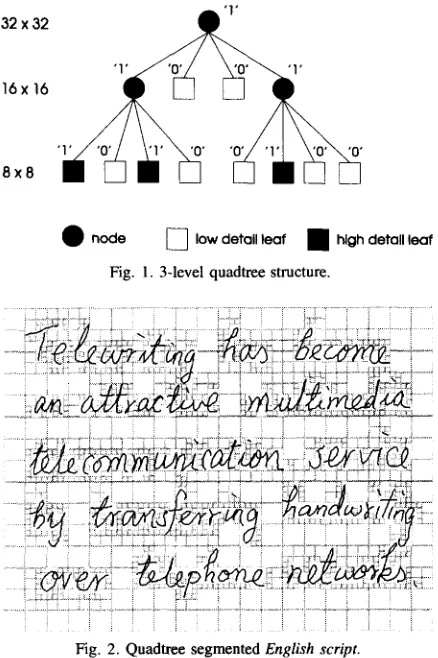
640 x 480 pixels, the largest block size is 32 × 32, the intermediate block size is 16 x 16 and the smallest block size is 8 x 8. Initially, the input image is uni- formly segmented into blocks of size 32 x 32 and each block is examined for its activity. If a block contains all white pixels with no black pixels, it will be clas- sifted as a background leaf block and a 1-bit quadtree code "0" is generated. Otherwise, it will be further split into four child blocks of 16 x 16 size, generating the quadtree code "1". This splitting process is contin- ued until the smallest block size 8 x 8 is reached and each block is marked by the code "0" or "1" accord- ing to the activity inside the block. In this way, all the high-detail information-carrying blocks can be identi- fied from the input image. Fig. 1 illustrates the 3-level quadtree structure along with the quadtree codes for each node or leaf.
[image:3.540.277.493.45.225.2]All variable size background blocks are encoded using just 1-bit quadtree code and no further encod- ing is required. Fig. 2 shows the quadtree segmented
Fig. 3. Quadtree segmented Map.
English script
while Fig. 3 displays the quadtree seg- mentedMap,
with the low-detail background blocks of three block sizes marked by their boundary. It can be seen that the quadtree segmentation has effectively located the background blocks especially along the edges of the input image, and identified the high- detail information-carrying blocks. Hence, the pro- posed quadtree decomposition may be useful in seg- menting handwriting for off-line recognition applica- tion.In order to achieve even higher efficiency in run-length encoding of the high-detail information- carrying leaf blocks, we grouped them together by scanning them into a long one-dimensional ( I - D ) block-run in order to have long pixel runs. The bit stream formed by raster scanning of each block in the block-run was then coded using the variable length RLC. Note that the ITU recommended 1-D modified Huffman code was optimized using CCITT standard facsimile test documents with a normal resolution of 1728 × 1188 pixels or high resolution of 1728 × 2376 pixels. It is not the optimal variable length RLC for the transcoded handwritten line drawings which con- sist of thin lines only. Hence the proposed scheme will be more efficient if the width of traces is more than one pixel.
3. Bit rate for graphic image
[image:3.540.38.257.48.377.2]190 H. Yuen, L. Hanzo/Pattern Recognition Letters 18 (1997) 187-191
Table 1
Bit rates of off-line and on-line coding schemes for various on-line handwriting and line drawings
Handwriting ITU RLC Proposed scheme SCC DCC FL-DCC
Bilingual script 0.2796 0.1988 0.1692 0.1337 0.1246
Chinese script 0.2100 0.1386 0.1274 0. l 195 0.0992
English script 0.2044 0.1249 0.0940 0.0748 0.0665
Drawing 0.1394 0~0855 0.0589 0.0483 0.0404
Map 0.0806 0.0260 0.0162 0.0138 0.0113
ITU 1-D RLC and various chain coding schemes, we define the bit rate r in bits per pixel of a coding scheme for a graphic image of M x N pixels as
b
r - (1)
M . N '
where b is the total number of bits required by the corresponding coding scheme to encode the whole graphic image. For on-line chain coding schemes, b is given by (Yuen, 1996)
b = ~ (PD + Xo + ro + Vi + P U ) , (2) i=1
where m is the total number of traces, PD is the num-
ber of bits for the pen-down, X0 and Y0 are the numbers of bits for the x- and y-coordinates of the trace ori- gin, respectively, V/is the number of bits for the vector
chain in trace i, and PU is the number of bits for the
pen-up. For the off-line coding schemes, b consists of quadtree structure bits and RLC bits in the proposed scheme while b represents only RLC bits in ITU rec- ommended 1-D RLC.
[image:4.540.43.489.66.131.2]The size of the handwriting and line drawings used in our implementation is 640 x 480 pixels for a VGA resolution. The bit rate required for a particular hand- writing or line drawing depends on the actual writing density. The more writing or drawing on the same area, the higher the bit rate. Bit rate r in Eq. ( 1 ) is different from the conventional coding rate used in chain cod- ing (Neuhoff and Castor, 1985), which was defined as the number of bits per unit length of the trace seg- ment. The per-length coding rate for chain codes is an image activity independent measure because it has been normalized by the trace length and the overhead bits such as pen-down and pen-up are not counted. In contrast, the bit rate r defined in Eq. ( 1 ) is image ac- tivity dependent which means lower bit rate for a lower activity image, owing to the higher amount of redun- dancy in the low activity area that can be exploited by an efficient coding scheme.
Table 2
Bit rates of off-line coding schemes for off-line CCITT test doc- uments
CCITI" document ITU RLC Proposed scheme
number
1 0.0760 0.0686
2 0.0682 0.0523
3 0.1299 0.1243
4 0.2256 0.2426
5 0.1384 0.1291
6 0.1032 0.0801
7 0.2162 0.2021
8 0.1249 0.1029
4. Experimental results
To evaluate the performance of the proposed cod- ing scheme, a range of on-line handwriting and line drawing images including a bilingual script, a Chinese script, an English script, a drawing and a map were captured by an electronic writing tablet and coded us- ing the proposed scheme, ITU recommended 1-D RLC scheme, SCC, DCC and FL-DCC (with a chain cod- ing resolution of M -- 8, ~- = 1), respectively. The on-line data was converted to off-line format before applying the off-line coding schemes. Table 1 shows results of bit rate in bits per pixel of the off-line and on-line coding schemes for on-line handwriting and line drawings. It can be seen that the proposed scheme outperforms the ITU 1-D RLC by achieving a lower bit rate for all the handwriting and line drawings. Its bit rate performance approaches that of SCC when the
image activity becomes higher in the Bilingual script
case, or when handwritten traces have shorter lengths
in the Chinese script case. On the other hand, DCC and
[image:4.540.281.498.170.274.2]H. Yuen, L. Hanzo/Pattern Recognition Letters 18 (1997) 187-191 191
R L C for most o f C C I T T test documents as well.
5. Conclusions
A n efficient off-line coding scheme for handwriting and bi-level graphics based on quadtree segmentation and block-run R L C has been presented. Quadtree segmentation separated the low-detail image areas from the high-detail areas which were coded by effi- cient R L C on a block-run basis. The proposed coding scheme achieved higher coding efficiency than the conventional I T U r e c o m m e n d e d one-dimensional R L C on h a n d w r i t i n g and line drawings as well as on f a c s i m i l e - t y p e documents while its performance is close to that o f on-line chain coding.
References
Arnbak, J.C., J.H. Bons and J.W. Vieveen (1989). Graphical correspondence in electronic-mail networks using personal
computers. IEEE J. Selected Areas in Communications 7 (2),
257-267.
ITU (1988). Standarization of Group 3 Facsimile Equiment for
Document Transmission. CCITT Recommendation, Blue Book, T.4, Geneva.
Liu, K. and R. Prasad (1989). Rate comparison of vector chain
coding and run-length coding for line drawings. Electronics
Lett. 25 (25), 1722-1723.
Liu, K. and R. Prasad (1991). Comparing coding efficiency of vector chain coding and run-length coding for line drawings.
lEE Proc.-I 138 (5), 363-370.
Neuhoff, D.L. and K.G. Castor (1985). A rate and distortion
analysis of chain codes for line drawings. IEEE Trans. Inform.
Theory 31 (1), 53-68.
Yuen, H (1996). DM-like differential chain code for handwriting
and line graphics, lEE Proc. Vision Image Signal Process. 143
(2), 96-100.
Yuen, H. and L. Hanzo (1995). Adaptive fixed-length differential
chain coding for transmission of line graphics. Electronics Lett.
31 (11), 862-863.
Yuen, H., K.C. Li and L. Hanzo (1995). Efficient variable
rate vector quantisation using quadtree segmentation. Proc.
IEEE lnternat. Symposium on Circuits and Systems (ISCAS'95),