Proceedings of the 56th Annual Meeting of the Association for Computational Linguistics (Long Papers), pages 2300–2310 2300
A Deep Relevance Model for Zero-Shot Document Filtering
Chenliang Li1, Wei Zhou2, Feng Ji2, Yu Duan1, Haiqing Chen2
1School of Cyber Science and Engineering, Wuhan University, China
{cllee,duanyu}@whu.edu.cn
2Alibaba Group, Hangzhou, China
{fayi.zw,zhongxiu.jf,haiqing.chenhq}@alibaba-inc.com
Abstract
In the era of big data, focused analysis for diverse topics with a short response time becomes an urgent demand. As a funda-mental task, information filtering therefore becomes a critical necessity. In this pa-per, we propose a novel deep relevance model for zero-shot document filtering, named DAZER. DAZER estimates the relevance between a document and a cat-egory by taking a small set of seed words relevant to the category. With pre-trained word embeddings from a large external corpus, DAZER is devised to extract the relevance signals by modeling the hidden feature interactions in the word embed-ding space. The relevance signals are ex-tracted through a gated convolutional pro-cess. The gate mechanism controls which convolution filters output the relevance signals in a category dependent manner. Experiments on two document collections of two different tasks (i.e., topic catego-rization and sentiment analysis) demon-strate that DAZER significantly outper-forms the existing alternative solutions, in-cluding the state-of-the-art deep relevance ranking models.
1 Introduction
Filtering irrelevant information and organizing rel-evant information into meaningful topical cate-gories is indispensable and ubiquitous. For ex-ample, a data analyst tracking an emerging event would like to retrieve the documents relevant to a specific topic (category) from a large document collection in a short response time. In the era of big data, the potentially possible categories covered by documents would be limitless. It
is unrealistic to manually identify a lot of posi-tive examples for each possible category. How-ever, new information needs indeed emerge ev-erywhere in many real-world scenarios. Recent studies on dataless text classification show promis-ing results on reducpromis-ing labelpromis-ing effort (Liu et al.,
2004;Druck et al.,2008;Chang et al.,2008;Song and Roth,2014;Hingmire et al.,2013;Hingmire and Chakraborti,2014;Chen et al.,2015;Li et al.,
2016). Without any labeled document, a data-less classifier performs text classification by us-ing a small set of relevant words for each category (called “seed words”). However, existing dataless classifiers do not considerdocument filtering. We need to provide the seed words for each category covered by the document collection, which is of-ten infeasible in the real world.
with the task of ad-hoc retrieval. Indeed, by treat-ing the seed words of each category as a query, the zero-shot document filtering is equivalent to ranking documents based on their relevance to the query. The relevance ranking is a core task in in-formation retrieval, and has been studied for many years. Although they share the same formulation, these two tasks diverge fundamentally. For ad-hoc retrieval, a user constructs a query with a specific information need. The relevant documents are as-sumed to contain these query words. This is con-firmed by the existing works that exact keyword match is still the most important signal of rele-vance in ad-hoc retrieval (Fang and Zhai, 2006;
Wu et al.,2007;Eickhoff et al.,2015;Guo et al.,
2016a,b).
For document filtering, the seed words for a cat-egory are expected to convey the conceptual mean-ing of the latter. It is impossible to list all the words to fully cover the relevant documents of a category. Therefore, it is essential to capture the conceptual relevance for zero-shot document fil-tering. The classical retrieval models simply es-timate the relevance based on the query keyword matching, which is far from capturing the concep-tual relevance. The existing deep relevance mod-els for ad-hoc retrieval utilize the statistics of the hard/soft-match signals in terms of cosine simi-larity between two word embeddings (Guo et al.,
2016a;Xiong et al.,2017). However, the scalar in-formation like cosine similarity between two em-bedding vectors is too coarse or limited to reflect the conceptual relevance. On the contrary, we be-lieve that the embedding features could provide rich knowledge towards the conceptual relevance. A key challenge is to endow DAZER a strong generalization ability to also successfully extract the relevance signals for unseen categories. To achieve this purpose, we extract the relevance sig-nals based on the hidden feature interactions be-tween the category and each word in the embed-ding space. Specifically, two element-wise opera-tions are utilized in DAZER: element-wise sub-traction and element-wise product. Since these two kinds of interactions represent the relative in-formation encoded in hidden embedding space, we expect that the relevance signal extraction pro-cess could generalize well to unseen categories. Firstly, DAZER utilizes a gated convolutional op-eration with k-max pooling to extract the rele-vance signals. Then, DAZER abstracts
higher-level relevance features through a multi-layer per-ceptron, which can be considered as a relevance aggregation procedure. At last, DAZER calcu-lates an overall score indicating the relevance be-tween a document and the category. Without fur-ther constraints, it is possible for DAZER to en-code the bias towards the category-specific fea-tures seen during the training (i.e., model over-fitting). Therefore, we further introduce an ad-versarial learning over the output of the relevance aggregation procedure. The purpose is to ensure that the higher-level relevance features contain no category-dependent information, leading to a bet-ter zero-shot filbet-tering performance.
To the best of our knowledge, DAZER is the first deep model to conduct zero-shot document filtering. We conduct extensive experiments on two real-world document collections from two different domains (i.e., 20-Newsgroup for topic categorization, and Movie Review for sentiment analysis). Our experimetnal results suggest that DAZER achieves promising filtering performance and performs significantly better than the exist-ing alternative solutions, includexist-ing state-of-the-art deep relevance ranking methods.
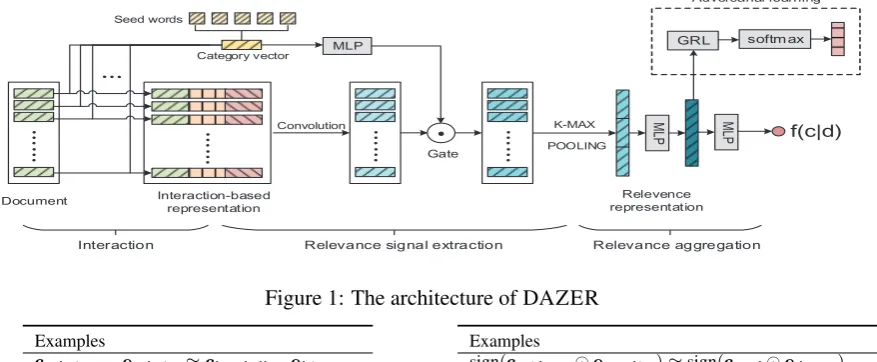
2 Deep Zero-Shot Document Filtering Figure 1 illustrates the network structure of the proposed DAZER model. It consists of two main components: relevance signal extractionand rel-evance aggregation. In the following, we present each component in detail.
2.1 Relevance Signal Extraction
Given a documentd= (w1, w2, ..., w|d|)and a set
of seed wordsSc ={sc,i}for categoryc, we first
map each wordwinto its dense word embedding representationew ∈ Rle wherele denotes the
di-mension number. The embedding representation is pre-trained by using a representation learning method from an external large text corpus. Since our aim is to capture the conceptual relevance, we simply take the averaged embedding of the seed words to represent a category in the embedding space:cc= 1/|Sc|Ps∈Sces.
Interaction-based Representation. It is widely recognized that word embeddings are useful be-cause both syntactic and semantic information of words are well encoded (Mikolov et al., 2013;
infor-噯
噯 噯噯 噯噯
6HHGZRUGV
&DWHJRU\YHFWRU
'RFXPHQW ,QWHUDFWLRQEDVHGUHSUHVHQWDWLRQ
&RQYROXWLRQ .0$;
322/,1*
,QWHUDFWLRQ 5HOHYDQFHVLJQDOH[WUDFWLRQ 5HOHYDQFHDJJUHJDWLRQ
噯
噯 *DWH
0/3
噯
5HOHYHQFH UHSUHVHQWDWLRQ
VRIWPD[ *5/
$GYHUVDULDOOHDUQLQJ
IF_G
0/
3 0/3
[image:3.595.81.520.70.251.2]Figure 1: The architecture of DAZER
Examples
catheism−eatheist≈cbaseball−ehitter
cautos−etoyata≈cmotorcycles−eyamaha
cbaseball−estadium≈cmed−ehosptial
creligion.misc−ef aith≈cmed−epatient
Table 1: Examples by using embedding offset.
mation that captures the offset bettwen a word and a category in the embedding space. These embedding offsets contain more intricate relation-ships for a word pair. A well known example
is: eking −equeen ≈ eman−ewoman (Mikolov
et al.,2013). Similar observations are made when we calculate the embedding offset between words and categories. Table 1 lists several interesting patterns observed for the embedding offsets be-tween a category and a word in 20-Newsgroup dataset (ref. Section3.2for more details). We can see that the embedding offsets are somehow con-sistent with a particular relation between the two category-word pairs.
An effective way to measure the relatedness for two words is the inner product or cosine similarity between two corresponding word em-beddings. This can be considered as a partic-ular linear combination of corresponding feature products for the two embeddings: rel(e1,e2) = P
ig(e1,e2, i)e1,i · e2,i = g(e1,e2)T(e1
e2) where g(e1,e2, i) refers to the weight cal-culated for i-th dimension, and g(e1,e2) =
[g(e1,e2,1);...;g(e1,e2, le)], is the element-wise product operation. The element-element-wise product between two embeddings is also a kind of relative information. The sign of a product of two em-beddings in a specific dimension indicates whether the two embeddings share the same polarity in this dimension. And the resultant value manifests to what extent that this agreement/disagreement reaches. It is intuitive that the element-wise
Examples
sign(cmideastemuslim)≈sign(cmededoctor)
sign(cspaceeorbit)≈sign(chockeyeespn)
sign(celectronicsecircuit)≈sign(cpcecontroller)
sign(ccryptealgorithm)≈sign(cspaceeburning)
Table 2: Examples by using element-wise prod-uct.
product offers some kinds of semantic relations. We conduct the element-wise product for each category-word pair in 20-Newsgroup dataset. Ta-ble 2 lists some interesting patterns we observe. The sign(x) function returns 1 whenx ≥ 0, oth-erwise return −1. Shown in the table, the sign pattern of the element-wise product encodes the relevance information between a category and its related words.
Inspired by these observations, we use these two kinds of element-wise interactions to comple-ment the representation of a word in a docucomple-ment. Specifically, for each wordw in documentd, we derive its interaction-based representationec
w
to-wards categorycas follows:
edif fc,w =cc−ew (1)
eprodc,w =ccew (2)
ecw = [ew⊕edif fc,w ⊕eprodc,w ] (3)
where ⊕ is the vector concatenation operation. Note that these two kinds of feature interactions are mainly overlooked by the existing literature. The embedding offsets are used in deriving word semantic hierarchies in (Fu et al., 2014). How-ever, there is no existing work incorporating these two kinds of feature interactions for relevance es-timation. Here, we expect that these two kinds of feature interactions can magnify the relevance in-formation regarding the category.
mconvolution filters to extract the relevance sig-nals for each word based on its local window of size l in the document. Specifically, after cal-culating the interaction-based representationd = (ec1,ec2, ...,ec|d|)for documentdand categoryc, we apply the convolution operation as follows:
ri =W1eci−l:i+l+b1 (4)
where ri ∈ Rm is the hidden features regard-ing the relevance signal extracted for i-th word,
W1 ∈Rm×3le(2l+1) andb1 ∈
Rmare the weight matrix and the corresponding bias vector respec-tively, eci−l:i+l refers to the concatenation from
eci−l to eci+l. Both l zero vectors are padded to the begining and the end of the document. With a local window of size l, the convolution operation can extract more accurate relevance information by taking the consecutive words (e.g., phrases) into account. We then applyk-max pooling strat-egy to obtain thek most active features for each filter. Letrjk−max denote theklargest values for filter j, we form the overall relevance signals rd
extracted by all m filters through the concatena-tion:rc,d= [r1k−max⊕r2k−max...⊕rmk−max].
Category-specific Gating Mechanism. Given a specific wordw, the interaction-based representa-tion ecw for each category ccould be very differ-ent. Therefore, for a specific local context, the extracted relevance signal from a particular con-volution filter could be also distinct for different categories. It is then reasonable to assume that the relevance signals for a specific category are cap-tured by a subset of filters. We propose to identify which filters are relevant to a category through a category-specific gating mechanism. Given cate-goryc, category-specific gatesac∈Rmare calcu-lated as follows:
ac=σ(W2ec+b2) (5)
whereW2 ∈Rm×3le andb2 ∈Rmare the weight matrix and bias vectors respectively, σ(·) is the
sigmoid function. With category-specific gating mechanism, Equation 4 can be rewritten as fol-lows:ri=ac(W1eci−l:i+l+b1)
Here,acworks ason-off switches formfilters.
Whileac,j →1indicates thatj-th filter should be
turned on to capture the relevance singals under categorycto its fullness, ac,j → 0 indicates that
the filter is turned off due to its irrelevance.
This collaboration of the convolution operation and gating mechanism is similar to the Gated Lin-ear Units (GLU) recently proposed in (Dauphin et al., 2017). Given an input X, GLU calculates the output as follow: h(X) = (XW + b)
σ(XV+c)where the first term in the right side refers to the convolution operation and the second term in the right side refers to the gating mech-anism. In GLU, both the convolution operation and the gates share the same inputX. In contrast, in this work, we aim to identify which filters cap-ture the relevance signals in a category-dependent manner. The experimental results validate that this category-dependent setting brings significant ben-efit for zero-shot filtering performance (ref. Sec-tion3).
2.2 Relevance Aggregation
The raw relevance signals rc,d are somehow
category-dependent, since the relevant filters are category-dependent. The hidden features regard-ing the relevance are distilled through a fully-connected hidden layer with nonlinearity:
hc,d=ga(W3rc,d+b3) (6)
where W3 ∈ Rla×3km and b3 ∈
Rla are the weight matrix and bias vector respectively, ga(·)
is the tanhfunction. This procedure can be con-sidered as a relevance aggregation process. Then, the overall relevance score is then estimated as fol-low:
f(c|d) =tanh(wThc,d+b) (7)
wherew ∈Rla andbare the parameters and bias
respective.
2.3 Model Training
Adversarial Learning The hidden features hc,d
are expected to be category-independent. How-ever, there is no guarantee that the category-specific information is not mixed with the rele-vance information extracted inhc,d. Here, we
in-troduce an adversarial learning mechanism to en-sure that no category-specific information can be memorized during the training. Otherwise, the proposed DAZER may not generalize well to un-seen categories. Specifically, we introduce an cat-egory classifier overhc,dto calculate the
probabil-ity thathc,dbelongs to each category seen during
b4) where W4 ∈ RC×la and b4 ∈ RC are the weight matrix and bias vector for the clas-sifier, C is the number of categories covered by the training set. We aim to optimize param-eters φ = {W4,b4} to successfully classify
hc,d to its true category. Let θ denote the
pa-rameters regarding the calculation of hc,d, i.e.,
θ = {W1,W2,W3,b1,b2,b3}, φ is optimized to minimize the negative log-likelihood:
Lcat(θ, φ) = 1
|T|
X
(d,y)∈T
−pcat(y|hy,d) (8)
whereTdenotes the training set{(d, y)}such that document d is relevant to category y. On the other hand, we expect that hc,d carries no
cate-gory specific information, such that the classifier can not perform the category classification pre-cisely. Hence, we add the Gradient Reversal Layer (GRL) (Ganin and Lempitsky,2015;Ganin et al.,
2016) betweenhc,dand the category classifier. We
can consider GRL as a pseudo-functionRλ(x):
Rλ(x) =x;
∂Rλ
∂x =−λI (9)
It means that θ is optimized to makehc,d
indis-tinguishable by the classifier. In Equation9, pa-rameterλcontrols the importance of the adversar-ial learning. DAZER is devised to return a rel-evance score, we utilize the pairwise margin loss for model training:
Lhinge(θ, δ) = 1
|T|
X
(d,y)∈T
max(0,∆−f(y|d)
+f(y|d−y)) (10)
where documentd−y is the negative sample for cat-egory y, ∆ is the margin and set to be 1 in this work, and δ = {w, b}. Overall, the proposed DAZER is an end-to-end neural network model. The parametersΘ = {θ, φ, δ} are optimized via back propagation and stochastic gradient descent. Specifically, we utilize Adam (Kingma and Ba,
2014) algorithm for parameter update over mini-batches. The final objective loss used in the train-ing is as follow:
L(Θ) =Lhinge(θ, δ) +Lcat(θ, φ) +λΘkΘk2
(11)
whereλΘcontrols the importance of the
regular-izaton term.
Label Seed Words
very negative bad, horrible, negative, disgusting negative bad, confused, unexpected, useless, negative
neutral normal, moderate, neutral, objective, impersonal positive good, positive, outstanding, satisfied, pleased very positive positive, impressive, unbelievable, awesome
Table 3: Seed words selected for Movie Review.
3 Experiment
In this section, we conduct experiments on two real-world document collections to evaluate the ef-fectiveness of the proposed DAZER1.
3.1 Existing Alternative Methods
Here, we compare the proposed DAZER against the following alternative solutions.
BM25 Model: BM25 is a widely known retrieval model based on keyword matching (Robertson and Walker, 1994). The default parameter setting is used in the experiments.
DSSM:DSSM utilizes a multi-layer perceptron to extract hidden representations for both the docu-ment and the query (Huang et al.,2013). Then, co-sine similarity is calculated as the relevance score based on the representation vectors. Since we use pre-trained word embeddings from a large text corpus, we choose to replace the letter-tri-grams representation with the word embedding represen-tation instead. We use the recommended network setting by its authors.
DRMM: DRMM calculates the relevance based on the histogram information of the semantic relat-edness scores between each word in the document and each query word (Guo et al.,2016a). The rec-ommended network setting (i.e., LCH×IDF) and parameter setting are used.
K-NRM: K-NRM is a kernel based neural model for relevance ranking based on word-level hard/soft matching signals (Xiong et al., 2017). We use the recommended setting as in their paper.
DeepRank: DeepRank is a neural relevance ranking model based on the query-centric con-text (Pang et al.,2017). The recommended setting is used for evaluation.
Seed-based Support Vector Machines (SSVM): We build a seed-driven training set by labeling a training document with a category if the document
1The implementation is available at
contains any seed word of that category. Then, we adopt a one-class SVM implemented by sklearn2 for document filtering3. The optimal performance is reported by tuning the hyper-parameter.
3.2 Datasets and Experimental Setup
20-Newsgroup (20NG)4is a widely used bench-mark for document classification research (Li et al., 2016). It consists of approximately 20K newsgroup articles from 20 different categories. The bydate version with 18,846 documents is used here. As provided, the training set and test set contain60%and40%documents respectively.
Movie Review5is a collection of movie reviews in
English (Pang and Lee, 2005). The scale dataset v1.0 is used in the experiments. Based on the numerical ratings, we split these reviews into five sentiment labels: very negative, negative, neu-tral, positive and very positive, which contains
167,1030,1786, 1682, 341reviews respectively. For each sentiment label, we randomly split the reviews into a training set (80%) and a test set (20%).
Since our work targets at zero-shot document filtering for unseen categories, the word embed-dings pre-trained by Glove over a large text corpus with total 840billion tokens6 are used across all the methods and the two datasets. The dimension of the word embeddings isle = 300. No further
word embedding fine-tuning is applied. For both datasets, the stop words are removed firstly. Then, all the words are converted into their lowercased forms. We further remove the words whose word embeddings are not supported by Glove.
Evaluation Protocol. With the specified unseen categories, we take all the training documents of the other categories to train a model. Then, all documents in the test set are used for evaluation. For each unseen category, the task is to rank the documents of that category higher than the oth-ers. Here, we choose to report mean average pre-cision (MAP) for performance evaluation. MAP is a widely used metric to evaluate the ranking qual-ity. The higher the relevant documents are ranked,
2
http://scikit-learn.org
3Signed distance to the separating hyperplan is used for ranking docu-ments.
4
http://qwone.com/˜jason/20Newsgroups/ 5
The Movie Review dataset is available at http://www.cs. cornell.edu/people/pabo/movie-review-data/
6
https://nlp.stanford.edu/projects/glove/
the larger the MAP value is, which means a bet-ter filbet-tering performance. For all neural networks based models, the training documents from one randomly sampled training category work as the validation set for early stop. We report the aver-aged results over 5 runs for all the methods (ex-cluding SSVM and BM25). The statistical signifi-cance is conducted by applying the student t-test.
Seed Word Selection. For 20NG dataset, we directly use the seed words7 manually compiled in (Song and Roth, 2014). These seed words are selected from the category descriptions and widely used in the works of dataless text classi-fication (Song and Roth,2014;Chen et al.,2015;
Li et al.,2016). For Movie Review, following the seed word selection process (i.e.,assisted by stan-dard LDA) proposed in (Chen et al., 2015), we manually select the seed words for each sentiment label. Table3lists the seed words selected for each sentiment label for Movie Review dataset. There are on average5.2and4.6seed words for each cat-egory over 20NG and Movie Review respectively. It is worthwhile to highlight that no category infor-mation is exploited within the seed word selection process.
Parameter Setting. For DAZER, the number of convolution filters ism = 50andk = 3is used for k-max pooling. The dimension size for rele-vance aggregation isla = 75. The local window
sizelis set to be2. The learning rate is0.00001. The models are trained with a batch size of16and λΘ = 0.0001,λ= 0.1.
3.3 Performance Comparison
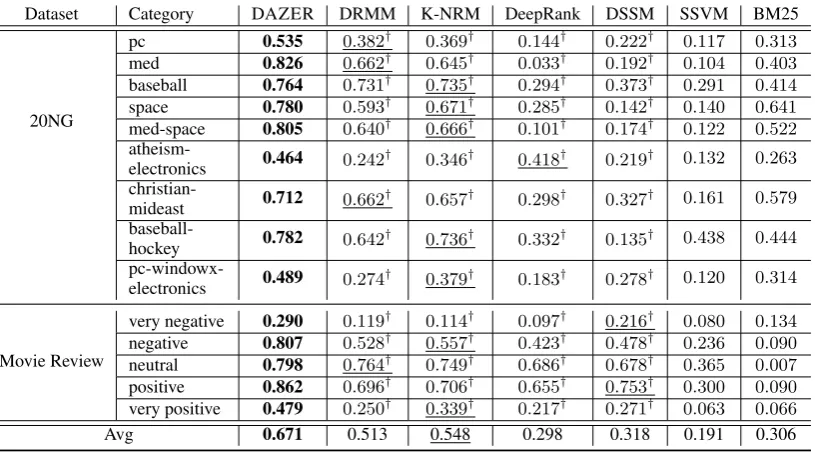
For 20NG dataset, we randomly create 9 docu-ment filtering tasks which cover10out of20 cate-gories. For Movie Review, we take each sentiment label as an unseen category for evaluation. Ta-ble4lists the performance of7methods in terms of MAP for these filtering tasks. Here, we make the following observations.
First, the proposed DAZER significantly achieves much better filtering performance on all
14 tasks across the two datasets. The averaged MAP of DAZER over these 14 filtering tasks is
0.671. Note that only5.2and4.6seed words are used on average for each task. The second best performer is K-NRM, which achieves the second
7The seed words are available at
Dataset Category DAZER DRMM K-NRM DeepRank DSSM SSVM BM25
20NG
pc 0.535 0.382† 0.369† 0.144† 0.222† 0.117 0.313 med 0.826 0.662† 0.645† 0.033† 0.192† 0.104 0.403 baseball 0.764 0.731† 0.735† 0.294† 0.373† 0.291 0.414
space 0.780 0.593† 0.671† 0.285† 0.142† 0.140 0.641
med-space 0.805 0.640† 0.666† 0.101† 0.174† 0.122 0.522
atheism-electronics 0.464 0.242
†
0.346† 0.418† 0.219† 0.132 0.263
christian-mideast 0.712 0.662
†
0.657† 0.298† 0.327† 0.161 0.579
baseball-hockey 0.782 0.642
†
0.736† 0.332† 0.135† 0.438 0.444
pc-windowx-electronics 0.489 0.274
†
0.379† 0.183† 0.278† 0.120 0.314
Movie Review
very negative 0.290 0.119† 0.114† 0.097† 0.216† 0.080 0.134 negative 0.807 0.528† 0.557† 0.423† 0.478† 0.236 0.090
neutral 0.798 0.764† 0.749† 0.686† 0.678† 0.365 0.007
[image:7.595.96.504.64.290.2]positive 0.862 0.696† 0.706† 0.655† 0.753† 0.300 0.090 very positive 0.479 0.250† 0.339† 0.217† 0.271† 0.063 0.066 Avg 0.671 0.513 0.548 0.298 0.318 0.191 0.306
Table 4: Performance of the7methods for zero-shot document filtering in terms of MAP. The best and second best results are highlighted in boldface and underlined respectively, on each task.†indicates that the difference to the best result is statistically significant at0.05level. Avg: averaged MAP over all tasks.
best on7tasks. Overall, the averaged performance gain for DAZER over K-NRM is about30.8%.
Second, We observe that DSSM performs sign-ficantly better for sentiment analysis than for topic categorization. As discussed in Section4, DSSM is designed to perform semantic matching. Com-pared with topic categorization, sentiment analy-sis is more like a semantic matching task. SSVM delivers the worst performance on both datasets. This illustrates that the quality of the labeled doc-uments is essential for supervised learning tech-niques. Apparently, recruiting training documents with the provided seed words in a simple fashion is error-prone. We also note that BM25 achieves inconsistent performance over the two kinds of tasks. It performs especially worse for sentiment analysis. This is reasonable because there are more diverse ways to express a specific sentiment. It is hard to cover a reasonable proportion of doc-uments with limited number of sentimental seed words. In comparison, the proposed DAZER ob-tains a consistent performance for both topic cate-gorization and sentiment analysis.
3.4 Analysis of DAZER
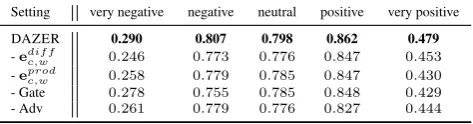
Component Setting.Here, we further discuss the impact of different component settings of DAZER on both 20NG and Movie Review datasets. Ta-ble5and6report the impacts of each component
setting via an ablation test on the two datasets re-spectively. We can see that each component brings significantly positive benefit for document filter-ing. First, we can see that either element-wise sub-traction or product contributes signifcantly to the performance improvement. Specifically, from Ta-ble6, we can see that both the element-wise sub-traction and element-wise product play equally on Movie Review dataset. On the other hand, it is observed that DAZER experiences significantly a much larger performance degradation on 20NG dataset. For example, a MAP of only 0.154 is achieved when eprodc,w is excluded from DAZER
for the filtering taskspace. A much severer case is for the filtering task baseball-hockey. By ex-cludingeprodc,w , the MAP performance of DAZER
is reduced from 0.782 to 0.045. That is, the element-wise product is more critical for extract-ing relevance signals for topical categorization. We also observe that these two hidden feature in-teractions together play a more important role for DAZER. For example, without both edif fc,w and
eprodc,w , DAZER only achieves a MAP of0.126for
filtering taskspace. The large performance deteri-oration is also observed for other filtering tasks on 20NG dataset.
con-Setting pc med baseball space med-space atheism-electronics christian-mideast baseball-hockey pc-windowx-electronics
DAZER 0.535 0.826 0.764 0.780 0.805 0.464 0.712 0.782 0.489 -edif fc,w 0.524 0.810 0.755 0.785 0.802 0.454 0.705 0.788 0.462 -eprod
[image:8.595.181.418.171.233.2]c,w 0.219 0.043 0.200 0.154 0.139 0.217 0.244 0.045 0.141 - Gate 0.518 0.819 0.715 0.780 0.803 0.443 0.695 0.784 0.489 - Adv 0.531 0.819 0.749 0.775 0.795 0.458 0.701 0.779 0.485
Table 5: Impact of different settings for DAZER on 20NG. The best results are highlighted in boldface. -edif fc,w : no element-wise subtraction; -eprodc,w : no element-wise product; - Gate: no category-specific gate
mechanism; - Adv: no adversarial learning.
Setting very negative negative neutral positive very positive
DAZER 0.290 0.807 0.798 0.862 0.479
-edif fc,w 0.246 0.773 0.776 0.847 0.453
-eprod
c,w 0.258 0.779 0.785 0.847 0.430 - Gate 0.278 0.755 0.785 0.848 0.429
- Adv 0.261 0.779 0.776 0.827 0.444
Table 6: Impact of different settings for DAZER on Movie Review. The best results are highlighted in boldface. -edif fc,w : no element-wise subtraction; -eprodc,w : no element-wise product; - Gate: no
category-specific gate mechanism; - Adv: no adversarial learning.
ceptual relevance extraction. Also, without using adversarial learning, DAZER still achieves much better filtering performance than the existing base-line methods compared in Section3.3. This obser-vation is also held on 20NG dataset. This further validates that the two kinds of hidden feature in-teractions indeed encode rich knowledge towards the conceptual relevance.
Impact of Seed Words. It has been recognized that the less seed words incur worse document classification performance in the existing data-less document classification techniques (Song and Roth, 2014; Chen et al., 2015; Li et al., 2016). Following these works, we also use the words ap-pearing in the category name of 20NG dataset as the corresponding seed words8. There are on aver-age2.75 seed words for a category of 20NG. Ta-ble7reports the MAP performace of each method on 20NG dataset. The experimental results show that all methods investigated in Section 3.3 ex-perience signficant performance degradation for most filtering tasks. We plan to incorporate the pseudo-relevance feedback into DAZER to tackle the scarcity of the seed words. One possible so-lution is to enrich the architecture of DAZER to allow few-shot document filtering. That is, the fil-tering decisions of high-confidence are utilized to derive more seed words for better filtering perfor-mance.
8The seed words based on the category name are available
athttps://github.com/WHUIR/STM
4 Related Work
Document filtering is the task to separate rele-vant documents from the irrelerele-vant ones for a spe-cific topic (Robertson and Soboroff,2002;Nanas et al., 2010; Gao et al., 2013, 2015; Proskur-nia et al., 2017). Both ranking and classifica-tion based soluclassifica-tions have been developed ( Har-man,1994;Robertson and Soboroff,2002; Sobo-roff and Robertson, 2003). In earlier days, a fil-tering system is mainly devised to facilitate the document retrieval for the long-term information needs (Mostafa et al., 1997). The term-based pattern mining techniques are widely developed to perform document filtering. A network-based topic profile is built to exploit the term correla-tion patterns for document filtering (Nanas et al.,
2010). Frequent term patterns in terms of fine-grained hidden topics are proposed in (Gao et al.,
2013,2015) for doucment filtering. Very recently, frequent term patterns are also utilized to perform event-based microblog filtering (Proskurnia et al.,
2017). However, these approaches are all based on supervised-learning, which requires a signifi-cant amount of positive documents for each topic. In the era of big data, the information space and new information needs are continuously growing. Retrieval of the relevance information in a short response time becomes a fundamental need. Re-cently, many works have been proposed to con-duct document filtering in an entity-centric man-ner (Frank et al., 2012; Balog and Ramampiaro,
2013; Zhou and Chang, 2013; Reinanda et al.,
Dataset Category DEZA DRMM KNRM DeepRank DSSM SSVM BM25
20NG
pc 0.316 0.170 0.144 0.104 0.316 0.057 0.092 med 0.831 0.369 0.267 0.183 0.089 0.040 0.000
baseball 0.519 0.315 0.301 0.299 0.419 0.066 0.161
space 0.641 0.337 0.326 0.414 0.212 0.049 0.329
med-space 0.670 0.348 0.331 0.279 0.076 0.044 0.165
atheism-electronics 0.359 0.266 0.253 0.499 0.141 0.042 0.091
christian-mideast 0.564 0.582 0.492 0.196 0.418 0.061 0.093
baseball-hockey 0.577 0.409 0.391 0.336 0.154 0.061 0.194
pc-windowx-electronics 0.346 0.176 0.194 0.185 0.227 0.067 0.124
Table 7: Performance of the7methods for zero-shot document filtering in terms of MAP. The words ap-pearing in the category name are used as the seed words. The best and second best results are highlighted in boldface and underlined respectively, on each task.
external knowledge base. Specifically,Balog and Ramampiaro(2013) examine the choice of classi-fication against ranking approaches. They found that ranking approach is more suitable for the fil-tering task. Following this conclusion, we formu-late the zero-shot document filtering as a relevance ranking task. Many information needs may not be well represented by a specific entity. Hence, these entity-centric solutions are restricted to knowledge base related tasks.
Many ad-hoc retrieval models can be used to perform zero-shot document filtering. In-deed, traditional term-based document filtering approaches utilize many term-weighting schemes developed for ad-hoc retrieval. Traditional ad-hoc retrieval models mainly estimate the relevance based on keyword matching. BM25 (Robertson and Walker, 1994) can be considered as the op-timal practice in this line of literature. The re-cent advances in word embedding offer effective learning of word semantic relations from a large external corpus. Several neural relevance ranking models are proposed to preform ad-hoc retrieval based on word embeddings. Both K-NRM (Xiong et al., 2017) and DRMM (Guo et al., 2016a) es-timate the relevance based on the macro-statistics of the hard/soft-match signals in terms of cosine similarity between two word embeddings. Deep-Rank (Pang et al., 2017) first measures the rel-evance signals from the query-centric context of each query keyword matching point through con-volutional operations. Then, RNN based networks are adopted to aggregate these relevance signals. These works achieve significantly better retrieval performance than the keyword matching based
so-lutions and represent the new state-of-the-art. The relevance between a query and a document can also be considered as a matching task between two pieces of text. There are many deep matching models, e.g., DSSM (Huang et al., 2013), ARC-II (Hu et al., 2014), MatchPyramid (Pang et al.,
2016), Match-SRNN (Wan et al., 2016). These models are mainly developed for some specific
semantic matching tasks, e.g., paraphrase identi-fication. Therefore, information like grammati-cal structure or sequence of words are often taken into consideration, which is not applicable to seed word based zero-shot document filtering.
5 Conclusion
In this paper, we propose a noveldeep relevance model for zero-shot document filtering, named DAZER. To enable DAZER to capture con-ceptual relevance and generalize well to unseen categories, two kinds of feature interactions, a gated convolutional network and an category-independent adversarial learning are devised. The experimental results over two different tasks val-idate the superiority of the proposed model. In the future, we plan to enrich the architecture of DAZER to allow few-shot document filtering by incorporating several labeled examples.
6 Acknowledgement
References
Krisztian Balog and Heri Ramampiaro. 2013. Cu-mulative citation recommendation: classification vs. ranking. InSIGIR. pages 941–944.
Ming-Wei Chang, Lev-Arie Ratinov, Dan Roth, and Vivek Srikumar. 2008. Importance of semantic rep-resentation: Dataless classification. InAAAI. pages 830–835.
Xingyuan Chen, Yunqing Xia, Peng Jin, and John A. Carroll. 2015. Dataless text classification with de-scriptive LDA. InAAAI. pages 2224–2231.
Yann N. Dauphin, Angela Fan, Michael Auli, and David Grangier. 2017. Language modeling with gated convolutional networks. InICML. pages 933– 941.
Gregory Druck, Gideon S. Mann, and Andrew McCal-lum. 2008. Learning from labeled features using generalized expectation criteria. In SIGIR. pages 595–602.
Carsten Eickhoff, Sebastian Dungs, and Vu Tran. 2015. An eye-tracking study of query reformulation. In
SIGIR. pages 13–22.
Hui Fang and ChengXiang Zhai. 2006. Semantic term matching in axiomatic approaches to information re-trieval. InSIGIR. pages 115–122.
John R. Frank, Max Kleiman-Weiner, Daniel A. Roberts, Feng Niu, Ce Zhang, Christopher R´e, and Ian Soboroff. 2012. Building an entity-centric stream filtering test collection for TREC 2012. In
TREC.
Ruiji Fu, Jiang Guo, Bing Qin, Wanxiang Che, Haifeng Wang, and Ting Liu. 2014. Learning semantic hier-archies via word embeddings. InACL. pages 1199– 1209.
Yaroslav Ganin and Victor S. Lempitsky. 2015. Unsu-pervised domain adaptation by backpropagation. In
ICML. pages 1180–1189.
Yaroslav Ganin, Evgeniya Ustinova, Hana Ajakan, Pascal Germain, Hugo Larochelle, Franc¸ois Lavi-olette, Mario Marchand, and Victor S. Lempitsky. 2016. Domain-adversarial training of neural net-works. Journal of Machine Learning Research
17:59:1–59:35.
Yang Gao, Yue Xu, and Yuefeng Li. 2013. Pattern-based topic models for information filtering. In
ICDM Workshops. pages 921–928.
Yang Gao, Yue Xu, and Yuefeng Li. 2015. Pattern-based topics for document modelling in informa-tion filtering. IEEE Trans. Knowl. Data Eng.
27(6):1629–1642.
Jiafeng Guo, Yixing Fan, Qingyao Ai, and W. Bruce Croft. 2016a. A deep relevance matching model for ad-hoc retrieval. InCIKM. pages 55–64.
Jiafeng Guo, Yixing Fan, Qingyao Ai, and W. Bruce Croft. 2016b. Semantic matching by non-linear word transportation for information retrieval. In
CIKM. pages 701–710.
Donna Harman. 1994. Overview of the third text re-trieval conference (TREC-3). InTREC. pages 1–20.
Swapnil Hingmire and Sutanu Chakraborti. 2014. Topic labeled text classification: A weakly super-vised approach. InSIGIR. pages 385–394.
Swapnil Hingmire, Sandeep Chougule, Girish K. Pal-shikar, and Sutanu Chakraborti. 2013. Document classification by topic labeling. In SIGIR. pages 877–880.
Baotian Hu, Zhengdong Lu, Hang Li, and Qingcai Chen. 2014. Convolutional neural network architec-tures for matching natural language sentences. In
NIPS. pages 2042–2050.
Po-Sen Huang, Xiaodong He, Jianfeng Gao, Li Deng, Alex Acero, and Larry P. Heck. 2013. Learning deep structured semantic models for web search us-ing clickthrough data. InCIKM. pages 2333–2338.
Diederik P. Kingma and Jimmy Ba. 2014. Adam: A method for stochastic optimization. CoRR
abs/1412.6980.
Chenliang Li, Jian Xing, Aixin Sun, and Zongyang Ma. 2016. Effective document labeling with very few seed words: A topic model approach. InCIKM.
Bing Liu, Xiaoli Li, Wee Sun Lee, and Philip S. Yu. 2004. Text classification by labeling words. In
AAAI. pages 425–430.
Tomas Mikolov, Kai Chen, Greg Corrada, and Jef-frey Dean. 2013. Efficient estimation of word representations in vector space. arXiv preprint arXiv:1301.3781.
Javed Mostafa, Snehasis Mukhopadhyay, Wai Lam, and Mathew J. Palakal. 1997. A multilevel approach to intelligent information filtering: Model, system, and evaluation. ACM Trans. Inf. Syst. 15(4):368– 399.
Nikolaos Nanas, Manolis Vavalis, and Anne N. De Roeck. 2010. A network-based model for high-dimensional information filtering. InSIGIR. pages 202–209.
Bo Pang and Lillian Lee. 2005. Seeing stars: Exploit-ing class relationships for sentiment categorization with respect to rating scales. In ACL. pages 115– 124.
Liang Pang, Yanyan Lan, Jiafeng Guo, Jun Xu, Jing-fang Xu, and Xueqi Cheng. 2017. Deeprank: A new deep architecture for relevance ranking in informa-tion retrieval. InCIKM. pages 257–266.
Jeffrey Pennington, Richard Socher, and Christo-pher D. Manning. 2014. Glove: Global vectors for word representation. InEMNLP. pages 1532–1543.
Julia Proskurnia, Ruslan Mavlyutov, Carlos Castillo, Karl Aberer, and Philippe Cudr´e-Mauroux. 2017. Efficient document filtering using vector space topic expansion and pattern-mining: The case of event de-tection in microposts. InCIKM. pages 457–466.
Ridho Reinanda, Edgar Meij, and Maarten de Rijke. 2016. Document filtering for long-tail entities. In
CIKM. pages 771–780.
Stephen E. Robertson and Ian Soboroff. 2002. The TREC 2002 filtering track report. InTREC.
Stephen E. Robertson and Steve Walker. 1994. Some simple effective approximations to the 2-poisson model for probabilistic weighted retrieval. InSIGIR. pages 232–241.
Ian Soboroff and Stephen E. Robertson. 2003. Build-ing a filterBuild-ing test collection for TREC 2002. In SI-GIR. pages 243–250.
Yangqiu Song and Dan Roth. 2014. On dataless hier-archical text classification. In AAAI. pages 1579– 1585.
Shengxian Wan, Yanyan Lan, Jun Xu, Jiafeng Guo, Liang Pang, and Xueqi Cheng. 2016. Match-srnn: Modeling the recursive matching structure with spa-tial RNN. InIJCAI. pages 2922–2928.
Ho Chung Wu, Robert W. P. Luk, Kam-Fai Wong, and K. L. Kwok. 2007. A retrospective study of a hybrid document-context based retrieval model. Inf. Pro-cess. Manage.43(5):1308–1331.
Chenyan Xiong, Zhuyun Dai, Jamie Callan, Zhiyuan Liu, and Russell Power. 2017. End-to-end neural ad-hoc ranking with kernel pooling. InSIGIR. pages 55–64.