Image-Mediated Learning for
Zero-Shot Cross-Lingual Document Retrieval
Ruka Funaki, Hideki Nakayama
Machine Perception Group
Graduate School of Information Science and Technology The University of Tokyo
{funaki,nakayama}@nlab.ci.i.u-tokyo.ac.jp
Abstract
We propose an image-mediated learning approach for cross-lingual document re-trieval where no or only a few parallel corpora are available. Using the images in image-text documents of each language as the hub, we derive a common seman-tic subspace bridging two languages by means of generalized canonical correla-tion analysis. For the purpose of evalu-ation, we create and release a new doc-ument dataset consisting of three types of data (English text, Japanese text, and images). Our approach substantially en-hances retrieval accuracy in zero-shot and few-shot scenarios where text-to-text ex-amples are scarce.
1 Introduction
Cross-lingual document retrieval (CLDR) is the task of finding relevant documents in one guage given a query document in another lan-guage. While sufficiently large-scale corpora are critical for parallel corpus-based learning meth-ods, manually creating corpora requires huge hu-man effort and is unrealistic in hu-many cases.
A straightforward approach is to crawl bilin-gual documents from the Web for use as train-ing data. However, because most documents on the Web are written in one language, it is not al-ways easy to collect a sufficient number of multi-lingual documents, especially those involving mi-nor languages. Let us consider the multimedia information in documents. We can, for exam-ple, find abundant pairings of text and images, e.g., text with the ALT property of<IMG>tags in HTML, text with photos posted to social network-ing sites, and articles on Web news posted with images. Unlike text, an image is a universal rep-resentation; we can easily understand the semantic
Learn relation indirectly
Language 1 Documents Language 2 Documents
images images pairs pairs
similarity
Image-Mediated Learning
Language1
[image:1.595.308.526.208.322.2]Texts Language2Texts
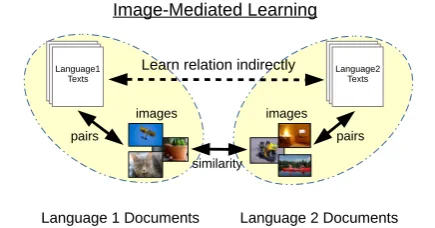
Figure 1: Concept of image-mediated learning. Our idea is to learn the relation between two lan-guages indirectly by using images attached to text. If two documents written in different languages include images with similar image features, it is likely that the texts contained in the two docu-ments are similar. Based on this idea, we seek the relation of texts written in different languages me-diated by the similarity between images.
content of images regardless of our mother tongue. Motivated by this observation, we expect that we can learn the relation of two languages indirectly through images, even if we do not have sufficient bilingual text pairs (Figure 1).
Generally, traditional image recognition tech-niques (or image features) are very poor com-pared with those in the natural language process-ing field. In recent years, however, deep learnprocess-ing has resulted in a breakthrough in visual recogni-tion and dramatically improved image recognirecogni-tion accuracy in generic domains, which is rapidly ap-proaching human recognition levels (Fang et al., 2015). We expect that these state-of-the-art im-age recognition technologies can effectively assist CLDR tasks.
We show that hub images enable zero-shot training of CLDR systems and improve retrieval accuracy given only a few parallel text samples.
2 Related Work
2.1 Multimodal Learning for CLDR
Multimodal learning, defined as a framework for machine learning using inputs from multiple me-dia or sensors, has played a key role in various cross-modal applications. The most widely used standard method for multimodal learning is canon-ical correlation analysis (CCA) (Hotelling, 1936), which projects multimodal data into a shared rep-resentation. For example, CCA has been success-fully used in image retrieval (tag to images) and image annotation (image to tags) (Hardoon et al., 2004; Rasiwasia et al., 2010; Gong et al., 2014). In the context of CLDR, each language’s texts con-stitute one modality. CCA has also commonly been used for cross-lingual information retrieval (Vinokourov et al., 2002; Li and Shawe-Taylor, 2004; Udupa and Khapra, 2010). Whereas CCA can handle only two modalities, we need to con-sider relations between three modalities because we use images in addition to the two languages. Therefore, we focus on an extension of CCA, gen-eralized canonical correlation analysis (GCCA), to handle more than two inputs (Kettenring, 1971).
2.2 Zero-Shot Learning for CLDR
Our core idea is to use another modality (image) as a hub to indirectly learn the relevance between two different languages. The work by Rupnik et al. is probably the closest to ours (Rupnik et al., 2012). In their study, they used a popular language (e.g., English) with enough bilingual documents shared with other languages as a hub to enhance CLDR for minor languages with few direct bilin-gual texts available. Nevertheless, this method assumes that parallel corpora of the hub and tar-get languages exist and therefore, its application is limited to specific domains where manual transla-tions are readily available, such as Wikipedia and news sites. Contrarily, because we use images as the hub, we can use documents closed with respect to each language for training. Considering that current generic Web documents are mostly closed with respect to one language, yet equipped with rich multimedia data, our setup is assumed to be more reasonable.
Division English Images Japanese
1 [train-E/I] E1 I1
-2 [train-I/J] - I2 J2
3 [train-E/J] E3 - J3
[image:2.595.310.527.61.136.2]4 [test-E/J] E4 - J4
Table 1: Division of training and test data. Each division of training dataset is missing one of the three modalities.
PCA projection English Features PCA
PCA
PCA
GCCA Image Features
Japanese Features
English Features GCCA projection
Japanese Features
Joint Space Training
Test
GCCA projection
English Features
Japanese Features Nearest Neighbors
Search
PCA projection
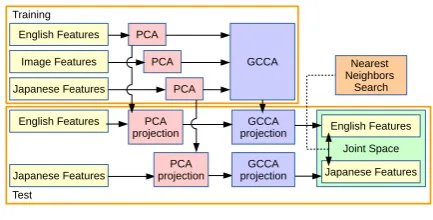
Figure 2: System overview
3 Our Approach
3.1 Overview of Image-Mediated Learning We use the following notations for specifying each non-overlapping data division.
1. [train-E/I]: Training documents consisting of English text and images.
2. [train-I/J]: Training documents consisting of images and Japanese text.
3. [train-E/J]: Training documents consisting of English and Japanese text.
4. [test-E/J]: Test documents consisting of En-glish and Japanese text.
We define IDs for each modality in each division as given in Table 1. For example, E1 represents features of English text in the [train-E/I] division. Typical CLDR based on parallel corpora uses only [train-E/J] for training and [test-E/J] for evalua-tion. In the zero-shot learning scenario without any [train-E/J] data, we use only [train-E/I] and [train-I/J] for training. In the few-shot learning scenario, we also use a small number of [train-E/J] samples. We call this approach image-mediated learning.
[image:2.595.307.524.191.301.2]3.2 Feature Extraction
A convolutional neural network (CNN) is one of the most successful deep learning methods for vi-sual recognition. It is known that we can ob-tain very good image features by taking activation of hidden neurons in a network pre-trained by a sufficiently large dataset (Donahue et al., 2013). We apply the CNN model pre-trained using the ILSVRC2012 dataset (Russakovsky et al., 2015) provided by Caffe (Jia et al., 2014), a standard deep learning software package in the field of vi-sual recognition.
As the text feature for both English and Japanese, we use the bag-of-words (BoW) rep-resentation and term frequency-inverse document frequency (TF-IDF) weighting. The MeCab (Kudo et al., 2004) library is used to divide Japanese text into words by morphological analy-sis. No preprocessing approaches like eliminating stop words and stemming, are used.
3.3 GCCA
GCCA is a generalization of CCA for any m
modalities (m = 3 in our case). Although sev-eral slightly different versions of GCCA have been proposed (Carroll, 1968; Rupnik et al., 2012; Velden and Takane, 2012), we implement the sim-plest one (Kettenring, 1971) because GCCA itself is not the main focus of this study.
Let E, I, and J denote English, images, and Japanese, respectively. For feature vector xk,∀k ∈ {E, I, J}, let zk = (xk −xk)hk de-note its canonical variables. Σij denotes a covari-ance matrix of modalities i and j where i, j ∈ {E, I, J}. Projection vectors hk are computed such that they maximize the sum of correlations between each pair of modalities obtained by solv-ing the followsolv-ing generalized eigenvalue problem:
1 2
Σ0IE Σ0EI ΣΣEJIJ
ΣJE ΣJI 0
h
=ρ
ΣEE0 Σ0II 00
0 0 ΣJJ
h
(1)
where h = (hT
E,hTI,hTJ)T. The canon-ical axises h are normalized such that
1 3
∑3
k∈{E,I,J}hTkΣkkhk = 1. Additionally,
we add a regularization term to the self covariance matrices to prevent over-fitting; that is, we set Σkk→Σkk+αI, whereαis a parameter to avoid
the singularity issue.
Despite our training datasets having only two of the three modalities as given in Table 1, we can handle this situation naturally by computing covariance matrices from the available data only. For example, in the few-shot learning scenario, we computeΣEI using E1 andI1, andΣEE us-ingE1andE3. In the zero-shot learning scenario, because [train-E/J] is not available, we compute ΣEEusingE1only and use a zero matrix forΣEJ.
3.4 Nearest Neighbor Search in Joint Space We can find relevant documents in another lan-guage by computing the distances from the query documents using the coupled canonical subspaces. Having set Japanese as the query language, we retrieve documents written in English. Nearest neighbors are obtained as follows:
ˆ
j:= arg min
j d(z
i
J,zjE), (2)
wherezi
J,zjE are projected feature vectors of the query and target documents, respectively, andd(·) is a distance function, which in our case, is the Euclidean distance.
4 Experiment
4.1 Pascal Sentence Dataset with Japanese Translation
The UIUC Pascal Sentence Dataset (Rashtchian et al., 2010) contains 1000 images, each of which is annotated with five English sentences describ-ing its content. This dataset was originally created for the study of sentence generation from images, which is one of the current hot topics in computer vision. To establish a new benchmark dataset for image-mediated CLDR, we included a Japanese translation for each English sentence provided by professional translators1, as shown in Figure 3. In
this experiment, we bundled the five sentences at-tached to each image for use as one text document. Therefore, in our setup, each of the 1000 docu-ments in the dataset consists of three items: an im-age, and the corresponding English and Japanese text.
1Dataset is available at:
- A family on a boat with a cross on a river - A happy couple with a young child wearing a life preserver sitting on a boat.
- A man, a woman, and a child sit on boat with a large cross on it.
- A man, women and small child sitting on top of a boat moving along the river.
- Family of three sitting on deck, child wearing red vest, brush and shoes are seen in the foreground.
- 川で十字架のあるボートに乗っている家族。 - ボートに座っている、救命具を着た幼い子ど もと幸せなカップル。
- 男性、女性と子どもが大きな十字架のある ボートに座っています。
- 川に沿って動いているボートの上部に座って いる男性、女性と小さな子ども。
- ブラシと靴が前景に写されている、子どもが 赤いベストを着て、デッキに座っている三人 の家族。
︙
English Texts Images Japanese Texts
︙ ︙
- A black and white cow in a grassy field stares at the camera.
- A black and white cow standing in a grassy field.
- A black and white cow stands on grass against a partly cloudy blue sky.
- a cow is gazing over the grass he is about to graze
- Black and white cow standing in grassy field.
- 草地の黒と白の雌牛がカメラをじっと見てい ます。
- 草地に立っている黒と白の雌牛。
- 一部曇った青空を背に黒と白の雌牛が草地に 立っています。
- 雌牛が食べようとしている草をじっと眺めて います。
[image:4.595.87.510.66.252.2]- 草地に立っている黒と白の雌牛。
Figure 3: Examples from the Pascal Sentence Dataset with Japanese translations: each image has about five sentences describing it from different perspectives.
4.2 Evaluation
We randomly sampled data from the dataset for each division in Table 1 without any overlap; we ignored the modality of each document that was not available in each data division (e.g., Japanese text in [train-E/I]). We ran experiments with vary-ing sample sizes for [train-E/I] and [train-I/J], that is, 100, 200, 300, and 400. Furthermore, we grad-ually increased the number of [train-E/J] samples from 0 to 100 to emulate the few-shot learning sce-nario. The size of the test data [test-E/J] was fixed at 100. Following this setup, we performed image-mediated CLDR based on GCCA, and compared the results with those obtained by standard CLDR using only [train-E/J] data with CCA. We eval-uated the performance with respect to the top-1 Japanese to English retrieval accuracy in the test data. Given that we used 100 test samples, the chance rate was 1%. For each run, we conducted 50 trials randomly replacing data and used the av-erage score. All features were compressed into 100 dimensions via PCA andαwas set to 0.01.
The experimental results, illustrated in Figure 4, clearly show that better accuracy is obtained with a greater number of text-image data in both zero-shot and few-zero-shot scenarios. We can expect even better zero-shot accuracy with more text-image data, although, we cannot increase [train-E/I] and [train-I/J] more than 400 each in the current setup because of the restricted dataset size. We sum-marized results in zero-shot scenario in Table 2 in several cases. Although both GCCA and CCA show improved performance as the sample size
0 20 40 60 80 100
Sample Size of [train-E/J] 0
10 20 30 40 50 60 70
Top 1 Retrieval Accuracy(%) CCAGCCA-400
GCCA-300 GCCA-200 GCCA-100
Figure 4: Retrieval accuracy varying the num-ber of [train-E/J] data. Each colored line shows the performance of our method with a differ-ent sample size of [train-E/I] and [train-I/J] data (e.g., GCCA-400 denotes respective 400 samples of [train-E/I] and [train-I/J] for GCCA). We used image features extracted from GoogLeNet and text features represented as bags-of-words.
[image:4.595.314.531.322.479.2]Model Accuracy(%) GCCA-400(BoW) 37.4±3.8 GCCA-300(BoW) 27.6±3.4 GCCA-200(BoW) 14.7±3.2 GCCA-100(BoW) 9.8±2.3 GCCA-400(TF-IDF) 42.0±4.6 GCCA-300(TF-IDF) 31.6±4.3 GCCA-200(TF-IDF) 17.2±2.6 GCCA-100(TF-IDF) 11.8±2.7 Table 2: Accuracy of zero-shot learning. Image features are extracted from GoogLeNet and both the bag-of-words (BoW) and the TF-IDF model are used as text features.
0 20 40 60 80 100
Sample Size of [train-E/J] 0
10 20 30 40 50 60 70
Top 1 Retrieval Accuracy (%) CCACNN(GoogLeNet)
[image:5.595.93.272.61.192.2]CNN(VGG) CNN(CaffeNet) FisherVector
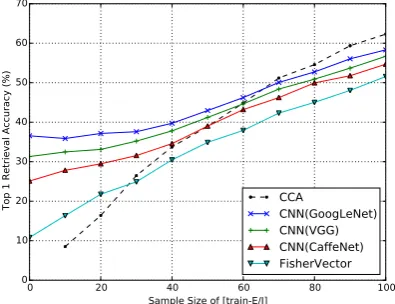
Figure 5: Retrieval accuracy using different image features in image-mediated CLDR. The sample size of both [train-E/I] and [train-I/J] is 400. Text features are based on the bag-of-words model.
4.3 Effect of Image Features
We also verified the effect of the performance of image features in our framework (see Figure 5 and Table 3). CNN has improved dramatically over the last few years, and many new powerful pre-trained networks are currently available. We compared three different features extracted from GoogLeNet (Szegedy et al., 2014), VGG 16 lay-ers (Chatfield et al., 2014), and CaffeNet (Jia et al., 2014; Krizhevsky et al., 2012). Additionally, we tested the Fisher Vector (Perronnin et al., 2010), which was the standard hand-crafted image fea-ture before deep learning. We extracted feafea-tures from the pool5/7x7 s1 layer in GoogLeNet, fc6 layer in VGG, and fc6 layer in CaffeNet. For the Fisher Vector, following the standard implemen-tation, we compressed SIFT descriptors (Lowe,
Feature Accuracy(%)
CNN(GoogLeNet), BoW 37.4±3.8
CNN(VGG), BoW 31.3±3.5
CNN(CaffeNet), BoW 25.1±3.4
FisherVector, BoW 10.8±2.7
CNN(GoogLeNet), TF-IDF 42.0±4.6
CNN(VGG), TF-IDF 37.8±2.9
CNN(CaffeNet), TF-IDF 29.7±4.4 FisherVector, TF-IDF 12.6±2.7 Table 3: Accuracy of zero-shot learning in multi-ple image features. The sammulti-ple size of both [train-E/I] and [train-I/J] is 400. Both the bag-of-words (BoW) and the TF-IDF model are used as text fea-tures.
1999) into 64 dimensions by PCA, and used a Gaussian mixture model with 64 components. We used four spatial grids for the final feature extrac-tion. Overall, the order of performance of features corresponds to that known in the image classifica-tion domain (Russakovsky et al., 2015). This re-sult indicates that when more powerful image fea-tures are used, better performance can be achieved in image-mediated CLDR.
5 Conclusion
We proposed an image-mediated learning ap-proach to realize zero-shot or few-shot CLDR. For evaluation, we created and released a new dataset consisting of Japanese, English, and image triplets, based on the widely used Pascal Sentence Dataset. We showed that state-of-the-art CNN-based image features can substantially improve zero-shot CLDR performance. Considering that image features have continued to improve rapidly since the deep learning breakthrough and the uni-versality of images in Web documents, this ap-proach could become even more important in the future.
Acknowledgments
This work was supported by JST CREST, JSPS KAKENHI Grant Number 26730085. We thank the three anonymous reviewers for their helpful comments.
References
[image:5.595.86.284.282.434.2]vari-ables. InProceedings of the 76th Annual Conven-tion of the American Psychological AssociaConven-tion, vol-ume 3, pages 227–228.
Ken Chatfield, Karen Simonyan, Andrea Vedaldi, and Andrew Zisserman. 2014. Return of the Devil in the Details: Delving Deep into Convolutional Nets. In Proceedings of the British Machine Vision Con-ference, pages 1–11.
Jeff Donahue, Yangqing Jia, Oriol Vinyals, Judy Hoff-man, Ning Zhang, Eric Tzeng, and Trevor Darrell. 2013. DeCAF: A Deep Convolutional Activation Feature for Generic Visual Recognition. In Proceed-ings of the International Conference on Machine Learning, pages 647–655.
Hao Fang, Saurabh Gupta, Forrest Iandola, K. Ru-pesh Srivastava, Li Deng, Piotr Doll´ar, Jianfeng Gao, Xiaodong He, Margaret Mitchell, John C. Platt, C. Lawrence Zitnick, and Geoffrey Zweig. 2015. From Captions to Visual Concepts and Back. In
Proceedings of the IEEE Conference on Computer Vision and Pattern Recognition.
Yunchao Gong, Qifa Ke, Michael Isard, and Svetlana Lazebnik. 2014. A Multiview Embedding Space for Modeling Internet Images, Tags, and their Se-mantics. International Journal of Computer Vision, 106(2):210–233.
David R Hardoon, Sandor Szedmak, and John Shawe-Taylor. 2004. Canonical Correlation Analysis: an Overview with Application to Learning Methods.
Neural Computation, 16(12):2639–2664.
Harold Hotelling. 1936. Relations between Two Sets of Variants. Biometrika, 28:321–377.
Yangqing Jia, Evan Shelhamer, Jeff Donahue, Sergey Karayev, Jonathan Long, Ross Girshick, Sergio Guadarrama, and Trevor Darrell. 2014. Caffe : Convolutional Architecture for Fast Feature
Embed-ding. InProceedings of the ACM International
Con-ference on Multimedia, pages 675–678.
Jon Robers Kettenring. 1971. Canonical Analysis of
Several Sets of Variables. Biometrika, 58(3):433–
451.
Alex Krizhevsky, Ilya Sutskever, and Geoffrey E. Hin-ton. 2012. ImageNet Classification with Deep
Con-volutional Neural Networks. InAdvances in Neural
Information Processing Systems, pages 1097–1105. Taku Kudo, Kaoru Yamamoto, and Yuji Matsumoto.
2004. Applying Conditional Random Fields to
Japanese Morphological Analysis. InProceedings
of the 2004 Conference on Empirical Methods in Natural Language Processing, pages 230–237. Yaoyong Li and John Shawe-Taylor. 2004. Using
KCCA for Japanese-English Cross-language
Infor-mation Retrieval and Classification. In Learning
Methods for Text Understanding and Mining Work-shop, pages 117–133.
David G Lowe. 1999. Object recognition from local scale-invariant features. InProceedings of the Sev-enth IEEE International Conference on Computer Vision, volume 2, pages 1150–1157.
Florent Perronnin, Jorge S´anchez, and Thomas Mensink. 2010. Improving the Fisher kernel for
large-scale image classification. In Proceedings
of the European Conference on Computer Vision, pages 143–156.
Cyrus Rashtchian, Peter Young, Micah Hodosh, Ju-lia Hockenmaier, and North Goodwin Ave. 2010.
Collecting Image Annotations Using Amazon ’s
Mechanical Turk. Human Language Technologies:
The 2010 Annual Conference of the North Ameri-can Chapter of the Association for Computational Linguistics Workshop on Creating Speech and Lan-guage Data with Amazon’s Mechanical Turk, pages 139–147.
Nikhil Rasiwasia, Jose Costa Pereira, Emanuele Coviello, Gabriel Doyle, Gert R.G. Lanckriet, Roger Levy, and Nuno Vasconcelos. 2010. A New
Ap-proach to Cross-modal Multimedia Retrieval.
Pro-ceedings of the International Conference on Multi-media, pages 251–260.
Jan Rupnik, Andrej Muhiˇc, and Primo ˇSkraba. 2012. Cross-Lingual Document Retrieval through Hub
Languages. InNeural Information Processing
Sys-tems Workshop.
Olga Russakovsky, Jia Deng, Hao Su, Jonathan Krause, Sanjeev Satheesh, Sean Ma, Zhiheng Huang, An-drej Karpathy, Aditya Khosla, Michael Bernstein, Alexander C. Berg, and Li Fei-Fei. 2015. ImageNet
Large Scale Visual Recognition Challenge.
Interna-tional Journal of Computer Vision.
Christian Szegedy, Scott Reed, Pierre Sermanet, Vincent Vanhoucke, and Andrew Rabinovich.
2014. Going deeper with convolutions. CoRR
abs/1409.4842.
Raghavendra Udupa and Mitesh M Khapra. 2010. Improving the Multilingual User Experience of Wikipedia Using Cross-Language Name Search.
Human Language Technologies: The 2010 Annual Conference of the North American Chapter of the Association for Computational Linguistics, pages 492–500.
Michel Velden and Yoshio Takane. 2012. General-ized Canonical Correlation Analysis with Missing Values.Computational Statistics, 27(3):551–571. Alexei Vinokourov, John Shawe-Taylor, and Nello
Cristianini. 2002. Inferring a Semantic Representa-tion of Text via Cross-Language CorrelaRepresenta-tion
Anal-ysis. Advances in Neural Information Processing