Proceedings of the 55th Annual Meeting of the Association for Computational Linguistics, pages 2121–2130 Vancouver, Canada, July 30 - August 4, 2017. c2017 Association for Computational Linguistics Proceedings of the 55th Annual Meeting of the Association for Computational Linguistics, pages 2121–2130
Vancouver, Canada, July 30 - August 4, 2017. c2017 Association for Computational Linguistics
Semi-supervised Multitask Learning for Sequence Labeling
Marek Rei
The ALTA Institute Computer Laboratory University of Cambridge
United Kingdom
Abstract
We propose a sequence labeling frame-work with a secondary training objec-tive, learning to predict surrounding words for every word in the dataset. This lan-guage modeling objective incentivises the system to learn general-purpose patterns of semantic and syntactic composition, which are also useful for improving accu-racy on different sequence labeling tasks. The architecture was evaluated on a range of datasets, covering the tasks of error detection in learner texts, named entity recognition, chunking and POS-tagging. The novel language modeling objective provided consistent performance improve-ments on every benchmark, without re-quiring any additional annotated or unan-notated data.
1 Introduction
Accurate and efficient sequence labeling mod-els have a wide range of applications, including named entity recognition (NER), part-of-speech (POS) tagging, error detection and shallow pars-ing. Specialised approaches to sequence label-ing often include extensive feature engineerlabel-ing, such as integrated gazetteers, capitalisation fea-tures, morphological information and POS tags. However, recent work has shown that neural net-work architectures are able to achieve compara-ble or improved performance, while automatically discovering useful features for a specific task and only requiring a sequence of tokens as input ( Col-lobert et al.,2011;Irsoy and Cardie,2014;Lample et al.,2016).
This feature discovery is usually driven by an objective function based on predicting the anno-tated labels for each word, without much incentive
to learn more general language features from the available text. In many sequence labeling tasks, the relevant labels in the dataset are very sparse and most of the words contribute very little to the training process. For example, in the CoNLL 2003 NER dataset (Tjong Kim Sang and De Meulder,
2003) only 17% of the tokens represent an entity. This ratio is even lower for error detection, with only 14% of all tokens being annotated as an error in the FCE dataset (Yannakoudakis et al., 2011). The sequence labeling models are able to learn this bias in the label distribution without obtaining much additional information from words that have the majority label (O for outside of an entity; C for correct word). Therefore, we propose an addi-tional training objective which allows the models to make more extensive use of the available data.
The task of language modeling offers an eas-ily accessible objective – learning to predict the next word in the sequence requires only plain text as input, without relying on any particular annota-tion. Neural language modeling architectures also have many similarities to common sequence label-ing frameworks: words are first mapped to dis-tributed embeddings, followed by a recurrent neu-ral network (RNN) module for composing word sequences into an informative context represen-tation (Mikolov et al., 2010;Graves et al., 2013;
Chelba et al., 2013). Compared to any sequence labeling dataset, the task of language modeling has a considerably larger and more varied set of pos-sible options to predict, making better use of each available word and encouraging the model to learn more general language features for accurate com-position.
In this paper, we propose a neural sequence labeling architecture that is also optimised as a language model, predicting surrounding words in the dataset in addition to assigning labels to each token. Specific sections of the network are
timised as a forward- or backward-moving lan-guage model, while the label predictions are per-formed using context from both directions. This secondary unsupervised objective encourages the framework to learn richer features for semantic composition without requiring additional training data. We evaluate the sequence labeling model on 10 datasets from the fields of NER, POS-tagging, chunking and error detection in learner texts. Our experiments show that by including the unsuper-vised objective into the training process, the se-quence labeling model achieves consistent perfor-mance improvements on all the benchmarks. This multitask training framework gives the largest im-provements on error detection datasets, outper-forming the previous state-of-the-art architecture.
2 Neural Sequence Labeling
We use the neural network model of Rei et al.
(2016) as the baseline architecture for our se-quence labeling experiments. The model takes as input one sentence, separated into tokens, and as-signs a label to every token using a bidirectional LSTM.
The input tokens are first mapped to a sequence of distributed word embeddings [x1, x2, x3, ..., xT]. Two LSTM (Hochreiter and Schmidhuber, 1997) components, moving in opposite directions through the sentence, are then used for constructing context-dependent representations for every word. Each LSTM takes as input the hidden state from the previous time step, along with the word embedding from the current step, and outputs a new hidden state. The hidden representations from both directions are concatenated, in order to obtain a context-specific representation for each word that is conditioned on the whole sentence in both directions:
− →
ht =LST M(xt,−−→ht−1) (1)
←−
ht =LST M(xt,←−−ht+1) (2)
ht= [−→ht;←h−t] (3)
Next, the concatenated representation is passed through a feedforward layer, mapping the compo-nents into a joint space and allowing the model to learn features based on both context directions:
dt=tanh(Wdht) (4)
whereWdis a weight matrix andtanhis used as
the non-linear activation function.
In order to predict a label for each token, we use either a softmax or CRF output architecture. For softmax, the model directly predicts a normalised distribution over all possible labels for every word, conditioned on the vectordt:
P(yt|dt) =sof tmax(Wodt)
= e
Wo,kdt
P ˜ k∈Ke
Wo,˜kdt
(5)
where K is the set of all possible labels, and Wo,k is thek-th row of output weight matrixWo.
The model is optimised by minimising categori-cal crossentropy, which is equivalent to minimis-ing the negative log-probability of the correct la-bels:
E=−
T X
t=1
log(P(yt|dt)) (6)
While this architecture returns predictions based on all words in the input, the labels are still predicted independently. For some tasks, such as named entity recognition with a BIO1scheme,
there are strong dependencies between subsequent labels and it can be beneficial to explicitly model these connections. The output of the architec-ture can be modified to include a Conditional Ran-dom Field (CRF,Lafferty et al.(2001)), which al-lows the network to look for the most optimal path through all possible label sequences (Huang et al.,
2015;Lample et al.,2016). The model is then op-timised by maximising the score for the correct la-bel sequence, while minimising the scores for all other sequences:
E=−s(y) +logX ˜ y∈Ye
es(˜y) (7)
wheres(y)is the score for a given sequenceyand Y is the set of all possible label sequences.
We also make use of the character-level compo-nent described byRei et al.(2016), which builds an alternative representation for each word. The individual characters of a word are mapped to character embeddings and passed through a bidi-rectional LSTM. The last hidden states from both direction are concatenated and passed through a
1Each NER entity has sub-tags for Beginning, Inside and
h2
x2 d2 o2
h2
proposes
m2 q2
m2 q2
O
Fischler measures
h3
x3 d3 o3
h3
measures
m3 q3
m3 q3
O
proposes </s>
h1
x1 d1 o1
h1
Fischler
m1 q1
m1 q1
PER
[image:3.595.74.527.61.192.2]<s> proposes
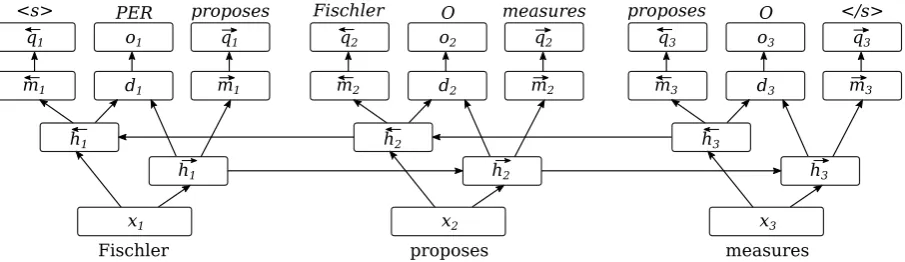
Figure 1: The unfolded network structure for a sequence labeling model with an additional language modeling objective, performing NER on the sentence”Fischler proposes measures”. The input tokens are shown at the bottom, the expected output labels are at the top. Arrows above variables indicate the directionality of the component (forward or backward).
nonlinear layer. The resulting vector representa-tion is combined with a regular word embedding using a dynamic weighting mechanism that adap-tively controls the balance between word-level and character-level features. This framework allows the model to learn character-based patterns and handle previously unseen words, while still taking full advantage of the word embeddings.
3 Language Modeling Objective
The sequence labeling model in Section2is only optimised based on the correct labels. While each token in the input does have a desired label, many of these contribute very little to the training pro-cess. For example, in the CoNLL 2003 NER dataset (Tjong Kim Sang and De Meulder,2003) there are only 8 possible labels and 83% of the to-kens have the label O, indicating that no named entity is detected. This ratio is even higher for er-ror detection, with 86% of all tokens containing no errors in the FCE dataset (Yannakoudakis et al.,
2011). The sequence labeling models are able to learn this bias in the label distribution without ob-taining much additional information from the ma-jority labels. Therefore, we propose a supplemen-tary objective which would allow the models to make full use of the training data.
In addition to learning to predict labels for each word, we propose optimising specific sections of the architecture as language models. The task of predicting the next word will require the model to learn more general patterns of semantic and syntactic composition, which can then be reused in order to predict individual labels more accu-rately. This objective is also generalisable to any
sequence labeling task and dataset, as it requires no additional annotated training data.
A straightforward modification of the sequence labeling model would add a second parallel output layer for each token, optimising it to predict the next word. However, the model has access to the full context on each side of the target token, and predicting information that is already explicit in the input would not incentivise the model to learn about composition and semantics. Therefore, we must design the loss objective so that only sec-tions of the model that have not yet observed the next word are optimised to perform the prediction. We solve this by predicting the next word in the sequence only based on the hidden representation −
→h
tfrom the forward-moving LSTM. Similarly, the
previous word in the sequence is predicted based on←h−tfrom the backward-moving LSTM. This
ar-chitecture avoids the problem of giving the correct answer as an input to the language modeling com-ponent, while the full framework is still optimised to predict labels based on the whole sentence.
First, the hidden representations from forward-and backward-LSTMs are mapped to a new space using a non-linear layer:
−→
mt=tanh(−W→m−→ht) (8)
←−
mt=tanh(←W−m←h−t) (9)
where −W→m and ←W−m are weight matrices. This
main goal, we restrict the number of parameters available for this component, forcing the model to generalise more using fewer resources.
These representations are then passed through softmax layers in order to predict the preceding and following word:
P(wt+1|−→mt) =sof tmax(−W→q−→mt) (10)
P(wt−1|←−mt) =sof tmax(←W−q←−mt) (11)
The objective function for both components is then constructed as a regular language mod-eling objective, by calculating the negative log-likelihood of the next word in the sequence:
− →E =
−
TX−1
t=1
log(P(wt+1|−→mt)) (12)
←−
E =−
T X
t=2
log(P(wt−1|←−mt)) (13)
Finally, these additional objectives are com-bined with the training objective E from either Equation 6or7, resulting in a new cost function
e
Efor the sequence labeling model:
e
E =E+γ(−→E +←E−) (14)
whereγ is a parameter that is used to control the
importance of the language modeling objective in comparison to the sequence labeling objective.
Figure1shows a diagram of the unfolded neu-ral architecture, when performing NER on a short sentence with 3 words. At each token position, the network is optimised to predict the previous word, the current label, and the next word in the sequence. The added language modeling objec-tive encourages the system to learn richer feature representations that are then reused for sequence labeling. For example,−→h1 is optimised to predict
proposesas the next word, indicating that the cur-rent word is a subject, possibly a named entity. In addition,←h−2is optimised to predictFischleras the
previous word and these features are used as input to predict thePERtag ato1.
The proposed architecture introduces 4 addi-tional parameter matrices that are optimised dur-ing traindur-ing: −W→m, ←W−m, −W→q, and ←W−q.
How-ever, the computational complexity and resource
requirements of this model during sequence la-beling are equal to the baseline from Section 2, since the language modeling components are ig-nored during testing and these additional weight matrices are not used. While our implementation uses a basic softmax as the output layer for the lan-guage modeling components, the efficiency during training could be further improved by integrating noise-contrastive estimation (NCE,Mnih and Teh
(2012)) or hierarchical softmax (Morin and Ben-gio,2005).
4 Evaluation Setup
The proposed architecture was evaluated on 10 different sequence labeling datasets, covering the tasks of error detection, NER, chunking, and POS-tagging. The word embeddings in the model were initialised with publicly available pretrained vectors, created using word2vec (Mikolov et al.,
2013). For general-domain datasets we used 300-dimensional embeddings trained on Google News.2 For biomedical datasets, the word
embed-dings were initialised with 200-dimensional vec-tors trained on PubMed and PMC.3
The neural network framework was imple-mented using Theano (Al-Rfou et al., 2016) and we make the code publicly available online.4 For
most of the hyperparameters, we follow the set-tings byRei et al.(2016) in order to facilitate di-rect comparison with previous work. The LSTM hidden layers are set to size 200 in each direction for both word- and character-level components. All digits in the text were replaced with the char-acter 0; any words that occurred only once in the training data were replaced by an OOV token. In order to reduce computational complexity in these experiments, the language modeling objective pre-dicted only the 7,500 most frequent words, with an extra token covering all the other words.
Sentences were grouped into batches of size 64 and parameters were optimised using AdaDelta (Zeiler, 2012) with default learning rate 1.0. Training was stopped when performance on the development set had not improved for 7 epochs. Performance on the development set was also used to select the best model, which was then evalu-ated on the test set. In order to avoid any outlier results due to randomness in the model
initialisa-2https://code.google.com/archive/p/word2vec/ 3http://bio.nlplab.org/
FCE DEV FCE TEST CoNLL-14 TEST1 CoNLL-14 TEST2 F0.5 P R F0.5 P R F0.5 P R F0.5
Baseline 48.78 55.38 25.34 44.56 15.65 16.80 15.80 25.22 19.25 23.62
+ dropout 48.68 54.11 23.33 42.65 14.29 17.13 14.71 22.79 19.42 21.91
[image:5.595.76.525.65.141.2]+ LMcost 53.17 58.88 28.92 48.48 17.68 19.07 17.86 27.62 21.18 25.88
Table 1: Precision, Recall andF0.5score of alternative sequence labeling architectures on error detection
datasets. Dropout and LMcost modifications are added incrementally to the baseline.
tion, each configuration was trained with 10 dif-ferent random seeds and the averaged results are presented in this paper. We use previously estab-lished splits for training, development and testing on each of these datasets.
Based on development experiments, we found that error detection was the only task that did not benefit from having a CRF module at the output layer – since the labels are very sparse and the dataset contains only 2 possible labels, explicitly modeling state transitions does not improve per-formance on this task. Therefore, we use a soft-max output for error detection experiments and CRF on all other datasets.
The publicly available sequence labeling sys-tem by Rei et al. (2016) is used as the base-line. During development we found that applying dropout (Srivastava et al.,2014) on word embed-dings improves performance on nearly all datasets, compared to this baseline. Therefore, element-wise dropout was applied to each of the input em-beddings with probability0.5during training, and the weights were multiplied by0.5during testing. In order to separate the effects of this modification from the newly proposed optimisation method, we report results for three different systems: 1) the publicly available baseline, 2) applying dropout on top of the baseline system, and 3) applying both dropout and the novel multitask objective from Section3.
Based on development experiments we set the value of γ, which controls the importance of the
language modeling objective, to0.1for all exper-iments throughout training. Since context predic-tion is not part of the main evaluapredic-tion of sequence labeling systems, we expected the additional ob-jective to mostly benefit early stages of training, whereas the model would later need to specialise only towards assigning labels. Therefore, we also performed experiments on the development data where the value ofγ was gradually decreased, but
found that a small static value performed compa-rably well or even better. These experiments in-dicate that the language modeling objective helps the network learn general-purpose features that are useful for sequence labeling even in the later stages of training.
5 Error Detection
We first evaluate the sequence labeling architec-tures on the task of error detection – given a sen-tence written by a language learner, the system needs to detect which tokens have been manu-ally tagged by annotators as being an error. As the first benchmark, we use the publicly released First Certificate in English (FCE,Yannakoudakis et al. (2011)) dataset, containing 33,673 manu-ally annotated sentences. The texts were writ-ten by learners during language examinations in response to prompts eliciting free-text answers and assessing mastery of the upper-intermediate proficiency level. In addition, we evaluate on the CoNLL 2014 shared task dataset (Ng et al.,
2014), which has been converted to an error de-tection task. This contains 1,312 sentences, writ-ten by higher-proficiency learners on more tech-nical topics. They have been manually corrected by two separate annotators, and we report results on each of these annotations. For both datasets we use the FCE training set for model optimisation and results on the CoNLL-14 dataset indicate out-of-domain performance. Rei and Yannakoudakis
(2016) present results on these datasets using the same setup, along with evaluating the top shared task submissions on the task of error detection. As the main evaluation metric, we use theF0.5
mea-sure, which is consistent with previous work and was also adopted by the CoNLL-14 shared task.
CoNLL-00 CoNLL-03 CHEMDNER JNLPBA
DEV TEST DEV TEST DEV TEST DEV TEST
Baseline 92.92 92.67 90.85 85.63 83.63 84.51 77.13 72.79
+ dropout 93.40 93.15 91.14 86.00 84.78 85.67 77.61 73.16
[image:6.595.73.525.64.142.2]+ LMcost 94.22 93.88 91.48 86.26 85.45 86.27 78.51 73.83
Table 2: Performance of alternative sequence labeling architectures on NER and chunking datasets, measured using CoNLL standard entity-levelF1 score.
error detection, which is likely due to the rela-tively small amount of error examples available in the dataset – it is better for the model to memo-rise them without introducing additional noise in the form of dropout. However, we did verify that dropout indeed gives an improvement in combina-tion with the novel language modeling objective. Because the model is receiving additional infor-mation at every token, dropout is no longer ob-scuring the limited training data but instead helps with generalisation.
The bottom row shows the performance of the language modeling objective when added on top of the baseline model, along with dropout on word embeddings. This architecture outperforms the baseline on all benchmarks, increasing both pre-cision and recall, and giving a3.9%absolute im-provement on the FCE test set. These results also improve over the previous best results byRei and Yannakoudakis(2016) andRei et al.(2016), when all systems are trained on the same FCE dataset. While the added components also require more computation time, the difference is not excessive – one training batch over the FCE dataset was pro-cessed in 112 seconds on the baseline system and 133 seconds using the language modeling objec-tive.
Error detection is the task where introducing the additional cost objective gave the largest improve-ment in performance, for a few reasons:
1. This task has very sparse labels in the datasets, with error tokens very infrequent and far apart. Without the language modeling objective, the network has very little use for all the available words that contain no errors.
2. There are only two possible labels, correct and incorrect, which likely makes it more dif-ficult for the model to learn feature detec-tors for many different error types. Language modeling uses a much larger number of
pos-sible labels, giving a more varied training sig-nal.
3. Finally, the task of error detection is directly related to language modeling. By learning a better model of the overall text in the training corpus, the system can more easily detect any irregularities.
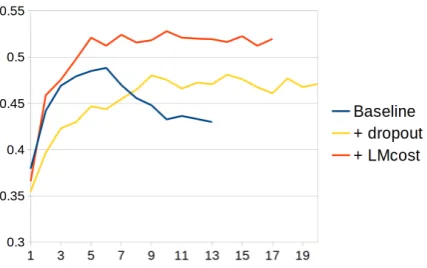
We also analysed the performance of the differ-ent architectures during training. Figure2 shows the F0.5 score on the development set for each
model after every epoch over the training data. The baseline model peaks quickly, followed by a gradual drop in performance, which is likely due to overfitting on the available data. Dropout pro-vides an effective regularisation method, slowing down the initial performance but preventing the model from overfitting. The added language mod-eling objective provides a substantial improve-ment – the system outperforms other configura-tions already in the early stages of training and the results are also sustained in the later epochs.
Figure 2: F0.5 score on the FCE development set
after each training epoch.
6 NER and Chunking
[image:6.595.310.524.510.644.2]GENIA-POS PTB-POS UD-ES UD-FI
DEV TEST DEV TEST DEV TEST DEV TEST
Baseline 98.69 98.61 97.23 97.24 96.38 95.99 95.02 94.80
+ dropout 98.79 98.71 97.36 97.30 96.51 96.16 95.88 95.60
[image:7.595.71.526.65.142.2]+ LMcost 98.89 98.81 97.48 97.43 96.62 96.21 96.14 95.88
Table 3: Accuracy of different sequence labeling architectures on POS-tagging datasets.
the English section of the CoNLL 2003 corpus (Tjong Kim Sang and De Meulder,2003), contain-ing news stories from the Reuters Corpus. We also report results on two biomedical NER datasets: The BioCreative IV Chemical and Drug corpus (CHEMDNER,Krallinger et al.(2015)) of 10,000 abstracts, annotated for mentions of chemical and drug names, and the JNLPBA corpus (Kim et al.,
2004) of 2,404 abstracts annotated for mentions of different cells and proteins. Finally, we use the CoNLL 2000 dataset (Tjong Kim Sang and Buch-holz, 2000), created from the Wall Street Journal Sections 15-18 and 20 from the Penn Treebank, for evaluating sequence labeling on the task of chunking. The standard CoNLL entity-level F1
score is used as the main evaluation metric. Compared to error detection corpora, the labels are more balanced in these datasets. However, ma-jority labels still exist: roughly 83% of the tokens in the NER datasets are tagged as ”O”, indicating that the word is not an entity, and the NP label covers 53% of tokens in the chunking data.
Table2contains results for evaluating the differ-ent architectures on NER and chunking. On these tasks, the application of dropout provides a consis-tent improvement – applying some variance onto the input embeddings results in more robust mod-els for NER and chunking. The addition of the language modeling objective consistently further improves performance on all benchmarks.
While these results are comparable to the re-spective state-of-the-art results on most datasets, we did not fine-tune hyperparameters for any spe-cific task, instead providing a controlled analy-sis of the language modeling objective in differ-ent settings. For JNLPBA, the system achieves 73.83% compared to 72.55% by Zhou and Su
(2004) and 72.70% by Rei et al. (2016). On CoNLL-03, Lample et al. (2016) achieve a con-siderably higher result of 90.94%, possibly due to their use of specialised word embeddings and a custom version of LSTM. However, our
sys-tem does outperform a similar architecture by
Huang et al.(2015), achieving 86.26% compared to 84.26%F1score on the CoNLL-03 dataset.
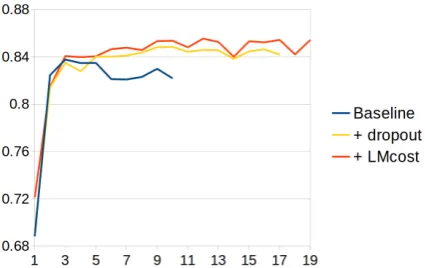
Figure 3 shows F1 on the CHEMDNER
de-velopment set after every training epoch. With-out dropWith-out, performance peaks quickly and then trails off as the system overfits on the training set. Using dropout, the best performance is sustained throughout training and even slightly improved. Finally, adding the language modeling objective on top of dropout allows the system to consistently outperform the other architectures.
Figure 3: Entity-level F1 score on the
CHEMD-NER development set after each training epoch.
7 POS tagging
[image:7.595.309.522.357.491.2]These datasets are somewhat more balanced in terms of label distributions, compared to error de-tection and NER, as no single label covers over 50% of the tokens. POS-tagging also offers a large variance of unique labels, with 48 labels in PTB and 42 in GENIA, and this can provide useful in-formation to the models during training. The base-line performance on these datasets is also close to the upper bound, therefore we expect the language modeling objective to not provide much additional benefit.
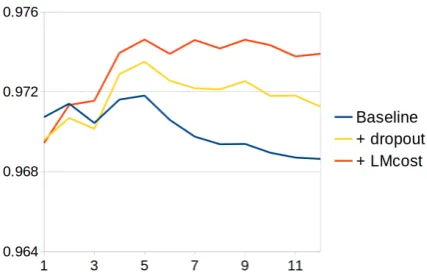
The results of different sequence labeling archi-tectures on POS-tagging can be seen in Table 3
and accuracy on the development set is shown in Figure 4. While the performance improvements are small, they are consistent across all domains, languages and datasets. Application of dropout again provides a more robust model, and the lan-guage modeling cost improves the performance further. Even though the labels already offer a var-ied training objective, learning to predict the sur-rounding words at the same time has provided the model with additional general-purpose features.
8 Related Work
Our work builds on previous research exploring multi-task learning in the context of different se-quence labeling tasks. The idea of multi-task learning was described byCaruana(1998) and has since been extended to many language process-ing tasks usprocess-ing neural networks. For example,
Collobert and Weston (2008) proposed a multi-task framework using weight-sharing between net-works that are optimised for different supervised tasks.
Cheng et al.(2015) described a system for de-tecting out-of-vocabulary names by also predict-ing the next word in the sequence. While they use a regular recurrent architecture, we propose a lan-guage modeling objective that can be integrated with a bidirectional network, making it applica-ble to existing state-of-the-art sequence labeling frameworks.
[image:8.595.309.523.64.204.2]Plank et al.(2016) described a related architec-ture for POS-tagging, predicting the frequency of each word together with the part-of-speech, and showed that this can improve tagging accuracy on low-frequency words. While predicting word fre-quency can be useful for POS-tagging, language modeling provides a more general training signal, allowing us to apply the model to many different
Figure 4: Token-level accuracy on the PTB-POS development set after each training epoch.
sequence labeling tasks.
Recently, Augenstein and Søgaard (2017) explored multi-task learning for classifying keyphrase boundaries, by incorporating tasks such as semantic super-sense tagging and iden-tification of multi-word expressions. Bingel and Søgaard (2017) also performed a systematic comparison of task relationships by combining different datasets through multi-task learning. Both of these approaches involve switching to auxiliary datasets, whereas our proposed language modeling objective requires no additional data.
9 Conclusion
We proposed a novel sequence labeling framework with a secondary objective – learning to predict surrounding words for each word in the dataset. One half of a bidirectional LSTM is trained as a forward-moving language model, whereas the other half is trained as a backward-moving lan-guage model. At the same time, both of these are also combined, in order to predict the most prob-able label for each word. This modification can be applied to several common sequence labeling architectures and requires no additional annotated or unannotated data.
The objective of learning to predict surrounding words provides an additional source of informa-tion during training. The model is incentivised to discover useful features in order to learn the lan-guage distribution and composition patterns in the training data. While language modeling is not the main goal of the system, this additional training objective leads to more accurate sequence labeling models on several different tasks.
learner texts, named entity recognition, chunking and POS-tagging. We found that the additional language modeling objective provided consistent performance improvements on every benchmark. The largest benefit from the new architecture was observed on the task of error detection in learner writing. The label distribution in the original dataset is very sparse and unbalanced, making it a difficult task for the model to learn. The added lan-guage modeling objective allowed the system to take better advantage of the available training data, leading to 3.9% absolute improvement over the previous best architecture. The language modeling objective also provided consistent improvements on other sequence labeling tasks, such as named entity recognition, chunking and POS-tagging.
Future work could investigate the extension of this architecture to additional unannotated re-sources. Learning generalisable language fea-tures from large amounts of unlabeled in-domain text could provide sequence labeling models with additional benefit. While it is common to pre-train word embeddings on large-scale unanno-tated corpora, only limited research has been done towards useful methods for pre-training or co-training more advanced compositional modules.
References
Rami Al-Rfou, Guillaume Alain, Amjad Almahairi, Christof Angermueller, Dzmitry Bahdanau, Nico-las BalNico-las, Fr´ed´eric Bastien, Justin Bayer, Ana-toly Belikov, Alexander Belopolsky, Yoshua Ben-gio, Arnaud Bergeron, James Bergstra, Valentin Bisson, Josh Bleecher Snyder, Nicolas Bouchard, Nicolas Boulanger-Lewandowski, and Others. 2016. Theano: A Python framework for fast computa-tion of mathematical expressions. arXiv e-prints abs/1605.0:19. http://arxiv.org/abs/1605.02688.
Isabelle Augenstein and Anders Søgaard. 2017. Multi-Task Learning of Keyphrase Boundary Classifica-tion. In Proceedings of the 54th Annual Meeting of the Association for Computational Linguistics. http://arxiv.org/abs/1704.00514.
Joachim Bingel and Anders Søgaard. 2017. Identi-fying beneficial task relations for multi-task learn-ing in deep neural networks. In arXiv preprint. http://arxiv.org/abs/1702.08303.
Rich Caruana. 1998.Multitask Learning. Ph.D. thesis. Ciprian Chelba, Tom´aˇs Mikolov, Mike Schuster, Qi Ge, Thorsten Brants, Phillipp Koehn, and Tony Robin-son. 2013. One Billion Word Benchmark for Mea-suring Progress in Statistical Language Modeling. InarXiv preprint.http://arxiv.org/abs/1312.3005.
Hao Cheng, Hao Fang, and Mari Ostendorf. 2015. Open-Domain Name Error Detection using a Multi-Task RNN. InProceedings of the 2015 Conference on Empirical Methods in Natural Language Pro-cessing.
Ronan Collobert and Jason Weston. 2008. A Unified Architecture for Natural Language Pro-cessing: Deep Neural Networks with Multitask Learning. Proceedings of the 25th interna-tional conference on Machine learning (ICML ’08) https://doi.org/10.1145/1390156.1390177.
Ronan Collobert, Jason Weston, L´eon Bottou, Michael Karlen, Koray Kavukcuoglu, and Pavel Kuksa. 2011. Natural Language Processing (Almost) from Scratch.Journal of Machine Learning Research12. https://doi.org/10.1145/2347736.2347755.
Alex Graves, Abdel-rahman Mohamed, and Geoffrey Hinton. 2013. Speech recognition with deep recur-rent neural networks. International Conference on Acoustics, Speech and Signal Processing (ICASSP) https://doi.org/10.1109/ICASSP.2013.6638947.
Sepp Hochreiter and J¨urgen Schmidhuber. 1997. Long Short-term Memory. Neural Computation 9. https://doi.org/10.1.1.56.7752.
Zhiheng Huang, Wei Xu, and Kai Yu.
2015. Bidirectional LSTM-CRF Models for Sequence Tagging. arXiv:1508.01991 http://arxiv.org/pdf/1508.01991v1.pdf.
Ozan Irsoy and Claire Cardie. 2014. Opinion Mining with Deep Recurrent Neural Networks. In Proceed-ings of the 2014 Conference on Empirical Methods in Natural Language Processing (EMNLP).
Jin-Dong Kim, Tomoko Ohta, Yoshimasa Tsuruoka, Yuka Tateisi, and Nigel Collier. 2004. In-troduction to the Bio-entity Recognition Task at JNLPBA. Proceedings of the Interna-tional Joint Workshop on Natural Language Processing in Biomedicine and Its Applications https://doi.org/10.3115/1567594.1567610.
Martin Krallinger, Florian Leitner, Obdulia Rabal, Miguel Vazquez, Julen Oyarzabal, and Alfonso Va-lencia. 2015. CHEMDNER: The drugs and chemi-cal names extraction challenge. Journal of Chemin-formatics7(Suppl 1). https://doi.org/10.1186/1758-2946-7-S1-S1.
John Lafferty, Andrew McCallum, and Fernando Pereira. 2001. Conditional random fields: Prob-abilistic models for segmenting and labeling se-quence data. In Proceedings of the 18th Interna-tional Conference on Machine Learning.
Mitchell P. Marcus, Beatrice Santorini, and Mary Ann Marcinkiewicz. 1993. Building a large annotated corpus of English: The Penn Treebank. Computational Linguistics 19. https://doi.org/10.1162/coli.2010.36.1.36100.
Tom´aˇs Mikolov, Kai Chen, Greg Corrado, and Jeffrey Dean. 2013. Efficient Estimation of Word Representations in Vector Space. In Proceedings of the International Conference on Learning Representations (ICLR 2013). https://doi.org/10.1162/153244303322533223.
Tom´aˇs Mikolov, Martin Karafi´at, Luk´aˇs Burget, Jan Cernock´y, and Sanjeev Khudanpur. 2010. Recur-rent Neural Network based Language Model. Inter-speech(September):1045–1048.
Andriy Mnih and Yee Whye Teh. 2012. A fast and sim-ple algorithm for training neural probabilistic lan-guage models. In Neural Information Processing Systems (NIPS).
Frederic Morin and Yoshua Bengio. 2005. Hi-erarchical probabilistic neural network language model. Proceedings of the Tenth International Workshop on Artificial Intelligence and Statistics https://doi.org/10.1109/JCDL.2003.1204852.
Hwee Tou Ng, Siew Mei Wu, Ted Briscoe, Christian Hadiwinoto, Raymond Hendy Susanto, and Christo-pher Bryant. 2014. The CoNLL-2014 Shared Task on Grammatical Error Correction. InProceedings of the Eighteenth Conference on Computa-tional Natural Language Learning: Shared Task. http://www.aclweb.org/anthology/W/W14/W14-1701.
Joakim Nivre, ˇZeljko Agi´c, Maria Jesus Aranzabe, Masayuki Asahara, Aitziber Atutxa, Miguel Balles-teros, John Bauer, Kepa Bengoetxea, Riyaz Ah-mad Bhat, Cristina Bosco, Sam Bowman, et al. 2015. Universal dependencies 1.2. LIN-DAT/CLARIN digital library at the Institute of For-mal and Applied Linguistics, Charles University. http://hdl.handle.net/11234/1-1548.
Tomoko Ohta, Yuka Tateisi, and Jin-Dong Kim. 2002. The GENIA corpus: An annotated re-search abstract corpus in molecular biology do-main. Proceedings of the second international con-ference on Human Language Technology Research http://portal.acm.org/citation.cfm?id=1289260.
Barbara Plank, Anders Søgaard, and Yoav Gold-berg. 2016. Multilingual Part-of-Speech Tagging with Bidirectional Long Short-Term Memory Mod-els and Auxiliary Loss. In Proceedings of the 54th Annual Meeting of the Association for Com-putational Linguistics (ACL-16). pages 412–418. http://arxiv.org/abs/1604.05529.
Marek Rei, Gamal K. O. Crichton, and Sampo Pyysalo. 2016. Attending to Characters in Neural Sequence
Labeling Models. InProceedings of the 26th Inter-national Conference on Computational Linguistics (COLING-2016).http://arxiv.org/abs/1611.04361.
Marek Rei and Helen Yannakoudakis. 2016. Compositional Sequence Labeling Models for Error Detection in Learner Writing. In Proceedings of the 54th Annual Meeting of the Association for Computational Linguistics. https://aclweb.org/anthology/P/P16/P16-1112.pdf.
Nitish Srivastava, Geoffrey E. Hinton, Alex Krizhevsky, Ilya Sutskever, and Ruslan Salakhut-dinov. 2014. Dropout : A Simple Way to Prevent Neural Networks from Overfitting. Jour-nal of Machine Learning Research (JMLR) 15. https://doi.org/10.1214/12-AOS1000.
Erik F. Tjong Kim Sang and Sabine Buchholz. 2000. Introduction to the CoNLL-2000 shared task: Chunking. Proceedings of the 2nd Workshop on Learning Language in Logic and the 4th Confer-ence on Computational Natural Language Learning 7. https://doi.org/10.3115/1117601.1117631.
Erik F. Tjong Kim Sang and Fien De Meulder. 2003. Introduction to the CoNLL-2003 Shared Task: Language-Independent Named Entity Recog-nition. In Proceedings of the seventh conference on Natural language learning at HLT-NAACL 2003. http://arxiv.org/abs/cs/0306050.
Yoshimasa Tsuruoka, Yuka Tateishi, Jin Dong Kim, Tomoko Ohta, John McNaught, Sophia Ananiadou, and Jun’ichi Tsujii. 2005. Developing a robust part-of-speech tagger for biomedical text. In Proceed-ings of Panhellenic Conference on Informatics.
Helen Yannakoudakis, Ted Briscoe, and Ben Medlock. 2011. A New Dataset and Method for Automati-cally Grading ESOL Texts. InProceedings of the 49th Annual Meeting of the Association for Com-putational Linguistics: Human Language Technolo-gies.http://www.aclweb.org/anthology/P11-1019.
Matthew D. Zeiler. 2012. ADADELTA: An Adap-tive Learning Rate Method. arXiv preprint arXiv:1212.5701http://arxiv.org/abs/1212.5701. GuoDong Zhou and Jian Su. 2004. Exploring Deep