18
POS Tagging for Improving Code-Switching Identification in Arabic
Mohammed Attia1 Younes Samih2 Ali Elkahky1 Hamdy Mubarak2 Ahmed Abdelali2 Kareem Darwish2
1Google LLC, New York City, USA
2Qatar Computing Research Institute, HBKU Research Complex, Doha, Qatar
1{attia,alielkahky}@google.com
2{ysamih,hmubarak,aabdelali,kdarwish}@hbku.edu.qa
Abstract
When speakers code-switch between their na-tive language and a second language or lan-guage variant, they follow a syntactic pattern where words and phrases from the embedded language are inserted into the matrix language. This paper explores the possibility of utiliz-ing this pattern in improvutiliz-ing code-switchutiliz-ing identification between Modern Standard Ara-bic (MSA) and Egyptian AraAra-bic (EA). We try to answer the question of how strong is the POS signal in word-level code-switching idtification. We build a deep learning model en-riched with linguistic features (including POS tags) that outperforms the state-of-the-art re-sults by 1.9% on the development set and 1.0% on the test set. We also show that in intra-sentential code-switching, the selection of lex-ical items is constrained by POS categories, where function words tend to come more often from the dialectal language while the majority of content words come from the standard lan-guage.
1 Introduction
Code-switching (CS) is common in multilingual communities as well as diglossic ones, where the language of information and education is different from the language of speaking and daily interac-tion. With the increased level of education, mobil-ity, globalization, multiculturalism, and multilin-gualism in modern societies, combined with the rise of social media, where people write in the way they speak, CS has become a pervasive phe-nomenon, particularly in user-generated data, and a major challenge for NLP systems dealing with that data.
CS is interesting for two reasons: first, there is a large population of bilingual and diglossic speak-ers, or at least speakers with some exposure to a foreign language, who tend to mix and blend two languages for various pragmatic, psycholinguistic
and sociolinguistic reasons. Second, existing the-oretical and computational linguistic models are based on monolingual data and cannot adequately explain or deal with the influx of CS data whether spoken or written.
CS has been studied for over half a century from different perspectives, including theoretical linguistics (Muysken, 1995; Parkin, 1974), ap-plied linguistics (Walsh,1969;Boztepe,2003; Se-tati,1998), socio-linguistics (Barker,1972;Heller,
2010), psycho-linguistics (Grosjean, 1989; Prior and Gollan, 2011;Kecskes, 2006), and more re-cently computational linguistics (Solorio and Liu,
2008a;Çetino˘glu et al.,2016;Adel et al.,2013b). In this paper, we investigate the possibility of using POS tagging to improve word-level lan-guage identification for diglossic Arabic in a deep-learning system. We present some syn-tactic characterization of intra-sentential code-switching, and show that POS can be a power-ful signal for code-switching identification. We also pay special attention to intra-sentential code-switching and examine the distribution of POS categories involved in this type of data.
The paper is organized as follows: in the re-mainder of this introduction we present chal-lenges, definitions, and types of CS, and the partic-ular aspects involved in Arabic CS. Section2gives an overview of related works. In Section3, we de-scribe and record our observations on the data used in our experiments. Section4 presents a descrip-tion of our system and the features used. Secdescrip-tion5
gives the details of our experiments and discusses the results, and finally we conclude in Section6.
1.1 Why is CS Computationally Challenging?
judged by a standard monolingual model, these ut-terances can be deemed as ungrammatical or un-natural. Therefore, CS should generally be treated in its own terms and not to be conceived of as a peripheral phenomenon that can be understood by tweaking and twisting monolingual models and theories. When two languages come in contact, this implies the cross-fertilization and the emer-gence of structures that may be absent in either languages. When code-switching, speakers com-promise the syntactic rules of the two languages involved, sometime adding in or leaving out a de-terminer, or applying a system of affixation from one language and not the other.
CS has conveniently been used as a cover term (Myers-Scotton,1997;Çetino˘glu et al.,2016) for all operations where two languages are used si-multaneously or alternately by the same speaker. When the user speaks one sentence in one lan-guage and another sentence in another lanlan-guage, this has been referred to as inter-sentential code-switching, while mixing elements from the two languages together in the same sentence has been termed intra-sentential. The language that pro-vides the function words and grammatical struc-ture is called the host (Bokamba, 1989) or ma-trix language, while the language being inserted is called the guest or embedded language.
While inter-sentential CS is relatively less chal-lenging for computational analysis, as each sen-tence still follows a monolingual model, intra-sentential CS poses a bottleneck challenge. It needs a special amount of attention, because it is only this type that involves the lexical and syn-tactic integration and activation of two language models at the same time. NLP systems trained on monolingual data suffer significantly when trying to process this kind bilingual text or utterance.
CS has proved challenging for NLP technolo-gies, not only because current tools are geared toward the processing of one language at a time (AlGhamdi et al., 2016), but also because code-switched data is typically associated with addi-tional challenges such as the non-convenaddi-tional or-thography, non-canonicity (nonstandard or incom-plete) of syntactic structures, and the large number of OOV-words (Çetino˘glu et al.,2016), which sug-gest the need for larger training data than what is typically used in monolingual models. Unfortu-nately, shortage of training data has usually been cited as the reason for the under-performance of
computational models when dealing with CS data (Adel et al.,2015).
The study of CS does not only help downstream tasks (like ASR (automatic speech recognition), IR (information retrieval), parsing, etc.), but it is also crucial for language generation (e.g. TTS (text to speech), MT (machine translation), and automated responses by virtual assistants) in order to allow computational models to produce natural sentences that closely match how modern societies talk.
1.2 Definition and Defining Perspectives
The definition of CS has varied greatly depend-ing on the different researchers’ attitude and per-spectives of the operation involved. While some viewed it as a process where two languages are ac-tively interacting with each other (ultimately cre-ating a new code), other viewed the operation just as two separate languages sitting side-by-side as isolated islands. Following the first perspective,
Joshi (1982) defined code-switching as the situ-ation when two languages systematically interact with each other in the production of sentences in a framework which consists of two grammat-ical systems and a mechanism for switching be-tween the two. Following the second perspec-tive,Muysken(1995) defined CS as “the alterna-tive use by bilinguals of two or more languages in the same conversation”, while other researchers (Auer, 1999; Nilep, 2006) defined it as the “jux-taposition” of elements from two different gram-matical systems within the same speech.
The juxtaposition definition has been widely cited in the research on code-switching, advanc-ing a monoladvanc-ingual view on the topic and promot-ing the idea that bilpromot-ingual speech is the sum (or juxtaposition) of two monolingual utterances. The literal meaning suggests placing two heteroge-neous and isolated pieces from different languages next to each other, but, in fact, foreign phrases are usually syntactically integrated and may often change phonologically, morphologically and prag-matically to fit homogeneously in the new posi-tion. The term also has a sense of randomness, which departs from the fact that CS is patterned and predictable.
lan-guages are being interwoven, where, when, how, and by whom. Thewhereandwhenrelates to the sociolinguistic factors, such as the situation and power relations, and thehowandby whom to the psycholinguistic factors, such as speakers’ compe-tence and proficiency in either or both languages. This is why we see a wide range of regular patterns as well as highly idiosyncratic behavior.
1.3 CS Types and Categories
A speaker can turn from one language to the other at the sentence level, or he/she can make the turn within the same sentence. Some re-searchers (Muysken et al., 2000) use the term “code-switching” to refer to the former case while reserving the term “code-mixing” to refer to the latter. However, these two types have more con-ventionally been termed as inter-sentential and intra-sentential code-switching, respectively, as explained above.
Intra-sentential CS has further been divided by
Muysken et al.(2000) into three types: 1) insertion where words or phrases from one language are in-serted into another, 2) alternation where there is a total shift from one language into the other, e.g. starting the sentence in one language and ending in another, and 3) congruent lexicalization similar to insertion, but with a high frequency, and found in typologically similar language pairs by fluent bilinguals.
Another classification is by looking at the na-ture of the language pairs, CS can be classified as diglossic, i.e. between varieties of the same language (e.g. Standard and Egyptian Arabic); typologically-related, i.e. between language pairs that belong to the same language family (e.g. En-glish and Spanish); or typologically-distinct, i.e. between language pairs that come from different language families (e.g. Chinese and English). It has been suggested that CS between typologically similar languages is facilitated in ways that are different from (and not found in) those in typo-logically distinct languages (Lipski, 2005; Chan,
2009). By contrast, dialect/standard variation has been viewed by some as a form of style shifting (Trudgill,1986) rather than proper CS, while oth-ers argue that style-shifting may serve the same kind of functions in conversation as CS (Boztepe,
2003), and that CS can happen between language varieties as well as different languages ( Gardner-Chloros,1991). It is to be noted however, that in
diglossic code-switching, the shift is more likely to be lexical, morphological, and structural, rather than phonological, unlike the other two cases when we have two completely distinct language systems.
1.4 Peculiarities of Arabic CS
Arabic is a diglossic language, where the lan-guage of education is different from the lanlan-guage of speaking. Dialectal Arabic has traditionally not enjoyed the same prestige, socio-economic sta-tus, and official recognition as MSA. Dialects, by nature, diverge from the standard language, and, therefore, they can easily and freely draw from the larger repository of the standard language.
It has been suggested that CS most frequently happens from the subordinate language to the more superior one not vice versa (Lipski, 2005). This, however, might be true in general, but not in the absolute sense, as CS to the so-called subordi-nate language may be for the back-stage commu-nicative purposes (e.g. establishing identity and friendliness or referencing a cultral meme).
Code-switching to MSA is used to establish au-thority and maintain credibility. Using the dialect (or mother tongue) on the other hand signifies a sense of belonging, community and solidarity, and attracts a higher level of attention and understand-ability. In other words, MSA is the intellectual language, while dialect is the emotive one.
The data used in the experiments in this pa-per comes from Twitter which are in the written modality, and this can significantly vary from the spoken interactions. Arabic speakers’ competence in spoken MSA is remarkably lower than in the written one. While most Arabic speakers with some level of education can write in MSA, far fewer are able to utilize MSA in speaking. Spo-ken CS can be observed more with public speak-ers, like presentspeak-ers, politicians and lecturspeak-ers, and less often with ordinary people.
Moreover, there is a large number of lexi-cal items which have shared orthography in EA (Egyptian) and MSA, though the pronunciation is different, e.g.
Y»
AJÓ
muta>ak~id/mito>ak~id“sure”,
éÊÓA¿
kamilap/kamolap “full”, andI
. KQ
¯
no way to know precisely whether words are pro-nounced with dialectal or standard accent, though the context can give some clue, and we think that this kind of distinction was left to the annotators’ best judgment.
Arabic, as a morphologically-rich language, has its peculiar behavior of merging morphemes and clitics from the matrix language to the em-bedded language. In diglossic mixed codes, standard verbs can show dialectal morphology, whether through affixes or templatic vowel shift-ing, e.g.
ÑêËAêÊQë
hayirosilhAlohum “will send it to them”. For foreign words, they can re-ceive agreement morphologyAîDJ.ºJë
haykabiyhA “he will copy it”. This type of morpho-syntactic blending is stereotypical of CS when Arabic, or one if its dialects, is the matrix language.2 Related Work
2.1 Computational Approaches
Research on computational approaches to CS has been mainly concentrated in four areas: predict-ing code-switchpredict-ing points, word-level language identification, POS tagging, and automatic speech recognition. However, some relatively recent re-search has tried to tackle CS in MT (Johnson et al.,
2017), question answering (Raghavi et al.,2015), sentiment analysis (Vilares et al.,2015) and infor-mation retrieval (Chakma and Das,2016).
The task of predicting code-switching points is significantly different from word-level code-switching identification, because in the former the classifier is allowed only to look at the past (pre-vious) words and predict which language the com-ing word is gocom-ing to be in, whereas in the latter, the classifier has the fuller context and evidently can achieve much higher accuracy. Moreover the for-mer focuses on the elements or points after which you can make the switch, while the latter looks at the elements being switched themselves.
Solorio and Liu(2008a) pioneered the work on CS and developed an ML (machine learning) clas-sifier to predict code-switching points in Spanish-English. The data they used was recorded con-versations among three English-Spanish bilingual speakers. The conversations included 922 sen-tences and were manually transcribed and anno-tated with POS tags. They trained their Naive Bayes classifier on a number of features including language ID, lemma and POS tags and reported an f-score of 28%, with 1% positive variance gained
through the POS feature.
In another effort,Solorio and Liu(2008b) tried POS tagging on Spanish-English CS data and con-cluded that feeding the output of two monolingual taggers to an ML algorithm yielded the best re-sults.
Çetino˘glu et al. (2016) pointed out that POS tagging of CS data proved much harder than tag-ging monolingual texts, as models could reach 97% accuracy for the latter, but only around 77% for the former. They attribute the poor perfor-mance largely to the lack of CS annotated data, and the fact that many systems just devise meth-ods to choose from the output of two monolingual POS taggers, e.g. the work of Solorio and Liu
(2008b) andSharma et al.(2016).
Similar to the work of (Solorio and Liu,
2008a),Adel et al.(2013b,a) tried to predict code-switching points for conversational speech in the Mandarin-English SEAME corpus to improve an ASR model. They used recurrent neural network language modeling relying on POS tags and using a factorized output layer. They noted that speak-ers most frequently switch to another language for nouns and object noun phrases. They also assumed that the switching attitude is speaker-dependent and clustered speakers into classes with similar switching attitude. They reported an ac-curacy of 43.31% and proved that POS tags have statistically significant role on improving the re-sults. Adel et al. (2013b) tried to accommodate bilingual data by merging monolingual resources, such as the English and Mandarin Dictionaries, the output of two separate POS taggers, the Stan-ford POS tagger for Mandarin, and the StanStan-ford tagger for English, and using two monolingual language models. Additionally they hard-coded some phonological rules to accommodate Singa-porean English. They later extended their features to include Brown clusters, open class words and word embeddings (Adel et al., 2015) and found that Brown word clusters, part-of-speech tags and open-class words are the most effective at reduc-ing the perplexity.
Fewer studies have focused on CS between related language varieties which is typically a diglossic kind of CS between a standard language and a dialect, e.g. Cypriot Greek and Standard Modern Greek (Tsiplakou,2009).
et al. (2016) explored different technique for the POS tagging of CS data and concluded that ap-plying a machine learning framework as a voting mechanism on top of the output of two mono-lingual POS taggers achieves the best perfor-mance. Word-level CS identification for Ara-bic (along with Spanish–English) has been fea-tured in a couple of shared tasks: the First Shared Task on Language Identification in Code-Switched Data (Solorio et al.,2014) and the Sec-ond Shared Task on Language Identification in Code-Switched Data (Molina et al., 2016), of which Samih et al. (2016) was the winning sys-tem, and against which we compare our results in this project.
Eskander et al.(2014) studied CS between EA written in Roman script (Arabizi) and English.
Habash et al.(2008) created a standard annotation guidelines for CS between MSA and dialects.
CS has also been studied in Arabic as a predictor of social influence in the collaborative writing in Wikipedia discussion pages in (Yoder et al.,2017) and it was found that CS is positively associated with the editor’s success in winning an argument.
We notice from the literature that in some in-stances POS tagging has been used to aid with the identification of code-switching points, and in some other instances language identification has been used as an indicator or a feature for POS tagging, showing what (Çetino˘glu et al.,2016) re-ferred to as task inter-relatedness, or the cyclic na-ture of task dependencies. In our work, we use a POS tagger as a predictor of CS. The POS tagger used has been trained specifically on CS data.
3 Data Description
The organizers of the Second Shared Task on Language Identification in Code-Switched Data (Molina et al., 2016) provided the annotated dataset for the MSA–EA code-switched pairs. The data consists of 8,862 tweets (185,928 tokens) as training set, 1,117 tweets (20,688 tokens) as de-velopment set and 1,262 tweets (20,713 tokens) as final test set. The tagset statistics for the training set are shown in Table1.
Furthermore, the training data contains 970 (11%) intra-sentential CS tweets, i.e. tweets with both lang1 (MSA) and lang2 (EA); 865 (10%) tweets withlang2only; and the remaining tweets (79%) withlang1only.
We analyze the POS distribution in the data
us-Labels Token Count Token Ratio %
ambiguous 1,186 0.64
unk 0 0.00
lang1 127,690 68.70
lang2 21,722 11.69
mixed 16 0.01
ne 21,567 11.60
[image:5.595.314.518.62.166.2]other 13,691 7.37
Table 1: Tag count and ratio in the training set, where
lang1is MSA,lang2is EA, andneis a named entity.
[image:5.595.308.523.341.475.2]ing the prediction of a specially designed POS tag-ger, described in4.1, and notice that in those intra-sentential CS sentences, the majority of func-tion words (particles, adverbs and pronouns) come from lang2 (dialect), while the majority of content words (adjectives, verbs and nouns) come from the lang1 (standard language). The distribution oflang1andlang2by POS is shown in Figure1.
Figure 1: POS Distribution in CS data
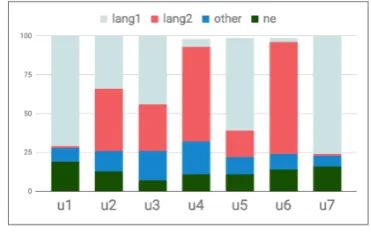
Figure 2 shows CS behavior on a sample of users, and it indicates that the switching attitude is idiosyncratic and user-dependent.
Figure 2: CS Distribution by Users
[image:5.595.322.508.563.683.2]size and streamline processing. Also in order to re-duce data sparsity, we converted all Persian num-bers (e.g.
2 ,1
) to Arabic numbers (e.g. 1, 2),Arabic punctuation (e.g. ‘
,
’ and ‘;
’) to Latin punc-tuation (e.g. ‘,’ and ‘;’), removed kashida (elonga-tion character) and diacritics, and separated punc-tuation marks from words.4 System Description
Deep learning and neural nets have been used ex-tensively in the past decade and were shown to sig-nificantly outperform traditional (linear) ML mod-els. The proclaimed advantage of deep learning is that it eliminates the need for feature engineering. Yet, there has been a growing interest recently to augment neural nets with more and more linguis-tic features, which has been shown to boost per-formance for many tasks.
We use a DNN (Deep Neural Network) model mainly suited for sequence tagging and is a variant of the bi-LSTM-CRF architecture (Ma and Hovy, 2016; Lample et al., 2016; Reimers and Gurevych, 2017; Huang et al., 2015). Our implementation is mostly inspired by the work of Reimers and Gurevych (2017). In its basic configuration, it combines a double representation of the input words by using word embeddings and a character-based representation with CNNs (convolutional Neural Networks). The input sequence is processed with bi-LSTMs, and the output layer is a linear chain CRF. We augment this model with various layers to accommodate the different features we want to incorporate. The features used in our model are explained below.
4.1 Dialectal POS Tagger
We develop a POS tagger using the data described inDarwish et al.(2018). The tagger used in this paper is developed using a deep neural network model, unlikeDarwish et al.(2018) who use a lin-ear model. Our model predicts POS tagging at the word level (not the token level), to suit how the CS data is structured. We experiment with two variants of the model, one that works with fine-grained POS tags and one that uses coarse-fine-grained tags.
Basically, the difference between fine and coarse tags is that in fine tags we preserve and con-catenate the POS representation of the affixes and clitics, while in coarse tags we eliminate affix
rep-Word Translit. / Fine Coarse
Gloss Tag Tag
½J.jK.
byHbk prog_part Verb likes+you +v+pronA KQ.ªJë
hyEbrnA will+ fut_part Verb consider+us +v+pronQÒªË@ð
wAlEmr and+ conj+det Noun the+life +noun½J.Ê
¯
qlbk noun+pron Noun your+heart½
®KA£
TAyqk adj+pron Adj standing+you [image:6.595.322.509.61.240.2]É
¯
BA«
EAl>ql at+ prep+det Adj the+least +adjTable 2: Examples of unsegmented words with fine and coarse POS tags.
resentation and keep the POS for stems only. The distinction between fine and coarse tags is illus-trated further with some examples in Table2.
Our system achieves 92.38% accuracy with the coarse tags and 88.43% using the fine tags. The gap in performance is mostly due to the size of the tagset. The number fine POS tags observed in the data is 218, while there are only 28 coarse tags. It is to be mentioned that the reported accuracy for segmented words byDarwish et al. (2018) is 92.9%.
4.2 Features Used
Here we describe the features used in our deep learning model.
POS tags. We include POS tags, as predicted by the specially developed model described in 4.1
above, as a layer in the neural network model.
Word-level embeddingsallow the learning algo-rithms to use large unlabeled data to generalize be-yond the seen training data. We explore randomly initialized embeddings based on the seen training data and pre-trained embedding.
list of words in our dataset by the predictor in the word vector model to ensure that we get represen-tations of all the words and reduce the number of OOVs (out of vocabulary words).
We find significant improvement using FastText embedding over the traditional word2vec repre-sentation (Mikolov et al.,2013). This is probably due to the utilization of sub-word (ex. prefixes or suffixes) information in the former.
Character-level CNNs. Although originally designed for image recognition, CNNs have proven effective for various NLP tasks due to their ability to encode character-level representations of words as well as extract sub-word information (Collobert et al., 2011; Chiu and Nichols, 2016;
dos Santos and Guimarães,2015).
Bi-LSTM Recurrent neural networks (RNN) are well suited for modeling sequential data, achieving ground-breaking results in many NLP tasks (e.g., machine translation). Bi-LSTMs (Hochreiter and Schmidhuber, 1997;
Schuster and Paliwal, 1997) are capable of learning long-term dependencies and maintaining contextual features from both past and future states while avoiding the vanishing/exploding gradients problem. They consist of two separate bidirectional hidden layers that feed forward to the same output layer.
CRF is used jointly with bi-LSTMs to avoid the output label independence assumptions of bi-LSTMs and to impose sequence labeling constraints as in Lample et al. (2016). In our experiments with this task we find that CRF has a slight advantage over the softmax optimizer.
[image:7.595.307.519.61.317.2]Brown clusters (BC). Brown clustering is an unsupervised learning method where words are grouped based on the contexts in which they appear (Brown et al., 1992). The assumption is that words that behave in similar ways tend to appear in similar contexts and hence belong to the same cluster. BCs can be learned from a large unlabeled corpus and have been shown to improve POS tagging as well as other sequence labelling tasks (Owoputi et al., 2013;Stratos and Collins,2015). We test the effectiveness of using Brown clusters in the context of code-switching experimentation in a DNN model by training
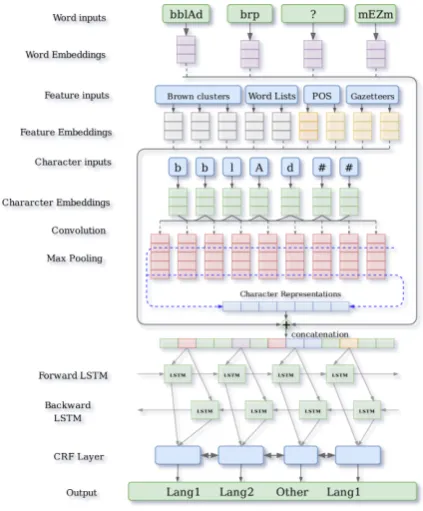
Figure 3: DNN Architecture.
BCs on our crawled code-switched corpus of 380 million words (mentioned above) with 100 Brown Clusters.
Named Entity GazetteersWe use a large collec-tion of named entity gazetteers of 40,719 unique names from Attia et al. (2010), who collected named entities from the Arabic Wikipedia, and
Benajiba et al.(2007), who annotated a corpus as part of a named entity recognition system. The assumption is that the gazetteer will enhance the system’s recognition of NE’s which constitutes between 11 and 14% of the tags in the datasets. The feature is used as a binary class, i.e. whether the word is present in the gazetteer list or not.
Spell Checking Word ListDialectal lexicon and inflection can vary significantly from the standard one. Based on this assumption we check for each word whether or not it exists in a large word list of fully inflected MSA words (Attia et al.,2012). The word list contains 9,196,215 and is obtained from the web as an open source resource1.
The architecture of our model (with the best performance) is shown in Figure 3. For each word in the sequence, the CNN computes the character-level representation with character em-beddings as inputs. Then the character-level
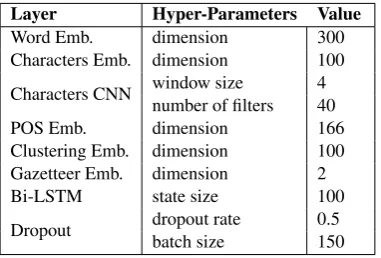
resentation vector is concatenated with both word embeddings vector and feature embedding vec-tors (Brown Clusters, POS, and Gazetteers) to feed into the bi-LSTM layer. Finally, an affine transformation followed by a CRF is applied over the hidden representation of the bi-LSTM to ob-tain the probability distribution over all the code-switching labels. Training is performed using stochastic gradient descent with a momentum of 0.9 and batch size equal to 150. We employ dropout (Hinton et al., 2012) to mitigate over-fitting, and early-stopping (Caruana et al., 2000) (with patience of 35). We further use the hyper-parameters detailed in Table3.
Layer Hyper-Parameters Value
Word Emb. dimension 300 Characters Emb. dimension 100
Characters CNN window size 4 number of filters 40 POS Emb. dimension 166 Clustering Emb. dimension 100 Gazetteer Emb. dimension 2 Bi-LSTM state size 100
[image:8.595.320.511.61.405.2]Dropout dropout rate 0.5 batch size 150
Table 3: Parameter fine-tuning
5 Experiments and Results
We conduct a number experiments with different layers in the neural network model stacked on top of each other, making use of word and char-acter representation, POS, FastText pre-trained embeddings, and other features. This allows us to see the significance of each feature and how it contributes to the overall performance of the system. The experiments are shown in Table4.
The results in Table 4 are reported for the f-score measure on the validation set, except for the last row which gives the best model results on the test set. The results generally show that the DNN model is incrementally improving by adding more features and external resources. The best result is obtained with the aggregation of all features, excluding the SP (spell checking word list).
In the training data,lang1(MSA) is the major-ity class representing 68.7% of the labels. We use majority voting as the baseline in order to detect if
# Experiments f-score averaged f-score
1 Baseline 30.97 7.88
(majority voting)
2 POS-coarse 66.19 40.57
3 POS-fine 72.99 45.28
4 Words 83.78 55.78
5 Words+POS-fine 84.68 57.06
6 Chars 84.02 56.52
7 Words+Chars 84.87 57.36
8 Words+Chars 86.47 58.15
+POS-fine
9 Words+Chars 89.18 59.71
+POS+BC
10 Words+Chars 89.21 59.63
+POS+BC+GZ
11 Words+Chars 91.90 61.33
+POS+BC+GZ +Embed
12 Words+Chars 91.48 61.02
+POS+Embed +BC+GZ+SP
13 Words+Chars 91.92 61.35
+POS+BC+GZ +Embed+PP
Results on 88.92 50.48
Test set
Table 4: DNN experiments and Results. Abbreviations: BC: Brown Clusters, GZ: named entity gazetteer, SP: Spelling word list, PP: post-processing
POS tags alone do send any positive signal to the model at all. We note that the baseline is very low which is due to the fact that the tag distribution in the training set is disproportionate with both the validation and the test set, wherelang1represents only 30.96% and 28.10% of the data respectively. It is to be noted that we apply post-processing (PP) to the output of the prediction. The idea is that foreign words (words written in Latin script), punctuation marks, user names (words starting with the ‘@’ sign), and hashtags (words starting with the ‘#’ sign) should all be assigned theother
tag. As these are deterministic cases, we develop a post-process procedure to correct errors in the pre-dictions of the probabilistic model, and to make sure that they are assigned the right tag.
[image:8.595.86.277.264.393.2]no-Labels TokenCount Ratio %Token al. (2016)Samih et CurrentSystem
ambiguous 10 0.05 0.00 0.00
lang1 6,406 30.96 0.88 0.91
lang2 9,355 45.22 0.92 0.93
mixed 2 0.01 0.00 0.00
ne 3,024 14.62 0.84 0.86
other 1,891 9.14 0.97 0.98
[image:9.595.307.526.61.149.2]Accuracy – – 0.900 0.919
Table 5: F1 score token level comparison between
Samih et al.(2016) and the current system on the de-velopment dataset.
Labels TokenCount Ratio %Token al. (2016)Samih et CurrentSystem
ambiguous 117 0.57 0.000 0.00
unk 26 0.13 0.000 0.00
lang1 5,804 28.10 0.854 0.860
lang2 9,630 46.62 0.904 0.913
mixed 1 0.00 0.000 0.000
ne 2,363 11.31 0.777 0.789
other 2,743 13.28 0.957 0.965
[image:9.595.72.290.61.147.2]Accuracy – – 0.879 0.889
Table 6: F1 score token level comparison between
Samih et al.(2016) and the current system on the test dataset.
tice that using the predicted fine-grained POS is significantly more helpful than using the predicted coarse-grained one (although the prediction ac-curacy for fine-grained tags is lower). This is probably because the fine-grained POS tags en-code more lexical information (related to clitics and affixes) that can have distinctive combina-tions. Adel et al. (2015) claimed that part-of-speech (POS) tags can predict CS points more re-liably than words themselves, but our results show that words still give a stronger signal than POS tags alone.
We also notice that Brown Clusters, named en-tity gazetteers and FastText pre-trained embed-dings contribute to incrementally improve the per-formance of the system. Unfortunately adding in-formation from the spelling word list did not show any improvement on the system, and this is why it is removed from the final system architecture.
Now we compare our best model to the state-of-the-art system ofSamih et al.(2016), which won the 2016 Second Shared Task on Language Iden-tification in Code-Switched Data (Molina et al.,
2016) on the MSA–EA dataset. We compare the performance of the two systems in terms of f-score accuracy on both the development and test set, in Table 5 and Table 6 respectively. We also in-clude the number of instances and the ratio per-centage for each label. As the tables show, the cat-egorylang2constitutes the majority class for both
amb ne mixed other L1 L2
amb 0 0 0 0 1 9
ne 0 2507 0 14 277 226
mx 0 0 0 0 0 2
other 0 4 0 1844 7 36
L1 12 121 0 9 5931 333
L2 1 188 0 9 423 8734
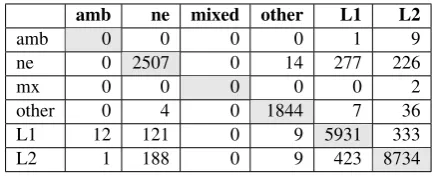
Table 7: Confusion matrix for the development dataset.
the validation and test sets (45.22% and 46.62% respectively), contrary to the training set where
lang1makes up 68.70% of the labels.
For the development set our system outperforms that ofSamih et al.(2016) by 1.9% absolute with significant gains for lang1(3% absolute) and ne
(2% absolute). For the test set our system again outperforms that ofSamih et al. (2016) by 1.0% absolute with the gain spread almost evenly across all labels.
Table 7 presents the confusion matrix for the validation set, which shows that ne suffers the largest confusion as it gets mixed up as either
lang2 (EA) or lang1 (MSA). This is due to the fact that many named entities in Arabic can also be used as ordinary words, and, unlike English, there is no case marking or other orthographic features that can superficially distinguish the two. For ex-ample, the word
Õç'Q»
krym, can mean either “Ka-reem” as anneor “generous” as an adjective, andÈAÔg.
jmAl can mean “Jamal” as anneor “beauty” as a noun. The second largest confusion is be-tweenlang1andlang2, where we find that a con-siderable amount of the mix-up coming from func-tion words, such asð
wa “and”,ð
@
>aw “or” andúÍ@
<ilY “to”, which can equally be used as eitherlang1orlang2, depending on the context.
6 Conclusion
[image:9.595.72.290.201.297.2]References
Heike Adel, Ngoc Thang Vu, Katrin Kirchhoff, Do-minic Telaar, and Tanja Schultz. 2015. Syntactic and semantic features for code-switching factored lan-guage models. IEEE/ACM Transactions on Audio,
Speech, and Language Processing, 23(3):431–440.
Heike Adel, Ngoc Thang Vu, Franziska Kraus, Tim Schlippe, Haizhou Li, and Tanja Schultz. 2013a. Re-current neural network language modeling for code switching conversational speech. In2013 IEEE In-ternational Conference on Acoustics, Speech and
Signal Processing, pages 8411–8415. IEEE.
Heike Adel, Ngoc Thang Vu, and Tanja Schultz. 2013b. Combination of recurrent neural networks and fac-tored language models for code-switching language modeling. InProceedings of the 51st Annual Meet-ing of the Association for Computational LMeet-inguistics (Volume 2: Short Papers), volume 2, pages 206–211.
Fahad AlGhamdi, Giovanni Molina, Mona Diab, Thamar Solorio, Abdelati Hawwari, Victor Soto, and Julia Hirschberg. 2016. Part of speech tagging for code switched data. InProceedings of the Second Workshop on Computational Approaches to Code Switching, pages 98–107.
Mohammed Attia, Pavel Pecina, Younes Samih, Khaled Shaalan, and Josef Van Genabith. 2012. Im-proved spelling error detection and correction for arabic. Proceedings of COLING 2012: Posters, pages 103–112.
Mohammed Attia, Antonio Toral, Lamia Tounsi, Mon-ica Monachini, and Josef van Genabith. 2010. An automatically built named entity lexicon for
Ara-bic. In Proceedings of the Seventh conference on
International Language Resources and Evaluation
(LREC’10), Valletta, Malta. European Languages
Resources Association (ELRA).
Peter Auer. 1999. From codeswitching via language mixing to fused lects: Toward a dynamic typology of bilingual speech. International journal of bilin-gualism, 3(4):309–332.
George Carpenter Barker. 1972. Social Functions of
Language in a Mexican-American Community,
vol-ume 22. University of Arizona Press.
Yassine Benajiba, Paolo Rosso, and José Miguel Benedíruiz. 2007. Anersys: An arabic named en-tity recognition system based on maximum entropy. InInternational Conference on Intelligent Text
Pro-cessing and Computational Linguistics, pages 143–
153. Springer.
Piotr Bojanowski, Edouard Grave, Armand Joulin, and Tomas Mikolov. 2017. Enriching word vectors with subword information. Transactions of the Associa-tion for ComputaAssocia-tional Linguistics, 5:135–146.
Eyamba G Bokamba. 1989. Are there syntactic constraints on code-mixing? World Englishes, 8(3):277–292.
Erman Boztepe. 2003. Issues in code-switching: Com-peting theories and models. Columbia University
Working Papers in TESOL and Applied Linguistics.
Peter F Brown, Peter V Desouza, Robert L Mercer, Vincent J Della Pietra, and Jenifer C Lai. 1992. Class-based n-gram models of natural language.
Computational linguistics, 18(4):467–479.
Rich Caruana, Steve Lawrence, and Lee Giles. 2000. Overfitting in neural nets: Backpropagation, conju-gate gradient, and early stopping. In NIPS, pages 402–408.
Özlem Çetino˘glu, Sarah Schulz, and Ngoc Thang Vu. 2016. Challenges of computational processing of code-switching. InProceedings of the Second Work-shop on Computational Approaches to Code Switch-ing, pages 1–11, Austin, TX.
Kunal Chakma and Amitava Das. 2016. Cmir: A cor-pus for evaluation of code mixed information re-trieval of hindi-english tweets. Computación y Sis-temas, 20(3):425–434.
Hok Shing Chan. 2009. Code-switching between typo-logically distinct languages. The Cambridge hand-book of linguistic code-switching, pages 182–198.
Jason Chiu and Eric Nichols. 2016. Named entity recognition with bidirectional lstm-cnns. Transac-tions of the Association for Computational Linguis-tics, 4:357–370.
R. Collobert, J. Weston, L. Bottou, M. Karlen, K. Kavukcuoglu, and P. Kuksa. 2011. Natural lan-guage processing (almost) from scratch. Journal of
Machine Learning Research, 12:2493–2537.
Kareem Darwish, Hamdy Mubarak, Ahmed Abdelali, Mohamed Eldesouki, Younes Samih, Randah Al-harbi, Mohammed Attia, Walid Magdy, and Laura Kallmeyer. 2018. Multi-dialect arabic pos tagging: A crf approach. InProceedings of the Eleventh In-ternational Conference on Language Resources and
Evaluation (LREC-2018), pages 93–98, Miyazaki,
Japan.
Ramy Eskander, Mohamed Al-Badrashiny, Nizar Habash, and Owen Rambow. 2014. Foreign words and the automatic processing of arabic social me-dia text written in roman script. In Proceedings of The First Workshop on Computational Approaches to Code Switching, pages 1–12.
Penelope Gardner-Chloros. 1991. Language selection
and switching in Strasbourg. Oxford University
Press.
François Grosjean. 1989. Neurolinguists, beware! the bilingual is not two monolinguals in one person.
Brain and language, 36(1):3–15.
Workshop on HLT & NLP within the Arabic world, pages 49–53.
Monica Heller. 2010.Codeswitching: Anthropological and Sociolinguistic Perspectives, volume 48. Walter de Gruyter.
Geoffrey E Hinton, Nitish Srivastava, Alex Krizhevsky, Ilya Sutskever, and Ruslan R Salakhutdinov. 2012. Improving neural networks by preventing co-adaptation of feature detectors. arXiv preprint arXiv:1207.0580.
Sepp Hochreiter and Jürgen Schmidhuber. 1997. Long short-term memory. Neural computation, 9(8):1735–1780.
Zhiheng Huang, Wei Xu, and Kai Yu. 2015. Bidi-rectional LSTM-CRF models for sequence tagging.
CoRR, abs/1508.01991.
Melvin Johnson, Mike Schuster, Quoc V Le, Maxim Krikun, Yonghui Wu, Zhifeng Chen, Nikhil Thorat, Fernanda Viégas, Martin Wattenberg, Greg Corrado, et al. 2017. Google’s multilingual neural machine translation system: Enabling zero-shot translation.
Transactions of the Association for Computational Linguistics, 5:339–351.
Aravind K. Joshi. 1982. Processing of sentences with intra-sentential code-switching. In Coling 1982: Proceedings of the Ninth International Conference on Computational Linguistics.
Istvan Kecskes. 2006. The dual language model to explain code-switching: A cognitive-pragmatic ap-proach. Intercultural Pragmatics, 3(3):257–283.
Guillaume Lample, Miguel Ballesteros, Sandeep Sub-ramanian, Kazuya Kawakami, and Chris Dyer. 2016. Neural architectures for named entity recognition.
arXiv preprint arXiv:1603.01360.
John M Lipski. 2005. Code-switching or borrowing? no sé so no puedo decir, you know. In Selected proceedings of the second workshop on Spanish so-ciolinguistics, pages 1–15. Cascadilla Proceedings Project Somerville, MA.
Xuezhe Ma and Eduard Hovy. 2016. End-to-end se-quence labeling via bi-directional lstm-cnns-crf. In
Proceedings of the 54th Annual Meeting of the As-sociation for Computational Linguistics (Volume 1:
Long Papers), pages 1064–1074, Berlin, Germany.
Association for Computational Linguistics.
Tomas Mikolov, Kai Chen, Greg Corrado, and Jeffrey Dean. 2013. Efficient estimation of word represen-tations in vector space.CoRR, abs/1301.3781.
Giovanni Molina, Fahad AlGhamdi, Mahmoud Ghoneim, Abdelati Hawwari, Nicolas Rey-Villamizar, Mona Diab, and Thamar Solorio. 2016. Overview for the second shared task on language identification in code-switched data. In Proceed-ings of the Second Workshop on Computational
Approaches to Code Switching, pages 40–49.
Pieter Muysken. 1995. Code-switching and grammat-ical theory, page 177–198. Cambridge University Press.
Pieter Muysken, Carmen Pena Díaz, Pieter Cornelis Muysken, et al. 2000. Bilingual speech: A typology
of code-mixing, volume 11. Cambridge University
Press.
Carol Myers-Scotton. 1997. Duelling languages:
Grammatical structure in codeswitching. Oxford
University Press.
Chad Nilep. 2006. “code switching” in sociocul-tural linguistics. Colorado Research in Linguistics, 19(1):1.
Olutobi Owoputi, Brendan O’Connor, Chris Dyer, Kevin Gimpel, Nathan Schneider, and Noah A Smith. 2013. Improved part-of-speech tagging for online conversational text with word clusters. In
Proceedings of NAACL-HLT 2013, pages 380–390.
Association for Computational Linguistics.
David J Parkin. 1974. Language switching in nairobi.
Language in Kenya, pages 189–216.
Anat Prior and Tamar H Gollan. 2011. Good language-switchers are good task-language-switchers: Evidence from spanish–english and mandarin–english bilinguals.
Journal of the International Neuropsychological So-ciety, 17(4):682–691.
Khyathi Chandu Raghavi, Manoj Kumar Chinnakotla, and Manish Shrivastava. 2015. Answer ka type kya he?: Learning to classify questions in code-mixed language. InProceedings of the 24th International
Conference on World Wide Web, pages 853–858.
ACM.
Nils Reimers and Iryna Gurevych. 2017. Reporting score distributions makes a difference: Performance study of lstm-networks for sequence tagging. In
Proceedings of the 2017 Conference on Empirical
Methods in Natural Language Processing (EMNLP),
pages 338–348, Copenhagen, Denmark.
Ryan Roth, Owen Rambow, Nizar Habash, Mona Diab, and Cynthia Rudin. 2008. Arabic morphologi-cal tagging, diacritization, and lemmatization using lexeme models and feature ranking. In
Proceed-ings of ACL-08: HLT, Short Papers, pages 117–
120, Columbus, Ohio. Association for Computa-tional Linguistics.
Younes Samih, Suraj Maharjan, Mohammed Attia, Laura Kallmeyer, and Thamar Solorio. 2016. Multi-lingual code-switching identification via lstm recur-rent neural networks. InProceedings of the Second Workshop on Computational Approaches to Code Switching, pages 50–59.
Mike Schuster and Kuldip K Paliwal. 1997. Bidirec-tional recurrent neural networks. IEEE Transactions
on Signal Processing, 45(11):2673–2681.
Mamokgethi Setati. 1998. Code-switching in a se-nior primary class of second-language mathemat-ics learners. For the Learning of Mathematics, 18(1):34–40.
Arnav Sharma, Sakshi Gupta, Raveesh Motlani, Piyush Bansal, Manish Srivastava, Radhika Mamidi, and Dipti M Sharma. 2016. Shallow parsing pipeline for hindi-english code-mixed social media text. arXiv preprint arXiv:1604.03136.
Thamar Solorio, Elizabeth Blair, Suraj Mahar-jan, Steven Bethard, Mona Diab, Mahmoud Ghoneim, Abdelati Hawwari, Fahad AlGhamdi, Ju-lia Hirschberg, Alison Chang, et al. 2014. Overview for the first shared task on language identification in code-switched data. In Proceedings of the First Workshop on Computational Approaches to Code Switching, pages 62–72.
Thamar Solorio and Yang Liu. 2008a. Learning to pre-dict code-switching points. In Proceedings of the Conference on Empirical Methods in Natural
Lan-guage Processing, pages 973–981. Association for
Computational Linguistics.
Thamar Solorio and Yang Liu. 2008b. Part-of-speech tagging for english-spanish code-switched text. In
Proceedings of the Conference on Empirical
Meth-ods in Natural Language Processing, pages 1051–
1060. Association for Computational Linguistics.
Karl Stratos and Michael Collins. 2015. Simple semi-supervised pos tagging. InVS@ HLT-NAACL, pages 79–87.
Peter Trudgill. 1986. Dialects in contact. B. Black-well.
Stavroula Tsiplakou. 2009. Code-switching and code-mixing between related varieties: establishing the blueprint. The International Journal of Humanities, 6(12):49–66.
David Vilares, Miguel A Alonso, and Carlos Gómez-Rodríguez. 2015. Sentiment analysis on monolin-gual, multilingual and code-switching twitter cor-pora. InProceedings of the 6th Workshop on Com-putational Approaches to Subjectivity, Sentiment and Social Media Analysis, pages 2–8.
Donald D Walsh. 1969. Bilingualism and bilingual ed-ucation: a guest editorial. Foreign Language Annals, 2(3):298–303.