Proceedings of the 57th Annual Meeting of the Association for Computational Linguistics, pages 1620–1629 1620
Stochastic Tokenization with a Language Model
for Neural Text Classification
Tatsuya Hiraoka1,Hiroyuki Shindo2, andYuji Matsumoto2,3
1Tokyo Institute of Technology 2Nara Institute of Science and Technology
3RIKEN Center for Advanced Intelligence Project (AIP)
2{shindo,matsu}@is.naist.jp
Abstract
For unsegmented languages such as Japanese and Chinese, tokenization of a sentence has a significant impact on the performance of text classification. Sentences are usually seg-mented with words or subwords by a morpho-logical analyzer or byte pair encoding and then encoded with word (or subword) representa-tions for neural networks. However, segmenta-tion is potentially ambiguous, and it is unclear whether the segmented tokens achieve the best performance for the target task. In this pa-per, we propose a method to simultaneously learn tokenization and text classification to ad-dress these problems. Our model incorporates a language model for unsupervised tokeniza-tion into a text classifier and then trains both models simultaneously. To make the model robust against infrequent tokens, we sampled segmentation for each sentence stochastically during training, which resulted in improved performance of text classification. We con-ducted experiments on sentiment analysis as a text classification task and show that our method achieves better performance than pre-vious methods.
1 Introduction
Tokenization is a fundamental problem in text classification such as sentiment analysis (Tang et al., 2014; Kim, 2014; dos Santos and Gatti, 2014), topic detection (Lai et al., 2015; Zhang et al., 2015), and spam detection (Liu and Jia, 2012;Liu et al.,2016). In text classification with neural networks, sentence representation is cal-culated based on tokens that compose the sen-tence. Specifically, a sentence is first tokenized into meaningful units such as characters, words, and subwords (Zhang et al., 2015; Joulin et al., 2017). Then, the token embeddings are looked up and fed into a neural network encoder such as a feed-forward neural network (Iyyer et al.,2015), a
convolutional neural network (CNN) (Kim,2014; Kalchbrenner et al., 2014), or a long short-term memory (LSTM) network (Wang et al.,2016a,b).
For English and other languages that use the Latin alphabet, the whitespace is a good indica-tor of word segmentation. However, tokenization is a non-trivial problem in unsegmented languages such as Chinese and Japanese since they have no explicit word boundaries. For these languages, tokenizers based on supervised machine learning with a dictionary (Zhang et al.,2003;Kudo,2006) have been used to segment a sentence into units (Lai et al., 2015). In addition, we use a neural network-based word segmenter to tokenize a raw corpus in Chinese text classification (Zhou et al., 2016;Zhang and Yang,2018). In machine trans-lation, subword tokenization with byte pair en-coding (BPE) addresses the problem of unknown words and improves performance (Sennrich et al., 2016).
1621
公司也未修正
Stochastic Tokenization
Text Classifier 公司也未修正
Deterministic Tokenization
Text Classifier 公司/ 也/ 未/ 修正
Possible Tokenization
Language
Model reflect sampled
tokenization on language model
Tokenizer
公司/ 也/ 未/ 修正
Sampled Tokenization
company has not corrected
修 正 公司也
公 司
未修正 公司
未 也
修正
< >
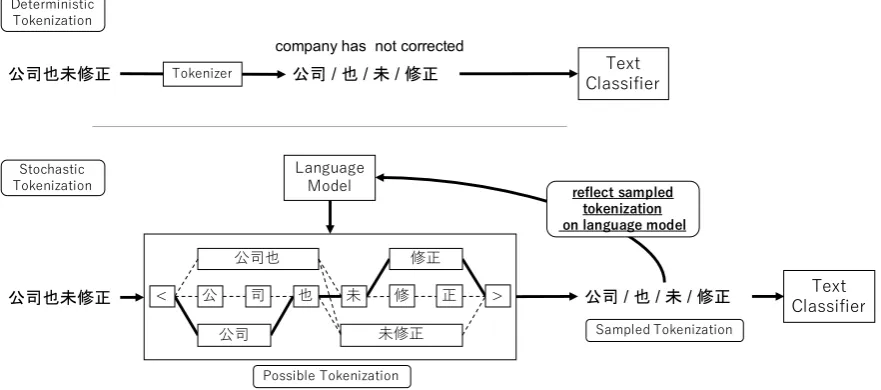
Figure 1: (Top) Schematic of the previous classification model with deterministic tokenization, and (bottom) our proposed model, which tokenizes a raw sentence stochastically with a language model and updates it by sampled tokens in the training phase. <and> in the lattice are special tokens indicating the beginning and end of a sentence, respectively. We input a tokenized sentence into the neural text classifier, and it is trained with its gold label.
2 Neural Text Classification
Text classification refers to the classifying of a sentence into a corresponding label. Typically, a neural network text classifier represents the sen-tences = t1...tn...tN as a vectorvs and predicts the distribution of labels by transforming the vec-tor. For example,vsis given by a forward LSTM as
ctokenn ,htokenn = LSTM(ctokenn−1 ,htokenn−1 ,vtn) vs =htokenN
(1)
wheretn is the n-th token composing a sentence of lengthN, andvtn is the vector for tokentn. h
andcare output vectors and cell states of LSTM, respectively. The N-th output vector htokenN of LSTM is assigned to the token vectorvs.
The token vector vt is obtained by concate-nating a token-level representation vtoken and a character-level representationvcharas follows:
vt=Wcat(vttoken;vtchar) +bcat (2)
wherevttokenis extracted from a lookup table, and
vtchar is calculated by a single-layered and uni-directional LSTM from embeddings of the charac-ters composing the token as well as the token-level LSTM (1).Wcatandbcatare parameters.
The probabilityp(ys =u|vs)that the sentence classys is au-th class is calculated by a decoder
with a linear layer as
p(ys=u|vs) = softmax(Wdecvs+bdec)u (3)
where Wdec and bdec are the parameters, and
softmax(·) refers to the softmax function. (·)u is the u-th element of a vector. The neural text classifier is trained with the optimizer to minimize cross-entropy loss for gold labels.
3 Proposed Model
3.1 Model Outline
We focus on the tokenization of neural text sification. During the training phase of text clas-sification, the proposed model tokenizes an input sentence stochastically in every epoch with a lan-guage model. A neural text classifier takes the to-kenized sentence and predicts a label for the sen-tence. In the evaluation, our model tokenizes the test set by the Viterbi algorithm with a language model.
[image:2.595.80.521.67.262.2]updates its language model depending on the cur-rently sampled tokens in the training phase.
Algorithm 1 outlines our model. After set-ting the initial language model and a classifier model, every sentence in a mini-batch for train-ing is tokenized stochastically, and the language model is updated based on the tokenized sentence. An example of our model’s processing is illus-trated at the bottom of figure 1. Compared with conventional text classification with determinis-tic tokenization, our model incorporates a lan-guage model into the training process and trains in both tokenization and text classification simul-taneously.
Algorithm 1Learning Algorithm
1: set/train a language modelLM 2: set a classifier modelCM
3: whileepoch<maxEpochdo
4: foreachminiBatchdo
5: foreach sentencesinminiBatchdo 6: ts= tokenizeswithLM
7: updateLMwithts
8: end for
9: updateCMwithminiBatch
10: end for
11: end while
3.2 Nested Unigram Language Model
To sample tokens for a sentence, we employed a nested unigram language model, which was pro-posed as a Bayesian framework for word segmen-tation (Goldwater et al., 2009). When a token t
consists ofMcharacters; that is,t=c1...cm...cM, its unigram probabilityp(t)in a text data is given as
p(t) = count(P t) +αpbase(t) ˆ
tcount(ˆt) +α
(4)
wherecount(t)is a function that returns the num-ber of tokenstin the text data. pbase(t)gives the
basic probability of the tokent with a character-level language model:
pbase(t:c1...cM) =puni(c1)
M
Y
m=2
pbi(cm|cm−1)
(5) To deal with a token that includes an unknown character, both puni(cm) and pbi(cm|cm−1) are
also calculated by a smoothed language model. A smoothed character unigram probabilitypuni(cm)
is given as
puni(cm) =
count(cm) +β(Y1)
Y +β
Y =X
ˆ
c
count(ˆc)
(6)
A smoothed character bigram probability
pbi(cm|cm−1)is also given as
pbi(cm|cm−1) =
count(cm|cm−1) +γpuni(cm)
count(cm−1) +γ
(7)
where Y is the total number of characters, and
count(cm|cm−1) is the number of character
bi-grams. 1/Y in (6) and puni(cm) in (7) are base probabilities of the character unigram and the character bigram, respectively. α, β, and γ are hyperparameters for smoothing language models. By setting higher values for these hyperparame-ters, the model associates a higher probability to out-of-vocabulary (OOV) tokens. The result of this association is that the model selects OOV to-kens more frequently when sampling.
We use a dictionary-based morphological ana-lyzer or unsupervised word segmentation to tok-enize a corpus initially, and the language model is initialized with the tokenized corpus.
3.3 Sampling Tokenization
With the nested unigram language model intro-duced above, the tokenization of a sentence is sampled from the distribution P(t|s) where t is possible tokenization for the sentence. A proba-bility of tokenization is obtained by a nested lan-guage model (4) asp(t|s) =Q
t∈tp(t).
Following (Kudo,2018) and (Mochihashi et al., 2009), we employ a dynamic programming (DP) technique called forward filtering backward sam-pling (FFBS) (Scott, 2002) to sample tokens stochastically. With FFBS, we can sample tokens in a sentence from a distribution considering all possible tokenizations within the limit of the max-imum token lengthl. In the forward calculation of FFBS, a DP Table D is calculated as follows:
D[i][j] =p(si−j:i)
min(i−j,l)
X
k=1
D[i−j][k]
D[0][1] = 1
(8)
whereiis the index of a character in a sentences
1623 of a token. si−j:i is a token that consists of
ci−j...ci, andp(si−j:i)is given by (4). D[i][j]is the marginalized probability that the tokensi−j:i appears in the sentence.
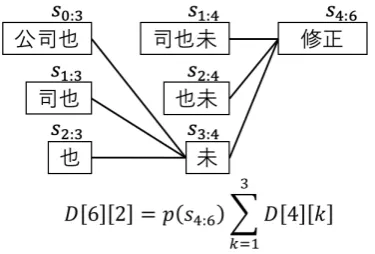
An example of the forward calculation is illus-trated in Figure2. In the figure, the probability of a two-length token that ends with the sixth char-acter is calculated recursively when the maximum length of a word is3.
[image:4.595.88.276.280.407.2]After completing Table D, we can sample to-kenization from the tail of a sentence with D. Note that our model uses the whitespaces in the sentence as the token boundaries when processing languages indicating word boundaries such as En-glish.
Figure 2: An example of forward calculation of for-ward filtering backfor-ward sampling for a Chinese sen-tence used in figure1with maximum length 3. In this figure, we illustrate the calculation ofD[6][2].
3.4 Updating of the Language Model
To update the language model with a tokenized sentence, we follow the updating method of blocked Gibbs sampling for unsupervised word segmentation (Mochihashi et al., 2009). Before sampling tokenization, the token counts of the sen-tence are removed from the language model (4) and the new tokenization is sampled with the lan-guage model. After sampling, the lanlan-guage model is updated by adding the token counts in a cur-rently tokenized sentence.
Specifically,count(t)in (4) is reduced for every tokentincluded in a sentence.count(c)is also re-duced for all charactercs included byt. We handle the adding process in the same way.
By updating the language model, when evalu-ating the classifier on validation and test datasets, our model can reproduce the segmentation sam-pled in the training phase. This updating method ensures that the tokenization is consistent between
training and evaluation, particularly for a sentence containing a low frequency phrase.
3.5 Embedding for Unfixed Vocabulary
Since our model does not limit the vocabulary, there are many ways to tokenize a single sen-tence. To use token-level representations, we typ-ically employ a lookup embedding mechanism, which requires a fixed vocabulary. In our model, however, the vocabulary changes as the language model is updated.
We, therefore, introduce word embeddings with continuous cache inspired by (Grave et al.,2016; Kawakami et al., 2017; Cai et al., 2017). This method enables the proposed model to assign token-level representations to recently sampled to-kens. Although embeddings of older tokens are discarded from the cache memory, we assume that meaningful tokens to solve the task appear fre-quently, and they remain in the cache during train-ing if the size of the cache is large enough. By updating representations in the cache, the model can use token-level information adequately.
In our embedding mechanism with a cache component, the model has a list Q that stores
|Q|elements of recent tokenization history. The model also keeps a lookup table Vcache com-posed of token-level vectors corresponding to to-kens cached inQ. A tokentis stored in Q, and each element inQhas a unique indexqto extract the representation fromVcache.
A token-level embedding of the token vtokent
is obtained by extracting a vector vcache
q from
Vcache.qis an index corresponding to the tokent
iftis in the listQ; otherwise, the oldest token inQ
drops from the list, and we assign its indexqto the new tokent. The representation for the new token
vqcache is initialized withvtchar mentioned in sec-tion 2, and the vector for the old token that drops from the list is discarded. This embedding process is described as:
vttoken=
(
Vcachekt (t∈Q)
vtchar (otherwise) (9)
wherekt is a one-hot vector whose q-th element indicatingtis 1 and 0 otherwise.
A token representation obtained by cache-embedding is used as a lookup representation
with gradients obtained by backward calculation from the loss function. In the evaluation phase,Q
is not changed by unknown tokens in the valida-tion and test set.
4 Experiments
4.1 Setup
Dataset:To evaluate the differences caused by
to-kenization and embedding, we conducted experi-ments on short-text sentiment classification tasks. We exploited formal and informal corpora in Chi-nese, JapaChi-nese, and English.
The NTCIR-6 dataset (Seki et al., 2007) con-tains newspaper articles on 32 topics in Chinese, Japanese, and English. We extracted only the sen-tences attached with three-class sentiment labels. and 1 to 28 topics were used for training, 29 to 30 topics for validation, and 31 to 32 topics for test-ing.
As a social short-text dataset, we used Twit-ter datasets in the Japanese1 and English2 exper-iments. These datasets were annotated with five-class sentiment labels in Japanese and two-five-class sentiment labels in English, and 21,000 sentences were randomly selected in a well-balanced man-ner. We split the corpus into 18,000 for training, 2,000 for validation, and 1,000 for testing in both Japanese and English.
We used ChnSentiCorp (HOTEL)3 as another dataset for Chinese sentiment classification on in-formal texts. We did not use any other resource except for the training datasets.
Model: To compare the results from different
to-kenization on text classification, we used the sim-ple neural text classifier described in section2 in all the experiments4. As the token vectorvt men-tioned in (1), we used representations by different tokenization and embedding.
We initialized randomly and trained token-level and character-level representations with a classi-fication task. The sizes of a token representation and a character representation were set as 512 and
1
http://bigdata.naist.jp/˜ysuzuki/ data/twitter/
2
https://www.kaggle.com/c/ twitter-sentiment-analysis2
3http://tjzhifei.github.io/resource.
html
4
We conducted the same experiment with Deep Average Network (DAN) (Iyyer et al.,2015) rather than LSTM and obtained similar results. We report the experiment with the LSTM classifier because the results are more significant than the results with DAN.
128, respectively, and the size of a sentence repre-sentation was 1,024. The sentence reprerepre-sentation was projected to a label-size vector depending on the dataset, and probabilities for labels were ob-tained using the softmax function.
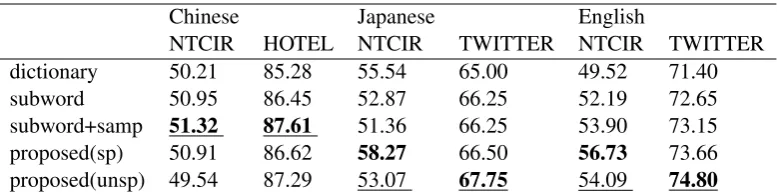
The main results are shown in Table 1. We compared the scores obtained by models trained with different tokenization. In the table, “dictio-nary” means the model trained with dictionary-based tokenization. Chinese and Japanese datasets are tokenized by Jieba5 and MeCab, respectively, and the English dataset is tokenized by original whitespaces. As a baseline model that samples tokenization, we employed SentencePiece imple-mentation6. We used SentencePiece in both op-tions with/without sampling (“subword” / “sub-word+samp”). We set the subword size as 6,000 for NTCIR in English and 8,000 for the others7.
Our model is denoted as “proposed” in the table. “sp” represents the proposed method whose lan-guage model is initialized with dictionary-based tokenization, and “unsp” represents the model initialized with unsupervised word segmentation. The sizes of the cache for the proposed model were the same as the sizes of the subword vocab-ulary for SentencePiece. We set the maximum length of the token for our method as eight for every language. When initializing the language model with a dictionary-based tokenization, the corpus was retokenized into tokens shorter than eight characters depending on the language model. The hyperparameters for smoothing were set as
α = β = γ = 1 in both pretraining for unsu-pervised word segmentation and training for clas-sification.
Dropout layers were used for embedding and sentence representations with a rate of 0.5. We used the softmax cross-entropy loss for optimiza-tion, and the parameters were optimized by Adam (Kingma and Ba,2014). We trained the models in 30 epochs, and the model with the highest score on the validation dataset was selected and evalu-ated on the test dataset. In this paper, we report the average F1 score in five experiments.
5
https://github.com/fxsjy/jieba
6https://github.com/google/
sentencepiece
7Although we should have set the subword size for the
1625
Chinese Japanese English
NTCIR HOTEL NTCIR TWITTER NTCIR TWITTER
dictionary 50.21 85.28 55.54 65.00 49.52 71.40
subword 50.95 86.45 52.87 66.25 52.19 72.65
subword+samp 51.32 87.61 51.36 66.25 53.90 73.15
proposed(sp) 50.91 86.62 58.27 66.50 56.73 73.66
[image:6.595.105.494.61.158.2]proposed(unsp) 49.54 87.29 53.07 67.75 54.09 74.80
Table 1: F1 scores (%) from the models trained with different methods of tokenization. The highest scores among all methods are highlighted by bold font, and the highest scores among unsupervised tokenization models are highlighted with an underline.
4.2 Results
First, we analyzed the overall results of the ex-periment. The highest scores among all tokeniza-tion methods are highlighted by bold font in Table 1. As shown in the table, the proposed method obtained the best scores in the Japanese and En-glish datasets. SentencePiece with a sampling op-tion, however, scored the highest in the Chinese datasets. This is because the Chinese vocabulary is larger than the Japanese and English vocabular-ies. In other words, Chinese datasets have a larger number of types of n-grams. We consider that the cache size of the proposed method is not sufficient to store meaningful words to solve the task of the Chinese dataset.
Second, we focus on the results by the super-vised methods (“dictionary” and “proposed(sp)”). The language model of the proposed method “sp” is initialized by corpus segmented by the “dictio-nary” method and trained by sampled tokenization while training a classifier. The table shows that the scores from our method surpassed the dictionary-based segmentation for all datasets. We conclude that the proposed method is superior to the method that trains a classifier with dictionary-based tok-enization.
Third, we analyzed the scores obtained us-ing unsupervised methods (“subword”, “sub-word+samp”, and “proposed(unsp)”). The highest scores among the unsupervised methods are em-phasized by an underline. The proposed method obtained the best scores for the Japanese and En-glish datasets, but SentencePiece was superior for the Chinese dataset as described in the overall comparison.
Finally, we compare the proposed methods. The proposed model whose language model is ini-tialized by a dictionary (“sp”) obtained higher scores on the NTCIR dataset in every language. On the other hand, the model with unsupervised
initialization scored higher on SNS dataset for all languages. From these results, we conclude that the performance of our model improved with dictionary-based segmentation for formal corpus while unsupervised initialization improved the performance of informal corpus when a generally used dictionary was employed.
5 Discussion
5.1 Cache Size
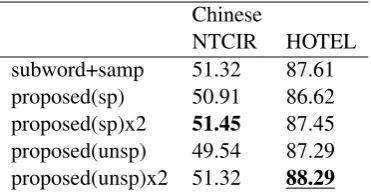
In the main experiment described in the previous section, we set the size of the cache for token-level embedding to be the same as the vocabulary of SentencePiece for a fair comparison. As ex-plained, the scores of our model for the Chinese dataset were lower than the scores for Sentence-Piece with sampling. We consider that this result was caused by the cache-overflow of the vocabu-lary. Therefore, we conducted an additional exper-iment where the size of the cache was increased. The results are shown in table2. The cache size of the model denoted as “x2” is twice the size (16,000) of the model used in Table1. From the result, we conclude that increasing the size of the cache improves the performance of the proposed model for the Chinese datasets. We also determine that the size of the cache used in the main exper-iment is sufficient to store meaningful words for the task in Japanese and English.
in-Chinese
NTCIR HOTEL
[image:7.595.89.275.62.158.2]subword+samp 51.32 87.61 proposed(sp) 50.91 86.62 proposed(sp)x2 51.45 87.45 proposed(unsp) 49.54 87.29 proposed(unsp)x2 51.32 88.29
Table 2: F1 scores (%) by models with different cache size for the proposed model on Chinese datasets. The size of the cache of proposed models when “+x2” is 16,000 and 8,000 otherwise. The best model in table1
“subword+samp” is quoted as a baseline model.
84 85 86 87 88 89 90
46 47 48 49 50 51 52
4000 8000 16000 32000
HO
TE
L(
CH)
F
1-sc
or
e(
%
)
NT
CI
R(
CH
) F
1-sc
or
e(
%
)
cache size
NTCIR(CH, sp) NTCIR(CH, unsp) HOTEL(CH, sp) HOTEL(CH, unsp)
Figure 3: F1 scores (%) by models trained with differ-ent cache sizes on NTCIR(CH) and HOTEL(CH).
Lanugage Dataset sp unsp Chinese NTCIR 29,299 28,232
HOTEL 22,170 15,816 Japanese NTCIR 7,623 10,139 Twitter 33,831 17,013 English NTCIR 11,449 3,544
Twitter 50,733 6,859
Table 3: The volume of vocabulary of the language model initialized by dictionary (sp) and unsupervised word segmentation (unsp) for each dataset.
creases up to the cache size around the size of the initial vocabulary. In addition, we consider from the vocabulary sizes of the Japanese and English Twitter dataset that it is important to select an ap-propriate tokenizer for initialization. Although the initial vocabulary is huge for the Japanese and En-glish datasets, the cache size is sufficient to store the useful words for classification. We consider the reason is that there are many similar but dif-ferent words in the vast vocabulary of the Twitter dataset unlike the Chinese dataset, and the differ-ence becomes small using the language model.
5.2 Sampling Option
Our model has two other options for sampling to-kenization: a model without sampling in the train-ing phase (“nosamp”) and a model that samples tokenization without updating the language model (“samp”). The former means that the model to-kenizes a sentence into the one-best tokenization with an initialized unigram language model while the latter can be described as a vocabulary-free version of SentencePiece. We tested this compari-son on the models with dictionary-based initializa-tion (“sp”) and the 500-epoch pretrained models (“unsp”). Table4shows the results. Our proposed model updating a language model is denoted as “train.”
The results show that higher scores are given by updating the language model (“train”) on all the datasets. While we cannot determine com-prehensively whether performance is improved by sampling without updating a language model (“samp”), from the results, we argue that the per-formance of the classification task is improved by sampling tokenization and updating its language model.
5.3 Case Study
Figure4shows distributions for each label for dif-ferent tokenizations for a sentence in a validation set of a Japanese Twitter dataset. Each distribution is calculated by the same model that samples tok-enization and updates its language model. In the figure, “INITIAL” means a prediction by a model inputted into a sentence tokenized by an initial lan-guage model. In other words, “INITIAL” shows the prediction by the model without updating the language model.
[image:7.595.79.284.243.364.2]1627
Chinese Japanese English
NTCIR HOTEL NTCIR TWITTER NTCIR TWITTER
sp+nosamp 50.36 86.28 53.96 66.25 52.85 72.80
sp+samp 50.27 85.28 51.98 66.25 53.33 72.40
sp+train 50.91 86.62 58.27 66.50 56.73 73.66
unsp+nosamp 49.08 86.95 52.80 65.37 53.80 73.90
unsp+samp 48.95 85.95 48.35 66.37 53.80 73.60
[image:8.595.107.488.62.172.2]unsp+train 49.54 87.29 53.07 67.75 54.09 74.80
Table 4: F1 scores (%) of the ablation study to compare the sampling options of the proposed model. “samp” rep-resents a model that samples tokenization without updating its language model while “train” updates its language model depending on the sampled tokenization.
0 0.2 0.4 0.6 0.8 1
[image:8.595.352.484.237.322.2] [image:8.595.75.290.245.369.2]pos+neg pos neg neutral unrelated [INITIAL]
Xperia _ _ _ _ _ _ _ _ [UPDATED]
Xperia_ _ _ _ _ _ _ _ _ 0
0.2 0.4 0.6 0.8 1
pos+neg pos neg neutral unrelated [INITIAL]
Xperia _ _ _ _ _ _ _ _ [UPDATED]
Xperia_ _ _ _ _ _ _ _ _
Label
P
robabi
lit
y
Figure 4: Label prediction by a trained model for a sentence with different tokenization. “ ” denotes word boundary, and the sentence means “I wish they had made the button on the Xperia more responsive.” True label for the sentence is “neg”. The sentence indicated by “UPDATED” is tokenized by a language model up-dated with sampled tokenization while “INITIAL” is segmented by an initial language model.
5.4 News-title Classification
In addition to sentiment analysis, we also evalu-ated our model on other domains of text classifica-tion, topic classification. We employed Japanese web news corpus provided by Livedoor8 and a model classified article titles into a label of nine topics. The experiment was conducted under the same condition as the sentiment analysis described in section 4.
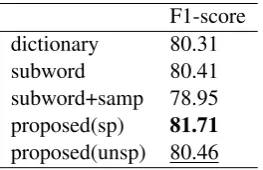
As shown in Table 5, the proposed method with unsupervised initialization obtained the high-est score. In addition to the result of sentiment analysis, we also determined that the performance improved by initializing the language model with dictionary-based tokenization. From the result, we conclude that our new tokenization strategy is ef-fective on some classification tasks.
8
https://www.rondhuit.com/download. html#ldcc
F1-score dictionary 80.31
subword 80.41
subword+samp 78.95 proposed(sp) 81.71
proposed(unsp) 80.46
Table 5: F1-scores (%) using the models with differ-ent tokenizations on the news-title classification task (Japanese).
6 Related Work
Our work is related to word segmentation for a neural network encoder. To tokenize a sentence into subwords without dictionary-based segmen-tation, BPE is commonly used in neural machine translation (NMT) (Sennrich et al., 2016). BPE forces a merger of tokens without any exceptions, and tokenization does not become natural.
The problem associate with BPE has been ad-dressed using a language model to tokenize a sen-tence. (Goldwater et al., 2006, 2009) proposed unsupervised word segmentation by sampling to-kenization and updating a language model with Gibbs sampling. The language model for unsuper-vised word segmentation is smoothed with base probabilities of words to give a probability for all possible words in a text. (Mochihashi et al., 2009) extended this to the use of blocked Gibbs sampling, which samples tokenization by a sen-tence. The authors introduced a nested Bayesian language model that calculates a probability of a word by hierarchical language models.
of sampling tokenization. Considering multiple subwords makes an NMT model robust against noise and segmentation errors. This differs from BPE in that it does not merge tokens uniquely by its frequency and differs from unsupervised word segmentation with a language model in that it lim-its subword vocabulary. Our work is similar to this line of research, but we focus on NLP tasks that do not require decoding such as text classification. The proposed model is different from this work in some respects: the vocabulary is not fixed, and the language model is updated by sampled tokeniza-tion.
In this paper, we address the problem of tok-enization for a neural network encoder by modi-fying a tokenization strategy. Another approach to address this problem alters the architecture of a neural network. For example, (Zhang and Yang, 2018) employs lattice LSTM, which considers all possible tokenizations of a sentence for named en-tity recognition. Lattice structured RNNs are also used for neural Chinese word segmentation such as (Chen et al., 2017) and (Yang et al., 2018), and they report improvement in performance. Our work is different from these works from the per-spective that we address the problem focusing on the segmentation itself not the architecture of a neural network as well as (Kudo,2018).
We used a caching mechanism proposed to aug-ment neural language models (Merity et al.,2016; Grave et al., 2016). This is also exploited for an open-vocabulary language model (Kawakami et al.,2017). (Cai et al.,2017) proposed a similar architecture to the caching mechanism for neural Chinese word segmentation.
7 Conclusion
In this paper, we introduced stochastic tokeniza-tion for text classificatokeniza-tion with a neural network. Our model differs from previous methods in terms of sampling tokenization that considers all pos-sible words under the maximum length limita-tion. To embed various tokens, we proposed the cache mechanism for frequent words. Our model also updates the language model depending on the sampled tokenizations in the training phase. With the updated language model, the proposed model can tokenize the test dataset considering recently used tokenization in the training phase. This re-sults in improved performance for sentiment anal-ysis tasks on Japanese and English datasets and
Chinese datasets with a larger cache. We find that the proposed model of tokenization provides an improvement in the performance of text classifi-cation with a simple LSTM classifier. We expect our model contributes to improved performance of other complex state-of-the-art encoding architec-tures for text classification.
Acknowledgments
We are grateful to the members of the Compu-tational Linguistics Laboratory, NAIST and the anonymous reviewers for their insightful com-ments.
References
Deng Cai, Hai Zhao, Zhisong Zhang, Yuan Xin, Yongjian Wu, and Feiyue Huang. 2017. Fast and accurate neural word segmentation for chinese. In
Proceedings of the 55th Annual Meeting of the As-sociation for Computational Linguistics (Volume 2: Short Papers), volume 2, pages 608–615.
Xinchi Chen, Zhan Shi, Xipeng Qiu, and Xuanjing Huang. 2017. Dag-based long short-term mem-ory for neural word segmentation. arXiv preprint arXiv:1707.00248.
Sharon Goldwater, Thomas L Griffiths, and Mark John-son. 2006. Contextual dependencies in unsuper-vised word segmentation. InProceedings of the 21st International Conference on Computational Lin-guistics and the 44th annual meeting of the Associa-tion for ComputaAssocia-tional Linguistics, pages 673–680. Association for Computational Linguistics.
Sharon Goldwater, Thomas L Griffiths, and Mark John-son. 2009. A bayesian framework for word segmen-tation: Exploring the effects of context. Cognition, 112(1):21–54.
Edouard Grave, Armand Joulin, and Nicolas Usunier. 2016. Improving neural language models with a continuous cache. arXiv preprint arXiv:1612.04426.
Mohit Iyyer, Varun Manjunatha, Jordan Boyd-Graber, and Hal Daum´e III. 2015. Deep unordered com-position rivals syntactic methods for text classifica-tion. InProceedings of the 53rd Annual Meeting of the Association for Computational Linguistics and the 7th International Joint Conference on Natural Language Processing (Volume 1: Long Papers), vol-ume 1, pages 1681–1691.
Armand Joulin, Edouard Grave, Piotr Bojanowski, and Tomas Mikolov. 2017. Bag of tricks for efficient text classification. volume 2, pages 427–431.
1629 modelling sentences. In Proceedings of the 52nd Annual Meeting of the Association for Computa-tional Linguistics (Volume 1: Long Papers), vol-ume 1, pages 655–665.
Kazuya Kawakami, Chris Dyer, and Phil Blunsom. 2017. Learning to create and reuse words in open-vocabulary neural language modeling. In Proceed-ings of the 55th Annual Meeting of the Association for Computational Linguistics (Volume 1: Long Pa-pers), volume 1, pages 1492–1502.
Yoon Kim. 2014. Convolutional neural networks for sentence classification. InProceedings of the 2014 Conference on Empirical Methods in Natural Lan-guage Processing (EMNLP), pages 1746–1751.
Diederik P Kingma and Jimmy Ba. 2014. Adam: A method for stochastic optimization. arXiv preprint arXiv:1412.6980.
Taku Kudo. 2006. Mecab: Yet another part-of-speech and morphological analyzer. http://taku910.github.io/mecab/.
Taku Kudo. 2018. Subword regularization: Improv-ing neural network translation models with multiple subword candidates. InProceedings of the 56th An-nual Meeting of the Association for Computational Linguistics (Volume 1: Long Papers), pages 66–75.
Taku Kudo and John Richardson. 2018. Sentencepiece: A simple and language independent subword tok-enizer and detoktok-enizer for neural text processing. In
Proceedings of the 2018 Conference on Empirical Methods in Natural Language Processing: System Demonstrations, pages 66–71.
Siwei Lai, Liheng Xu, Kang Liu, and Jun Zhao. 2015. Recurrent convolutional neural networks for text classification. InTwenty-ninth AAAI conference on artificial intelligence.
Chenwei Liu, Jiawei Wang, and Kai Lei. 2016. Detect-ing spam comments posted in micro-blogs usDetect-ing the self-extensible spam dictionary. In 2016 IEEE In-ternational Conference on Communications (ICC), pages 1–7. IEEE.
Lin Liu and Kun Jia. 2012. Detecting spam in chinese microblogs-a study on sina weibo. In2012 Eighth International Conference on Computational Intelli-gence and Security, pages 578–581. IEEE.
Stephen Merity, Caiming Xiong, James Bradbury, and Richard Socher. 2016. Pointer sentinel mixture models. arXiv preprint arXiv:1609.07843.
Daichi Mochihashi, Takeshi Yamada, and Naonori Ueda. 2009. Bayesian unsupervised word segmen-tation with nested pitman-yor language modeling. In Proceedings of the Joint Conference of the 47th Annual Meeting of the ACL and the 4th International Joint Conference on Natural Language Processing of the AFNLP: Volume 1-Volume 1, pages 100–108. Association for Computational Linguistics.
Cicero dos Santos and Maira Gatti. 2014. Deep con-volutional neural networks for sentiment analysis of short texts. In Proceedings of COLING 2014, the 25th International Conference on Computational Linguistics: Technical Papers, pages 69–78.
Steven L Scott. 2002. Bayesian methods for hidden markov models: Recursive computing in the 21st century. Journal of the American Statistical Asso-ciation, 97(457):337–351.
Yohei Seki, David Kirk Evans, Lun-Wei Ku, Hsin-Hsi Chen, Noriko Kando, and Chin-Yew Lin. 2007. Overview of opinion analysis pilot task at ntcir-6.
Rico Sennrich, Barry Haddow, and Alexandra Birch. 2016. Neural machine translation of rare words with subword units. InProceedings of the 54th Annual Meeting of the Association for Computational Lin-guistics (Volume 1: Long Papers), volume 1, pages P1715–1725.
Duyu Tang, Furu Wei, Nan Yang, Ming Zhou, Ting Liu, and Bing Qin. 2014. Learning sentiment-specific word embedding for twitter sentiment clas-sification. InProceedings of the 52nd Annual Meet-ing of the Association for Computational LMeet-inguistics (Volume 1: Long Papers), volume 1, pages 1555– 1565.
Jin Wang, Liang-Chih Yu, K Robert Lai, and Xuejie Zhang. 2016a. Dimensional sentiment analysis us-ing a regional cnn-lstm model. InProceedings of the 54th Annual Meeting of the Association for Compu-tational Linguistics (Volume 2: Short Papers), vol-ume 2, pages 225–230.
Yequan Wang, Minlie Huang, Li Zhao, et al. 2016b. Attention-based lstm for aspect-level sentiment clas-sification. InProceedings of the 2016 conference on empirical methods in natural language processing, pages 606–615.
Jie Yang, Yue Zhang, and Shuailong Liang. 2018. Sub-word encoding in lattice lstm for chinese Sub-word seg-mentation.arXiv preprint arXiv:1810.12594.
Hua-Ping Zhang, Hong-Kui Yu, De-Yi Xiong, and Qun Liu. 2003. Hhmm-based chinese lexical analyzer ictclas. InProceedings of the second SIGHAN work-shop on Chinese language processing-Volume 17, pages 184–187. Association for Computational Lin-guistics.
Xiang Zhang, Junbo Zhao, and Yann LeCun. 2015. Character-level convolutional networks for text clas-sification. In Advances in neural information pro-cessing systems, pages 649–657.
Yue Zhang and Jie Yang. 2018. Chinese ner using lat-tice lstm.arXiv preprint arXiv:1805.02023.
Yujun Zhou, Bo Xu, Jiaming Xu, Lei Yang, and Changliang Li. 2016. Compositional recurrent neu-ral networks for chinese short text classification. In