ISSN Print: 2162-5999
DOI: 10.4236/ojsst.2018.83006 Sep. 7, 2018 98 Open Journal of Safety Science and Technology
Enclosing the Air Gap from Formalin Delivery
Tubing to Vertical-Flow Fish Egg Incubators
Does Not Decrease Aerosolized Formaldehyde
Levels
Jill M. Voorhees
1, Brian Fletcher
2, Michael E. Barnes
1*1South Dakota Department of Game, Fish and Parks, McNenny State Fish Hatchery, 19619 Trout Loop, Spearfish, South Dakota,
USA
2South Dakota Department of Game, Fish and Parks, Cleghorn Springs State Fish Hatchery, 4725 Jackson Boulevard, Rapid City,
South Dakota, USA
Abstract
Formalin treatments are frequently used to control water molds during hat-chery incubation of salmonid eggs, creating potential occupational safety and health issues. This investigation evaluated the use of a novel technique to en-close the air gap from formalin treatment tubes to 16-tray vertical-flow incu-bation stacks. Standard formalin treatments of 1667 mg/L for 15-minutes were administered to one, three, or five stacks, both with, and without air gap enclosures. Enclosing the air gap did not significantly reduce aerosolized for-maldehyde levels. Even during the treatment of five incubation stacks when formalin amounts were the greatest, mean (SE) peak airborne formaldehyde levels were 1.6 (0.2) mg/L and 1.5 (0.2) mg/L, either with or without air gap enclosure, respectively. The failure of air gap enclosure indicates other tech-niques are required to decrease aerosolized formaldehyde during formalin treatments of fish eggs in vertical-flow incubators.
Keywords
Formalin, Formaldehyde, Incubation, Fish Eggs, Occupational Health
1. Introduction
Formalin is one of the most widely used therapeutic agents in fish culture [1], and consists of 37% formaldehyde and methanol in an aqueous solution. De-pending on the source, formaldehyde is either a suspected [2] [3] or known [4]
How to cite this paper: Voorhees, J.M., Fletcher, B. and Barnes, M.E. (2018) En-closing the Air Gap from Formalin Delivery Tubing to Vertical-Flow Fish Egg Incubators Does Not Decrease Aerosolized Formalde-hyde Levels. Open Journal of Safety Science and Technology, 8, 98-105.
https://doi.org/10.4236/ojsst.2018.83006
Received: July 18, 2018 Accepted: September 4, 2018 Published: September 7, 2018
Copyright © 2018 by authors and Scientific Research Publishing Inc. This work is licensed under the Creative Commons Attribution International License (CC BY 4.0).
DOI: 10.4236/ojsst.2018.83006 99 Open Journal of Safety Science and Technology [5] [6] [7] human carcinogen. In the United States, formalin is approved for the control of external parasites on finfish or shrimp and for fungal control on fin-fish eggs [8].
Formalin is routinely used to control fungal (water mold) infections during the incubation of salmonid eggs [9], particularly when using vertical-flow incu-bators [10]. Such use can be potentially problematic for aquaculture workers. In a prior study, Voorhees and Barnes [11] found that the treatment of five vertic-al-flow incubation stacks produced airborne formaldehyde levels that exceeded permissible exposure level (PEL) of 2.0 ppm set by the Occupational Safety and Health Administration (OSHA). While formalin can be delivered directly into the incubation water system with the proper technology, many hatcheries drip formalin into the top of the incubation stack from plastic tubing. To prevent back-flow siphon of water into the tubing, an air gap is required between the end of the tubing and the water in the incubation stack.
By providing an interface between formalin and the atmosphere, the air gap was hypothesized to contribute to formaldehyde aerosolization. Because no equipment currently exists to eliminate this air gap, a novel device was devel-oped and described in this article. Additionally, its potential effects on airborne formaldehyde levels were evaluated.
2. Methods
2.1. Study Location and Formalin Delivery
The study was conducted at Cleghorn Springs State Fish Hatchery, Rapid City, SD, USA, using 11˚C spring water (total hardness as CaCO3, 36 mg/L; alkalinity as CaCO3, 210 mg/L; pH, 7.6; total dissolved solids, 390 mg/L). Formalin (Para-site-S; 37% formaldehyde, 6% - 14% methanol; Syndel USA, Ferndale, Wash-ington) was administered to vertical-flow incubators (MariSource, Fife, Washing-ton) using a peristaltic pump (Masterflex model 07524-40 pump driver; 07519-25 pump head; cartridge model 07519-85; Cole-Parmer Instrument Company, Vernon Hills, Illinois). Each incubation stack of 16 trays received 11.34 L/min of constant water flow. Formalin treatments were set at 1667 mg/L for 15 minutes [1]. Figure 1 illustrates the experimental incubation stack design.
2.2. Air Gap Elimination Device
DOI: 10.4236/ojsst.2018.83006 100 Open Journal of Safety Science and Technology
Figure 1. Illustration of the water inlet, formalin drip line tubing, and sixteen tray
incu-bation stack.
Figure 2. Diagram of formalin dispensing location into vertical-flow egg incubation
stack.
Incubation Trays
Water Inflow
Formalin Drip Line
Formalin Drip Line
Top Tray
[image:3.595.207.540.402.691.2]DOI: 10.4236/ojsst.2018.83006 101 Open Journal of Safety Science and Technology
Figure 3. Diagram of modified centrifuge tube used during formalin treatment into
ver-tical-flow egg incubation stack.
2.3. Evaluation Experimental Design
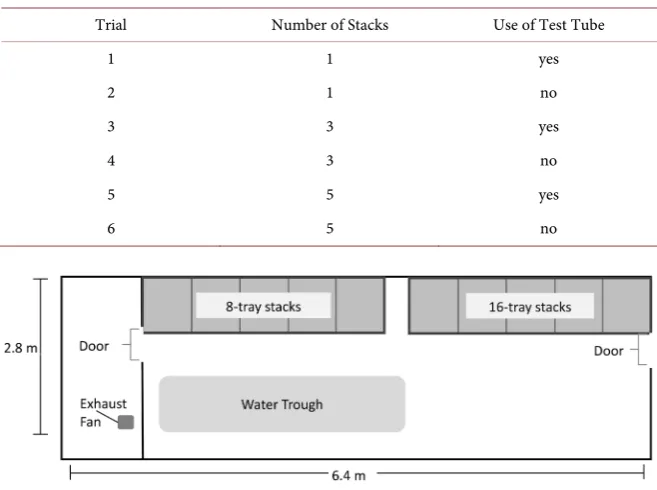
The incubation room contained five sixteen-tray stacks and five eight-tray stacks (Figure 4). Throughout the experiment, water was continuously supplied to all ten stacks to ensure high and constant humidity for consistent airborne formal-dehyde measurement [12] [13]. Airborne formalformal-dehyde concentrations were measured in six trials, which varied in the number of 16-tray incubation stacks treated (one, three, or five) and if the air gap was eliminated (Table 1). The door to the small closet containing the exhaust fan was left open throughout all of the trials. Each trial was replicated three times.
Airborne formalin concentrations were measured using a formaldehyde meter (model HAL-HFX205l; HalTech; Fontana, California). Prior to any trials, basal formalin concentrations were measured and consistently found to be 0.2 mg/L. During the trials, formalin measurements were recorded every min for the first 60 min after the start of a treatment. If the concentration was at the basal con-centration after the first 60 min, no further formalin readings were conducted. However, if the values were elevated above the basal level, additional readings were taken thereafter at 30 min intervals until basal readings were obtained.
Formaldehyde concentrations were compared to the United States Depart-ment of Labor, Occupational Safety and Health Administration (OSHA) regula-tion limits of 0.75 mg/L permissible exposure limit (PEL) measured as an 8-hour
Water
Formalin Drip Line
Top Tray
DOI: 10.4236/ojsst.2018.83006 102 Open Journal of Safety Science and Technology
Table 1. Description of experimental design, including number of vertical-flow
incuba-tors evaluated in each trial, along with the use of test tube.
Trial Number of Stacks Use of Test Tube
1 1 yes
2 1 no
3 3 yes
4 3 no
5 5 yes
[image:5.595.208.539.101.343.2]6 5 no
Figure 4. Diagram of incubation room.
time-weighted average (TWA), and the 2.0 mg/L short-term exposure limit (STEL) as measured in a 15-minute period, and the OSHA action level of 5.0 mg/L TWA [2].
2.4. Statistical Analysis
Data were analyzed using the SPSS (9.0) statistical analysis program (SPSS, Chi-cago, Illinois). Statistical significance was predetermined at p < 0.05. Two-way ANOVA was used for analysis.
3. Results
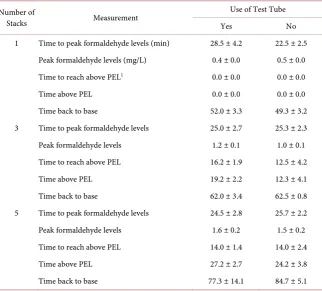
The use of the air-gap eliminator had no significant effect on any of the parame-ters measured (Table 2). The time (minutes) it took to reach peak formaldehyde levels, the peak of formaldehyde reached, the time (minutes) to reach PEL, the time (minutes) the level stayed above PEL, and the time (minutes) to get back to the base level were similar between the groups. Even with the use of the modified centrifuge tubes, and regardless the number of incubation stacks being used, the OSHA [2] action level was still reached in the all trials. Back-feeding (siphoning) of water from the incubation stack into the formalin barrel when the air gap eli-minator was being used was also observed.
4. Discussion
4.1. Device Effectiveness
DOI: 10.4236/ojsst.2018.83006 103 Open Journal of Safety Science and Technology
Table 2. Mean (±SE) parameters measured for 1, 3, or 5 stacks being treated
simulta-neously.
Number of
Stacks Measurement
Use of Test Tube
Yes No
1 Time to peak formaldehyde levels (min) 28.5 ± 4.2 22.5 ± 2.5 Peak formaldehyde levels (mg/L) 0.4 ± 0.0 0.5 ± 0.0 Time to reach above PEL1 0.0 ± 0.0 0.0 ± 0.0 Time above PEL 0.0 ± 0.0 0.0 ± 0.0 Time back to base 52.0 ± 3.3 49.3 ± 3.2 3 Time to peak formaldehyde levels 25.0 ± 2.7 25.3 ± 2.3 Peak formaldehyde levels 1.2 ± 0.1 1.0 ± 0.1 Time to reach above PEL 16.2 ± 1.9 12.5 ± 4.2 Time above PEL 19.2 ± 2.2 12.3 ± 4.1 Time back to base 62.0 ± 3.4 62.5 ± 0.8 5 Time to peak formaldehyde levels 24.5 ± 2.8 25.7 ± 2.2 Peak formaldehyde levels 1.6 ± 0.2 1.5 ± 0.2 Time to reach above PEL 14.0 ± 1.4 14.0 ± 2.4 Time above PEL 27.2 ± 2.7 24.2 ± 3.8 Time back to base 77.3 ± 14.1 84.7 ± 5.1
1Permissible Exposure Level = PEL.
aerosolized formaldehyde levels in this study. These results indicate that most of the formaldehyde aerosolization is likely occurring due to surface deposition as the water falls from each incubation tray into the tray immediately below it [14]. The small air gap from the formalin tubing to the incubation stack water surface appears to be a very minor contributor to formaldehyde aerosolization.
4.2. Back Flow Issues
The back-flow of water from the incubation stack into the barrel of formalin used for egg treatment was unexpected and also very problematic. It is possible that if such back-feeding occurred during actual production-level formalin treatments, that it might not be detected, resulting in a dilution of the source formalin. Treatment at lower formalin concentrations may be ineffective at egg fungal control [15]. Even more problematic would be if such back-feeding re-sulted in formalin discharge from the source barrel, resulting in additional oc-cupational exposure during the clean-up and remediation of the spill [16] [17].
5. Conclusion
for-DOI: 10.4236/ojsst.2018.83006 104 Open Journal of Safety Science and Technology maldehyde during routine egg treatments. Although potentially disconcerting, the publication of negative results is also encouraged to prevent study duplica-tion and promote learning [18] [19] [20].
Acknowledgements
We thank Cody Treft and Tabor Martin for their assistance with this study.
Conflicts of Interest
The authors declare no conflicts of interest regarding the publication of this paper.
References
[1] Piper, R.G., McElwain, I.B., Orme, L.E., McCraren, J.P., Fowler, L.G. and Leonard, J.R. (1982) Fish Hatchery Management. 4th Printing, U.S. Fish and Wildlife Service, Washington, DC.
[2] OSHA (Occupational Safety and Health Administration) (2011) OSHA Fact Sheet. United States Department of Labor.
https://www.osha.gov/OshDoc/data_General_Facts/formaldehyde-factsheet.pdf
[3] NIOSH (National Institute of Occupational Safety and Health) (2016) NIOSH Pocket Guide to Chemical Hazards: Formaldehyde. Centers for Disease Control.
https://www.cdc.gov/niosh/npg/npgd0293.html
[4] IARC (International Agency for Research on Cancer) (2011) Formaldehyde. World Health Organization.
http://monographs.iarc.fr/ENG/Monographs/vol100F/mono100F-29.pdf
[5] ATSDR (Agency for Toxic Substances and Disease Registry) (2015) Formalde-hyde-ToxFAQs. Department of Health and Human Services.
http://www.atsdr.cdc.gov/toxfaqs/tfacts111.pdf
[6] New Jersey Department of Health (2016) Right to Know: Hazardous Substance Fact Sheet: Formaldehyde. http://nj.gov/health/eoh/rtkweb/documents/fs/0946.pdf [7] National Toxicology Program (2016) 14th Report on Carcinogens. U.S. Department
of Health and Human Services.
https://ntp.niehs.nih.gov/pubhealth/roc/index-1.html#toc1
[8] FDA (United States Food and Drug Administration) (2018) Approved Aquaculture Drugs. U.S. Department of Health and Human Services.
https://www.fda.gov/AnimalVeterinary/DevelopmentApprovalProcess/Aquaculture
/ucm132954.htm
[9] Barnes, M.E., Cordes, R.J. and Sayler, W.A. (1997) Use of Formalin During Incuba-tion of Eyed Eggs of Inland Fall Chinook Salmon. The Progressive Fish-Culturist, 59, 303-306. https://doi.org/10.1577/1548-8640(1997)059<0303:UOFDIO>2.3.CO;2 [10] Stickney, R.R. (1994) Principles of Aquaculture. John Wiley & Sons, New York. [11] Voorhees, J.M. and Barnes, M.E. (2016) Airborne Formaldehyde Levels During
Si-mulated Formalin Egg Treatments in Vertical-Flow Tray Incubators at a Production Fish Hatchery. Journal of Agriculture Safety and Health, 22, 199-207.
https://doi.org/10.13031/jash.22.11791
DOI: 10.4236/ojsst.2018.83006 105 Open Journal of Safety Science and Technology
[13] Obee, T.N. and Brown, R.T. (1995) TiO2 Photocatalysis for Indoor Air Applications:
Effects of Humidity and Trace Contaminant Levels on the Oxidation Rates of For-maldehyde, Toluene, and 1,3-Butadiene. Environmental Science & Technology, 29, 1223-1231. https://doi.org/10.1021/es00005a013
[14] Nazaroff, W.W. and Cass, G.R. (1989) Mathematical Modeling of Indoor Aerosol Dynamics. Environmental Science and Technology, 23, 157-166.
https://doi.org/10.1021/es00179a003
[15] Barnes, M.E. and Soupir, C.A. (2006) Evaluation of Formalin and Hydrogen-Peroxide Treatment Regimes on Rainbow Trout Eyed Eggs. North American Journal of Aq-uaculture, 69, 5-10. https://doi.org/10.1577/A05-080.1
[16] Burgess, J.L. (1999) Hospital Evacuations Due to Hazardous Materials Incidents. American Journal of Emergency Medicine, 17, 50-52.
https://doi.org/10.1016/S0735-6757(99)90016-5
[17] Hill Jr., R.H. and Finster, D.C. (2013) Academic Leaders Create Strong Safety Cul-tures in Colleges and Universities. Journal of Chemical Health and Safety, 20, 27-34.
https://doi.org/10.1016/j.jchas.2013.06.011
[18] Johnson, R.T. and Dickersin, K. (2007) Publication Bias against Negative Results from Clinical Trials: Three of the Seven Deadly Sins. Nature Reviews Neurology, 3, 590. https://doi.org/10.1038/ncpneuro0618
[19] Dirnagl, U. and Lauritzen, M. (2010) Fighting Publication Bias: Introducing the Negative Results Section. Journal of Cerebral Blood Flow and Metabolism, 30, 263-1264. https://doi.org/10.1038/jcbfm.2010.51