doi:10.4236/ampc.2011.13017 Published Online December 2011 (http://www.SciRP.org/journal/ampc)
Transient and Steady State Currents of Bisphenol A
Corncobs Sample
Taha A. Hanafy
1Physics Department, Faculty of Science, Tabuk University, Tabuk, KSA 2Physics Department, Faculty of Science, Fayoum University, Fayoum, Egypt
E-mail: tahanafy2@yahoo.com
Received June 29, 2011; revised August 8, 2011; accepted August 25, 2011
Abstract
Transient current (I-t), current-voltage (I-V) characteristics, and dc conductivity ln(σ) for bisphenol A corn-cobs (BPACC) sample were investigated. At higher temperatures, I-V characteristics reveal that the dc cur-rent for the sample undergoes two regions one due to ohmic conduction and the other has been attributed to Space charge limited current (SCLC). The activation energy (Ea), the electron mobility (μo), effective
elec-tron mobility (μe), the concentration of the charge’s concentrations in conduction band, trapping factor (θ)
and the trap concentration (Nt) were calculated. At lower temperatures, the dc current exhibits a peculiar
be-havior for I-t regime and I-V characteristics. Transient current of BPACC sample exhibits approximately constant value at constant electric field and it has saturation value for I-V characteristics. The attained results suggest strongly the applicability of this material in the electrical applications.
Keywords:Bisphenol A Corncobs, Transient Current, I-V Characteristics, Conduction Mechanism
1. Introduction
Phenol and phenolic derivatives are major industrial (pe-troleum, chemical and plastic) and agricultural by prod-uct that are found on surface of water as well as in food and clinical samples. Among these, bisphenol A (BPA) used to fabricate polycarbonate plastic and resins. BPA has recently received considerable attention due to its endocrine disrupting activity and possible toxic envi-ronmental and health impacts [1-4]. The use of BPA as the condensation agent with Egyptian corncobs was in-vestigated [5]. The optimum preparation conditions and characterization of bisphenol A Egyptian bagasse pith polycondensation products and corncobs have been re-ported [5]. The chemical analysis and IR spectroscopy have shown that bisphenol A Egyptian corncobs (BPACC) resin has a complicated structure. The resin structure includes furan and lignin hydrolysate units. They are present in a random alternation in the resin chains. IR spectroscopy of soda lignin/bisphenol resin shows the presence of aliphatic methyl, methylene, O-CH3, and strong OH groups [6].
A growing interest has been noted in employing the space charge limited current (SCLC). It is a powerful tool for study of conduction phenomenon in insulators
[7,8]. It has been successfully used in obtaining general information about the localized defect states in the for-bidden gap. The charge injected into the insulator in re-sponse to an applied voltage using a constant voltage source is trapped at localized defect. The presence of the trapping sites in the forbidden gap strongly affects the current-voltage (I-V) and current-time (I-t) characteris-tics of the material. The form of (I-V) characterischaracteris-tics depends on the type of distribution of traps [8,9]. The magnitude of the current flow is reduced due to trapping effect [7,10,11]. The appearance of SCLC regime is in-hibited until a sufficiently large field is applied. The transition from ohmic behavior to an SLCC regime de-pends markedly on the distribution of the trapping en-ergy levels.
field, it is important to study the Poole-Frenkel mecha-nism of conduction in BPACC. The aim of this work is to investigate the variation of dc current for BPACC sample as a function of time and the applied voltage at different temperatures. Therefore, transient current I-t, I-V characteristics, and dc conductivity for the investi-gated sample were carried out.
2. Experimental
BPACC was prepared by adding the powder of corncobs to the bisphenol A in the weight ratio 1:1 (5 g of each) together with 0.566 g mole HCl/50 ml and maintaining at 95˚C - 100˚C for 8 hr. The product was cooled and neu-tralized with 0.1 of ammonium hydroxyl solution. The sample was washed with a diluted acetic acid (30%) to remove any bisphenol molecules. The polycondensate was washed with hot water and allowed to dry. The dry resin was ground to a powder. The chemical structure of BPACC is shown in Figure 1. A tablet of the
investi-gated sample was obtained by presses 2.0 mg of BPACC under the pressure of 1.96 × 10⁸ N/m2. The obtained BPACC sample has a radius and a thickness of 0.45 cm and 1.3 mm, respectively.
The dc electrical current was measured by a Keithly 485 auto ranging picoammeter (Cleveland, OH, USA). The temperature of the sample was measured by a k-type thermocouple connected to a degi-sense digital ther-mometer (USA) with an accuracy ±1. For ohmic contacts, the surface of the samples was coated with silver paste.
3. Results and Discussion
[image:2.595.313.536.233.419.2]3.1. Transient Current
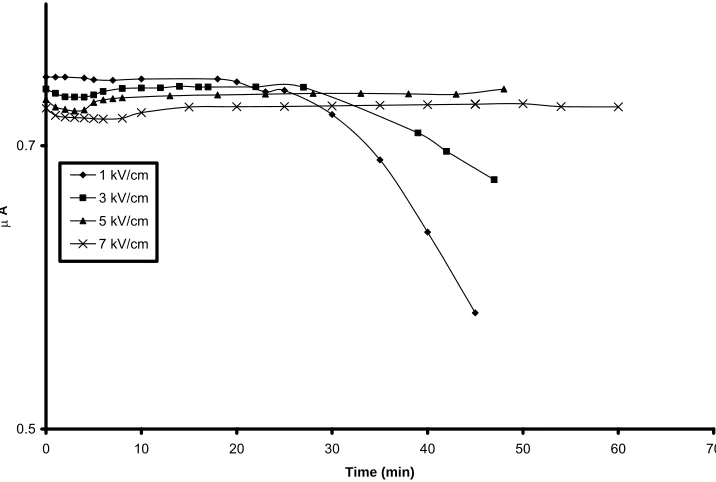
Figure 2 illustrates the time dependence of dc current for
BPACC sample at different applied electric fields (Ep) of 1, 3, 5 and 7 kV/cm, forward direction, and at 300 K. It is clear that, dc current of the investigated sample decreases with the increase of the applied electric field. Also, the dc current, at Ep= 3 kV/cm, decreases with the increase of the time up to 3 min and then increase again with the time up to 10 min. After 10 min the current of BPACC
CH3
CH2
CH OH
H3C
OH
OH
[image:2.595.119.470.449.707.2]MeO
Figure 1. The chemical structure of BPACC.
1.3 1.34 1.38 1.42 1.46 1.5
0 5 10 15 20 25 30 35 40 45 50
Time (min)
A
1 kV/cm
3 kV/cm
5 kV/cm
7 kV/cm
sample exhibits a saturation value for the time interval from 10 to about 48 min. Similar curves were obtained at the applied electric field at 5 and 7 kV/cm. The increase of the dc current for BPACC with time at constant ap-plied voltage can be interpreted as follows: the applica-tion of electric field for a long time on the investigated sample has a chance to generate different types of free carriers or to orient the dipolar groups such as phenyl, methyl and methylene ones of BPACC structure [1,6].
Then a competitive growth in the conduction mecha-nisms between these carriers can be obtained. This causes the increase of the current value of the investi-gated sample. After 15 min from the application of the electric field on the BPACC sample, the current exhibits approximately constant value. At this moment the ap-plied electric is able to orient all the dipolar groups within the polymeric material. Figure 3 shows the
tran-sient current curves for BPACC sample at 300 K and at different applied electric fields of 1, 3, 5 and 7 kV/cm with the reverse polarities. It can be seen that, the dc current exhibits a saturation region, for the dc current value, at each value of Ep. The saturation value of the dc current of BPACC sample is established for a long time interval about 60 min at Ep = 7 kV/cm, The saturation value of the transient current for BPACC sample can be interpreted as follows: before the application of the ap-plied electric field with the reverse polarities on the BPACC sample, the most dipolar groups of the sample have the same direction of the forward electric field. When we apply the electric field with the reverse polari-ties, the two methyl and O-CH3 groups had a maximum
potential energy. So, these polar groups have an influ-ence on the flexibility for the movements of the lateral groups. These intermolecular movements increase the chaotic thermal oscillations of the side groups [12]. This means that, the polar groups such as phenyl ones have a high relaxation time to attain the new direction of the electric field. This is the reason for the emergence of the stable value of the dc current for BPACC sample.
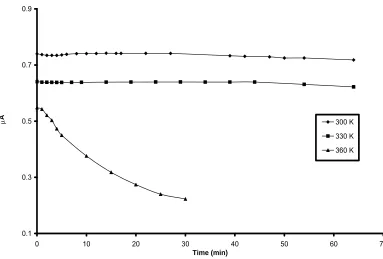
Figures 4 and 5 depict the transient current curves of
BPACC sample for forward and reverse polarities of the electrodes, respectively at Ep = 3 kV/cm and at different temperatures of 300, 330 and 360 K. It is observed that, the values of dc current decrease with the increase of temperature. Also, the breadth of the saturation region of the transient current decreased with the increase of the temperature from 300 to 330 K. At 360 K the saturation region of the dc current completely disappeared. This is due to the thermal agitation of the polar groups which attached to the main chain of BPACC structure. This energy enables the dipolar groups such as methyl phenyl and O-CH3 groups to overcome the direction of the ap-plied electric field. In addition, the thermal energy will increase the lateral movements of methyl, O-CH3 and phenyl groups. So, the increase of the chaotic motion and the steric volume phenyl groups lead to decrease the value of the dc current [6,11].
3.2. I-V Characteristics
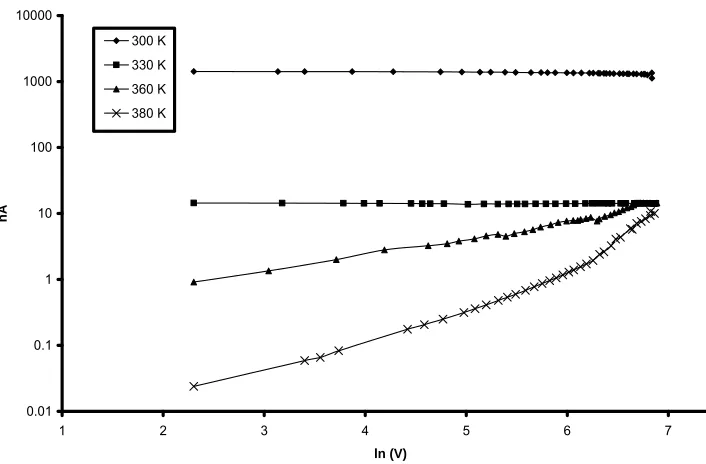
Figure6 shows plots of (I-V) characteristics for BPACC
at different temperatures of 300, 330, 360 and 380 K. It is
0.5 0.7
0 10 20 30 40 50 60 7
Time (min)
A
0 1 kV/cm
3 kV/cm 5 kV/cm 7 kV/cm
[image:3.595.118.476.463.704.2]0 0.4 0.8 1.2 1.6
0 5 10 15 20 25 30 35 40 45 50
Time (min)
A
300 K 330 K
[image:4.595.118.479.78.313.2]360 K
Figure 4. Transient current curves for BPACC sample at different temperatures and at electric field of 3 kV/cm.
0.1 0.3 0.5 0.7 0.9
0 10 20 30 40 50 60
Time (min)
A
70 300 K
330 K
360 K
Figure 5. Transient current curves for BPACC sample at different temperatures and at electric field of 3 kV/cm with reverse polarity.
clear that, the dc current decreases with the increase of the temperature. At 300 K and 330 K the dc current of the investigated sample exhibits approximately constant value with the increase of the applied electric filed. This can be discussed as follows: the reduction of the dc cur-rent with the increase of the ambient temperature was assigned to the scattering of the free carriers when it
[image:4.595.106.489.339.598.2]
0.01 0.1 1 10 100 1000 10000
1 2 3 4 5 6 7
ln (V)
nA
[image:5.595.119.472.76.308.2]300 K 330 K 360 K 380 K
Figure 6. I-V characteristics for BPACC sample at different temperatures.
tion of neighboring lateral groups. These intermolecular movements hinder reorientation and lengthen the relaxa-tion time of the polar groups of BPCC smple [6,13]. The methyl and methylene groups have an influence on the flexibility of the ionic groups in the free volume of BPACC. Then, the scattering of the charge carriers is expected because of the repulsive force among phenyl, aliphatic methyl, and methylene groups of the sample. This interprets the appearance of the saturation value of the dc current.
However, at 360 and 380 K, I-V characteristics have two regions, one at low voltages with slope approxi-mately 1 (i.e. IV) and the other at higher voltages with slope approximately 2 (i.e. IV2). At the first region, the conduction is ohmic due to the intrinsic conductivity of the material. This indicates that the thermally activated free carriers controlled the current of BPACC sample. So, the current density can be estimated according to the thermo-ionic emission function [14]:
exp 1
s
JJ eV mkT (1)
where m is a quantity factor, k is the Boltzmann’s con-stant, e is the charge of the electron, V is the applied voltage, T is the absolute temperature and Js is the satu-ration current density.
I-V characteristics of insulators at different tempera-tures show a fairly well defined transition voltage. The slope of logarithmic plots increases with the increase of the applied voltage. Such behavior suggests an ohmic manner below the threshold voltage and a SCLC trend for higher voltage levels. According to this theory the current flow is given by [8]:
Je n x E x (2)
where μ is the electric mobility of the free carrier, E(x) is the electric field and n(x) is the concentration of the free thermally activated carriers at position (x) in conduc-tion band (CB). The current voltage dependence at the second region can be interpreted by SCLC theory. Such dependence leads to conclusion that the conduction mechanism of BPACC is due to SCLC dominated by a discrete trapping level.
The band model is used to justify the mechanism of charge transport through the polymeric material. For this model the localized energy states were assumed to be uniformly distributed in energy state within a range of the energy gap. Moreover, the localized states are due to the lack of order were considered as trapping level. These localized states arise from impurities, dislocation, crack, etc. within the BPACC sample [15,16]. Then, the current flow in the second region obeys the equation [10,17]:
2 39
8 o
J V d
(3)where ε is the electric permittivity, μo is the free carrier mobility in CB, d is the thickness of the sample, V is the transition voltage between the ohmic and the square re-gion and θ is the trapping parameter. The latter can be considered to be the ratio between the density of free electrons (no) in CB to the total density of electrons (no +
1 2 o
o t
n J J
n n
(4)
The free carrier mobility (μo) could be obtained from Equation (3) the calculated values of θ and μo are listed in Table 1. The equilibrium concentration of charge
car-riers in CB is achieved by [9]:
2o
n ed
V (5)It was found that when the trap level exists, the elec-tron mobility is reducing by 1/θ, and the effective elec-tron drift mobility (μe) in insulator with trap is:
e o
(6) The trap concentration Nt can be obtained by [9,15]:
2 2
t
N ed VTFL (7)
where VTFLis the voltage at trap field limit. The values of
no, μe and VTFL are calculated see Table 1.
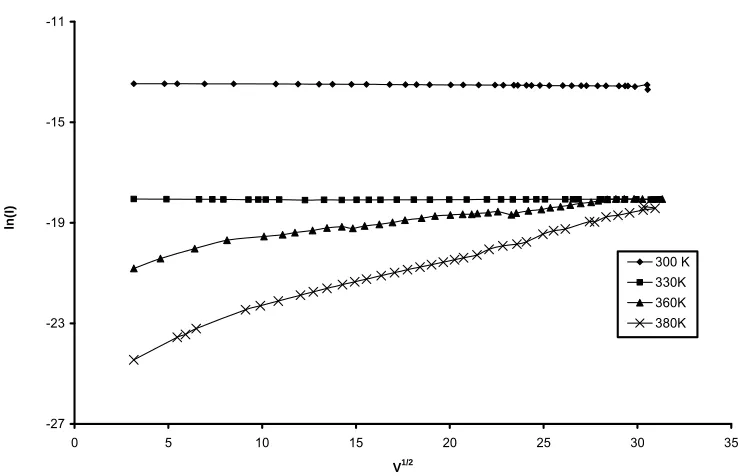
From another point of view, at 360 and 380 K, the in-terpretation of the conduction mechanism from the ex-perimental data may be done by using the measure of the slope of ln(I) versus V1/2 as in
Figure7. The plot shows a
linear behavior with appreciable deviation from linearity at lower electric field and at higher temperatures of 360 and 380 K. This is attributed to accumulation of space charge at the electrodes [18]. These data can be fitted to the relation [19]:
1/2exp
J e V kT (8)
where β is a constant characteristic of the conduction mechanism.
The linear behavior of ln(I) versus V1/2 plot points to a conduction mechanism in which the charge carriers are released by thermal activation over a potential barrier [18,20] that is decreased by the applied electric field. The physical nature of such a potential barrier can be inter-preted in two ways. It can be the transition of electrons over the barrier between the cathode and the dielectric, Richardson-Schottky emission. Alternatively, charge carrier can be released from the traps into BPACC, Poole- Frenkel effect. To know the actual conduction mecha-nism, the experimental values of β were calculated from the slope of ln(I) versus V1/2 plot.
The theoretical value of β was deduced from the rela-tion [21]:
1 2 3 2
π
PF RS
o
e
(9) where o, RS and PF are the electric permittivity of the free space, and the field-lowering coefficients of the Richardson-Schottky and the Poole-Frenkel, respec-tively.
Table 1. Some electrical parameters for BPACC sample.
Sample parameter 360 K 380 K
θ 0.65 0.24
no (cm–3) 28 × 1027 1 × 1027
μo (cm2·V–1·S–1) 2.4 × 10⁻¹⁷ 2.3 × 10⁻¹⁷
μe (cm2·V–1·S–1) 1.55 × 10⁻¹⁷ 5.1 × 10⁻¹⁸
Nt (cm–3) 1 × 1025 1.1 × 1025
-27 -23 -19 -15 -11
0 5 10 15 20 25 30 35
V1/2
ln
(I)
[image:6.595.114.483.467.705.2]300 K 330K 360K 380K
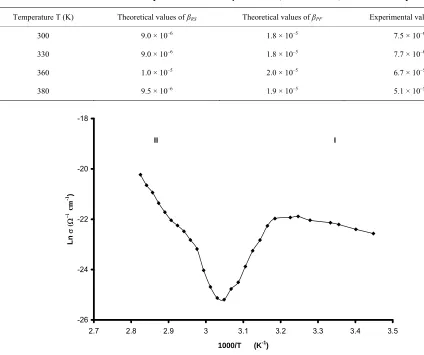
The experimental and theoretical values of βRS and βPF at 360 K and 380 K are listed in Table 2. We notice that,
at 360 and 380 K, the experimental values of β consistent with the theoretical values of βPF. Therefore, one can suggest that the dominant conduction mechanism for BPACC is Poole-Frenkel type at higher temperature.
3.3. Dc Conductivity
The temperature dependence of dc conductivity ln(σ) versus 1000/T for BPACC sample is shown in Figure8.
It is observed that, ln(σ) of the investigated sample ex-hibits two straight regions (I and II). These two regions correspond to lower and higher temperature within 3.5 - 3.2 K–1 and 3 - 2.8 K–1, respectively. The behavior of dc conductivity in regions (I and II) can be described ac-cording to Arrhenius equation [17,22]:
exp a
o
E kT
(10)
where σo is constant, Ea is the activation energy. The val-
ues of activation energy Ea, for region I and II, are 0.3 eV and 1.5 eV, respectively. The data of Ea in region I and II indicate that the ionic conduction mechanism is assumed to be effective in the second region II, while the electronic conduction one is predominant for the region I. This means that the conductivity of BPACC sample in region I depends mainly on the type of free carriers pre-sent in the sample. These carriers can be obtained by breaking weakly bonded ions inside the skeleton of BPACC sample or the electrons injected from the elec-trodes [11,20,23]. This agrees with what we assumed earlier, at 300 and 330 K, the conduction mechanism depends on the free carriers within the BPACC sample.
Figures 2-6 reveal that, at 300 and 330 K, the dc
[image:7.595.64.488.353.708.2]cur-rent for BPACC sample exhibits approximately constant value for I-t for the time interval about 60 min at Ep = 7/kV/cm. Moreover, it has a saturation value with the change of the applied voltage on the investigated sample from 10 to 940 V. The outcome results of this work give a good signal for its use in the field of the electrical ap-plications.
Table 2. Theoretical and experimental values of β coefficient, in eVV–1/2·m1/2, for BPACC sample.
Temperature T (K) Theoretical values of βRS Theoretical values of βPF Experimental values of β
300 9.0 × 10⁻⁶ 1.8 × 10⁻⁵ 7.5 × 10⁻⁶
330 9.0 × 10⁻⁶ 1.8 × 10⁻⁵ 7.7 × 10⁻⁶
360 1.0 × 10⁻⁵ 2.0 × 10⁻⁵ 6.7 × 10⁻⁵
380 9.5 × 10⁻⁶ 1.9 × 10⁻⁵ 5.1 × 10⁻⁵
II I
-26 -24 -22 -20 -18
2.7 2.8 2.9 3 3.1 3.2 3.3 3.4 3.5
1000/T (K-1)
Ln
(
cm
-1 )
4. Conclusions
Transient current, I-V characteristics, and dc conductiv-ity for BPACC sample were analyzed. Electrical meas-urements of the investigated sample show that, the dc current has a peculiar behavior for I-t and I-V character-istics. Transient current of BPACC sample exhibits ap-proximately constant value at constant electric field. Also, dc current of the investigated sample for I-V char-acteristics has a saturation value at lower temperatures. At higher temperatures, I-V regime reveals that the cur-rent of the sample exhibits two regions one due to ohmic conduction and the other is attributed to SCLC. The ionic conduction mechanism was assumed to be the main conduction mechanism at higher temperatures. The elec-tronic conduction has been established at lower tem-peratures. The value of the dc current for I-t and I-V characteristics has a good stability with passage of time and the change of the applied voltage, respectively.
5. References
[1] R. I. Cristina, M. T. R. Matthew, S. Ashley and A. Sil-vana, “Multifunctional Biomagnetic Capsules for Easy Removal of Phenol and Bisphenol A,” Water Research, Vol. 44, No. 6, 2010, pp. 1961-1969.
[2] A. Ballesteros-Gَmez, S. Rubio and D. Pérez-Bendito, “Analytical Methods for the Determination of Bisphenol A in Food,” Journal of Chromatography A, Vol. 1216, No. 3, 2009, pp. 449-469.
doi:10.1016/j.chroma.2008.06.037
[3] J.-H. Kang, F. Kondo and Y. Katayama, “Human Expo-sure to Bisphenol A,” Toxicology, Vol. 226, No. 2-3, 2006, pp. 79-89. doi:10.1016/j.tox.2006.06.009
[4] H. H. Le, E. M. J. P. Chua and S. M. Belcher, “Bisphenol A Is Released from Polycarbonate Drinking Bottles and Mimics the Neurotoxic Actions of Estrogen in Develop-ing Cerebellar Neurons,” Toxicology Letters, Vol. 176, No. 2, 2008, pp. 149-156.
doi:10.1016/j.toxlet.2007.11.001
[5] I. A. Sabbah, F. A. Khalifa, N. E. Metwally and S. M. Sayyah, “Prepration and Characterization of Moulded shaps from Egyptain Corncobs-Bisphenol Polyconden-sate Resins,” Egyptian Journal of Chemistry, Vol. 35, 1992, pp. 651-660.
[6] M. A. Ahmed and T. A. Hanafy, “Dielectric Relaxation and Poole-Frenkel Conduction in Poly(Vinyl Chloride) Blends with Bisphenol A/Egyptian Corncob Resin,” Journal of Applied Polymer Science, Vol. 109, No. 1, 2008, pp. 182-189. doi:10.1002/app.28075
[7] M. A. Ahmed and T. A. Hanafy, “Optical Absorption and Electrical Properties of Polyvinyl Alchol (PVA)-Gelatin Blend,” Indian Journal of Physics, Vol. 79, No. 10, 2005, pp. 1149-1155.
[8] R. K. Singh, Y. K. Sharma and A. K. Upadhaya, “ Cur-rent in an Insulator with Specially Distributed Shallow
traps,” Indian Journal of Pure and Applied Physics, Vol. 23, 1985, pp. 529-530.
[9] S. M. El-Sayed, H. M. Abdel Hamid and R. M. Radwan, “Effect of Electron Beam Irradiation on the Conduction Phenomena of Unplasticized PVC/PVA Copolymer,” Radiation Physics and Chemistry, Vol. 69, No. 4, 2004, pp. 339-345. doi:10.1016/j.radphyschem.2003.07.001
[10] A. Sawaby, A. A. shabaka and M. G. Khafagi, “The Ef-fect of Light on the Electrical Conduction pf Pure and Doped Poly(Methyl Methacrylate),” Polymer Degrada-tion and Stability, Vol. 30, No. 3, 1990, pp. 319-328.
doi:10.1016/0141-3910(90)90085-L
[11] S. Mahrous and T. A. Hanafy, “Poole-Frenkle Conduc-tion Mechanism in Polyvinyl Chloride Stabilized with Dibutylin Laurate-Maleate,” Current Applied Physics, Vol. 4, No. 5, 2004, pp. 461-464.
doi:10.1016/j.cap.2004.02.003
[12] T. A. Hanafy, “Dielectric Properties of Bisphenol A Egyp-tain Corncobs Irradiated by Nd: YAG Laser of Science,” Proceedings of the 5th International Science Conference of Al-Azher University, Cairo, 25-27 March 2003, pp. 323-345. [13] S. Mahrous, “Transient Current and Dielectric Relaxation
in PVC Stabilized with DI-N-Octyltin-Mercaptopropion-ate,” International Journal of Polymeric Materials, Vol. 54, 2005, pp. 1-9.
[14] T. G. Abdel-Malik, “Direct Current Conductivity and Thermal Stimulated Current of Nickel Phathaocyanine Films Using Gold and Aluminum Electrode,” Interna-tional Journal of Electronics, Vol. 72, No. 3, 1992, pp. 409-418. doi:10.1080/00207219208925582
[15] Y. H. A. Fawzy and R. M. Radwan, “conduction Mecha-nism in Electron Beam-Irradiated Unplasticized PVC/ PVA Copolymer Films under High Electric Field,” Physica B: Condensed Matter, Vol. 395, No. 1-2, 2007, pp. 79-83.
doi:10.1016/j.physb.2007.02.059
[16] A. J. Campbell, D. D. C. Bradley and D. G. Lidzey, “Charge Trapping in Polymer Diodes,” Optical Materials, Vol. 9, No. 1-4, 1998, pp. 114-119.
doi:10.1016/S0925-3467(97)00145-6
[17] F. H. Abd El-kader, W. H. Osaman, K. H. Mahmoud and M. A. F. Basha, “Dielectric Investigation and ac Conduc-tivity of Polyvinyl Alcohol Films Doped with Europium and Terbium Chloride,” Physica B: Condensed Matter, Vol. 403, No. 19-20, 2008, pp. 3473-3484.
doi:10.1016/j.physb.2008.05.009
[18] V. V. R. Narasimha, T. Mahender and B. Subba Rao, “Electrical Conduction in Solution Grown Polyacrylic Acid Polymer Films,” Journal of Non-Crystalline Solids, Vol. 104, No. 2-3, 1988, pp. 224-228.
doi:10.1016/0022-3093(88)90392-4
[19] J. R. Yeargan and H. L. Taylor, “The Poole-Frenkel Ef-fect with Compensation Present,” Journal of Applied Physics, Vol. 39, No. 12, 1968, pp. 5600-5604.
doi:10.1063/1.1656022
[21] S. Sze, “Physics of Semiconductor Devices,” Wiley, New York, 1983.
[22] T. A. Hanafy, “Drastic Effects of Fast Neutrons and C-Irradiation on the DC Conductivity of Co-, Ni-, Mn- and Ag-Gelatin Doped Films,” Current Applied Physics, Vol. 8, No. 5, 2008, pp. 527-534.
doi:10.1016/j.cap.2007.09.002