AWARENESS AND PRACTICE OF TISSUE SUPPORTED COMPLETE IMMEDIATE REMOVABLE
DENTURE PROSTHESIS TREATMENT PROTOCOLS IN PATIENTS WITH COMPROMISED
DENTITIONS IN WESTERN MAHARASHTRA
*,1
Sushma R.,
2Anand Farias,
1
Department of Prosthodontics, School of Dental Sciences, K
2
Department of Prosthodontics, Faculty of Dentistry,
3
Department of Oral Pathology and Microbiology
ARTICLE INFO ABSTRACT
Background:
conventional dentures as well as the implant dentures. But due to unknown reasons this treatment protocol is vanishing from every day dental practice.
Aim and Objectives:
patients towards immediate dentures among the local population of Western Maharashtra. Material and
and around Karad and Kolhapur, Maharashtra, India to know their responses and attitude towards immediate denture treatment protocol.
Part 2: Questionnaire survey was condu
of Prosthodontics, School Of Dental Sciences to assess the patients’ awareness and attitude of the patients towards this treatment modality.
All the data collected was statisticallyanalysed using tests.
Conclusion:
dentures if they are well educated and motivated. This survey also concludes that the dental undergraduate students need to be encouraged more and trained in the spe
patients who belong to lower strata of economy can benefitted.
Copyright ©2016,Dr. SushmaRet al.This is an open access article distributed under the Creative Commons Att
distribution, and reproduction in any medium, provided the original work is properly cited.
INTRODUCTION
Prosthodontics as a specialised branch in dentistry has come a long way with rapid development of newer materials, technologies and techniques to rehabilitate the fully or partially edentulous patient or the patient with failing dentition with removable or fixed prosthesis. With these steps forward comes the inevitable high treatment cost which not eve
afford. Patients worldwide might not seek the dental treatment at the right time or till the very end due to either lack of awareness or financial constraints. As we travel back in time, we do have treatment options which aimed at rehabilitating the
*Corresponding author: Dr. SushmaR.,
Department of Prosthodontics, School of Dental Sciences, KIMSDU, Karad, Satara, Maharashtra 415110.
ISSN: 0975-833X
Article History:
Received 10th July, 2016 Received in revised form 28th August, 2016
Accepted 19th September, 2016 Published online 30th October,2016
Key words:
Immediate Denture, Alveolar bone resorption, Aesthetics.
Citation: Sushma R., FariasA, Bommanavar S, Kore
denture prosthesis treatment protocols in patients with compr
Current Research, 8, (10),39986-39990.
RESEARCH ARTICLE
AWARENESS AND PRACTICE OF TISSUE SUPPORTED COMPLETE IMMEDIATE REMOVABLE
DENTURE PROSTHESIS TREATMENT PROTOCOLS IN PATIENTS WITH COMPROMISED
DENTITIONS IN WESTERN MAHARASHTRA- A CROSS-SECTIONAL
Anand Farias,
3Sushma Bommanavar,
1Abhijeet Kore and
1Shubha Joshi
Department of Prosthodontics, School of Dental Sciences, Krishna Insitute of Medical Sciences Deemed
University
Department of Prosthodontics, Faculty of Dentistry, Melaka Manipal Medical College
Microbiology, School of Dental Sciences, Krishna Insitute of Medical Sciences
Deemed University
ABSTRACT
Background: Immediate denture is a treatment modality which has many advantages compared to the conventional dentures as well as the implant dentures. But due to unknown reasons this treatment protocol is vanishing from every day dental practice.
Aim and Objectives: The purpose of this survey was to understand the awareness and attitude of the patients towards immediate dentures among the local population of Western Maharashtra.
Material and Methods: Part 1: Questionnaire survey was conducted involving the Prosthodontists in and around Karad and Kolhapur, Maharashtra, India to know their responses and attitude towards immediate denture treatment protocol.
Part 2: Questionnaire survey was conducted among the patients attending the OPD of the Department of Prosthodontics, School Of Dental Sciences to assess the patients’ awareness and attitude of the patients towards this treatment modality.
All the data collected was statisticallyanalysed using Rates Ratio and Chi Square and Kruskal
Conclusion: The results of this surveyindicate that the patients were more than willing for immediate dentures if they are well educated and motivated. This survey also concludes that the dental undergraduate students need to be encouraged more and trained in the spe
patients who belong to lower strata of economy can benefitted.
is an open access article distributed under the Creative Commons Attribution License, which distribution, and reproduction in any medium, provided the original work is properly cited.
Prosthodontics as a specialised branch in dentistry has come a development of newer materials, technologies and techniques to rehabilitate the fully or partially edentulous patient or the patient with failing dentition with removable or fixed prosthesis. With these steps forward comes t which not every patient can worldwide might not seek the dental treatment at the right time or till the very end due to either lack of awareness or financial constraints. As we travel back in time, d at rehabilitating the
Department of Prosthodontics, School of Dental Sciences, KIMSDU,
patient at the right time and with limited resources and finances compared to the expensive treatment options of today. According to a survey in 2015, a majority of the world’s
population (56%) continues to live a low
existence(Kocchar Rakesh, 2015
effective treatments like immediate denture,if initiated at the right time would improve people’s health and help them lead a healthier and happier life. An immediate complete denture is any removable dental prosthesis fabricated for pl
immediately following the removal of a natural
tooth/teeth(Glossory of Prosthodontic terms, 2005 among the many advantages of immediate dentures is the absence of edentulous period while the dentures are being fabricated by which the patient'
restored.Hence immediate denture is still an apt treatment
International Journal of Current Research
Vol. 8, Issue, 10, pp.39986-39990, October, 2016
INTERNATIONAL
OF CURRENT RESEARCH
, Kore A, Joshi S, 2016.“Awareness and practice of tissue supported complete immediate removable
denture prosthesis treatment protocols in patients with compromised dentitions in western maharashtra- A cross-sectional survey”,
AWARENESS AND PRACTICE OF TISSUE SUPPORTED COMPLETE IMMEDIATE REMOVABLE
DENTURE PROSTHESIS TREATMENT PROTOCOLS IN PATIENTS WITH COMPROMISED
SECTIONAL SURVEY
Abhijeet Kore and
rishna Insitute of Medical Sciences Deemed
elaka Manipal Medical College, Melaka, Malaysia
Krishna Insitute of Medical Sciences
Immediate denture is a treatment modality which has many advantages compared to the conventional dentures as well as the implant dentures. But due to unknown reasons this treatment
The purpose of this survey was to understand the awareness and attitude of the patients towards immediate dentures among the local population of Western Maharashtra.
Part 1: Questionnaire survey was conducted involving the Prosthodontists in and around Karad and Kolhapur, Maharashtra, India to know their responses and attitude towards
cted among the patients attending the OPD of the Department of Prosthodontics, School Of Dental Sciences to assess the patients’ awareness and attitude of the
Rates Ratio and Chi Square and Kruskal-Wallis
The results of this surveyindicate that the patients were more than willing for immediate dentures if they are well educated and motivated. This survey also concludes that the dental undergraduate students need to be encouraged more and trained in the speciality field, so that the
ribution License, which permits unrestricted use,
at the right time and with limited resources and finances compared to the expensive treatment options of today. in 2015, a majority of the world’s
population (56%) continues to live a low-income
Kocchar Rakesh, 2015). In such a scenario, cost effective treatments like immediate denture,if initiated at the right time would improve people’s health and help them lead a An immediate complete denture is any removable dental prosthesis fabricated for placement
immediately following the removal of a natural
Glossory of Prosthodontic terms, 2005). One among the many advantages of immediate dentures is the absence of edentulous period while the dentures are being fabricated by which the patient's original appearance can be restored.Hence immediate denture is still an apt treatment INTERNATIONAL JOURNAL OF CURRENT RESEARCH
option for a patient with failing dentition. The patients remaining natural teeth could provide the correct vertical and horizontal relationship between the maxilla and the mandible, which would help the patient to continue his/her oral functions like mastication, deglutition,speech etcwithout hindrance.The main role of the immediate denture as a therapeutic and prophylactic agent cannot be overlooked as it acts as a bandagefor extraction wounds and helps to control bleeding and also protects the wound from further trauma and covers the wound by inhibiting the food lodgement. It prevents the dislodgement of blood clots thereby improving the wound
healing (Kraljevicet al., 2001). And most important is that this
treatment protocol is cost effective compared to the other
expensive treatment alternatives like implants. The
disadvantages of this procedure of immediate denture fabrication is that the treatment procedure lasts longer and more sittings are required, especially during the stage of the patient's adaptation to the denture, and also it involves complex clinical and laboratory procedures but the advantages
clearly outweighs the disadvantages(Arbeeet al., 2004). It
could be possible that because of the complexity of the clinical and lab procedures, dentists do not emphasise on this treatment option due to which the treatment protocol is vanishing.This study was therefore conducted to analyze the awareness about the immediate denture protocol among the patients and practice of complete tissue supported immediate removable
prosthesis treatment protocol for the patients with
compromised dentition.Current protocols followed in clinical dental setups do not utilize immediate removable prosthesis on a routine basis despite these advantages. A need therefore exists to examine this scenario and understand why immediate removable dentures are decreasing and determine whether more emphasis should be given to this clinical modality along with conventional removable prosthetic procedures.The main aim of this study was to analyze the awareness of the existence and extent of practice of complete tissue supported immediate removable prosthesis treatment protocol.
MATERIALS AND METHODS
A cross sectional survey study was conducted in the Department of Prosthodontics School of Dental Sciences, Krishna Institute of Medical Sciences Deemed University. Patients attending the OPD of the Dept. of Prosthodontics of School of Dental Sciences who had periodontallycompromised dentition and were diagnosed to be rehabilitated with removable prosthesis were approached on a random basis and 120 patients gave their consent to participate in the survey. These subjects were grouped as group I. Table 1 shows the demographic details of the subject participants of this survey. With the patients consent, they were made to sit comfortably in a counseling room, and were explained the wholeprocedure of immediate denturetreatment protocol in their local language. The questionnaires were translated to thelocal language and back translated to English by abilingual expert and validated. Thereliability was assessed by measuring Cronbach’s alpha. Test-retest reliability wascalculated using Intraclass correlation
coefficient (ICC). The internal consistencyreliability
coefficient (Cronbach’s alpha) for thequestionnaire was 0.72. Thecoefficient of test-retest reliability measured byICC was 0.78 (0.74-0.83). Then the questions were posed to the patients and the answers were marked by a single subject expert.To understand the attitude of the specialists towards the immediate
Maharashtra, India were approached at their work place to answer a questionnaire form. The Prosthodontists were identified from the registered list of Prosthodontists under the
Maharashtra Dental Council. The Prosthodontists were
approached personally by the investigators and the nature and
the purpose of the study was explained.120 of them gave their
consent to answer the same. These were grouped as Group II.A validated set of 13 close ended Yes-No types of questions were posed to specialists with a master’s degree in Prosthodontics.
Eight experts in the field wereapproached to review this
questionnaire for its face and contentvalidity. The
Prosthodontists approached for the survey were either academicians or practitioners or both. Their years of experience as an academician or private practitioner or both were taken into consideration. Once the data was collected, it was subjected to statistical analysis.Before the protocol was submitted to the Ethical committee tools were validated by various experts in the field of Dental and Medical research and the reliability was also tested by test retest method after which the ethical clearance was obtained by the concerned authorities.The obtained data was entered in SPS version 21.0.Bivariate analysis performed using chi square test. P<0.05 is considered significant.
RESULTS
This survey was conducted to know the level of awareness amongst the patients about immediate dentures and the attitude and responses of the Prosthodontists towards the tissue
supported removable immediate denture treatment
Table 1. Demographic details of the patients
Variables Number of patients Total number of patients N (%)
Age 45-55 years 20
120
16.66%
56-65 years 62 51.66%
66-75 years 38 31.66%
Gender Male 62 120 51.66%
Female 58 48.33%
Socio Economic Status Rich 8
120
6.66%
Middle class 71 59.16%
[image:3.595.82.508.211.410.2]Poor 41 34.16%
Table 2. The responses of the patients for the questionnaire [Appendix 1]
Frequency Percent Q1 Awareness of the treatment protocol yes 35 29.2
no 85 70.8
Q2 Awareness of the advantages of immediate dentures yes 8 6.7
no 112 93.3
Q3 Willingness for the ready artificial teeth set yes 96 80.0
no 24 20.0
Q4 Preference for Immediate denture over conventional denture yes 50 41.7
no 70 58.3
Q5 preference for Immediate denture for esthetics, functions yes 106 88.3
no 14 11.7
Q6 Education about immediate denture by the Dentist yes 29 24.2
no 91 75.8
Q7 Motivation about immediate denture by the Dentist yes 69 57.5
no 51 42.5
Q8 Financial constraints yes 80 66.7
no 40 33.3
Q9 Treatment preference after education and motivation yes 82 68.3
no 38 31.7
Q10 2-3 extra visits and post insertion follow up yes 84 70.0
no 36 30.0
Table 3. % of Distribution of the specialists in-terms of Academicians/ Private Practitioners/b Both
N Mean Std. Deviation P value 95% Confidence Interval for Mean Minimum Maximum Lower Bound Upper Bound
Academician 38 4.1842 3.47077 3.0434 5.3250 1.00 16.00
Private practioners 25 2.7600 1.76257 0.16 2.0324 3.4876 1.00 8.00
Both 57 4.6316 4.31621 3.4863 5.7768 1.00 25.00
Total 120 4.1000 3.69510 3.4321 4.7679 1.00 25.00
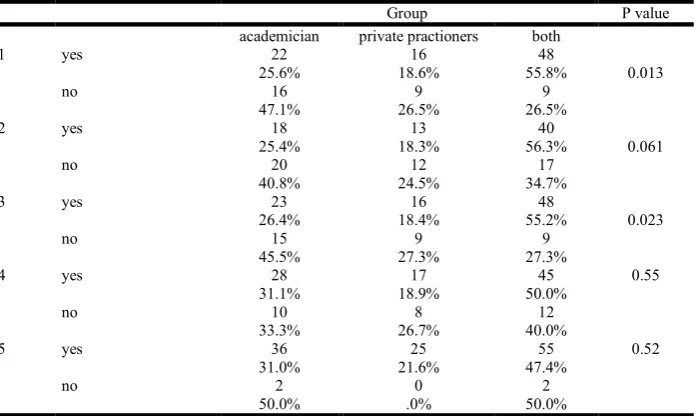
Table 4. Responses of the specialists to the questionnaire
Group P value
academician private practioners both
q1 yes 22 16 48
25.6% 18.6% 55.8% 0.013
no 16 9 9
47.1% 26.5% 26.5%
q2 yes 18 13 40
25.4% 18.3% 56.3% 0.061
no 20 12 17
40.8% 24.5% 34.7%
q3 yes 23 16 48
26.4% 18.4% 55.2% 0.023
no 15 9 9
45.5% 27.3% 27.3%
q4 yes 28 17 45 0.55
31.1% 18.9% 50.0%
no 10 8 12
33.3% 26.7% 40.0%
q5 yes 36 25 55 0.52
31.0% 21.6% 47.4%
no 2 0 2
50.0% .0% 50.0%
[image:3.595.57.541.452.513.2] [image:3.595.127.476.547.755.2]That is the specialists who were both academicians and private practitioners said that they thought the immediate denture would be an ideal treatment plan for a failing dentitionand agreed to the fact that the fabrication of immediate denture required extra skill. The survey also shows that thelack of training was the most important reason why the immediate denture is considered as a challenging treatment option.
DISCUSSION
An immediate complete denture is any removable dental prosthesis fabricated for placement immediately following the removal of a natural tooth/teeth(Glossory of Prosthodontic terms, 2005).This particular treatment plan is almost a century
and half old(Arbeeet al., 2004).Several authors (Standard,
that the immediate denture treatment protocol has many advantages especially the absence of edentulous period so that the patient can go on in his social life uninterrupted.Through the years there have been many improvements in terms of
techniques(vanWaaset al., 1996; Phoenix and Flaeigel, 2008;
Lutes and Ellinger, 1967; Campagna, 1968; Javidet al., 1974;
Cupero, 1978; Grandos, 1979; Beaumont, 1987; Caputiet al.,
2013)and materials used in the fabrication of immediate dentures. However, this particular treatment modality requires special attention in terms of diagnosis and meticulous planning, good laboratory support and immense co-operation from the patients.This study was conducted to assess the attitude of the specialists and also the patients’ response in terms of willingness to go for this treatment protocol. Although there are many studies done to check the success rate, newer materials
q5a 0 2 0 2 0.81
50.0% .0% 50.0%
2 9 6 7
40.9% 27.3% 31.8%
3 15 11 28
27.8% 20.4% 51.9%
4 11 7 19
29.7% 18.9% 51.4%
5 1 1 1
33.3% 33.3% 33.3%
q5b 0 2 0 2 0.33
50.0% .0% 50.0%
1 2 1 0
66.7% 33.3% .0%
2 6 2 9
35.3% 11.8% 52.9%
3 13 13 21
27.7% 27.7% 44.7%
4 15 7 24
32.6% 15.2% 52.2%
5 0 2 1
.0% 66.7% 33.3%
q6 yes 26 15 45 0.18
30.2% 17.4% 52.3%
no 12 10 12
35.3% 29.4% 35.3%
q7 yes 22 13 39 0.31
29.7% 17.6% 52.7%
no 16 12 18
34.8% 26.1% 39.1%
q8 yes 30 22 46 0.64
30.6% 22.4% 46.9%
no 8 3 11
36.4% 13.6% 50.0%
q8a 0 8 3 11 0.03
36.4% 13.6% 50.0%
lack training 15 5 20
37.5% 12.5% 50.0%
lack lab support 10 16 15
24.4% 39.0% 36.6%
otehrs 5 1 11
29.4% 5.9% 64.7%
q9 yes Count % within q9
19 18 39 0.11
25.0% 23.7% 51.3%
No Count % within q9
19 7 18
43.2% 15.9% 40.9%
q10 academics 22 15 40 0.42
28.6% 19.5% 51.9%
private practice 16 10 17
37.2% 23.3% 39.5%
q11 yes 17 10 22 0.833
34.7% 20.4% 44.9%
No 21 15 35
lacking.According to the results of the present study, it is clearly evident that if the patients are educated and motivated well, they would be willing to go for the immediate dentures.It therefore becomes the responsibility of the dentists to educate and motivate the patients towards this treatment modality.The results of this survey show thatthe specialists agree to the fact that said they do consider “Immediate denture” as an ideal treatment option for a failing dentition and also agree to the fact that the immediate dentures help in ridge preservation which is vital and helps in longevity of the bone underneath the edentulous mucosa which is suggestive of the advantages of the immediate denture treatment.Almost half the number of the specialists who respondedthink that this treatment protocol requires an extra skill, time and dedication possibly why the dentists do not educate and motivate the patient towards this treatment plan. They also admitted that the immediate denture would help the patient adapt better to the conventional dentures which is helping the patients in more than one way in terms of aesthetics, phonetics, and maintenance of vertical relation. It was pleasant to know that the specialists accepted that Immediate Denture treatment protocol should be added in the undergraduate study design so that more dentistsare skilled enough to serve their patients better.This study was conducted only in the Western Maharashtra region hence a generalised opinion cannot be given. Further studies need to be conducted in various parts of the country so that a clear conclusion can be drawn.Patient education and awareness programmes need to be conducted so that patients are made aware.Follow up studies have to be done after the awareness programmes.
Conclusion
The present study was conducted in two parts concerning the patients and specialists. The survey aimed at gauging the level of awareness of the patients and their willingness to get the immediate denture treatment done and also to gauge the attitude of the specialists towards this treatment protocol. Within the limitations of this survey, it was observed that the patients should be more educated and motivated towards treatment plans such as immediate dentures, which has so many advantages along with being cost effective compared to the implant solutions. Our laboratories have to be trained for the challenges like these and also a major breakthrough could happen if the under graduates are trained in complex treatment procedures so that many patients are benefited.In the era of constant technological improvement in the health care field we tend to forget some of the inventions or treatment protocols which in deed help the patients, who cannot really afford the fancy treatment costs. Functional, aesthetic and psychological reasons justify fabrication of immediate complete dentures wherever possible. This survey was a small step towards such a treatment plan which is being pushed to the side-lines. The results of this present survey clearly dictate that the patients are more than willing for immediate dentures if they are well educated and motivated.
This survey also indicates that if undergraduate students are trained in this treatment modality the patients who belong to lower economical stratacan be well benefitted. This study poses a future scope into the in depth clinical study into this field with definite clinical study involving the specialists and patients covering a greater geographical area.
REFERENCES
Arbee N. S. in Zarb G, Bolender C. 2004.Prosthodontic Treatment for Edentulous Patients: Complete Dentures and Implant-Supported Prostheses.St.louis, Elsevier- Saunders; Chapter 9. Immediate dentures; p
Beaumont A.J. 1987. Limited esthetic try-in for some
immediate dentures. J Prosthet Dent, 55(5):655-656
Campagna S.J. 1968. An impression technique for immediate
dentures. J Prosthet Dentistry, 20(3):196-203.
Caputi S, Murmura.G, Ricci L, Varvara G, Sinjari B.2013. Immediate denture fabrication: a clinical report. 4(3-4): 273–277
Cupero H.M. 1978. Impression technique for complete
immediate denture. J Prosthet Dent, 39(1):108-109
Garver D.G., Muir T.E. 1983. The retention of vital submucosal roots under immediate dentures: A surgical
procedure. J Prosthet Dent, 50(6):753-756.
Glossory of Prosthodontic terms:J Prosthet Dent. 2005; 94
(1):44
Grandos J.I. 1979. Immediate dentures using patients existing
dentures. J Prosthet Dent, 41(2):228-231
Heartwell C.M., Salisbury F.W. 1965. Immediate complete
dentures: An Evaluation. J Prosthet Dent, 15(4):615-624.
Javid N, Tanaka H, Porter M. 1974. Split-tray impression
technique for immediate upper dentures. J Prosthet Dent,
32(3):348-351
Kocchar Rakesh. A Global Middle Class Is More Promise than Reality: From 2001 to 2011, Nearly 700 Million Step Out of Poverty, but Most Only Barely; Washington, D.C.: Pew Research Center, 2015 Aug. 95 p. Report No: 202.419.4372
Kraljevic S, Panduric J, Badel T, Celi R. 2001. Immediate
Complete Denture. ActaStomatol Croat, 35(2): 281-285
Lutes M.R., Ellinger C.W. 1967. An impression procedure for
construction of maxillary immediate dentures. J Prosthet
Dent, 18(3):202-210.
Phoenix RD, Flaeigel JD. 2008. Cast modification for immediate complete dentures: traditional and contemporary
considerations with an introduction of spatial modelling. J
Prosthet Dent, 100:399-405.
Standard S. G. 1958. Preparation of casts for immediate
dentures. J Prosthet Dent, 8(1):26-30.
VanWaas M.A.J, Kalk W, van Zetten B.L, et al. 1996.
Treatment results with immediate dentures: an evaluation
of 4.5 years. J Prosthet Dent, 76:153-157