INFLUENCE OF TRAINING ON EMPLOYEE PERFORMANCE IN THE PRIVATE SECURITY INDUSTRY
IN KENYA WITH A FOCUS ON PRIVATE SECURITY GUARDS IN NAIROBI COUNTY
1*
Emily Atieno Odhong,
1
PhD Candidate, College of Human Resource Development, Jomo Kenyatta University of
2
Lecturer, College of Human Resource Development, Jomo Kenyatta University of Agriculture and
3
Senior Lecturer, Department of Political Science and Public Administration, University of Nairobi
ARTICLE INFO ABSTRACT
In a globally dynamic business environment, continual employee performance in the 21
average, businesses allocate 3% of their operating budgets to private security services and security upgrade. The main
performance in the Private Security Industry in Kenya. The study sought to improve employee performance, efficiency, and effectiveness in service delivery. The study adopts descri
design and positivism research paradigm; study unit of observation was the Private Security Guards. The target population is 150,000 and the sample size was 213. Kaiser
measure of sample adequacy. Purposive and system pilot test of 10% of sample size was used.
Reliability was determined through Cronbach’s Coefficient Alpha. Triangulation was adopted in data collection tools. The study adopted descriptive data analysis, use of statistical inferences and hypothesis testing. The Data Analysis was done with the help of STATA Version 13.0. quantitative data was presented through tables and descriptive statistics
regression and ANOVA was adopted in the analysis. The study found a practical and statistically significant positive relationship between training and employee performance at regression coefficient of 1.112, t
is 1.112; this implies that, ceteris paribus, a one unit change in the score of training leads to 1.112 units change in the score of employee performance. Hence, training is a key driver
study recommends focus on offering
centers, have a well developed standard training curriculum and improved terms and condition of employment.
Copyright © 2018, Emily Atieno Odhong et al. This unrestricted use, distribution, and reproduction in any medium,
INTRODUCTION
According to Muzaffar, Salamat and Ali (2012), to increase the employee’s performance, it is crucial to inspire the employees by means of satisfying the space in between skills necessary and the owned or operated by means of staff through delivering applicable and relevant training. Farooq and K (2011) in their study concluded that role of the valuable training is to improve the quality of task process that brings improvement in the performance of employees application of formal processes to impart knowledge and help to acquire skills necessary for them to perform their
involving employees in the organization.
*Corresponding author: Emily Atieno Odhong,
PhD Candidate, College of Human Resource Development, Jomo Kenyatta University of Agriculture and Technology.
ISSN: 0975-833X
Article History:
Received 26th December, 2017
Received in revised form
14th January, 2018
Accepted 09th February, 2018
Published online 28th March, 2018
Citation: Emily Atieno Odhong, Dr. Susan Were and Dr. Fred Jonyo
Industry in Kenya with a Focus on Private Security Guards in Nairobi County
Key words:
Training, Key Driver Analysis, Standardized-Training-Curriculum, Employee Performance and Private Security Guards.
RESEARCH ARTICLE
INFLUENCE OF TRAINING ON EMPLOYEE PERFORMANCE IN THE PRIVATE SECURITY INDUSTRY
IN KENYA WITH A FOCUS ON PRIVATE SECURITY GUARDS IN NAIROBI COUNTY
Emily Atieno Odhong,
2Dr. Susan Were and
3Dr. Fred Jonyo
PhD Candidate, College of Human Resource Development, Jomo Kenyatta University of
Agriculture and Technology
College of Human Resource Development, Jomo Kenyatta University of Agriculture and
Technology, Senior Lecturer
Department of Political Science and Public Administration, University of Nairobi
ABSTRACT
globally dynamic business environment, continual training is a key driver of sustainable employee performance in the 21st century organizations. A survey of Kenya firms revealed that on average, businesses allocate 3% of their operating budgets to private security services and security upgrade. The main objective of the study is to determine the influence of training on employee performance in the Private Security Industry in Kenya. The study sought to improve employee performance, efficiency, and effectiveness in service delivery. The study adopts descri
design and positivism research paradigm; study unit of observation was the Private Security Guards. The target population is 150,000 and the sample size was 213. Kaiser
measure of sample adequacy. Purposive and systematic random sampling technique was adopted pilot test of 10% of sample size was used. Test for validity was done through Bartlet’s sphericity test Reliability was determined through Cronbach’s Coefficient Alpha. Triangulation was adopted in data
ection tools. The study adopted descriptive data analysis, use of statistical inferences and hypothesis testing. The Data Analysis was done with the help of STATA Version 13.0. quantitative data was presented through tables and descriptive statistics
regression and ANOVA was adopted in the analysis. The study found a practical and statistically significant positive relationship between training and employee performance at regression coefficient of 1.112, t-value = 2.63 and P-Value 0.010. Interpretation: the magnitude of the coefficient of training is 1.112; this implies that, ceteris paribus, a one unit change in the score of training leads to 1.112 units change in the score of employee performance. Hence, training is a key driver
study recommends focus on offering relevant and effective training, identifying approved training centers, have a well developed standard training curriculum and improved terms and condition of employment.
is an open access article distributed under the Creative Commons medium, provided the original work is properly cited.
2012), to increase the employee’s performance, it is crucial to inspire the employees by means of satisfying the space in between skills necessary and the owned or operated by means of staff through delivering applicable and relevant training. Farooq and Khan 2011) in their study concluded that role of the valuable training is to improve the quality of task process that brings improvement in the performance of employees application of formal processes to impart knowledge and help to acquire ry for them to perform their: job engagement
PhD Candidate, College of Human Resource Development, Jomo Kenyatta
According to Victor (2013), Training indicators such as on the-job, off-the-job and its relevance serves as a motivating force in improving the efficiency and
workers. Many organizations
tool to enhance their employee and
performance.
Victor (2013) appraised the vital role of human resources in an organization and posits that human capital/resources are the most valuable assets of the organization. In the conceptual framework, the training variable is operationalised by on job training, off job training and relevance. On job training techniques includes mentorship, coaching, job rotation and role play. Techniques of off-job training includes sensitivity training, transactional analysis,
International Journal of Current Research Vol. 10, Issue, 03, pp.66355-66362, March, 2018
Odhong, Dr. Susan Were and Dr. Fred Jonyo. 2018. “Influence of Training on Employee Performance in the Private Security
Industry in Kenya with a Focus on Private Security Guards in Nairobi County”, International Journal of Current Research
INFLUENCE OF TRAINING ON EMPLOYEE PERFORMANCE IN THE PRIVATE SECURITY INDUSTRY
IN KENYA WITH A FOCUS ON PRIVATE SECURITY GUARDS IN NAIROBI COUNTY
Dr. Fred Jonyo
PhD Candidate, College of Human Resource Development, Jomo Kenyatta University of
College of Human Resource Development, Jomo Kenyatta University of Agriculture and
Department of Political Science and Public Administration, University of Nairobi
training is a key driver of sustainable century organizations. A survey of Kenya firms revealed that on average, businesses allocate 3% of their operating budgets to private security services and security objective of the study is to determine the influence of training on employee performance in the Private Security Industry in Kenya. The study sought to improve employee performance, efficiency, and effectiveness in service delivery. The study adopts descriptive research design and positivism research paradigm; study unit of observation was the Private Security Guards. The target population is 150,000 and the sample size was 213. Kaiser-Meyer-Oklin was used to atic random sampling technique was adopted. The Test for validity was done through Bartlet’s sphericity test. Reliability was determined through Cronbach’s Coefficient Alpha. Triangulation was adopted in data ection tools. The study adopted descriptive data analysis, use of statistical inferences and hypothesis testing. The Data Analysis was done with the help of STATA Version 13.0. The quantitative data was presented through tables and descriptive statistics analysis, correlation, regression and ANOVA was adopted in the analysis. The study found a practical and statistically significant positive relationship between training and employee performance at regression coefficient e 0.010. Interpretation: the magnitude of the coefficient of training is 1.112; this implies that, ceteris paribus, a one unit change in the score of training leads to 1.112 units change in the score of employee performance. Hence, training is a key driver in the PSI. The effective training, identifying approved training centers, have a well developed standard training curriculum and improved terms and condition of
Commons Attribution License, which permits
2013), Training indicators such as on-job and its relevance serves as a motivating force in improving the efficiency and productivity of the any organizations consider training as a veritable
employee and organizational
appraised the vital role of human resources in an organization and posits that human capital/resources are the most valuable assets of the organization. In the conceptual ing variable is operationalised by on job training, off job training and relevance. On job training techniques includes mentorship, coaching, job rotation and role job training includes sensitivity training, transactional analysis, simulation and lectures.
OF CURRENT RESEARCH
Influence of Training on Employee Performance in the Private Security
Training is the systematic acquisition of skills, knowledge and abilities to enable one carry out a task effectively. Argwalla (2010) explained that the purpose of training in any organization is to develop the skills of the individual and to satisfy the current and future manpower needs in the work
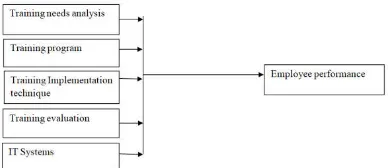
situation. In this study the indicators of training include:Needs
analysis; Design; programme; implementation; Evaluation
techniques, and IT Systems. Akhar et al., (2011) discovered
that training has an optimistic association between motivations along with job engagement involving personnel doing work in organizations. Khanfar (2011) argued that employee performance is provided by training acquired. According to Armstrong and Taylor (2014), training is the systematic ‘acquisition and development of knowledge, skills and attitudes by employee to adequately perform a task or job or to improve performance in the job environment. Training is systematic and continual in nature.
Private Security Industry
Performance of every sector is key towards achievement of economic growth. At the organizational level, performance can be measured in terms of effectiveness and efficiency, customer satisfaction, increased sales, diversification, or even personal data such as measures of accidents, turnover and absence among others (Ratti, 2012). The organizational performance depends on the quality of human capital. Globally, the available estimates suggest that eight countries of the world alone have more than 60,000 private security services agencies. The countries are: India, Germany, China, Canada, Russia, the United Kingdom, Australia and Nigeria. The industry employs approximately 12 million private security personnel, in these countries. These employees mainly work as security guards, armed security guards and security supervisors (Upadhyaya, 2011).
In Tanzania, the PSI permeated Tanzanian market in the form of private security companies in 1980’s. The private security industry mushroomed in 1990s and prospered in 2000s, the period when the government of Tanzania undertook extensive
reform of the ordained Ujamaa Policy to liberal policy
(Shadrack, 2011). In Kenya, performance of PSI is reflected in Kenya’s economy which is estimated to have expanded by 5.9 per cent in 2015, compared to a growth of 5.3 per cent in 2014 (RoK, 2016).
Mulupi (2014) noted that KK security holds more than 70% of security contracts for embassies in Kenya and that the PSI is a booming business. The International Commission for Truth and Justice (ICTJ) reported that the deteriorating security conditions have been attributed to uneven performance of some of the country’s security agencies (ICTJ, 2010). Mulupi (2014) reported that Private Security Industry CEOs noted major challenges such as competition, managing cooperation with public authorities and keeping standards; improving standards; customer needs have evolved and increasing demand to increase skilled manpower and install additional equipment increased.
Statement of the problem
In a globally dynamic business environment, continual training
is a key driver of sustainable employee performance in the 21st
century organizations. A survey of Kenya firms revealed that on average, businesses allocate 3% of their operating budgets to private security services and security upgrade (KPMG, 2012).
According to (Omolo, 2015; Murunga, 2015; Wekesa, 2013; and Oanda, 2013), PSI face fierce competition, while the PSGs face challenges such as inadequate training, since no training institution providing standardized training, hence affecting employee performance. Nassazi (2013) found that (92.5%) of employees link training to their improved performance. Odhong and Were (2013) asserted that the challenge confronting organizations is to transit to a more cost effective service delivery model, while leveraging technology to offer better services. The study sought to determine the influence of training on employee performance in the Private Security Industry in Kenya.
Objective of the study
The study sought to determine the influence of training on employee performance in the private security industry in Kenya.
Hypothesis
The study was guided by the Null Hypothesis.
Ho: Training has no significant influence on employee
performance in the Private Security Industry in Kenya.
Underpinning Theory
Analysis, Design, Develop, Implement and Evaluate (ADDIE) Model
The concept of Instructional System Design (ISD) has been around since early 1950. While the concept of Analysis; Design, Develop, Implementation and Evaluation represent (ADDIE) first appeared in 1975. It was created by centre for educational technology at Florida State University for the US Army in 1975. The model has since evolved several times over
the years to become interactive, dynamic and user friendly
(Eddie Timeline, 2015). Culatta and Kearsley (2016) explained that ADDIE model is a generic process traditionally used by instructional designers and training developers. The five phase: Analysis; Design, Develop, Implementation and Evaluation represent, a dynamic flexible guideline for building effective training and performance support tools. In the ADDIE Model each step has an outcome that feeds into the subsequent step. Some of the weaknesses of ADDIE model includes:
First, the typical process require unrealistically comprehensive up-front analysis most teams respond by doing very little at all and fail to access critical elements; secondly, learning program are designed to meet criteria that are measured (schedule, cost, throughout) and fail to focus on identifying behavioural changes and no accommodation for dealing with faults or good ideas throughput the process (Culatta and Kearsley, 2016). This model supports training as independent variable. The implication of this model to this study is that for training to be conducted, the organization needs to conduct Training Needs Analysis (TNA), determine the training method; develop a program, implement through conducting training and evaluate the effectiveness at the end of training. Effective instructional designs provide a method, that if followed will facilitate the transfer of knowledge, skills and attitudes to the learner.
Empirical review
secondary data. The study found that some of the symptoms that call for training manifest themselves in various ways such as lack of interest in job, negative attitude to work, low productivity, tardiness, excessive absenteeism rate, excessive complaints from customer, high accidents and insubordination among others. The study recommends that everyone involve in training should agree exactly to what the training are lacking; skills needed and the attitude. Shaheen, Naqvi and Khan (2013) conducted an empirical study on employees training and organizational performance: mediation by employees performance. Both quantitative and qualitative methods were used; questionnaire used for data collection involving 220 questionnaires that were dispersed amongst schools teachers out of those 197 received with 90 percent turnover. The SPSS was used for data analysis and policy based on results presented for ensuring training effectiveness and enhancing employee’s performance. Overall results revealed significant and positive association between training and organization performance. Kirschenbaum and Rapaport (2014) carried out a comprehensive study of Airports across Europe to establish the impact of training on security-related decisions was examined in detail. The study hypothesized that those more trained would comply more with protocols and rules than those with less training and robustness of training process. The study results confirmed that training is constrained in the ability to determine security decision behavior primarily because of an
employee’s experience of actual threat. The study
recommended simulation to bridge the gap between rule compliance and reality.
Employee performance
Employee performance is a complex mix of skills, knowledge, ability, attitude, effort and results (Jamal, 2011). Jamal (2011) concluded that when organization consider their employees as an asset and invest in their capabilities the performance of the
organization enhances. To achieve these 21st century
organizations must integrate their practices with information technology systems to improve efficiency and effectiveness. Inyang and Abraham (2014) in their study explored the Role of Private Guard Companies and Crime Control in Akwa State, Nigeria. The survey research design was utilized to a study sample of 160 respondents of different categories of people who constitutes the Private Security Practitioners in Akwa Ibom State as well as members of the public who reside in community where there private guard companies offer their services. The study found that the private guard business in Nigeria has been infiltrated by unregistered and unlicensed persons. The study recommended amendment of Private Guard Company’s Act to check on a number of abuses most especially in regard to training and appropriate facilities for effective security services in the region.
Conceptual framework
Figure 2.1. Conceptual framework Independent variable Dependent variable
METHODOLOGY
The study adopted descriptive research design. Descriptive studies are designed primarily to document what is going on or
what exists (Trochim et al., 2016). Serekan (2010) explained a
good research design has a clearly defined purpose and has consistency between the research questions and the proposed research methods. Cooper and Schindler (2014) posits that, if the research is concerned with finding out who, what where, when or how much, then the study is descriptive. Purposive and systematic sampling was adopted. The study also adopted triangulation in data collection tools.
Research Philosophy
This study adopted positivism research paradigm since this study involves hypothesis testing and thus seek to obtain the objective truth or reality and also predict what may happen in future. The study took a viewer/observer approach. Aligu, Bello, Kasim and Martin (2014) in their study argue that positivism could be regarded as a research strategy and approach of the viewer and observer.
RESULTS
Response rate
In this study the total response rate comprised 150 respondents which translates to 150 (70.42%) of the total sample size 213, while 63 (29.58%) did not return/respond to the questionnaires. The response rate of (70.42%) gave the study high degree of representativeness that could be relied upon confidently to
generalize the respondents’ views on this study. Otieno et al.,
(2015) in their study found a response rate of 76.6%.
Demographic statistics
Age bracket of the Study Respondents
[image:3.595.66.260.679.763.2] [image:3.595.353.514.729.800.2]The study result shows none of the respondents are in the age range of 15-17. The study shows that the majority (66.67%) of the Private Security Guards who respondent to the study were in the age bracket of 18-35 years old. This implies that the PSI attracts youthful workforce. According to Article 260 of Kenya’s Constitution, the youth are those who are in the age range of 18-35 years. The study results concurs with Murunga (2015), who found that 83 (55.41%) of the security guards are of age between 21-30 and only 12 (12%) are between 41-50. The study results also shows that 26.67% of the study respondents are in the age range of 36-47 years, 5.33% are in the age range of 48-64 years and 1.33% are in the age range of 65 years and above. Ngari (2015) study results in the PSI in Kenya showed that age bracket 20-40 (59%). Similarly, a study by Friedrich Ebert Stiftung (2011) on Wages and Working Conditions of Private Security Workers in Ghana showed that more than half (54%) of the study respondents, were between ages 15-35years, who are considered as youth. Table 4.1 shows the age of the study respondents.
Table 4.1. Age bracket of the study Respondents
Age Frequency Percent
15 – 17 - -
18 – 35 36 - 47 48 – 64 65 and above
100 40
8 2
66.67 26.67 5.33 1.33
Gender of the Study Respondents
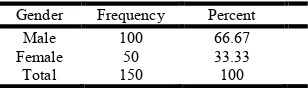
[image:4.595.86.240.229.273.2]The study result shows that 100 (66.67%) were males, while 50 (33.33%) were females. This is an indication that the PSI is still a male dominated sector; however, the female employees are slowly coming up and breaking the barrier. This shows that there is an effort towards narrowing the gender gap in terms of employment opportunity and labour force participation in this sector. The study results concurs with that of Murunga (2015), who found that majority of the security guards 79% were males and 21% were female. Table 4.2 shows the gender of the study respondents.
Table 4.2. Gender of the study respondents
Gender Frequency Percent
Male 100 66.67
Female 50 33.33
Total 150 100
Level of Education
The study result found that nearly all the respondents have attained some level of education, 13 (8.67%) of the study respondents have attained primary level education, 105 (70%) of the study respondents have attained secondary level education while 29 (19.33%) of the study respondents have attained some certificate level courses, and 3 (2%) have attained diploma level courses. The study results concurs with Murunga (2015) who found that majority of the security guards (53%) attained secondary level, (26%) attained certificate level and (13%) attained diploma level, and no respondents were graduates. Research shows that residents of Nairobi County have 2.2 times more access to secondary education than average Kenyan (KNBS and SID, 2013).
Empirical Results
Descriptive statistics
The study sought to determine the influence of training on employee performance. Table 4.3 gives summary descriptive statistics for various components of training. It shows that majority 60 (40%) of the study respondents, disagreed that organizations perform TNA, and a few 5 (3.33%) of the study respondents, strongly agreed that TNA are done in their organizations. The TNA indicator had a mean of 2.12 and SD of 1.14, implying that most organizations in PSI do not conduct TNA, which is a key indicator to help in identification of training needs and the gaps. The results concurs with that of Ejakait (2016) who did a study to examine effects of TNA on employee performance, found that half (50%) of respondents disagreed that their organizations conduct TNA. In addition, Ejakait (2016)study findings revealed that 47% disagreed that TNA conducted in their organizations improved employee performance and 39% agreed that TNA conducted in their organizations improved their performance. The result in Table 4.3 shows that majority 103 (68.67%) of the study respondents, strongly disagreed that the training programs offered are relevant and robust. Training programmes had a mean of 1.52 and SD of 0.86, implying that most of the respondents indicated that the training programs offered in their organizations are not relevant and robust. Muluka (2014) reporting the views of the KNPSWU, noted that most PSFs offer little training, if any professional training to the guards which not only expose the clients to serious security risk, but to
them as well. In addition Muluka (2014) further recommended a relook into training of the guards. The summary result presented in Table 4.3 show that majority 124 (82.67%) of the study respondents, disagreed that training implementation techniques in their organizations comprises both classroom and fieldwork or out of classroom are conducted effectively. A few 3 (2%) of the respondents agreed that implementation of training techniques in their organizations includes both class room lectures and field demonstrations. The study result in Table 4.3 shows that implementation techniques had a mean of 1.89 and SD of 0.47, implying that majority of PSFs do not combine both classroom lecturers and field demonstration as a blended approach in training implementation technique. Alogo (2015) found that most PSFs have adopted new defensive techniques which had a mean of 3.0 and SD of 1.20. In addition, the study revealed 76% of the firms are SMEs with less than 500 employees, implying that they may not have the ability to invest much in advanced technology, hence they need government support and universal/ standard regulation in the sector.
The study results in Table 4.3 shows that majority 111 (74%) of the study respondents, indicated they had never had training evaluation in their organization, and a few 6 (4%) of the study respondents strongly agreed they have had training evaluation. The variable, training evaluation has a mean of 2.77 and a SD of 0.57, implying that most PSFs do not conduct training evaluation. Training evaluation provides feedback and opportunity for assessment of the impact of training. Karim, Huda, and Khan (2012) carried out a study on significance of
training and post training evaluation for employee
effectiveness, and found that 77% of the study responded strongly agreed that training evaluation develops training program and employee effectiveness. The study results in Table 4.3 show that majority 81 (54%) of the study respondents, strongly disagreed that they are trained on ICT skills and conversant with IT related services. A few 32 (21.33%) of the study respondents, indicated they have neither been trained nor have their firms introduced them to ICT systems to enhance their performance. The IT systems indicator had a mean of 1.67 and a SD of 0.81, implying that most organizations have not yet fully embraced ICT in all of its operations to support employee performance. Effective integration of ICT in training improves employee performance. Weeks (2013) in conducting overall assessment in every aspect of employee job performance, found that after implementation of IT systems, success rate of employees after training increased by 22%.
Table 4.3. Training and Employee performance
Training SA %
A %
N %
D %
DA %
M SD
TNA Programme Techniques Evaluation IT systems
3.33 0 0 4 0
14.67 3.33 2 18.67 0
7.33 14 0 74 21.33
40 14 82.67 0 24.67
34.67 68.67 15.33 4 54
2.12 1.52 1.89 2.77 1.67
1.14 0.86 0.47 0.57 0.81
performance. In conclusion, in adequate or irrelevant training affect employee performance. Nassazi (2013) found that 92.5% of employees link training to their performance. Table 4.11 shows the results for training as independent variable.
Qualitative Analysis of Training and employee
performance
[image:5.595.334.530.181.262.2]First, the study respondents were asked to state the training programs available in the organizations. The summary descriptive statistics for this training are summarized in Table 4.4 The results presented in Table 4.4 shows that majority 104 (71.72%) of the study respondents are trained in physical fitness/field demonstration, 24 (16.55%) indicated that they have sensitivity training and conducting drills, and 7 (4.83%) indicated that they are taken through classroom lectures on security studies. This concurs with the results of the study by Ouma (2014) who found that majority security guards receive basic training 31 (77.5%), and only 7 (17.5%) indicated that they had received additional training on a continuous basis and 5% had not received any training. this also concurs with Omolo (2015) who found that majority receive basic physical fitness training. Table 4.4 shows the available training programs.
Table 4.4. Training Programmes
Programme F %
Physical fitness, /field demonstrations Classroom lectures on security studies Fire fighting/emergency services Counter terrorism preparedness Customer care
Security search procedures Sensitivity training/conducting drills
104 7 4 2 1 3 24
71.72 4.83 2.76 1.38 0.69 2.07 16.55
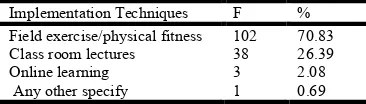
Second, the study respondents were also asked to identify the training techniques available in their organizations. The purpose of this question was to enable the study to identify key training techniques that can be explored apart from the regular physical fitness training that gives the best outcome. As illustrated in Table 4.5, 102 (70.83%) of the study respondents indicated that the techniques of training is field exercise and physical fitness, 38 (26.39%) indicated that their organization have class room lectures, 3 (2.08%) indicated that they have online learning programs and 1 (0.69%) indicated that there are seminars and workshops organized by their firms. Omolo (2015) carried out a baseline survey in the private security industry in Kenya. The findings indicated that most PSFs conduct physical fitness training only
Table 4.5.Training Implementation Techniques
Implementation Techniques F %
Field exercise/physical fitness Class room lectures Online learning Any other specify
102 38 3 1
70.83 26.39 2.08 0.69
In conclusion, the study respondents were asked to state why they think that training enhances employee performance. The study results presented in Table 4.6 Shows that majority 29
(20.14%) indicated that training enhances employee
performance, 27 (20.14%) of the respondents indicated that training helps in acquiring new skills to enhance performance. In addition, 23 (15.97%) indicated that training helps reduce customer complaints and 23 (15.97%) indicated that training helps to clarify expectation at the time of their engagement.
Other respondents, 18 (12.50%) indicated that training enhances efficiency and effectiveness, 13 (9.03%) indicated that training improves and 11 (7.64%) indicated that training to
build confidence needed at work. Table 4.6 presents the
[image:5.595.52.272.348.430.2]respondents’ views on how training can improve employee performance, series 1 represents frequencies and series 2 represents percentage (%). Table 4.6 shows the benefits of training.
Table 4.4: benefits of training on employee performance
Benefits of training F %
Reduced customer complaints Enhanced job satisfaction Helps to clarify expectation Enhanced employee performance Helps in acquiring new skills Helps build confidence
Improves efficiency/effectiveness 23 23 13 29 27 11 18
15.97 15.97 9.03 20.14 18.75 7.64 12.50
Correlation Coefficient Analysis
The results of the analysis revealed that there is a positive correlation between training and employee performance. The correlation coefficient is 0.1767, implying a weak correlation between the two variables. In the study, indicators of training includes: training needs analysis, Training program, Training implementation technique, Training evaluation, and IT Systems. The positive attributes of these indicators shows that training and employee performance commoves in the same
direction. Shaheen et al., (2013) found weak but positive
correlation between training and employee performance with r = 0.18, F=43.378, P-value of 0.001, implying that 0.18 that there exist a weak positive correlation between training and training. Gidey (2016) also found weak but positive relationship between training and employee performance with correlation coefficient of 0.309 and p-value of 0.01. Gidey (2016) study further indicates that there exist strong positive
relationship between training design and employee
performance at r = 0.62, on job training with correlation coefficient of 0.505 and off-job training with r=0.728.
Regression results of training and employee performance
The study result found that training has a strong positive relationship with employee performance. The coefficient of this variable is 1.112 with a t-value of 2.63 and p-value of 0.010. According to the results, the coefficient of training is statistically significant at 1 per cent level of significance. The magnitude of the coefficient of training is 1.112; this implies
that, ceteris paribus, a one unit change in the score of training
leads to 1.112 units change in the score of employee performance. The results presented in Table shows that there is a strong positive relationship between training and employee performance.
[image:5.595.71.254.637.689.2]ANOVA results of training and employee performance
Table 4.6 shows the ANOVA results for training and employee performance. The ANOVA result shows that F-statistic is 2.56 and the Prob>F is 0.0409, implying that the coefficient of joint determination is statistically significant at 5% level of significance. This means that training determines employee performance, and that the influence is statistically significant. Basing the confidence level at 95%, the analysis indicates that
high reliability of the results was obtained. The F-critical at df
(4,144) was 2.38, while the F-calculated reported in Table 4.37 was 3.22. This shows that calculated is greater than the F-critical, hence there is a positive significant linear relationship between employee engagement and employee performance.
This also implies that, ceteris paribus, when there is an
increase in training, there is a significant increase in employee performance. In addition, the p-value was 0.0, 409 which is less than the significance level of 0.05.
Bartlett’s Sphericity Test result which shows training at
Prob>chi2 = 0.434. An indicationthat the variables in question
are not intercorrelated since the P- values is less than 0.05.In
conclusion the ANOVA results show that training has a
statistically significant relationship with employee
performance. Iqbal, Ahmad and Javad (2014) did a study to establish the impact of training on employee performance. The study results show that ANOVA of p-value 0.000 and F is 556.177. This implies that it is a statistically significant at 1% level of significance. The correlation shows significant positive relationship between training and employee performance at P-value = 0.000 and r = 0.889.
Table 4.6. The ANOVA Results of Training and Employee performance
Model SS df MS F Prob>f
Regression Residual Total
2.328052 32.69959 35.02764
4 144 148
0.582 0.227 0.237
2.56 0.0409
Bartlett’s test for equal variances: chi2 (3) = 2.7343 Prob>chi2 = 0.434
Beta Coefficient result of training and employee engagement
The study results shows that the unstandardised β coefficient
of training is 0.108, standard error of 0.054, t-value =1.99, p-value=0.048 and standardised β coefficient is 0.158. The β coefficient of training is positive, implying that for every one unite increase in the predictor variable -training, the outcome variable – employee performance will increase by 0.108. The t-value is statistically different from zero and p-value 0.048 shows the beta coefficient of training is statistically significant at 5 per cent level of significance. The study results concurs with Abeba, Mesele and Lemessa (2015) who found that the β coefficient from the general linear models unadjusted score of training was β=0.46 (0.28,0.63) while employee performance was 0.49 (0.39, 0.60) and the adjusted models of the β value for training was 0.25 (0.11, 0.39), while employee performance scores were 0.42 (0.32, 0.53). In conclusion, the relationship between training and employee performance is statistically significant. The beta coefficients in the regression results were used to identify and rank the key drivers. The higher the beta coefficient the more a key driver a variable is. Based on this criterion the independent variables were ranked as follows in terms of explaining performance of employees in
the Private Security Industry in Kenya. This means that firms in PSI should focus on quality training as priority, then ensure that their workers are engaged, embrace knowledge sharing and dissemination and continuous skills development. This result is consistent with the explanation by Cucina, Walmsley, Gast, Martin and Patrick (2011) that SKDA is an analysis that attempts to identify a set of survey items called drivers, that have the greatest impact on a specified organizational outcome.
Test of Hypothesis
The second objective sought to examine the effect of training on performance of employees in the private security industry in Kenya. To this end the following null hypothesis was tested.
H02:Training has no effect on performance of employees in the
private security industry in Kenya
The results showed that the coefficient training was 1.112 with a t statistic of 2.63 and a corresponding P value of 0.010. Since the p-value is less than 0.05 the calculated t is greater than the critical at five per cent level of significance. Therefore, at five per cent level of significance the null hypothesis was rejected implying that training has a significant positive effect on employee performance in the private security industry in Kenya. The magnitude of the coefficient training is 1.112; this implies that a one unit change in the score of training leads to 1.112 units change in the score of employee performance. Ravi
et al., (2013) found a significant positive impact of training on
employee performance. The study results revealed that a unit increase in training is linked to a 2.114 per cent increase in an
employee performance. Iqbal, et al., (2014) found that the
correlation analysis shows significant positive relationship between training and employee performance at P-value = 0.000 and r = 0.889. Implying that, it is statistically significant at 1% level of significance.
Summary
The study sought to determine the influence of Training on Employee Performance in the Private Security Industry in Kenya. The indicators that were used to determine in training includes: training needs analysis, training design, training program, training implementation techniques and training evaluation mechanisms. The study results shows that the
unstandardised βcoefficient of training is 0.108, standard error
of 0.054, t-value =1.99, p-value=0.048 and standardised β coefficient is 0.158. The β coefficient of training is positive, implying that for every one unite increase in the predictor variable -training, the outcome variable – employee performance will increase by 0.108. The results show there is a weak positive correlation between training and employee performance. The regression result presented shows that
training has a positive relationship with employee
performance. The coefficient of this variable is 1.112 with a
t-value of 2.63 and p-t-value of 0.010. Ravi et al. (2013) in their
lower unit labour costs compared with those that do not offer training.
Conclusion
Training enhances employee performance. Training Needs Analysis is a key tool for assessment and identification of the gaps to be filled. Given the kind of work the security guards do, the training they get at the organization should identify the gaps and meet their expectations. The training programmes should be robust and relevant, the training implementation techniques should be a blended approach since they need both
classroom lectures and fieldwork/demonstrations are
conducted efficiently. The training evaluation: training evaluation should be conducted, hence identify areas to be adjusted or reviewed.
Recommendation
Training enhances employees’ performance and enables the
enterprises achieve a competitive advantage, above
competitors. Hence, relevant and adequate training is necessary. To achieve better results Training needs analysis should be conducted when training the private security guards to enable the firms to identify the current trend, training requirements and materials needed. Through TNA, the firms also get the opportunity to anticipate the relevant training
required in future, due to the labour market dynamics.
Training designs adopted should entail both on-job and off-job programs. The on-job training enables the security guards cope with the duties they are assigned in every work stations. For example, some require ICT skills, ability to communicate in English and Kiswahili, and/or any other additional foreign
languages, where applicable to enhance employability.
It is important to have standard curriculum with minimum qualification being secondary level training, to ensure that effective implementation techniques are in place, holistic and blended training techniques that comprises both class room lectures, field demonstrations, online learning and paralegal training is very useful in this sector. The study suggest that Government training academy or accredited institution is necessary for the private security guards. The government should train the private security guards and also offering an integrated coordinated approach to any security concern if necessary; continued surveillance and collective responsibility in the case of a security concern. The study suggest that the Government owned institutions, for example, Technical Vocational Education and Training (TVET) could be the best institutions to offer basic formal training for security guards. The suggested key institution by the study respondents is the National Youth Service (NYS) and TVET institutions. Finally, formal training will also help as a move towards recognition of the security guards as professionally certified to carry out the duties. The IT based training programmes such as such as organizational owned on-site training, web based training, class room training, net courses (short), webinars and video tutorial offering relevant training, are imperative.
Areas for Future Research
The study sought to establish the influence of training on employee performance in the Private Security Industry in Kenya. The study independent variable was training and employee performance as dependent variable. The study unit of observation was private security guards. Therefore, further
studies can be done in this sector, since there are various categories of employees in the PSI. It is also important to note that at the time of this study other factors were held constant,
ceteris paribus. Hence, further studies can be conducted to
explore more on training in the PSI.
Acknowledgement
I wish to thank the University for giving me a chance to improve my knowledge, skills and abilities. I also wish to acknowledge the invaluable guidance given by my Supervisors, Dr Susan Were, and Dr Fred Jonyo, and all the lecturers from JKUAT Nairobi CBD Campus, and the entire College of Human Resource Development for their willingness to impart knowledge throughout my coursework.
REFERENCES
Aligu, A.A., Bello, U, M., Kasim, R. and Martin, D. 2014. Positivist and Non-Positivist Paradigm in Social Science Research: Conflicting Paradigms or Perfect Partners?
Journal of Management and Sustainability, Vol. 4, No. 3
Argwalla, T. 2011. Strategic Human Resource Management,
(9th edition), India, University Press
Armstrong, M. and Taylor, S. 2014. A Handbook of Human
Resource Management Practice, (13th edition.), London,
Kogan Page Publishers
Cooper, D. R. and Schindler, P. S. (2014). Business Research
Methods, (12th edn.), Boston, Mc Graw-Hill Irwin
Cucina, J. M.,Walmsley, P. T., Gast, F. I., Martin, R. N. and
Patrick, C. 2011. Survey Key Driver Analysis: Are We
Driving Down The Right Road?, A Paper Presented at the
2011 and 2012 Meetings of The Society for Industrial and Organizational Psychology and The January Meeting of The US Office of the Personnel Management’s FedPsych Forum, Washington DC, USA.
Culatta, R. and Kearsley, G. 2016. Instructional Design.
Available at www.instructionaldesign.org/index
Eddie Timeline 2015. EDDIE Model, available at
www.nwlink.com
Farouq, M. and Khan M. A. 2011. Impact of Training and
Feedback on Employee Performance. Far East journal of
Psychology and Business 5 (1) 23-33.
Friedrich Ebert Stiftung 2011. Wages and Working Conditions of Private Security Workers in Ghana, Friedrich Ebert Stiftung Ghana.
Githinji, S. N. 2014. The effect of Staff Turnover on Financial
Performance of the Private Security Firms in Kenya. A
Research Report Submitted to the Chandaria School of Business in Partial Fulfillment of the Requirement for The Degree of Masters in Business Administration, United State International University – Africa.
Inyang, J. D. and Abraham, U. E. 2014. Private Guard Companies and Crime Control in Akwa Ibom State,
Nigeria, Scholar Journal of Arts, Humanities and Social
Sciences 2 (5D): 786-795
International Centre for Transitional Justices 2010. Security
Sector Reform and Transitional Justice In Kenya, Nairobi,
Kenya
International Labour Organizations 2017. World Employment and Social Outlook of 2017; Sustainable Enterprises and Jobs-Formal Enterprises and Decent Work, International Labour Organizations.
Iqbal, N., Ahmad, N. and Javad, K. 2014. Impact of Training
Telecommunication Sector of D. G. GKhan in Pakistant.
International Letters of Social and Humanistic Science,
Scipress Ltd Swiszerland Pakistan, Vol. 17 pp 60 - 73
Jamal, W. 2011. Impact of Human Capital Management on
Organizational Performance, European Journal of
Economics, Finance and Administrative Sciences, Vol. 5
(34) pp:13309-13315
Kenya National Bureau of Statistics and Society for International Development, 2013 Exploring Kenya’s Inequality; Pulling apart or Pooling together, Nairobi
County, Kenya. As retrieved from
www.http//inequalities.sidint.net/kenya/wp_content/upload s/sites/2/2013/09Nairobipdf. on 13/1/2018.
Kirschenbaum, A. and Rapaport, C. 2014. Does Training Improve Security Decisions? A Case Study of Airports,
Security Journal. Available at DOI:1057/55.2014.39
Mulupi, D. (2014). Kenya’s Private Security Industry Booming
Due to Terror Threats, Now we made it in Africa, DHL
Report, Nairobi, Kenya. Retrieved on 5/4/2016
Murunga, P. L. 2015. The Effects of Working of Private
Security Guards on Service Delivery. Case of Secure Force
Security Company, Nairobi County. A published thesis
submitted in partial fulfillment for the award of degree of Master of Arts in Security Management and Police Studies in the School of Humanities and Social Sciences of Kenyatta University
Muzaffar, M. U., Salamat, S. H. and Ali, M. M. 2012. Impact of Trainings on Employee Outcome in IT Sector, Pakistan.
Global Journal of Management and Business Research, 12
(6):20-26
Nassazi, A. 2013. Effects of Training on Employee
Performance. Evidence from Uganda, Published Thesis,
Vaasan Ammattikorkeakoulu, University of Applied Sciences, International Business
Ndulue, T. I. 2010. Impact of Training and Development on
Workers Performance in an Organization, International
Journal of Research in Management Economics and
Commerce, Vol. 2, Issue 9
Ngari, A. W. 2015. Mergers and Acquisition As A Growth
Strategy in The Private Security Industry in Kenya, A
Research Project Submitted to The Chandaria School of Business in Partial Fulfillment of the Requirement for The Degree of Master of Business Administration (MBA).
Oanda, V. T. 2013. Challenges of Strategy Implementation in
Private Security Companies in Kenya, Published Masters
Research Project, University of Nairobi, Kenya
Odhon’g, E. A. and Were S. 2013. “Human Capital
Management as a Tool for Value Creation”, in proceedings
of First SHRD Annual Research Conference, 12th and 13th
September, Vol. 1, 696-703. African Institute for Capacity Development (AICAD), JKUAT, Nairobi, Kenya.
Odhon’g, E., A. and Omolo, J. 2015. Effect of Human Capital
Investment on Organizational Performance of
Pharmaceutical Companies in Kenya, Global Journal of
Human Resource Management, Vol. 3. No. 6, pp.1 – 29.
Omolo, J. 2015. Baseline Survey Report of the Private Security
Industry in Kenya, Law growth Nexus III, International
Labour Organization, Nairobi.
Otieno, B.B.A., Waiganjo, E. W. and Njeru, A. 2015. Effect of Employee Engagement on Organizational Performance in
Kenya’s Horticultural Sector, International Journal of
Business and Administration, Vol. 6, No. 2
Ratti, M. 2012. Analytical Study of Human Resource
Accounting Practices. Journal of Management, 5 (2), 37 –
45
Ravi, B., Nishtha, Amit., Ram, G. and Alok, G. 2013. Human capital investment and employee performance: An analysis
of IT services Industry. Journal of Management Science,
Vol.
Republic of Kenya 2016. Economic Survey, Nairobi: Kenya
National Bureau of Statistics
Serekan, U. 2010. Research Methods for Business: A skill
Building Approach, (5th edn), USA, John Wiley and Sons
Publisher
Shadrack, J. 2011. The Private Security Industry in Tanzania:
Challenges, Issues and Regulations, Published Masters
Dissertation, University of Dar es Salaam
Shaheen, A., Naqvi, M. H. and Khan, A. M. 2013. Employees
Training and Organizational Performance: Mediation by
Employees Performance; Institute of Interdisciplinary
Business Research
Trochim, M. W., Donnelly, J. P. and Arora, K. 2016. Research
Methods: The Essential Knowledge Base, Boston, USA,
Cengage Learning
Upadhyaya, S. 2011. Plight and Predicament of Security Guards Engaged By Private Security Agencies in India,
International Journal of Management Science Vol. 7 No. 1
Victor, A. M 2013. Training and Manpower Development
Employee productivity and Organizational Performance,
International Journal of Advances in Management and Economics.
Wekesa, D. W. M., Cheruiyot, K. P. and Kwasira, J. 2013. An Assessment of Human Resource Management Practices on Organizational Performance in Private Security Industry in
Kenya. International Journal of Human Resource
Management and Research, Vol. 3, Issue 5. Pp. 11 – 18.