CONTROLLER TUNING ALGORITHM FOR MIMO PROCESSES
Department of Instrumentation and Control,
ARTICLE INFO ABSTRACT
A MIMO (multi input
outputs but also one or more other outputs in the plant. Thus such processes are difficult to control due to the presence of the interactions. The interactions between input/output variables are a common phenomenon
multivariable processes.
degraded process behavior. Such processes are found in process indu
design of plants that are subject to rigid product quality specifications, are more energy efficient, have more material integration, and have better environmental performance.
for a SISO (Single in
performance and stability. Much research has been focused on how to efficiently take loop interactions into account in the multi
taken in terms of control system design, loop interactions can cause performance degradation and instability. This leads to the development of different controller tuning methods.
been proposed, including the Detuning method, Sequential tuning method, and independent loop method.
for MIMO
Copyright © 2016, Darshna Joshi.This is an open access article
distribution, and reproduction in any medium, provided the original work is properly cited.
INTRODUCTION
Multivariable or multi-input multi-output (MIMO) systems are frequently encountered in the chemical and process
Despite the considerable work that has been done on advanced multivariable controllers for MIMO systems, multi
controllers are still much more favored in most commercial process control applications, because of their satisfactory performance along with their simple, failure tolerant, and easy to understand structure.
• Multi-loop control: Each manipulated variable depends on only a single controlled variable, i.e., a set of conventional feedback controllers.
• Multivariable Control: Each manipulated variable can depend on two or more of the controlled variables.
Figure 1 shows SISO (Single input- Single output) system with u as one of the process input and y as its output.
*Corresponding author: Darshna M. Joshi,
Department of Instrumentation and Control, Government Polytechnic Ahmedabad-15, India.
ISSN: 0975-833X
Article History:
Received 19th December, 2015
Received in revised form 15th January, 2016
Accepted 27th February, 2016
Published online 16th March,2016
Key words:
Controller Tuninig, MIMO, Detuning method,
Sequential Loop closing (SLC) method, Relay auto-tuning method,
Independent loop method , Algorithms.
Citation: Darshna M. Joshi, 2016. “Controller Tuning Algorithm for
RESEARCH ARTICLE
CONTROLLER TUNING ALGORITHM FOR MIMO PROCESSES
*Darshna M. Joshi
Instrumentation and Control, Government Polytechnic Ahmedabad
ABSTRACT
A MIMO (multi input-multi output process) system is one in which one input not only affects its own outputs but also one or more other outputs in the plant. Thus such processes are difficult to control due to the presence of the interactions. The interactions between input/output variables are a common phenomenon and the main obstacle encountered in the design of multi
multivariable processes. Increase in complexity and interactions between inputs and outputs yield degraded process behavior. Such processes are found in process indu
design of plants that are subject to rigid product quality specifications, are more energy efficient, have more material integration, and have better environmental performance.
for a SISO (Single input- Single output) system to multi-loop systems often leads to poor performance and stability. Much research has been focused on how to efficiently take loop interactions into account in the multi-loop controller design. Thus, unless proper precautions ar taken in terms of control system design, loop interactions can cause performance degradation and instability. This leads to the development of different controller tuning methods.
been proposed, including the Detuning method, Sequential Loop closing (SLC) method, Relay auto tuning method, and independent loop method. This paper presents different controller tuning methods for MIMO-multi input-multi output process.
is an open access article distributed under the Creative Commons Attribution License, which distribution, and reproduction in any medium, provided the original work is properly cited.
output (MIMO) systems are frequently encountered in the chemical and process industries. Despite the considerable work that has been done on advanced multivariable controllers for MIMO systems, multi-loop PID controllers are still much more favored in most commercial process control applications, because of their satisfactory rmance along with their simple, failure tolerant, and easy
Each manipulated variable depends on only a single controlled variable, i.e., a set of conventional
ach manipulated variable can depend on two or more of the controlled variables.
Single output) system with as its output.
[image:1.595.337.526.507.614.2]rumentation and Control, Government Polytechnic
[image:1.595.339.515.667.754.2]Figure 1. SISO Process
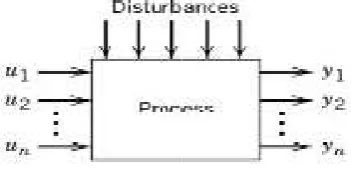
Figure 2 shows MIMO (Multi input u1 to un as inputs and y1 to yn as outputs.
Figure 2. MIMO Process
International Journal of Current Research Vol. 8, Issue, 03, pp.27845-27849, March, 2016
INTERNATIONAL
Controller Tuning Algorithm for MIMO Processes”, International Journal of Current Research,
CONTROLLER TUNING ALGORITHM FOR MIMO PROCESSES
Government Polytechnic Ahmedabad-15, India
which one input not only affects its own outputs but also one or more other outputs in the plant. Thus such processes are difficult to control due to the presence of the interactions. The interactions between input/output variables are a common and the main obstacle encountered in the design of multi-loop controllers for interacting Increase in complexity and interactions between inputs and outputs yield degraded process behavior. Such processes are found in process industries as they arise from the design of plants that are subject to rigid product quality specifications, are more energy efficient, have more material integration, and have better environmental performance. Applying the tuning methods loop systems often leads to poor performance and stability. Much research has been focused on how to efficiently take loop Thus, unless proper precautions are taken in terms of control system design, loop interactions can cause performance degradation and instability. This leads to the development of different controller tuning methods. Many methods have Loop closing (SLC) method, Relay auto-This paper presents different controller tuning methods
ribution License, which permits unrestricted use,
Figure 1. SISO Process
Figure 2 shows MIMO (Multi input- Multi output) system with as outputs.
Figure 2. MIMO Process
INTERNATIONAL JOURNAL OF CURRENT RESEARCH
Multi-loop PID controllers are made up of individual PID controllers acting in a multi-loop fashion and tuned mainly on a single loop basis. However, due to the process interactions in MIMO systems, this approach cannot guarantee stability when all of the loops are closed simultaneously. This is because the closing of one loop affects the dynamics of the other loops and can make them worse or even unstable. This complex interactive nature of MIMO systems makes the proper tuning of controllers very important for an effective and efficient output.
Detuning method
In the detuning method, each controller of the multi loop control system is first designed ignoring process interactions from other loops. Then interactions are taken into account by detuning each controller until a performance criterion is met. Typically, controller settings are made more conservative, that is, the gains are decreased and the integral times are increased in one or more loops. In a 2x2 control problem, one could choose to detune the control loop for the less important controlled variable.
Sequential loop tuning method
SLC is one of the well-known methods to tune multi loop control system for multivariable processes. In this method, the controllers are tuned sequentially, wherein the controller of the fastest loops should be tuned first by considering a selected input–output pair; this loop is then closed and then the controller of the lower loops is tuned for a second pair while the first control loop remains closed and so on. In this manner, all loops are designed. Each controller is designed based on the transfer function between the paired input and output while former loops have been closed. The SLC method is simpler than the detuning method as each controller is designed using SISO design methods.
One potential disadvantage is that the control performance is highly dependent on which loop is designed first and how it is designed. Specifically, the control performance of the multi loop control system which is designed with the SLC method can be worse if pair of inputs and outputs is undesirable or the design sequence is not appropriate.
[image:2.595.307.480.248.383.2]Faster loops with higher ultimate frequencies are usually tuned first. Since a faster loop is less affected from slower loops, faster loops can be treated as decoupled loops and designed independently. On the other hand, when some loops are comparable speeds, the tuning sequence should be repeated for better control performance.
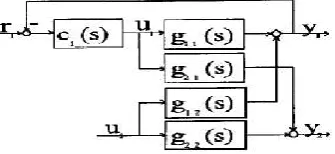
Figure 3. Partial Control System for SLC Identification
Figure 3 shows the partial control system for SLC identification. Consider a n × n multivariable process whose transfer function matrix is
G(s)={gij(s), i=l, 2 . . . n, j=l, 2 . . . n}
The first m - 1 loops are assumed closed already with a multiloop controller as shown above
C1(s) = diag{ci(s), i= 1, 2 . . . . (m- 1)}
Then the transfer function between the mth pair becomes
qmm(s) = gmm(s) -- P2(s)C1(s)(I + PI(S)CI(S)) -1
P3(s )
where
The mth loop is designed for the transfer function. The transfer function qmm (s) usually cannot be approximated well with the
first order plus time delay model. Hence, to tune the mth loop, the frequency response methods such as the Ziegler-Nichols method and the gain and phase margins method are often used (Luyben, 1986; Hovd and Skogestad, 1994; Shiu and Hwang, 1998; Wood and Berry, 1984).
Consider a 2x2 process,
At first we, with the usual step change of the first input, we identify gll(s) and g21(s).From gll (s), we design the first
controller by the Ziegler-Nichols tuning rule. Tune the first controller c1(s) for the transfer function gll(s), the estimate of
gl1(s), and close the first loop. Then perturbation is introduced
[image:2.595.78.246.658.735.2]In this manner, full multivariable process transfer functions can be determined while multiloop control system is being designed. When the pairing is inadequate, good control performance cannot be expected for any multiloop control system including what is designed with the auto tuning SLC method. For some multiloop control systems with pairing of negative relative gain array, the control system does not have loop failure tolerance so that the control system can be unstable when some loops are open or manipulated variables are on their limits. It is suggested to identify the full multivariable model while multiloop control system is tuned with the SLC method. The model can be used to correct the pairing, determine design sequence and design model based control systems.
Relay auto tuning method
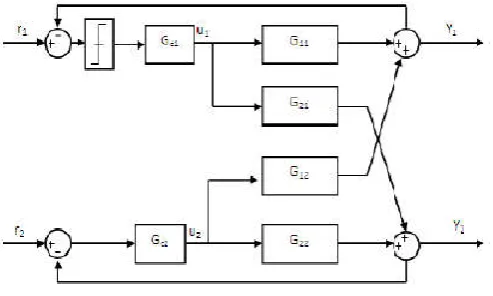
A relay enhanced design employs a relay in series with the controller. The relay can ensure a satisfactory level of closed loop performance and it also yields oscillations for tuning of the PI controller based on an equivalent process model for each loop.
A relay in series with the usual PI controller serves two purposes.
(1) It gives a high gain which gives satisfactory performance even if the controller is not properly tuned.
(2) It automatically generates oscillations based on which an equivalent model of the process can be obtained.
[image:3.595.42.289.578.726.2]These methods require minimal process information. Only the sign of the steady state gain is required to set the direction of the relay. But tuning sequence has to be repeated for the correct sequence if the design sequence is not appropriate. This procedure is repeated until convergence occurs. Figure 5 below shows the relay enhanced system.
Figure 4. Relay Enhanced System
where K, τ and θ are, respectively, the steady state gain, natural period of oscillation and the input delay of the process.
Under the equivalent representation, the closed loop transfer functions for loop1 and loop2 are
Assume that both controllers use a PI control structure
In this configuration, a relay is inserted into a loop, with all loops (including the one with the relay) already under closed loop control, although the controllers may not be adequately Tuned. The approach is to attempt to fit a low-order transfer function model for the equivalent models G1(s) and G2(s),
based on the oscillating signals already prevalent in the loop due to the presence of relay. The PI controller is then tuned based on this model. A first-order rational transfer function model with dead time is chosen, given by
where d is the relay amplitude and a is the amplitude of the limit cycle oscillation. Under the relay feedback, the amplitude (a) and oscillation frequency (ω) of the limit cycle is thus given by the solution of
The above complete equation generates the following two real equations
Kpi is determined from Kpi=Δyi,ss /Δui,ss following a change in set point, where Δyi,ss & Δui,ss denotes the steady state change in the output and input of the system, respectively. The remainingtwo unknown parameters Ti and Li of the model are obtained from the solution of these equationsas
Based on this model, the PI controller has
Where, Tci is the desired closed-loop time constant (Shen and Yu, 1994; Levy et al., 2012).
Independent Loop method
The independent loop method is used to surmount the restriction of the relay auto-tuning. The method has a potential advantage in that the failure tolerance of the overall control system is automatically guaranteed, wherein each controller is independently designed based on the corresponding open-loop and closed-loop transfer functions, thereby satisfying the inequality constraints on the process interactions. Then the IMC internal model control approach is used to obtain the PID controller settings, usually a single tuning parameter for each loop. The concept of an effective open-loop transfer function (EOTF) to take into account the loop interactions in the novel design of a multi-loop controller. Using this concept, the design of a multi-loop controller can be reasonably converted to the design of a single-loop controller.
On the basis of structure decomposition, the multi-loop control system is completely separated into equivalent individual SISO loops, and thus the effects of the process and controller on the loop interaction and subsequent system properties, such as right half plane (RHP) zeros and poles, integrity, and stability, are elucidated.
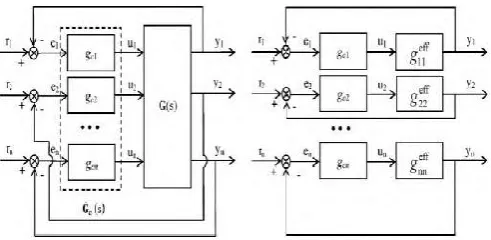
Consider the open-loop stable multi-loop system in the figure 5, where r-i, u-i, and y-i are the set point, manipulated, and controlled variable vectors, where ri, ui, and yi are discarded
[image:4.595.309.555.193.313.2]from r, u, and y, respectively.
Figure 5. Multi-loop system and equivalent independent SISO systems with the corresponding EOTFs
Let the EOTF of loop i be defined as the transfer function relating ui with yi where loop i is open while all other loops are
closed. It is clear that the EOTF corresponds to the actual openloop transfer function under multi-loop situations and thus, tuning of the controller of loop i should be done based on the EOTF, geffii, rather than the original OTF, gii.
With r-i=0,
Therefore, the relation between yi and ui is written as
The open-loop dynamics between yi and ui depend not only upon the single transfer function, gii, but also on the process and controller terms in all other loops.
Once a reduced EOTF is obtained, any PID tuning method for a SISO system can be applied for the design of each individual PID controller. The IMC-PID design approach is commonly used for the PID controller tuning in the process industry because of its many advantages, including simplicity, robust performance, and analytical form. First, the reduced EOTF,
gr_eff
ii is decomposed to gr_eff ii = pAipMi, where pAi and pMi are
the non-minimum portion with an all-pass form and the minimum phase portion, respectively. The conventional IMC filter, f, is selected as: fi(s)=1/( λ i s+1)mi , in which λ i is a design parameter that provides the tradeoff between performance and robustness. It is the desired closed loop time constant for the set-point tracking. The filter order mi is selected as a positive integer so that the controller is proper and realizable (Aström and Hägglund, 1984; Campo and Morari, 1994; Lee et al., 1998; Luyben, 1986).
Then, the ideal feedback controller to yield the desired closed loop response perfectly is given by
Where, qi is the IMC controller and is designed by:
qi = p−1mi fi.
Expanding gci in a Maclaurin’s series in s yields
This way effectively the PID controller can be tuned.
Conclusion
In this paper, methodology for tuning controllers for MIMO processes has been proposed. A novel method for the independent design of a multi-loop PID controller is proposed, based on the concept of EOTF. The EOTF concept was successfully applied to decompose the complex multi-loop control systems into a number of independent SISO loops in which dynamic interaction is taken into account. Therefore, the multi-loop PID controller was accomplished by designing the SISO PI/PID controllers for each loop based on the corresponding EOTF model. In the Relay based method there is no need of any prior knowledge about the system. The only design parameter to be set is the relay signal amplitude, which in inherently small. For SLC method, it is suggested to identify the full multivariable model while multi loop control system is tuned with the SLC method. The model can be used to correct the pairing, determine design sequence and design model based control of the plant.
REFERENCES
Aström K. J. and T. Hägglund, 1984. “Automatic tuning of simple regulators with specifications on phase and amplitude margins,” Automatica, vol. 20, no. 5, pp. 645– 651.
Campo, P.J. and M. Morari, 1994. Achievable closed-loop properties of systems under decentralized control: conditions involving the steady-state gain, IEEE Trans. Automat. Control 39, 932–943.
Hovd, M. and Skogestad, S. 1994. Sequential design of decentralized controllers, Automatica, 30, 1601-1607. Lee, J., W. Cho, T.F. Edgar, 1998. Multi-loop PI controller
tuning for interacting multivariable processes, Comput. Chem. Eng., 22, 1711–1723.
Levy S., S. Korotkin, K, Hadad, A. Ellenbogen, M. Arad, Y. Kadmon, 2012. “PID autotuning using Relay feedback” 27th Convention Of Electrical And Electronics Engineers In Israel, IEEE.
Luyben, W. L. 1986. Simple Method for Tuning SISO Controllers in Multivariable Systems. Ind. Eng. Chem. Res., 25, 654.
Luyben, W.L. 1986. Simple method for tuning SISO controllers in multivariable systems, Ind. Eng. Chem. Process Des. Dev., 25, 654–660.
Shen, S. H. and Yu, C. C. 1994. Use of relay-feedback test for automatic tuning of multivariable systems. American
Institute of Chemical Engineering Journal, 40, 627. Shiu, S. J. and Hwang, S. H. 1998. Sequential design method
for multivariable decoupling and multiloop PID controllers.
Industrial Engineering & Chemical Research, 37, 107-119. Wood, R. K. and Berry, M. W. 1984. Terminal composition
control of a binary distillation column. Chemical Engineering Science, 28,1707.