ISSN Online: 2327-5227 ISSN Print: 2327-5219
DOI: 10.4236/jcc.2019.71005 Jan. 28, 2019 49 Journal of Computer and Communications
Using Category Theory to Explore and Model
Label Event Structures
Ming Zhu, Jing Li
College of Computer Science and Technology, Shandong University of Technology, Zibo, China
Abstract
The development of a concurrent system poses unique challenges, especially those related to correctness and consistency, as such a system usually involves several interactive processes executing simultaneously. To deal with some of these challenges, we resorted to Labeled Event Structures (LES) and category theory as the formal methods to model concurrent systems. Specifically, in this paper, we proposed an idea to define categories and corresponding con-structs, such as product and sum, to model events and relationships among events represented by LES. To explain the idea, several examples are devel-oped. Though a mathematical proof, the proposed idea helped to build a cor-rect-by-construction approach for formalizing LES models of concurrent systems.
Keywords
Concurrent System, LES, Formalization, Category Theory
1. Introduction
A concurrent system that consists of several simultaneously executing compo-nents allows carrying out multiple tasks at the same time, which can accelerate the computational work of software substantially. To model concurrent system, Labeled Event Structures (LES) were proposed and evolved in research [1] [2]. However, a concurrent system usually involves many concurrently interactive components; the exhibition of a large number of different behaviors typically occurs, which may introduce difficulties to the development of concurrent sys-tems [3]. In particular, the notable difficulties include the state-space explosion, unpredictable composition, and others [4]. To tackle this kind of challenge, the formal method is considered to be a way, which can provide systems with known safety properties [5]. Usually, a formal specification can be used to check How to cite this paper: Zhu, M. and Li, J.
(2019) Using Category Theory to Explore and Model Label Event Structures. Journal of Computer and Communications, 7, 49-60.
https://doi.org/10.4236/jcc.2019.71005
Received: December 12, 2018 Accepted: January 25, 2019 Published: January 28, 2019
Copyright © 2019 by author(s) and Scientific Research Publishing Inc. This work is licensed under the Creative Commons Attribution International License (CC BY 4.0).
DOI: 10.4236/jcc.2019.71005 50 Journal of Computer and Communications for particular types of errors and as inputs for model checking. Category theory is a formal method, which has been used to model and verify concurrent systems. Category theory has been proposed as a framework to offer specification struc-ture. It has a rich body of theory to reason objects and their relations. Moreover, category theory adopts a correct-by-construction approach by which compo-nents can be specified, proved and composed in the way of preserving their properties.
Researches [6] [7] used category theory to model concurrent systems. As a continuation, we propose to use category theory to explore and model LES for concurrent systems in this paper. Specifically, we propose an approach to con-struct categorical object, morphism, product, and sum for LES. To explain our work, a vending machine example is designed by LES, and modeled by category theory. The rest of this paper is organized as follows. Section 2 introduces related work to this paper. Section 3 introduces background knowledge required to un-derstand the remaining content of the paper. Section 4 provides a vending ma-chine example modeled by LES, which is used for the explanation of the pro-posed categorical modeling. Section 5 shows how to construct categorical struc-tures from LES. Section 6 illustrates how to use the proposed categorical ap-proach to model the vending machine example. Section 7 concludes this paper.
2. Related Work
2.1. Labeled Event Structure
LES is a mathematical model with true concurrency that describes a process in terms of relations between sets of events it generates. Loogen and Goltz used LES to analyze and model nondeterministic concurrent processes [8]. de León, Haar and Longuet proposed a theoretical framework based on LES for testing and ve-rifying observable behaviors of concurrent systems from true concurrency mod-els like Petri nets or networks of automata [9]. Castellan, Clairambault, Rideau and Winskel introduced a detailed, self-contained update to concurrent games on event structures which were preserved by composition with a copycat strate-gy, and the construction of a bicategory of these strategies [10]. Bruni, Melgratti and Montanari proposed a definition of a particular class of graph grammars that are expressive enough to model name passing calculi while simplifying the denotational domain construction, and applied this technique to derive event structure semantic [11].
2.2. Category Theory
in-DOI: 10.4236/jcc.2019.71005 51 Journal of Computer and Communications troduces a formal language model which formalized agent-environment inte-raction in a multi-agent framework called Conversational Grammar Systems (CGS). This system provided a model with a high degree of flexibility. Based on eco-grammar systems, the formal model used in this paper can be defined as an evolutionary multi-agent system. Category theory is applied to study relation-ships between geometrical models for concurrency and classical models [17]. Abdel Gawad outlined and summarized four new potential applications of cate-gory theory to OOP research are presented the use of operads to model Java sub-typing [18].
3. Background
In this section, background and work related to our research are introduced.
3.1. Labeled Event Structure
An event structure expresses how these events are related to each other. In gen-eral event structures that are widely used, a concurrent system or a process can be represented as tuples
(
E Con; ;)
.Definition 1. An event structure is a tuple
(
E Con; ;)
consisting of • a set of events E,• the consistency predicate Con⊆2E, the set of conflict-free finite subsets of
E, and
• the enabling relation ⊆Con E× which satisfies the following properties:
• consistency of Con: ∀X Y E X Y, ⊆ ∧ ⊆ ⇒ ∈Y Con and
• ∀ ∈e E. ∀X Y E, ⊆ . X e X Y Con ∧ ⊆ ∈ ⇒Y e , that is, if X enables e so does any conflict-free superset Y of X.
Example 1. There is a transition system with states S=
{
S S S S S0, , , ,1 2 3 4}
, where S0 is the initial state, and transitions T ={
a b c d, , ,}
. The graphical repre-sentation of the transition system is show in Figure 1.This transition system can be represented by LES as follows:
{
; ; ;}
E= a b c d
{ } { } { } { } { } { } { } { } {
}
{
, , , , , , , , , , , , , , ,}
Con= ∅ a b c d a b a d a c b c a b c
{ }
{ }
{ }
:∅ a a, b a, d a b, , c
Figure 1. A transition system.
S0 S1
S2
S4
S3
a
b
c
DOI: 10.4236/jcc.2019.71005 52 Journal of Computer and Communications
3.2. Category Theory
Category theory focuses on the relationships (morphisms) between objects in-stead of their representations; the morphisms can determine the nature of inte-ractions established between the objects.
Definition 2. A category consists of the following data: • Objects: A, B, C, etc.
• Arrows (Morphisms): f, g, h, etc.
• For each arrow f, there are given objects: dom(f), cod(f) called domain as well as codomain of f, and f: A → B indicates that A = dom(f), B = cod(f).
• Given arrows f: A → B and g: B → C with cod(f) = dom(g), there is an given arrow:
:
g f A →C called composite of f and g.
• For each object A, there is an given arrow: 1A: A → A called identity arrow of A.
These data need to satisfy the following laws:
• Associativity: h g f
(
) (
= h g )
f for all f: A → B, g: B → C, h: C → D. • Unit: f1A= =f 1B f for all f: A → B.Example 2. Let (S; ≤) be a partially-ordered set (poset). Define the category C in which: each member x of S is an object of C; and each relation x ≤ y of (S; ≤) is a morphism x → y of C.
We can verify that C is a category as follows:
• For every object x, there is an identity morphism x → x, corresponding to reflexivity, x ≤ x, in the poset.
• The morphisms (x → y) and (y → z) form a composition pair:
(
y→z) (
x→y) (
= x→z)
; corresponding to transitivity, x ≤ y, y ≤ z, and x ≤ z, in the poset.• Composition is associative:
(
) (
)
(
x→y v→x)
(
u→v) (
= v→y) (
u→v)
= →u yand
(
x→y) (
(
v→x) (
u→v)
)
=(
x→y) (
u→x) (
= u→y)
, because of(
) (
)
(
)
(
)
(
) (
(
) (
)
)
(
) (
)
(
) (
) (
)
x y v x u v
x y v x u v
x y u x
v y u v u y
≤ ≤ ≤
= ≤ ≤ ≤
= ≤ ≤
= ≤ ≤ = ≤
Definition 3. Let A and B be objects in a category Cat. Then a product of A and B consists of:
• an object, A × B,
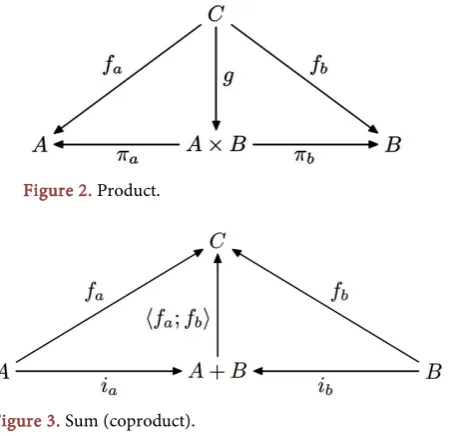
DOI: 10.4236/jcc.2019.71005 53 Journal of Computer and Communications • the property that, for any object C and morphisms C→fa A, C→fb B, there is a unique morphism C→ ×g A B such that Figure 2 commutes.
That is πag f= a and πbg f= b.
Definition 4. Let A and B be objects in a category Cat. Then a sum (or co-product) of A and B consists of:
• an object, A + B,
• morphisms, often called inclusions or canonical projections, A→ +ia A B and B→ +ib A B, and
• the property that, for any object C and morphisms C→fa A and b
f
[image:5.595.265.503.506.724.2]C→B , there is a unique morphism A B+ →f fa b; C such that Figure 3 commutes. That is fa;fb ia = fa and fa;fb ib= fb.
4. An Overview of a Vending Machine Example
In this paper, we use a vending machine example to illustrate how to construct categories and the corresponding structures for models specified by LES which is defined and specified in section 3.
Example 3. There is a vending machine and a person. The vending machine can offer coke and pepsi. Each time, the vending machine accepts a coin first, then dispenses a bottle of coke or pepsi according to the person’s choice.
In this example, the vending machine and the person are modeled as two processes. When the person inserts a coin and vending machine accepts the coin, this interaction can be represented by the shared event coin in person and vending machine. When person chooses coke or pepsi and vending machine ac-cepts it, this interaction can be represented by the shared event coke or pepsi in person and vending machine. After that, the communications between person and vendingmachine terminate.
By using LES, the communications between person and vendingmachine in the example can be modeled as follows:
Figure 2. Product.
DOI: 10.4236/jcc.2019.71005 54 Journal of Computer and Communications
(
; ;)
VMP= E Con
{
; ; ;}
E= coin coke pepsi stop
{
} {
} {
} {
} {
}
{
{
} {
}
}
, , , , , , , ,
, , , , ,
Con coin coke pepsi coin coke coin pepsi coin pepsi stop coin coke stop
= ∅
{
}
{
}
{
}
{
}
:∅ coin coin, coke coin, pepsi coin coke, , stop coin pepsi, , stop
5. Construct Categorical Structures for LES Models
In this section, we use category theory to construct structures for LES models. We first define categorical object and morphism for constructing categories for LES models, then we construct product and sum based on the categories, and we use the vending machine example in Section 3 to explain the categorical struc-tures.
5.1. Object
An object is like an event structure, but simpler. Formally, an object (E, R) con-sists of a set of events, E, and an ordering relation R E E⊆ × . If events e1 and e2 are related by R (that is,
(
e e1, 2)
∈R),{ }
e1 e2 that indicates “e1 precedes e2” or “e1 happens before e2”.The relation R is a partial order: reflexive, antisymmetric, and transitive. If
1 2
e ≠e , it is not possible to have both e e1 2 and e2e1, but it is possible that neither is true.
An object can be represented by a forest diagram such as Figure 4. For exam-ple:
For this object,
{
, , , ,}
E= a b c d e ,{ }
{ }
{ }
{
, , , ,}
R= ∅a∅c a b c d c e
R is reflexive, transitive. In Figure 3, we omit reflexive and transitive arrows. Note that some pairs of events, e.g., a and c, are unrelated: this means simply that there are no constraints on their order of occurrence.
5.2. Morphism
Let O1=
(
E R1, 1)
and O2=(
E R2, 2)
be objects. There is a morphism1 m 2
O →O if and only if E1⊆E2 and O1⊆O2. In words:
• Every event e that belongs to E1 also belongs to E2. • Every ordered pair
{ }
e1 e2 in O1 also belongs to O2.There is an identity morphism for every object (E, R) because E E⊆ and
R R⊆ . Similarly, compositions of morphism exist by transitivity of ⊆. Con-sequently, the objects and morphisms combined forma category CP.
DOI: 10.4236/jcc.2019.71005 55 Journal of Computer and Communications
Figure 4. Graphical representation of object.
Also, if there is a morphism O1→m O2, then it must be unique, because there is only one way that a set can be a subset of another set.
There exist some special cases:
• Traces are objects: the trace
{ }
a b,{ }
a b, c can be represented as object a → b→ c.• If trace t1 is a prefix of trace t2, there is a morphism t1→m t2.
• Event trees are objects: the object shown above in Figure 3 has a tree with c as root.
• There is a morphism from any path in a tree to the tree itself.
5.3. Sum (Coproduct)
If S and T are objects, we define their sum(coproduct) S + T to be the smallest object that contains both S and T. The sum can be defined by set union as fol-lows:
Definition 5. Let S=
(
E R1, 1)
and T =(
E R2, 2)
, then(
1, 1) (
2, 2) (
1 2, 1 2)
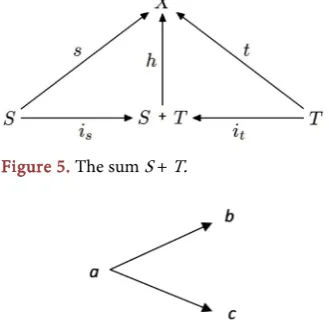
. S T+ = E R + E R = E E R R• By definition, S + T contains S. Consequently, there is a morphism s
i
S→ +S T . Similarly, there is a morphism Tit→ +S T.
• Let X be another object and suppose there is a morphism Ss→X , then X
contains S. Similarly, if there is a morphism T t→X , then X contains T.
Thus X contains both S and T. Since S + T is the smallest object containing both S and T, it follows that X must contain S + T and therefore there is a morphism S T+ h→X . The morphism h is unique.
To illustrate the sum S + T, Figure 5 describes the sum and it commutes. We can use sum to build branching structures, which can be explained by us-ing Example 4 as follows:
Example 4. Given (E1, R1) and (E2, R2), where • E1=
{ }
a b, , R1= ∅{
a a,{ }
b}
.• E2=
{ }
a c, , R2= ∅{
a a,{ }
c}
.Then, there is a sum
(
E E R R1 2, 1 2) {
=(
a b c, , ,}
{
∅a a,{ }
b a,{ }
c}
)
which can be represented by Figure 6.DOI: 10.4236/jcc.2019.71005 56 Journal of Computer and Communications
Figure 5. The sum S + T.
Figure 6. The sum
(
E E R R1 2, 1 2)
.5.4. Product
The purpose of the product is to combine concurrent processes, each defined by an object, i.e., event structure. To do this, two kinds of event must be distin-guished:
Let P1=
(
E R1, 1)
and P2=(
E R2, 2)
be objects corresponding to concurrent processes and let e E∈ 1. Then:• If e E∈ 2, it indicates that e is a communication event and e must occur si-multaneously in both processes.
• Otherwise, e E∉ 2, and e belongs to process P only. In this case, e is an in-dependent event.
Product of P1and P2 can be constructed as follows:
• Let E×=E1 E2
be the set of events that communicate, namely the com-munication set. The communication set is as large as possible, which means that the only events that cannot be added to it are not communication events. • The ordering relation R × is the union
1 2
R R restricted to elements of E ×. Formally,
(
)
(
)
{
1, 2 | 1 and 2 and 1, 2 1 2}
R×= e e e E∈ × e ∈E× e e ∈R R
So, the definition of product is provided as follows: Definition 6. Let S=
(
E R1, 1)
and T =(
E R2, 2)
, then(
) (
)
(
)
(
)
{
}
(
11 1 2 21 22 1 2 1 2 1 2)
, ,
, , | and and ,
S T E R E R
E E e e e E× e E× e e R R
× = ×
= ∈ ∈ ∈
• By construction, S × T contains only events that occur in S and T and is therefore contained in both of them. Thus the projections S T× →πs S and S T× →πt T are well-defined.
• Assuming that there is an object X and morphisms X s→S and t
X→T . Then X must be contained in both S and T. Therefore it must
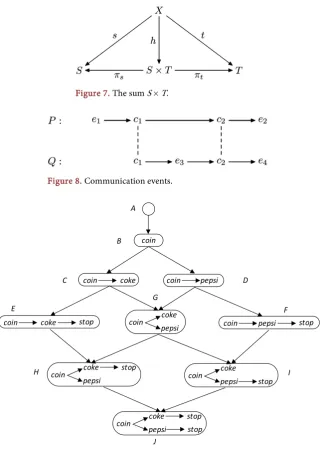
DOI: 10.4236/jcc.2019.71005 57 Journal of Computer and Communications To illustrate the sum S × T, Figure 7 describes the product and it commutes. We can use product to build largest communication structures, which can be explained by using Example 5 as follows:
Example 5. Let P=
(
E RP, P)
and Q=(
E RQ, Q)
defined as in Figure 8, inwhich the c’s are communicating events and the e’s are independent events: Then the product P × Q has the events EPEQ =
{
c c1, 2}
and the ordering is just{ }
c1 c2. The processes execute as shown, with time increasing from left to right, synchronizing at c1 and c2. The execution independent events, such as e3, are ignored, as they don’t affect the communications. So, independent events are abstracted out of the system.6. Use Categorical Structures to Model the Vending Machine
In Section 4, this paper provided a vending machine in Example 3 which is modeled by LES. In this section, we use categorical structures defined in Section 5 to model the vending machine example.The objects of the vending machine are listed as follows:
{} {}
(
,)
,A=
{
} {
}
(
,)
,B= coin ∅coin
{
}
{
{
}
}
(
, , ,)
,C= coin coke ∅coin coin coke
{
}
{
{
}
}
(
, , ,)
,D= coin pepsi ∅coin coin pepsi
{
}
{
{
}
{
}
}
(
, , , ,)
,E= coin coke ∅coin coin coke coke stop
{
}
{
{
}
{
}
}
(
, , , ,)
,F = coin pepsi ∅coin coin pepsi pepsi stop
{
}
{
{
}
{
}
}
(
, , , ,)
,G= coin coke ∅coin coin coke coin pepsi
{
}
{
{
}
{
}
{
}
}
(
, , , , ,)
H= coin coke ∅coin coin coke coin pepsi coke stop
,
{
}
{
{
}
{
}
{
}
}
(
, , , , ,)
I= coin coke ∅coin coin coke coin pepsi pepsi stop
,
{
}
{
{
}
{
}
(
{
}
{
}
}
)
, , , , ,
, ,
J coin coke coin coin coke coin pepsi
coke stop pepsi stop
= ∅
The morphisms between objects are listed as follows, where identities and composites are ignored:
, , , , , , ,
, , , , ,
A B B C B D C E D F C G D G
E H F I G H G I H J I J
→ → → → → → →
→ → → → → →
DOI: 10.4236/jcc.2019.71005 58 Journal of Computer and Communications
Figure 7. The sum S × T.
Figure 8. Communication events.
Figure 9. Category of the vending machine.
• Products of the category of the vending machine are listed as follows:
, , , , ,
G F D H F D H I G E G C H F D E F B× = × = × = × = × = × =
The above-mentioned products are just some in the category, while there are other products that are not listed specifically in above.
• Sums of the category of the vending machine are listed as follows:
, , , , , ,
C D G E G H G F I H I J E D H E F J C F I+ = + = + = + = + = + = + = The above-mentioned sums are just some in the category, while there are oth-er sums that are not listed specifically in above.
7. Conclusion
In view of the difficulties in the development of concurrent systems, the present coin
coin pepsi
coin coke
coin coke stop coin coke coin pepsi stop
pepsi
coin coke
pepsi coin
coke pepsi stop
stop
coin coke pepsi
stop stop A
B
C D
E F
G
H I
DOI: 10.4236/jcc.2019.71005 59 Journal of Computer and Communications work proposes a new approach to model LES based on the category theory, which helps to explore the communication events and relationship among them. Specifically, categorical object, morphism, product, and sum are constructed for events and relationships. To explain the work, a vending machine example is de-signed by LES, and the communications between vending machines and persons are modeled by category theory. By adopting the categorical approach, we can explore and model concurrent systems designed by LES with categorical struc-tures, which can be specified, proved and composed formally with preserving their properties. In Future, we will explore the usage of more categorical struc-tures, such as limit/colimit and natural transformation in LES which may be useful for the formalization and verification of communications.
Acknowledgements
We thank the editor and the referee for their comments. Research of M. Zhu and J. Li is funded by the Shandong University of Technology grants 4041-416069 and 4041-417010. The support is greatly appreciated.
Conflicts of Interest
The authors declare no conflicts of interest regarding the publication of this pa-per.
References
[1] Winskel, G. (1989) An Introduction to Event Structures. Proceeding of Linear,
Time, Branching Time and Partial Order in Logics and Models for Concurrency, Berlin, 30 May-3 June 1989, 364-397.
[2] Baldan, P., Busi, N., Corradini, A. and Pinna, G.M. (2000) Domain and Event Structure Semantics for Petri Nets with Read and Inhibitor Arcs. Theoretical Com-puter Science, 323, 129-189. https://doi.org/10.1016/j.tcs.2004.04.001
[3] Kuang, H. (2013) Towards a Formal Reactive Autonomic Systems Framework Us-ing Category Theory. Ph.D. Thesis, Concordia University, Montreal.
[4] Sampson, A.T. (2008) Process-Oriented Patterns for Concurrent Software Engi-neering. Ph.D. Thesis, University of Kent, Kent.
[5] Hinchey, M.G., Rouff, C.A., Rash, J.L. and Truszkowski, W.F. (2005) Requirements of an Integrated Formal Method for Intelligent Swarms. Proceedings of the 10th In-ternational Workshop on Formal Methods for Industrial Critical Systems, Lisbon, 5-6 September 2005, 125-133. https://doi.org/10.1145/1081180.1081196
[6] Zhu, M., Grogono, P. and Ormandjieva, O. (2017) Exploring Relationships between Syntax and Semantics of a Process-Oriented Language by Category Theory. Pro-ceedings of the 8th International Conference on Ambient Systems, Networks and Technologies, Madeira, 16-19 May 2017, 241-248.
https://doi.org/10.1016/j.procs.2017.05.342
[7] Zhu, M., Grogono, P., Ormandjieva, O. and Kuang H. (2016) Using Failures and Category Theory to Verify Process Communications between Design and Imple-mentation of Concurrent Systems. Proceedings of the 7th International Conference on Ambient Systems, Networks and Technologies, Madrid, 23-26 May 2016, 700-704.
DOI: 10.4236/jcc.2019.71005 60 Journal of Computer and Communications
[8] Loogen, R. and Goltz, U. (1991) Modelling Nondeterministic Concurrent Processes with Event Structures. Fundamenta Informaticae, 14, 39-73.
[9] León, H.P.D., Haar, S. and Longuet, D. (2012) Conformance Relations for Labeled Event Structures. Proceedings of the 6th International Conference on Tests and Proofs, Prague, 31 May-1 June 2012, 83-98.
https://doi.org/10.1007/978-3-642-30473-6_8
[10] Castellan, S. and Clairambault, P., Rideau, S. and Winskel, G. (2016) Concurrent Games. Logical Methods in Computer Science, 13, 1-51.
[11] Bruni, R., Melgratti, H. and Montanari, U. (2006) Event Structure Semantics for Nominal Calculi. Proceedings of 17th International Conference on Concurrency Theory, Bonn, 27-30 August 2006, 295-309.
[12] Winskel, G. and Nielsen, M. (1995) Models for Concurrency. Handbook of Logic in Computer Science, Vol. 4, 1-148.
[13] Nielsen, M., Sassone, V. and Winskel, G. (1996) Models for Concurrency: Towards a Classification. Theoretical Computer Science, 170, 297-348.
https://doi.org/10.1016/S0304-3975(96)80710-9
[14] Hildebrandt, T.T. (2000) Categorical Models for Fairness: Completion vs. Delay.
Proceedings of the First Irish Conference on the Mathematical Foundations of Computer Science and Information Technology, Cork, 20-21 July 2000, 188. [15] Sisiaridis, D., Kuchta, V. and Markowitch, O. (2016) A Categorical Approach in
Handling Event-Ordering in Distributed Systems. Proceedings of IEEE 22nd Inter-national Conference on Parallel and Distributed Systems, Wuhan, 13-16 December 2016, 1145-1150.https://doi.org/10.1109/ICPADS.2016.0150
[16] Enguix, G.B. and Lopez, M.D.J. (2007) Agent-Environment Interaction in a Mul-ti-Agent System: A Formal Model. Proceedings of the GECCO Conference on Ge-netic and Evolutionary Computation, London, 7-11 July 2007, 2607-2612.
[17] Goubault, E. and Mimram, S. (2010) Formal Relationships between Geometrical and Classical Models for Concurrency. Proceedings of the Workshop on Geometric and Topological Methods in Computer Science, Denmark, 11-15 January 2010, 77-109.