An Improved Image Denoising Method Based on Wavelet
Thresholding
Hari Om, Mantosh Biswas
Department of Computer Science & Engineering, Indian School of Mines, Dhanbad, India. Email: {hariom4india, mantoshb}@gmail.com
Received November 10th,2011; revised December 13th, 2011; accepted December 25th, 2011
ABSTRACT
VisuShrink, ModineighShrink and NeighShrink are efficient image denoising algorithms based on the discrete wavelet transform (DWT). These methods have disadvantage of using a suboptimal universal threshold and identical neigh- bouring window size in all wavelet subbands. In this paper, an improved method is proposed, that determines a thresh-old as well as neighbouring window size for every subband using its lengths. Our experimental results illustrate that the proposed approach is better than the existing ones, i.e., NeighShrink, ModineighShrink and VisuShrink in terms of peak signal-to-noise ratio (PSNR) i.e. visual quality of the image.
Keywords: Wavelet Transforms; Neighboring Coefficients; Wavelet Thresholding; Image Denosing; Neighbouring Coefficients; Peak Signal-to-Noise Ratio
1. Introduction
An image is often corrupted by noise during its acquisi- tion and transmission. Image denoising is used to remove the additive Gaussian noise while retaining important maximum possible image features. Wavelet analysis has been demonstrated to be one of the powerful methods for performing image noise reduction [1,2]. The procedure for noise reduction is applied on the wavelet coefficients obtained after applying the wavelet transform to the im- age at different scales. The motivation for using the wa- velet transform is that it is good for energy compaction since the small and large coefficients are more likely due to noise and important image features, respectively [3]. The small coefficients can be thresholded without af- fecting the significant features of the image. In its most basic form, each coefficient is thresholded by comparing against a value, called threshold. If the coefficient is smaller than the threshold, it is set to zero; otherwise it is kept either as it is or modified. The inverse wavelet trans- form on the resultant image leads to reconstruction of the image with essential characteristics [4].
Since the pioneer work of Donoho & Johnstone, there have been many works on finding suitable thresholds; however, very few have been designed for images [4-6]. There exist various methods for wavelet thresholding which rely on the choice of a threshold value such as VisuShrink [5,7], SureShrink [4,8] and BayesShrink [9]. The VisuShrink [5] has a limitation of not dealing with minimizing the mean squared error, i.e. it removes too
many coefficients. However, it is known to give the re- covered images that are overly smoothed. The Sure- Shrink threshold depends upon Stein’s Unbiased Risk Estimator (SURE) [7]. It minimizes the mean squared error that takes the combination of the universal thresh- old and the SURE threshold. In this method, the em- ployed thresholding is adaptive, i.e., if the unknown function contains abrupt changes or boundaries in the image, the reconstructed image also does. The Bayes- Shrink [9] is a data-driven adaptive image denoising method. Hall et al. and Cai studied local block thresh-olding rules for wavelet function estimation [10-12]. These methods threshold the empirical wavelet coeffi- cients in groups rather than individually, making simul- taneous decisions to retain or to discard all the coeffi- cients within non-overlapping blocks. The proposed me- thod overcomes the limitations of the above mentioned methods. It determines the threshold and neighbouring window size for every subband using its lengths.
The rest of the paper is organized as follows. Section 2 describes the related work. Section 3 discusses the pro- posed work. The experimental results are given in Sec-tion 4. The results are discussed by taking three test im-ages and various noise levels. Finally, the concluding remarks are given in Section 5.
2. Related Work
deviation of the noise. It follows the hard thresholding rule. The threshold in VisuShrink is also referred to as universal threshold and it is defined as:
T 2 logM
where σ is the noise variance present in the signal and M represents the signal size or number of samples.
An estimate of the noise level σ is defined based on the median absolute deviation that is given by:
22
ij
median Y 0.06745
where ij 1 subband.
A threshold chosen based on Stein’s Unbiased Risk Estimator (SURE) [4,8] is called as SureShrink. It is a combination of the universal threshold and the SURE threshold. This method specifies a threshold value tjfor each resolution level j in the wavelet transform which is referred to as level dependent thresholding. The goal of SureShrink is to minimize the mean squared error that is defined as:
Y HH
M 2
2 i, j 1
1
MSE z i, j s i, j M
,where z(x, y) is the estimate of the image and s(x, y) is the original image without noise and M× Mis the image size. The SureShrink suppresses the noise by threshold- ing the empirical wavelet coefficients. The SureShrink threshold t* is defined as:
tmin t, 2 log M
where t denotes the value that minimizes Stein’s Unbi-ased Risk Estimator, σ is the noise variance, and Mis the size of the image. SureShrink follows the soft threshold-ing rule. The thresholdthreshold-ing employed in this case is adap-tive, i.e., a threshold level is assigned to each dyadic resolution level by the principle of minimizing the Stein’s Unbiased Risk Estimator for threshold estimates.
The BayesShrink [9] minimizes the Bayesian risk, and hence its name, BayesShrink. It uses soft thresholding and is subband-dependent, which means that the thresh- olding is done at each band of resolution in the wavelet decomposition. Like the SureShrink procedure, it is smoothness-adaptive. The Bayes threshold, tB, is defined as:
2
B s
t
where σ2 is the noise variance and σ
s is the signal vari-ance without noise. The noise varivari-ance σ2 is estimated from the subband HH1.
The aim of local thresholding rules is to increase the estimation accuracy by utilizing information about neigh- boring wavelet coefficients. The block thresholding in- creases the estimation precision by utilizing the informa-
tion about the neighbor wavelet coefficients. Recently, there has been a fair amount of research to select the threshold for image denoising from the noisy image us- ing wavelet [13-16].
The choice of a threshold is an important point of in- terest. It plays a major role in noise removal of images because denoising most frequently produces smoothed images, reducing their sharpness. Generally, the choice should be taken to preserve the edges of the denoised image. Our proposed image denoising method is based on thresholding that not only removes noise but also preserves the edges. It is discussed in next section.
3. Proposed Work
Before discussing our proposed work, we will review the wavelet transform in brief.
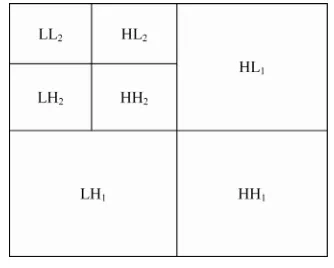
Let x= {x(i, j), i, j = 1, 2, ···, M} denote M × M origi- nal image to be recovered and M is some integer power of 2. During transmission, the image x is corrupted by independent and identically distributed (i.i.d) zero mean, white Gaussian Noise, i.e. n(i, j)~ M (0, σ2). At the re-ceiver end, the noisy observations g(i, j)= x(i, j)+ σ n(i, j) are obtained. The goal is to estimate x from the noisy observation g(i, j)such that the mean squared error (MSE) is minimum [3]. Let W and W-1 denote the two dimen-sional discrete wavelet transform (DWT) and its inverse (IDWT), respectively. Then Y = W * g represents the matrix of wavelet coefficients of g having four subbands (LL, LH, HL and HH) [17-19]. The subbands HH, HL, LH are called details and the subband LL is called ap- proximation. Performing DWT on LL, we again get four subbands. We can perform DWT of approximation sub- band obtained in previous wavelet transform multiple times so that the final approximation band contains only single value. Denote the maximum number of levels (decompositions) by J. The size of the subband at scale k is M/2k × M/2k.
Figure 1 shows two level decomposi- tion of an image. The wavelet thresholding denoising method processes each coefficient Y(i, j)from the detail subbands with a threshold function to obtain X i, j
. The denoised estimate of the image x is inverse wavelet transform ofˆx
X, i.e., ˆx W X 1 . We now discuss the parameter estimation,
3.1. Parameters Estimation
(i) In our proposed method, we calculate threshold value TNEW using the following:
NEW ˆ
T 2log M (1) where M M 2ˆ k , here k = 1, 2, ···, J. J represents sub- band.
Figure 1. 2D-DWT with 2-Level decomposition.
2
ij ij
S
W2within the window ij
(iii) Shrink the wavelet coefficients by using:
ij W *ij ij
(iv) The shrinkage factor is given as:
2 2
ij 1 TNEW Sij
here “+” means that the positive value should be kept as it is and the negative value should be replaced by zero.
After apply this thresholding function and using Neigh- Shrink, it was observed that the reconstructed image had mat like aberrations when the noise content was high. We could remove these aberrations using Wiener filter.
Using NeighShrink we loose some details of the image and sometimes the reconstructed image becomes unac- ceptably blurred. The reason of this blurring may be the suppression of too many details of wavelet coefficients. This problem can be avoided using the following shrin- kage factor is:
2 2
ij 1 3 4 TNEW Sij
3.2. Denoising Algorithm
The proposed procedure is given below:
Perform multiscale decomposition on the image cor-rupted by Gaussian noise. The 2-D wavelet transform W on the noisy image Y is performed up to Jth level to generate several subbands.
Estimate the robust median using the following:
22
ij
median Y 0.06745
(2) For each level, compute TNEW as a threshold using
(1).
For each subband (except the low pass residual), ap- ply NeighShrink method to obtain the noiseless wavelet coefficients.
Perform the inverse wavelet transform on the modi- fied coefficients to obtain the denoised estimate im- age ˆx.
4. Results and Discussions
We have evaluated the performance of our proposed method using the quality measure PSNR which is calcu-lated as:
210
PSNR in db 10*log 255 MSE,
where MSE is the mean squared error between the origi-nal image and reconstructed image.
Here, we have compared the performance of our sche- me with different de-noising schemes that include Visu- shrink, NeighShrink and ModineighShrink. We have taken different window sizes of 2 × 2, 3 × 3, 5 × 5, and 7 × 7. The noise levels have been taken as 10, 20, 30, 50, 75, and 100. The images considered in our experiments are standard images that include Lena, Barbara, and Goldhill each of size 512 × 512 (refer Figure 2). The wavelet transform used is Daubechies least asymmetric com- pactly supported wavelet with eight vanishing moments [20]. We have performed wavelet transform four times in order to obtain four scales of decomposition.
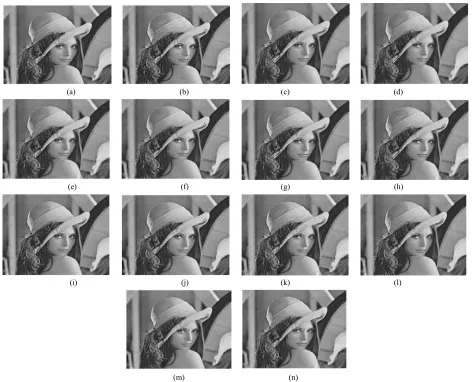
We have drawn graphs for PSNR vs noise level for the VisuShrink, NeighShrink, ModNeiSh and proposed me- thods for Lena image and they are shown in Figures 4(a)-(d), for window sizes 2 × 2, 3 × 3, 5 × 5 and 7 × 7, respectively. It is evident from these figures that our pro-posed method performs better than the VisuShrink, NeighShrink, ModNeiSh methods for all window sizes considered in this paper. The only case when our method performs no better then these methods is for window size of 7 × 7 and noise level up to 20. In fact, for higher val-ues of noise, the performance of all methods converges as is evident from the Figures 4(a)-(d). The reason is that all the methods, remove almost same number of co-efficients. For other two images, i.e., Barbara and Gold- hill, similar graphs were obtained. We have shown in Figures 3(a)-(n) images of Lena using noise level 10 and different window sizes. Similar results were obtained for other images also. We however have given the numerical results for all images in Tables 1-4.
5. Conclusion
Our proposed scheme performs better for all noise levels and for all window sizes under consideration for PSNR
[image:3.595.308.537.622.709.2](a) (b) (c)
(a) (b) (c) (d)
(e) (f) (g) (h)
(i) (j) (k) (l)
[image:4.595.62.534.83.465.2](m) (n)
Figure 3. Comparative performance of various methods on Lena with noise level 10 (a) Original; (b) Noisy image with noise level 10; (c) Denoise using VisuShrink (3 × 3); (d) Denoise using VisuShrink (5 × 5); (e) Denoise using VisuShrink (7 × 7); (f) Denoise using NeighShrink (3 × 3); (g) Denoise using NeighShrink (5 × 5); (h) Denoise using NeighShrink (7 × 7); (i) Denoise using ModNeiSh (3 × 3); (j) Denoise using ModNeiSh (5 × 5); (k) Denoise using ModNeiSh (7 × 7); (l) Denoise using Proposed (3 × 3); (m) Denoise using Proposed (5 × 5); (n) Denoise using Proposed (7 × 7).
10 20 30 40 50 60 70 80 90 100
22 23 24 25 26 27 28 29 30 31 32
Noise Level
PS
N
R
(
d
b
)
Window size 2x2
VisuShrink NeighShrink ModNeiSh Proposed
10 20 30 40 50 60 70 80 90 100
22 24 26 28 30 32 34
Noise Level
P
S
NR (d
b
)
Window size 3x3
VisuShrink NeighShrink ModNeiSh Proposed
10 20 30 40 50 60 70 80 90 100 22
24 26 28 30 32 34 36
Noise Level
P
S
NR (
d
b
)
Window size 5x5
VisuShrink NeighShrink ModNeiSh Proposed
10 20 30 40 50 60 70 80 90 100
22 24 26 28 30 32 34
Noise Level
P
S
N
R
(
db)
Window size 7x7
VisuShrink NeighShrink ModNeiSh Proposed
[image:5.595.59.536.86.289.2](c) (d)
Figure 4. PSNR gain vs noise level of Proposed, VisuShrink, NeighShrink, ModineighShrink (ModNeiSh) methods for Lena image for window size. (a) 2 × 2; (b) 3 × 3; (c) 5 × 5; (d) 7 × 7.
Table 1. Denoising results (PSNR in db) for Lena, Barbra and Goldhill using window size of 2 × 2.
Image Name Noise Levels VisuShrink NeiSh MoNeiSh Proposed
10 30.36 31.05 31.37 31.67
20 25.82 26.32 26.62 27.03
30 23.87 24.11 24.30 24.64
50 22.76 22.84 22.92 23.06
75 22.44 22.44 22.44 22.44
Lena
100 22.23 22.23 22.23 22.23
10 27.39 28.25 28.67 28.97
20 22.53 22.82 23.07 23.31
30 21.39 21.59 21.70 21.89
50 20.55 20.60 20.64 20.73
75 20.33 20.33 20.33 20.35
Barbara
100 20.20 20.20 20.20 20.20
10 28.08 28.58 28.86 29.13
20 24.80 25.08 25.26 25.56
30 23.66 23.82 23.93 24.14
50 22.90 22.95 22.98 23.06
75 22.64 22.64 22.64 22.65
Goldhill
[image:5.595.102.497.345.734.2]Table 2. Denoising results (PSNR in db) for Lena, Barbra and Goldhill using window size of 3 × 3.
Image Name Noise Levels VisuShrink NeiSh MoNeiSh Proposed
10 31.96 32.58 32.85 33.06 20 27.08 27.67 28.00 28.39 30 27.08 27.67 28.00 28.39 50 22.99 23.13 23.26 23.47 75 22.46 22.47 22.48 22.55 Lena
100 22.23 22.23 22.23 22.24
10 29.49 30.33 30.72 30.96
20 23.76 24.32 24.71 25.00
30 21.90 22.12 22.26 22.47 50 20.73 20.80 20.86 21.02 75 20.33 20.34 20.36 20.44 Barbara
100 20.20 20.20 20.20 20.20
10 29.42 29.94 30.27 30.51
20 25.69 26.08 26.33 26.62 30 24.11 24.33 24.50 24.77 50 23.01 23.09 23.17 23.33 75 22.64 22.64 22.64 22.65 Goldhill
100 22.42 22.43 22.42 22.42
Table 3. Denoising results (PSNR in db) for Lena, Barbra and Goldhill using window size of 5 × 5.
Image Name Noise Levels VisuShrink NeiSh MoNeiSh Proposed
10 33.62 33.88 34.01 34.04 20 28.96 29.55 29.85 30.12 30 26.29 26.78 27.06 27.42 50 23.61 23.85 24.09 24.44 75 22.60 22.68 22.73 22.87 Lena
100 22.25 22.26 22.28 22.29
10 31.89 32.24 32.39 32.43 20 26.08 26.78 27.15 27.40 30 23.14 23.59 23.93 24.22 50 21.19 21.37 21.55 21.79 75 20.41 20.43 20.48 20.62 Barbara
100 20.22 20.23 20.24 20.27
10 31.51 31.87 32.06 32.12
20 27.11 27.51 27.78 28.03
30 25.15 25.48 25.73 26.04 50 23.43 23.58 23.70 23.95 75 22.75 22.80 22.85 22.87 Goldhill
[image:6.595.102.493.425.734.2]Table 4. Denoising results (PSNR in db) for Lena, Barbra and Goldhill using window size of 7 × 7.
Image Name Noise Levels VisuShrink NeiSh MoNeiSh Proposed
10 32.81 32.16 31.54 31.21
20 29.65 29.97 30.12 30.18
30 27.16 27.64 27.90 28.15
50 24.17 24.45 24.72 25.20
75 22.80 22.99 23.18 23.42
Lena
100 22.24 22.24 22.24 22.24
10 32.17 31.56 31.08 30.83
20 27.55 27.96 28.17 28.26
30 24.45 25.00 25.36 25.61
50 21.73 21.96 22.10 22.32
75 20.64 20.75 20.87 21.09
Barbara
100 20.26 20.28 20.29 20.36
10 32.00 31.33 30.84 30.61
20 28.08 28.39 28.59 28.70
30 25.97 26.31 26.53 26.74
50 24.02 24.26 24.43 24.60
75 22.80 22.90 23.02 23.25
Goldhill
100 22.44 22.44 22.44 22.44
Here, NeiSh and MoNeiShrepresent NeighShrink and ModiNeighShrink methods respectively.
value and visual quality of the denoised image than Vis-ushrink, NeighShrink and Modified NeighShrink for all window sizes and almost all noise levels.
6. Acknowledgements
The authors express their sincere thanks to Prof. S. Chand for his invaluable comments and suggestions.
REFERENCES
[1] C. S. Burrus, R. A. Gopinath and H. Guo, “Introduction to Wavelet and Wavelet Transforms,” Prentice Hall, New Jersey, 1997.
[2] S. Mallat, “A Wavelet Tour of Signal Processing,” 2nd Edition, Academic, New York, 1999.
[3] M. Jansen, “Noise Reduction by Wavelet Thresholding,” Springer-Verlag, New York, 2001.
doi:10.1007/978-1-4613-0145-5
[4] D. L. Donoho and I. M. Johnstone, “Ideal Spatial Adapta-tion via Wavelet Shrinkage,” Biometrika, Vol. 81, No. 3,
1994, pp. 425-455. doi:10.1093/biomet/81.3.425
[5] D. L. Donoho, “De-Noising by Soft Thresholding,” IEEE Transactions on Information Theory, Vol. 41, No. 3, 1995,
pp. 613-627. doi:10.1109/18.382009
[6] D. L. Donoho and I. M. Johnstone, “Wavelet Shrinkage: Asymptotic?” Journal of the Royal Statistical Society: Series B, Vol. 57, No. 2, 1995, pp. 301-369.
[7] D. L. Donoho and I. M. Johnstone, “Adapting to
Un-known Smoothness via Wavelet Shrinkage,” Journal of American Statistical Association, Vol. 90, No. 432, 1995,
pp. 1200-1224. doi:10.2307/2291512
[8] X. P. Zhang and M. D. Desai, “Adaptive Denoising Based on SURE Risk,” IEEE Signal Processing Letters,
Vol. 5, No. 10, 1998, pp. 265-267. doi:10.1109/97.720560
[9] S. G. Chang, B. Yu and M. Vetterli, “Adaptive Wavelet Thresholding for Image Denoising and Compression,”
IEEE Transactions on Image Processing, Vol. 9, No. 9,
2000, pp. 1532-1546. doi:10.1109/83.862633
[10] T. T. Cai and B. W. Silverman, “Incorporating Informa-tion on Neighboring Coefficients into Wavelet Estima-tion,” Sankhya Series B, Vol. 63, No. 2, 2001, pp. 127-
148.
[11] T. T. Cai, “Adaptive Wavelet Estimation, a Block Thres- holding and Oracle Inequality Approach,” Annals of Sta-tistics, Vol. 27, No. 3, 1999, pp. 898-924.
doi:10.1214/aos/1018031262
[12] T. T. Cai and H. H. Zhou, “A Data-Driven Block Thresh-olding Approach to Wavelet Estimation,” Annals of Sta-tistics, Vol. 37, No. 2, 2009, pp. 569-595.
doi:10.1214/07-AOS538
[13] F. N. Yi, et al., “A Wavelet Threshold of a New Method of Image Denoising,” Science & Technology Information, 2008.
doi:10.1109/ICMET.2010.5598411
[15] P. Hedaoo and S. S. Godbole, “Wavelet Thresholding Approach for Image Denoising,” International Journal of Network Security & Its Applications, Vol. 3, No. 4, 2011,
pp. 16-21.
[16] V. Nigam, S. Luthra and S. Bhatnagar, “A Comparative Study of Thresholding Techniques for Image Denoising,” 2010 International Conference on Computer and Com-munication Technology, Allahabad, 17-19 September 2010,
pp. 173-176.
[17] M. Vattereli and J. Kovacevic, “Wavelets and Subband
Coding,” Prentice Hall, Englewood Cliffs, 1995. [18] S. Gupta and L. Kaur, “Wavelet Based Image
Compres-sion Using Daubechies Filters,” Proceedings of the 8th National Conference on Communications, Bombay, 2002.
[19] M. J. T. Smith and S. L. Eddins, “Analysis/Synthesis Techniques for Sub Band Image Coding,” IEEE Transac-tions Acoustics, Speech and Signal Processing, Vol. 38,
No. 8, 1990, pp. 1446-1456. doi:10.1109/29.57579 [20] I. Daubechies, “Ten Lectures on Wavelets,” Proceedings