warwick.ac.uk/lib-publications
Original citation:Francis, Leslie J. and Penny, Gemma. (2016) Christian commitment and personal wellbeing : exploring the connection between religious affect and global happiness among young churchgoers in Australia. Journal of Research on Christian Education, 25 (3). pp. 222-232. Permanent WRAP URL:
http://wrap.warwick.ac.uk/83285
Copyright and reuse:
The Warwick Research Archive Portal (WRAP) makes this work by researchers of the University of Warwick available open access under the following conditions. Copyright © and all moral rights to the version of the paper presented here belong to the individual author(s) and/or other copyright owners. To the extent reasonable and practicable the material made available in WRAP has been checked for eligibility before being made available.
Copies of full items can be used for personal research or study, educational, or not-for profit purposes without prior permission or charge. Provided that the authors, title and full bibliographic details are credited, a hyperlink and/or URL is given for the original metadata page and the content is not changed in any way.
Publisher’s statement:
“This is an Accepted Manuscript of an article published by Taylor & Francis The Seventeenth Century on 02/12/2016 available online:
http://dx.doi.org/10.1080/10656219.2016.1237841 A note on versions:
The version presented here may differ from the published version or, version of record, if you wish to cite this item you are advised to consult the publisher’s version. Please see the ‘permanent WRAP URL’ above for details on accessing the published version and note that access may require a subscription.
C:\Users\lyshai\Downloads\0673558-ces-311016-religious_affect_and_global_happiness_revised_2_february_2016.docx 31/10/2016 Christian commitment and personal wellbeing: Exploring the connection between religious
affect and global happiness among young churchgoers in Australia
Leslie J Francis*
University of Warwick, UK
Gemma Penny
University of Warwick, UK
Ruth Powell
NCLS Research / Australian Catholic University, Australia
Author note:
*Corresponding author: Leslie J Francis
Warwick Religions & Education Research Unit Centre for Education Studies
The University of Warwick
Coventry CV4 7AL United Kingdom Tel: +44 (0)24 7652 2539 Fax: +44 (0)24 7657 2638
Abstract
Drawing on data from the 2011 Australian National Church Life Survey, this study was
designed to assess the connection between religious affect (as a measure of Christian
commitment) and global happiness (as a measure of personal wellbeing) among a sample of
6,194 young churchgoers in Australia between the ages of 8 and 14 years, attending a range
of denominations, including Catholic, Anglican, Uniting, Pentecostal and other Protestant
churches. Employing the Francis Scale of Attitude toward Christianity and the Powell Index
of Global Happiness, the data demonstrate a significant positive correlation between
religious affect and global happiness, after controlling for individual differences in sex and
age.
Introduction
The connection between religion and happiness generates a direct conversation between the
psychology of religion and positive psychology (see for example, Atherton, Graham, &
Steedman, 2011). The challenge to engage in this conversation is clearly raised by the claims
made within mainline religious traditions. For example, the Judeo-Christian scriptures signal
a hypothesised connection between religion and happiness in a number of places. Psalm 1
proclaims ‘Happy are those who reject the advice of evil men... Instead they find joy in
obeying the Law of the Lord.’ According to Psalm 128, ‘Happy is everyone who fears the
Lord and walks in his ways.’ Similarly, the Book of Proverbs proclaims, ‘Happy are those
who trust in the Lord’ (Proverbs 8:32) and ‘Happy are those who keep my ways’ (Proverbs
16:20).
Assessing the empirical evidence available to test such claims advanced by the
Judeo-Christian scriptures, Robbins and Francis (1996) identified studies that had found a positive
association between religion and happiness, studies that had found a negative association
between religion and happiness, and studies that had demonstrated no association.
Commenting on such discrepancies within the empirical literature, Robbins and Francis
(1996) concluded that the problem, at least in part may arise from the diversity of definitions
and measures of both religion and happiness employed in this literature. Their
recommendation was to initiate a series of studies that could be linked by some common
measures employed over diverse samples.
Drawing on literature shaped within the psychology of religion, Robbins and Francis
(1996) proposed that such a programme of research could be integrated by focusing on the
affective dimension of religion, rather than indicators of religious affiliation, religious belief
or religious practice. The argument is that the affective dimension gets closer to the heart of
now employed the Francis Scale of Attitude toward Christianity (Francis & Stubbs, 1987) or
the Katz-Francis Scale of Attitude toward Judaism (Francis & Katz, 2007) to explore the
association between affective religiosity and happiness.
Drawing on literature shaped within positive psychology, Robbins and Francis (1996)
also proposed that such a programme of research could be integrated by focusing on a model
of personal happiness proposed by Argyle and Crossland (1987) and Argyle, Martin and
Crossland (1989) and operationalised in their instrument, the Oxford Happiness Inventory.
The argument is that this model of happiness benefits from robust conceptualisation, sound
operationalisation, and a growing body of empirical literature. Following this
recommendation, a series of studies has now employed the Oxford Happiness Inventory
(Argyle, Martin, & Crossland, 1989).
This series of studies (employing the attitudinal dimension of religion alongside the
Oxford Happiness Inventory) has drawn on a diverse range of samples, including 360
undergraduate students in Wales (Robbins & Francis, 1996); 212 undergraduate students in
the USA (Francis & Lester, 1997); 295 individuals ranging from late teens to late seventies
recruited from course participants(Francis & Robbins, 2000); 994 secondary school students
between 15 and 16 years of age (Francis, Jones, & Wilcox, 2000), 496 participants over the
age of 50 years engaged in an informal educational network for senior citizens (Francis,
Jones, & Wilcox, 2000); 89 students in Wales (Francis, Robbins, & White, 2003); 298 female
undergraduate students in Israel (Francis & Katz, 2002); 203 male undergraduate students in
Israel (Francis, Katz, Yablon, & Robbins, 2004); and 284 female undergraduate students in
Israel (Francis, Yablon, & Robbins, 2014). The fact that all of these studies found a positive
correlation between religious affect and happiness provides strong scientific support for the
connection between religion and happiness as assessed by the Francis measure of religious
In parallel to the set of studies employing the Francis Scale of Attitude toward Christianity
alongside the Oxford Happiness Inventory, a second set of studies initiated by Lewis,
Lanigan, Joseph, and de Fockert (1997) employed the Francis Scale of Attitude toward
Christianity alongside the Depression-Happiness Scale proposed by Joseph and Lewis
(1998). In this initial study Lewis, Lanigan, Joseph, and de Fockert (1997) employed two
samples: 154 undergraduate students in Northern Ireland and 67 undergraduate students in
England. In a second study, French and Joseph (1999) employed a sample of 101
undergraduates in the UK. In a third study, Lewis, Maltby, and Burkinshaw (2000) employed
two samples: 64 Anglican priests in England and 70 Anglican churchgoers in England.
Considered separately all five samples reported no significant association between scores
recorded on the Francis Scale of Attitude toward Christianity and the Depression-Happiness
Scale. Reviewing the literature alongside the studies using the Oxford Happiness Inventory,
Lewis and Cruise (2006) highlight the consistent difference found when happiness is assessed
by different measures while keeping the measure of religiosity constant.Research question
Against this background, the present study plans to build on this research tradition and to
extend it in three ways. First, previous research has explored the association between
religious affect and happiness across a wide age range, with the youngest participants aged 15
and the oldest participants in their eighties. The present study will extend the age range to a
sample of 8- to 14-year-olds. Second, previous research has explored the association between
religious affect and happiness within samples that include a wide range of religious
engagement. The present study will restrict the range of religious engagement by drawing the
sample entirely from among young people who are contacted within church congregations.
Third, previous research has explored the association between religious affect and one
specific measure of happiness, the Oxford Happiness Inventory. Since the Oxford Happiness
present study employed a different measure of happiness appropriate for the age range 8- to
14-years, but with the underlying notion of happiness consistent with the form
operationalised by the Oxford Happiness Inventory.
This new project assesses religious affect by the short form of the Francis Scale of
Attitude toward Christianity in order to link the new study with the research tradition that has
assessed religious affect by means of this family of instruments. Indeed, the Francis Scale of
Attitude toward Christianity was originally designed for use among young people between
the ages of 8 and 16 years (Francis, 1978). The reliability and validity of the 24-item version
of the Francis Scale of Attitude toward Christianity among this age range has been supported
by a series of studies conducted in a variety of cultural contexts, including England (Francis ,
1987), Scotland (Gibson, 1989), Northern Ireland (Francis & Greer, 1990; Greer & Francis,
1991), Kenya (Fulljames & Francis, 1987), and Nigeria (Francis & McCarron, 1989). Also
the reliability and validity of the short 7-item version has been supported among young
people between the ages of 8 and 16 years by a series of studies conducted in a variety of
cultural contexts, including England (Francis, 1992; Robbins, Francis, & Williams, 2003),
Northern Ireland and Scotland (Francis, Greer, & Gibson, 1991), and South Africa (Lewis,
Francis, & Kerr, 2003; Francis, Kerr, & Lewis, 2005).
This new project assesses happiness by the development of a new short measure of
global happiness accessing four domains of happiness well within the experience and
vocabulary of 8- to 14-year-old students: self, family, school, and locality.
Method
Procedure
The Australian National Church Life Survey is now a well-established instrument for
assessing congregational opinions and attitudes across a wide range of Christian
findings have been widely disseminated (Kaldor, Bellamy, Correy, & Powell, 1992; Kaldor,
Bellamy, Moore, Powell, Castle, & Correy, 1995; Kaldor, Bellamy, Powell, Castle, &
Hughes, 1999; Kaldor, Bellamy, Powell, Hughes, & Castle, 1997; Kaldor, Dixon, Powell,
Bellamy, Hughes, Moore, & Dalziel, 1999; Bellamy, Cussen, Sterland, Castle, Powell, &
Kaldor, 2006; Kaldor & McLean, 2009). The 2011 National Church Life Survey included a
special questionnaire styled ‘Children’s survey for 8 to 14 year olds’. Participating
congregations were invited to distribute these questionnaires among young people within the
target age group attending either ‘church groups for children and youth’ or ‘church worship
services or mass’. Young participants were assured of privacy, confidentiality and anonymity.
They were instructed not to write their name on the questionnaire.
Participants
The present analyses were conducted on data provided by the young people who attended
church worship services or mass. Of the 6,194 participants, 3,258 were attending Catholic
churches, 826 Anglican churches, 772 Baptist or Churches of Christ churches, 599 Uniting
Church churches, 189 Lutheran churches, 168 Pentecostal churches, and 316 other Protestant
churches, with the remaining 66 attending unspecified congregations. In terms of sex, 2,929
participants were male, 3,231 were female, and 34 did not disclose their sex. In terms of age,
799 were 8 years old, 902 were 9 years old, 982 were 10 years old, 1,014 were 11 years old,
975 were 12 years old, 784 were 13 years old, 665 were 14 years old, and 73 did not disclose
their age. In terms of church attendance, 51% attended service every week, 32% most weeks,
and 17% some weeks.
Instrument
In addition to sex and age, the following data from the questionnaire are employed in the
Attitude toward Christianity was assessed by a modified version of the short form of
the Francis Scale of Attitude toward Christianity (FSAC) as documented by Francis, Greer,
and Gibson (1991) and Francis, Lewis, Philipchalk, Lester, and Brown (1995). This
instrument invited participants to respond on a five-point scale (agree strongly, agree, not
certain, disagree, disagree strongly) to seven items: I know that Jesus helps me; I think going
to church is a waste of my time; God helps me to lead a better life; God means a lot to me;
prayer helps me a lot; I know that Jesus is very close to me; I think the Bible is helpful to my
life (modified from the original form: I think the Bible is out of date).
Global happiness was assessed by a short four-item index developed for this study
and named the Powell Index of Global Happiness (PIGH). This instrument invited
participants to respond on a five-point scale (agree strongly, agree, not certain, disagree,
disagree strongly) to the following items: I am happy with my school; I am happy with
myself; I am happy with my family; I am happy where I live.
Data analysis
The data were analysed by the SPSS package, using the frequency, reliability, correlation and
regression routines.
Results
The first step in data analysis explored the psychometric properties of the two core
instruments, the measure of attitude toward Christianity and the measure of global happiness.
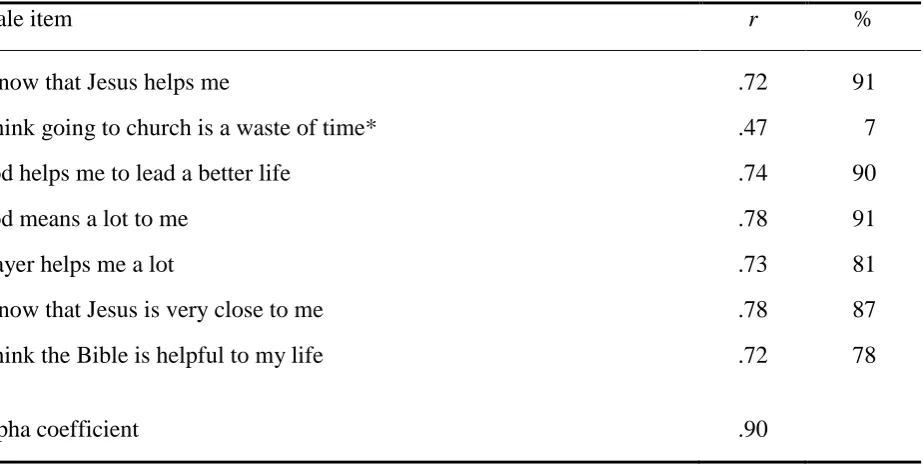
Table one presents the properties of the short-form Francis Scale of Attitude toward
Christianity in terms of the correlations between each individual item and the sum of the
other six items, the item endorsement in terms of the sum of the agree and agree strongly
responses, and the alpha coefficient (Cronbach, 1951). These data demonstrate a high level of
other items (r ranging from .47 to .78), and a high level of positive affect (endorsement of
positive items ranging from 78% to 91%).
- insert tables 1 and 2 about here -
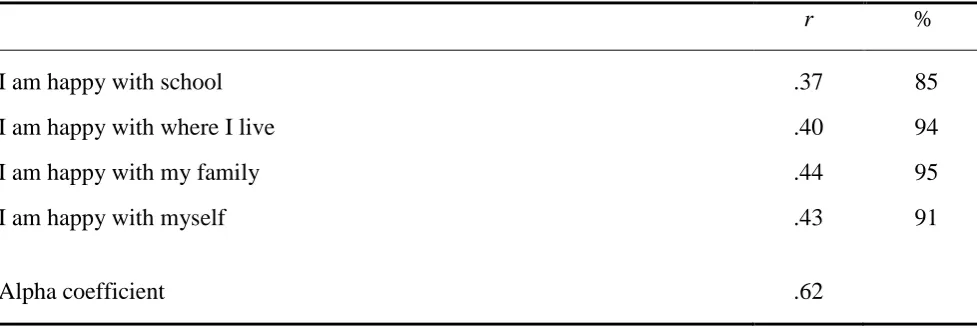
Table two presents the properties of the Powell Index of Global Happiness in terms of
the correlations between each individual item and the sum of the other three items, the item
endorsement in terms of the agree and agree strongly responses, and the alpha coefficient
(Cronbach, 1951). These data demonstrate that each of the four items contributes in an equal
way to the overall identity of the underlying construct (r ranging from .37 to .44), while the
relatively low alpha coefficient (α = .62) suggests the notion of ‘global happiness’ is a broad
construct. The item endorsement demonstrates a high level of happiness (endorsement
ranging from 85% to 95%).
- insert table 3 about here -
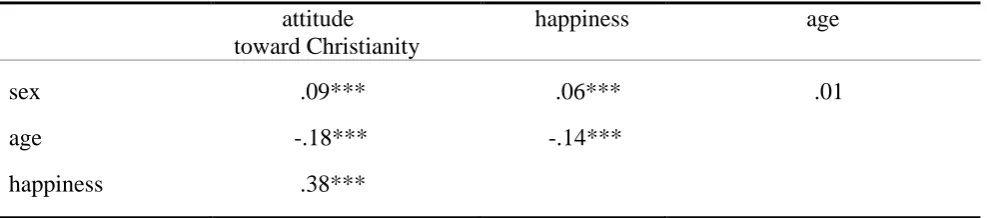
The second step in data analysis explored the bivariate correlations between the two
principle variables (sex and age). Two main conclusions are suggested by this correlation
matrix. First, the data confirm the wisdom of regarding sex and age as potential contaminants
of the relation between religious affect and global happiness. Compared with male students,
female students record higher levels of religious affect and higher levels of global happiness.
Compared with younger students, older students record lower levels of religious affect and
lower levels of global happiness. Second, the data confirm a significant positive correlation
between religious affect and global happiness.
- insert table 4 about here -
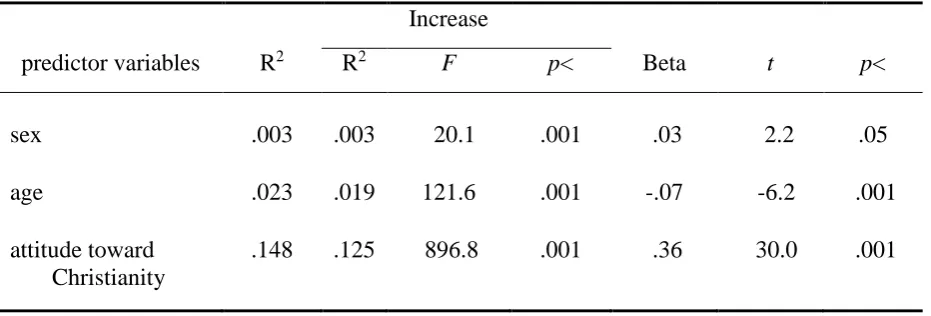
The third step in data analysis employed multiple regression to take sex differences
and age differences into account before examining the effect of religious affect on scores of
global happiness. In this regression model global happiness served as the dependent variable
These data confirm a positive correlation between religious affect and global happiness after
controlling for individual differences in sex and age. The beta weights also suggest that age
and sex contribute additional predictive power to levels of global happiness alongside
religious affect. The highest levels of global happiness are found among the younger female
churchgoing students who hold a highly positive attitude toward Christianity.
Conclusion
This study set out to extend scientific knowledge concerning the connection between religion
and happiness by operating within a developing research tradition specifically concerned with
religious affect or the attitudinal dimension of religion. The aim was to explore this
connection among a younger population than had been included in earlier studies (8- to
14-year-olds) and among a population in which religious engagement was salient (churchgoers).
The difficulty encountered by this research objective was the need to develop a measure of
happiness appropriate for the age range under investigation. While the Oxford Happiness
Inventory had provided a consistent measure of happiness across the earlier set of studies
reported by this research tradition, this measure was not deemed appropriate for these
younger participants. The question must remain open regarding the extent to which the
notions of happiness accessed by the Oxford Happiness Inventory and by the Powell Index of
Global Happiness may be regarded as comparable. Notwithstanding this reservation, the data
generated by the present study (conducted among 6,128 young Australian churchgoers) is
consistent with the findings from the other nine studies listed in the introduction to this paper
(conducted in both Jewish and Christian contexts) that have all reported a positive correlation
between happiness and religious affect. Two main conclusions may be drawn from the
cumulative evidence emerging from these studies.
The first conclusion concerns the value of connecting research concerned with the
measures accessing the affective dimension of religion. If, as Francis (2009) argued, the
affective dimension does get closer to the heart of the part played by religion in people’s lives
(closer than measures of religious affiliation, belief and practice), it is reasonable to
hypothesise stable associations to be tracked across diverse populations. So far this has
proved to be the case in respect of associations with happiness.
The second conclusion concerns the value of careful replication concerned with
addressing the same research question and employing the same family of instruments
accessing the affective dimension of religion across diverse populations. While the recent
series of studies concerned with the connection between religion and happiness has
established the association largely through employing the Oxford Happiness Inventory, the
present study has shown that the same finding emerges using a different conceptualisation
and operationalisation of happiness.
The next step in building on this research tradition may consider taking research in
two directions. First, more studies would be welcome employing the Powell Index of Global
Happiness alongside measures of religious affect among other samples of young people to
check whether the same finding occurs beyond the sample of young Australian churchgoers.
Second, published studies have so far been restricted to samples in which the Francis Scale of
Attitude toward Christianity (Francis, Lewis, Philipchalk, Brown, & Lester, 1995) or the
Katz-Francis Scale of Attitude toward Judaism (Francis & Katz, 2007) have been included.
More studies would be welcome extending this research within other religious traditions,
employing the Sahin-Francis Scale of Attitude toward Islam (Sahin & Francis, 2002) or the
Santosh-Francis Scale of Attitude toward Hinduism (Francis, Santosh, Robbins, & Vij, 2008).
This body of scientific research across religious traditions also carries specific
implications for Christian education. Since the present data were generated by young people
activities (like Sunday School), it is clear that all of these young people were in some form of
active contact with the Christian Church. Among these young people, differences in levels of
personal wellbeing (as accessed through the measure of global happiness) were related to
individual differences in religious affect (as accessed through the attitudinal measure). It
remains important for churches, therefore, to be aware of and to pay attention to the religious
affect of their young participants and not simply monitor the frequency of their attendance.
Sensitivity to the factors that either promote or inhibit positive attitudes to their church and to
their Christian faith may hold an important educational key not only to the religious
References
Argyle, M., & Crossland, J. (1987). Dimensions of positive emotions. British Journal of
Social Psychology, 26: 127-137.
Argyle, M., Martin, M., & Crossland, J. (1989). Happiness as a function of personality and
social encounters. In J. P. Forgas & J. M. Innes (Eds.), Recent advances in social
psychology: An international perspective (pp. 189-203). Amsterdam, North Holland:
Elsevier Science Publishers.
Atherton, J., Graham, E., & Steedman, I. (Eds.) (2011). The practices of happiness: Political
economy, religion, and wellbeing. London: Routledge.
Bellamy, J., Cussen, B., Sterland, S., Castle, K., Powell, R., & Kaldor, P. (2006). Enriching
church life: A practical guide for local churches. Adelaide, South Australia:
Openbook.
Cronbach, L. J. (1951). Coefficient alpha and the internal structure of tests. Psychometrika,
16: 297-334.
Francis, L. J. (1978). Measurement reapplied: Research into the child's attitude towards
religion. British Journal of Religious Education, 1: 45-51.
Francis, L. J. (1987). Measuring attitudes towards Christianity among 12- to 18-year-old
pupils in Catholic schools. Educational Research, 29: 230-233.
Francis, L. J. (1992). Reliability and validity of the short measure of attitude towards
Christianity among nine to eleven year old pupils in England. Collected Original
Resources in Education, 16: fiche 2, A03.
Francis, L. J. (2009). Understanding the attitudinal dimensions of religion and spirituality. In
M. De Souza, L. J. Francis, J. O’Higgins-Norman, & D. G. Scott (Eds.), International
Handbook of education for spirituality, care and wellbeing (pp. 147-167). Dordrecht:
Francis, L. J., & Greer, J. E. (1990). Measuring attitudes towards Christianity among pupils
in Protestant secondary schools in Northern Ireland. Personality and Individual
Differences, 11: 853-856.
Francis, L. J., Greer, J. E., & Gibson, H. M. (1991). Reliability and validity of a short
measure of attitude towards Christianity among secondary school pupils in England,
Scotland and Northern Ireland. Collected Original Resources in Education, 15: fiche
2, G09.
Francis, L. J., Jones, S. H., & Wilcox, C. (2000). Religiosity and happiness: During
adolescence, young adulthood and later life. Journal of Psychology and Christianity,
19: 245-257.
Francis, L. J., & Katz, Y. J. (2002). Religiosity and happiness: A study among Israeli female
undergraduates. Research in the Social Scientific Study of Religion, 13: 75-86.
Francis, L. J., & Katz, Y. J. (2007). Measuring attitude toward Judaism: The internal
consistency reliability of the Katz-Francis Scale of Attitude toward Judaism. Mental
Health, Religion and Culture, 10: 309-324.
Francis, L. J., Katz, Y. J., Yablon, Y., & Robbins, M. (2004). Religiosity, personality and
happiness: A study among Israeli male undergraduates. Journal of Happiness Studies,
5: 315-333.
Francis, L. J., Kerr, S., & Lewis, C. A. (2005). Assessing attitude toward Christianity among
adolescents in South Africa: The Francis scale. South African Journal of Psychology,
35: 147-155.
Francis, L. J., & Lester, D. (1997). Religion, personality and happiness. Journal of
Francis, L. J., Lewis, J. M., Philipchalk, R., Lester, D., & Brown, L. B. (1995). Reliability
and validity of a short scale of attitude toward Christianity among students in the UK,
USA, Australia and Canada. Psychological Reports, 77: 431-434.
Francis, L. J., & McCarron, M. M. (1989). The measurement of attitudes towards Christianity
among Nigerian secondary school students. Journal of Social Psychology, 129:
569-571.
Francis, L. J., & Robbins, M. (2000). Religion and happiness: A study in empirical theology.
Transpersonal Psychology Review, 4: 17-22.
Francis, L. J., Robbins, M., & White, A. (2003). Correlation between religion and happiness:
A replication. Psychological Reports, 92: 51-52.
Francis, L. J., Santosh, R., Robbins, M., & Vij, S. (2008). Assessing attitude toward
Hinduism: The Santosh-Francis Scale. Mental Health, Religion and Culture, 11:
609-621.
Francis, L. J., & Stubbs, M. T. (1987). Measuring attitudes towards Christianity: From
childhood into adulthood. Personality and Individual Differences, 8: 741-743.
Francis, L. J., Yablon, Y. B., & Robbins, M. (2014). Religion and happiness: A study among
female undergraduate students in Israel. International Journal of Jewish Education
Research, 7: 77-92.
French, S., & Joseph, S. (1999). Religiosity and its association with happiness, purpose in
life, and self-actualisation. Mental Health, Religion and Culture, 2: 117-120.Fulljames, P., &
Francis, L. J. (1987). The measurement of attitudes towards Christianity
among Kenyan secondary school students. Journal of Social Psychology, 127:
407-409.
pupils in non-denominational schools in Scotland. Educational Research, 31:
221-227.
Greer, J. E., & Francis, L. J. (1991). Measuring attitudes towards Christianity among
pupils in Catholic secondary schools in Northern Ireland. Educational Research¸33:
70-73.
Joseph, S., & Lewis, C. A. (1998). The Depression-Happiness Scale: Reliability and validity
of a bipolar self-report scale. Journal of Clinical Psychology, 54: 537-544.
Kaldor, P., Bellamy, J., Correy, M., & Powell, R. (1992). First look in the mirror: Initial
findings of the 1991 National Church Life Survey. Homebush West, New South
Wales: Lancer.
Kaldor, P., Bellamy, J., Moore, S., Powell, R., Castle, K., & Correy, M. (1995). Mission
under the microscope: Keys to effective and sustainable mission. Adelaide, South
Australia: Openbook Publishers.
Kaldor, P., Bellamy, J., Powell, R., Castle, K., & Hughes, B. (1999). Build my Church:
Trends and possibilities for Australian churches. Adelaide, South Australia:
Openbook Publishers.
Kaldor, P., Bellamy, J., Powell, R., Hughes, B., & Castle, K. (1997). Shaping a future:
Characteristics of vital congregations. Adelaide, South Australia: Openbook
Publishers.
Kaldor, P., Dixon, R., Powell, R., Bellamy, J., Hughes, B., Moore, S., & Dalziel, J. (1999).
Taking stock: A profile of Australian church attenders. Adelaide, South Australia:
Openbook Publishers.
Kaldor, P., & McLean, J. (2009). Lead with your strengths. Sydney, New South Wales:
Lewis, C. A., & Cruise, S. M. (2006). Religion and happiness: Consensus, contradictions,
comments and concerns. Mental Health, Religion and Culture, 9: 213-225.
Lewis, C. A., Francis, L. J., & Kerr, S. (2003). Reliability and validity of a short scale of
attitude toward Christianity among 12-19 year olds in South Africa. IFE
Psychologica, 11: 147-152.
Lewis, C. A., Lanigan, C., Joseph, S., & de Fockert, J. (1997). Religiosity and happiness: No
evidence for an association among undergraduates. Personality and Individual
Differences, 22: 119-121.
Lewis, C. A., Maltby, J., & Burkinshaw, S. (2000). Religion and happiness: Still no
association. Journal of Beliefs and Values, 21: 232-236.
Robbins, M., & Francis, L. J. (1996). Are religious people happier? A study among
undergraduates. In L. J. Francis, W. K. Kay, & W. S. Campbell (Eds.), Research in
religious education (pp. 207-217). Leominster: Gracewing.
Robbins, M., Francis, L. J., & Williams, N. (2003). Reliability of the Francis Scale of
Attitude toward Christianity among 8 year olds. Psychological Reports, 92: 104.
Sahin, A., & Francis, L. J. (2002). Assessing attitude toward Islam among Muslim
adolescents: The psychometric properties of the Sahin-Francis scale. Muslim
Table 1
Francis Scale of Attitude toward Christianity: Scale properties
Scale item r %
I know that Jesus helps me .72 91
I think going to church is a waste of time* .47 7
God helps me to lead a better life .74 90
God means a lot to me .78 91
Prayer helps me a lot .73 81
I know that Jesus is very close to me .78 87
I think the Bible is helpful to my life .72 78
Alpha coefficient .90
Note % = sum of agree and agree strongly responses
r = correlation between individual item and sum of other six items
*this negative item was reverse scored to calculate r
Table 2
Powell Index of Global Happiness: Scale properties
r %
I am happy with school .37 85
I am happy with where I live .40 94
I am happy with my family .44 95
I am happy with myself .43 91
Alpha coefficient .62
Note % = sum of agree and agree strongly responses
r = correlation between individual item and sum of other six items
Table 3
Correlation matrix
attitude toward Christianity
happiness age
sex .09*** .06*** .01
age -.18*** -.14***
happiness .38***
Note: *** p < .001
Table 4
Multiple- regression
Increase
predictor variables R2 R2 F p< Beta t p<
sex .003 .003 20.1 .001 .03 2.2 .05
age .023 .019 121.6 .001 -.07 -6.2 .001
attitude toward Christianity
.148 .125 896.8 .001 .36 30.0 .001