http://wrap.warwick.ac.uk/
Original citation:
Cygan , Marek, Lokshtanov , Daniel , Pilipczuk, Marcin, Pilipczuk
, Michał and Saurabh,
Saket (2014) Minimum bisection is fixed parameter tractable. In: STOC '14 : 46th Annual
ACM Symposium on Theory of Computing, New York, 31 May- 3 Jun 2014. Published
in: STOC '14 Proceedings of the 46th Annual ACM Symposium on Theory of Computing
pp. 323-332.
Permanent WRAP url:
http://wrap.warwick.ac.uk/66072
Copyright and reuse:
The Warwick Research Archive Portal (WRAP) makes this work of researchers of the
University of Warwick available open access under the following conditions. Copyright ©
and all moral rights to the version of the paper presented here belong to the individual
author(s) and/or other copyright owners. To the extent reasonable and practicable the
material made available in WRAP has been checked for eligibility before being made
available.
Copies of full items can be used for personal research or study, educational, or
not-for-profit purposes without prior permission or charge. Provided that the authors, title and
full bibliographic details are credited, a hyperlink and/or URL is given for the original
metadata page and the content is not changed in any way.
Publisher statement:
© ACM. This is the author’s version of the work. It is posted here for your personal use.
Not for redistribution. The definitive version was published in STOC '14 Proceedings
http://dx.doi.org/10.1145/2591796.2591852
A note on versions:
The version presented here may differ from the published version or, version of record, if
you wish to cite this item you are advised to consult the publisher’s version. Please see
the ‘permanent WRAP url’ above for details on accessing the published version and note
that access may require a subscription.
Minimum Bisection is Fixed Parameter Tractable
[Extended Abstract]
∗Marek Cygan
Institute of Informatics University of Warsaw, Poland[email protected]
Daniel Lokshtanov
Department of Informatics University of Bergen, Norway[email protected]
Marcin Pilipczuk
Department of Informatics University of Bergen, Norway[email protected]
Michał Pilipczuk
Department of Informatics University of Bergen, Norway
[email protected]
Saket Saurabh
Institute of MathematicalSciences, India & Department of Informatics University of Bergen, Norway
[email protected]
ABSTRACT
In the classicMinimum Bisectionproblem we are given as input a graphGand an integerk. The task is to determine whether there is a partition ofV(G) into two partsA and
B such that ||A| − |B|| ≤ 1 and there are at mostk edges with one endpoint inA and the other inB. In this paper we give an algorithm forMinimum Bisectionwith running time O(2O(k3)n3log3n). This is the first fixed parameter
tractable algorithm forMinimum Bisection. At the core of our algorithm lies a new decomposition theorem that states that every graphGcan be decomposed by small separators into parts where each part is “highly connected” in the fol-lowing sense: any cut of bounded size can separate only a limited number of vertices from each part of the decompo-sition.
Our techniques generalize to the weighted setting, where we seek for a bisection of minimum weight among solutions that contain at mostkedges.
Categories and Subject Descriptors
F.2.2 [Analysis of Algorithms and Problem Complex-ity]: Nonnumerical Algorithms and Problems— Computa-tions on discrete structures
General Terms
Algorithms, Theory
Keywords
minimum bisection, fixed-parameter tractability, tree
de-∗A full version of this paper is available at arXiv [8]
Permission to make digital or hard copies of all or part of this work for personal or classroom use is granted without fee provided that copies are not made or distributed for profit or commercial advantage and that copies bear this notice and the full citation on the first page. Copyrights for components of this work owned by others than ACM must be honored. Abstracting with credit is permitted. To copy otherwise, or republish, to post on servers or to redistribute to lists, requires prior specific permission and/or a fee. Request permissions [email protected].
STOC’14, May 31 - June 03 2014, New York, NY, USA Copyright 2014 ACM 978-1-4503-2710-7/14/05 ...$15.00. http://dx.doi.org/10.1145/2591796.2591852.
composition, randomized contractions
1.
INTRODUCTION
In theMinimum Bisectionproblem the input is a graph
Gonnvertices together with an integerk, and the objective is to find a partition of the vertex set into two partsAand
B such that|A|=bn
2c,|B|=d
n
2e, and there are at mostk
edges with one endpoint inAand the other endpoint inB. The problem can be seen as a variant ofMinimum Cut, and is one of the classic NP-complete problems [13]. Minimum Bisection has been studied extensively from the perspec-tive of approximation algorithms [11, 10, 18, 23], heuris-tics [2, 4] and average case complexity [1].
In this paper we consider the complexity ofMinimum Bi-section when the solution size k is small relative to the
input sizen. A na¨ıve brute-force algorithm solves the prob-lem in timenO(k). Until this work, it was unknown whether there exists afixed parameter tractablealgorithm, that is an algorithm with running time f(k)nO(1), for the
Minimum Bisectionproblem. In factMinimum Bisectionwas one of very few remaining classic NP-hard graph problems whose parameterized complexity status was unresolved. Our main result is the first fixed parameter tractable algorithm for
Minimum Bisection.
Theorem 1.1. Minimum Bisectionadmits an algorithm running in time O(2O(k3)n3log3n).
Theorem 1.1 implies thatMinimum Bisectioncan be solved in polynomial time for k =O(√3logn). In fact, our
tech-niques can be generalized to solve the more general problem where the target|A|is given as input, the edges have non-negative weights, and the objective is to find, among all partitions ofV(G) intoA andB such thatA has the pre-scribed size and there are at mostkedges betweenAandB, such a partition where the total weight of the edges between
AandB is minimized.
1.1
Our methods
that each part of the decomposition is “highly connected”. To properly define what we mean by “highly connected” we need a few definitions. Aseparationof a graphGis a pair
A, B ⊆ V(G) such that A∪B = V(G) and there are no edges betweenA\B andB\A. Theorderof the separation (A, B) is|A∩B|. A vertex setX ⊆V(G) is called (q, k )-unbreakable if every separation (A, B) of order at most k
satisfies|(A\B)∩X| ≤qor|(B\A)∩X| ≤q. The parts of our decomposition will be “highly connected” in the sense that they are (2O(k), k)-unbreakable. We can now state the decomposition theorem as follows.
Theorem 1.2. There is an algorithm that givenGandk
runs in timeO(2O(k2)n2m)and outputs a tree-decomposition (T, β)ofGsuch that(i)for eacha∈V(T),β(a)is(2O(k), k) -unbreakable in G, (ii) for each ab ∈ E(T) we have that
|β(a)∩β(b)| ≤2O(k), andβ(a)∩β(b)is(2k, k)-unbreakable inG.
Hereβ(a) denotes the bag at nodea∈V(T); the completely formal definition of tree-decompositions may be found in the preliminaries. It is not immediately obvious that a set X
which is (q, k)-unbreakable is “highly connected”. To get some intuition it is helpful to observe that if a setX of size at least 3q is (q, k)-unbreakable then removing any k ver-tices from G leaves almost all ofX, except for at most q
vertices, in the same connected component. In other words, one cannot separate two large chunks ofX with a small sep-arator. From this perspective Theorem 1.2 can be seen as an approximate way to “decompose a graph bykvertex-cuts into it’sk+ 1-connected components” [5], which is consid-ered an important quest in structural graph theory. The proof strategy of Theorem 1.2 is inspired by the recent de-composition theorem of Marx and Grohe [15] for graphs ex-cluding a topological subgraph. Contrary to the approach of Marx and Grohe [15], however, the crucial technical tool we use to decompose the graph are the important separators of Marx [19].
Our algorithm forMinimum Bisectionapplies Theorem 1.2 and then proceeds by performing bottom up dynamic pro-gramming on the tree-decomposition. The states in the dynamic program are similar to the states in the dynamic programming algorithm forMinimum Bisectionon graphs of bounded treewidth [16]. Property (ii) of Theorem 1.2 ensures that the size of the dynamic programming table is upper bounded by 2O(k2)nO(1). For graphs of bounded treewidth all bags have small size, making it easy to com-pute the dynamic programming table at a node b of the decomposition tree, if the tables for the children ofbhave already been computed. In our setting we do not have any control over the size of the bags, we only know that they are (2O(k), k)-unbreakable. We show that the sole assumption that the bag atb is (2O(k), k)-unbreakable is already suffi-cient to effisuffi-ciently compute the table atbfrom the tables of its children, despite no a priori guarantee on the bag’s size. The essence of this step is an application of the “randomized contractions” technique [7].
We remark here that the last property of the decomposi-tion of Theorem 1.2 — the one that asserts that adhesions
β(a)∩β(b) are (2k, k)-unbreakable inG— is not essential to establish the fixed-parameter tractability ofMinimum Bi-section. This high unbreakability of adhesions is used to
further limit the number of states of the dynamic program-ming, decreasing the dependency onk in the algorithm of
Theorem 1.1 from double- to single-exponential.
1.2
Related work on balanced separations
There are several interesting results concerning the pa-rameterized complexity of finding balanced separators in graphs. Marx [19] showed that the the vertex-deletion vari-ant of the bisection problem is W[1]-hard. In Minimum Vertex Bisection the task is to partition the vertex set into three partsA,SandBsuch that|S| ≤kand|A|=|B|, and there are no edges betweenAandB. It is worth men-tioning that the hardness result of Marx [19] applies to the more general problem where|A|is given as input, however the hardness ofMinimum Vertex Bisectioneasily follows from the results presented in [19].
As the vertex-deletion variant of the bisection problem is W[1]-hard, we should not expect that our approach would work also in this case. Observe that one can compute the decomposition of Theorem 1.2 and define the states of the dynamic programming over the tree decomposition, as it is done for graphs of bounded treewidth. However, we are un-able to perform the computations needed for one bag of the decomposition. Moreover, it is not only the artifact of the “randomized contractions” technique, but the hard instances obtained from the reduction of [19] are in fact highly un-breakable by our definition, and Theorem 1.2 would return a trivial decomposition.
Feige and Mahdian [12] studied cut problems that may be considered as approximation variants of Minimum
Bisec-tionandMinimum Vertex Bisection. We say that a ver-tex (edge) setS is anα-(edge)-separator if every connected component ofG\Shas at mostαnvertices. The main result of Feige and Mahdian [12] is a randomized algorithm that given an integer k, 23 ≤ α <1 and >0 together with a graphGwhich has anα-separator of size at mostk, outputs in time 2f()knO(1) either anα-separator of size at mostk
or an (α+)-separator of size strictly less thank. They also give a deterministic algorithm with similar running time for the edge variant of this problem. To complement this result they show that, at least for the vertex variant, the exponen-tial running time dependence on 1/is unavoidable. Specif-ically, they prove that for anyα > 1
2 finding anα-separator
of size k is W[1]-hard, and therefore unlikely to admit an algorithm with running timef(k)nO(1), for any functionf.
On the other hand, our methods imply a 2O(k3)nO(1/α)time
algorithm for finding anα-edge-separator of size at mostk, for anyα >0.
Minimum Bisectionon planar graphs was shown to be fixed parameter tractable by Bui and Peck [3]. It is inter-esting to note that Minimum Bisection is not known to be NP-hard on planar graphs, and the complexity of Min-imum Bisection on planar graphs remains a challenging
open problem. More recently, van Bevern et al. [25] used the treewidth reduction technique of Marx et al. [20] to give a fixed parameter tractable algorithm forMinimum
Bisec-tionfor the special case when removing the cut edges leaves
a constant number of connected components. Their algo-rithm also works for the vertex-deletion variant the same restrictions. SinceMinimum Vertex Bisectionis known to be W[1]-hard, it looks difficult to extend their methods to give a fixed parameter tractable algorithm forMinimum Bisectionwithout any restrictions. Thus, Theorem 1.1
1.3
Related work on graph decompositions
The starting point of our decomposition theorem is the “recursive understanding” technique pioneered by Grohe et al. [14], and later used by Kawarabayashi and Thorup [17] and by Chitnis et al. [7] to design a number of interesting parameterized algorithms for cut problems. Recursive un-derstanding can be seen as a reduction from a parameterized problem on general graphs to the same problem on graphs with a particular structure. Grohe et al. [14] essentially use recursive understanding to reduce the problem of deciding whetherGcontainsHas a topological subgraph to the case where G either excludes a clique on f(|H|) vertices as a minor or contains at most f(|H|) vertices of degree more than f(|H|), for some function f. Marx and Grohe [15] subsequently showed that any graph which excludes H as a topological subgraph can be decomposed by small sepa-rators, in a tree-like fashion, into parts such that each part either excludes a clique onf(|H|) vertices as a minor or con-tains at mostf(|H|) vertices of degree more thanf(|H|), for some functionf. Thus, the decomposition theorem of Marx and Grohe [15] can be seen as a “structural” analogue of the recursive understanding technique for topological subgraph containment.
Both Kawarabayashi and Thorup [17] and Chitnis et al. [7] apply recursive understanding to reduce certain parameter-ized cut problems on general graphs to essentially the same problem on a graphGwhereV(G) is (f(k), k)-unbreakable for some function f. Then they proceed to show that the considered problem becomes fixed parameter tractable on (f(k), k)-unbreakable graphs. Observe that Minimum
Bi-section on (f(k), k)-unbreakable graphs is trivially fixed parameter tractable - if the number of vertices is more than 2f(k) we can immediately say no, while if the number of vertices is at most 2f(k), then a brute force algorithm is al-ready fixed parameter tractable. More importantly, it turns out that even the more general problem where|A|is given on the input can be solved in fixed parameter tractable time on (f(k), k)-unbreakable graphs via an application of the “ran-domized contractions” technique of Chitnis et al [7]. It is therefore very natural to try to use recursive understanding in order to reduceMinimum Bisectionon general graphs toMinimum Bisectionon (f(k), k)-unbreakable graphs.
Unfortunately, it seems very difficult to pursue this route. In particular, recursive understanding works by cutting the graph into two parts by a small separator, “understanding” the easier of the two parts recursively, and then replacing the“understood” part by a constant size gadget. For Mini-mum Bisectionit seems unlikely that the understood part can be emulated by any constant size gadget because of the balance constraint in the problem definition. Intuitively, we would need to encode the behaviour of the understood part for every possible cardinality ofA, which gives us amount of information that is not bounded by a function ofk. The issue has strong connections to the fact that the best known algorithm for Minimum Bisection on graphs of bounded treewidth is at least quadratic [16] rather than linear.
At this point our decomposition theorem comes to the rescue. It precisely allows us tostructurallydecompose the graph in a tree-like fashion into (f(k), k)-unbreakable parts, which provides much more robust foundations for further al-gorithmic applications. Thus, essentially our decomposition theorem does the same for cut problems as the decompo-sition theorem of Marx and Grohe [15] does for
topologi-cal subgraph containment. Notably, the “recursive under-standing” step used by Kawarabayashi and Thorup [17] and Chitnis et al. [7] for their problems could be replaced by dy-namic programming over the tree-decomposition given by Theorem 1.2.
We remark here that it has been essentially known, and observed earlier by Chitnis, Cygan and Hajiaghayi (private communication), thatMinimum Bisectioncan be solved in FPT time on sufficiently unbreakable graphs via the “ran-domized contractions” technique. Furthermore, although our application of this framework to handle one bag of the decomposition is more technical than in [7], due to the pres-ence of the information for children bags, it uses no novel tools compared to [7]. Hence, we emphasize that our main technical contribution is the decomposition theorem (Theo-rem 1.2), with the fixed-parameter algorithm forMinimum Bisectionbeing its corollary via an involved application of
known techniques.
In this extended abstract we prove the main technical con-tribution of the paper, namely Theorem 1.2. This is done in Section 3, after setting up notation and preliminary results in Section 2. We briefly skecth the dynamic programming algorithm forMinimum Bisectionin Section 4. For full ex-position of this algorithm, as well as discussion on weighted extension andα-edge-separators we refer to the full version of the paper [8].
2.
PRELIMINARIES
We use standard graph notation, see e.g. [9]. We use n
and m to denote cardinalities of the vertex and edge sets, respectively, of a given graph provided it is clear from the context. We begin with some definitions and known results on separators and separations in graphs.
Definition 2.1 (separator). For two setsX, Y ⊆V(G) a setW ⊆V(G)is called anX−Y separator if inG\W no connected component contains a vertex ofX and a vertex of
Y at the same time.
Definition 2.2 (separation). A pair(A, B)whereA∪ B=V(G)is called aseparationifE(A\B, B\A) =∅. The orderof a separation(A, B)is defined as|A∩B|.
Definition 2.3 (important separator). An inclusion-wise minimal X −Y separator W is called an important
X −Y separator if there is no X −Y separator W0 with
|W0| ≤ |W|and RG\W(X\W) ( RG\W0(X\W0), where
RH(A) is the set of vertices reachable fromA in the graph
H.
Lemma 2.4 ([6, 21]). For any two sets S, T ⊆ V(G) there are at most 4k importantS−T separators of size at mostkand one can list all of them inO(4kk(n+m))time.
We proceed to define tree-decompositions. For a rooted treeTand a non-root nodet∈V(T), by parent(t) we denote the parent oftin the treeT. For two nodesu, t∈T, we say that uis adescendant of t, denotedu t, iftlies on the unique path connectinguto the root. Note that every node is thus its own descendant.
• for each node v∈ V(G) the set {t∈ V(G)|v ∈β(t)}
induces a nonempty and connected subtree ofT,
• for each edgee∈E(G)there existst∈V(T)such that
e⊆β(t).
The setβ(t) is called thebag at t, while setsβ(u)∩β(v) foruv∈E(T) are calledadhesions. Following the notation from [15], for a tree decomposition (T, β) of a graphG we define auxiliary mappingsσ, γ:V(T)→2V(G)as
γ(t) = [
ut
β(u),
σ(t) = (
∅ if t is the root ofT
β(t)∩β(parent(t)) otherwise
Finally, we proceed to the definition of unbreakability.
Definition 2.6 ((q, k)-unbreakable set). We say that
a setAis(q, k)-unbreakable, if for any separation(X, Y)of order at mostkwe have|(X\Y)∩A| ≤qor|(Y\X)∩A| ≤q. OtherwiseAis(q, k)-breakable, and any separation(X, Y) certifying this is called a witnessing separation.
Let us repeat the intuition on unbreakable sets from the introduction. If a setXof size at least 3qis (q, k)-unbreakable then removing anykvertices fromGleaves almost all ofX, except for at mostqvertices, in the same connected compo-nent. In other words, one cannot separate two large chunks ofX with a small separator.
Observe that if a set A is (q, k)-unbreakable in G, then any of its subset A0 ⊆ A is also (q, k)-unbreakable in G. Moreover, if A is (q, k)-unbreakable in G, then A is also (q, k)-unbreakable in any supergraph ofG. For a small setA
it is easy to efficiently verify whetherAis (q, k)-unbreakable inG, or to find a witnessing separation, by checking, for all possible pairs (A1, A2) of disjoint subsets ofAof sizeq+ 1,
whetherA1 andA2 can be separated in Gby a cut of size
at mostk.
Lemma 2.7. Given a graph G, a set A ⊆V(G) and an integerqone can check inO(|A|2q+2
k(n+m))time whether
Ais(q, k)-unbreakable inG, and if not, then find a separa-tion(X, Y) of order at mostk such that|(X\Y)∩A|> q
and|(Y \X)∩A|> q.
3.
DECOMPOSITION
We now restate our decomposition theorem in a slightly stronger form that will emerge from the proof.
Theorem 3.1. There is anO(2O(k2)n2m)time algorithm that, given a connected graphGtogether with an integerk, computes a tree decomposition(T, β) of Gwith at most n
nodes such that the following conditions hold:
(i) for eacht∈V(T), the graphG[γ(t)]\σ(t)is connected andN(γ(t)\σ(t)) =σ(t),
(ii) for eacht∈V(T), the setβ(t)is(2O(k), k)-unbreakable
inG[γ(t)],
(iii) for each non-roott∈V(T), we have that|σ(t)| ≤2O(k) andσ(t)is(2k, k)-unbreakable inG[γ(parent(t))].
3.1
Proof overview
We first give an overview of the proof of Theorem 3.1, ignoring the requirement that each adhesion is supposed to be (2k, k)-unbreakable. As discussed in the introduction, this property is only used to improve the running time of the algorithm, and is not essential to establish fixed-parameter tractability.
We prove the decomposition theorem using a recursive ap-proach, similar to the standard framework used for instance by Robertson and Seymour [24] or by Marx and Grohe [15]. That is, in the recursive step we are given a graphGtogether with a relatively small setS ⊆V(G) (i.e., of size bounded by 2O(k)), and our goal is to construct a decomposition of
G satisfying the requirements of Theorem 3.1 with an ad-ditional property thatS is contained in the root bag of the decomposition. The intention is that the recursive step is invoked on some subgraph of the input graph, and the set
S is the adhesion towards the decomposition of the rest of the graph.
Henceforth we focus on one recursive step, and consider three cases. In the base case, if|S| ≤3k, we add an arbitrary vertex toSand repeat. In what follows, we assume|S|>3k. First, assume that S is (2k, k)-breakable in G, and let (X, Y) be the witnessing separation. We proceed in a stan-dard manner (cf. [24]): we create a root bagA:=S∪(X∩ Y), for each connected component C of G\A recurse on (NG[C], NG(C)), and glue the obtained trees as children of
the root bag. It is straightforward from the definition of the witnessing separation that in every recursive call we have
|NG(C)| ≤ |S|. Moreover, clearly|A| ≤ |S|+kand henceA
is appropriately unbreakable.
In the last, much more interesting case the adhesion S
turns out to be (2k, k)-unbreakable. Hence, any separation (X, Y) in Gpartitions S very unevenly: almost the entire set S, up to O(k) elements, lies on only one side of the separation. Let us call this side the “big” side, and the second side the “small” one.
The main idea now is as follows: if, for eachv∈V(G), we mark all important separators of size O(k) betweenv and
S, then the marked vertices will separate all “small” sides of separations from the setS. Let B be the set of marked vertices and let A be the set of all vertices ofG that are either inB∪S, or are not separated fromS by any of the considered important separator. We observe that the strong structure of important separators — in particular, the single-exponential bound on the number of important separators for one vertexv — allows us to argue that each connected componentCofG\Athat is separated by some important separator from S has only bounded number of neighbours in A. Moreover, the fact that we cut all “small” sides of separations implies that A is appropriately unbreakable in
G. Hence, we may recurse, for each connected component
C of G\Athat is separated by some important separator fromS, on (NG[C], NG(C)), and takeAas a root bag.
The section is organised as follows. In Section 3.2 we de-fine formally the notion ofchips, that are parts of the graph cut out by important separators, and provide all the prop-erties that play crucial role in Section 3.3. In Section 3.3 we also show how to proceed with the case S being un-breakable, that is, how extract the root bag containing S
the obtained results and construct the main decomposition of Theorem 3.1.
3.2
Chips
In this subsection we define fragments of the graph which are easy to chip (i.e. cut out of the graph) from some given set of verticesS, and show their basic properties.
Definition 3.2 (chips). For a fixed set of verticesS⊆ V, a subset C ⊆ V is called a chip, if G[C] is connected,
|N(C)| ≤3k, andN(C)is an important C−S separator.
LetC be the set of all inclusion-wise maximal chips. The following lemma is straightforward from the definition of important separators.
Lemma 3.3. For any nonempty setC ⊆V(G)such that
G[C]is connected, the following conditions are equivalent.
(i) N(C) is an importantC−S separator;
(ii) for anyv∈C,N(C) is an importantv−S separator;
(iii) there existsv∈Csuch thatN(C)is an importantv−S
separator.
Note also that for a connected set of vertices D and any important D−S separator Z of size at most 3k that is disjoint withD, the set of vertices reachable fromDinG\Z
forms a chip. Lemmata 2.4 and 3.3 show how to enumerate inclusion-wise maximal chips.
Lemma 3.4. Given a setS⊆V(G) one can compute the setC of all inclusion-wise maximal chips in O(2O(k)n(n+
m))time. In particular,|C| ≤43kn.
Proof. For anyv∈V, we use Lemma 2.4 to enumerate the setZvof all importantv−S separators of size at most
3k. Recall that for any Z ∈ Zv, the set RG\Z(v) is the
vertex set of the connected component ofG\Z containing
v. DefineAv={RG\Z(v) :Z∈ Zv}and letCvbe the set of
inclusion-wise maximal elements ofAv. By Lemma 3.3 we
infer that if some chipC∈ Avis not inclusion-wise maximal,
then there existsC0∈ Av such thatC(C0. Therefore, we
have thatC=S
v∈V(G)Cv.
As|Zv| ≤43kfor anyv∈V(G), the bound on|C|follows.
For eachv∈V(G), the setsZv,AvandCvcan be computed
inO(2O(k)(n+m)) time in a straightforward manner. The computation ofC =S
v∈V(G)Cv inO(2O(k)n(n+m)) time
can be done by inserting all the elements ofS
v∈V(G)Cvinto
a prefix tree (trie), each inO(n) time, and ignoring encoun-tered duplicates.
Definition 3.5 (chips touching). We say that two chips C1, C2∈ C, C1 6=C2, toucheach other, denotedC1∼C2, if
C1∩C26=∅orE(C1, C2)6=∅.
The following lemma provides an alternative definition of touching that we will find useful.
Lemma 3.6. C1∈ CtouchesC2∈ Cif and only ifN(C1)∩
C26=∅.
Proof. From right to left, ifv∈N(C1)∩C2 then there
exists a neighbour u of v that belongs to C1, and
conse-quentlyuv∈E(C1, C2).
From left to right, first assume C1∩C2 6= ∅. Since C
contains only inclusion-wise maximal chips, we have that
C2\C1 6= ∅. By the properties of chips, the graphG[C2]
is connected, hence there is an edge between C2\C1 and
C1∩C2insideG[C2]. This provesN(C1)∩C26=∅.
In the other case, assume that C1∩C2 = ∅ but there
existsuv∈E(C1, C2) such thatu∈C1 andv∈C2. Since
C1∩C2=∅, it follows thatv /∈C1, and hencev∈N(C1)∩
C2.
The next result provides the most important tool for bound-ing the size of adhesions in the constructed decomposition.
Lemma 3.7. Any chip C ∈ C touches at most 3k·43k
other chips ofC.
Proof. Assume thatCtouches someC0∈ C. By Lemma 3.6 there exists a vertex v ∈ N(C)∩C0. Observe that since
N(C0) is an importantC0−Sseparator, thenN(C0) is also an important v−S separator. By Lemma 2.4 there are at most 43kimportantv−Sseparators of size at most 3k. Since
|N(C)| ≤ 3k (by the properties of chips), we infer that C
touches at most 3k·43k chips fromC.
3.3
Local decomposition
Equipped with basic properties of chips we are ready to prove the main step of the decomposition part of the paper. In what follows we show that given a (2k, k)-unbreakable setSof size bounded inkone can find a (potentially large) unbreakable partA⊆V of the graph, such thatS⊆Aand each connected component ofG\Ais adjacent to a small number of vertices ofA. In what follows, let us define
η= 3k·(3k·43k+ 1), τ = (3k)2·83k+ 2k. Theorem 3.8. There is an O(2O(k)nm) time algorithm
that, given a connected graph G together with an integerk
and a (2k, k)-unbreakable set S ⊆ V(G), computes a set
A⊆V(G) such that:
(a) S⊆A,
(b) for each connected componentDofG\Awe have|NG(D)| ≤
η,
(c) Ais(τ, k)-unbreakable inG, and
(d) if|S|>3k,G\S is connected and N(V(G)\S) =S, thenS6=A.
Proof. LetCbe the set of inclusion-wise maximal chips,
enumerated by Lemma 3.4. We define
A= \
C∈C
V(G)\N[C] !
∪ [
C∈C N(C).
In the definition we assume that whenCis empty, thenA=
V(G). The claimed running time of the algorithm follows directly from Lemma 3.4.
For property (a), note that no vertex ofS is contained in a chip ofC, henceS⊆A. We now show property (d). Note thatN(V(G)\S) =Sand|S|>3kimpliesS6=V(G). Con-sequently, ifC =∅, property (d) is straightforward. Other-wise, letC∈ C. Note that|S|>3kimplies thatS\N(C)6=∅
and the connectivity ofG\Stogether withN(V(G)\S) =S
further implies thatN(C)\S=6 ∅. Consequently,A\S6=∅
and property (d) is proven.
Claim 3.9. For any connected component D of G\A
there exists a chipC1∈ C such thatD⊆C1.
Proof. Observe that a vertex which is not contained in any chip belongs to the setA, as it is either contained in
N(C) for someC∈ Cor it belongs toV(G)\N[C] for every
C∈ C. LetDbe an arbitrary connected component ofG\A
and letv∈Dbe its arbitrary vertex. As v /∈A, there is a chipCv∈ C such thatv∈Cv. Recall that by its definition
the setAcontains all the neighbours of all the chips inC, henceN(Cv)∩D =∅and by the connectivity ofG[D] we
haveD⊆Cv. y
In the following claim we show that the set A satisfies property (b) of Theorem 3.8.
Lemma 3.10. For any connected component D of G\A
it holds that|N(D)| ≤η.
Proof. LetD be an arbitrary connected component of G\A. By Claim 3.9 there existsC∈ C such thatD⊆C. Intuitively each vertex ofN(D) belongs to the setAfor one of two reasons: (i) it belongs toN(C), or (ii) it is adjacent to a vertex of some other chip, which touchesC. In both cases we show that there is only a bounded number of such vertices, which is formalized as follows.
Let v be any vertex of N(D). Clearly v ∈ N[C], hence we either havev∈N(C) orv∈C. Observe that ifv∈C, then since v ∈ A, by the definition of the set A we have
v∈N(C0) for someC0∈ C,C06=C. Sincev∈N(C0)∩C, thenC0 touches C by Lemma 3.6. We infer thatN(D) ⊆ N(C)∪S
C0∈C,C∼C0N(C0). The claimed upper bound on
|N(D)|follows from Lemma 3.7.
Next, we show that the setA is unbreakable. A short an informal rationale behind this property is that everything what could be easily cut out of the graph was already ex-cluded in the definition ofA.
Lemma 3.11. The setAis(τ, k)-unbreakable.
Proof. Assume the contrary, and let (X, Y) be a
wit-nessing separation, i.e. we have that|X∩Y| ≤k,|(X\Y)∩ A|> τand|(Y\X)∩A|> τ. SinceSis (2k, k)-unbreakable, then either|(X\Y)∩S| ≤2kor|(Y\X)∩S| ≤2k. Without loss of generality we assume that|(X \Y)∩S| ≤2k. Let us define a set Q = (X ∩Y)∪(X∩S) and observe that
|Q| ≤3k.
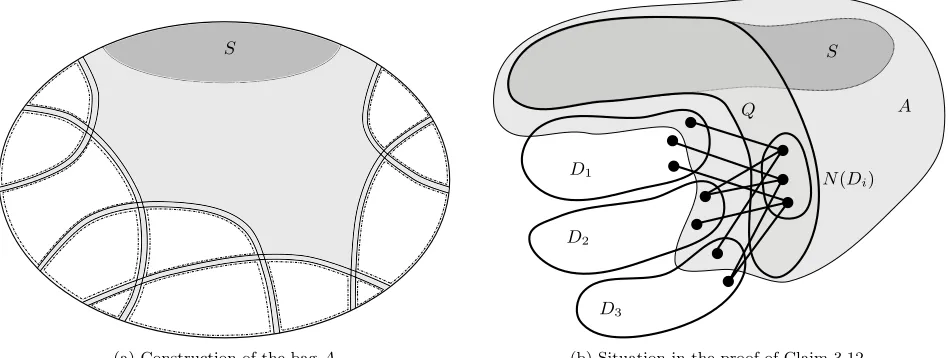
Note that each connected component of G\Q is either entirely contained inX\Y or inY \X (see Fig. 1a). Con-sider connected components of the graph G\Q that are contained inX\Y and observe that they contain at least
|((X\Y)∩A)\S|> τ−2kvertices ofAin total. Therefore, by grouping the connected components ofG\Qcontained in
X\Y by their neighbourhoods inQ, we infer that there ex-ists a set of connected componentsD={D1, . . . , Dr}, such
that∀1≤i,j≤rNG(Di) =NG(Dj) and
r
[
i=1
Di∩A
> τ−2k
23k = (3k)
2
·43k. (1)
We now need the following claim.
Claim 3.12. There is a subset C0 ⊆ C, such that each
v∈Sr
i=1Di∩Abelongs to some chip of C0, and there are
at most3k·43kchips in C that touch some chip ofC0.
Proof. Observe that, for each 1≤i≤r,Qis aDi−S
separator (see Fig. 1a) of size at most 3k. Therefore, for each Di there is an important Di−S separator of size at
most 3kdisjoint withDi, hence eachDiis contained in some
chip ofC. Consider two cases.
First, assume that for each 1 ≤i ≤r we haveDi ∈ C.
AsC0 take {D1, . . . , Dr}. Observe that as components Di
have the same neighbourhoods in G, then by Lemma 3.6 each chip ofC that touches some chipDi touches alsoD1.
Therefore, by Lemma 3.7 there are at most 3k·43k chips in
C that touch some chip ofC0.
In the second case assume that there exist 1≤i0≤rand
a chip C ∈ C such that Di0 (C. We shall prove that for
each 1≤i≤rwe haveDi⊆C. SinceC is connected and
C\Di0 is non-empty, we have thatC∩N(Di0) 6=∅. Let
C0=C∪S
1≤i≤rDi. ClearlyC
0∩
S=∅, andC0is connected since each componentDiis adjacent to every vertex ofC∩
N(Di0). Moreover, as eachDihas the same neighbourhood
in Q we have |N(C0)| ≤ |N(C)| ≤ 3k (see Fig. 1b).As C
contains only maximal chips we have C0 = C and hence S
1≤i≤rDi ⊆C. DefineC0 as{C}. By Lemma 3.7 a single
chip touches at most 3k·43kother chips, which finishes the
proof of Claim 3.12 y
Letv∈A∩Difor some 1≤i≤r. Sincevis contained in
someC0∈ C0, we havev /∈V(G)\N[C0]. Consequently, by
the definition of the set A there exists a chipCv ∈ Csuch
that v∈N(Cv). Note that C0 6=Cv andN(Cv)∩C0 6=∅,
hence by Lemma 3.6 C0 touchesCv. By Claim 3.12 there
are at most 3k·43k chips touching a chip ofC0. As eachCv
satisfies|N(Cv)| ≤3k, we infer that the number of vertices
ofAinS
1≤i≤rDiis at most (3k)243k, which contradicts (1)
and finishes the proof of Lemma 3.11.
Lemma 3.10 and Lemma 3.11 ensure properties (b) and (c) of the set A, respectively. This concludes the proof of Theorem 3.8.
3.4
Strengthening unbreakability of adhesions
So far Theorem 3.8 provides us with a construction of the bag that meets almost all the requirements, apart from (2k, k)-unbreakability of adhesions. For this reason, in this section we want to show that the set A from Theorem 3.8 can be extended to a set A0 in such a way that for each connected component D of G\A0 the set NG(D) is even
(2k, k)-unbreakable. During this extension we may weaken unbreakability ofA0, but if we are careful enough then this loss will be limited to a single-exponential function ofk. In the following we let
τ0=τ+
τ+k
2 !
·k+k
!
·kη .
Lemma 3.13. LetGbe a graph, andL⊆V(G) be a
sub-set of vertices of size at least 2k+ 1. Then one can in
O(|L|4k+3
kn(n+m))time find a set L0, L⊆L0, such that
|L0\L| ≤(|L| −2k−1)·kand for each connected compo-nent D of G\L0, we have that |NG(D)| ≤ |L| andNG(D)
is(2k, k)-unbreakable inG.
S
(a) Construction of the bagA
D1
D2
D3
S
Q
N(Di)
A
[image:8.612.69.544.56.235.2](b) Situation in the proof of Claim 3.12.
Figure 1: Illustrations of the proof of Theorem 3.8
O(|L|4k+2k(n+m)) time using Lemma 2.7. Then for each
connected componentD of G\L we have that NG(D) ⊆
L, and thus |NG(D)| ≤ |L| and NG(D) is also (2k, k
)-unbreakable in G. Hence we can set L0 = L, and since
|L| ≥2k+ 1, we have that|L0\L| ≤(|L| −2k−1)·k. Now let us assume that Lis (2k, k)-breakable inG, and hence there exists a separation (X, Y) ofGsuch that|X∩ Y| ≤ k, |(X \Y) ∩L| > 2k and |(Y \X) ∩L| > 2k, found by the algorithm of Lemma 2.7. We use inductively Lemma 3.13 for the pair (G1=G[X], L1= (X∩L)∪(X∩Y))
and for the pair (G2 = G[Y], L2 = (Y ∩L)∪(X ∩Y)),
to obtain sets L01 and L02, respectively. Note here that
|L1|,|L2| ≥2k+ 1 and|L1|,|L2|<|L|. DefineL0=L01∪L02.
Each connected componentDofG\L0is either a connected component of G1\L01 and is adjacent only to L
0
1, or is a
connected component ofG2\L02 and is adjacent only toL02.
Assume without of loss of generality the first case. By induc-tive assumption we infer that|NG1(D)| ≤ |L1|andNG1(D)
is (2k, k)-unbreakable in G1, and since NG1(D) = NG(D), |L1|<|L|, andG1 is a subgraph ofG, then it follows that
|NG(D)| ≤ |L| andNG(D) is (2k, k)-unbreakable in G. It
remains to argue that the cardinality of L0\L is not too large. Observe that
L0\L⊆(L01\L1)∪(L02\L2)∪(X∩Y) ;
therefore, by induction we have
|L0\L| ≤(|L1| −2k−1)·k+ (|L2| −2k−1)·k+k
≤(|L1|+|L2| −4k−1)·k
≤(|L|+ 2|X∩Y| −4k−1)·k ≤(|L| −2k−1)·k .
Let us now bound the running time of the recursion. Clearly, as the size of the setL decreases in the recursive calls, the depth of the recursion is at most|L|. Moreover, note that any vertex may appear inV(G)\Lin at most one recursive call (G, L) at any fixed level of the recursion tree. Hence, there are at most |L|n recursive calls that do not corre-spond to the first base case, and, consequently, at most 2|L|n+ 1 recursive calls in total. As each recursive call takesO(|L|4k+2
k(n+m)) time, the promised running time bound follows.
Theorem 3.14. There is anO(2O(k
2)
nm)time algorithm that, given a connected graph G together with an integerk
and a (2k, k)-unbreakable setS, computes a setA0⊆V(G) such that:
(a) S⊆A0,
(b) for each connected componentDofG\A0the setNG(D)
is(2k, k)-unbreakable, and|NG(D)| ≤η,
(c) A0 is(τ0, k)-unbreakable inG,
(d) moreover, if|S|>3k,G\S is connected andN(V(G)\ S) =S, thenS6=A0.
Proof. We start by finding the set A by running the algorithm Theorem 3.8. Next, for each connected compo-nent DofG\Ausing Lemma 2.7 we check whetherN(D) is (2k, k)-breakable inG. By Theorem 3.8, the cardinality of N(D) is bounded by η, hence all tests take total time
O(η4k+2knm) = O(2O(k2)nm) time. Note that if N(D) is (2k, k)-breakable inG, then in particular |N(D)| > 2k, hence we can use Lemma 3.13 for the pair (G[N[D]], LD=
N(D)); let L0D be the obtained set. As |LD| ≤ η, the
algorithm of Lemma 3.13 runs in O(η4k+3k|N[D]|m) time
for a fixed component D, and total time taken by calls to Lemma 3.13 is:
X
D
O(η4k+3k(|D|+|N(D)|)m)
≤ O(η4k+3km)· X
D
|D|+X
D
η
!
=O(η4k+4knm) =O(2O(k2)nm).
In the case when N(D) is (2k, k)-unbreakable, let LD =
L0D=N(D). DefineA
0
=A∪(S
DL
0
D), where the union is
taken over all the connected componentsDofG\A. Since S ⊆ A ⊆ A0, we have that S ⊆ A0, and, more-over, the property (d) follows directly from property (d) of Theorem 3.8. Moreover, as |LD| ≤ η for each connected
componentD of G\A, then by Lemma 3.13 for each con-nected componentD0 ofG\A0 we also have|NG(D0)| ≤η.
directly from Lemma 3.13. It remains to show that A0 is (τ0, k)-unbreakable inG.
Consider any separation (X, Y) ofGof order at mostk. By Theorem 3.8 the setAis (τ, k)-unbreakable, hence either
|(X\Y)∩A| ≤τ or |(Y \X)∩A| ≤ τ, and without loss of generality assume the former. As (X, Y) is an arbitrary separation of order at most k, to show that A0 is (τ0, k )-unbreakable it suffices to prove that|(X\Y)∩(A0\A)| ≤
( τ+2k
·k+k)·kη. Note that A0 \A ⊆ S
DL
0
D\LD. As for each D we
have|L0D\LD| ≤kη by Lemma 3.13, to finish the proof of
Theorem 3.14 we are going to show that there are at most
τ+k
2
·k+k connected components D of G\A such that
D∩(X\Y)6=∅andL0D6=LD. As (X, Y) is of order at most
k, there are at mostkconnected componentsDofG\A inter-sectingX∩Y. Hence we restrict our attention to connected componentsDofG\A, such thatD⊆X\Y, which in turn impliesN(D)⊆A∩X. Recall that ifL0D6=LD for such a
connected componentD, thenN(D) is (2k, k)-breakable in
G, and hence there exist two verticesva, vb∈N(D)⊆A∩X,
such that the minimum vertex cut separatingva andvb in
Gis at mostk. However, such a pair of verticesva, vbmay
be simultaneously contained in neighbourhoods of at most
kconnected components D, since each componentD adja-cent both tovaand tovbcontributes with at least one path
between them. As|A∩X| ≤τ+k, the theorem follows.
3.5
Constructing a decomposition
In this subsection we prove our main decomposition theo-rem, i.e. Theorem 3.1. However, for the inductive approach to work we need a bit stronger statement, where addition-ally we have a setS⊆V(G) that has to be contained in the top bag of the tree decomposition. Note that Theorem 3.1 follows from the following by settingS=∅.
Theorem 3.15. There is anO(2O(k
2)
n2m)time algorithm
that, given a connected graph Gtogether with an integer k
and a setS⊆V(G)of size at mostηsuch thatG\S is con-nected andN(V(G)\S) =S, computes a tree decomposition (T, β)such thatS is contained in the top bag of the tree de-composition, and the following conditions are satisfied:
(i) for eacht∈V(T), the graphG[γ(t)]\σ(t)is connected andN(γ(t)\σ(t)) =σ(t),
(ii) for eacht∈V(T), the setβ(t)is(τ0, k)-unbreakable in
G[γ(t)],
(iii) for each non-roott ∈ V(T), we have that |σ(t)| ≤ η
andσ(t)is(2k, k)-unbreakable inG[γ(parent(t))].
(iv) |V(T)| ≤ |V(G)\S|.
Proof. If |V(G)| ≤ τ0, the algorithm creates a single bag containing the entire V(G). It is straightforward to verify that such a decomposition satisfies all the required properties. Thus, in the rest of the proof we assume that
|V(G)|> τ0, in particular,|V(G)|>3k.
DefineS0=S and, if|S| ≤3k, add 3k+ 1− |S|arbitrary vertices ofV(G)\S to S0. Note that, as η >3k, we have 3k <|S0| ≤η.
We now define a setA0 as follows. First, we verify, using Lemma 2.7, whetherS0is (2k, k)-breakable inGor not. If it turns out to be (2k, k)-breakable inG, we apply Lemma 3.13 to the pair (G, S0), obtaining a set which we denote byA0.
Otherwise, we can use Theorem 3.14 on the pair (G, S0) to obtain a setA0. Note that in both cases S ⊆S0⊆A0 and all computations so far takeO(2O(k2)nm) time in total.
Regardless of the way the setA0was obtained, we proceed with it as follows. For each connected componentDofG\A0, we use Theorem 3.15 inductively for the graphG[N[D]] and
SD=N(D). Let us now verify that (a) eachSD is (2k, k
)-unbreakable inG, (b) that the assumptions of the theorem are satisfied, and (c) that the recursive call is applied to a strictly smaller instance in the sense defined in the following.
For the first two claims, ifSis (2k, k)-breakable, Lemma 3.13 asserts that |SD| ≤ |S| ≤η and SD is (2k, k)-unbreakable
inG. Otherwise, property (b) of Theorem 3.14 ensures that
|SD| ≤ηandSD is (2k, k)-unbreakable inG. The other
as-sumptions on the setSDin the recursive calls follow directly
from the definitions of these calls.
For the last claim, we show that either|N[D]|<|V(G)|or
N[D] =V(G) and|D|<|V(G)\S|. Assume the contrary, that is, D = V(G)\S and N(D) = SD =S = S0 = A0.
In particular, asSD is (2k, k)-unbreakable inG, the setA0
was obtained using Theorem 3.14. However, as |S0|> 3k, property (d) of Theorem 3.14 ensures thatS0 (A0, a
con-tradiction.
Let (TD, βD) be the tree decomposition obtained in the
recursive call for the pair (G[N[D]], SD). Construct a tree
decomposition (T, β), by creating an auxiliary noder, which will be the root ofT, and attachTDtor, by making the root
rD of TD a child ofr inT. Finally, defineβ=SDβD and
setβ(r) =A0. A straightforward check shows that (T, β) is indeed a valid tree decomposition. We now proceed to verify its promised properties.
Clearly,S⊆S0⊆A0. For any connected componentDof
G\A0, note thatγ(rD) =N[D] andσ(rD) =N(D) =SD.
This, together with inductive assumptions on recursive calls, proves properties (i) and (iii).
IfA0 is obtained using Lemma 3.13, then|A0| ≤ k|S0| ≤ kη < τ0, hence clearlyA0 =β(r) is (τ0, k)-unbreakable. In the other case, property (c) of Theorem 3.14 ensures the unbreakability promised in property (ii).
It remains to bound the number of bags of (T, β); as each bag is processed inO(2O(k2)nm) time this would also prove the promised running time bound. Note that by property (iv) for the recursive calls we have that|V(TD)| ≤ |D|and,
consequently,|V(T)| ≤ |V(G)\A0|+ 1 =|V(G)\S|+ 1− |A0\S|. To finish the proof of property (iv) it suffices to show thatS ( A0. IfS (S0, the claim is straightforward.
Otherwise, ifS=S0 is (2k, k)-breakable, then Lemma 3.13 cannot returnA0=S0 asG\S0 is connected andN(V(G)\ S0) =S0 is not (2k, k)-unbreakable. Consequently,S0 (A0
in this case. In the remaining case, whenS=S0 is (2k, k )-unbreakable, property (d) of Theorem 3.14 ensures thatS0( A0. This finishes the proof of Theorem 3.15.
4.
BISECTION
In this section we give a very brief overview on how to prove Theorem 3.1, that is, how to solveMinimum
Bisec-tionby dynamic programing on the tree decomposition
ob-tained from Theorem 1.2.
with endpoints of different colours is called acut edge. In the dynamic programming algorithm, for each nodetof the tree decomposition, for each colouring col :σ(t)→ {B,W}
and for each integerµ we would like to find a colouring of
γ(t) that extends col, colours exactlyµvertices withBand minimizes the number of cut edges that are not present in
G[σ(t)]. Moreover, we can discard any such colouring that has more thanksuch cut edges.
The essence of computation task for one bag of the de-composition is captured by the following definition.
Hypergraph Paintinga
Input: Positive integers k, b, d, q, a multihypergraph
H with hyperedges of size at most d, a partial function col0 :V(H)9{B,W}, and a functionfF :{B,W}F ×
{0, . . . , b} → {0,1, . . . , k,∞}for eachF∈E(H).
Goal: For each 0≤µ≤b, compute the valuewµ,
wµ= min
col⊇col0,(aF)F∈E(H)
X
F∈E(H)
fF(col|F, aF),
where the minimum is taken over colourings col :V(H)→ {B,W} extending col0 and partitions of µ into
non-negative integersµ=P
F∈E(H)aF, and the sum attains
value∞whenever its value exceedsk.
a
We are intentionally not using the name Hypergraph Colouring, as it has an established, and different,
mean-ing.
In each node tof the decomposition, we create auxiliary
Hypergraph Paintinginstances as follows. We setb=n. The partial colouring col0 iterates through all colourings of
the adhesionσ(t). Each edgeF of the multihypergraphH
corresponds either to a vertex, an edge of G[β(t)], or an adhesionσ(t0) for some childt0 oft.
In the case of F corresponding to an adhesionσ(t0), the function fF represents the already computed information
for the subtree rooted at t0. That is, fF(colF, aF) is the
minimum number of cut edges not present in G[β(t)] that can be attained by a colouring ofγ(t0) extending colF that
colours exactly aF vertices of γ(t0)\σ(t0) with B. If this
minimum exceedsk, we setfF(colF, aF) =∞.
In the case ofF corresponding to an edgeuv ofG[β(t)], we define fF in a straightforward manner to fit into the
same interpretation and count the number of cut edges in-sideG[β(t)]. That is,fF((B,B),0) =fF((W,W),0) = 0,
fF((B,W),0) =fF((W,B),0) = 1 and the value∞is
at-tained otherwise.
Finally, the edges F for single vertices are designed to count the number of vertices colouredBinβ(t): fF(B,1) =
fF(W,0) = 1 and the value∞is attained otherwise.
By the properties of the decomposition obtained from Theorem 1.2, the instances (k, b, d, q, H,col0,(fF)F∈E(H)) of
Hypergraph Paintingencountered by the algorithm sat-isfy the following properties (henceforth called proper in-stances):
• (local unbreakability), for each F ∈ E(H), each col : F → {B,W}marking more than 3k vertices of each colour, i.e. |col−1(B)|,|col−1(W)|>3k, and each
0≤µ≤bthe valuefF(col, µ) equals∞,
• (connectivity), for each F ∈E(H), each col :F → {B,W}marking at least one vertex with each colour,
i.e. |col−1(B)|,|col−1(W)| >0, and each 0≤ µ ≤b
the valuefF(col, µ) is non-zero,
• (global unbreakability) for each 0≤µ≤bsuch that
wµ<∞there is a witnessing colouring col :V(H)→
{B,W}, which colours at mostqvertices with one of the colours, i.e. min(|col−1(B)|,|col−1(W)|)≤q.
Note that, by local unbreakability, for proper instances each functionfF can be represented by at most (2P3i=0k di)·(b+
1)≤4(b+ 1)d3kvalues which are smaller than∞.
By a quite involved application of the “randomized con-tractions” framework we prove the following (theO?
nota-tion supresses factors polynomial in the input size):
Lemma 4.1. There is anO?
(qO(k)·dO(k2))time algorithm solving the Hypergraph Paintingproblem for proper in-stances.
Hence, Lemma 4.1 allows us to perform all necessary com-putations in a bottom-to-top manner, eventually resolving the input Minimum Bisectioninstance. A detailed anal-ysis of the polynomial factor of Lemma 4.1, together with the sparsification technique of Nagamochi and Ibaraki [22], gives the running time bound promised by Theorem 1.1.
5.
CONCLUSIONS
In this paper we have settled the parameterized complex-ity of Minimum Bisection. Our algorithm also works in the more general setting when the edges are weighted, when the vertex set is to be partitioned into a constant number of parts rather than only two, and when the cardinality of each of the parts is given as input.
The core component of our algorithm is a new decompo-sition theorem for general graphs. Intuitively, we show that it is possible to partition any graph in a tree-like manner using small separators so that each of the resulting pieces cannot be broken any further. This uncovered structure is very natural in the context of cut-problems, and we strongly believe that our decomposition theorem will find many fur-ther algorithmic applications.
Having settled the parameterized complexity ofMinimum
Bisectionit is natural to ask whether the problem also ad-mits apolynomial kernel, i.e. a polynomial-time preprocess-ing algorithm that would reduce the size of the input graph to some polynomial of the budget k. This question, how-ever, has been already resolved by van Bevern et al. [25], who showed that Minimum Bisection does not admit a polynomial kernel unless coNP ⊆ NP/poly. We conclude with a few intriguing open questions.
(a) Can the running time of our algorithm be improved? In particular, does there exist an algorithm forMinimum Bisectionwith running time 2O(k)nO(1), that is with
linear dependence on the parameter in the exponent?
(c) Are the parameters in the decomposition theorem tight? For example, is it possible to lower the adhesion size from 2O(k)to polynomial ink? Similarly, can one make the bags (kO(1), k)-unbreakable rather than (2O(k), k
)-unbreakable? Is it possible to achieve both simultane-ously? We remark that if the latter question has a pos-itive answer, this would improve the parameter depen-dence in the running time of our algorithm forMinimum
BisectiontokO(k).
(d) Is it possible to compute our decomposition faster, say in 2O(klogk)nO(1)or even in 2O(k)nO(1)time? Currently the main bottleneck is the very simple Lemma 2.7, which we are unable to speed up.
6.
ACKNOWLEDGMENTS
We would like to thank Rajesh Chitnis, Fedor Fomin, Mo-hammadTaghi Hajiaghayi and M. S. Ramanujan for earlier discussions on this subject.
M. Cygan is supported by the Polish National Science Centre, grant n. UMO-2013/09/B/ST6/03136. D. Loksh-tanov is supported by the BeHard grant under the recruit-ment programme of the of Bergen Research Foundation. The research of M. Pilipczuk and M. Pilipczuk leading to these results has received funding from the European Re-search Council under the European Union’s Seventh Frame-work Programme (FP/2007-2013) / ERC Grant Agreement n. 267959. S. Saurabh is supported by PARAPPROX, ERC starting grant no. 306992.
We also acknowledge the very inspiring atmosphere of the Dagstuhl seminar 13121, where the authors discussed the core ideas leading to this work.
7.
REFERENCES
[1] T. N. Bui, S. Chaudhuri, F. T. Leighton, and M. Sipser. Graph bisection algorithms with good average case behavior.Combinatorica, 7(2):171–191, 1987.
[2] T. N. Bui, C. Heigham, C. Jones, and F. T. Leighton. Improving the performance of the Kernighan-Lin and simulated annealing graph bisection algorithms. In DAC, pages 775–778, 1989.
[3] T. N. Bui and A. Peck. Partitioning planar graphs. SIAM J. Comput., 21(2):203–215, 1992.
[4] T. N. Bui and L. C. Strite. An ant system algorithm for graph bisection. InGECCO, pages 43–51, 2002. [5] J. Carmesin, R. Diestel, F. Hundertmark, and
M. Stein. Connectivity and tree structure in finite graphs.CoRR, abs/1105.1611, 2011.
[6] J. Chen, Y. Liu, and S. Lu. An improved parameterized algorithm for the minimum node multiway cut problem.Algorithmica, 55(1):1–13, 2009. [7] R. H. Chitnis, M. Cygan, M. Hajiaghayi,
M. Pilipczuk, and M. Pilipczuk. Designing FPT algorithms for cut problems using randomized contractions. InFOCS, pages 460–469, 2012.
[8] M. Cygan, D. Lokshtanov, M. Pilipczuk, M. Pilipczuk, and S. Saurabh. Minimum bisection is fixed parameter tractable.CoRR, abs/1311.2563, 2013.
[9] R. Diestel.Graph Theory. Springer, 2005.
[10] U. Feige and R. Krauthgamer. A polylogarithmic approximation of the minimum bisection.SIAM J. Comput., 31(4):1090–1118, 2002.
[11] U. Feige, R. Krauthgamer, and K. Nissim.
Approximating the minimum bisection size (extended abstract). InSTOC, pages 530–536, 2000.
[12] U. Feige and M. Mahdian. Finding small balanced separators. InSTOC, pages 375–384, 2006. [13] M. R. Garey and D. S. Johnson.Computers and
intractability, volume 174. Freeman New York, 1979. [14] M. Grohe, K. Kawarabayashi, D. Marx, and P. Wollan.
Finding topological subgraphs is fixed-parameter tractable. InSTOC, pages 479–488, 2011. [15] M. Grohe and D. Marx. Structure theorem and
isomorphism test for graphs with excluded topological subgraphs. InSTOC, pages 173–192, 2012.
[16] K. Jansen, M. Karpinski, A. Lingas, and E. Seidel. Polynomial time approximation schemes for
max-bisection on planar and geometric graphs.SIAM J. Comput., 35(1):110–119, 2005.
[17] K. Kawarabayashi and M. Thorup. The minimum
k-way cut of bounded size is fixed-parameter tractable. InFOCS, pages 160–169, 2011. [18] S. Khot and N. K. Vishnoi. The unique games
conjecture, integrality gap for cut problems and embeddability of negative type metrics intol1. In
FOCS, pages 53–62, 2005.
[19] D. Marx. Parameterized graph separation problems. Theor. Comput. Sci., 351(3):394–406, 2006.
[20] D. Marx, B. O’Sullivan, and I. Razgon. Finding small separators in linear time via treewidth reduction. ACM Transactions on Algorithms, 9(4):30, 2013. [21] D. Marx and I. Razgon. Fixed-parameter tractability
of multicut parameterized by the size of the cutset. In L. Fortnow and S. P. Vadhan, editors,STOC, pages 469–478. ACM, 2011.
[22] H. Nagamochi and T. Ibaraki. A Linear-Time
Algorithm for Finding a Sparsek-Connected Spanning Subgraph of ak-Connected Graph.Algorithmica, 7(5&6):583–596, 1992.
[23] H. R¨acke. Optimal hierarchical decompositions for congestion minimization in networks. InSTOC, pages 255–264, 2008.
[24] N. Robertson and P. D. Seymour. Graph minors XIII. The disjoint paths problem.J. Comb. Theory, Ser. B, 63(1):65–110, 1995.