ISSN: 1816-949X © Medwell Journals, 2008
Corresponding Author: J. Jayakumari, Department of Electronics and Communication Engineering, C.S.I Institute of Technology, Nagercoil, 629302, Tamil Nadu, India
Interference Analysis of Partial Response Coded OFDM Signals
J. Jayakumari and Sakuntala S. Pillai
1 2
Department of Electronics and Communication Engineering, 1
C.S.I Institute of Technology, Nagercoil, 629302, Tamil Nadu, India Department of Electronics and Communication Engineering, 2
Mar Baselios College of Engineering, Trivandrum, 695015, Kerala, India
Abstract: Orthogonal Frequency Division Multiplexing (OFDM) is one of the main techniques proposed to be employed in fourth generation wireless systems. However, there are several hurdles that need to be overcomed before OFDM finds widespread use in modern wireless communication systems. The spectra of OFDM are not strictly band limited. As a result, the linear distortion such as multipath causes each subchannel to spread energy into the adjacent channels and consequently cause intersymbol interference (ISI). Moreover, the time variations of the channel destroy the orthogonality among the subcarriers and causes intercarrier interference (ICI). In this study, time domain Partial Response Coding (PRC) is proposed for eliminating interference without the need of cyclic prefix. The expression for the interference power with PRC is derived. Simulation results show that PRC in OFDM systems reduce the ICI power without decreasing the bandwidth efficiency.
Key words: Partial response coding, orthogonal frequency division multiplexing, intercarrier interference
INTRODUCTION Partial Response Coding (or Signaling) (Peter and
Increasing demand for wireless data communication domain has been studied for single carrier systems to and services has introduced new technologies capable of reduce the sensitivity of time offset without sacrificing the handling higher data rates. Third generation wireless bandwidth. In frequency domain, the PRC with correlation mobile systems, like UMTS, are widely expected to cope polynomial F(D) = 1-D was used to mitigate the ICI caused with such demands. Presently much research is being by carrier frequency offset (Zhang and Geoffrey, 2003; undertaken for future generation of wireless systems. One Jayakumari and Pillac, 2005a, 2005b). In this study, partial of the proposed modulation formats is Orthogonal response signaling is applied to the time domain signal to Frequency Division Multiplexing (OFDM). OFDM has improve the performance of multicarrier OFDM system. already been adopted in single frequency networks, such The idea is to exploit the correlation between adjacent as Digital Video Broadcasting (DVB) and Digital Audio symbols to compensate for the effect of time variation in Broadcasting (DAB), as well as, in indoor wireless the sub channels. Here, we have analyzed the systems, such as IEEE 802.11 and HiperLAN2. performance of OFDM system with Class IV PRC. The Eventhough OFDM is effective in avoiding intersymbol expression for the ICI power with PRC is derived. interference due to multipath delay, it is sensitive to time Simulation results show that PRC in OFDM systems selective fading, which destroys the orthogonality among reduce the ICI power without decreasing the bandwidth subcarriers in one OFDM symbol and thus causes Inter- efficiency.
Carrier Interference (ICI) (Cimini, 1985). Several methods
have been proposed to reduce the effect of ICI. Self ICI SYSTEM DESCRIPTION cancellation scheme has been proposed (Zhao and
Haggman, 2001). Although, this method can suppress the Proposed OFDM system with PRC: A baseband model of ICI significantly; it halves the bandwidth efficiency since the proposed OFDM system using PRC is shown (Fig. 1). it transmits each symbol over a pair of adjacent Before applying data to the Class IV PRC, the binary input subcarriers with a 180° phase shift. In this study, we sequence {a } is precoded is to avoid error propagation. propose a new method based on time domain partial The precoded input sequence {d } is applied to the PRC response signaling for eliminating ICI. block It consists of a tapped delay line with coefficients Pasupathy, 1975; Zhao and Haggman, 1998) in the time
k
( ) ( )
( )(
)
D exp j T N 1
n n 0
F F D
f exp j nT
= − ω −
=
ω =
=
∑
− ω( )
N 1 n n n 0F D f D
−
=
=
∑
k k k 2
b =d −d −
( )
N 1 j2 nms N
i i,n
n 0
E
s m b e
N
m 0,1,..., N 1
− π = = = −
∑
( )
( )
(
)
( )
nm j2N 1 N 1 N
s i,n
i n 0 m 0
E b e .
y l w l
N h l m i N ; l
π ∞ − − =−∞ = = = + − −
∑ ∑ ∑
( )j s N 1
k 2 i,n i,k,n k
i n 0
E
y b w
N
∞ −
=−∞ =
=
∑ ∑
γ +(
) ( )
(
)
kl nm N 1 N 1 j2
N i,k,n
m 0 l 0
e h l m i N ;l −
− − − π
= =
γ =
∑∑
− −(
) (
)
m m
1
a B M 1 mod M
2
= + −
(
) ( )
e 0
P ≤2 1 P Q d− σ
L 1
k n k n
n 0
b f d
− − =
[image:2.612.85.266.93.204.2]=
∑
Fig. 1: Proposed OFDM system model using PRC {f } in cascade with a filter with frequency response G(n T) (Proakis, 1995; Simon and Lindsey, 2003; Jayakumari and Pillai, 2006). The transversal filter has the periodic frequency response:
(1)
where, T is the symbol spacing and F(D) is the PRC system polynomial given by:
(2)
Thus the output of the partial response coder will be: (3)
This output is BPSK modulated to get the sequence {b }.i,n
After performing IFFT, the transmitted samples s (m)i
corresponding to the i time interval is given byth
(Jayakumari and Sakunthala, 2007)
(4)
where, N represents the number of carriers in the system. At the receiver the samples obtained, y(l) is given by:
(5)
The FFT output is then given by:
(6)
Where,
The FFT output is passed through a decoder to recover the original data (Jayakumari and Pillai, 2007). The receiver can recover the data {a }by subtracting out thek
effect of previous input symbols. In practice the receiver makes estimates of the data and then uses these to cancel the tails of the pulse responseThe original data sequence {a } can be recovered from the noise free sampled outputm
from the receiving filter {B } as:m
(7)
where, M represents the number of output levels of the PRC.
In order to keep the error rate expressions simple, it is assumed that the output levels are evenly spaced. Let P0
represent the probabilities of the outer levels. for M = 2, L = 3, the probabilities are 1/4, 1/2 and 1/4 (Jayakumari and Pillai, 2007b). Then, the probability of error of the proposed system is then approximately:
(8)
where, S is the noise variance at the decoder and d is the2
decision distance (half the level separation, equal to unity).
PERFORMANCE ANALYSIS
ICI power of the proposed system: In PRC-OFDM, the data signal is encoded by partial response polynomial. The proposed partial response coding is performed as:
(9)
where, L is the partial response code length and f , then
( )
( ) (
)
(
) ( )
K 1 N 1
2 2
ICI n
n 0 l 1
K 1 K l k N 1
n n k
k 1 n 0 l 2
P f S l
S l S l k n f f
S l k n S l
− − = = ∗ − − − − + ∗ = = = = − + + + + −
∑∑
∑ ∑
∑
(
)
(
(
)
)
(
)
(
)
n n n sin l kS l k
N sin l k N
1 exp j 1 l k
N
π − + ε
− =
π
− + ε
π − − + ε
performed before encoding in order to avoid error propagation during the decoding process. If S(k) represents the transmitted signal for the kth subcarrier, then in terms of partial response coding coefficients, the intercarrier interference power can be expressed as:
(10) where, S(l-k) is defined as the ICI coefficient between the lth and kth subcarriers given by:
(11)
and gn denotes the frequency offset. SIMULATION RESULTS
[image:3.612.322.513.102.265.2] [image:3.612.107.282.300.395.2]Using computer techniques OFDM systems with and without partial response coding were simulated. Here BPSK modulation is used for signal mapping. The channel model used in this simulation is Rayleigh fading with 5 taps and maximum Doppler shift 100 Hz. The simulation parameters used are shown in Table 1.
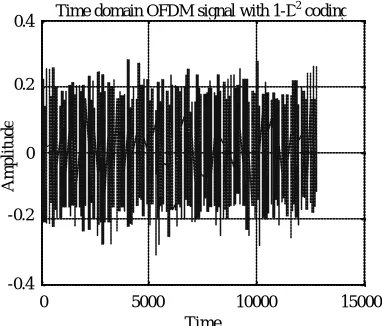
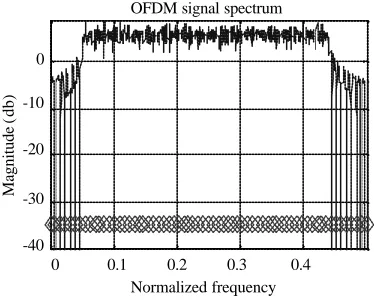
[image:3.612.319.512.308.462.2]It can be seen that the bit error rate could be reduced by 5% using this new technique and the spectral efficiency could be improved by 7%. The effect of PRC in time domain has not been analyzed previously for OFDM systems. Here, Class IV PRC scheme is used. This technique is well known for its simplicity and useful Table 1: Simulation parameters
Simulation Conventional Proposed parameters system system1
No: of carriers 50 50
IFFT size 128 128
Signal mapping BPSK BPSK Symbols/ carrier 100 100 Cyclic 10 samples per
prefix length symbol period ---Correlation polynomial used --- 1-D2
Fig. 2: Time domain shape of OFDM using 1-D coding2
Fig. 3: Time domain shape of OFDM
Fig. 4: Spectrum of OFDM using 1-D coding2
spectral shapes. Figure 2-5 show the time domain shapes and spectra of partial response coded OFDM and
0
5000
10000
15000
0.4
0.2
0
-0.2
-0.4
0 5000 10000 15000 Time
Amplitude
OFDM time domain signal 0.4
0.2
0
-0.2
-0.4
0 5000 10000 15000 Time
Amplitude
Time domain OFDM signal with 1-D2 coding
-40 -30 -20 -10 0
Signal spectrum with 1-D2 coding
Magnitude (
db)
Normalized frequency 0 0.1 0.2 0.3 0.4 0
-10
-20
-30
[image:3.612.322.511.509.660.2] [image:3.612.72.298.633.722.2]Fig. 5: Spectrum of OFDM the total symbol period for the conventional
Fig. 6: Comparison of Bit error rate of the Conventional Jayakumari, J. and Sakunthala S. Pillai, 2006. A new and proposed systems approach for error rate reduction in OFDM systems. conventional OFDM signals. Figure 6 shows the plot of Jayakumari, J. and S.S. Pillai, 2007. BER Performance of bit error rate for the proposed and conventional Partial Response Coded OFDM System in Rician systems in Rayleigh fading channel. This figure Fading Channels. In: Proc. NCTC, pp: 24-28. shows the robustness of the proposed signaling Jayakumari, J. and S.S. Pillai, 2007. Improved OFDM
technique. Transmission over Fading Channels. In: Proc. IEEE.
CONCLUSION pp: 326-330.
The performance of OFDM transmission along with Scheme for OFDM Transmission over Multipath three level partial response coding scheme is analyzed. Fading Channels. In: Proc. ICACC. Int. Conf. One of the merits of PRC is that the controlled interference Madurai, India, pp: 554-557.
can be used to shape the system spectrum. Also, this Jayakumari, J. and S.S. Pillai, 2005b. Performance of spectral shaping makes the system less sensitive to timing multicarrier OFDM systems. In: Proc. 36th IETE errors and allows the practical systems to transmit at the Midterm Symp., pp: 347-352.
Nyquist rate. The conventional OFDM systems use cyclic Peter Kabal and B. Pasupathy, 1975. Partial response prefix to overcome interference which in turn reduce the
spectral efficiency. The proposed system is simulated without adding the cyclic prefix. This leads to maximum
spectral efficiency. In addition, since no channel equalization is needed for reducing ISI, the proposed scheme is easy to implement without increasing system complexity. Therefore, this is a promising approach for OFDM systems working in a mobile radio environment. Our new method is very promising for wireless high speed data transmission where spectral efficiency is important.
Using this new simple coding technique, for the simulation parameters listed in Table 1, we could improve the spectral efficiency by 7% compared to the conventional system with cyclic prefix. For practical cases in wireless environment for avoiding ISI and ICI, the cyclic prefix length should be almost 40% of OFDM system whereas if PRC is used along with the OFDM system, this cyclic prefix can be avoided and in such cases, high spectral efficiency could be achieved.
REFERENCES
Cimini, L.J., 1985. Analysis and simulation of a digital mobile channel using orthogonal frequency division multiplexing. IEEE Trans. Commun., 33: 665-675.
Jayakumari, J. and Sakunthala S. Pillai, 2005a. Orthogonal frequency division multiplexing. In: Proc. Kerala Sci. Congress, pp: 139-142.
In: proc. 37th IETE MTS:ICTIRD, pp: 23-I.
ICSCN. MIT Campus, Anna University, India, Jayakumari, J. and S.S. Pillai, 2007. Optimal Coding
signaling. IEEE. Trans. Commun., pp: 23.
Proakis, J.G., 1995. Digital Communications. 3rd Edn. New York: McGraw- Hill.
0 0.1 0.2 0.3 0.4
-40 -30 -20 -10 0
OFDM signal spectrum
0 0.1 0.2 0.3 0.4 Normalized frequency 0
-10
-20
-30
-40
Magnitude (
Simon, H. and Lindsey, 2003. Digital Communication Zhao, Y. and S.G. Haggman, 2001. Intercarrier interference Techniques: Signal Design and Detection, Prentice self-cancellation scheme for OFDM mobile
Hall, India. communication systems. IEEE. Trans. Commun.,
Zhao, Y. and S.G. Haggman, 1998. Intercarrier 49: 1185-1191.
interference compression in OFDM system Zhang, H. and Y. Geoffrey, 2003. Optimum frequency communication by using correlative coding. IEEE. domain partial response encoding in OFDM system.