Original citation:
Cullen, Mairi Ann, Cullen, Stephen Michael and Lindsay, Geoff (2017) A better start
implementation evaluation workstream report 1 - learning from the bid development phase.
Coventry: Warwick Consortium ; National Lottery.
Permanent WRAP URL:
http://wrap.warwick.ac.uk/90062
Copyright and reuse:
The Warwick Research Archive Portal (WRAP) makes this work by researchers of the
University of Warwick available open access under the following conditions. Copyright ©
and all moral rights to the version of the paper presented here belong to the individual
author(s) and/or other copyright owners. To the extent reasonable and practicable the
material made available in WRAP has been checked for eligibility before being made
available.
Copies of full items can be used for personal research or study, educational, or not-for-profit
purposes without prior permission or charge. Provided that the authors, title and full
bibliographic details are credited, a hyperlink and/or URL is given for the original metadata
page and the content is not changed in any way.
A note on versions:
The version presented in WRAP is the published version or, version of record, and may be
cited as it appears here.
Acknowledgements
The authors would like to thank the people in the five A Better Start areas (Blackpool, Bradford, Lambeth, Nottingham and Southend) who gave so generously of their time to be interviewed about their involvement in the development of their area’s bid to the Big Lottery Fund’s programme, A Better Start. Without their participation, there would have been no report. We extend our thanks also to the administrative staff in these five areas who helped to organise the logistics of the interview dates, times and locations.
We would also like to thank our research secretaries in CEDAR who transcribed the interviews so expertly.
This report is an output of the Warwick Consortium A Better Start Evaluation, funded by Big Lottery Fund. The views expressed are therefore those of the authors and not necessarily those of the Big Lottery Fund.
Contents
Executive summary ... v
1.
Introduction ... 1
1.1
A Better Start ... 1
3.1
The Warwick Consortium evaluation ... 3
3.2
The implementation evaluation ... 3
1.3.1
Overall approach: the Quality Implementation Framework ... 5
1.3.2
An Interactive Systems Framework ... 7
1.3.3
Phase 1: Participatory action research (formative evaluation) ... 8
1.3.4
Phase 2: Implementation evaluation ... 8
1.4
The structure of this report ... 9
2.
Evaluating the bid development phase ... 10
2.1
The bid development process ... 10
2.1.1
A staged process ... 10
2.1.2
How the bid development process mapped on to the Quality
Implementation Framework ... 12
2.2
The data collected about the bid development phase ... 12
2.3
Analysis of the data ... 13
2.4
Learning from the evaluation of the bid development phase ... 14
3.
Learning themes (i) – mainly relating to Steps 1-4 of
Quality Implementation Framework ... 15
3.1
Spread the word that implementation is as important as the
intervention ... 15
3.2
Engage and motivate using the A Better Start concept and
vision ... 16
3.3
Articulate how a ward-based investment will benefit the whole
area ... 19
3.4
Keep questioning, listening and learning together ... 25
3.5
Attend to (changing) context: mitigate against known risks to
4.
Learning themes (ii) – mainly related to Steps 5-8 in
Quality Intervention Framework ... 40
4.1
Lead and maintain the partnership ... 40
4.2
Change the culture ... 51
4.3
Build on known strengths ... 55
4.4
Be part of the system you want to change ... 56
4.5
Induct new staff into the A Better Start vision and
understandings ... 57
4.6
Summary ... 58
5.
Taking stock of the implementation process ... 59
5.1
Use the Quality Implementation Framework to help
communicate progress to stakeholders and to manage their
expectations around delivery ... 59
5.2
Make use of programme-level capacity building activity ... 60
5.2.1
Negotiate local fit into programme-level capacity building activity ... 60
5.2.2
Take what works from external support ... 61
5.2.3
Learn from others’ previous relevant experience ... 67
5.2.3
Provide financial resources to create necessary capacity ... 68
5.3
Continue to be reflective ... 72
5.4
Summary ... 73
6.
Next steps in relation to our Research Questions ... 74
7.
Conclusion ... 75
8.
Recommendations ... 76
8.1
Learning themes from Chapter 3 ... 76
8.2
Learning themes from Chapter 4 ... 77
8.3
Learning themes from Chapter 5 ... 77
Appendix One: Stages and timeline of the bid development
phase ... A1
Appendix Two: Important questions to answer at each step in
List of figures
Figure 1: The three levels of implementation encompassed in the evaluation... 4
Figure 2: Implementation evaluation in the
A Better Start
timeline ... 4
Figure 3: Relating the Quality Implementation Framework (Meyers et al, 2012)
to our implementation evaluation ... 5
Figure 4: The Quality Implementation Framework ... 6
Figure 5: The development support provided by the Big Lottery Fund through
the Social Research Unit during Stage 2:'Better Evidence for a Better Start' ... 11
Figure 6: The main topics structured in to the interviews ... 13
Figure 7: Workforce development: focusing on the 'how' of delivery ... 16
Figure 8: The A Better Start vision: engaging and motivating aspects ... 18
Figure 9: Selecting the wards: how it was done at the Expression of Interest
stage ... 20
Figure 10: Examples where particular strengths in local data supported ward
selection decision-making... 21
Figure 11: Area-wide benefits as a result of the work done on the bid ... 22
Figure 12: Area-wide benefits planned and predicted as a result of the work
done on the bid ... 24
Figure 13: Structures for bringing people together across role and hierarchical
boundaries ... 25
Figure 14: Example 1 of how and when parents were involved ... 26
Figure 15: Example 2 of how and when parents were involved ... 27
Figure 16: Example 3 of how and when parents were involved ... 28
Figure 17: Examples of new learning from listening to parents' views ... 29
Figure 18: New learning from bringing people together across role and
hierarchical boundaries ... 30
Figure 19: New learning from bringing people together for the strategy days ... 31
Figure 20: The spectrum of local fit with the A Better Start framework ... 33
Figure 21: Being proactive about population churn
within
a local authority ... 34
Figure 22: Contrasting consequences of public service budget cuts on two bid
development partnerships ... 36
Figure 23: The five core approaches within an overall public health-informed
model ... 38
Figure 26: Example where the handover of leadership resulted in a change in
balance of power ... 42
Figure 27: Purpose and audience for appreciative inquiry event held between
Expression of Interest and Stage 1 ... 43
Figure 28: Definitions of 'community' relevant to
A Better Start
... 44
Figure 29: Basic structures of partnership at Stages 1 and 2 in each of the five
areas ... 45
Figure 30: Composite list of what worked well about building the partnerships ... 46
Figure 31: Community engagement: example of engaging schools through
pupils' views ... 47
Figure 32: A voluntary sector-led approach to engaging parents ... 48
Figure 33: A public sector-led approach to engaging parents... 49
Figure 34: Understanding the population in order to engage parents ... 51
Figure 35: Beginning to embed necessary culture change: vignette from one
area ... 54
Figure 36: Composite list of local strengths mentioned during interviews ... 55
Figure 37: Examples of signalling that
A Better Start
was about integrated
systems ... 57
Figure 38: Summary of four approaches to leverage and the concept of a
partnership bank ... 62
Figure 39: What was valued about the strategy days ... 66
Figure 40: Critical success factors relating to the associate role ... 67
Figure 41: Learning from others' relevant experience... 67
Figure 42: Uses of the development funding: To obtain buy-in and foster a
supportive community climate (Step 5 of Quality Implementation Framework) ... 69
Figure 43: Uses of the development funding: To build general/organisational
capacity (Step 6 of Quality Implementation Framework) ... 70
Figure 44: Uses of the development funding: To buy pre-innovation staff
training (Step 8 of Quality Implementation Framework) ... 71
Figure 45: Interviewees' learning themes carried from bid development to
inform implementation ... 72
Figure 46: (A1): The stages and timeline of the
A Better Start
bid development
process ... 1
Executive summary
1.0 Introduction
1.1
A Better Start
The Big Lottery Fund is investing £215 million over 10 years (from 2015 to 2025) in the ‘Fulfilling Lives: A Better Start’ programme (referred to throughout as A Better Start). A Better Start is designed to enable different models of effective preventative services to be implemented and tested out locally in the five selected areas:
Blackpool
Bradford
Lambeth
Nottingham
Southend
The five A Better Start areas are each made up of specific wards with a population of 30-70000 people
where there is evidence of deprivation and high levels of need amongst children, as measured by, for example, data on child poverty, low birth weight births, child development at age 5 and obese children at Year 6.
A Better Start focuses on pregnancy and the first three years of life. In particular, it aims to create
population-level improvements in the life chances of children through the investment being spent on the
design and delivery of preventative interventions implemented collaboratively across health and other public services and the voluntary, community and social enterprise (VCSE) sector. It focuses on three
outcome domains: social and emotional health; nutrition; communication and language development. The
fourth desired outcome is long term systemic change in the way that local health, other public services and the VCSE sector work together to improve outcomes for children.
1.2 Evaluation and learning
The Big Lottery Fund appointed the Warwick Consortium to undertake the evaluation and learning
contract for A Better Start. The Consortium is led by Professor Jane Barlow, University of Warwick, and
comprises a team from the Universities of Warwick, Oxford, Imperial College, King’s College London (KCL), Glasgow, and Durham; Ipsos MORI; Bryson Purdon Social Research; and ECORYS.
The purpose of the evaluation and learning contract is to ensure that the lessons in terms of what works,
Workstream 2: Impact and economic evaluation of the area programmes
Workstream 3: Learning and dissemination.
1.2.1
Workstream 1: The implementation evaluation
This report is the first from Workstream 1, the implementation evaluation. In this context,
“implementation” means “the putting into practice of A Better Start”, i.e. the whole process of making it happen, from planning onwards. This is a different and wider definition of “implementation” than is used by the Big Lottery Fund in its terminology of “implementation and embedding phase”. In that context, “implementation” is viewed as happening prior to “full delivery”, and is limited to the period during which first interventions are piloted and begin to move beyond piloting to roll out.
The implementation evaluation is concerned with three aspects of how A Better Start is put into practice:
how the overall A Better Startprogramme is implemented (the overview); how it is implemented in each of
the five areas (the case studies); and how individual interventions (portfolio projects) are implemented in
each area.
The implementation evaluation work has two phases. Phase 1 (of which this report is the first) is underpinned by a participatory action research approach. Also known as formative evaluation, this approach involves the researchers feeding back to the funder and the intervention sites’ findings from the
evaluation during the study so that the intervention can be optimised. The aim of Phase 1 is to work with
all the relevant A Better Start partners to ensure that the learning from the evaluation is used to support
high quality implementation of A Better Start across the five sites.
The three research questions guiding the first phase are:
1 Beginning of the programme? (i.e. prior to A Better Start).
2 What planning procedures were undertaken in order to set up and implement the programme?
3 What was the nature of the relationship between the A Better Start areas and the external support available (e.g. from the Social Research Unit) during the bid development phase, the grant set-up phase and the implementation and embedding phase (Years 1 and 2)?
These questions will enable later exploration of which factors were associated with the effective implementation of the programme in the delivery phase (from Year 3).
In Phase 2 (from April 2017), two methodologies, process evaluation and context-mechanism-outcome
(CMO) profiling, will be used in order to identify how well services have been constructed and delivered,
especially taking into account joined up service delivery, within each of the five A Better Start areas, as
well as the critical success factors for practice and systems necessary for wider replication and taking to
The overall approach of the implementation evaluation has been informed by the Quality Implementation
Framework (Meyers, Durlak and Wandersman, 20121), which comprises a synthesis of 25 other
implementation frameworks.
1.2.2
This report
This report focuses on learning from activity in the five successful areas relating to the development of their winning bid for funding from the Big Lottery Fund’s Fulfilling Lives: A Better Start grant. The bid development process took place over 18 months from January 2013 to June 2014, including three competitive stages: Expression of Interest; Stage 1 (longlist of 40) and Stage 2 (shortlist of 15).
This report addresses parts of our Research Questions 2 and 3.
The method used was semi-structured interviews. Twenty-four interviews were carried out with 35 people
across the five sites who had been involved as part of the core team developing their respective area’s
bid. The interviews were held during autumn 2014. They were mainly conducted face-to-face. A small number were done over the telephone. The interview questions covered set topics but also enabled and encouraged interviewees to raise other issues and topics if they so desired.
Transcriptions of the interviews were analysed thematically, using both the themes we had structured in
to the interviews, and additional themes raised by interviewees. We then considered the data in the light of the Quality Implementation Framework (Meyers, Durlak and Wandersman, 2012) and identified implications for learning to support the continuing implementation process.
2.0 Main Findings
The main findings are organised here by the chapter in which they appear in the main report and with topic sub-headings. The findings are derived mainly from analysis of interview data. As such, they encapsulate the range and relative balance of the perceptions, experiences and opinions shared during the interviews. Area bid documents were also drawn upon.
2.1
Main findings reported in Chapter 3
The importance of implementation
The 18-month bid development phase enabled those involved in it to understand that positive
The vision for A Better Start
Across all five areas, and all interviewees, it was clear that the A Better Start vision, as articulated by
the Big Lottery Fund in its call for Expressions of Interest and afterwards, motivated people to get involved. The focus on better lives for children, the concept of early intervention expressed as getting it right from the start; the focus on prevention and universal provision within the A Better Start wards; and the focus on evidence-based practice were reported as being especially engaging.
The wards within the areas
The selection of the wards, which were to be the focus of A Better Start in each area, was a critical
decision, taken during the Expression of Interest stage. To a large extent, selection was driven by data on local need but other issues, such as local politics and population diversity, were also taken in to account where appropriate.
Each of the five areas provided at least one example of how the bid development work, focused on
the selected wards, had led to learning that informed area-wide good practice.
New understanding of local need
Professionals involved in the bid development reported working in new ways to create spaces and
ways to bring together a wide range of people (including local parents) to be involved in planning and decision-making regarding the bid. This was viewed as having led to new understanding about local needs and strengths, and to new learning about the local community that informed each area’s respective bid.
The collection and review of local data required by the bid development process was reported to have
led, in some areas, to new awareness of local needs, and of the need to change the priorities for spending public money locally.
Local context
The specific local contexts in the five areas were taken into account in the planning developed through the bid development phase. ‘Local fit’ was viewed as important.
Interviewees were very aware that their A Better Start programme would take place in the specificity
of their local context; and that that context would change over time.
Contextual issues relating to local populations that were discussed varied by area but included rapid
population turnover and/or population movement around the LA and/or changes in the ethnic compositions of local populations.
Other contextual issues mentioned related to changes made to central and/or local government
Different core approaches
Area bid documents showed that the different areas adopted different core ‘approaches’ within their
overall, public health-informed, models. Interviews indicated that, to a greater or lesser extent in different areas, there were tensions within the partnership around competing views/visions for the core model.
2.2
Main findings reported in Chapter 4
Leadership
The processes described as having been used to select a voluntary sector organisation to lead the partnership varied from open (advertised nationwide) to closed (one organisation approached).
The handover of leadership from LA (at Expression of Interest stage) to VCSE organisation (from
Stage 1) was perceived as having worked well overall.
Four benefits of having a VCSE sector organisation as lead partner were reported:
- Ability to create/build on strong links to local community groups and families.
- Ability to create/build on strong relationships with local universal and targeted services.
- Ability to offer challenge to the statutory sector from a position of lead partner (i.e. ‘insider’) with a VCSE sector viewpoint (i.e. ‘outsider’)2
.
- Necessity of LA relinquishing some power to the wider partnership in support of systemic change.
Partnership
Interviews and bid documents indicated that a substantial amount of work was done to build the
implementation partnerships during the bid development phase.
During Stage 2, interviews indicated that partnership-building was strongly influenced by the Social
Research Unit’s governance model, as described in a Better Evidence for a Better Start3
methodology paper. That paper specified the need for an area partnership of 12 to 20 members collectively accountable for a local strategy. It also specified that each area should engage
community representation.
Overall, the partnerships were viewed as having worked well, supported by the requirement to have a
Engaging parents and community
Interviews indicated that, during the bid development process, each area created structured ways of
successfully fostering community engagement and involving parents.
Some areas reported successfully involving more parents (fathers as well as mothers) than others. Interviewees described the efforts made to reach out to different segments of the parent population.
Culture change
All five areas were aware of the challenge involved in implementing A Better Start. Two big cultural
changes were perceived as being required: embedding a prevention focus and embedding the use of evidence-based practice.
There was some evidence that these cultural changes had begun during the bid development phase.
Each area described local experience and resources that could be drawn on to support the process
of changing the culture.
System change
Each area reported successfully achieving senior leadership commitment to the aim of making
systemic changes to the ways in which the public sector worked with the VCSE sector in order to deliver high quality services to improve outcomes for children.
2.3
Main findings reported in Chapter 5
Programme-level support
The Big Lottery Fund commissioned development support and provided development funding to all
shortlisted areas: this was valued by interviewees across all five areas,
Engaging with the development support commissioned from the Social Research Unit was a
requirement of Stage 2 of the process. In all five areas, the Social Research Unit guidance informed:
- The governance structures put in place.
- The commitment to leverage (i.e. a systematic shift in public spending towards prevention,
evidence-based interventions, and young children).
- The way in which existing spending was mapped to create a baseline from which any such shift
could be measured.
- The way in which the area strategy was developed.
The development funding was spent on capacity-building activity, including activity reported as having resulted in:
- Gaining buy-in from professionals and communities to the vision for A Better Start.
- Removing practical barriers to parent engagement.
- Enhancing the bid development team.
- Improving communication amongst partners.
- Improving skills.
- Improving infrastructure.
- Pre-innovation training.
In addition to the staffing and activities it paid for, the development funding was perceived as having
given a psychological boost to local communities which increased engagement.
Carrying learning from the bid development phase forward into implementation
All interviewees spoke about learning from the bid development phase that would continue to be
influential during the implementation of A Better Start.
3.0 Conclusions
On the basis of the evidence presented in this report, we conclude that the bid development phase was
an important investment in planning for high quality implementation of A Better Start in the five successful
areas. It enabled all five areas to create partnerships across local authority (especially Early Years4 and
4.0 Recommendation
On the basis of our reflections on the evidence presented in this report, we make the following recommendations with regard to learning themes.
4.1 Learning themes from Chapter 3
Spread the word that implementation is as important as the intervention
- Those involved in the bid development process need to ensure that they pass on to new staff, partners and beneficiaries the understanding they gained of how important quality implementation is in order to achieve positive outcomes from interventions.
Engage and motivate using the A Better Start concept and vision
- The power of the vision should be kept central to all activity and used to engage and motivate new staff, existing staff, partners and beneficiaries.
Articulate how a ward-based investment will benefit the whole area
- Attention needs to be paid to how the investment in specific wards is communicated and justified
to the wider population in the local area.
- Ensure relevant data is collected and used to support quality implementation and to provide a basis for operational and commissioning decisions.
Keep questioning, listening and learning together
- It is worth continuing to coproduce the work of planning and implementation with local mothers,
fathers and grandparents and to continue to bring people together across role, hierarchical and organisational boundaries to coproduce new solutions to entrenched issues and new challenges.
Attend to (changing) context
- Mitigate against known risks to outcomes from the start.
- Repeat implementation steps as necessary when change happens.
- The systematic collection and use of relevant data can lead to new understandings of local need.
- Consider the local fit of any innovation and make appropriate local adaptations if required.
- Tensions within any partnership during the bid development phase, underpinned by differing professional or organisational identities, should not be ignored as they are unlikely to disappear. Continued discussion and coproduction should diminish them.
4.2 Learning themes from Chapter 4
Lead and maintain the partnership.
- Early decisions about the leadership are likely to have ramifications throughout the programme.
Obtaining explicit buy-in from critical stakeholders and fostering a supportive
community/partnership climate5 will be an important and continuing leadership task requiring structured ways of doing so.
- Engaging the beneficiary parents requires specific skills which has implications for workforce
development and the skill-mix of core team staff.
- Avoid generalising to ‘the community’ or to ‘parents’ on the basis of small numbers of parent representatives.
- Ensure fathers’ views, as well as mothers’ views, are expressly canvassed and included.
Change the culture (towards prevention and early intervention and use of evidence).
- Each A Better Start area will need to invest effort, time and resources in ensuring that all stakeholders understand why this culture change needs to happen and that it will mean things being done differently.
Build on known strengths.
- Local capacity-building activity and work towards culture change is likely to benefit from
acknowledging and learning from local experience and resources.
Be part of the system you want to change.
- In each area, A Better Start must guard against becoming, or being viewed as, a ‘project’ that is
happening on its own, separate from the wider systems across the local area that it seeks to change.
Induct new staff into the A Better Start vision and understandings.
- Induction support is required to ensure that the vision and learning that has led to new knowledge
4.3 Learning themes from Chapter 5
Use the Quality Implementation Framework to help communicate progress to stakeholders and to
manage their expectations around delivery.
- Use the Framework to help explain that, of necessity, the stage of implementation of the overall
programme will be in advance of the stage of implementation of area plans. These area plans will, in turn, be in advance of the implementation stage of specific interventions on the ground, at least for a time.
Make use of programme-level capacity building activity.
- Because it is designed to improve the implementation of the overall programme, all five sites should continue to make use of programme-level capacity-building support offered by the Big Lottery Fund to support implementation in their respective areas.
Negotiate local fit into programme-level capacity building support.
- Each area is a unique setting and so it makes sense that consideration should be given to
negotiating with external providers as to what, if any, local adaptation may be made to capacity-building support to ensure local fit.
Take what works from external support.
- Experience from the bid development phase showed that all of the areas reported benefits to a greater or lesser extent of the capacity-building support offered.
Learn from others’ previous relevant experience.
- Use the expert knowledge available to A Better Start teams to feed in to local implementation of A
Better Start the lessons from others’ previous relevant experience (e.g. from Sure Start, from WAVE Trust, from Family Nurse Partnership).
Provide financial resources to create necessary capacity to do implementation well.
- Learning from the uses of the development funding at Stage 2 suggests that other grant
makers/funders of innovations should also provide financial resources to create the capacity to do implementation well.
- It also suggests that implementation leaders in each of the five areas need to provide the delivery
teams with the financial resources necessary to build the capacity required to do implementation well.
Continue to be reflective.
- In addition to learning from others’, learning from each area’s own experience over time will also
1.
Introduction
This is the first report (of what is planned to be a series of reports) sharing findings from the evaluation of the implementation of A Better Start. From the point of view of the evaluation team, “implementation”
means “the process of putting into action the plan for A Better Start”, i.e. the whole process of making the
programme happen on the ground, from planning onwards, all the way through to the end. The work is
focused on three areas: how the overall A Better Startprogramme is implemented (the overview); how it
is implemented in each of the five areas (the case studies); and how individual interventions (portfolio projects) are implemented in each area.
This is a different and wider definition of “implementation” than is sometimes used, including by the Big
Lottery Fund in its terminology relating to A Better Start. For example, the Big Lottery Fund refers to the
“implementation and embedding phase”. In that context, “implementation” is viewed as a phase of the programme happening prior to “full delivery”, and is limited to the period during which first interventions are piloted and begin to move beyond piloting to roll out. For the Big Lottery, “implementation” of interventions in A Better Start means:
“Using evidence on what works from implementation science to effectively bridge the gap between science and practice to ensure that interventions shown to be effective elsewhere produce similar outcomes when implemented in our local sites. Where interventions are innovative we use the same principles to ensure that they are put into practice and monitored effectively to test their effectiveness in improving outcomes for children. (A Better Start definitions document, June 2016)
This first implementation evaluation report is intended to be of formative6 use to the five A Better Start areas and/or of use to a wider audience interested in implementation science.
In this chapter, we introduce the A Better Start programme and the Warwick Consortium appointed to evaluate it. We provide an overview of how the evaluation is structured before setting out, in more detail, information about its implementation workstream. The chapter closes with an overview of the structure of the report.
1.1
A Better Start
The Big Lottery Fund is investing £215 million over 10 years (from 2015 to 2025) in the ‘Fulfilling Lives: A
Better Start’ programme (referred to throughout as A Better Start). A Better Start aims to ‘deliver a step
change in the use of preventative approaches for babies and children from pregnancy to three years of age’7
. It is designed to enable different models of effective preventative services to be implemented and tested out locally in the five selected areas: Blackpool, Bradford, Lambeth, Nottingham and Southend.
The five A Better Start areas are each made up of specific wards with a population of 30-70000 people
example, data on child poverty, low birth weight births, child development at age 5 and obese children at Year 6.
A Better Start focuses on pregnancy and the first three years of life. In particular, it aims to create
population-level improvements in the life chances of children through the investment being spent on the
design and delivery of preventative interventions implemented collaboratively across health and other public services and the voluntary, community and social enterprise (VCSE) sector in three outcome domains:
Social and emotional health.
Nutrition.
Communication and language development.
The rationale for focusing on “population-level improvements” is that:
Focusing solely on the most disadvantaged will not reduce health inequalities sufficiently. To reduce the steepness of the social gradient in health, actions must be universal, but with a scale and intensity that is proportionate to the level of disadvantage. (A Better Start definitions document, ‘proportionate universalism’, June 2016)
The fourth desired outcome is long term systemic change in the way that local health, other public services and the VCSE sector work together to improve outcomes for children. “Systems change” has
been defined by the Big Lottery Fund in the context of A Better Start as meaning:
“Changes in organisational culture, policies and procedures within individual organisations or across organisations that enhance or streamline access and reduce or eliminate barriers to needed services by a target population. For A Better Start, this means a shift in culture and spending across children and families agencies towards prevention. That local health, public services, VCSE and the wider community work together to coproduce and deliver less bureaucratic, more joined up services that are prevention focused and needs and demand led.
Services that work with the whole family effectively to improve outcomes for children.” (A Better
Start definitions document, June 2016)
The Big Lottery Fund stated8 that, through the investment made in each of the five areas, these areas must:
Give disadvantaged and vulnerable children a better start in life.
Reduce the costs of dealing with later health and social problems.
Harness the skills, commitment and resources of VCSE, health and local authority practitioners and sector leaders working together.
Provide effective, sustainable and scalable preventative approaches in pregnancy and very early
life.
8
In order to have the best chance of delivering the aims of the programme, there is a strong emphasis on the use of interventions that have evidence of their efficacy from rigorous trials, particularly randomised controlled trials (RCTs), and especially where there is accumulated evidence of efficacy and effectiveness in community settings. Where new interventions (without prior evidence of effectiveness) are to be implemented, these must be based on sound theory and must be locally evaluated.
1.2 The Warwick Consortium evaluation
The Big Lottery Fund appointed the Warwick Consortium to undertake the evaluation and learning
contract for A Better Start. The Consortium is led by Professor Jane Barlow, University of Warwick, and
comprises a team from the Universities of Warwick, Oxford, Imperial, King’s College London (KCL), Glasgow, and Durham; Ipsos MORI; Bryson Purdon Social Research; and ECORYS.
The purpose of the evaluation and learning contract is to ensure that the lessons in terms of what works,
for whom and why are identified and widely disseminated. This fits the definition of the purpose of a ‘realist evaluation’ (Pawson and Tilley, 1997; 2004):
Such evaluation has an explanatory quest – programme theories are tested for the purpose of refining them. The basic question asked [...] is thus multi-faceted. Realist evaluations ask not, “What works?” or “Does this programme work?” but ask instead, “What works for whom in what circumstances and in what respects, and how?” (Pawson and Tilley, 2004, p2)
To provide answers to these questions, the Warwick Consortium evaluation involves three workstreams:
Workstream 1: Implementation evaluation of the set-up and delivery of the programme.
Workstream 2: Impact and economic evaluation of the area programmes.
Workstream 3: Learning and dissemination.
This report is the first from Workstream 1, the implementation evaluation. We now describe Workstream 1 in more detail to give a context for our first findings.
1.3 The implementation evaluation
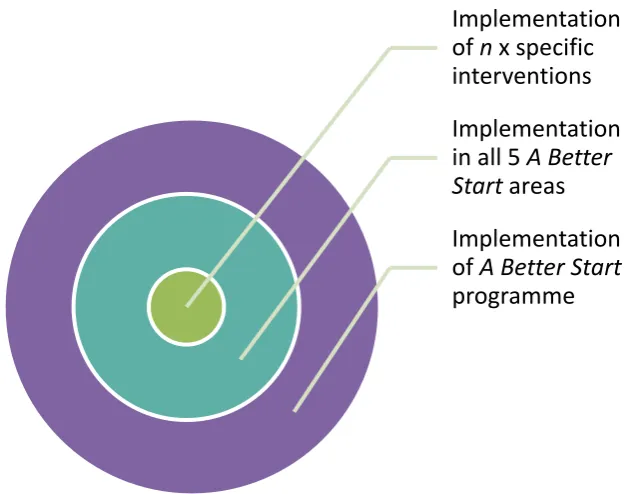
The implementation evaluation workstream encompasses three levels of implementation (Figure 1):
Programme level: the overall A Better Startprogramme (the overview).
Figure 1: The three levels of implementation encompassed in the evaluation
The implementation evaluation work has two phases: Phase 1 (lasting two years) and Phase 2 (lasting
seven years). Figure 2 shows how the implementation evaluation relates to the A Better Start timeline and
terminology.
Figure 2: Implementation evaluation in the
A Better Start
timeline
A Better Start timeline Phases of our implementation evaluation
Development phase:
Expression of Interest
Stage 1 application
Stage 2 application
Grant set-up:
July 2014 – March 2015
Implementation and embedding phase:
Year 1: April 2015-March 2016 Year 2: April 2016 – March 2017
Phase 1
Participatory action research (formative evaluation) – interviews, focus groups, surveys
Delivery phase:
Year 3: April 2017
to
Year 9: April 2023 - March 2024
Phase 2
Implementation evaluation (analysis of process data) – interviews, surveys, document analysis, monitoring data
Implementation
of
n
x specific
interventions
Implementation
in all 5
A Better
Start
areas
Implementation
of
A Better Start
1.3.1
Overall approach: the Quality Implementation Framework
The overall approach of the implementation evaluation has been informed by the Quality Implementation
Framework (Meyers, Durlak and Wandersman, 20129), which comprises a synthesis of 25 other
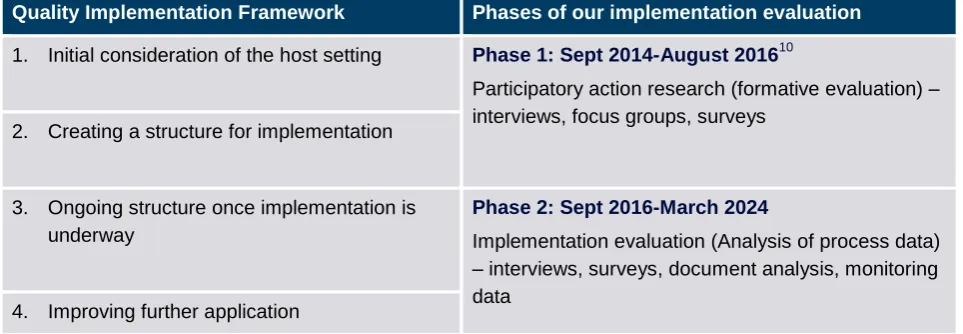
implementation frameworks. The Quality Implementation Framework has four stages that we relate to the two Phases of our implementation evaluation (see Figure 3).
Figure 3: Relating the Quality Implementation Framework (Meyers et al, 2012) to our
implementation evaluation
Quality Implementation Framework Phases of our implementation evaluation
1. Initial consideration of the host setting Phase 1: Sept 2014-August 201610
Participatory action research (formative evaluation) – interviews, focus groups, surveys
2. Creating a structure for implementation
3. Ongoing structure once implementation is underway
Phase 2: Sept 2016-March 2024
Implementation evaluation (Analysis of process data) – interviews, surveys, document analysis, monitoring data
4. Improving further application
Source: Based on Warwick Consortium: Fulfilling Lives: A Better Start evaluation and learning contract bid
The essence of the Quality Implementation Framework is that it encapsulates the way in which the
implementation process can be, “viewed systematically in terms of a temporal series of linked steps that
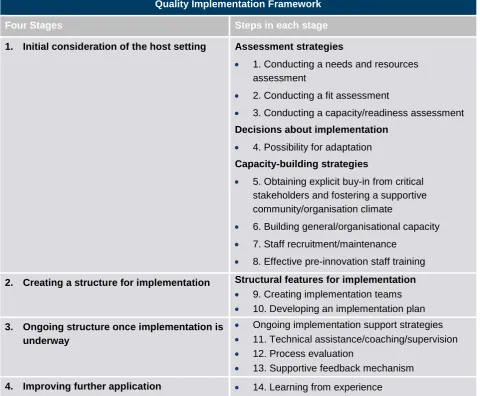
[image:22.595.65.547.189.356.2]Figure 4: The Quality Implementation Framework
Quality Implementation Framework
Four Stages Steps in each stage
1. Initial consideration of the host setting Assessment strategies
1. Conducting a needs and resources
assessment
2. Conducting a fit assessment
3. Conducting a capacity/readiness assessment
Decisions about implementation
4. Possibility for adaptation
Capacity-building strategies
5. Obtaining explicit buy-in from critical
stakeholders and fostering a supportive community/organisation climate
6. Building general/organisational capacity
7. Staff recruitment/maintenance
8. Effective pre-innovation staff training
2. Creating a structure for implementation Structural features for implementation
9. Creating implementation teams
10. Developing an implementation plan
3. Ongoing structure once implementation is underway
Ongoing implementation support strategies
11. Technical assistance/coaching/supervision
12. Process evaluation
13. Supportive feedback mechanism
4. Improving further application 14. Learning from experience
Source: Myers, D.C., Durlak, J.A., Wanersman, A. (2012).
It is important to note that the first two stages occur before implementation begins: they represent the necessary preparatory work to support quality implementation. Of the 14 steps, 10 occur prior to implementation on the ground.
The framework developers stress that the order of the steps is not rigid; they may vary in practice, “because implementation is a dynamic process” (p474). They state that, depending on the specific context, some steps may need to be revisited, skipped over, or addressed simultaneously.
The Quality Implementation Framework informs our work in evaluating the implementation of the A Better
The overall programme.
Each successful area’s A Better Start.
Specific interventions in each successful area.
Our evaluation of the bid development phase focuses only on the five successful areas11.
1.3.2
An Interactive Systems Framework
A Better Start includes a strong emphasis on the use of evidence-based interventions in the local delivery of the programme in the five areas. The implementation evaluation therefore draws on a framework that is useful for understanding how the gap between what is known about prevention and its use in practice is bridged: the Interactive Systems Framework (Wandersman, Duffy, Flaspohler, Noonan, Lubell, Stillman, Blachman, Dunville and Saul, 2008). The Interactive Systems Framework focuses on, “key elements and
relationships involved in the movement of knowledge of research into practice” (Wandersman et al.,
p174). It consists of three interacting systems, “crucial for the successful dissemination and
implementation of [evidence-based] prevention innovations in practice” (Wandersman et al., p178):
Prevention synthesis and translation system
- That is, activities to synthesise existing research and translate it into products (e.g. journal articles, training manuals, implementation protocols) for use by practitioners in everyday practice.
Prevention support systems
- That is, the external support in place to help the local delivery teams optimise effective, high quality
delivery of the intervention.
- This support may be:
- specific to an intervention (e.g. providing information about the intervention before an organisation decides if it wants to adopt it, providing training on how to deliver the intervention, providing technical assistance once the intervention is being delivered such as further training, coaching, monitoring of fidelity).
- focused on general capacity in an organisation (e.g. effective organisational infrastructure, creating strong partnerships, developing leadership skills).
Prevention delivery system
That is, the capacities of the organisations and individuals that will implement the
programme/intervention/s in a specific community.
- Using innovation-specific capacities; that is, activities such as gathering information about possible interventions to use, choosing which interventions to adopt, knowledge, skills and motivation needed to implement and maintain an intervention over time.
- Using community capacities to identify and address (or prevent) existing problems.
The developers of the Interactive Systems Framework also acknowledge the importance of the broader
context within which dissemination and implementation of evidence-based innovation takes place.
The Interactive Systems Framework informs our evaluation of the specific interventions making up the portfolio of projects in each area’s implementation of A Better Start.
1.3.3
Phase 1: Participatory action research (formative evaluation)
Phase 1, lasting from September 2014 to March 2017, is underpinned by a participatory action research approach. Participatory action research, also known as formative evaluation, involves the researchers
feeding back to the funder and the intervention site/s, findings from the evaluation during the study so that
the intervention (in this case, A Better Start) can be optimised.
The aim of Phase 1 is to work with all the relevant A Better Start partners to ensure that the learning from
the evaluation is used to support high quality implementation of A Better Start across the five sites.
The three research questions guiding this first phase are:
1. What services, organisational structures and monitoring systems were in place at the beginning of the programme? (i.e. prior to A Better Start).
2. What planning procedures were undertaken in order to set up and implement the programme?
3. What was the nature of the relationship between the A Better Start areas and the external support available (e.g. from the Social Research Unit) during the bid development phase, the grant set-up phase and the implementation and embedding phase (Years 1 and 2)?
These questions will enable us to later explore which factors were associated with the effective implementation of the programme during the delivery phase (from Year 3).
This report contributes to answering research questions 2 and 3 above; further reports will also address
these questions. Research question 1 is not addressed here; it will be the focus of a later report.
The Phase 1 methods include stakeholder interviews, focus groups and bespoke surveys.
1.3.4
Phase 2: Implementation evaluation
Phase 2 will begin in April 2017 and run until March 2024. Two methodologies, process evaluation and
context-mechanism-outcome (CMO) profiling, will be used in order to identify how well services have
1.4
The structure of this report
In Chapter 2, we describe the bid development phase of A Better Start, and report on the evaluation data
2.0 Evaluating the bid development phase
In this chapter, we begin by describing what we mean by ‘the bid development phase’. We then describe the evaluation data collected and analysed about that phase.
2.1
The bid development process
The bid development process is outlined here to provide the context for the rest of the report.
2.1.1
A staged process
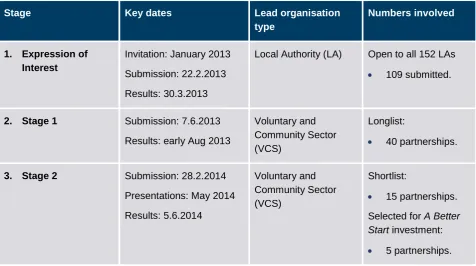
The bid development process for applying to A Better Start took place over 18 months from January 2013
to June 2014, and involved three stages:
Expression of interest.
Stage 1 (long list).
Stage 2 (short list).
At the Expression of Interest stage, the local authority (LA) had to lead on the submission. During that stage, the LA had to identify a voluntary and community sector organisation able and willing to be the lead applicant if invited to submit a Stage 1 application. The Chief Executive Officers (CEOs) of the local authority and of the lead VCSE organisation, as well as the Director of Public Health, had to support and approve the Expression of Interest. The proposed partnership had to involve senior leaders in the LA,
NHS and VCSE sectors. The wards selected to be the proposed A Better Start ‘area’ had to be identified,
along with the rationale for selection. The Expression of Interest also included 750 words on the existing commitment to prevention in these wards and a list of all local organisations and agencies ‘so far identified’ that would play a significant role in the partnership and project, along with an indication of what their contribution would be.
The Stage 1 application had to be led by the VCSE sector partner identified at Expression of Interest stage. The application form asked for specified information in relation to six key questions:
What will your project do?
Why is your project needed?
What difference will your project make?
How will you carry out your project?
Included details of project management, of project costs and the amount requested from the Big
Lottery Fund, and level of development funding requested from the Fund.
Do you have the skills, experience and resources to run your project?
Who will benefit from your project?
The Stage 2 application, also led by the voluntary and community sector partner, was supported by development funding of up to £400,000 for each of the 15 shortlisted sites. This was in addition to
development support commissioned by the Big Lottery Fund from the Social Research Unit (see Figure
5).
Figure 5: The development support provided by the Big Lottery Fund through the Social
Research Unit during Stage 2: 'Better Evidence for a Better Start'
Better Evidence for a Better Start
Three key elements:
1. A governance framework
‘This framework will allow local statutory agencies, voluntary sector organisations, practitioners and parents to share accountability for the design, implementation, monitoring and adaptation of a single strategy for the duration of the investment. It includes a ‘bank’ mechanism – the financial governance arrangements needed to ensure that our investment leverages a systemic shift in existing spending on services towards prevention’
2. Three inputs to inform strategy development
Evidence on what works.
Area needs profiles.
A map of how local funds are spent.
3. Training and support to facilitate the development of a shared vision and strategy
Seminars, webinars and website information from “leading national and international experts and
practitioners in prevention”.
Training for the local partnerships, “on how to think about prevention, how to use a common language
to analyse local solutions to local problems, and how to interpret and apply the ‘inputs’ described above”.
Experienced facilitators to bring the local partnership together to, “analyse the data and evidence and
use it to prepare a detailed prevention strategy” (referred to later as the strategy days).
Each area will have, “access to a highly trained site manager, experienced in using the methodology”
(referred to later as the associate).
Source: Stage 2 applications - Guidance
The documentation required to be submitted for a Stage 2 application was substantial. In addition to the
2.1.2
How the bid development process mapped on to the Quality Implementation
Framework
The work required during the bid development process involved the 15 shortlisted areas in working through at least six of the 10 steps of the first two phases of the Quality Implementation Framework (Steps 1, ‘Conducting a needs and resources assessment’, 2. ‘Conducting a fit assessment, 3. ‘Conducting a capacity/readiness assessment’, 4. ‘Making decisions about implementation, including possibilities for adaptation’, 5. ‘Obtaining explicit buy-in from critical stakeholders and fostering a supportive community/organisational climate’ and 10. ‘Developing an implementation plan’). For this reason, it was important to capture the views, experiences and learning from the process from the five
areas that were successful in achieving investment through the A Better Start programme.
2.2
The data collected about the bid development phase
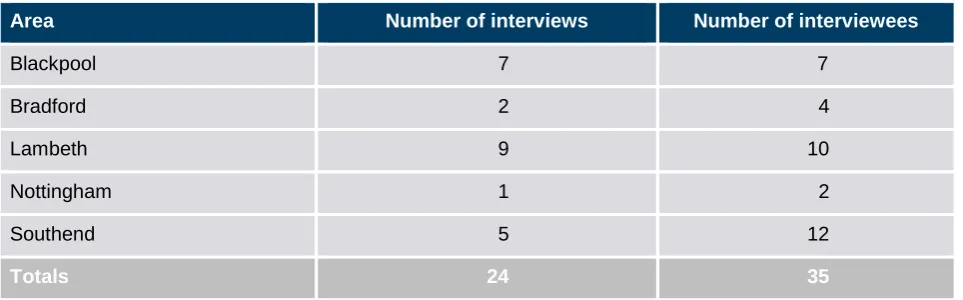
This report focuses on learning from the views and experiences of those closely involved in the bid development process. It is based on analysis of 24 semi-structured interviews with 35 people across the
five A Better Start areas (Table 1). The findings reported encapsulate the range and relative balance of
[image:29.595.66.548.361.511.2]the perceptions, experiences and opinions shared during the interviews. Area bid documents are also drawn upon at times to expand or explain points made in interviews.
Table 1: Number of interviews and interviewees by
A Better Start
area
Area Number of interviews Number of interviewees
Blackpool 7 7
Bradford 2 4
Lambeth 9 10
Nottingham 1 2
Southend 5 12
Totals 24 35
Source: Bid development phase interviews, Autumn 2014
Each site was invited to include in the interviews, ‘the core team of people involved in the bid development’, resulting in varying numbers of interviewees by site (Table 1). These varying numbers of interviewees reflected the reality of differently sized ‘core teams’ involved in developing the bid in each area. Nottingham’s bid, for example, while informed by much wider local consultations (as in all of the areas), was largely developed and written by the two interviewees.
The interviews were held during autumn 2014. Most were conducted face-to-face. A small number were done over the telephone, when that better suited the person interviewed. Site teams and individuals chose whether they wanted to be interviewed on a one-to-one basis, in pairs or in small groups. All three of these formats were used, in accordance with interviewee preference.
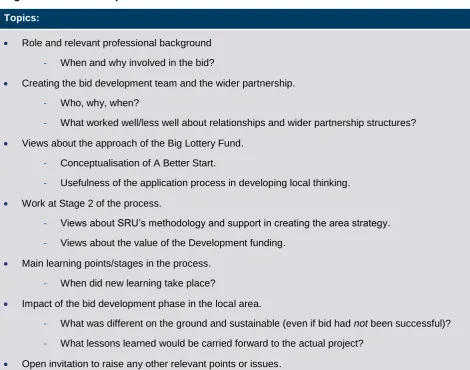
Figure 6: The main topics structured in to the interviews
Topics:
Role and relevant professional background
- When and why involved in the bid?
Creating the bid development team and the wider partnership.
- Who, why, when?
- What worked well/less well about relationships and wider partnership structures?
Views about the approach of the Big Lottery Fund.
- Conceptualisation of A Better Start.
- Usefulness of the application process in developing local thinking.
Work at Stage 2 of the process.
- Views about SRU’s methodology and support in creating the area strategy.
- Views about the value of the Development funding.
Main learning points/stages in the process.
- When did new learning take place?
Impact of the bid development phase in the local area.
- What was different on the ground and sustainable (even if bid had not been successful)?
- What lessons learned would be carried forward to the actual project?
Open invitation to raise any other relevant points or issues.
Source: Bid development phase interviews, Autumn 2014
2.3
Analysis of the data
The interviews were transcribed and then analysed thematically, using both the themes we had structured in to the interviews, and additional themes raised by interviewees. We then considered the data in the light of the Quality Implementation Framework (Chapter 1, section 1.3.1) and identified implications for learning to support the continuing implementation process.
2.4
Learning from the evaluation of the bid development phase
The following three chapters are structured around learning themes derived from our analysis of the bid development phase interviews. Through these themes we have tried to capture what we were told about what people learned during the bid development phase and its relevance to the continuing
implementation of A Better Start.
It is hoped that reflection on these themes will prove of practical benefit to each of the five A Better Start
areas. We also hope the themes will be useful to others beyond A Better Start who are also interested in
3.
Learning themes (i) – mainly relating to
Steps 1-4 of Quality Implementation
Framework
The next two chapters are structured by learning themes. The ordering of the themes is mainly influenced by the structure of the interview schedule topics, by the stages of the bid development process, and by the numbered steps of the Quality Implementation Framework.
3.1
Spread the word that implementation is as important as the intervention
We begin with a topic that was raised as an ‘additional point’, towards the end of one interview: namely, that, “the implementation is just as important as the actual intervention” (I.18). This interviewee noted that
the 10-year timescale of the A Better Start programme allows areas to be “really thoughtful” about
implementation, adding:
“I think the implementation is just as important as the actual intervention. People need to understand it and believe it. And we need to have sorted out all the systems and processes and relationships and all of that properly which you can’t do with [short term grants].”
The bid development phase enabled those involved in it to understand that: positive outcomes for
children and families are not created only by what is done but also by how it is done. For some, this was a
new way of thinking:
“Lots of people [in this area] were very familiar with lots of programmes and lots of ideas but not
really thinking about how the delivery of those programmes and those ideas was going to make
the change in the outcomes we were getting. [...] In the last year, we’ve learned a huge amount about that. That’s a permanent change; it wasn’t there a year ago.” (I.25)
The 18-month period of bid development demonstrated that there was recognition from the funder of the importance of how implementation happens, and that it takes time to plan well for implementation. The staged bid development process was reported as: “standing us in good stead now [during the Grant Set-up phase] because we’ve got a lot to build on.” Equally, the 10-year timeline of the programme itself included time to create the systems needed to deliver that plan well.
In our view, the learning from this is that the local teams who were involved in the bid development
phase need to ensure that they pass on to new staff, partners and beneficiaries the understanding
they gained of how important quality implementation is to positive outcomes from interventions.
For example, during the bid development phase, all the shortlisted sites were provided with structured
learned about the importance of implementation from Section 4 of the document, What Works: An overview of the best available evidence on giving children a better start (version 1.0) (Axford and Barlow, 2014). 12
Across the areas, it was clear that the implications of this for workforce development had been noted (Figure 7).
Figure 7: Workforce development: focusing on the 'how' of delivery
How practitioners talk to parents when sharing the importance of using evidence to guide action
- One area planned to work on how practitioners talked to parents – for example, about stages of
brain development (“all that brain science stuff”): There was a recognition that, “we need consistency of message” which included the, “underpinning of all that evidence” (I.22).
- In another area, the importance of how information about breastfeeding was conveyed to
pregnant women and new mothers was taken on board; there was a new awareness that telling mothers what they should do was, “the wrong approach for the people you are telling” (I.32). Instead, the information would be shared in ways that encouraged breast-feeding whilst respecting each mother’s individual circumstances and choices about feeding her baby.
How the workforce is encouraged to introduce systematic evaluation
- In one area, the importance of the, “way of working” was emphasised (I.26) – for example, when
introducing systematic evaluation, there was recognition of the need to establish an “ethos” of the workforce “learning from [everything they do] as well as collecting information” and to ensure that staff were aware that, alongside the data, their feedback might drive changes in work practices.
- In another area, the point was made that, “Just because someone is an expert [in a programme]
and is delivering out there […] doesn’t meant that it’s being delivered in the best way or that it’s being true to the way that the [programme] developers wanted it to be.” (I.30) (The local example given a programme to address domestic abuse).
Source: Interviews, autumn 2014; examples from four areas
3.2
Engage and motivate using the
A Better Start
concept and vision
Across all five areas, and all interviewees, it was clear from what interviewees said that the A Better Start
vision, as articulated by the Big Lottery Fund in its call for Expressions of Interest and afterwards,
motivated people to get involved. What was it about the A Better Start vision that ‘hooked’ individuals in to
the partnership effort required to put together a bid? The findings from these interviews suggest that it was the focus on better lives for children, the concept of early intervention expressed as getting it right
12
from the start; the focus on prevention and universal13 provision; and the focus on evidence-based practice.
Step 1 in the Quality Implementation Framework is to conduct a needs and resource assessment. The
Framework authors14 state that the important questions to ask at this step are:
Why are we doing this?
What needs will it address?
What part/s of [the area] and who in [the area] will benefit from it?
In our interviews, when people talked about why they became involved and what they thought about the conceptualisation of A Better Start, their responses were, in effect, initial answers to these questions. They wanted to be involved because the programme would address local needs in universal ways that would benefit the local population. For example, one parent (I.14) felt that the vision was, “mirroring” her thoughts about, “getting it right from the start”, something she, “held dear anyway”. The universal focus was also, “really exciting”:
“One of the things that was really exciting for me is that it was going to be universal; that it wasn’t going to be targeted. It wasn’t just going to be people on low income or just people from a certain background, it was going to be everyone [i.e. in the identified wards]: everyone can benefit from this. […] So you don’t get, ‘your neighbour gets this and you don’t’.” (I.14)
A professional who was interviewed explained that she was attracted by the, “focus on prevention”, by the opportunity to have, “the time and money to show prevention worked”, explaining that, “a big motivation” for her was that A Better Start offered, “a once in a lifetime opportunity to really make the shift” around local health inequalities (I.17):
“I have lived in [area name] for 35 years so a big motivation for me was the health inequalities. We’ve actually recently seen in [area name] an increase in the gap with our life expectancy. We kept saying [A Better Start] was a once in a lifetime opportunity to really make the shift. I think that is what made us determined.” (I. 17)
Figure 8 is a summary of aspects of the vision that were perceived as engaging and motivating.