University of Warwick institutional repository:
http://go.warwick.ac.uk/wrap
A Thesis Submitted for the Degree of PhD at the University of Warwick
http://go.warwick.ac.uk/wrap/72739
This thesis is made available online and is protected by original copyright.
Please scroll down to view the document itself.
U N
IVER
SITAS WARWICEN
SIS
Towards Scalable Adaptive Mesh Refinement on
Future Parallel Architectures
by
David Alexander Beckingsale
A thesis submitted to The University of Warwick
in partial fulfilment of the requirements
for admission to the degree of
Doctor of Philosophy
Department of Computer Science
The University of Warwick
In the march towards exascale, supercomputer architectures are undergoing a
significant change. Limited by power consumption and heat dissipation, future
supercomputers are likely to be built around a lower-power many-core model.
This shift in supercomputer design will require sweeping code changes in order
to take advantage of the highly-parallel architectures. Evolving or rewriting
legacy applications to perform well on these machines is a significant challenge.
Mini-applications, small computer programs that represent the
perfor-mance characteristics of some larger application, can be used to investigate new
programming models and improve the performance of the legacy application
by proxy. These applications, being both easy to modify and representative, are
essential for establishing a path to move legacy applications into the exascale
era.
The focus of the work presented in this thesis is the design,
develop-ment and employdevelop-ment of a new mini-application, CleverLeaf, for shock
hydro-dynamics with block-structured adaptive mesh refinement (AMR). We report
on the development of CleverLeaf, and show how the fresh start provided by a
mini-application can be used to develop an application that is flexible, accurate,
block-structured AMR library for Graphics Processing Units (GPUs).
Extend-ing the SAMRAI library usExtend-ing the CUDA programmExtend-ing model, we develop
datatypes that store data only in GPU memory, as well the necessary
opera-tors for moving and interpolating data on an adaptive mesh. We show that
executing AMR simulations on a GPU is up to 4.8⇥faster than a CPU, and
demonstrate scalability on over 4,000 nodes using a combination of CUDA and
MPI.
Finally, we show how mini-applications can be employed to improve
the performance of production applications on existing parallel architectures
by selecting the optimal application configuration. Using CleverLeaf, we
iden-tify the most appropriate configurations on three contemporary supercomputer
architectures. Selecting the best parameters for our application can reduce
I am indebted to many people for the advice, support and friendship they have
provided over the past few years. It is my great pleasure to acknowledge them,
and their contribution to shaping the contents of this thesis, here.
First and foremost, I would like to thank my supervisor, Prof. Stephen
Jarvis. From supporting a foray into research as an undergraduate working on
my final-year project, through to the very end of my time at Warwick, you have
set an example for, and taken a keen interest in, my professional development.
Thank-you for the hard work, enthusiasm, and willingness to engage with all
my research.
In is my pleasure to acknowledge my colleagues, past and present, in the
Performance Computing and Visualisation Group: Richard Bunt, Dr. Adam
Chester, Peter Coetzee, James Davis, Dr. Henry Franks, Dr. Simon Hammond,
Dr. Matthew Leeke, Andrew Mallinson, Dr. John Pennycook, Dr. Oliver Perks
and Dr. Steven Wright. I reserve special thanks for Robert Bird, there from the
start and still there at the end of all things.
In addition to the members of the Performance Computing and
Visu-alisation group, I have also enjoyed the support of many individuals within
the secretarial team. Thanks for your tireless, often unseen, work that holds
the department together.
Thanks also to the staff at Lawrence Livermore National Laboratory, for
their valuable support throughout my secondment and beyond. In particular,
I’d like to thank Dr. Rich Hornung, Dr. Jeff Keasler, and Dr. Mike Wickett.
Rich and Jeff for your continued involvement in my research, including
count-less discussions and lots of good advice. Mike, thanks for all the discussions
(work-related and otherwise) in the beautiful surroundings we often found
our-selves climbing. I’d also like to thank Dr. Todd Gamblin, whose supervision,
guidance, and friendship has been instrumental in the writing of this thesis and
the surrounding research.
Much of the work presented in this thesis has been both influenced, and
guided by technical work at AWE. I would like to thank the members of AWE’s
Applied Computer Science team for involving us in discussions, external
col-laborations, and work streams: in particular Ash Vadgama, Dr. Iain Miller, Dr.
Paddy Gillies, Dr. Satheesh Mahesharawan, and Andy Bennett. In
particu-lar, I’d like to thank Andy Herdman and Wayne Gaudin, whose guidance and
encouragement (both professionally and beyond) has been an essential
compo-nent of the work presented here.
Finally, I’d like to thank my family: Mum and Garry, Dad and Jo, Em
and Harry. Thank you for understanding, letting me make the most of the past
This thesis is presented in accordance with the regulations for the degree of
Doctor of Philosophy. It has been composed by the author and has not been
submitted in any previous application for any degree. The work described in
this thesis has been undertaken by the author except where otherwise stated.
The work presented (including data generation and analysis) was carried out
by the author except in the following cases:
• Execution times for CloverLeaf on HECToR and ARCHER (Chapter 4)
were collected by Andrew Mallinson (University of Warwick).
• Execution times for CloverLeaf on Titan (Chapter 4) were collected by
John Levesque (Cray).
• CloverLeaf and TeaLeaf were developed as open-source projects in
col-laboration with: Wayne Gaudin (AWE), Andy Herdman (AWE), Andy
Mallinson (University of Warwick), and Michael Boulton (University of
Bristol). An up to date list of all contributors can be found on the Web at:
mF@K+X;Bi?m#XBQ
• CleverLeaf:?iiT,ffmF@K+X;Bi?m#XBQf*H2p2`G27f
• TeaLeaf:?iiT,ffmF@K+X;Bi?m#XBQfh2G27f
Much of the work presented in this thesis has been published in peer reviewed
conferences, workshops and journals. Publication highlights include the
fol-lowing:
• [18] D. A. Beckingsale, W. P. Gaudin, J. A. Herdman, and S. A. Jarvis,
“Res-ident Parallel Block Structured Adaptive Mesh Refinement on Graphics
Processing Units”, in: Proceedings of the 44th International Conference
on Parallel Processing, September 2015.
• [72] J. A. Herdman, W. P. Gaudin, O. F. J. Perks, D. A. Beckingsale, A.
C. Mallinson, and S. A. Jarvis, “Achieving portability and performance
through OpenACC,” in: Proceedings of the 1st Workshop on Accelerator
Programming using Directives, November 2014.
• [105] A. C. Mallinson, D. A. Beckingsale, W. P. Gaudin, J. A. Herdman,
J. M. Levesque, and S. A. Jarvis, “CloverLeaf: Preparing Hydrodynamics
Codes for Exascale,” in: Proceedings of the Cray User Group, Napa, CA,
May 2013.
• [104] A. C. Mallinson, D. A. Beckingsale, W. P. Gaudin, J. A. Herdman, and
S. A. Jarvis, “Towards Portable Performance for Explicit Hydrodynamics
Codes,” in: Proceedings of the 1st International Workshop on OpenCL,
Atlanta, GA, May 2013.
• [71] J. A. Herdman, W. P. Gaudin, S. McIntosh-Smith, M. Boulton, D. A.
Beckingsale, A. C. Mallinson, and S. A. Jarvis, “Accelerating Hydrocodes
with OpenACC, OpeCL and CUDA,” in: Proceedings of the 24th IEEE/ACM
sented in this thesis or conducted during the period of registration includes:
• [17] D. A. Beckingsale, O. Perks, W. P. Gaudin, J. A. Herdman, and S. A.
Jarvis, “Optimisation of Patch Distribution Strategies for AMR
Applica-tions,” Lecture Notes in Computer Science, vol. 7587, pp. 210–223, 2013.
• [129] O. Perks, D. A. Beckingsale, A. S. Dawes, J. A. Herdman, C.
Maza-uric, and S. A. Jarvis, “Analysing the influence of InfiniBand choice on
OpenMPI memory consumption,” in: Proceedings of 5th the International
Conference on High Performance Computing and Simulation, 2013, pp.
186–193.
• [25] R. F. Bird, S. A. Wright, D. A. Beckingsale, and S. A. Jarvis,
“Perfor-mance Modelling of Magnetohydrodynamics Codes,” Lecture Notes in
Computer Science, vol. 7587, pp. 197–209, 2013.
• [133] O. F. J. Perks, D. A. Beckingsale, S. D. Hammond, I. Miller, J. A.
Herd-man, A. Vadgama, A. H. Bhalerao, L. He, and S. A. Jarvis, “Towards
Au-tomated Memory Model Generation Via Event Tracing,” The Computer
Journal, vol. 56(2), pp. 156–174, Feb. 2013.
• [132] O. F. J. Perks, R. F. Bird, D. A. Beckingsale, and S. A. Jarvis,
“Exploit-ing spatiotemporal locality for fast call stack traversal,” in: Proceed“Exploit-ings of
the 2nd Workshop on High-Performance Infrastructure for Scalable Tools,
2012, pp. 1–10.
Additional work currently submitted to journals for review or pending
correc-tions includes the following:
• D. A. Beckingsale, A. Bhatele, J. Thiagarajan, S. A. Jarvis, T. Gamblin,
“Op-timising Parallel Loop Execution in Scientific Applications with
are described in internal reports and research articles for the United Kingdom
Atomic Weapons Establishment (AWE). These are not contained or referenced
within this thesis but demonstrate the applicability and extensibility of the
The research presented in this thesis was made possible by the support of the
following benefactors and sources:
The University of Warwick Postgraduate Research Scholarship (2011–2014).
The United Kingdom Atomic Weapons Establishment under grants CDK0660
(The Production of Predictive Models for Future Computing Requirements), CDK0724
(AWE Technical Outreach Programme) and KTP006740 (TSB Knowledge Transfer
Partnership).
The Royal Society Industry Fellowship Scheme under grant IF090020/AM.
The research presented in this work has made extensive use of the resources at
Lawrence Livermore National Laboratory, which is supported U.S. Department
of Energy under Contract DE-AC52-07NA27344.
Access to the Titan supercomputer was provided by the Oak Ridge
Leader-ship Facility at the Oak Ridge National Laboratory, which is supported by the
Office of Science of the U.S. Department of Energy under Contract No.
rrrX`+?2`X+XmFand?iiT,ffrrrX?2+iQ`X+XmF) managed by EPSRC on
be-half of Research Councils UK.
Finally, this material is based upon work supported by the National Science
Foundation under Grant Number 1137097 and by the University of Tennessee
through the Beacon Project. Any opinions, findings, conclusions, or
recommen-dations expressed in this material are those of the author and do not necessarily
reflect the views of the National Science Foundation or the University of
AMR Adaptive Mesh Refinement
APU Accelerated Processing Unit
AWE United Kingdom Atomic Weapons Establishment
CEA Commissariat á l’Énergie Atomique
CPU Central Processing Unit
CUDA Compute Unified Device Architecture
EFLOPs Exa (1018) Floating Point Operations per Second
FLOPs Floating Point Operations per Second
FPGA Field-Programmable Gate Array
GFLOPs Giga (109) Floating Point Operations per Second
GPGPU General-Purpose Graphics Processing Unit
GPU Graphics Processing Unit
HPL High-Performance Linpack
LANL Los Alamos National Laboratory
LINPACK Linear Algebra Package
LLNL Lawrence Livermore National Laboratory
LOC Lines of Code
MFLOPs Mega (106) Floating Point Operations per Second
MHD Magnetohydrodynamics
MPI Message Passing Interface
ORNL Oak Ridge National Laboratory
PFLOPs Peta (1015) Floating Point Operations per Second
PCI Peripheral Component Interconnect
SNL Sandia National Laboratories
Abstract ii
Acknowledgements iv
Declarations vi
Sponsorship and Grants x
Abbreviations xii
List of Figures xix
List of Tables xxiii
List of Algorithms xxv
1 Introduction 1
1.1 Motivations . . . 4
1.2 Contributions . . . 7
2.1 Parallel Computers . . . 12
2.1.1 Flynn’s Taxonomy of Parallel Processors . . . 14
2.1.2 Abstract Models of Parallel Computation . . . 16
2.2 Laws of Parallel Programming . . . 18
2.2.1 Amdahl’s Law . . . 18
2.2.2 Gustafson’s Law . . . 19
2.3 Parallel Computing Hardware . . . 20
2.3.1 Mainframes . . . 20
2.3.2 Vector Machines . . . 21
2.3.3 Distributed-Memory Machines . . . 21
2.3.4 Many-Core Machines and the Future of Supercomputers 22 2.4 Parallel Programming Models and Languages . . . 24
2.4.1 Message-Passing . . . 24
2.4.2 Multi-Threading . . . 26
2.4.3 Vectorisation . . . 27
2.5 Performance Analysis and Engineering . . . 29
2.5.1 Benchmarks . . . 30
2.5.2 Mini-Applications . . . 33
2.6 Summary . . . 35
3 Computational Physics and Adaptive Mesh Refinement 36 3.1 Computational Hydrodynamics . . . 38
3.1.1 Euler’s Equations . . . 39
3.1.2 Lagrangian-Eulerian Scheme . . . 41
3.1.3 Test Problems . . . 44
3.2 Adaptive Mesh Refinement . . . 47
3.2.1 Berger’s Integration Algorithm . . . 50
3.2.2 Alternative Adaptive Mesh Refinement Approaches . . 51
4 Performance Engineering with Mini-Applications 58
4.1 Production Applications and Future Architectures . . . 59
4.2 Mini-Applications . . . 60
4.3 Mantevo: Mini-Applications in Practice . . . 65
4.4 Mini-Application Development and Deployment . . . 67
4.4.1 CloverLeaf . . . 68
4.4.2 TeaLeaf . . . 75
4.4.3 CleverLeaf . . . 76
4.5 Summary . . . 77
5 CleverLeaf: An Adaptive Mesh Refinement Mini-Application 79 5.1 Related Work . . . 80
5.2 Design and Development . . . 82
5.2.1 SAMRAI . . . 83
5.2.2 CleverLeaf . . . 88
5.3 Validation and Verification . . . 95
5.3.1 Validation . . . 95
5.3.2 Verification . . . 102
5.4 Summary . . . 110
6 Scalable AMR on Graphics Processing Units 113 6.1 Related Work . . . 115
6.2 Design and Development . . . 117
6.2.1 Programming Models . . . 117
6.2.2 Extending SAMRAI with CudaPatchData . . . 119
6.2.3 Adding CudaPatchData to CleverLeaf . . . 124
6.3 Validation and Verification . . . 128
6.3.1 Validation . . . 129
6.5 Summary . . . 136
7 Improving AMR Parameter Selection on Contemporary Compute Plat-forms 138 7.1 Application Parameters . . . 139
7.2 Related Work . . . 141
7.3 Experimental Setup . . . 143
7.4 Performance Analysis . . . 146
7.4.1 Scalability . . . 147
7.4.2 Parameter Evaluation . . . 151
7.5 Parameter Selection for Production Applications . . . 159
7.5.1 Optimal Parameter Configuration . . . 159
7.5.2 Increasing Job Throughput . . . 160
7.5.3 Reducing Data Use . . . 163
7.6 Summary . . . 165
8 Conclusions and Future Work 167 8.1 Research Impact Highlights . . . 168
8.2 Discussion and Implications . . . 169
8.3 Limitations . . . 170
8.4 Future Work . . . 172
8.4.1 Investigating Simulation Accuracy . . . 173
8.4.2 Application to Production Codes . . . 174
8.4.3 Extension of GPU Implementation . . . 175
8.4.4 Additional Parallel Architectures . . . 176
Bibliography 179 A Experimental Results 201 A.1 Performance Engineering with Mini-Applications . . . 201
1.1 Traditional, current, and future supercomputer node architectures. 3
2.1 Flynn’s Taxonomy of Computer Architectures. . . 15
2.2 The three parts of the Bulk-Synchronous Parallel model superstep. 17
2.3 Gustafson’s Law for fixed- and scale-size problems. . . 20
2.4 Mapping between hardware, software, and the levels of
paral-lelism in a supercomputer. . . 25
2.5 The fork-join model used for thread level parallelism in OpenMP. 26
2.6 Vector instructions generated for a simple loop. . . 28
2.7 The representativeness and simplicity of the three classes of
bench-mark. . . 30
3.1 An example mesh used to discretise the spatial domain in a
sci-entific simulation. . . 37
3.2 The difference between the Lagrangian and Eulerian
hydrody-namics schemes . . . 40
3.3 Cell variable positions in the Lagrangian-Eulerian scheme. . . . 42
problem. . . 46
3.6 Initial conditions for Sedov’s blastwave problem. . . 47
3.7 Example adaptive mesh and the corresponding grid hierarchy. . 49
3.8 Mesh configurations for block-structured, cell-based, and
tile-based AMR. . . 52
4.1 Kernel-driver design used in CloverLeaf. . . 69
4.2 CloverLeaf weak-scaling on HECToR and Titan. . . 73
4.3 MPI rank re-ordering strategy used to improve performance by
reducing off-node communication. . . 74
5.1 The object-oriented design used in CleverLeaf. . . 84
5.2 Relationship between theSi+?,Si+?.iand*2HH.iclasses. 85 5.3 AMR meshes and density at the initial and final times of the Sod
problem. . . 96
5.4 Plot of density, velocity, and energy att= 0.2for the CPU-based
solution of Sod’s shock tube problem. . . 97
5.5 AMR meshes and density at the initial and final times of the
Woodward-Colella problem. . . 98
5.6 Plot of density, velocity, and energy att = 0.038for the
CPU-based solution of Woodward-Colella interacting blastwaves
prob-lem. . . 99
5.7 AMR meshes and density at the initial and final times of the
Se-dov problem. . . 100
5.8 Plot of density att = 1for the CPU-based solution of Sedov’s
blast wave problem. . . 100
5.9 Correlation between performance counter and efficiency loss
cal-culated bypζЁϔАΞЅ. . . 105
5.10 Performance characteristics of Shamrock covered by CleverLeaf. 107
source. . . 112
6.1 Accelerator-based heterogeneous architectures. . . 118
6.2 The SAMRAI PatchData interface. . . 120
6.3 The SAMRAI CudaPatchData datatypes. . . 122
6.4 Data-parallel buffer packing for MPI operations. . . 123
6.5 Host and device code for data-parallel node-centred linear refine. 125
6.6 Original Fortran linear refine code for node-centred data. . . 126
6.7 Flexible CPU and GPU implementation in CleverLeaf. . . 127
6.8 Data-parallel volume-weighted coarsen operator. . . 128
6.9 Code listing for the data-parallel volume-weighted coarsen kernel.129
6.10 Code listings for the original Fortran and data-parallel CUDA
equation of state kernels. . . 130
6.11 Code listings for the original and data-parallel linear refine kernels.132
6.12 Wall-clock time for increasing problem size on a single GPU vs.
dual-socket CPUs. . . 134
6.13 Wall-clock time for strong-scaling runs on up to 8 GPUs. . . 135
6.14 Initial and final density and patch configuration for the
triple-point shock interaction problem. . . 135
6.15 Weak-scaling performance analysis on Titan. . . 136
7.1 AMR provides increased accuracy by increasing the resolution
around areas of interest. . . 144
7.2 Initial conditions and coarse patch configuration for the
replication-scaled Sod problem. . . 146
7.3 AMR ( ) and uniform ( ) replication scaling on Cab,
Vul-can, and ARCHER. . . 147
7.4 Message size histogram comparison for a 16-core run. . . 150
7.5 Communication pattern comparison for a 16-core run. . . 150
7.8 Impact of refinement ratio on runtime. . . 157
7.9 Predicted improvement in timesteps/month with optimal
pa-rameter selection, compared to the default configuration. . . 161
7.10 Relative data usage and runtime compared to the default
config-uration. . . 164
4.1 The solutions mini-applications provide to the problem of
port-ing production codes. . . 61
4.2 The 10 mini-apps included in the Mantevo Suite version 2. . . . 65
5.1 Description for the PAPI counters used during the analysis of
Shamrock and CleverLeaf. . . 104
5.2 Groups assigned to PAPI counters bypζЁϔАΞЅ. . . 111
6.1 IPA and Titan: hardware and software configurations. . . 133
7.1 Parameters exposed by CleverLeaf. . . 140
7.2 Cab, Vulcan, and ARCHER: hardware and software
configura-tions. . . 146
7.3 Optimal parameter values and achieved improvements over the
default configuration, derived from our CleverLeaf mini-app study.159
8.1 Error norms and runtimes for various simulation configurations. 174
A.1 Runtime for CloverLeaf kernels using three GPU-based
A.3 Performance improvements (% decrease in runtime) for
rank-reordering on HECToR. . . 202
A.4 CPU vs. GPU runtime for increasing problem size. . . 203
A.5 Strong scaling results for the CPU- and GPU-based versions of
CleverLeaf. . . 203
A.6 Grind times for replication scaled runs on Titan. . . 203
A.7 Runtime breakdown on ARCHER. . . 205
A.8 Runtime breakdown for varying regridding frequency. . . 206
A.9 Runtime breakdown for varying maximum level number. . . 207
A.10 Runtime breakdown for varying refinement ratio. . . 208
A.11 Relative impact of parameters on runtime and memory when
3.1 Lagrangian-Eulerian hydrodynamics scheme. . . 44
Introduction
Computational simulation is an essential tool in modern scientific research,
al-lowing the validation of theories that may be too dangerous, impractical or
expensive to validate via experiment. The results of these simulations are
in-credibly valuable, and scientific simulations push scientific discovery in fields
as diverse as astrophysics, engineering and medicine. This impact drives the
desire for results to be produced as fast as possible. Additionally, many
sci-entific domains rely on time-sensitive results; if a simulation of tomorrow’s
weather takes two days to run, it won’t be particularly useful! To deliver
re-sults quickly, researchers turn to supercomputers; these machines are typically
at least one order of magnitude faster than desktop computers. Researchers in
the field of High-Performance Computing (HPC) are interested in maximising
the performance and efficiency of these machines through hardware
develop-ment, algorithmic research, and the optimisation of existing codes.
Since their inception, the performance of supercomputers has grown
delivered faster, and gives supercomputers a new capability to solve problems
that were previously intractable due to runtime or memory constraints. The
key metric for assessing supercomputer performance is Floating Point
Oper-ations per Second (FLOPs), the number of a specific type of operation that a
computer is able to perform per-second. Floating-point operations are
mathe-matical operations involving decimal numbers, so FLOPs measures arithmetic
throughput, and is relevant in determining the performance of a scientific
ap-plication. In terms of FLOPs, the fastest supercomputer today is over 200,000
times faster than the fastest computer in 1994 [156]. Modern supercomputers
are typically constructed from a huge number of commodity components
con-nected using a high-speed interconnect. Scientific applications execute using a
collection of parallel tasks that communicate in order to share data; each task
processes a small part of the simulation data.
Although clusters of commodity processors and high-speed
intercon-nects make successful supercomputers, in 2008 Los Alamos National
Labora-tory (LANL) bought the Roadrunner machine from IBM. Not only was this
ma-chine the first to achieve a sustained performance of over one Peta (1015)
Float-ing Point Operations per Second (PFLOPs), it was the first accelerated
com-puting platform, with each node containing one conventional AMD processor
and an IBM-designed Cell accelerator. The use of accelerators was motivated in
part by the increasing cost of running conventional architectures; accelerators
are designed to deliver more FLOPs per Watt than a standard processor. At
the time, the Roadrunner architecture was revolutionary, but now accelerated
supercomputers appear everywhere from University campuses to the largest
supercomputer centres in the world. In June 2014, half of the ten fastest
super-computers in the world relied on a range of accelerators to achieve over 30 Tera
(1012) Floating Point Operations per Second (TFLOPs) of computational
perfor-mance [156]. One feature common to all accelerators is the large number of low
power cores that they provide. This era of many-core computing is set to
perfor-Single CPU
CPU
Memory
CPU
Memory CPU
CPU CPU
Memory Accelerator
CPU CPU
Memory
Memory Accelerator
CPU CPU
Memory Smaller, Faster Memory
Many-Core CPU
Larger, Slower Memory Multiple CPUs
Heterogeneous Accelerator Unified Memory Non-Uniform MemoryProgrammer Managed
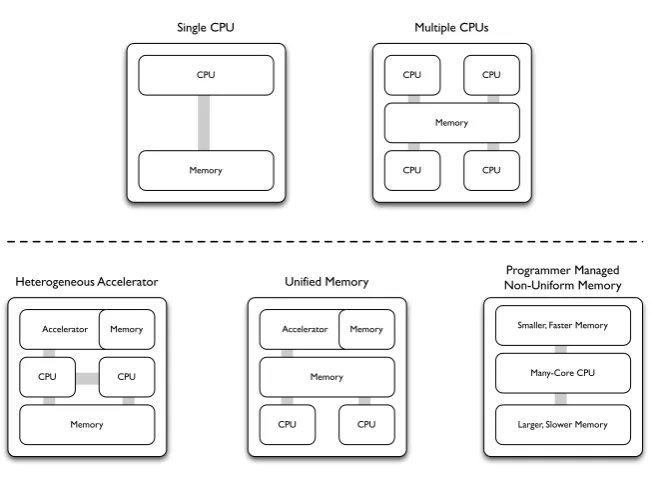
[image:29.595.134.460.144.391.2]Current and Future Node Architectures (2010-2020) Traditional Node Architectures (1990-2010)
Figure 1.1: Traditional, current, and future supercomputer node architectures.
mance of over one Exa (1018) Floating Point Operations per Second (EFLOPs).
Figure 1.1 highlights the changes in supercomputer node architecture, from the
single- and multi-core cluster architectures of the 90s, to the more complex
cur-rent and future architectures. A key feature of many accelerated architectures
is the separation of memory into distinct regions, and managing the transfer of
data between the different memory spaces is an important consideration.
The applications used for scientific delivery are often at least 15 years
old, with some applications still being used over 20 years after they were first
developed [11, 53, 137]. To solve new, pivotal problems, computational
scien-tists and code developers will expend most effort adding new scientific features
to an application without necessarily considering code portability and
mainte-nance. This focus on scientific features has created a huge suite oflegacycodes;
those that are written in older programming languages and without modern
updated and ported to the new many-core architectures predicted to be at the
core of HPC for the next 10 years. However, due to their monolithic nature,
ensuring these applications can run on next generation supercomputers is a
considerable challenge. Mini-applications, small computer programs that
rep-resent the legacy application, can be employed to help ease this porting effort.
The research presented in this thesis represents over three years of
inves-tigations conducted with the Atomic Weapons Establishment (AWE), one of the
largest supercomputing sites in the UK. These investigations focus on
evaluat-ing, understandevaluat-ing, and improving the performance of a range of applications
on existing and future computing architectures. As we approach the exascale
era, applications must adapt in order to continue to deliver timely and useful
scientific results. This work details the development of a mini-application
de-signed to investigate some of these evolutionary and revolutionary approaches
to preparing applications for future supercomputers. The investigations are
validated on some of the largest supercomputers available in the world today
including those in the United Kingdom, and at Lawrence Livermore National
Laboratory (LLNL) and Oak Ridge National Laboratory (ORNL) in the United
States of America. The principle domain of the mini-application developed in
this work is shock hydrodynamics, a type of simulation at the core of many
applications used at AWE and other large supercomputing sites such as LANL
and LLNL.
1.1 Motivations
In the 50 years since the introduction of Seymour Cray’s CDC 1604 in 1964,
supercomputers have followed a steady trend of increasing application
per-formance. These improvements were provided by Moore’s law, the
predic-tion by Gordon Moore that the transistor density of a chip would double
ev-ery 18 months [112]. With each new generation of hardware, these transistors
speeds and additional low-level parallelism increasing the speed at which
ap-plications would run. This period of significant performance improvement
every generation was known as the “free lunch”, and application developers
could rely on each new supercomputer allowing them to solve larger problems
faster [152, 153]. However, the reliability of these performance improvements
meant that research into application performance and efficient algorithms was
unnecessary to increase scientific delivery, and application developers focused
on scientific features.
In 2001, issues concerning heat dissipation and power consumption meant
that clock speeds began to stall and hardware manufacturers instead focused on
increasing the number of processor cores on a single chip [113]. The free lunch
was over, and in some cases clock speeds even decreased in order to
accommo-date the extra hardware required to manage the increased number of processor
cores. These new multi-core chips widened the gap between the theoretical and
achieved performance, with typical applications performing at only a tenth of
any supercomputer’s peak FLOPs [88]. At the system, rather than the processor
scale, concerns about power consumption have led hardware manufacturers to
propose vastly different architectures to reach exascale levels of performance.
With one Megawatt of power costing around one million US dollars a year,
re-ducing the power consumption of supercomputers has a huge impact on the
total cost of ownership.
The significant shift in supercomputer design will require sweeping code
changes and means that an application that is both easy to modify yet
represen-tative is essential for discovering a path to move existing legacy applications
into the exascale era. Performance engineering is a branch of computer science
that encompasses the tools and techniques used to measure, analyse, and
opti-mise the performance of applications running on anything from an embedded
chip to the largest supercomputer. A recent branch of performance engineering
research aims to use mini-applications, small computer programs that represent
by proxy. Tools and techniques are applied to the mini-application to identify
optimisation opportunities. Once these optimisations are implemented and
verified in the mini-application, they can be transferred to the larger
appli-cation with the hope of seeing similar improvements in performance. In this
role, mini-applications can be seen to supplant earlier benchmarking
method-ologies where either small, micro-benchmarks or large application benchmarks
were used. Micro-benchmarks lack the representativeness of a larger
applica-tion, but if the application is too large the work required to measure, analyse,
and optimise its performance becomes significant. To date, all three classes of
benchmarks have been used to successfully optimise code performance in both
academic and industrial settings.
The subject of this thesis is the use of mini-applications to improve
ap-plication performance and evaluate future hardware. We focus on optimising
and porting a code with Adaptive Mesh Refinement (AMR), where the
accu-racy of the simulation is dynamically increased where it is most necessary. For
example, when simulating the earth during a meteor impact, the location of the
impact is the most important feature. Focusing computational resources on this
region of the simulated domain can save both time and memory, but adds
com-plexity to the application due to the management of the dynamic workload. It is
the dynamic nature of AMR simulations that make them particularly
challeng-ing to port to accelerator-based architectures. Performchalleng-ing these investigations
with a mini-application removes unnecessary code complexity stemming from
the features required in a production code, and allows us to focus on challenges
specific to adaptive execution on a highly-parallel architecture.
The context of this investigation into application performance and
fu-ture hardware is CleverLeaf, a hydrodynamics mini-application with an AMR
capability. The class of applications represented by CleverLeaf form a
signifi-cant proportion of the workload at AWE, one of the largest supercomputer sites
in the UK. Similar codes also occupy large portions of total execution time at
appli-cation runtime through the tuning of software parameters, appropriate
hard-ware choices, algorithm optimisation, and machine configurations. When the
improvements we identify using a mini-application can be applied to real
ap-plications, the reductions in time to solution provide a measurable reduction
in the cost associated with day-to-day operations at AWE. The research
pre-sented in this thesis is thus of interest to computer scientists, domain experts,
and management.
1.2 Contributions
This thesis makes the following specific contributions to knowledge in the field
of performance engineering:
• We present an investigation into the role of mini-applications in
prepar-ing existprepar-ing production applications for future high-performance
com-puting architectures. This study describes the development and use of
two mini-applications at the University of Warwick and AWE. One of
these applications, CloverLeaf, has been released as part of the Mantevo
suite [73, 106]. We extended our study with a discussion of how a
cen-tralised repository of applications, such as Mantevo, provides valuable
infrastructure and guidance for a large collection of mini-applications. We
illustrate the use of mini-applications in exascale application preparation
with a number of examples.This study provides application developers
with an overview of available mini-applications and a range of ways to
use them to steer application development.
• We develop the first reported shock hydrodynamics mini-application
with adaptive mesh refinement: CleverLeaf. Applications using AMR
can be characterised by their complex control logic, and developing a
mini-application with this same control flow allows us to easily
archi-tectures. We show that the simulation is physically accurate, as well as
ac-curate in terms of how it captures the key performance characteristics of
another AMR benchmark application. CleverLeaf has also been released
under an open-source licence as part of the Mantevo suite.
• We develop the first reported resident GPU-based block-structured
adap-tive mesh refinement library.Specifically, we develop a set of extensions
for the SAMRAI library, and use them to extend CleverLeaf so that it
can execute with all data stored exclusively on Graphics Processing Unit
(GPU)s. These changes involve the development of classes to manage
data storage in GPU memory and novel algorithms that implement the
necessary adaptive mesh refinement operations in a data-parallel fashion.
The AMR-specific code we have developed to run on GPUs forms part of
a larger library, and as such can be applied to any other block-structured
AMR code that uses a Cartesian geometry.
• We present an investigation into applying mini-applications to influence
and predict future application performance. Using CleverLeaf, we
ex-pose and experiment with a range of application parameters and
iden-tify the most appropriate for three contemporary supercomputer
archi-tectures. These values can be used in production codes, and where this
opportunity is not available, we are able to inform code developers about
the most effective code development path for their application. This study
shows the way that mini-applications can be used to influence current
production applications. The optimal parameter values we identify can
be applied immediately for improvements in both application runtime
1.3 Thesis Overview
This chapter addresses the fundamental motivation for the research presented
in this thesis and describes the key contributions of this research. The
remain-der of this thesis is structured as follows:
Chapter 2 presents the terms, theory, hardware and software essential to the
fields of high performance computing and performance engineering. The
chal-lenges addressed by this research largely arise from the complex combination
of programming models and hardware described in this chapter. This
presen-tation includes a thorough review of the future hardware and programming
models at the core of this thesis.
Chapter 3 describes the use of computers to simulate physical systems. We
focus on computational shock hydrodynamics, the simulation of fluids under
intense pressure and temperature conditions. We provide an overview of Berger’s
adaptive mesh refinement technique, which is used to reduce the resources
re-quired to reach an accurate solution. This includes a thorough review of related
literature, and a detailed description of the mathematical techniques used to
solve Euler’s equations on an adaptive mesh.
Chapter 4 provides a comprehensive introduction to mini-applications, and
their use in exploring possible solutions for exascale code development.
Mini-applications can be used to explore new hardware, programming languages,
and programming models. They can also be used to explore application
per-formance on current supercomputers. Our research applies mini-applications
in both these contexts, and this chapter presents additional examples of the
suc-cessful use of mini-applications.
Chapter 5 presents the development of the first hydrodynamics mini-application
the application and the integration scheme used to advance the simulation
us-ing AMR. We describe the implementation of this scheme in CleverLeaf, and
present results that verify both the accuracy and representativeness of our
mini-application.
Chapter 6 extends CleverLeaf to execute on contemporary GPU
architec-tures. This requires modification of the data-structures and algorithms at the
core of both the AMR routines and the hydrodynamics scheme, and highlights
the flexibility and utility of mini-applications in investigating new architectures
and programming models. We evaluate the accuracy and performance of our
GPU-based application on over 4,000 nodes of the largest GPU-accelerated
su-percomputer in the world.
Chapter 7 demonstrates how mini-applications can be used to improve the
performance of applications on existing architectures through the selection of
optimal runtime parameters for a given architecture. With a series of
bench-marking experiments we identify hardware-appropriate values for core
appli-cation parameters. Using these parameters, we identify the increase in job
throughput and decrease in data usage that can be obtained through careful
parameter selection.
Chapter 8 concludes the thesis with a discussion of the implications of the
research presented to application developers, facilities staff, and organisation
management. We also identify and address the limitations of our research and
Parallel Programming and High-Performance Computing
Since the 1960s, supercomputers have been used to solve some of the largest
computational problems in the world. At least an order of magnitude faster
than a desktop computer, these machines are used to tackle problems
includ-ing cryptography, scientific simulations, and data analysis. Thanks to the
dou-bling of transistor density every 18 months predicted by Intel’s Gordon Moore
in 1965, the performance of applications was able to grow without explicit
pro-grammer intervention, through the increase in parallelism of the chip [112]. The
extra transistors were used to add multiple instructions units, increase
instruc-tion level parallelism, and add caches to reduce delays due to fetching data;
all features which improved application performance. At the start of the
mil-lennium, hardware limitations meant that the ever increasing transistor counts
couldn’t be used to increase the performance of a single processor core much
further. To put the transistors to good use, engineers began creatingmulti-core
CPUs, where each Central Processing Unit (CPU) contained multiple
multiple parts of a program are executed simultaneously, and in the case of
multi-core CPUs, each core will execute one part of the program.
Program-ming these multiple cores is difficult without the support of some underlying
programming model.
Parallel computing is inherent in all modern supercomputer design, and
future architectures are likely to require the application to expose more
paral-lelism. Many different types of parallelism are supported at a hardware level,
including: instruction-level parallelism, where multiple instructions are
exe-cuted every clock cycle; data-level parallelism, where each instruction can
oper-ate on a different of data item; and task-level parallelism, where many threads,
processes, or programs can execute independently. The levels of parallelism
can be viewed as a hierarchy that must be exploited at all stages in order to
achieve maximum performance.
Parallel programming is a complex combination of theory, hardware and
software. In this chapter we present a detailed description of the hierarchy
of parallelism exhibited by supercomputers, along with the laws that govern
them. We also provide an overview of past supercomputer architectures and
present trends exhibited by current platforms that provide a context for the
research presented in this thesis. We describe the programming models that
support each level of parallelism, with four of these models used in the
ap-plications discussed throughout this thesis. Finally, we consider performance
analysis and engineering, detailing the use of benchmark applications in
mea-suring and improving computer performance.
2.1 Parallel Computers
Parallel computers are those that can execute multiple parts of a program
simul-taneously. This parallel execution can come in three forms: (i) instruction-level,
(ii) data-level, and (iii) task-level. Each form moves successively further from
Par-allelism at every level is supported by a number of technologies: programming
languages, programming models, and compilers; that help the application
pro-grammer use this parallelism.
Instruction-level parallelism is the most technical of the three forms, and
involves multiple instruction units and multiple independent instructions
be-ing executed simultaneously. Parallelism at the instruction level is enabled in
the processor, and modern processors can use a number of techniques to extract
parallelism at the instruction level. Pipelining partially overlaps the execution
of multiple instructions, separating the different phases so that one instruction
is always in some part of the fetch-decode-execute cycle. Branch prediction and
speculative execution are two more advanced techniques that involve
begin-ning to compute instructions before the required data is available to determine
whether the instruction is necessary. For example, one part of an if-then-else
statement may be executed before the condition has been fully evaluated. If
the correct branch is executed then this technique avoids the stall that would
be introduced whilst waiting for the condition to be evaluated.
Whilst instruction level parallelism is responsible for much of the
per-formance provided by modern processors, the parallel programming models
considered most frequently in this thesis are task- and data-level parallelism.
We define data-level parallelism at a node level, where multiple data-items are
manipulated simultaneously by a single processor, provides a higher level of
parallelism that is amenable to programmer control. First available in early
vector-processing machines, vectorisation allows multiple data items to be
ma-nipulated in parallel, provided they are all mama-nipulated with the same
instruc-tions.
We define task-level parallelism as communication between a number
of co-ordinating tasks that are executing simultaneously. This communication
can be explicit, where the programmer must manually tell the tasks to exchange
data, or implicit, where the system uses knowledge of dependencies within the
Task-level parallelism can also exist within a typical supercomputer node,
where each executing thread forms a parallel task. Whilst concurrent tasks
ex-ecuting within a node can communicate using shared memory, tasks exex-ecuting
on different nodes must communicate by sending data across the network.
2.1.1 Flynn's Taxonomy of Parallel Processors
To classify the possible types of parallel computer, Flynn proposed a taxonomy
based on the method of instruction and data dispatch of the processor [51]. He
described four classes of processor, each having either single or multiple data
and instruction units (see Figure 2.1). Single instruction, single data processors
(SISD) are the most simple and were common in early computers.
Vector processors (like the Cray–1) or processors with vector instruction
sets (for example Intel’s Advanced Vector Extensions) apply the same
instruc-tion to multiple pieces of data simultaneously and are considered examples of
the single instruction, multiple data class of processor. This gives rise to the
initialism SIMD, which is commonly used to describe vector-parallel
comput-ing. The third category: multiple-instruction, single-data processors (MISD)
are considered redundant due to the complexity of manipulating single data
values in parallel. Examples of MISD processors exist in fault-tolerant
comput-ing where the same calculation is performed in parallel and the result combined
to reduce the chances of an incorrect outcome.
The final category: multiple-instruction, multiple-data (MIMD); is an
ab-stract representation of a distributed computing architecture such as a modern
cluster. Each processor has its own local memory and the capability to execute
instructions independently of any other processor. Another term for
describ-ing this kind of execution class is sdescrib-ingle-program multiple-data (SPMD) [40],
and it is a ubiquitous description for contemporary distributed scientific
ap-plications, where multiple instances of the same program are launched with
each processing some portion of the application domain. Extending this
P
Data Instruction
SISD
P
Data Istr.
Data
Instruction
Data Data
Istr. Istr. Istr. Istr. Istr.
Data Data Data
P P P P P
P
P P
SIMD
[image:41.595.171.424.238.592.2]MISD MIMD
(MPMD) design. These heterogenous applications use multiple programs to
compute different parts of the simulation, often combining results from the
dif-ferent programs to calculate some final result [157].
2.1.2 Abstract Models of Parallel Computation
Having a general abstract model of parallel computation allows us to discuss
different parallel machines without worrying about their specific hardware
con-figurations. This provides an architecture independent description of the
ma-chine which can be used to analyse or model application behaviour.
One of the first models of parallel computation was the Parallel Random
Access Machine (PRAM) model [52]. The PRAM model extends the concept
of a conventional random-access memory machine to include a set of
process-ing units. Each processprocess-ing unit has its own local memory, and is connected to
other processing units via a shared global memory. This simple model
over-looks many hardware features of common architectures such as non-uniform
memory access times, and contention on shared resources. Additionally, the
reality of providing a large, shared global memory is prohibitively expensive
at the scale required in contemporary computer systems.
The Bulk Synchronous Parallel (BSP) model is a successor to PRAM, and
is more complex and inherently more representative of typical parallel
pro-grams [158]. As a model, BSP represents computation as a series of global
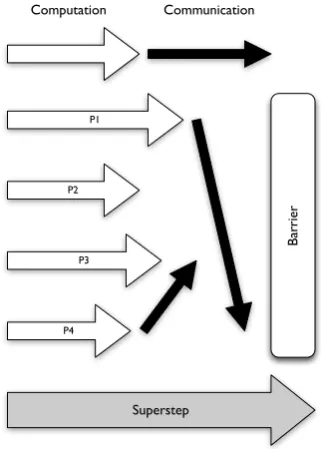
super-steps executed bypprocessors. The pattern of each super-step is highly
structured, and consists of: parallel computation, taking woperations;
com-munication ofhunits of data between processes, which consumesh⇥gtime
on a network of bandwidthg 1; and finally a global synchronisation barrier
with a constant timel. In practice, barrier-type communications scale with the
number of processes atO(logp). Figure 2.2 shows the general pattern for a BSP
program.
al-Ba
rri
er
Superstep
P1
P2
P3
P4
[image:43.595.216.377.136.361.2]Communication Computation
Figure 2.2: The three parts of the Bulk-Synchronous Parallel model superstep.
gorithm withSsuper-steps using the formula:
W +H⇥g+S⇥l (2.1)
where
W =⌃Ss=1ws (2.2)
and
H=⌃Ss=1hs (2.3)
Whilst the utility of the BSP model for predicting execution time has been
succeeded by later, more accurate, approaches such as LogP [39] and LogGP [4],
as a general model for describing the behaviour of a typical parallel
applica-tion, BSP is useful. Most of the applications discussed in this thesis follow this
model. Additionally, software packages exist that provide primitives for
de-veloping BSP-based applications. The BSPLib package has been under active
bring the BSP model to modern multi-core processors, showing the BSP model
can still be used more than 24 years after it was initially proposed [166].
2.2 Laws of Parallel Programming
The study of parallel programming often lies at the intersection between the
practical and the experimental. Each of the programming models and
support-ing technologies described here is governed by a set of laws that succinctly and
completely describe the limitations of parallel programming.
2.2.1 Amdahl's Law
Amdahl’s law, published in 1967, provides a series of equations that govern the
maximum speedup that can be achieved by a parallel program when compared
to its serial runtime [6]. Speedup is defined as the ratio between the serial and
parallel runtimes of a program. ForNprocessors:
Speedup(N) = ts
tp
(2.4)
wherets is the execution time of the program on a single processor andtp is
the execution time of the program onNprocessors. Another measure derived
from the speedup is the parallel efficiency:
Efficiency(N) =Speedup(N)
N (2.5)
A parallel program can be divided into two parts, one part in which the work
is parallel, and one in which the work is sequential. It is because of this that
Amdahl’s law can state the maximum speedup of a parallel program will be
determined by the runtime of the sequential part of the program:
Speedup(N){ 1
fs+fNp
whereN is the number of processors, andfs+fp = 1are the sequential and
parallel fractions of the program. As N tends to infinity, it is clear that the
speedup will remain limited by the sequential fraction of the program.
2.2.2 Gustafson's Law
The speedups bounded by Amdahl’s law can often be exceeded as users
in-crease the amount of work in proportion to the number of processors. Gustafson
recognised this, and in his 1988 paperReevaluating Amdahl’s Lawhe describes
several cases where a speedup larger than Amdahl’s proposed maximum was
observed [66]. Executing an application in this fashion, known as weak-scaling,
means that each processor has a fixed local problem size, rather than sharing
part of a fixed global problem. As more processors are used, larger and larger
problems can be solved. Gustafson argued that this mode of execution is
typ-ical for many users and programs, where the size of problem is scaled to use
all available computing resources. This reasoning leads to thescaled speedup
equation:
Scaled speedup(N) = s+p⇥N
s+p (2.7)
Gustafson observed that the serial runtime of the programswill contain
start-up routines and serial bottlenecks which can make it a fixed cost that does not
grow with problem size. When considering scaled speedup, if the input size
is increased such that the parallel work pis larger thansthen we will have
good parallel scalability. For a serial processor to execute this work it would
take time equal tos+p⇥N. Figure 2.3 shows the difference between the fixed
and scaled speedup. Scaled speedup provides a theoretical basis for analysing
weak-scaled codes, which allow scientists to increase the size of the problems
they solve by adding more hardware. The ever increasing number of cores in
modern supercomputers are perfectly suited for solving huge problems using
s p
N 1
t = s + p/N t = 1
serial
parallel
(a) Fixed-size (strong-scaling) speedup.
s p
N 1
t = 1 t = s + pN
serial
parallel
(b) Scaled-size (weak-scaling) speedup.
Figure 2.3: Gustafson’s Law for fixed- and scale-size problems. Scale-size prob-lems often exhibit performance that exceeds the constraints of Amdahl’s law.
2.3 Parallel Computing Hardware
Parallel computing hardware can be organised into three eras prior to today:
(i) mainframe systems, (ii) parallel vector machines, and (iii) the
distributed-memory machines. Each era defines a common hardware model, and with this
hardware model comes one or more programming models that allow
program-mers and applications to make efficient use of the available hardware. The
dis-tinct hardware and programming models make transition between each era
dif-ficult, and the shift from the distributed-memory hardware model to the more
complex many-core model of the exascale era will contain a range of challenges
from both a hardware and software perspective.
2.3.1 Mainframes
The first era of supercomputers was that of the mainframe. Mainframes are
general purpose computers designed for scientific computing. Examples of
these include early IBM systems such as the IBM 701, and the first Seymour
Cray-designed system, the CDC 1604. The CDC 6600 is considered the first
real supercomputer, and provided full separation between IO and
computa-tion. Mainframes were serial computers, and often programmed using intimate
knowledge of the target system and programming languages that would seem
2.3.2 Vector Machines
Vector computers are in the SIMD model of Flynn’s taxonomy, and execute
the same instruction on multiple data items simultaneously, giving them
im-proved performance when compared to mainframe machines. The first vector
machine developed by Seymour Cray after he left CDC, the Cray 1, is one of
the most famous vector machines and one of the most successful
supercom-puters. Programming in the vector era often meant writing custom software
to take full advantage of the vector processors, but some compilers were able
to perform sophisticated code transformations to automatically vectorise code
where appropriate. The main problem with vector machines was executing
se-rial portions of code. Since the speed of a vector processor was only realised
when processing multiple items simultaneously, serial portions of the program
(where only one data item could be processed at a time) suffered from
signif-icant slowdowns. This serial bottleneck is neatly encapsulated by Amdahl’s
Law, and occurs at both the processor and system level on modern multi-core
architectures.
2.3.3 Distributed-Memory Machines
The 1990s saw the rise of cluster computing, using cache-based reduced
in-struction set processors. Clusters are high-performance computers comprised
of commodity components and fast interconnects, and allowed a much wider
range of users to have access to the power of High-Performance Computing
(HPC) platforms. Task-parallel programming models such as Message
Pass-ing Interface (MPI) evolved to allow programmers to use these machines
effec-tively [111].
The development of these systems was driven by the fact that desktop
computer components were becoming a commodity, and the size of
shared-memory systems such as vector computers and mainframes was reaching a
system helped allow anyone to build a supercomputer, known as a Beowulf
cluster. The distributed computing era has been the dominant hardware model
since the 90s. This has led to the development of robust programming models,
languages and all their accompanying infrastructure.
2.3.4 Many-Core Machines and the Future of
Supercom-puters
Performance improvements in the first three eras of supercomputing were driven
by the relentless increases predicted by Moore [112]. This period of significant
performance improvement every generation was known as the “free lunch”,
and application developers could rely on each new supercomputer allowing
them to solve larger problems faster [152, 153]. However, the reliability of these
performance increases meant that research into application performance and
efficient algorithms was sacrificed. This focus on scientific discovery rather
than application maintenance means that codes have stood still as machines
have advanced, making the switch from the distributed-memory era to future
many-core architectures harder than previous leaps.
In 2001, heat dissipation and power consumption issues meant that CPU
clock speeds began to stall and hardware manufacturers instead focused on
in-creasing the number of processor cores on a single chip [113]. The free lunch
was over, and in some cases clock speeds have decreased in order to
accommo-date the extra hardware required to manage an increased number of processor
cores. These new multi-core chips widened the gap between theoretical and
achieved performance, with typical applications performing at only a tenth of
any supercomputers peak Floating Point Operations per Second (FLOPs) [88].
At the system, rather than the processor scale, concerns about power
consump-tion have led hardware manufacturers to propose vastly different architectures
to provide the necessary performance. Many-core architectures are the natural
consist of processors with even more cores, running at even lower frequencies.
It is now common to see an accelerator attached to a typical multi-core
processor. These devices are specialised for fast floating point performance and
have their own memory space. In 2005, Fung et al. realised that the
video-focused hardware of a consumer Graphics Processing Unit (GPU) could be
har-nessed for scientific applications through the use of complex shader
program-ming languages [54]. In 2006, NVIDIA released their CUDA programprogram-ming
model and provided an easy-to-use method for programming GPUs. These
new general-purpose GPUs (GPGPUs) offered huge improvements in
compu-tational performance over a traditional chip provided the application suited the
new architecture.
Accelerated Processing Units (APUs) from AMD consist of a CPU and a
Graphics Processing Unit (GPU) on a single chip, meaning that different
hard-ware resources can be used to perform the computations for which they are
most suitable. In 2012, Intel released the Xeon Phi, a co-processor with around
60 processor cores. These cores have more in common with a typical
multi-core CPU than GPUs and can be programmed without any special
program-ming language, but as with other accelerators aim to provide more FLOPs
us-ing many slower cores. The most customised form of accelerator is a
Field-Programmable Gate Array (FPGA). These devices are produced by a variety
of manufacturers, and provide high-performance at an extremely low power
budget since the hardware is configured by the programmer to implement the
required algorithm.
Machines such as IBM’s Blue Gene series are customised for
supercom-puting. With a typical system containing many thousands of cores, each of
which has four hardware threads, a parallel job running on a Blue Gene/Q
may use up to one million concurrent threads. The nodes are connected with a
custom torus network designed to minimise the time parallel tasks will spend
communicating.
mixture of custom and commodity parts. Cray’s XC30 supercomputer
exempli-fies this middle ground between a commodity cluster and a bespoke machine
such a Blue Gene. The XC30 uses commodity processing components, such as
Intel processors and NVIDIA GPUs, but houses them in custom packaging, and
connects each node using a custom interconnect for increased performance.
2.4 Parallel Programming Models and Languages
Writing applications for parallel computers is a complex discipline, since the
details of the communicating processes will be left to the application
devel-oper. The software infrastructure surrounding high-performance computing
and parallel programming has grown considerable since early mainframes, and
the incremental development used for scientific applications means that the
programming languages used have not changed for many years.
The most common languages for writing scientific applications remain
C, C++ and Fortran. The mathematical slant of Fortran means it is popular with
domain scientists, but the object-oriented nature of C++ often allows computer
scientists to write more flexible and maintainable code. Newer languages and
programming models have been developed to support the more complex
par-allelism present in contemporary parallel architectures.
The mapping between the three levels of parallelism to the
correspond-ing layers of the hardware/software hierarchy is shown in Figure 2.4. In this
section we focus on the software side of the hierarchy and discuss the
program-ming models and languages that can be used at each level.
2.4.1 Message-Passing
The highest level of the parallel programming hierarchy, message-passing,
al-lows processes to communicate through the sending and receiving of messages.
First used during the era of distributed memory machines, message-passing
Task-Level
Data-Level
Instruction-Level
Cluster
Multi-Core
SIMD
Superscalar
Message Passing
Multi-Threading
Vectorisation
Compilers
Hardware Software
Parallelism
Figure 2.4: Mapping between hardware, software, and the levels of parallelism in a supercomputer.
to the same shared memory. This paradigm is typically used through a
soft-ware library, with the canonical standard being the Message Passing Interface
(MPI) standard. MPI provides an explicit style of data transfer, where processes
must actively call send and receive functions in order to communicate. Other
approaches to message-passing rely on a more implicit style of data transfer.
One such approach, languages implementing the Partitioned Global Address
Space (PGAS) model, transfers data behind the scenes based on knowledge
in-ferred from the application code [136]. One example of a PGAS language is
co-array Fortran, where the implicit data transfers are supported by extensions
to the Fortran language [33]. Accessing memory on another node is given
spe-cial syntax, and the compiler and runtime can use this knowledge to transfer
data without the involvement of the programmer.
The ubiquitous nature of the message-passing model and its
familiar-ity to scientific application developers means that HPC programs are almost
always written using this paradigm, and it is often used to handle both
inter-and intra-node parallelism. This means that the same code could be used from
the start of the distributed-memory era (where single-core processors were
con-nected) right through to the end of that era and the present day (where nodes
Serial Work
Parallel Work
Parallel Work
Parallel Work
Parallel Work
Fo
rk Join Serial Work
Figure 2.5: The fork-join model used for thread level parallelism in OpenMP.
2.4.2 Multi-Threading
The second level of the parallel programming hierarchy, the multi-threading
level, is how multiple tasks execute concurrently within a supercomputer node.
As seen in Figure 2.4, this level of the model maps to the cores of a processor
and task-based programming models. Task-based parallelism is most often
im-plemented using the fork-join model (see Figure 2.5). Serial sections of work are
executed by one master thread. When a region of parallel work is encountered,
multiple threads are created and each will be responsible for some portion of
the parallel work. At the end of the parallel region there will be a
synchroni-sation before the master thread continues to execute the next serial part of the
code.
The most widely used task-based programming model in HPC is OpenMP [121].
The OpenMP standard defines a number of compiler directives that can be
in-serted into code and used as instructions to the compiler about which parts
of the code should be executed in parallel. OpenMP offers two main forms of
multi-threading: loop-based, and task-based. The loop-based style implements
the fork-join model with a specific emphasis on executing the body of a loop
in parallel. This kind of parallelism is often found in HPC applications, where
arrays representing a physical domain are processed one element at a time in