EFFECT OF CITRATE IONS ON THE ELECTROCHEMICAL
BEHAVIOUR OF MILD STEEL IN TIPA – Zn
2+SYSTEM
(TIPA=TRIISOPROPANOLAMINE)
Y. Brightson Arul Jacob
[a],*, R. Sayee Kannan
[b], J. Jeyasundari
[c]Keywords: Electrochemical study,Corrosion inhibition, Triisopropanolamine, Trisodium citrate, FTIR spectra.
The inhibition efficiency (IE) of various concentrations of a TIPA(triisopropanolamine)-TSC(trisodium citrate)-Zn2+ system in controlling
corrosion of mild steel immersed in aqueous solution containing 60 ppm Cl- was evaluated by a weight loss study. The formulation
consisting of 100 ppm of TIPA and 50 ppm of Zn2+ showed 62% inhibition efficiency. When TSC (250 ppm) is added the inhibition
efficiency increases to 100%. In the presence of TSC has excellent inhibition efficiency. Polarization studies reveal that TIPA-TSC-Zn2+
function as an anodic inhibitor. AC impedance spectra suggest that a protective film is formed on the metal surface. FTIR spectra reveal that the protective film consists of Fe2+ - TIPA, Fe2+ - TSC complex and Zn(OH)
2.
Corresponding Authors
*E-Mail: brightson
_
[email protected][a] Department of chemistry, NMSSVN College, Madurai-625019, Tamilnadu, India
[b] Department of Chemistry, Thiagarajar College, Madurai-625009, Tamilnadu, India, Email:[email protected] [c] Department of chemistry, NMSSVN College,
Madurai-625019, Tamilnadu, India, Email: [email protected]
Introduction
Studies on the corrosion of metals in organic medium have attracted considerable interest in recent years due to their wide applications. It has been reported that the overvoltage for the cathodic reaction on metals in contact with such medium is lower than to the aqueous medium. Hence it causes accelerated, uniform and localized types of corrosion attack. It has been found earlier that the corrosion caused by the aqueous organic solvents can be effectively controlled by the use of corrosion inhibitors for a system can not only extend the life of the reaction vessels in use but could also enable the use of a less expense.1-5
Therefore, in this investigation, the authors have chosen mild steel to study corrosion inhibition, in contact with a very important aqueous organic medium petroleum having acetic acid and NaCl, Amines that are reported as good organic inhibitor for aqueous acid solutions have been used as inhibitor in this study. The aim of our study was to propose surface protection that will be able both to act in the corrosive medium having petroleum, and to have a tumble rule to chosen a best chemical structure for such mediums.
In previous work the mode of action of some alkyl amines to protect of mild steel was studied. It was shown that two intermediates adsorbed on the steel surface. Because these amines are different in attached groups, we choose to investigate the electrochemical corrosion behavior of carbon steel inhibited by amines with different structures.6
These organic compounds adsorb on the metal surface and
cases, it appears that adsorption inhibitors affect both the anodic and cathodic process although in many cases the effect is unequal.7
Materials and Methods
Sample Preparation
Carbon steel specimens (0.026% S, 0.067 % P, 0.4% Mn, 0.1% C and the rest iron) of the dimensions 1.0 cm x 4.0 cm x 0.2 cm were polished to mirror finish and degreased with Acetone and used for weight loss method.
Weight Loss Method
Mild steel specimens in triplicate were immersed in 100 ml of aqueous solution containing 60 ppm Cl- and various
concentrations of Triisopropanolamine in the presence and absence of Zn2+ (as ZnSO
4.7H2O) for a period of one day.
The corrosion products were cleaned with Clark’s solution.8 The weight of the specimens before and after immersion was determined using Shimadzu balance AY62. The corrosion inhibition efficiency was calculated with
Where W1 is the corrosion rate in the absence of the
inhibitor and W2 is the corrosion rate in the presence of
inhibitor. From the weight loss, the corrosion rates was calculated ρ- density of the metal is g cm-3.
Electrochemical Study
Polarization studies were carried out using a CHI electro chemical impedance analyzer, model 660 A. A three electrode cell assembly was used. The working electrode was a rectangular specimen of mild steel with one face of
2
2
(%) 100 1 (1)
1
W IE
W
lacquer. A saturated calomel electrode (SCE) was used as the reference electrode and a rectangular platinum foil was used as the counter electrode. Polarization curves were recorded using iR compensation. The results, such as tafel slopes and Icorr, Ecorr, and LPR values were calculated.
During the Polarization study, the scan rate (V/S) was 0.01, hold time at E f(s) was zero, and quit time (s) was 2.
AC impedance measurement
A time interval of 5 to 10 minutes was give for the system to attain a steady state open circuit potential. The AC frequency was varied from 100 mHZ to 100 Khz. The real part (Z’) and imaginary part (Z’’) of the cell impedance were measured in ohms for various frequencies. The Rt(charge transfer resistance) and Cdl (double layer
capacitance) were calculated. Cdl values were calculated by
using the following relationship.
FT-IR spectra
These spectra were recorded in a perki-Elmer 1600spectrophotometer. The film was carefully removed, mixed thoroughly with Kbr and made in to pellets and the FTIR spectra were recorded
Results and Discussion
Analysis of the Weight Loss Method
Corrosion rates (CR) of mild steel(MS) immersed in aqueous solution containing 60 ppm Cl – in the absence and
presence of inhibitors triisopropanolamine, Zn2+, trisodium
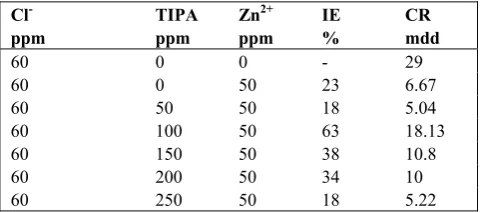
citrate are given in Table 1-3. The inhibition efficiencies (IE) are also given in this table. It is observed from table 1 that triisopropanolamine(TIPA) shows some inhibition efficiency of 47%. 100 ppm of TIPA and 50 ppm of Zn2+
shows 63% inhibition efficiency. After the addition of trisodium citrate(TSC) 250 ppm the increase in inhibition efficiency of the system (TIPA + TSC+ Zn2+) is 100% IE.
Table 1. Corrosion rates of (CR mdd) mild steel immersed in an aqueous solution containing 60 ppm of Cl- and the inhibition
efficiencies (IE %) obtained by weight loss method (pH=8.2)
Cl- ppm TIPA ppm IE % CR mdd
60 50 28 8.12
60 100 47 13.34
60 150 31 8.99
60 200 31 8.99
60 250 25 7.25
Table 2. Corrosion rates (CR mdd) mild steel immersed in an aqueous solution containing 60 ppm Cl- and the inhibition
efficiencies (IE%) obtained by weight loss method (pH=8.2)
Cl- ppm TIPA ppm Zn2+ ppm IE % CR mdd
60 0 0 - 29
60 0 50 23 6.67
60 50 50 18 5.04
60 100 50 63 18.13
60 150 50 38 10.8
60 200 50 34 10
60 250 50 18 5.22
Table 3. Corrosion rates (CR mdd) mild steel immersed in an aqueous solution containing 60 ppm Cl- and the inhibition
efficiencies (IE%) obtained by weight loss method (pH=8.2)
Cl- ppm TIPA ppm Zn2+ ppm TSC ppm IE % CR mdd
60 100 50 50 68.75 9.06
60 100 50 100 87.50 3.62
60 100 50 150 97.81 0.63
60 100 50 200 96.80 0.92
60 100 50 250 100 -
Influence of TSC on the inhibition efficiencies of TIPA
The inhibitory17 and co-inhibitory effect18 of trisodium
citrate has been described recently. The influence of TSC on the inhibition efficiencies of TIPA + Zn2+ system is given in
table 3. It is observed that as the concentration of TSC increases the IE increases. It is also observed that a synergistic effect exists between TSC and TIPA + Zn2+
system. For example 100 ppm of TIPA, 50 ppm of Zn2+ and
250 ppm of TSC has 100% IE. On the metal surface Fe2+
-TIPA complex and Fe2+–TSC complex is formed on the
anodic sites of the metal surface. Thus the anodic reaction is controlled. The cathodic reaction is the generation of OH-,
which is controlled the formation of Zn(OH)2 on the
cathodic sites of the metal surface. Thus the anodic reaction and cathodic reaction are controlled effectively. This accounts for the synergistic effect existing between TIPA-Zn2+ and TSC.
Fe → Fe2+ + 2e- (Anodic reaction)
Fe2+ + Zn2+-TIPA-TSC complex→ Fe2+-TIPA+Fe2+-TSC+
Zn2+
O2 + 2H2O + 4e- → 4OH- (Cathodic reaction)
Zn2+ + 2OH-→Zn(OH) 2↓
Corrosion Measurement
Polarization study has been to confirm the formation of protective film formed on the metal surface during corrosion inhibition process.9-14 If a protective film is formed on the
metal surface. The linear polarization resistance value (LPR) increases and the corrosion current value (Icorr) decreases. 1
(2)
2 max
Cdl
R ft
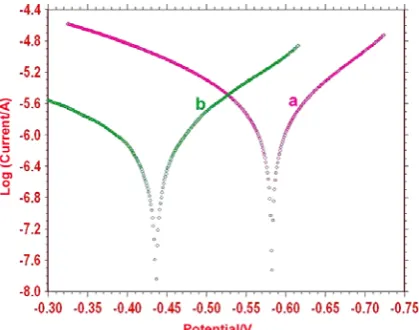
The potentiodynamic polarization curves of mild steel immersed in aqueous solution containing 60 ppm Cl- in the
absence and presence of inhibitors are shown in figure 1. The corrosion parameters are given in table 4. When mild steel was immersed in 60 ppm Cl- the corrosion potential
was -583mV versus SCE. When TIPA (100 ppm), Zn2+ (50
ppm) and TSC (250 ppm) were added to the above system, the corrosion potential shifted to the noble side -436 mV versus SCE. This indicates that a film is formed on the anodic sites of the metal surface. This film controls the anodic reaction of metal dissolution by forming Fe2+-TIPA,
Fe2+-TSC complex on the anodic sides of the metal surface.
The formation of protective film on the metal surface is further supported by the fact that the anodic Tafel slope (ba)
increases from 170 to 197 mV. Further, the LPR value increases from 1.693 x 10⁴ ohm cm2 to 4.6 x 10⁴ ohm cm2.
The corrosion current decreases from 1.873 x 10⁻⁶ A cm-2 to
7.54 x 10⁻⁷ A cm-2. Thus Polarization study confirm the
formation of a protective film on the metal surface
Table 4. Corrosion parameters of mild steel immersed in A obtained from polarization study
System Ecorr
mV*
ba,
mV**
bc
mV**
LPR
Ω cm2
Icorr
A cm-2 A -583 127 170 1.693 x 10⁴ 1.873x10⁻¹⁰
A+B -436 135 197 4.6 x 10⁴ 7.54x10⁻⁷
A=Aqueous solution containing 60 ppm Cl-; B= TIPA (100 ppm);
Zn2+ (50 ppm); TSC (250 ppm); *mV vs SCE; ** mV in one
decade.
Figure 1. Polarization curves of MS is immersed in a) 60 ppm Cl
-(Blank) b) TIPA (100 ppm) + Zn2+ (50 ppm) + TSC (250 ppm)
Analysis of AC impedance spectra
AC impedance spectra (electro chemical impedance spectra) have been used to confirm the formation of protective film on the metal surface. If a protective film is formed on the metal surface, charge transfer resistance (Rt)
increases, double layer capacitance value (Cdl) decreases,
and the impedance log (Z ohm-1) value increases. The AC
impedance spectra of mild steel immerse in an aqueous solution containing 60 ppm Cl- in the presence and absence
of inhibitors (TIPA – Zn2+ -TSC) are shown in figure-2 (a)
and (b) (Nyquist Plots) and figure - 3a and 3b (Bode plots). The AC impedance parameter, namely, charge transfer resistance (Rt) and double layer capacitance (Cdl) derived
from Nyquist plots are given in table 5.
It is observed that when the inhibitors (TIPA (100 ppm) - Zn2+ (50 ppm) –TSC (250 ppm) are added the charge
transfer resistance (Rt) increases from 3149 cm2 to 2398 cm2.
The Cdl value decreases from 5.07 x 10⁻⁷ F cm-2 to 6.66 x
10-10 F cm-2. The impedance value [log (Z ohm-1)] increases
from 3.3411 to 3.4620. These results lead to the conclusion that a protective film is formed on the metal surface.
Figure 2. AC impedance spectra(Nyquist plot) of MS immersed in a) 60 ppm Cl- (Blank) b) TIPA (100 ppm) + Zn2+ (50 ppm) + TSC
(250 ppm)
Figure 3a. AC impedance spectra of MS immersed in various test solutions (Bode Plot) a) 60 ppm Cl-(Blank)
Figure 3b. AC impedance spectra of MS immersed in various test solutions (Bode Plot) a) TIPA (100 ppm) + Zn2+(50 ppm) + TSC
Table 5. Corrosion parameters of mild steel immersed in aqueous solution containing 60 ppm Cl- obtained by AC impedance spectra.
System Rt
ohm cm2 F cmCdl -2 [log(Z ohmImpedance -1)]
A 3149 5.07×10⁻⁷ 3.3411
A+B 2398 6.66× 10⁻¹⁰ 3.4620
A= Aqueous solution containing 60 ppm Cl- ; B= TIPA (100 ppm);
Zn2+ (50 ppm); TSC (250 ppm)
FT-IR spectra
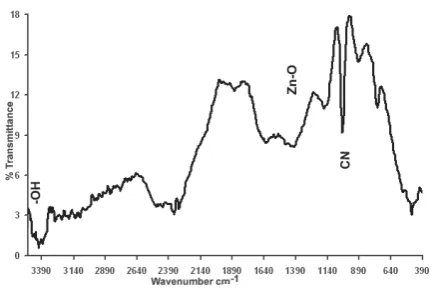
FT-IR spectra of TIPA+ Zn2+ is shown in figure 4a. The
–NH stretching and –OH stretching frequency have overlapped and appear at 3350 cm-1. The –CN stretching
frequency appears 1042 cm-1. The FTIR spectra of film
formed on the metal surface after immersion in solution containing 60 ppm Cl-, 100 ppm of TIPA and 50 ppm Zn2+,
250 ppm of TSC is shown in figure 4b. The –OH stretching frequency has shifted from 3350 cm-1 to 3427 cm-1. The CN
stretching frequency has shifted 1042 cm-1 to 1115 cm-1.
This suggest that TSC and TIPA coordinated with Fe2+
through their polar groups resulting in the formation of Fe2+
-TSC complex and Fe2+-TIPA complex. The peak at 1416
cm-1 is due to Zn-O stretching.15-16 The –OH stretching
frequency appears at 3427 cm-1. The C=O stretching
frequency of TSC has shifted from 1599 cm-1 to 1562 cm-1.
This shift indicates that the carboxyl oxygen atom was coordinated to Fe2+ results in the formation of Fe2+-TSC
complex on the anodic sites of the metal surface. These results suggest the formation of Zn(OH)2 on cathodic sites
of the metal surface.
Scheme 1. Triisopropanolamine Scheme 2. Trisodiumcitrate
Figure 4a. Aqueous solution containing 60 ppm of Cl- +
100 ppm of TIPA + 50 ppm of Zn2+
Figure 4b. Aqueous solution containing 60ppm of Cl- + 100
ppm of TIPA + 50 ppm of Zn2+ + 250 ppm of TSC
Conclusion
With these discussions, a mechanism may be proposed for the corrosion inhibition of carbon steel immersed in aqueous solution containing 60 ppm Cl- by TIPA (100 ppm) –
Zn2+(50 ppm) - TSC (250 ppm) system. When the
formulation consisting 60 ppm Cl-, 100 ppm TIPA and 50
ppm of Zn2+, there is formation of TIPA-Zn2+, TSC-Zn2+
complex in solution. When mild steel immersed in this solution TIPA-Zn2+, TSC-Zn2+ complex diffuses from the
bulk of the solution towards the metal surface. TIPA-Zn2+,
TSC-Zn2+complex are converted in to TIPA-Fe2+,
TSC-Fe2+complex on the anodic sites of the metal surface with
release of Zinc ion.
Zn2+-TIPA, Zn2+-TSC+Fe2+→Fe2+-TIPA, Fe2+-TSC+Zn2+
The released Zn2+ combines with OH- to form Zn(OH) 2 on
the cathodic sites of the metal surface
Zn2+ + 2OH→-Zn(OH) 2
Thus the protective film consists of TIPA-Fe2+, TSC-Fe2+
complex and Zn(OH)2. In aqueous solution the anodic
reaction is the formation of Fe2+. This anodic reaction is
controlled by the formation of TIPA-TSC-Fe2+ complex on
the anodic sites of the metal surface. The cathodic reaction is the formation of OH- which is controlled by the formation
of Zn(OH)2 on the cathodic sites of the metal surface
Fe → Fe2+ + 2e- (Anodic reaction)
2H2O + O2 + 4e-→ 4OH- (Cathodic reaction)
FTIR spectra reveal that protective film formed on the metal surface. This accounts for the synergistic effect of TIPA-Zn2+-TSC system function as an anodic inhibitor.
Acknowledgement
References
1Altoe, P., Pimenta, G., Moulin, C. F., Diaz, S. L. and Mattor, O.
R., Electrochim. Acta., 1996, 41, 1165.
2Roberse, P. R. and Sastri, V. S., Corros. Sci., 1993, 35, 1503. 3Gauveric, L., Corrosion in the Photo Chemical Industry, ASM
International., 1995.
4Matsunami, K., Kato, T., Sugimoto, K., Int. J. Pressure Vessels
Piping., 1991, 45, 179.
5Paty, B. B. and Singh, D. D. N., Corros. Sci., 1992, 489, 442. 6Ashassi–Sorkhabi, H. and Nabavi–Amri, S. A., Acta Chim.
Sloven., 2000, 47(4) 507-518.
7Fontana, M. G., Corrosion Engineering, 3rd Edition, M. C. Graw- Hill, 1982.
8Eddy, N. O., Ibok, U. J. and Ita, B. I., J. Comput. Methods Sci.
Eng., 2011, 2, 25-43.
9Ormellese, M., Bolzoni, F., Lazzari, I., Brenna, A. and Predeterri,
M., Mater. Corros., 2011, 62, 170-172.
10Helal, N. H. and Badawy, W. A., Electrochim. Acta, 2011, 56, 19. 11Wranglen, G., An Introduction to corrosion and Protection of
Metals, Chapran & Hall, 1985.
12Bawal, A. and Engelken, R. D., Environ. Sci. Policy, 2002, 5, 2
121-133.
13EI-Eme, A. Y., Corros. Sci., 2003, 45(11), 2485-2495. 14EI-Eme, A. Y., Corros. Sci., 1998, 40(11), 1845-1850.
15Silverstein, R. M., Basler, G. C. and Morrill, T. C., Spectroscopic
Identification of Organic Compounds, 4th Edition, John Wiley and Sons, 1981.
16Cross, A. D., Introduction to Practical Infrared Spectroscopy,
Butterworths Scientific Publication, 1990.
17Shyamala Devi, B. and Rajendran, S., Eur. Chem. Bull., 2012
, 1(5), 150-157.
18
Vijaya, N., Peter Pascal Regis, A., Rajendran, S., Pandiarajan, M. and Nagalakshmi, R., Eur. Chem. Bull. 2013, 2(5), 275-278.