Michieletto, Davide and Turner, Matthew S. . (2016) A topologically driven glass in ring
polymers. Proceedings of the National Academy of Sciences of the United States of America.
201520665.
http://dx.doi.org/10.1073/pnas.1520665113
Permanent WRAP URL:
http://wrap.warwick.ac.uk/78766
Copyright and reuse:
The Warwick Research Archive Portal (WRAP) makes this work by researchers of the
University of Warwick available open access under the following conditions. Copyright ©
and all moral rights to the version of the paper presented here belong to the individual
author(s) and/or other copyright owners. To the extent reasonable and practicable the
material made available in WRAP has been checked for eligibility before being made
available.
Copies of full items can be used for personal research or study, educational, or not-for-profit
purposes without prior permission or charge. Provided that the authors, title and full
bibliographic details are credited, a hyperlink and/or URL is given for the original metadata
page and the content is not changed in any way.
Publisher’s statement:
© PNAS 2016.
A note on versions:
The version presented here may differ from the published version or, version of record, if
you wish to cite this item you are advised to consult the publisher’s version. Please see the
‘permanent WRAP URL’ above for details on accessing the published version and note that
access may require a subscription.
A Topologically Driven Glass in Ring Polymers
Davide Michieletto∗and Matthew S. Turner†
∗School of Physics and Astronomy, University of Edinburgh, Edinburgh, United Kingdom, and†Department of Physics, University of Warwick, Coventry, United Kingdom
Submitted to Proceedings of the National Academy of Sciences of the United States of America
The static and dynamic properties of ring polymers in concentrated solutions remains one of the last deep unsolved questions in Poly-mer Physics. At the same time, the nature of the glass transi-tion in polymeric systems is also not well understood. In this work we study a novel glass transition in systems made of circular poly-mers by exploiting the topological constraints that are conjectured to populate concentrated solutions of rings. We show that such rings strongly inter-penetrate through one another, generating an extensive network of topological interactions that dramatically af-fects their dynamics. We show that a kinetically arrested state can be induced by randomly pinning a small fraction of the rings. This occurs well above the classical glass transition temperature at which microscopic mobility is lost. Our work demonstrates both the exis-tence of long-lived inter-ring penetrations and also realises a novel, topologically-induced, glass transition.
glass transition | polymers | topology | topological glass
T
he physics of ring polymers remains one of the last big mysteries in Polymer Physics [1]. Concentrated systems of ring polymers have been observed in both, simulations and experiments, to display unique features that are not easily reconciled with the standard reptation theory of linear poly-mers [2, 3, 2, 3, 6]. The main reason for this is that ring polymers do not possess free terminal segments, or ends, es-sential for end-directed curvilinear diffusion. In contrast, ring polymers possess a closed contour, which leads to a markedly different relaxation and diffusion mechanisms. Recently, there has been much improvement in the production of purified sys-tems of rings [6, 7, 8] with the consequent result that more and more experimental puzzling evidence requires a deeper under-standing of their motion in concentrated solutions and melts from a theoretical point of view.Recently, it has been conjectured that ring polymers assume crumpled, segregated conformations in concentrated solution or the melt [3]. On the other hand, numerical and experimen-tal findings [3, 6], suggest that rings exhibit strong inter-coil correlations which have proved difficult to address in simplified theoretical models [9, 10, 11, 12]. Because of this, there have been many recent attempts to rigorously characterise these inter-chains interactions [13, 14, 15, 16], although a precise definition and unambiguous identification of these “thread-ings” in concentrated solutions of rings remains elusive. The primary reason for this is that the rings are assumed to remain strictly topologically un-linked from one-another throughout if synthesised in this state.
In the case of concentrated solutions of rings embedded in a gel, a method to identify these inter-penetrating threadings has recently been proposed [13]. Here it was shown that the number of threadings scales extensively in the polymer length (or mass) and can therefore be numerous for long rings, cre-ating a hierarchical sequence of constraints that can span the entire system. It has also been conjectured that a kinetically frozen state, or a “topological glass” [17] can emerge, since such an extensive network of constraints can eventually sup-press the translational degrees of freedom of the rings. How-ever the molten, or highly concentrated, state does differ from that of polymers embedded in a gel and so whether a sim-ilar jamming transition occurs for long enough polymers or even whether threadings are present in the absence of a gel
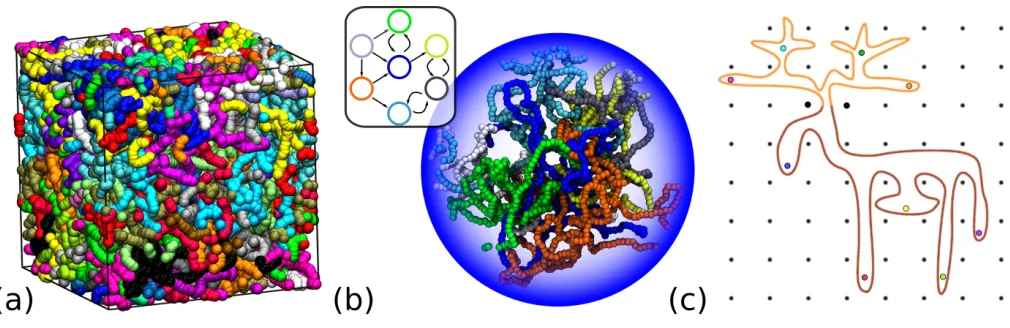
remain open problems and are the main questions addressed in this study. An example of inter-threaded ring configuration is shown in Fig. 1. A spherical region (Fig. 1(b)) is carved from the configuration depicted in Fig. 1(a) which represents a typical system studied in this work. The degree of inter-penetration between the different coils is readily appreciable from the figure, and it can be boiled down even further into a network representation [13]. The un-crossability constraint between chains transforms the threadings into topological hin-drance in the motion of the coils, which we conjecture to form the basis for a dramatic slowing down in the dynamics of long enough coils.
Glass-forming systems exhibit degrees of freedom that be-come constrained as the temperature, or the density, of the system approaches the glass transition temperatureTg or the
critical jamming densityρc, thereby (super-)exponentially
in-creasing the viscosity of the system [18]. Understanding the origin of these constraints, being kinetic or thermodynamic in nature, is still an open topic that animates intense re-search [19, 20].
Recently, a novel and promising theoretical approach to study the glass transition in glass-forming liquids has been advanced: It involves perturbing a system by randomly pin-ning some fraction of the constituents and by observing the behaviour of the un-frozen fraction. This method introduces a field of “quenched” disorder by freezing in space and time a subset of the system [21, 22, 7, 24, 25, 26, 27].
Inspired by this approach we focus our attention on a con-centrated solution of rings and apply a similar protocol: we freeze in space and time a fraction of polymers in the system and observe the response of the un-frozen constituents. We find that while linear polymers are substantially insensitive to
Significance
The glass transition is commonly associated with a reduction in the temperature of liquids or by an increase in density of granular materials. In this work we propose a radically different approach to study dynamical arrest that relies on the topology of the com-ponents. We find that a concentrated solution of ring polymers can be driven to a kinetically arrested state by randomly pinning a small fraction of rings, a transition not observed in linear poly-mers. We attribute this jamming to topological interactions, called “threadings”, that populate solutions of rings. Our work provides the first evidence for these threadings and suggests that very long rings may be expected to be kinetically arrested even as the fraction of pinned rings approaches zero.
Fig. 1. Networks of threadings (a)Snapshot from a simulation representing a system withN = 50chainsM = 512beads long. (b)Snapshot of a spherical region and some of the rings from(a). One can easily appreciate the inter-penetration between the rings in the system (for instance cyan through dark grey or orange through blue). The sketched network in the top corner is obtained by visual inspection and depicts the penetrations of the rings. Two circles are connected by a directed arrow when the former is threading through the latter [13] (see also Suppl. Movie M1). (c) Lattice animal representation of a single ring polymer surrounded by non-threading rings (black dots) and penetrated by threading rings (coloured dots). Modified from Ref. [6] with permission.
this perturbation, ring polymers become irreversibly trapped in a network of inter-coil constraints (threadings) which, in the limit of long rings, allows us to drive a kinetically arrested state with only a small fraction of permanently frozen chains. We conjecture that a spontaneous glassy state might therefore emerge in the long chain limit, even as the fraction of explic-itly pinned chains goes to zero. Because these constraints are topological in nature, originating from non-crossability of the chains, this glassy state has the potential to be produced at arbitrary temperature or monomer density, provided only that these inter-coil topological interactions remain abundant in the system,i.e., the rings are sufficiently long and not too dilute. This system is therefore a candidate for a novel kind of glass transition in systems made of polymers or other elements with non-trivial topology.
Rings in Solution Assume Crumpled but Largely Overlapping Conformations.The static properties of rings in solution have been studied for some decades and it is nowadays thought that rings assume crumpled conformations characterised by a scal-ing law for their gyration radiusRg∼Mνwithν'1/3 in the
limit of rings with large polymerisationM [11, 28, 5, 30, 31]. On the other hand they also have been found to maintain nu-merous contacts with their neighbours. This is often quantified by measuring the “contact surface” of the polymers, which is defined as the number of segmentsmsurfin any one chain that are in contact with any segment belonging to any other chain. This has been found to scale nearly extensively with the size of rings (SI Appendix, Figs. S1-S2)msurf ∼Mβ withβ'0.98.
This has been interpreted as a clear signature of abundant in-teractions and coil overlap. This picture is also supported by the fact that a coil’s pair correlation functiong(r) is peaked atrc <2rmax '2.6Rg (see Fig. S3 in SI), in light of which
the coils can be viewed as inter-penetrating ultra-soft colloids of radiusrmax'1.3Rg [32, 33, 34].
The counter-intuitive fact that rings have numerous inter-coil interactions while assuming a scaling exponentν ' 1/3 can be understood within the fractal globule conjecture [35, 11] in which the rings assume a fractal, hierarchical and virtually entanglement-free, conformation, that can accommodate near extensive interactions with other chains with a contact expo-nentγnear unity [5] (SI Appendix Fig. S3).
These inter-chain interactions may include “threadings” that have been conjectured to be intimately related to the
slow overall diffusion of the rings centre of mass [3, 13, 16, 8] (see also SI Appendix Fig. S4), an observation that is in apparent contrast with the very fast stress relaxation [6, 7], characterised by a power-law decay of the relaxation modulus G(t) and by a remarkable absence of the entanglement plateau that characterises concentrated solutions of linear polymers. In light of these findings, we believe that further investigation of the role of these inter-ring interactions is crucial.
Contiguity is Persistent for Longer Chains.In order to probe inter-coil interactions we first adopt a definition of surface monomers where the i-th monomer of chain I is a surface monomer of that chain if its distance from a monomerj be-longing to a different chainJisdij< ρ−1/3 whereρ= 0.1σ−3
is the monomer concentration. We then define as “contigu-ous” two coils that share surface monomers. From this defini-tion, we propose a method to track the exchange dynamics of contiguous chains,I andJ, by computing a dynamicN×N matrixP(t) whose elements are defined as
PIJ(t) =
(
0 ifdij≥ρ−1/3 ∀i, j
1 otherwise [ 1 ]
From this it is straightforward to obtain the correlation func-tion
ϕnc(t) =
*
1 N
N
X
J=1
PIJ(t)PIJ(t−∆t). . . PIJ(0)
+
[ 2 ]
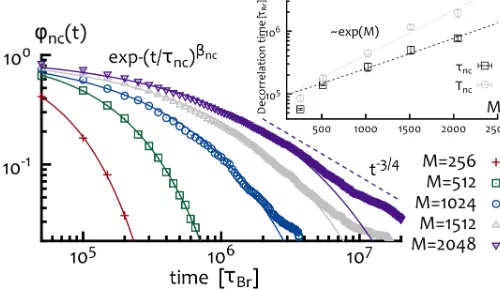
whereh. . .iindicates the ensemble average over ringsIand ini-tial times. This function quantifies the exchange dynamics of contiguous chains and tracks the time that the chainsfirst be-come non-contiguous since it involves the product ofPIJ over
by stretched exponentials
ϕnc= exp
"
−
t τnc
βnc#
[ 3 ]
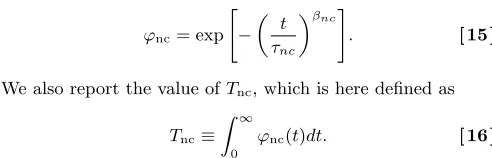
[image:4.657.338.581.91.231.2]with an exponentβncwhich varies fromβnc= 1 forM = 256 toβnc'1/2 for the longest chains in the system (see Fig. S5 in SI). Even more striking is the exponential increase of the typical time to become non-contiguous τnc, indicating a very slow de-correlation between chains (or very long “exchange time”), often interpreted as the onset of glassy dynamics [34]. Asϕncshows fat tails at long times, we also computeTncas the (numerical) integral of the correlation function. We find that the functional behaviour ofTnc is in agreement withτnc and shows an even steeper increase (see inset Fig. 2). This is most likely due to the fact that only the long-time tails show devia-tions from the stretched exponential behaviour, and these act to further increase the exchange time of the coils.
Fig. 2. The rate at which chains become non-contiguous slows with their length. Correlation functionϕnc(t)as a function of time (in simulation time unitsτBr, see Materials and Methods) for different chain length.
Solid lines represent stretched exponentials while the dashed line on the right repre-sents a power law decay with exponent of−3/4suggesting an even slower inter-ring de-correlation dynamics. The inset shows the exponential increase of the typical ex-change timeτncandTncfor the systems displaying a stretched exponential relaxation (SI Appendix Fig. S5).
These findings are a strong signature that rings display long lasting inter-coil correlations that are present even after they have travelled beyond their own size, in agreement with pre-vious numerical and experimental findings [3, 8]. In addition, this is clear evidence that the exchange dynamics of the rings becomes slower, more glass-like [16, 6], as the polymerisation M increases. The increasingly stretched decay ofϕncalso im-plies that the relaxation dynamics of the chains becomes more heterogeneous, i.e., some parts of the chains are much slower to separate from one another than other parts. One might con-jecture that the increasingly slow and heterogeneous exchange dynamics will eventually appear in the long-time dynamics of the ring displacement since contiguity will ultimately constrain motion.
[image:4.657.74.324.297.442.2]It is natural to now ask whether we can understand the nature of these correlations, and the heterogenity in the relax-ation dynamics observed in Fig. 2, as being directly related to the threadings recently proved to exist in concentrated so-lution of rings embedded in gels [13, 14]. In the case of pure solutions of rings, such threadings have never been rigorously identified.
Fig. 3. A single un-frozen ring in a system of frozen chains becomes permanently caged while a linear polymer is sub-stantially unaffected.Mean square displacement of the centre of massg3(t)
of a probe ring (red squares) and of a probe linear polymer (green circles) diffusing through,N−1frozen ring and linear polymers, respectively. The curves are averaged over 10 different probes (samples). The two systems have the same monomer density
ρ= 0.1σ−3and are comprised ofN= 50polymers each containingM= 256
beads that differ only in their topology. Solid lines represent the behaviour of the free solution,i.e. thec= 0case, while dashed lines represent the diameter (squared) for rings and linear polymers, respectively (see Suppl. Movie M2).
Our approach consists in artificially immobilising (“freez-ing”), in space and time, a fraction c of randomly selected rings from equilibrated configurations and then tracking the dynamics of the “un-frozen” fraction. This protocol is inspired by recent theoretical and experimental studies on the nature of glass transitions and idealises the case in which a fraction cof polymers in the system might be arbitrarily frozen, per-haps by mixing two polymeric species with differentTg or by
using optical tweezers [24, 25], although the primarily interest in this work is in its role as a conceptual tool.
If the rings are mutually threaded, perhaps in a way that resembles the threaded lattice animal in Fig. 1(c), then one would expect those un-frozen rings that are threaded by frozen ones to have their mobility substantially limited. They would appear to be immobilised within effective “cages”, being the region of space that they can explore limited by the thread-ings that they experience. In the alternative picture where rings remain un-threaded, as is often envisaged in simplified models, the mobility would be substantially unaffected by the presence of frozen chains.
A primary result of the present work, discussed below, is that we do indeed observe immobilisation of the un-frozen fraction. We believe that this represents excellent evidence for the existence of threadings in concentrated solutions of rings, something which has not previously been demonstrated.
Randomly Pinning Rings Induces a Kinetically Arrested State. Starting from an equilibrated configuration, we perturb the system by randomly freezing, in space and time, a fractionc of coils. As a comparison, we first consider a system of lin-ear polymers with one unfrozen linlin-ear “probe” chain diffusing throughcN =N −1 artificially immobilised (frozen) linear polymers. The same perturbation is then applied to a dense solution of ring polymers, and the two cases are compared in Fig 3. This figure shows that the long-time dynamics of the unfrozen linear chain (green circles) is substantially insensitive
1There is a weak correlation effect due to the lack of mass relaxation in the frozen chains, leaving
Fig. 4. The critical fraction of frozen chainsc†at which all the non-explicitly frozen chains are usually caged by thread-ings decreases with ring length. The mean squared displacement of the centre of mass (g3(t)) averaged over only the non-frozen fraction (1−c) of rings
plotted against time for different values of the frozen fractioncranging fromc= 0(free solution) toc≥c†at which all rings in the un-frozen fraction have become permanently caged.(a)M= 256,(b)M = 512(c)M = 1024,(d)M = 1512and(e)M = 2048. The thick horizontal dashed lines indicate the diameter of the chains. (f )The value ofDeff (eq. [ 4 ]) normalized byD0 ≡Deff(c= 0)is shown in (main) linear-linear and (inset) linear-log scale to appreciate the nearly
exponential dependence. The critical valuec†is defined as the one for whichD
eff(c†)/D0is below a critical threshold that we here set to0.02(dashed line).
to the presence of frozen neighbours. This is because the linear polymer can undergo reptation and simply snake through the frozen surroundings1. On the other hand, when we repeated this procedure on a corresponding system of rings we observed the probe ring’s diffusion to be arrested with it becoming ir-reversibly trapped within a region of space of size somewhat smaller than its gyration radiusRg (see red squares in Fig. 3).
Because nothing other than the topology of the polymers was changed, this dramatically different dynamical response should be attributed to the presence of topological interac-tions between ring polymers, which we identify as the thread-ings. This immediately implies that the equilibrated state of the rings in our systems is one in which threadings constrain the free diffusion of the rings (see sketch in Fig. 1(c)), there-fore limiting their motion and, in the extreme case, leading to caged diffusion when neighbouring rings that thread them are permanently frozen. The constraints provided by threading between rings in the unperturbed (c= 0) solution will be tran-sient to a greater or lesser extent but they must nonetheless exist. Our results therefore represent the first unambiguous evidence for inter-ring threading in dense solutions of rings.
It is also worth stressing that the measurement that we per-form should be interpreted as carrying a statistical meaning: With enough attempts one will always be able to find a ring that is not caged, however unlikely that might be. When we interrogate the rings regarding their state, caged or free, we are implicitly drawing from a binomial distribution and there-fore we can calculate the probability p of observing a non-caged ring in any one test for a given fraction of frozen rings. Having performed 10 tries freezing N−1 rings and having observed 10 caged rings, we can set a 95% confidence bound on the fact thatp'0.26, although the precise values are not particularly important and any statistical confidence criterion will give qualitatively similar results in what follows.
Given that for all systems studied here we observe a regime in which all the un-frozen rings are caged in regions smaller than their sizes (2Rg) for the whole simulation run-time, it is
natural to ask how the behaviour crosses over from the
un-perturbed system (c = 0), in which all the rings are free to diffuse and none are explicitly frozen, to the case in which enough rings are explicitly frozen to implicitly pin, or cage, the others (at some level of statistical confidence).
We study this transition by tracking the behaviour of each chain’s centre of mass diffusion g3(t), averaged over the un-frozen rings. The observed behaviour ofg3(t) is reported in Fig. 4: For all systems there exists a critical frozen fraction (c†), for which every single unfrozen polymer is permanently trapped by the network of threadings. In other words, at c = c†, the systems exhibit a transition from (at least par-tially) liquid, or diffusive, behaviour to a glassy state in which the unfrozen chains, although free to re-arrange their confor-mations to some extent, are all irreversibly caged.
More practically, one can definec†by introducing the effec-tive diffusion coefficient [36]:
Deff(c)≡ lim
t→∞
hg3(t)i
6t [ 4 ]
whose average is taken over the unfrozen rings and vanishes when all the unfrozen rings are “caged” by the topological in-teractions. It is therefore natural to identifyc†as the value of cat whichDeff = 0. In practice, we run the simulations for a time much longer than the relaxation time of the rings mea-sured atc= 0 (see also SI Appendix Fig. S4) and define as “caged” all the systems that display aDeff fifty times smaller than the diffusion coefficient of the unperturbed (c= 0) case, D0 (see Fig. 4(f)). From this figure one can notice that the decay of the Deff becomes increasingly steeper as the rings become longer, suggesting that the systems with long chains are more susceptible to small contaminations of frozen chains while from the inset one can also appreciate the nearly expo-nential decay ofDeff withc[27].
func-tion
Sc(q, t) =
1 Sc(q)
*
1 f N
X0
I
1 M
X
ij∈I
eiq[ri(t)−rj(0)]
!+
, [ 5 ]
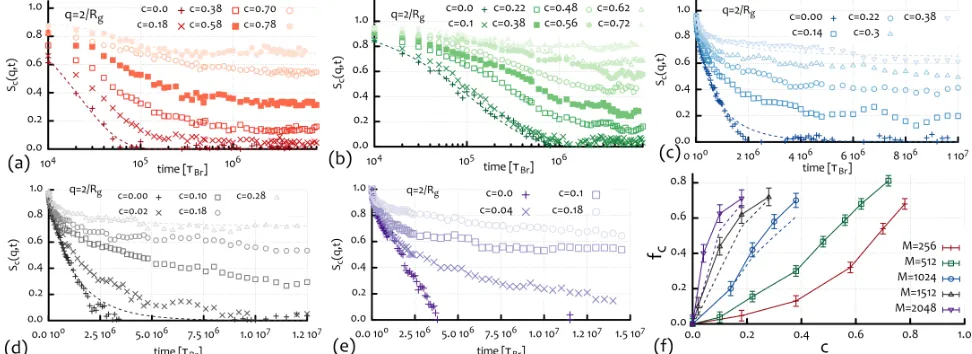
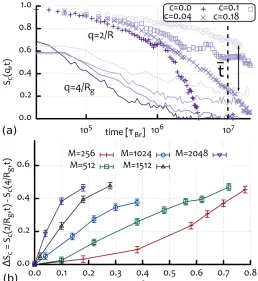
where P0 stands for the summation over the (1−c)N =f N non-frozen chains and the average is performed over time and orientations ofq. In Fig. 5 (and SI Appendix Figs. S6-S8) we report the behaviour of this quantity computed for two choices of wave vectorqprobing length scales (l= 2π/q) comparable to the rings’ diameter 2Rg. We observe that Sc(2/Rg, t)
de-cays much more slowly than the scattering function measured at q= 4/Rg. In order to compare their behaviour we choose
an arbitrarily long time (¯t = 107 τBr) at which we evaluate
the scattering function and report their difference ∆Sc for a
[image:6.657.73.331.269.550.2] [image:6.657.339.589.486.625.2]range of values of cand rings’ length (see Fig. 5, and see SI Appendix for different choices of ¯t).
Fig. 5. The freezing procedure affects long length scales more strongly than short ones. (a)Behaviour of the dynamic scat-tering functionSc(q, t)for the system withM = 2048and forq = 2/Rg
(l = πRg) (symbols) andq = 4/Rg (l = πRg/2) (solid lines) (more ex-amples can be found in SI Appendix Figs. S7 and S8). The difference∆Sc =
Sc(2/Rg,t¯)−Sc(4/Rg,¯t)is computed at an arbitrary long time¯t= 107τBr
and reported in(b)for the different cases. From this plot it is clear that the relaxation of length scales longer than2Rg is slowed down more severely than the relaxation
of shorter ones by the pinning procedure. In turn, this suggests that threadings act mainly by constraining low wavenumber modes.
The increasing trend of ∆Sc suggests that length scales
longer than the diameter of the rings are more susceptible to the freezing procedure. This is consistent with the fact that threadings between ring polymers constrain their translational degrees of freedom on length scales comparable to the size of the rings while there can exist internal modes that are left un-hindered and free to relax. In addition, we observe that the systems with longer chains require a smaller value ofcto sig-nificantly slow down the relaxation of the scattering function
with respect to systems with shorter chains. This observation is in turn in agreement with the fact that threadings are more numerous for systems with longer chains [13], and therefore a smaller fraction of frozen rings is sufficient to achieve a similar slowing down.
Fig. 5 also suggests that while coils are strongly constrained by the presence of frozen rings, the configurations can still par-tially relax by internal re-arrangements and this allows rings to relax their internal stress. The picture that emerges is rather different than that for linear polymers, where the centre of mass diffusion is intimately related to its ability to undergo any and all conformational re-arrangements. In the latter case, motion is only arrested by the onset of a microscopi-cally glassy state forT < Tg. In the case of ring polymers,
given their closed topology, threadings instead decouple the dynamics involved in displacing the centre of mass and those involved in the internal re-arrangement. Any glassy jamming that emerges in this work is unusual in that it is not associated with arrest of microscopic degrees of freedom but rather the topological arrest of low wavenumber modes, including that associated with the motion of the centre of mass. This is the reason why an entanglement plateau is absent. It also means that the slowing down of the dynamics in systems of rings might not be clearly captured by the stress relaxation func-tionG(t) frequently studied in the literature [6, 7, 8, 30], which is mostly dominated by the unconstrained internal modes, but rather by the mean square displacement of the unfrozen rings (as in Fig. 4) or the dynamic scattering functionSc(q, t).
The Phase Diagram of the System.The behaviour of both, the effective diffusion coefficient Deff and ∆Sc, show an
in-creasingly steeper dependence on the freezing parametercas the length of the rings increases (see Fig. 4(f) and 5(b)). This implies that systems made of long chains become extremely sensitive to very small perturbations. Indeed one can think of these observables as quantifying a form of susceptibility that captures how the dynamic mobility of the system responds to the freezing of (very few) threading constraints by chain immobilisation.
Fig. 6. The phase diagram of the system suggests a spon-taneous vitrification at largeM.Phase space(1/M, c)for systems of rings with lengthMand a fractioncof rings permanently frozen in space and time. The transition line(1/M†, c†)is shown together with an exponential fit (dotted line). The coloured data points in the diagram indicate whether the system displays a finite diffusion coefficient at large times (red) or whether it is irreversibly caged with vanishingDeff (blue). Along the transition line we also report the value of the
probabilitypof finding an un-caged ring in any one test performed at fixedc(see text for details).
represent the position of the simulated systems in the phase space and whether their behaviour was liquid-like (finiteDeff – red) or solid-like (vanishingDeff – blue). The diagram in Fig. 6 is reminiscent of that observed in more traditional glass-forming systems subject to random pinning fields [22] where the temperatureTis here replaced by the inverse length 1/M; a substitution not unfamiliar to field-theoretic treatments of polymer systems [2]. Along the transition line we also report the value of the probabilitypof finding an un-caged ring in any one sample as obtained from the binomial distribution at 95% confidence interval (1−p)(1−c†)N = 0.05. It is also worth noticing that the curve is well fitted by an exponential function of the formM†(c) =Mge−3.3c withMg '3500.
Computa-tional limitations forbid a thorough exploration of the small cregion; Nonetheless, and somewhat remarkably, our results show that the number of caged chains per explicitly frozen ring is exponential in the ring length (see SI Appendix Fig. S9(b)). This would seem to mean that an arbitrarily large fraction of caged chains can be achieved from an arbitrarily small fraction of frozen rings provided that the rings are long enough. This raises the possibility that a glassy state could emerge spon-taneously in the critical regime nearc= 0 in the (universal) limit of largeM.
From these results it is clear that concentrated solutions of long rings are extremely sensitive to a small external pinning field that can drive the centre of mass motion of the rings to become glassy (jammed). We have here traced this phe-nomenon to the unusual, topological constraints provided by the threadings between ring polymers. While branched poly-mers also display exponentially-long relaxation times, the ori-gin of this is notcooperativein nature and would therefore be rather insensitive to the freezing of some components. On the
other hand, cooperativity, such as the inter-ring threadings we study, is thought to be an essential ingredient of a genuine glass transition [18].
Our work therefore elucidates the conformation of rings in concentrated solutions and unambiguously characterises, for the first time, the presence of threadings between rings. Fur-thermore, we show the dynamics of ring polymers to be sen-sitive to these interactions and, finally, we provide strong ev-idence for the emergence of a kinetically arrested state solely driven by topological constraints. This system is therefore a novel instance of a glassy state induced through the topology of the constituents.
Materials and Methods
Simulations Details. We model the system by enclosingNsemi-flexible polymers modelled using the standard Kremer-Grest model [1] and formed byMbeads of nom-inal sizeσin a box with periodic boundary conditions of linear sizeL. The monomer fraction is fixed atρ=N M/L3 = 0.1σ−3and we vary the length of the
poly-mersM as our main control parameter. The simulation time-step is denoted with
τBrand correspond to the time taken by a bead of sizeσexperiencing a frictionξ
to diffuse its size. The simulation is carried out in NVT ensemble with the LAMMPS engine. Further computational details are described in the SI Appendix.
ACKNOWLEDGMENTS.The authors would like to thank Mike Cates, Davide Marenduzzo, Enzo Orlandini, Christos Likos and Dimitris Vlassopoulos for useful dis-cussions and careful remarks throughout the project. We also acknowledge the support of EPSRC through the Complexity Science Doctoral Training Centre at the Univer-sity of Warwick (DM), grant EP/E501311 and a Leadership Fellowship (MST), grant EP/I005439/1. The computing facilities were provided by the Centre for Scientific Computing of the University of Warwick with support from the Science Research In-vestment Fund. The authors also gratefully acknowledge the computing time granted by the John von Neumann Institute for Computing (NIC) and provided on the super-computer JURECA at Jlich Supercomputing Centre (JSC).
1. McLeish TCB (2008) Floored by the rings. Nature 7:933-935.
2. de Gennes PG (1979) Scaling concepts in polymer physics (Cornell University Press). 3. Doi M, Edwards S (1988) The theory of polymer dynamics (Oxford University Press). 4. Halverson JD, Lee WB, Grest GS, Grosberg AY, Kremer K (2011) Molecular dynamics simulation study of nonconcatenated ring polymers in a melt. I. Statics. J Chem Phys 134(20):204904.
5. Halverson JD, Lee WB, Grest GS, Grosberg AY, Kremer K (2011) Molecular dynamics simulation study of nonconcatenated ring polymers in a melt. II. Dynamics. J Chem Phys 134(20):204905.
6. Kapnistos M, et al. (2008) Unexpected power-law stress relaxation of entangled ring polymers. Nat Mater 7(12):997-1002.
7. Pasquino R, et al. (2013) Viscosity of Ring Polymer Melts. ACS Macro Lett 2:874-878. 8. Doi Y, et al. (2015) Melt Rheology of Ring Polystyrenes with Ultrahigh Purity.
Macro-molecules 48(9):3140-3147.
9. Cates ME, Deutsch J (1986) Conjectures on the statistics of ring polymers. J Phys 47:2121-2128.
10. Rubinstein M (1986) Dynamics of ring polymers in the presence of fixed obstacles. Phys Rev Lett 57(24):3023-3026.
11. Grosberg A (2014) Annealed lattice animal model and Flory theory for the melt of non-concatenated rings: towards the physics of crumpling. Soft Matter 10:560-565. 12. Smrek J, Grosberg AY (2015) Understanding the dynamics of rings in the melt in terms
of annealed tree model. J Phys Condens Matter 27:064117.
13. Michieletto D, Marenduzzo D, Orlandini E, Alexander G, Turner M (2014) Threading Dynamics of Ring Polymers in a Gel. ACS Macro Lett 3:255-259.
14. Michieletto D, Marenduzzo D, Orlandini E, Alexander GP, Turner MS (2014) Dynamics of Self-Threading Ring Polymers in a Gel. Soft Matter 10:5936-5944.
15. Tsalikis D, Mavrantzas V (2014) Threading of Ring Poly (ethylene oxide) Molecules by Linear Chains in the Melt. ACS Macro Lett 3:763-766.
16. Lee E, Kim S, Jung Y (2015) Slowing Down of Ring Polymer Diffusion Caused by Inter-Ring Threading. Macromol Rapid Commun.
17. Lo W-C, Turner MS (2013) The topological glass in ring polymers. EPL (Europhysics Lett 102(5):58005.
18. Gibbs JH, DiMarzio EA (1958) Nature of the Glass Transition and the Glassy State. J Chem Phys 28(3):373.
19. Berthier L, Biroli G (2011) Theoretical perspective on the glass transition and amor-phous materials. Rev Mod Phys 83(2):587-645.
20. Ritort F, Sollich P (2003) Glassy dynamics of kinetically constrained models. Adv Phys 52(4):219-342.
21. Biroli G, Bouchaud J-P, Cavagna A, Grigera TS, Verrocchio P (2008) Thermodynamic signature of growing amorphous order in glass-forming liquids. Nat Phys 4(10):771-775.
22. Cammarota C, Biroli G (2012) Ideal glass transitions by random pinning. Proc Natl Acad Sci USA 109(23):8850-8855.
23. Karmakar S, Parisi G (2013) Random pinning glass model. Proc Natl Acad Sci USA 110(8):1-6.
24. Gokhale S, Nagamanasa KH, Ganapathy R, Sood a K (2014) Growing Dynamical Facil-itation on Approaching the Random Pinning Colloidal Glass Transition. Nat Commun 5:1-13.
25. Nagamanasa KH, Gokhale S, Sood a. K, Ganapathy R (2015) Direct measurements of growing amorphous order and non-monotonic dynamic correlations in a colloidal glass-former. Nat Phys 11(May):403-408.
26. Ozawa M, Kob W, Ikeda A, Miyazaki K (2015) Equilibrium phase diagram of a ran-domly pinned glass-former. Proc Natl Acad Sci USA 112(22):6914-6919.
27. Kob W, Coslovich D (2014) Nonlinear dynamic response of glass-forming liquids to random pinning. Phys Rev E 90(5):052305.
28. Grosberg AY, Rabin Y, Havlin S, Neer A (1993) Crumpled globule model of the three-dimensional structure of DNA. Europhys Lett 23(5):373-378.
29. Halverson JD, Smrek J, Kremer K, Grosberg A (2014) From a melt of rings to chro-mosome territories: the role of topological constraints in genome folding. Rep Prog Phys 77:022601.
30. Br´as A, Gooßen S, Krutyeva M (2014) Compact structure and non-Gaussian dynamics of ring polymer melts. Soft Matter 10:3649-3655.
31. Rosa A, Everaers R (2014) Ring polymers in the melt state: the physics of crumpling. Phys Rev Lett 112:118302.
32. Bernabei M, Bacova P, Moreno AJ, Narros A, Likos CN (2013) Fluids of semiflexible ring polymers: effective potentials and clustering. Soft Matter 9(4):1287. 33. Likos CN, Narros A, Moreno A, Capone B (2014) Multi-blob coarse graining for ring
polymer solutions. Soft Matter.
34. Mattsson J, et al. (2009) Soft colloids make strong glasses. Nature 462(7269):836.
35. Mirny LA (2011) The fractal globule as a model of chromatin architecture in the cell. Chromosom Res 19(1):37-51.
36. Bi D, Yang X, Marchetti MC, Manning ML Motility-driven glass and jamming transi-tions in biological tissues. arXiv:150906578.
37. Kremer K, Grest GS (1990) Dynamics of entangled linear polymer melts: A molecular-dynamics simulation. J Chem Phys 92(8):5057.
Appendix: Supplementary Information
Computational Details.We model the system by enclosing N = 50 semi-flexible bead-spring polymers formed by M beads in a box with periodic boundary conditions of linear sizeL. The monomer densityρ=N M/L3 = 0.1σ−3 is fixed and we vary the length of the polymers and the size of the box to keep the density constant. The chains are modelled via the Kremer-Grest worm-like chain model [1]. as follows: Let ri and di,j ≡rj−ri be respectively the position of the
center of the i-th bead and the vector of lengthdi,j between
beads iandj, the connectivity of the chain is treated within the finitely extensible non-linear elastic model with potential energy,
UF EN E(i, i+ 1) =−
k 2R 2 0ln " 1−
di,i+1 R0
2#
fordi,i+1< R0 andUF EN E(i, i+ 1) =∞, otherwise; here we
choose R0 = 1.6σ andk = 30/σ2 and the thermal energy kBT is set to. The bending rigidity of the chain is captured
with a standard Kratky-Porod potential,
Ub(i, i+ 1, i+ 2) =
kBT lp
2σ
1−di,i+1·di+1,i+2 di,i+1di+1,i+2
,
where we set the persistence length lp = 5σ. The steric
in-teraction between beads is taken into account by a truncated and shifted Lennard-Jones (WCA) potential
ULJ(i, j) = 4
" σ di,j 12 − σ di,j 6 + 1/4
#
θ(21/6σ−di,j).
whereθ(x) is the Heaviside function.
Denoting byUthe total potential energy, the dynamic of the beads forming the rings is described by the following Langevin equation:
mr¨i=−ξr˙i− ∇U+η [ 6 ]
whereξis the friction coefficient andηis the stochastic delta-correlated noise. The variance of each Cartesian component of the noise,ση2satisfies the usual fluctuation dissipation
rela-tionship ση2= 2ξkBT.
As customary [1] we setm/ξ=τLJ=τBr, with the LJ time
τLJ = σ
p
m/and the Brownian time τBr = σ/Db, where
Db=kBT /ξis the diffusion coefficient of a bead of sizeσ, is
chosen as simulation time step. From the Stokes friction coef-ficient of spherical beads of diametersσwe have: ξ= 3πηsolσ
whereηsolis the solution viscosity. It is possible to map this to
real-time units by using the nominal water viscosity, ηsol= 1
cP and setting T = 300 K and σ equal, for instance,to the diameter of hydrated B-DNA (σ= 2.5nm), for which one has τLJ =τBr = 3πηsolσ3/'37ns. The numerical integration
of Eq. [ 6 ] is performed by using a standard velocity-Verlet algorithm with time step ∆t= 0.01τBrand is implemented in
the LAMMPS engine.
System Preparation and Equilibration.The systems are pre-pared by placing the rings randomly in a very large box. The linking number between all pairs of rings is also checked in order to avoid linked polymers. In addition, the rings are ini-tialised as perfect circles in order to avoid self-knotting. The desired monomer density is achieved by slowly shrinking the box until the target box size is reached (effectively applying a constant pressure). At this stage, we checked for unwanted
linked rings and found none. After this, we equilibrate the systems by performing standard runs (with no rings artifi-cially pinned) for at least the time need for the chains to dis-place their centres of mass of several Rg’s. We observe that
t = 107τBr time-steps are enough to obtain this condition.
After the equilibration we performed another run in order to study the free,i.e. unperturbed, behaviour of the system. The mean square displacement obtained from this run is reported in see Fig. S4. The simulations in which we artificially pin some of the rings are then started from the late stages of this last run, so that the initial configuration for theseperturbed simulations were un-correlated from the initial system set up. The rings that are artificially pinned are chosen at random among theN rings. Because the simulations are very compu-tationally expensive, we only perform one simulation for each choice ofc. For the longest chains reported here (M = 2048 beads) each run up to 2 107 τ
Br takes up to 4 weeks when
running in parallel over 64 processors. This time-window has to be run for every choice of the fraction of pinned chainsc. As we tested four choices of c, the results reported only for the system withM = 2048 (Fig. 3(e) in main text) take∼4 months of 64 CPUs time or, equivalently,∼20 years of single CPU time.
The Size and Static Structure of Rings are in Agreement with the Crumpled Globule Behaviour.In agreement with re-sults reported in the literature [2, 3] we observe (Fig. S1) that the radius of gyration of the rings scales asRg ∼ Mν with
ν '1/3 in the limit of large polymerisation indexM, while we observeν'2/5 for shorter rings. This is supported by the measurement ofhRg2ieither for the whole rings or as a
func-tion of the contour lengths. The values of the exponents are in agreement with previously reported findings and we refer to previous works[2, 3] for dedicated measurements ofν. An-other way of investigating the conformation of the rings is by measuring the static structure factor. For wave-vectors in the range 1/Rg < q <1/σ, one should expect thatS1(q) defined
as
S1(q) =
*
1 M
M
X
i,j∈I
eiq(ri(t)−rj(t))
+
[ 7 ]
where the indexesi,jrun over ringI, to giveS1(q)∼q−DF [4],
whereDF is the fractal dimension of the chain at length scale
1/qand it is related to the scaling exponentν asDF = 1/ν.
Linear chains in the melt display DF = 2 for a broad range
ofq’s [1] while we observe the rings to have a more complex organisation with DF ranging from DF ' 3 to DF ' 1 at
largeq, in agreement with previous findings [2] (see Fig. S1).
The Contact Surface of the Coils Grows Extensively with the Length of the Rings.In order to quantify the degree of inter-action between coils, we investigate (i) the number of surface monomers, (ii) the number of contiguous chains and (iii) the number of neighbouring chains.
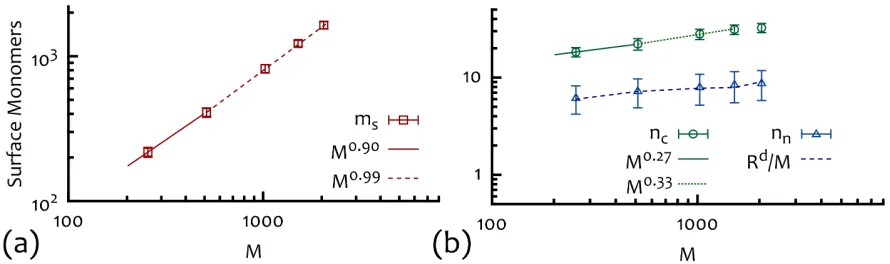
(i) The number of surface monomers ms is computed by
counting the number of beads forming the chains that are in contact with beads forming any other chains, accord-ing to the contact matrix in eq. 3 of the main text, i.e. any two beads are in contact if their position is closer than d=ρ−1/3, where 1/ρ= 10σ3 is the free volume per bead. (ii) The number of contiguous chainsnc is computed the
number of chains that have surface beads that are in con-tact.
(iii) The number of neighbouring chainsnn is instead
Fig. S1. (a) Ensemble average of the radius of gyrationhRgi ≡ hR2gi1/2and plotted against rings’ contour lengths(main) and total lengthM(inset) both in units
of the bead size. As reported in the literature, the rings show a collapsed behaviour for largeM. (b) Static scattering functionS1(q)plotted againstqRgand normalised
by the length of the ringsM. This quantity indicates a complex arrangement of the rings internal structure, which does not seem to follow a unique fractal dimension at all lengths.
Fig. S2. (a) The number of surface monomersmsshows a scalingms∼Mβcwithβc'0.99for the longest chains. (b) The number of contiguous chainsncand
number of neighbouring chainsnnis shown. While their scaling behaviour is similar, the average number of chains in contact at any time is systematically larger than the
number of chains whose centre of mass is closer than2Rg. This may imply large fluctuations in the rings conformations that bring distant chains in contact with one another. In (b) we show two curves with exponents0.33and0.27as a guide for the eye but refer to the literature and further studies for more precise estimates.
These quantities are reported in Fig. S2.
The surface monomers show a near extensive dependence to the length of the rings, as already observed in previous works [2], while the number of contiguous and neighbour-ing chains show a similar scalneighbour-ing behaviour as a function of M, althoughncis found systematically larger thannn. This
may imply large fluctuations in the rings conformations, which bring distant coils in contact.
The Contact Probability Shows a Decay Consistent with the Mean-Field Estimate
γ
= 1
.The contact probability is de-fined asPc(|i−j|) =
*
1 M
M−1
X
i=1
M
X
j=i+1
Θ(a− |ri(t)−rj(t)|)
+
[ 8 ]
where Θ(x) is the Heaviside function andais the chosen cut-off. In Fig. S3 we reportPcfor two value ofaand for different
chain lengths. The behaviour ofPc(m) is expected to follow
the crumpled globule scaling
Pc(m)∼m−γ [ 9 ]
withγ & 1, and for which the mean field value γ =νd is a lower bound. We here observeγ'1.02−1.09 (see Fig. S3). The prediction that fixes the sum of the contact exponentγ and the surface exponentβc equal to 2 in the case of
crum-pled globules (ν= 1/3),i.e. βc+γ= 2 [5], is therefore here
recovered within errors.
The Pair Correlation Function Suggest that the Coils are Largely Inter-Penetrating.In order to probe the inter-penetration of the coils one can also investigate the pair corre-lation functiong(r) which we here defined similarly to a recent work [6]
g(r) = 2 N(N−1)
N−1
X
I=1
N
X
J=N+1
δ[|rCM,I(t)−rCM,J(t)| −r]
[ 10 ]
where rCM,I indicates the position of the centre of mass of
ringI.
This function has been used in a recent work [6] probing the glassy dynamics of polymers under confinement and we here find well characterising the degree of overlap between coils. The behaviour ofg(r) (reported in Fig. S3) in fact shows a distinct peak atrc '1.8Rg forM = 256 and atrc'1.4Rg
[image:9.657.92.537.282.414.2]Fig. S3. (a) The contact probability functionPc(m)(defined in eq.[ 8 ]) shows a scaling behaviourm−γwithγslightly dependent on the choice of the cut-offabut
compatible with previous findings [2]. (b) Pair correlation functiong(r)for the rings centre of mass as defined in eq.[ 10 ]. The peak position imply that the coils are largely overlapping. In the inset we reportg(r)normalised by the ideal pair distribution functiongI(r) = 4πρcr2, whereρc≡N/L3is the coils’ density. The coils behave as
ultra-soft sphere with large inter-penetrations.
Fig. S4. (a)g3(t): Mean square displacement (MSD) of the rings centre of mass. The faint horizontal lines represent the square radius of gyrationhR2g(t)i. (b)
g3(t)/R2g: MSD of the rings centre of mass divided by their squared gyration radius. The solid horizontal line in(b)marks the valueg3(t)/Rg2= 1at which the rings
have, on average, travelled once their own size.(c)and(d)Report the behaviour of the diffusion coefficient of the centre of mass of the rings and the relaxation timeτR
(see eq. [ 12 ]), respectively. By fitting the last three data-points in order to obtain the asymptotic values ofDCMfor largeMwe obtain−2±0.1. By considering all
data point we obtain a value for the exponent ofDCMof around1.8±0.1.
The Mean Squared Displacement of the Unperturbed Sys-tem is in Agreement with Previous Observations.In Fig. S4 we report the rings centre of mass mean square displacement g3(t) defined as
g3(t) =
[rCM(t)−rCM(0)]2
, [ 11 ]
along with the diffusion coefficient DCM ≡ limt→∞g3(t)/6t
and the relaxation timeτRdefined via the following condition
g3(τR)≡R2g. [ 12 ]
As one can notice, the mean square displacement (MSD) of the centre of mass displays an intermediate sub-diffusive regime in whichg3(t)∼t3/4before crossing over to a diffusive regime at large times. This is most evident for longer rings. The scal-ing of the diffusion coefficient as a function of the rscal-ings length is comparable to the one found in Ref. [3] although slightly
smaller, which is in agreement with the lower monomer density considered in this work. This scales asymptotically as
DCM ∼M
−2
[ 13 ]
as well as the relaxation timeτR for which we find
τR∼M2.3. [ 14 ]
[image:10.657.125.529.295.519.2]Fig. S5. (a)Values of the relaxation timesτncandTncfor the contiguous correlation functionϕnc(t)reported in Fig. 2 of the main text.We observe an exponential increase of the typical exchange time for largeM.(b)Value of the stretching exponentβnc, ranging from near unity forM= 256to around1/2forM= 2048.
Fig. S6. Overlap parametersQcoil(solid lines) andQmon(dashed lines) for different values ofcand for the 5 values ofMconsidered: (a)M= 256, (b)M= 512,
(c)M = 1024, (d)M = 1512and (e)M = 2048. In the inset the overlap parameter is plotted in linear scale to highlight the long time flattening.(f )The value of the overlap parameterfov≡Qcoil(t=ti;c)is evaluated and reported at two arbitrary (long) timest1= 5 106τBr(solid lines and data points) andt2= 107τBr
(dashed lines), showing a consistent increased tendency to display an arrest of the decay at larger values.
exponentials of the form
ϕnc= exp
"
−
t τnc
βnc#
. [ 15 ]
We also report the value ofTnc, which is here defined as
Tnc≡
Z ∞
0
ϕnc(t)dt. [ 16 ]
Both relaxation timesτnc and Tnc are observed to grow
ex-ponentially inM. The stretching parameter βnc is found to
reach values close to 1/2 for the longest chains studied in this work. This implies that the exchange time of the rings be-comes extremely slow in the limit of largeM and in turn this may suggest the onset of a glassy dynamics (see discussion of Fig. 2 in the main text).
The Overlap Parameter Shows an Arrested Decay Corre-sponding to Caged Length-Scales.The overlap parameters Qmons (t) andQcoils (t) are useful to characterise the glassy
dy-namics [7]. We here define them here as follows:
Qmon(t;c) =hΘ(w− |ri(t)−ri(0)|)i [ 17 ]
and
Qcoil(t;c) =hΘ(w− |rCM(t)−rCM(0)|)i. [ 18 ]
Where the average is performed over monomers (coils) and initial times. The window parameter is chosen to bew= 2Rg
being the length-scale at which the glassy dynamics is conjec-tured to occur. In other words, we aim to average out all the jiggling of the coils inside cages of size 2Rgand to capture the
slowing down of the translational dynamics of the centre of mass of the coils. As shown in Fig. S6, this two-point correla-tion funccorrela-tion clearly reflects the arrested relaxacorrela-tion whencis increased towardc†. As discussed in the main text, coils that are completely caged cannot escape and freely diffuse. This means that their centre of mass is confined in a cage of linear size 2Rgat all times. The coils’ overlap parameter reflects the
constraint by arresting its decay and in particular we find that
lim
t→∞Q
coil
(t;c†)'1 [ 19 ]
at any time.
[image:11.657.69.315.517.596.2]Fig. S7. Scattering functionSc(q, t)computed atq= 4/Rg for different chain lengths: (a)M = 256, (b)M = 512, (c)M = 1024, (d)M = 1512and
(e)M = 2048. The last three set of curves are plotted in linear scale to highlight the behaviour at large times. (f )The value of the scattering function at arbitrary time
¯
t,fc≡Sc(q,¯t)is plotted againstcfor two chosen values of time¯t:t= 5 106τ
Br(solid lines and symbols),t= 107τBr(dashed lines) and for the different chain
lengths.
Fig. S8. Scattering functionSc(q, t)computed atq= 2/Rg for different chain lengths: (a)M = 256, (b)M = 512, (c)M = 1024, (d)M = 1512and (e)M= 2048. The last three set of curves are plotted in linear scale to highlight the behaviour at large times.(f )The value of the scattering function at arbitrary time¯t,
fc≡Sc(q,¯t)is plotted againstcfor two chosen values of timet¯:t1= 5 106τBr(solid lines and symbols),t2= 107τBr(dashed lines) and for the different chain
lengths.
and this implies that the relaxation dynamics is decoupled by the topological constraints, which suppress the degree of free-dom of the centre of mass of the coils while leaving shorter segments along the chains relatively unhindered.
Given the fact that the arrested decay of Qcoil(t;c) and Qmon(t;c) ends with an unambiguous flattening at a con-stant value at long times only for small chains, we compare the behaviour of this correlation function by choosing two arbitrary (long) times (t1 and t2)and plotting the value of fov ≡ Qcoil(t = ti;c) at those times in Fig. 6(f). One can
clearly notice that by increasingcany system becomes slower and for larger chains, a small contamination of frozen chains (c) is enough to dramatically arrest the decay of the overlap function.
The Scattering Function Indicates Markedly Different Relax-ation Times Above and Below the Average Size of a Coil.In
this section we discuss the dynamic scattering function
Sc(q, t) =
*
1 M
M
X
i,j∈I
eiq[ri(0)−rj(t)]
+
, [ 20 ]
calculated forq1= 4/Rg andq2= 2/Rg. The latter explores
length scales larger than the diameter of the coils (l2=πRg>
2Rg) twice as long of the former, which probes length scales
shorter than the diameter of the coils (l1 = (π/2)Rg<2Rg).
As one can notice from Fig. S7 and Fig. S8, these two dy-namics are markedly different.
It is clear from Figs. S7 and S8 that length scales larger than 2Rg are much slower than the internal modes, probed
bySc(q= 4/Rg, t). This is shows by the large-time value
at-tained bySc(q, t), defined asfc, in the two cases and reported
in S7(f) and S8(f). In the figures, we show fc computed for
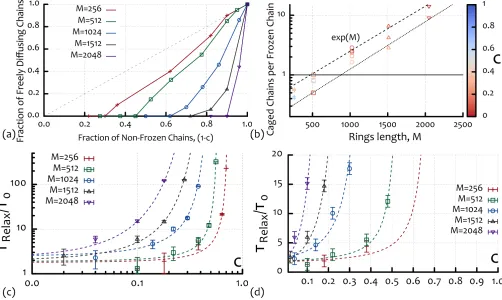
[image:12.657.84.570.338.515.2]Fig. S9. (a)Fraction of freely diffusing ringsΦf d=nf d/(1−c)Nagainst the fraction of non-frozen chains1−c. The dotted line marks the case in which all the
non explicitly frozen chains are also freely diffusing.(b)The “efficiency” of the pinning procedure can be quantified by plotting the number of caged rings per frozen chain as a function of the chains’ length and for the variouscused. Here the points plotted mark the result from a simulation for fixedcandM. Both the most and the least efficient cases (for a given rings lengthM) show an exponential growth withM.(c)-(d)Relaxation time of the systems computed asR2
g/Deff. The divergence of the relaxation
as a function of the freezing fractioncis broadly captured by a VFT function,i.e. τRelax=τ0exp [Ac/(c0−c)], wherec0is generally larger thanc†defined using
Deff(see main text).
for the overlap function. The way in whichfc grows steeper
and steeper forq = 2/Rg and for increasing chain lengths as
a function ofcis indicative that the pinning procedure affects large length scales more severely than shorter ones.
From these findings, as discussed in the main text, we argue that the relaxation of the long wave length modes is strongly hindered by the pinned rings, while the short wavelength are relatively free to relax. This once again implies that the stronger effect of the pinning of rings is experienced by the translational degrees of freedom of the rings while it leaves short segments of the rings able to partially re-arrange their conformations.
The Efficiency of Freezing Grows Exponentially with the Chains’ Length.The freezing procedure described in the main text offers a pathway to generate glassy states by exploiting the topology of the constituents. We show how the fraction of freely diffusing chains depends on the fraction of (non-)frozen chains in Fig. S9(a). This is done by tracking the individual MSD of the coils centre of mass and by counting the number of these which have travelled more than 2Rgat the end of the
simulation run time and by classifying these as freely diffus-ing. The dashed line represents the curve followed by the data points if every non-explicitly frozen chain were free to diffuse. The deviation from this (zero pinning efficiency) line becomes stronger as the chains become longer and readily show that long chain are very sensitive to a small amount of explicitly
frozen chains.
Fig. S9(b) shows the number of caged chains as a func-tion of rings’ length. Once again we identify the caged coils by tracking the individual MSD of the centre of mass and by identifying as “caged” those which have not travelled more than 2Rg at the end of the simulation. We repeat this
analy-sis for every choice ofc. We observe that not all simulations have the same caging “efficiency” but, remarkably, we observe that both the least and the most efficient (highest and low-est number of caged rings per frozen one) scale exponentially withM. This finding strongly encourages further computa-tional and experimental studies of this system, as the number of chains implicitly caged can become arbitrarily big depend-ing on the choice ofM. Because of this exponential increase, fewer explicitly frozen chains will be needed to significantly slow down the system, raising the possibility that the system might spontaneously vitrify.
Finally, we study the longest relaxation time of the per-turbed systems by computingτRelax≡R2
g/Deff and we report
glass-forming systems
τRelax=τ0exp
Dc0 c0−c
. [ 21 ]
where here c replaces T. This result can be understood in terms of cooperativity of the chains: as one gets closer to the critical linec†(M), the activation energy to arrange and re-lax the system becomes higher, as the number of topological
constraints becomes closer to the critical value for which all the translational degrees of freedom of the system are quenched. On the other hand, it is important to notice that we can track the relaxation time of the chains only up to roughly two orders of magnitude larger than the unperturbed relaxation time (τ0) and this is far too small a range to draw definite conclusions on the nature of this divergence.
1. Kremer K, Grest GS (1990) Dynamics of entangled linear polymer melts: A molecular-dynamics simulation. J Chem Phys 92(8):5057.
2. Halverson JD, Lee WB, Grest GS, Grosberg AY, Kremer K (2011) Molecular dynamics simulation study of nonconcatenated ring polymers in a melt. I. Statics. J Chem Phys 134(20):204904.
3. Halverson JD, Lee WB, Grest GS, Grosberg AY, Kremer K (2011) Molecular dynamics simulation study of nonconcatenated ring polymers in a melt. II. Dynamics. J Chem Phys 134(20):204905.
4. de Gennes PG (1979) Scaling concepts in polymer physics (Cornell University Press).
5. Halverson JD, Smrek J, Kremer K, Grosberg A (2014) From a melt of rings to chro-mosome territories: the role of topological constraints in genome folding. Rep Prog Phys 77:022601.
6. Kang H, Yoon Y, Thirumalai D, Hyeon C (2015) Confinement-Induced Glassy Dynam-ics in a Model for Chromosome Organization. Phys. Rev. Lett. 115, 198102.

![Fig. S3.(a) The contact probability function Pc(m) (defined in eq. [8]) shows a scaling behaviour m−γ with γ slightly dependent on the choice of the cut-off a butcompatible with previous findings [2]](https://thumb-us.123doks.com/thumbv2/123dok_us/9476614.453965/10.657.125.529.295.519/probability-function-behaviour-slightly-dependent-butcompatible-previous-ndings.webp)