Crystallization of Amorphous Poly(Lactic Acid) Induced
by Vapor of Acetone to Form High Crystallinity and
Transparency Specimen
Naofumi Naga1, Yuji Yoshida1, Keiichi Noguchi2, Shigemitsu Murase3
1Department of Applied Chemistry, Material Science Course, College of Engineering,
Shibaura Institute of Technology, Tokyo, Japan
2Instrumentation Analysis Center,
Tokyo University of Agriculture and Technology, Tokyo, Japan
3Department of Organic and Polymer Materials Chemistry, Faculty of Technology,
Tokyo University of Agriculture and Technology, Tokyo, Japan Email: [email protected]
Received December 24, 2012; revised January 24, 2013; accepted January 30,2013
Copyright © 2013 Naofumi Naga et al. This is an open access article distributed under the Creative Commons Attribution License, which permits unrestricted use, distribution, and reproduction in any medium, provided the original work is properly cited.
ABSTRACT
Crystallization of amorphous poly(lactic acid) (PLA) was investigated by exposing to vapor of acetone. The vapor of acetone induced crystallization of the amorphous PLA effectively. It took about 24 min to complete the crystallization of a 1 cm × 2 cm × 0.55 mm specimen at 25˚C. The crystallization rate increased with increasing of conducting temperature. The crystallization method yielded high crystallinity about 40%, which was almost equal to that attained by annealing or immersion methods conducted as references. The specimens crystallized by the vapor showed higher transparency than those prepared by the reference methods. The crystallization was induced by diffusion of acetone into the amorphous phase of PLA, and polarized optical photomicrographs cleared that the diffusion obeyed Fick type diffusion.
Keywords: Poly(Lactic Acid); Acetone; Crystallization; Transparency
1. Introduction
Poly(lactic acid) (PLA) is one of the most useable bio- deradable plastics which are made from bio-resources. PLA is used in various products, for example film, sheet, fiber, resin, and so on [1-3]. Improvement of the mecha- nical property and processability of PLA will expand the application of PLA. Crystallization rate and crystallinity of PLA are relatively low due to its slow nucleation [4,5], and its slow crystallization causes long molding cycle for producing of products. Addition of a nucleating agent to PLA is effective to improve the crystallization rate, and some nucleating agents, such as benzoic acid hydrazide, for PLA have been developed [6-14]. Nanocomposite of PLA is an effective method to improve the mechanical properties and increased the crystallization rate of PLA [15-19].
We found out crystallization of amorphous PLA in- duced by immersion it in organic solvents [20]. Acetone is the most effective among the organic solvents used in the experiments. This is a very easy and conventional me- thod to obtain high crystalline PLA samples. However,
this method yields whitened PLA specimens due to the forming small bubbling accompanied by immersion of the specimens in acetone. The problem which we must solve next is to fide a method for preparing high crystal- linity with high transparency specimen of PLA.
We came to an idea that use of vapor of organic sol- vent to induce crytslallization of amorphous PLA. For example, crystallization of amorphous syndiotacic-poly- styrene induced was induced by vapor of toluene [21]. It may offer the key to attain the crystallization of PLA with- out whitening. In this paper, we investigated solvent in- duced crystallization of amorphous PLA and its proper- ties precisely, and found out that vapor of acetone indu- ced crystallization of amorphous PLA effectively and yielded not only high crystallinity but also transparent specimens.
2. Experimental Part
2.1. Materials
tika Ltd., and was used as received. Number average molecular weight (Mn) and molecular weight distribution
(Mw/Mn) of the PLA were 83,600 and 2.5, respectively,
calibrated with standard polystyrene samples. Sample sheet for the crystallization was cut as a size of 1 cm × 2 cm × 0.55 mm. Sample for polarized optical micrograph was prepared on the slide glass covered with cover glass. The sample was melted at 220˚C for 5 min and rapidly cooled to room temperature. Acetone was commercially obtained and used without further purification.
2.2. Crystallization of Amorphous PLA
The crystallization was conducted in a 100 ml Erlenme- yer flask in the presence of 20 mL of acetone at desired temperatures. The amorphous PLA sample was exposed to the acetone vapor for desired time, and dried in vacuo at room temperature for 6 h. The sample was placed at room temperature for 1 week before DSC measurement.
Crystallization of amorphous PLA was also conducted by annealing at 90˚C or immersion in acetone at 25˚C.
2.3. Analytical Procedures
Thermal properties of the PLA samples were investigated by a Rigaku DSC 8230 at a heating rate of 3˚C/min to 200˚C after previous cooling to 0˚C and holding for 5 min. Haze of the specimen was determined by a Nippon Denshoku Industries Co., Ltd. NDH-2000. Polarized op- tical micrographs of the PLA were observed using an op- tical microscope (Olympus BX50). Wide angle X-ray diffraction (WAXD) patterns of the PLA samples were recorded on a Rigaku RAD-C using Cu K radiation.
3. Results and Discussion
3.1. Structure and Properties of PLA Specimens Crystallized by Acetone Vapor
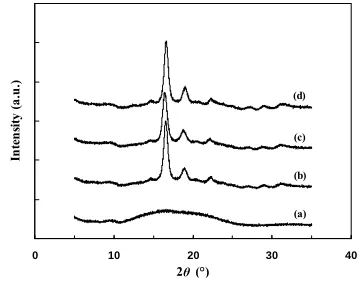
Amorphous PLA was exposed to the vapor of acetone at 25˚C, 40˚C, and 50˚C. WAXD patterns of the specimens are shown in Figure 1. The specimens exposed to ace- tone vapor showed clear diffraction peaks at 2= 14.7˚, 16.5˚, 18.9˚, and 22.3˚. These diffraction peaks are de- rived from 010, 110/200, 203, and 015 phases of form, respectively [22-24]. These diffraction peaks are not de- tected in the amorphous sample but detected in a ther- mally crystallized sample. The results clear that amor- phous PLA can be crystallized by acetone vapor and the crystal preferentially forms the form.
Properties of PLA specimens are summarized in Table 1. The properties of the PLA samples, which are amor-phous, immersed in acetone, and thermally crystallized samples, are also listed for references. Crystallinity val- ues of all the crystallized samples induced by acetone vapor were more than 40%. The values are as high as
[image:2.595.332.511.204.346.2]that of the crystallized samples by immersion in acetone and annealing at 90˚C. Photographs of the specimens are shown in Figure 2. The specimen crystallized in acetone solvent is whitened as described above. Whereas, the crystallized samples induced by acetone or annealing are highly transparent. Haze values are also summarized in
Table 1. The crystallized samples induced by acetone vapor showed low haze values than that of the thermally crystallized sample.
0 10 20 30 40
2θ (°)
In
ten
si
ty
(
a.
u
.)
(a) (b) (c) (d)
[image:2.595.338.507.391.519.2]Figure 1. WAXD profiles of PLA samples; amorphous PLA (a), exposed to acetone vapor at 25˚C (b), 40˚C (c), and 50˚C (d).
[image:2.595.308.536.580.696.2]Figure 2. Photographs of PLA samples; amorphous PLA (a), exposed to acetone at 25˚C (b), annealed at 90˚C (c), and immersed in acetone at 25˚C (d).
Table 1. Properties of PLA samplesa.
Sample Method Temp.˚C Time min Hcb J/g
Hmb J/g
Xcc %
Haze %
1d --- --- --- 38.1 39.6 1.6 6.7
2 Vapore 25 60 38.0 40.9 65.9
3 Vapore 40 20 39.7 42.7 76.1
4 Vapore 50 20 40.9 44.0 83.2
5 Annealing 90 270 40.5 43.5 90.5
6 Immersionf 25 10 40.4 43.4
aSample: 10 × 20 × 0.55 mm, bHeat of fusion of crystallization (Hc) or melt-
3.2. Crystallization Behavior of Amorphous PLA by Acetone Vapor
The crystallization process of amorphous PLA in acetone was also traced with DSC. Figure 3 shows time evolu- tion of DSC thermograms of the PLA exposed to acetone vapor at 25˚C. In the DSC profile of the amorphous PLA (Figure 3. 0 min), endothermic and exothermic peaks derived from glass transition, crystallization of amor- phous phase, and melting of crystalline phase were de- tected at 60˚C, 110˚C, and 165˚C, respectively [25-27]. Multiple melting peaks at around 161˚C and 166˚C in the DSC curve of amorphous PLA sample should be derived from transition from α’ to phase as previously reported [28]. The samples exposed to acetone vapor for 3 - 18 min showed a Tg (Tgl) ranging from 40˚C - 30˚C, which
was lower than that of the amorphous PLA (Tgh at around
60˚C). Two exothermic peaks of the crystallization were detected in the PLA samples exposed to acetone vapor for 3 - 18 min. Those were low Tc (Tcl) ranging from
80˚C to 60˚C and high Tc (Tch) ranging from 110˚C to
85˚C, and these temperatures decreased with increasing of the conducting time. Only an exothermic peak derived from crystallization was detected at around 60˚C in the sample exposed for 21 min, and the peak disappeared in the sample immersed for 24 min. Vapor induced crystal- lization takes longer time for crystallization than that induced by immersion in the solvent, the results of DSC profiles are resemble each other. The DSC profiles can be explained by the supposing three phases in the PLA samples, amorphous phase without acetone (Area 1), amorphous phase containing small amount of acetone (Area 2), and crystalline phase (Area 3), as previously proposed in the PLA samples crystallized in acetone sol- vent [20]. The contained acetone would play a role of like a plasticizer, and decrease Tg and Tc to Tgl and Tcl in
the Area 2. The Tch also decreased with increasing the
conducting time, indicating the crystallization of Area 2 would induce the crystallization of Area 1. The DSC
0 50 100 150 200
Temperature (ºC)
Endo.
←
→
Ex
o.
Tch
Tcl
Tgh
Tgl
0 min 3 min 6 min
9 min 12 min 15 min
18 min 21 min
[image:3.595.342.502.519.699.2]24 min
Figure 3. Time evolution of DSC profiles of PLA sample exposed to acetone vapor at 25˚C.
profile of the sample exposed for 21 min did not show
Tch indicating that acetone vapor had reached to the cen-
ter of the specimen. The DSC profile of the sample ex- posed to acetone for 24 min did not show any Tc indicat-
ing the crystallization had completed.
The melting enthalpy of total crystalline phase (Hm)
corresponds to the sum of melting enthalpies of original crystalline phase (Hmc) and crystallized amorphous phase
(Hma). In the case of amorphous PLA sample, although a
small amount of crystalline phase was contained, the values of Hc (38.1 J/g) and Hm (39.6 J/g) were almost
same, as shown in Table 1. Crystallinity of the original PLA samples (Xc), therefore, was estimated from enthal-
pies of crystallization of amorphous phase (Hc) and
melting of total crystalline phase (Hm) using a following
equation, as previously reported [20].
0mt ca m 100
c
X H H H (1)
where, 0 m
H is theoretical melting enthalpy of PLA, 93 J/g [29].
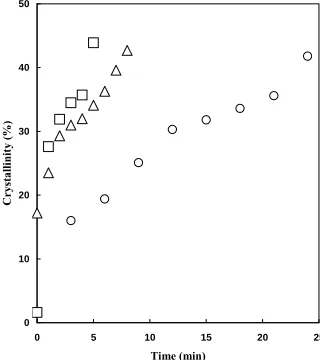
The crystallization at 40˚C and 50˚C was also trace by DSC. Relationship between conducting time and Xc is
shown in Figure 4 to study the effect of temperature of vapor on the crystallization rate. Increase of the con- ducting temperature is effective to accelerate the crystal- lization induced by acetone vapor. The crystallization was completed within 8 min or 5 min at 40˚C or 50˚C, re- spectively.
Crystallization of amorphous PLA induced by acetone vapor was conducted between cover glass and slide glass on the stage of an optical micrograph to trace the diffu- sion of the vapor in the specimen. Figure 5 shows the polarized optical micrographs of PLA specimen at around the edge exposed to acetone vapor at 25˚C. The sample before exposure to acetone vapor did not show
0 10 20 30 40 50
0 5 10 15 20 25
Time (min)
C
rys
ta
lli
nit
y (%
)
[image:3.595.89.256.558.709.2]birefringence, as shown in Figure 5(a). After the expo- sure of the sample to acetone vapor, birefringence ap- peared at where crystalline area. The area which showed the birefringence increased as time passed, as shown in
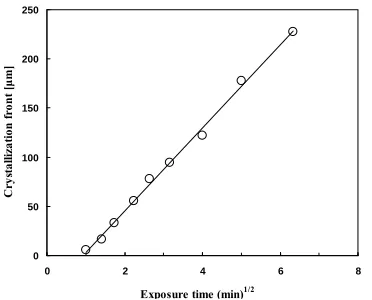
Figures 5(b)-(d). A relationship between conducting time (square root of the time) and crystallization front (length from edge of the specimen to crystallization front) is shown in Figure 6. The plot clears that diffusion dis- tance of acetone is in proportion to square root of the exposed time, indicating the diffusion of acetone vapor in PLA obeys Fick type diffusion [30-32]. These results show good agreement with the results of the PLA crys- tallization immersed in acetone solvent.
4. Conclusions
Crystallization of amorphous PLA was carried out in
(a) (b)
Crystallization front Amorphous
[image:4.595.67.277.294.490.2]
(c) (d)
Figure 5. Polarized optical photomicrographs of PLA ex- posed to acetone vapor at 25˚C, (a) 0 min, (b) 5 min, (c) 10 min, and (d) 40 min.
0 50 100 150 200 250
0 2 4 6
Ex
8
posure time (min)1/2
C
ry
st
alli
za
ti
on
fro
n
t [
μ
[image:4.595.81.267.540.690.2]m]
Figure 6. A relationship between exposure time (Square root of time) and crystallization front (length from edged of the specimen to crystallization front) of amorphous PLA sample at 25˚C.
acetone vapor. Diffusion of acetone vapor into PLA sam- ple induced the crystallization. This method formed high crystallinity and high transparency PLA specimens. The diffusion of acetone vapor in PLA specimen obeyed Fick type diffusion, and crystallization rate increased with in- creasing of the conducting temperature.
Solvent vapor induced crystallization should be one of the easy and useful methods to improve the properties of PLA. Although, it took longer time for crystallization than immersion in some organic solvents, it must be useful to make PLA products with high crystallinity and transpar- ency for practical use. For example, it is possible to in- crease crystallinity of molds or films of PLA without damage of their optical properties. The crystallization can be induced by vapors of various solvents, and selec- tion of chemically safety solvent would make the process practicable.
REFERENCES
[1] R. Auras, B. Harte and S. Selke, “An Overview of Poly- lactides as Packaging Materials,” Macromolecular Bio-science, Vol. 4, No. 9, 2004, pp. 835-864.
[2] Y. Ikada and H. Tsuji, “Biodegradable Polyesters for Me- dical and Ecological Applications,” Macromolecular Ra- pid Communication, Vol. 21, No. 3, 2000, pp. 117-132. [3] J. R. Dorgan, B. Braun, J. R. Wegner and D. M. Knauss,
“Degradable Polymers and Materials: Principles and Pra- ctice (ACS Symposium Series),” 2006, pp. 102-125. [4] M. Yasuniwa, S. Tsubakihasra, K. Iura, Y. Ono, Y. Dan
and K. Takahashi, “Crystallization Behavior of Poly(L-lac- tic acid),” Polymer, Vol. 47, No. 21, 2006, pp. 7554-7563. doi:10.1016/j.polymer.2006.08.054
[5] T. Miyata and T. Masuko, “Crystallization Behavior of Poly (L-Lactide),” Polymer, Vol. 39, No. 22, 1998, pp. 5515-5521. doi:10.1016/S0032-3861(97)10203-8 [6] N. Kawamoto, A. Sakai, T. Horikoshi, T. Urushihara and
E. Tobita, “Nucleating Agent for Poly(L-Lactic Acid)—An Optimization of Chemical Structure of Hydrazide Com- pound for Advanced Nucleation Ability,” Journal of Ap- pllied Polymer Science, Vol. 103, No. 1, 2007, pp. 198- 203. doi:10.1002/app.25109
[7] E. Tobita, N. Kawamoto, T. Urushihara, H. Saito, H. Oku- yama, T. Kanamori, M. Nakano and H. Okamoto, “Poly- lactic Acid Resin Compositions, Moldings, and Process for Production Thereof,” 2011.
[8] N. Kawamoto, A. Sakai, T. Horikoshi, T. Urushihara and E. Tobita, “Physical and Mechanical Properties of Poly(L- Lactic Acid) Nucleated by Dibenzoylhydrazide Com- pound,” Journal of Appllied Polymer Science, Vol. 103, No. 1, 2007, pp. 244-250. doi:10.1002/app.25185 [9] M. Yoshimura and Y. Fukuoka, “Lactic Acid Polymer Com-
positions with Improved Crystallization Rate, Moldability, and Heat and Impact Resistance, Their Manufacture, and Moldings from Them,” 2006.
Compositions Containing Crystal Nucleating Agents with Accelerated Crystallization and Good Heat Resistance and Moldability,” 2005.
[11] N. Sato, T. Noguchi and H. Mori, “Polyester Resin Com- positions with Improved Crystallizability,” 2004.
[12] H. Nishimura and M. Hioki, “Lactic Acid Polymer Mol- ded Products with Excellent Heat and Impact Resistance and Their Manufacture,” 2004.
[13] H. Tsuji, H. Takai and S. K. Saha, “Isothermal and Non- isothermal Crystallization Behavior of Poly(L-Lactic Acid): Effects of Stereocomplex as Nucleating Agent,” Polymer, Vol. 47, No. 11, 2006, pp. 3826-3837.
[14] S. Niga, M. Yoshimura and K. Matsumoto, “Lactic Acid Polymer Compositions with Improved Crystallization Rate, Their Moldings with High Crystallinity and Heat Resistance, and Method for Manufacture of the Mold-ings,” 2009.
[15] S. S. Ray, K. Yamada, K. Ueda and M. Okamoto, “Poly- lactide-Layered Silicate Nanocomposite: A Novel Biode- gradable Material,” Nano Letters, Vol. 2, No. 10, 2002, pp. 1093-1096. doi:10.1021/nl0202152
[16] S. S. Ray, P. Maiti, M. Okamoto, K. Yamada and K. Ue- da, “New Polylactide/Layered Silicate Nanocomposites. Preparation, Characterization, and Properties,” Macro- molecules, Vol. 35, No. 8, 2002, pp. 3104-3110. [17] P. Maiti, M. Okamoto, K. Yamamda, K. Ueda and K.
Okamoto, “New Polylactide/Layered Silicate Nanocom- posites: Role of Organoclays,” Chemistry of Materials, Vol. 14, No. 11, 2002, pp. 4654-4661.
doi:10.1021/cm020391b
[18] J. Y. Nam, S. S. Ray and M. Okamoto, “Crystallization Behavior and Morphology of Biodegradable Polylatide/ Layered Silicate Nanocomposite,” Macromolecules, Vol. 36, No. 19, 2003, pp. 7126-7131. doi:10.1021/ma034623j [19] R. Hiroi, S. S. Ray, M. Okamoto and T. Shiroi, “Organi-
cally Modified Layered Titanate: A New Nanofiller to Im- prove the Performance of Biodegradable Polylactide,”
Macrmolecular Rapid Communications, Vol. 25, No. 15, 2004, pp. 1359-1364. doi:10.1002/marc.200400173 [20] N. Naga, Y. Yoshida, M. Inui, K. Noguchi and S. Murase,
“Crystallization of Amorphous Poly(Lactic Acid) Induced by Organic Solvents,” Journal of Applied Polymer Sci- ence, Vol. 119, No. 4, 2011, pp. 2058-2064.
doi:10.1002/app.32890
[21] K. Tashiro and Y. Ueno, “Molecular Mechanism of Sol- vent-Induced Crystallization of Syndiotactic Polystyrene Glass. 1. Time-Resolved Measurements of Infrred/Raman Spectra and X-Ray Diffraction,” Macromolecules, Vol. 34, No. 2, 2001, pp. 310-315. doi:10.1021/ma001659s [22] P. Pan, B. Zhu and Y. Inoue, “Effect of Crystallization
Temperature on Crystal Modifications and Crystallization
Kinetics of Poly(L-Lactide),” Journal of Applied Polymer Science, Vol. 107, No. 1, 2008, pp. 54-62.
doi:10.1002/app.27102
[23] J. Zhang, Y. Duan, H. Sato, H. Tsuji, I. Noda, S. Yan and Y. Ozaki, “Crystal Modifications and Thermal Behavior of Poly(L-Lactic Acid) Revealed by Infrared Spectrosco- py,” Macromolecules, Vol. 38, No. 19, 2005, pp. 8012- 8021. doi:10.1021/ma051232r
[24] P. Pan, B. Zhu, W. Kai, T. Dong and Y. Inoue, “Polymor- phic Transition in Disordered Poly(L-Lactide) Crystals Induced by Annealing at Elevated Temperatures,” Mac- romolecules, Vol. 41, No. 12, 2008, pp. 4296-4304. [25] M. Pyda and B. Wunderlich, “Reversing and Nonrevers-
ing Heat Capacity of Poly(Lactic Acid) in the Glass Tran- sition Region by TMDSC,” Macromolecules, Vol. 38, No. 25, 2005, pp. 10472-10479. doi:10.1021/ma051611k [26] J. Zhang, Y. Liang, J. Yan and J. Lou, “Study of the Mo-
lecular Weight Dependence of Glass Transition Tempe- rature for Amorphous Poly(L-Lactide) by Molecular Dy- namics Simulation,” Polymer, Vol. 48, No. 16, 2007, pp. 4900-4905. doi:10.1016/j.polymer.2007.06.030
[27] E. Zuza, J. M. Ugartmendia, A. Lopez, E. Meauiro, A. Leiardi and J. R. Sarasua, “Glass Transition Behavior and Dynamic Fragility in Polylactides Containing Mobile and Rigid Amorphous Fractions,” Polymer, Vol. 49, No. 20, 2008, pp. 4427-4432. doi:10.1016/j.polymer.2008.08.012 [28] J. Zhang, K. Tashiro, H. Tsuji and A. J. Domb, “Disor-
der-to-Order Phase Transition and Multiple Melting Be- havior of Poly(L-Lactide) Investigated by Simultaneous Measurements of WAXD and DSC,” Macromolecules, Vol. 41, No. 4, 2008, pp. 1352-1357.
doi:10.1021/ma0706071
[29] E. W. Fischer, H. J. Sterzel and G. Wegner, “Investiga- tion of the Structure of Solution Grown Crystals of Lac- tide Copolymers by Means of Chemicals Reactions,”
Kolloid Zeitschrift & Zeitschrift fuer Polymere, Vol. 251, No. 11, 1973, pp. 980-990. doi:10.1007/BF01498927 [30] H. Ouyang and C. C. Chen, “Acetone Transport in Poly
(Ethylene Terephthalate) and Related Phenomena,” Jour- nal of Polymer Science Part B: Polymer Physics, Vol. 36, No. 1, 1998, pp. 163-169.
[31] H. Ouyang and S. H. Shore, “The Mass Transport in Poly (Ethylene Terephthalate) and Related Induced-Crystalli- zation,” Polymer, Vol. 40, No. 19, 1999, pp. 5401-5406. doi:10.1016/S0032-3861(98)00764-2