Munich Personal RePEc Archive
Does the direct-response method induce
guilt aversion in a trust game?
Amdur, David and Schmick, Ethan
Muhlenberg College
June 2012
Online at
https://mpra.ub.uni-muenchen.de/40157/
Does the Direct-response Method Induce Guilt Aversion in a Trust
Game?
∗David Amdur Muhlenberg College†
Ethan Schmick Muhlenberg College‡ This Version: June 2012
Abstract
We compare the strategy and direct-response methods in a one-shot trust game with hidden action. In our experiment, the decision elicitation method affects neither participants’ behavior nor their beliefs about this behavior. We conclude that the direct-response method does not, by itself, induce guilt aversion.
JEL Classification: A13, C91, D03
Keywords: Trust, guilt aversion, strategy method, direct-response method, behavioral eco-nomics, experimental economics.
∗This work is based on Ethan’s economics honors thesis at Muhlenberg College, conducted under David’s men-torship. The authors gratefully acknowledge funding from Muhlenberg College.
†Corresponding author. Muhlenberg College, Department of Accounting, Business and Economics, 2400 Chew Street, Allentown, PA 18104, USA. Tel: 484-664-3257. E-Mail: [email protected].
1
Introduction
Individuals often behave in trustworthy ways, despite opportunities to earn higher material payoffs
by betraying another’s trust.1
Why do people repay the trust of others? One theory is that they
would feel guilty if they did not (Charness and Dufwenberg (2006), Battigalli and Dufwenberg
(2007)). According to the theory of guilt aversion, people experience disutility when they fail to
live up to the expectations of others. What factors induce guilt? Must a trustee make – and break
– an explicit promise, or can guilt be induced by the revealed expectation of a truster? The answer
has important implications for efforts aimed at promoting trust and cooperation.
To examine the link between revealed expectations and trustworthy behavior, we conduct a
one-shot trust game with hidden action, similar to Charness and Dufwenberg (2006). Player A
(the “truster”) chooses whether or not to trust Player B (the “trustee”); and Player B, if trusted,
chooses whether or not to reciprocate. We use two different decision elicitation treatments. Under
the strategy method, Player B decides whether to reciprocatecontingent on being trusted by Player
A, but without observing A’s actual decision. Under the direct-response method, B makes her choice
after observing A’s actual decision.2
We hypothesize that B’s who observe a trusting decision by
A’s in the direct-response treatment will manifest more “guilt aversion” than B’s in the strategy
method treatment. In fact, we find no evidence of this. In our experiment, observability of the
truster’s decision affects neither the frequency of trustworthy behavior nor participants’ beliefs
about this behavior. We conclude that the direct-response method does not, by itself, induce guilt
aversion in the trust game considered here.
2
Guilt Aversion in a Trust Game
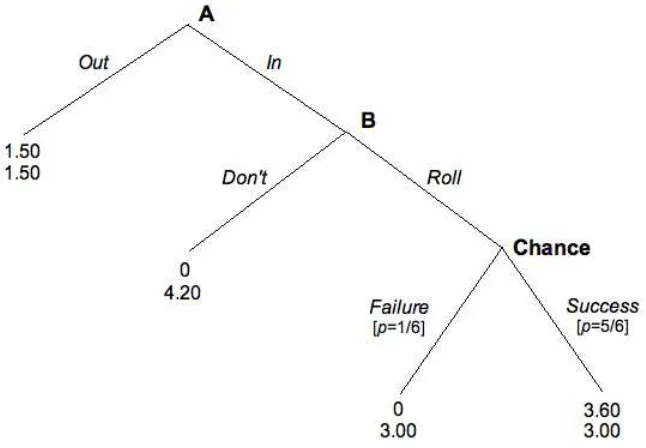
Our experiment is similar to the one conducted by Charness and Dufwenberg (2006), henceforth
“CD”. The game tree is shown in Figure 1. Payoffs are in dollars, not necessarily utilities that
may depend on psychological factors such as guilt.3
Player A first choosesIn orOut. If Player A
choosesIn, then Player B chooses whether to Roll orDon’t Roll a six-sided die. If A and B choose
1
See Fehr and Gachter (2000) for a survey of early work on trust and reciprocity.
2
Figure 1: The game tree.
the strategy profile (In, Roll), then the die roll determines the final monetary payoffs. Assuming
risk-neutral and narrowly self-interested preferences, the only subgame perfect Nash equilibrium is
(Out,Don’t Roll). Note, however, that the equilibrium is inefficient. Both players would get higher
expected payoffs if they could commit, ex-ante, to the strategy profile (In,Roll). Commitment is
ruled out by the assumption that A cannot observe B’s decision.
CD show that when Player B can send a non-binding, free-form message to Player A prior to
the game, B players are more likely to choose Roll. CD argue that guilt aversion can explain this
result. Their hypothesis is that B experiences guilt whenever she believes that she has failed to live
up to A’s expectation. CD show that pre-game messages from B to A are associated with higher
B beliefs about A’s expectation that B will chooseRoll, consistent with guilt aversion.4
CD conducted their experiment using the strategy method. In particular, Player B made a
contingent decision without observing Player A’s choice, with the understanding that B’s decision
would only matter if A chose In. We play the game without any pre-game messaging, using the
strategy method in one treatment and the direct-response method in another. In the direct-response
4
treatment, A plays first, and B makes her choice after observing A’s decision.5
We hypothesize that Player B’s observation of an In decision from Player A will induce guilt
aversion. If B sees that A chose In, then B could plausibly infer that A believes B is likely to
Roll. This should increase B’s guilt from choosing Don’t Roll. In effect, we ask whether
direct-response can “substitute” for B-to-A communication as a vehicle for inducing guilt aversion. In
CD, B made a promise to A, prompting B to believe that A expected her to be trustworthy. In our
direct-response treatment, B directly observes that A expects her to be trustworthy. The key tests
will be (1) is B more likely toRoll under direct-response (conditional on seeingIn) than under the
strategy method, and (2) does B have higher second-order beliefs under direct-response than under
the strategy method. The answer to both questions turns out to be negative.
3
Related Literature
Ellingsen et al. (2010) (“EJTT”) repeat CD’s experiment with a twist: They reveal each A player’s
first-order belief to the B partner before B makes her decision. Guilt aversion predicts a positive
relationship between A’s revealed belief and B’s likelihood of rolling. EJTT find no evidence of
this. Our approach is different: We reveal A’s decision to B, while keeping A’s belief private.
Nonetheless, our result is similar: We find no relationship between the observability of A’s decision
and B’s likelihood of rolling. CD report a related result. They find that non-binding, free-form
messages from A to B do not increase B’s likelihood of rolling, in contrast with messages from B
to A.
Kawagoe and Narita (2011) (“KN”) note that in the existing literature, the evidence for guilt
aversion is strongest when trustees can make – and possibly break – a promise.6
This motivates
KN to propose the following refinement of the guilt aversion hypothesis: “people feel guilty when
they betray another person’s expectation,with that expectation having been raised by their very own
5
Of course, B’s choice is only informative if A choosesIn, as the payoffs are already determined if A choosesOut.
6
actions, typically by their promises” (italics theirs). Our result is consistent with KN’s formulation
in the sense that we have no pre-play communication and hence no opportunity for B to proactively
raise A’s expectation. Viewed this way, the direct-response method resembles other forms of
“A-to-B information transfer” in the literature.
4
Design
The experiment was conducted at Muhlenberg College. There were four sessions, two each of the
strategy method and direct-response treatments. Each session had between 25 and 37 participants;
no one participated in more than one session. Average earnings were about $4 (including a $1
show-up fee).
The experimental instructions are included in an online appendix (Amdur and Schmick, 2012).
We randomly assigned participants to A and B roles based on identification numbers that we handed
out (A’s were even, B’s were odd). A and B participants sat in separate classrooms, and the A-B
pairings were anonymous to all participants throughout. In the strategy method sessions, A and
B participants made their decisions simultaneously. In the direct-response sessions, we informed
each B participant of her A partner’s decision while preserving anonymity.7
Note that under direct
response, B’s decision is only meaningful if B saw that A choseIn. If B saw that A choseOut, then
B knew with certainty that her own decision would not matter, making it difficult to interpret.
After the B’s had made their decisions, each B rolled a six-sided die. As in CD, we made this
clear to the participants in advance, to preserve public anonymity for B’s who chose Don’t Roll.
We then collected the decision sheets (with die roll results noted) and calculated the payouts while
the participants filled out a questionnaire. Following CD, we elicited beliefs by asking A’s to guess
the percentage of B’s who chose Roll, and B’s to guess the average guess made by A’s who chose
In.8
We handed payoffs to students in sealed envelopes.
7
Specifically, each A indicated his decision ofInorOuton a decision sheet with his id number. We then transcribed this decision onto another sheet with only B’s id number and delivered the transcribed sheet to B.
8
A’sIn Rate B’sRoll Rate (In,Roll)
SM DR Z Stat SM DR Z Stat SM DR Z Stat
15/24 18/33 0.60 10/24 10/18 0.89 7/24 10/33 0.09
[image:7.612.131.481.82.135.2](63%) (55%) (42%) (56%) (29%) (30%)
Table 1: Tests for the effect of the decision elicitation method on behavior. SM/DR refer to strategy method/direct-response treatments. In the DR treatment, the denominator for B’sRoll rate is less than the denominator for A’sInrate because B makes an informative decision only when A chooses
In. The Z statistic reflects the test of proportions for two populations.
5
Results
Table 1 summarizes the decisions across the two treatments. First consider B’s behavior. In the
strategy method (SM) treatment, 10 of 24 (42%) B’s choseRoll; while in the direct-response (DR)
treatment, 10 of 18 (56%) B’s who observed In chose Roll. This difference is not statistically
significant at any of the conventional significance levels (p=0.37 on a test of proportions for two
populations, two-tailed). Next consider A’s behavior. 15 of 24 (63%) A’s chose In in the SM
treatment, compared to 18 of 33 (55%) A’s in the DR treatment, a difference that is not significant
either (p=0.55). The fraction of pairs choosing (In,Roll) was almost identical across treatments:
29% (7 of 24 pairs) under SM and 30% (10 of 33 pairs) under DR (p=0.93). We conclude that the
direct-response method did not have a significant effect on behavior.9
Table 2 reports elicited beliefs by treatment. A’s average guess about the percentage of B’s
who choseRoll was 32.3 in the SM treatment and 29.8 in the DR treatment. This difference is not
statistically significant at any of the conventional significance levels (p=0.54 on a
Wilcoxon-Mann-Whitney rank sum test, two-tailed). B’s average guess about A’s average guess was 43.2 in the
SM treatment and 46.4 in the DR treatment, also not significant (p=0.86).10
Neither participants’
choices nor their beliefs varied significantly across treatments. We conclude that the direct-response
method did not induce guilt aversion in our experiment.
9
The behavioral results from both of our treatments are very similar to those reported in the baseline treatment of CD (no messages). In that treatment, CD reported A’sInrate as 56% (25 of 45), B’sRollrate as 44% (20 of 45),
and the (In,Roll) rate as 20% (9 of 45 pairs). CD also conducted a treatment in which the A participant could send a non-binding, free-form message to B prior to the game. This somewhat resembles our DR treatment in the sense that guilt aversion could have been introduced by Player A. In this treatment, CD reported A’sIn rate as 67% (31
of 46), B’sRoll rate as 39% (18 of 46), and the (In,Roll) rate as 26% (12 of 46 pairs). None of these rates differ significantly from those in our treatments.
10
A’s Average Guess B’s Average Guess
SM DR Z Stat SM DR Z Stat
[image:8.612.205.406.83.122.2]32.3 29.8 0.61 43.2 46.4 0.18
Table 2: Tests for the effect of the decision elicitation method on beliefs. SM/DR refer to strategy method/direct-response treatments. The Z statistic reflects the Wilcoxon-Mann-Whitney rank sum test for the two populations compared.
Do we find evidence of guilt aversion when we abstract from the treatment? Not as such.
Pooling treatments, the average belief of B’s who choseDon’t Roll was 48.6, and the average belief
of B’s who choseRoll was 40.2. So B’s who reciprocated actually had lower average beliefs about
A’s expectation, although the difference is not significant (Z=0.81, p=0.42). Interestingly, A’s
average belief was significantly higher for A’s choosingIn(38.2) as opposed toOut (20.8) (Z=3.12,
p<0.01). While not a test of guilt aversion per se, this suggests that A’s who chose In had more
favorable beliefs about their B partners.11
6
Conclusion
We conduct a one-shot trust game with hidden action using two decision elicitation treatments:
strategy and direct-response. We find no significant differences in behavior or beliefs across
elicita-tion methods. We conclude that the direct-response method did not, by itself, induce guilt aversion
in our experiment.
11
Beliefs across decisionswithin the DR treatment were similar. Beliefs within the SM treatment were fairly flat
References
Amdur, David and Ethan Schmick, “Supplemental Materials for: Does the Direct-response Method Induce Guilt Aversion in a Trust Game?,” Mimeo 2012.
Battigalli, Pierpaolo and Martin Dufwenberg, “Guilt in Games,” American Economic Re-view, 2007, 97(2), 170–176.
Brandts, Jordi and Gary Charness, “The Strategy Versus the Direct-response Method: A First Survey of Experimental Comparisons,” Experimental Economics, 2011, 14, 375–398.
Charness, Gary and Martin Dufwenberg, “Promises and Partnership,”Econometrica, 2006,
74 (6), 1579–1601.
and , “Bare Promises: An Experiment,” Economics Letters, 2010, 107(2), 281–283.
Ellingsen, Tore, Magnus Johannesson, Sigve Tjotta, and Gaute Torsvik, “Testing Guilt Aversion,” Games and Economic Behavior, 2010, 68(1), 95–107.
Fehr, Ernst and Simon Gachter, “Fairness and Retaliation: The Economics of Reciprocity,”
Journal of Economic Perspectives, 2000, 14(3), 159–181.
Kawagoe, Toshiji and Yusuke Narita, “Guilt Aversion Revisited: An Experimental Test of a New Model,” Mimeo 2011.
Reuben, Ernesto, Paola Sapienza, and Luigi Zingales, “Is Mistrust Self-fulfilling?,” Eco-nomics Letters, 2009, 104 (2), 89–91.
Selten, Reinhard, “Die Strategiemethode zur Erforschung des Eingeschrankt Rationalen Verhal-tens im Rahmen eines Oligopolexperiments,” in H. Sauermann, ed.,Beitrage zur Experimentellen Wirtschaftsforschung, Mohr, 1967, pp. 136–168.