http://www.scirp.org/journal/psych ISSN Online: 2152-7199
ISSN Print: 2152-7180
Rejection Sensitivity, Self-Efficacy, and
Learning Strategy: Mediating and Moderating
the Role of Basic Needs Satisfaction
Miki Terada
1, Taishi Kawamoto
21Otemae University, Hyogo, Japan 2The University of Tokyo, Tokyo, Japan
Abstract
Rejection sensitive people often experience interpersonal difficulties, resulting in dissatisfaction with their need for relatedness. However, whether they are satisfied with their autonomy and competence, or experience difficulties from these factors other than in interpersonal relationships, remains largely unex-plored. This study examined the influence of rejection sensitivity and need sa-tisfaction (autonomy, competence, and relatedness) on learning strategy and self-efficacy. We found that competence satisfaction mediates the relationship between rejection sensitivity and self-efficacy. In addition, hierarchical regres-sion analysis revealed a significant three-way interaction of rejection sensitiv-ity, autonomy, and competence satisfaction with learning strategy. Compe-tence satisfaction has a positive effect when individuals have low rejection sensitivity and are satisfied with autonomy need, whereas autonomy satisfac-tion has a positive effect when individuals have high rejecsatisfac-tion sensitivity and are dissatisfied with their competence levels. This suggests that autonomy and competence satisfaction levels are important for the understanding of psy-chological difficulties in rejection sensitive individuals.
Keywords
Rejection Sensitivity, Self-Efficacy, Learning Strategy, Autonomy, Competence, Relatedness
1. Introduction
Interpersonal relationships and learning are important aspects of school life for university students. People with high rejection sensitivity—characterized as an-xious expectation of and defensive reaction to social rejection (Downey & Feld-How to cite this paper: Terada, M., &
Kawamoto, T. (2017). Rejection Sensitivity, Self-Efficacy, and Learning Strategy: Me-diating and Moderating the Role of Basic Needs Satisfaction. Psychology, 8, 449-462. https://doi.org/10.4236/psych.2017.83028
Received: January 26, 2017 Accepted: February 24, 2017 Published: February 27, 2017
Copyright © 2017 by authors and Scientific Research Publishing Inc. This work is licensed under the Creative Commons Attribution International License (CC BY 4.0).
man, 1996)—tend to experience psychological difficulties. How can they spend their school life successfully, especially in relation to learning? This research ap-proaches how rejection sensitivity is related to learning with need satisfaction. We sought to develop our understanding of the difficulties rejection sensitive individuals have in these situations by focusing on learning strategy and self-ef- ficacy. We focused on the possible mediating roles of need satisfaction on the relationships between rejection sensitivity and learning strategy/self-efficacy. We also investigated the possible moderating role of rejection sensitivity on the rela-tionship between satisfaction of needs and learning strategy/self-efficacy.
1.1. Learning Strategy, Self-Efficacy, and Rejection Sensitivity
Recently, problem based learning (PBL) has been adopted by universities. PBL is one of the learning approaches that students use to solve problems and answer questions which are raised or found by themselves. To experience success in PBL, students need to use a learning strategy. A learning strategy is defined as proceeding with conscious study to enhance the learning effects that derive from cognitive, meta-cognitive, and motivational strategies (Dignath, Buettner, & Langfeld, 2008; Pintrich & DeGroot, 1990). A learning strategy delivers the large component of self-regulated learning that is necessary for PBL (English & Kit-santas, 2013). In fact, managing a learning strategy which engages in sustaining motivation, goal setting, strategic planning, maintaining attention on important information related to goals, monitoring progress toward those goals, self-ob- servation, engaging in self-reflection through feedback, and self-motivation, has an important role in the self-regulatory process (Zimmerman, 2013).In addition to its association with learning strategies, self-efficacy is also an important factor in increasing academic success (Holzberger, Philipp, & Kunter, 2013; Zimmerman, 2000). For example, Komarraju and Nadler (2013) showed that self-efficacious students can achieve academic success because they monitor and self-regulate their impulses, and persist in the face of difficulties. Another study revealed that self-efficacy beliefs in self-regulated learning better predict future academic achievement beyond the effects of previous achievements, gen- der, socioeconomic status, intelligence, personality traits, and self-esteem (Zuf-fianò et al., 2013).
Although few studies have investigated the relationship between rejection sensitivity and learning strategy or self-efficacy, there is some indirect evidence that rejection sensitivity has an influence on learning strategy and self-efficacy. For example, Downey, Lebolt, Rincon, & Freitas (1998) found a relationship between rejection sensitivity and a decline in children’s academic performance. Another study showed that rejection sensitivity was negativity associated with cognitive function, including logical reasoning and nonverbal intelligence (To-bia, Riva, & Caprin, 2016). Thus, we predict that rejection sensitivity is negative-ly associated with learning strategy and self-efficacy.
1.2. Mediating Roles of Need Satisfaction between Rejection
Sensitivity and Learning Strategy/Self-Efficacy
Self-determination theory (SDT) shows that needs have been defined in the areas of autonomy, competence and relatedness (Deci & Ryan, 1987, 2000). These needs are naturally provided for in basic needs, and the fulfillment of these needs produces a positive effect on study, life satisfaction, and mental health (Gunnell, Crocker, Mack, Wilson, & Zumbo, 2014; Ng et al., 2012; Ryan, Huta, & Deci, 2008; Silva et al., 2010). Thus, in this study we focus on the satis-faction of needs as a possible mediator between rejection sensitivity and learning strategy/self-efficacy.
1.3. The Moderating Role of Rejection Sensitivity on the
Relationship between Needs Satisfaction and Learning
Strategy/Self-Efficacy
In addition to the possibility that satisfaction of needs mediates in the relation-ship between rejection sensitivity and learning strategy/self-efficacy, rejection sensitivity has a moderating role on the relationships between satisfaction of needs and learning strategy/self-efficacy. In other words, the influence of rejec-tion sensitivity and satisfacrejec-tion of needs on learning strategy and self-efficacy may be more complex than hitherto thought.
One possibility is that positive impacts from the satisfaction of autonomy and competence needs on learning strategy and self-efficacy only occur in people with low rejection sensitivity. Prior studies have suggested that a good balance of satisfaction across the three needs has an effect on happiness and well-being, ra-ther than this being a simple sum of the three needs (Sheldon & Niemiec, 2006). For example, someone that tries to facilitate their own psychological health may have a higher level of satisfaction in relation to their need for autonomy, com-petence, and relatedness than someone having greater autonomy and compe-tence who may feel a low level of satisfaction in regard to their need for related-ness, even though both experience the same total amount of satisfaction. Rejec-tion sensitive individuals, therefore, may be falling into a state of imbalance even if they have enough autonomy and competence, because they are not fulfilled at the level of relatedness satisfaction. There may in fact be a positive impact from the satisfaction of autonomy and competence needs on learning strategy/self- efficacy in people with a low sensitivity to rejection, but not in people having high rejection sensitivity. Thus, we predict that the positive effect of autonomy and competence satisfaction of needs on learning strategy/self-efficacy is mod-erated by rejection sensitivity.
Another possibility is that the satisfaction of competence needs will have harmful effects on people with high rejection sensitivity. Self-verification theory (Swann & Read, 1981), holds that people want to confirm themselves correctly, and to think that their way of thinking and values are not wrong. Through such processes, people create a social reality and sustain their conceptions. Here, re-jection sensitivity is associated with lack of interpersonal competence (Butler et al., 2007), and self-worth with perceived competence (Ayduk et al., 2000). Thus, if people with high rejection sensitivity are satisfied with their competence levels, this will be inconsistent with their self-view. We therefore predict that high competence levels will be harmful for people with high rejection sensitivity, be-cause it is difficult for them to confirm themselves. In contrast, they could use more learning strategies, and have high self-efficacy with low competence rather than high competence, because it is easy for people with rejection sensitivity to consistently believe that they have low task competence.
in-dividuals who possess anxious or angry expectations of rejection. They also con-sidered the conflict over how the expression of false self-versus-true self contri-butes to the onset of depression. Therefore, we examine how rejection sensitive people can use more learning strategies, and experience high self-efficacy with low autonomy, rather than high autonomy.
1.4. The Present Research
We sought to investigate the influence of rejection sensitivity and the satisfaction of needs on learning strategy/self-efficacy. More specifically, we tested whether 1) need satisfaction mediates the relationship between rejection sensitivity and learning strategy/self-efficacy, and 2) whether rejection sensitivity moderates the relationship between need satisfaction and learning strategy/self-efficacy.
2. Method
2.1. Participants
A web survey was conducted by a polling organization company (Fastask). The questionnaire was randomly distributed to 309 male and female from 15 to 24 years old on the web monitors. At the beginning of the questionnaire, “What your university grade? −1. 1st, 2. 2nd, 3. 3rd, 4. 4th, 5. Other” was asked. And, res-pondents who selected other than 5 and did not have a defect such as unans-wered data were selected. Finally, data were collected from 179 university stu-dents (82 females, Mage = 20.00, SD = 1.42).
2.2. Measures
Learning strategy. Learning strategies were measured via their cognitive as-pects (Ito, 1996; Pintrich & De Groot, 1990), their meta-cognitive aspects (Ichi-hara & Arai, 2006), and self-motivational strategy scales (Ito & Shinto, 2003) that included 23 items (α = .87). These items have been used in previous studies (Jones, Estell, & Alexander, 2008; Loyens, Rikers, & Schmidt, 2008). Participants were asked to rate how often they use learning strategies using a 5-point scale ranging from 1 (Not apply) to 5 (Apply), and averages derived. The average scores were analyzed in the present study.
Self-efficacy. We used The General Self-Efficacy Scale (GSES; Sakano & Tohjoh, 1986; Bandura, 1977). The GSES contains 16 items that measure indi-vidual strength of general self-efficacy across a variety of settings in everyday life (α = .64). Participants were asked whether these items did or did not apply in their situation. The total score relating to high self-efficacy was used in the anal-ysis (range: 0 - 12).
would respond in an accepting manner, again using a 6-point scale ranging from 1 (Very unlikely) to 6 (Very likely). A cross-situational total RSQ score was computed by obtaining the mean scores across the situations described in the questionnaire, as was done in previous studies (Berenson et al., 2009; Kawamoto, Ura, & Hiraki, 2017).
Need satisfactions. Need satisfaction was measured using the Basic Psycho-logical Needs Scale for School Life (BPNS-SL; Nishimura, & Sakurai, 2015; Ryan & Deci, 2000). This scale consists of 12 items each including 4 items. Autonomy and relatedness included 1 reversal item. We calculated the a coefficients by scoring each item respectively, excluding the 1 reversal item, because this item reduced the a coefficients, autonomy (α = .73), competence (α = .80), and rela-tedness (α = .75). Participants reported the degree to which each statement ap-plied to themselves, using a 4-point scale ranging from 1 (not at all) to 4 (applies very well). The average score was used in the present study.
Learning time outside the classroom. We asked how much time was spent on learning (e.g., homework, reports) outside of classroom per day. This was ca-tegorized as 1: not at all, 2: less than 30 minutes, 3: from 30 minutes to less than 1 hour, 4: from1 hour to less than 2 hours, 5: from 2 hours to less than 3 hours, 6: from 3 hours to less than 4 hours, and 7: more than 4 hours.
2.3. Data Analysis
First, we conducted a correlational analyses to confirm the relationships among variables. Next, we performed a mediation analysis to test for a possible mediat-ing effect of need satisfaction on the relationship between rejection sensitivity, the use of learning strategies, and self-efficacy. We applied the bootstrapping method (1000 resamples) using the PROCESS macro (Hayes, 2015). Finally, hierarchical regression analysis was conducted to examine the possible mod-erating role of rejection sensitivity on the relationships between needs satisfac-tion, the use of learning strategies, and self-efficacy (Shimizu, 2016).
3. Results
3.1. Correlation of Family Support, Psychopathy, and the
Amount of Punishment
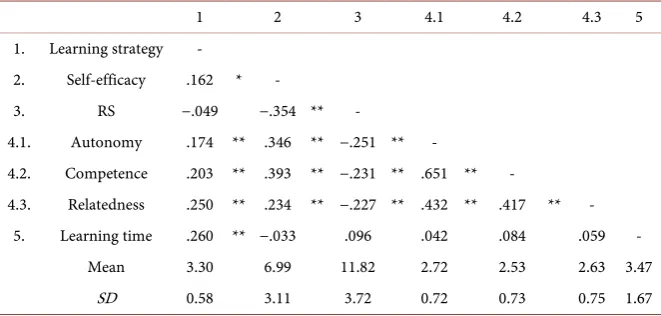
As shown in Table 1, although rejection sensitivity was negatively correlated with self-efficacy, rejection sensitivity was not significantly associated with learning strategy. In addition, rejection sensitivity was negatively correlated with satisfaction of the three needs. Finally, both learning strategy and self-efficacy were positively correlated with satisfaction of the three needs.
Table 1. Descriptive statistics and correlation among variables.
1 2 3 4.1 4.2 4.3 5
1. Learning strategy -
2. Self-efficacy .162 * -
3. RS −.049 −.354 ** -
4.1. Autonomy .174 ** .346 ** −.251 ** -
4.2. Competence .203 ** .393 ** −.231 ** .651 ** -
4.3. Relatedness .250 ** .234 ** −.227 ** .432 ** .417 ** - 5. Learning time .260 ** −.033 .096 .042 .084 .059 -
Mean 3.30 6.99 11.82 2.72 2.53 2.63 3.47 SD 0.58 3.11 3.72 0.72 0.73 0.75 1.67
Note: RS = Rejection sensitivity. *p < .05. **p < .01.
Figure 1. The mediation effect of the satisfaction of needs on the relationship between
rejection sensitivity and self-efficacy. Note. *p < .05. **p < .01.
sensitivity and self-efficacy (indirect effect = −.079, 95%CI [−.161, −.025]). In addition, although the simple indirect effects of competence satisfaction (indi-rect effect = −.058, 95%CI [−.130, −.014]) were significant, those of autonomy (indirect effect = −.008, 95%CI [−.058, .029]) and relatedness satisfaction (indi-rect effect = −.012, 95%CI [−.055, .012]) were not. Finally, because there was no significant correlation between rejection sensitivity and learning strategy, we did not conduct a mediation analysis in respect of learning strategy.
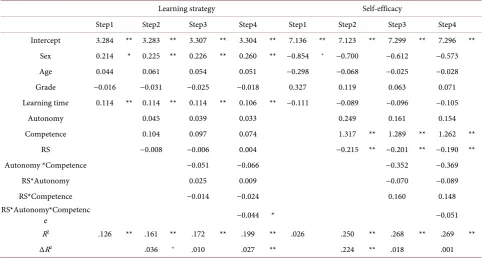
[image:7.595.209.539.272.430.2]Table 2. The result of hierarchical regression analysis.
Learning strategy Self-efficacy
Step1 Step2 Step3 Step4 Step1 Step2 Step3 Step4
Intercept 3.284 ** 3.283 ** 3.307 ** 3.304 ** 7.136 ** 7.123 ** 7.299 ** 7.296 ** Sex 0.214 * 0.225 ** 0.226 ** 0.260 ** −0.854 + −0.700 −0.612 −0.573
Age 0.044 0.061 0.054 0.051 −0.298 −0.068 −0.025 −0.028
Grade −0.016 −0.031 −0.025 −0.018 0.327 0.119 0.063 0.071 Learning time 0.114 ** 0.114 ** 0.114 ** 0.106 ** −0.111 −0.089 −0.096 −0.105
Autonomy 0.045 0.039 0.033 0.249 0.161 0.154
Competence 0.104 0.097 0.074 1.317 ** 1.289 ** 1.262 **
RS −0.008 −0.006 0.004 −0.215 ** −0.201 ** −0.190 **
Autonomy *Competence −0.051 −0.066 −0.352 −0.369
RS*Autonomy 0.025 0.009 −0.070 −0.089
RS*Competence −0.014 −0.024 0.160 0.148
RS*Autonomy*Competenc
e −0.044 * −0.051
R2 .126 ** .161 ** .172 ** .199 ** .026 .250 ** .268 ** .269 **
ΔR2 .036 + .010 .027 ** .224 ** .018 .001
Note: RS = Rejection sensitivity. +p < .10. *p < .05. **p < .01.
Figure 2. The modulation effect of rejection sensitivity on the relationship between satisfaction of needs
and learning strategies, and (a) low rejection sensitivity, and (b) high rejection sensitivity.
sensitivity and high autonomy (b = −.18, p = .21), the effect of competence sa-tisfaction on learning strategy did not appear. These results partly support our expectation, and indicate that the impact of competence satisfaction is seen only in conditions of high autonomy and low rejection sensitivity. In other words, the synergy effect of autonomy and competence satisfaction on learning strategy is shown only in people with low rejection sensitivity.
[image:8.595.157.539.377.542.2]When people have low rejection sensitivity and low levels of satisfaction with their competence (b = −.07, p = .53), and high rejection sensitivity and high au-tonomy (b = −.10, p = .50), the effect of satisfaction with level of competence on learning strategy does not appear. It should be noted however, that a significant effect of satisfaction with autonomy is seen when people have high rejection sen-sitivity and low competence levels. In other words, people who have high rejec-tion sensitivity use learning strategies more when they feel their competence lev-el is low than when their competence levlev-el is high. There were no significant in-teractions between the effects of rejection sensitivity, and satisfaction with au-tonomy and competence on self-efficacy (Table 2).
4. Discussion
The purpose of this study was to examine the influence of rejection sensitivity and the satisfaction of needs on learning strategy/self-efficacy. More specifically, we examined, 1) the mediating roles of need satisfaction on the relationships between rejection sensitivity and learning strategy/self-efficacy, and 2) the mod-erating role of rejection sensitivity on the relationship between satisfaction of needs and learning strategy/self-efficacy. We found that satisfaction with com-petence level mediates the relationship between rejection sensitivity and self-ef- ficacy. In addition, rejection sensitivity moderates the relationships between sa-tisfaction of needs and learning strategy. The synergistic effect of autonomy and satisfaction with level of competence on learning strategy appeared only in people with low rejection sensitivity. People who have high rejection sensitivity and high autonomy use more learning strategies when they have low compe-tence levels than when their compecompe-tence levels are high.
These findings extend our understanding of the relationships between trait rejection sensitivity and self-efficacy, by showing that competence mediates these relationships. Prior studies have revealed the association between rejection sensitivity and cognitive functioning, as well as with academic success (Downey et al., 1998). We therefore suggest that rejection sensitivity will result in de-creased self-efficacy through a lack of satisfaction of the competence need. Un-expectedly however, even though rejection sensitive individuals are not fulfilled when they are satisfied with relatedness, this form of satisfaction did not mediate the relationship between rejection sensitivity and self-efficacy. In this study, we showed that it is not only relatedness that is important; people with high rejec-tion sensitivity have greater levels of depleted competence satisfacrejec-tion, which does lead to a lack of self-efficacy.
sup-port this finding. The synergistic effect of satisfaction with autonomy and com-petence levels on learning strategies appeared only when a good balance between satisfaction and relatedness was experienced. Second, people with high rejection sensitivity and high autonomy more often use more learning strategies if they have low competence levels than if they have high competence levels. In other words, learning strategies are harmful to satisfaction with competence level needs for rejection sensitive individuals, whereas they facilitate learning strate-gies in people with low competence levels. Self-verification theory (Swann & Read, 1981) suggests that people want to confirm themselves correctly, and to think that their way of thinking and values are not wrong. Our results support this. People with high rejection sensitivity use more learning strategies when they have low competence levels, because it is harmful to have a high compe-tence level as this would not be consistent with their self-worth.
We propose two educational suggestions from these findings: First, fostering autonomy is an important way for rejection sensitive people to avoid rejection and preserve relationships. Only people who have a low level of rejection sensi-tivity expect acceptance, or engage higher-level cognitive self-regulatory systems (Romero-Canyas & Downey, 2013). Although people who have high level of re-jection sensitivity tend to behave in a more self-silencing way, it is necessary to experience interpersonal relationships to enhance autonomy choice. Enhancing autonomy choice or asserting themselves properly will have a positive impact, on not only interpersonal relationships, but also on learning, especially for rejec-tion sensitive people; second, in relarejec-tion to competence, rejecrejec-tion sensitive people use learning strategies more often when they have low competence levels, than when they have high competence levels. These findings emphasize the im-portance of understanding the cognitive imbalances and conflicts rejection sen-sitive people may have. It is worthwhile for them to interact proactively with someone, and grow competence through accomplishment. But for rejection sen-sitive people, interacting proactively with someone else is difficult, so it may be necessary to start by changing self-worth.
im-balance, which in some will be obsessive, and will decrease the use of learning strategies. In contrast, when they have low competence levels, they will use learning strategies with harmonious passion. But the imbalance in rejection sen-sitivity and high competence may not make for obsessive behavior for self-effi- cacy purposes.
We acknowledge the several limitations of this study. First, the possibility re-mains that people who often use learning strategies, and have efficient self-effi- cacy, tend to have a low level of rejection sensitivity. There is thus benefit from longitudinal research designs that enable identification of the potential casual relationships between rejection sensitivity and learning strategy/self-efficacy. Second, although we investigated learning strategy and self-efficacy, the effect of learning should be verified by examining a greater range of indicators. Future research focusing on achievement performance and task deadline expectations would improve our understanding of the relationship between rejection sensitivity and learning.
5. Conclusion
To conclude, the present research showed how rejection sensitive people tend to experience psychological difficulties in trying to spend their school life success-fully, especially in relation to learning. Recently, learning strategy use themselves and socially shared learning has been prompted in university. It is said that exit-ing lesson would be innovative for students. Of course, there are effective pros-pect for students. This study serves to highlights and we suggest that autonomy and satisfaction with competence levels are important when we are trying to understand the psychological difficulties faced by rejection sensitive individuals.
References
Ayduk, O., Mendoza-Denton, R., Mischel, W., Downey, G., Peake, P. K., & Rodriguez, M. (2000). Regulating the Interpersonal Self: Strategic Self-Regulation for Coping with Re-jection Sensitivity. Journal of Personality and Social Psychology, 79, 776-792.
https://doi.org/10.1037/0022-3514.79.5.776
Bandura, A. (1977). Self-Efficacy: Toward a Unifying Theory of Behavioral Change. Psy-chological Review, 84, 191-215. https://doi.org/10.1037/0033-295X.84.2.191
Berenson, K. R., Gyurak, A., Ayduk, O., Downey, G., Garner, M. J., Mogg, K., & Pine, D. S. (2009). Rejection Sensitivity and Disruption of Attention by Social Threat Cues.
Journal of Research in Personality, 43, 1064-1072.
https://doi.org/10.1016/j.jrp.2009.07.007
Butler, J. C., Doherty, M. S., & Potter, R.M. (2007). Social Antecedents and Consequences of Interpersonal Rejection Sensitivity. Personality and Individual Differences, 43, 1376- 1385. https://doi.org/10.1016/j.paid.2007.04.006
Deci, E. L., & Ryan, R. M. (1987). The Support of Autonomy and the Control of Behavior.
Journal of Personality and Social Psychology, 53, 1024-1037.
https://doi.org/10.1037/0022-3514.53.6.1024
Deci, E. L., & Ryan, R. M. (2000). The “What” and “Why” of Goal Pursuits: Human Needs and the Self-Determination of Behavior. Psychological Inquiry, 11, 227-268.
Dignath, C., Buttner, G., & Langfeld, H. P. (2008). How Can Primary School Students Learn Self-Regulated Learning Strategies Most Effectively? A Meta-Analysis on Self- Regulation Training Programmes. Educational Research Review, 3, 101-129.
https://doi.org/10.1016/j.edurev.2008.02.003
Downey, G., & Feldman, S. I. (1996). Implications of Rejection Sensitivity for Intimate Relationships. Journal of Personality and Social Psychology, 70, 1327-1343.
https://doi.org/10.1037/0022-3514.70.6.1327
Downey, G., Lebolt, A., Rincón, C., & Freitas, A. L. (1998). Rejection Sensitivity and Children’s Interpersonal Difficulties. Child Development, 69, 1074-1091.
https://doi.org/10.1111/j.1467-8624.1998.tb06161.x
English, M. C., & Kitsantas, A. (2013). Supporting Student Self-Regulated Learning in Problem-and Project-Based Learning. Interdisciplinary Journal of Problem-Based Lear- ning, 7, 128-150. https://doi.org/10.7771/1541-5015.1339
Feldman, S., & Downey, G. (1994). Rejection Sensitivity as a Mediator of the Impact of Childhood Exposure to Family Violence on Adult Attachment Behavior. Development and Psychopathology, 6, 231-247. https://doi.org/10.1017/S0954579400005976
Gunnell, K. E., Crocker, P. R., Mack, D. E., Wilson, P. M., & Zumbo, B. D. (2014). Goal Contents, Motivation, Psychological Need Satisfaction, Well-Being and Physical Activ-ity: A Test of Self-Determination Theory over 6 Months. Psychology of Sport and Ex-ercise, 15, 19-29. https://doi.org/10.1016/j.psychsport.2013.08.005
Harper, M. S., Dickson, J. W., & Welsh, D. P. (2006). Self-Silencing and Rejection Sensi-tivity in Adolescent Romantic Relationships. Journal of Youth and Adolescence, 35,
435-443. https://doi.org/10.1007/s10964-006-9048-3
Hayes, A. F. (2015). An Index and Test of Linear Moderated Mediation. Multivariate Be-havioral Research, 50, 1-22. https://doi.org/10.1080/00273171.2014.962683
Holzberger, D., Philipp, A., & Kunter, M. (2013). How Teachers’ Self-Efficacy Is Related to Instructional Quality: A Longitudinal Analysis. Journal of Educational Psychology, 105, 774-786. https://doi.org/10.1037/a0032198
Ichihara, M., & Arai, K. (2006). Moderator Effects of Meta-Cognition: A Test in Math of a Motivational Model. The Japanese Journal of Educational Psychology, 54, 199-210.
https://doi.org/10.5926/jjep1953.54.2_199
Ito, T. (1996). Self-Efficacy, Causal Attribution and Learning Strategy in an Academic Achievement Situation. The Japanese Journal of Educational Psychology, 44, 340-349.
https://doi.org/10.5926/jjep1953.44.3_340
Ito, T., & Shinto, T. (2003). Construction of the Self-Motivational Strategies Scale for Ju-nior High School Students. The Japanese Journal of Psychology, 74, 209-217.
https://doi.org/10.4992/jjpsy.74.209
Järvelä, S., Kirschner, P. A., Panadero, E., Malmberg, J., Phielix, C., Jaspers, J., Koi-vuniemi, M., & Järvenoja, H. (2015). Enhancing Socially Shared Regulation in Colla-borative Learning Groups: Designing for CSCL Regulation Tools. Educational Tech-nology Research and Development, 63, 125-142.
https://doi.org/10.1007/s11423-014-9358-1
Jones, M. H., Estell, D. B., & Alexander, J. M. (2008). Friends, Classmates, and Self-Re- gulated Learning: Discussions with Peers inside and outside the Classroom. Metacog-nition and Learning, 3, 1-15. https://doi.org/10.1007/s11409-007-9007-8
Kawamoto, T., Ura, M., & Hiraki, K. (2017). Curious People Are less Affected by Social Rejection. Personality and Individual Differences, 105, 264-267.
https://doi.org/10.1016/j.paid.2016.10.006
Implicit Beliefs, Goals, and Effort Regulation Matter? Learning and Individual Differ-ences, 25, 67-72.https://doi.org/10.1016/j.lindif.2013.01.005
Loyens, S. M. M., Rikers, R. M. J. P., & Schmidt, H. G. (2008). Relationships between Students’ Conceptions of Constructivist Learning and Their Regulation and Processing Strategies. Instructional Science, 36, 445-462.
https://doi.org/10.1007/s11251-008-9065-6
Malmberg, J., Järvelä, S., Järvenoja, H., & Panadero, E. (2015). Promoting Socially Shared Regulation of Learning in CSCL: Progress of Socially Shared Regulation among High- and Low-Performing Groups. Computers in Human Behavior, 52, 562-572.
https://doi.org/10.1016/j.chb.2015.03.082
Newman, R. S. (1990). Children’s Help-Seeking in the Classroom: The Role of Motiva-tional Factors and Attitudes. Journal of Educational Psychology, 82, 71-80.
https://doi.org/10.1037/0022-0663.82.1.71
Ng, J. Y., Ntoumanis, N., Thøgersen-Ntoumani, C., Deci, E. L., Ryan, R. M., Duda, J. L., & Williams, G. C. (2012). Self-Determination Theory Applied to Health Contexts a Me-ta-Analysis. Perspectives on Psychological Science, 7, 325-340.
https://doi.org/10.1177/1745691612447309
Nishimura, T., & Sakurai, S. (2015). Relationship between Basic Psychological Needs and School Morale in Junior High School Students: Development of the Basic Psychological Needs Scale for School Life. The Japanese Journal of Personality, 24, 124-136.
https://doi.org/10.2132/personality.24.124
Pintrich, P. R., & De Groot, E. V. (1990). Motivational and Self-Regulated Learning Components of Classroom Academic Performance. Journal of Educational Psychology, 82, 33-40. https://doi.org/10.1037/0022-0663.82.1.33
Romero-Canyas, R., & Downey, G. (2013). What I See When I Think It’s about Me: People Low in Rejection-Sensitivity Downplay Cues of Rejection in Self-Relevant In-terpersonal Situations. Emotion, 13, 104-117. https://doi.org/10.1037/a0029786
Ryan, R. M., & Deci, E. L. (2000). The Basic Need Satisfaction in Life Scale. Unpublished Manuscript, Rochester, NY: University of Rochester.
Ryan, R. M., Huta, V., & Deci, E. L. (2008). Living Well: A Self-Determination Theory Perspective on Eudaimonia. Journal of Happiness Studies, 9, 139-170.
https://doi.org/10.1007/s10902-006-9023-4
Sakano, Y., & Tohjoh, M. (1986). The General Self-Efficacy Scale (GSES): Scale Develop-ment and Validation. Japanese Journal of Behavior Therapy, 12, 73-82.
Schunk, D. H., & Hanson, A. R. (1985). Peer Models: Influence on Children’s Self-Effi- cacy and Achievement. Journal of Educational Psychology, 77, 313-322.
https://doi.org/10.1037/0022-0663.77.3.313
Sheldon, K. M., & Niemiec, C. P. (2006). It’s Not Just the Amount That Counts: Balanced Need Satisfaction Also Affects Well-Being. Journal of Personality and Social Psycholo-gy, 91, 331-341. https://doi.org/10.1037/0022-3514.91.2.331
Shimizu, H. (2016). An Introduction to the Statistical Free Software HAD: Suggestions to Improve Teaching, Learning and Practice Data Analysis. Journal of Media, Informa-tion and CommunicaInforma-tion, 1, 59-73.
Silva, M. N., Vieira, P. N., Coutinho, S. R., Minderico, C. S., Matos, M. G., Sardinha, L. B., & Teixeira, P. J. (2010). Using Self-Determination Theory to Promote Physical Activity and Weight Control: A Randomized Controlled Trial in Women. Journal of behavioral medicine, 33, 110-122. https://doi.org/10.1007/s10865-009-9239-y
https://doi.org/10.1016/0022-1031(81)90043-3
Tobia, V., Riva, P., & Caprin, C. (2016). Who Are the Children Most Vulnerable to Social Exclusion? The Moderating Role of Self-Esteem, Popularity, and Nonverbal Intelli-gence on Cognitive Performance Following Social Exclusion. Journal of Abnormal Child Psychology, 1-13.
Vallerand, R. J., Blanchard, C., Mageau, G. A., Koestner, R., Ratelle, C., Leonard, M. et al. (2003). Les Passions de l’ame: On Obsessive and Harmonious Passion. Journal of Per-sonality and Social Psychology, 85, 756-767.
https://doi.org/10.1037/0022-3514.85.4.756
Zimmer-Gembeck, M. J., Trevaskis, S., Nesdale, D., & Downey, G. A. (2014). Relational Victimization, Loneliness and Depressive Symptoms: Indirect Associations via Self and Peer Reports of Rejection Sensitivity. Journal of youth and adolescence, 43, 568-582.
https://doi.org/10.1007/s10964-013-9993-6
Zimmerman, B. J. (2000). Self-Efficacy: An Essential Motive to Learn. Contemporary Educational Psychology, 25, 82-91. https://doi.org/10.1006/ceps.1999.1016
Zimmerman, B. J. (2013). From Cognitive Modeling to Self-Regulation: A Social Cogni-tive Career Path. Educational Psychologist, 48, 135-147.
https://doi.org/10.1080/00461520.2013.794676
Zimmerman, B. J., & Martinez-Pons, M. (1990). Student 1 Differences in Self-Regulated Learning: Relating Grade, Sex, and Giftedness to self-Efficacy and Strategy Use. Journal of Educational Psychology, 82, 51-59. https://doi.org/10.1037/0022-0663.82.1.51
Zuffianò, A., Alessandri, G., Gerbino, M., Kanacri, B. P. L., Di Giunta, L., Milioni, M., & Caprara, G. V. (2013). Academic Achievement: The Unique Contribution of Self-Effi- cacy Beliefs in Self-Regulated Learning beyond Intelligence, Personality Traits, and Self-Esteem. Learning and Individual Differences, 23, 158-162.
https://doi.org/10.1016/j.lindif.2012.07.010
Submit or recommend next manuscript to SCIRP and we will provide best service for you:
Accepting pre-submission inquiries through Email, Facebook, LinkedIn, Twitter, etc. A wide selection of journals (inclusive of 9 subjects, more than 200 journals)
Providing 24-hour high-quality service User-friendly online submission system Fair and swift peer-review system
Efficient typesetting and proofreading procedure
Display of the result of downloads and visits, as well as the number of cited articles Maximum dissemination of your research work