Pro3Gres Parser in the CoNLL Domain Adaptation Shared Task
Gerold Schneider and Kaarel Kaljurand and Fabio Rinaldi and Tobias Kuhn Institute of Computational Linguistics, University of Zurich
Binzm¨uhlestrasse 14 CH - 8050 Zurich, Switzerland
{gschneid,kalju,rinaldi,tkuhn}@ifi.uzh.ch
Abstract
We present Pro3Gres, a deep-syntactic, fast dependency parser that combines a hand-written competence grammar with proba-bilistic performance disambiguation and that has been used in the biomedical domain. We discuss its performance in the domain adap-tation open submission. We achieve aver-age results, which is partly due to difficulties in mapping to the dependency representation used for the shared task.
1 Introduction
The Pro3Gres parser is a dependency parser that combines a hand-written grammar with probabilis-tic disambiguation. It is described in detail in (Schneider, 2007). It uses tagger and chunker pre-processors – parsing proper happens only be-tween heads of chunks – and a post-processor graph converter to capture long-distance dependencies. Pro3Gres is embedded in a flexible XML pipeline. It has been applied to many tasks, such as parsing biomedical literature (Rinaldi et al., 2006; Rinaldi et al., 2007) and the whole British National Cor-pus, and has been evaluated in several ways. We have achieved average results in the CoNLL do-main adaptation track open submission (Marcus et al., 1993; Johansson and Nugues, 2007; Kulick et al., 2004; MacWhinney, 2000; Brown, 1973). The performance of the parser is seriously affected by mapping problems to the particular dependency rep-resentation used in the shared task.
The paper is structured as follows. We give a brief overview of the parser and its design policy in
sec-tion 2, we describe the domain adaptasec-tions that we have used in section 3, comment on the results ob-tained in section 4 and conclude in section 5.
2 Pro3Gres and its Design Policy
There has been growing interest in exploring the space between Treebank-trained probabilistic gram-mars (e.g. (Collins, 1999; Nivre, 2006)) and formal grammar-based parsers integrating statistics (e.g. (Miyao et al., 2005; Riezler et al., 2002)). We have developed a parsing system that explores this space, in the vein of systems like (Kaplan et al., 2004), using a linguistic competence grammar and a probabilistic performance disambiguation allow-ing us to explore interactions between lexicon and grammar (Sinclair, 1996). The parser has been ex-plicitly designed to be deep-syntactic like a formal grammar-based parser, by using a dependency rep-resentation that is close to LFG f-structure, but at the same time mostly context-free and integrating shallow approaches and aggressive pruning in or-der to keep search-spaces small, without permitting compromise on performance or linguistic adequacy. (Abney, 1995) establishes the chunks and dependen-cies model as a well-motivated linguistic theory. The non-local linguistic constraints that a hand-written grammar allows us to formulate, e.g. expressing X-bar principles or barring very marked construc-tions, further reduce parsing time by at least an order of magnitude. Since the grammar is on Penn tags (except for few closed classed words, e.g. allow-ing includingto function as preposition) the effort for writing it manually is manageable. It has been developed from scratch in about a person month,
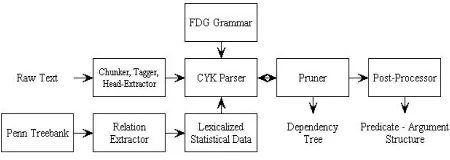
Figure 1: Pro3Gres parser flowchart
using traditional grammar engineering development cycles. It contains about 1000 rules, the number is largely so high due to tag combinatorics: for ex-ample, the various subject attachment rules combin-ing a subject (NN, NNS, NNP, NNPS) and a verb ( VBZ, VBP, VBG, VBN, VBD) are all very simi-lar.
The parser is fast enough for large-scale appli-cation to unrestricted texts, and it delivers depen-dency relations which are a suitable base for a range of applications. We have used it to parse the entire 100 million words British National Corpus (http://www.natcorp.ox.ac.uk) and similar amounts of biomedical texts. Its parsing speed is about 500,000 words per hour. The flowchart of the parser can be seen in figure 1.
Pro3Gres (PRObabilistic PROlog-implemented RObust Grammatical Role Extraction System) uses a dependency representation that is close to LFG f-structure, in order to give it an established lin-guistic background. It uses post-processing graph structure conversions and mild context-sensitivity to capture long-distance dependencies. We have ar-gued in (Schneider, 2005) that LFG f-structures can be parsed for in a completely context-free fashion, except for embedded WH-questions, where a de-vice such as functional uncertainty (Kaplan and Za-enen, 1989) or the equivalent Tree-Adjoining Gram-mar Adjoining operation (Joshi and Vijay-Shanker, 1989) is used. In Dependency Grammar, this device is also known aslifting(Kahane et al., 1998; Nivre and Nilsson, 2005).
We use a hand-written competence grammar, combined with performance-driven disambiguation obtained from the Penn Treebank (Marcus et al., 1993). The Maximum-Likelihood Estimation (MLE) probability of generating a dependency re-lationRgiven lexical heads (aandb) at distance (in
chunks)δis calculated as follows.
p(R, δ|a, b)∼=p(R|a, b)·p(δ|R) = #(R, a, b)
Pn
i=1#(Ri, a, b)
·#(R, δ) #R
The counts are backed off (Collins, 1999; Merlo and Esteve Ferrer, 2006). The backoff levels include semantic classes from WordNet (Fellbaum, 1998): we back off to the lexicographer file ID of the most frequent word sense. An example output of the parser is shown in figure 2.
3 Domain Adaptation
Based on our experience with parsing texts form the biomedical domain, we have used the following two adaptations to the domain of chemistry.
(Hindle and Rooth, 1993) exploit the fact that in sentence-initialNP PPsequences the PP unambigu-ously attaches to the noun. We have observed that in sentence-initialNP PP PPsequences, also the sec-ond PP frequently attaches to the noun, the noun itself often being a relational noun. We have thus used such sequences to learn relational nouns from the unlabelled domain texts. Relational nouns are allowed to attach several argument PPs in the gram-mar, all other nouns are not.
Multi-word terms, adjective-preposition construc-tions and frequent PP-arguments have strong collo-cational force. We have thus used the collocation extraction tool XTRACT (Smadja, 2003) to discover collocations from large domain corpora. The prob-ability of generating a dependency relation is aug-mented for collocations above a certain threshold. Since the tagging quality of the Chemistry testset is high, the impact of multi-word term recognition was lower than the biomedical domain when using a standard tagger, as we have shown in (Rinaldi et al., 2007).
Figure 2: Example of original parser output
LFG f-structure based dependencies to the CoNLL representation, much less time than expected was available for the domain adaptation.
4 Our Results
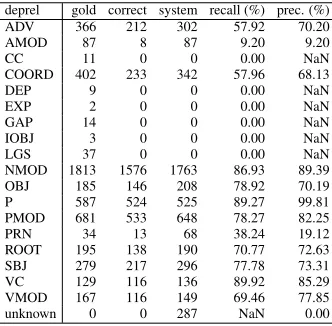
We have achieved average results: Labeled attach-ment score: 3151 / 5001 * 100 = 63.01, unlabeled at-tachment score: 3327 / 5001 * 100 = 66.53, label ac-curacy score: 3832 / 5001 * 100 = 76.62. These re-sults are about 10 % below what we typically obtain when using our own dependency representation or GREVAL (Carroll et al., 2003), a deep-syntactic an-notation scheme that is close to ours. Detailed eval-uations are reported in (Schneider, 2007). Our map-ping was quite poor, especially when conjunctions are involved. Also punctuation is attached poorly. 5.7 % of all dependencies remained unmapped ( un-knownin the figure). We give an overview of the the relation-dependent results in figures 1 and 2.
Mapping problems include the following exam-ples. First, headedness is handled very differently: while we assume auxiliaries, prepositions and co-ordinations to be dependents, the CoNNL repre-sentation assumes the opposite, which leads to in-correct mapping under complex interactions. Sec-ond, the semantics of parentheticals (PRN) partly remains unclear. In Quinidine elimination was capacity limited with apparent Michaelis constant (appKM) of 2.6 microM (about 1.2 mg/L) the gold standard annotates the second parenthesis as paren-thetical, but the first as nominal modification, al-though both may be said to have appositional char-acter. Third, we seem to have misinterpreted the roles of ADV andAMOD, as they are often mutu-ally exchanged. Fourth, the logical subject (LGS) is sometimes marked on the by-PP (... are strongly inhibited by-LGS carbon monoxide) and sometimes on the participle (... are increased-LGS by
pre-deprel gold correct system recall (%) prec. (%) ADV 366 212 302 57.92 70.20 AMOD 87 8 87 9.20 9.20
CC 11 0 0 0.00 NaN
COORD 402 233 342 57.96 68.13
DEP 9 0 0 0.00 NaN
EXP 2 0 0 0.00 NaN
GAP 14 0 0 0.00 NaN
IOBJ 3 0 0 0.00 NaN
LGS 37 0 0 0.00 NaN
NMOD 1813 1576 1763 86.93 89.39 OBJ 185 146 208 78.92 70.19 P 587 524 525 89.27 99.81 PMOD 681 533 648 78.27 82.25 PRN 34 13 68 38.24 19.12 ROOT 195 138 190 70.77 72.63 SBJ 279 217 296 77.78 73.31 VC 129 116 136 89.92 85.29 VMOD 167 116 149 69.46 77.85 unknown 0 0 287 NaN 0.00
Table 1: Prec.&recall of DEPREL
treatment) in the gold standard. Relations between heads of chunks, which are central for predicate-argument structures which Pro3Gres aims to re-cover, such asSBJ, NMOD, ROOT, perform better than those for which Pro3Gres was not originally designed, particularlyADV, AMOD, PRN, P. Perfor-mance on COORD was particularly disappointing. Generally, mapping problems between different rep-resentations would be smaller if one used a depen-dency representation that maximally abstracts away from form to function, for example (Carroll et al., 2003).
[image:3.612.343.509.180.343.2]deprel gold correct system recall (%) prec. (%) ADV 366 161 302 43.99 53.31 AMOD 87 5 87 5.75 5.75
CC 11 0 0 0.00 NaN
COORD 402 170 342 42.29 49.71
DEP 9 0 0 0.00 NaN
EXP 2 0 0 0.00 NaN
GAP 14 0 0 0.00 NaN
IOBJ 3 0 0 0.00 NaN
LGS 37 0 0 0.00 NaN
[image:4.612.101.273.58.223.2]NMOD 1813 1392 1763 76.78 78.96 OBJ 185 140 208 75.68 67.31 P 587 221 525 37.65 42.10 PMOD 681 521 648 76.51 80.40 PRN 34 12 68 35.29 17.65 ROOT 195 138 190 70.77 72.63 SBJ 279 190 296 68.10 64.19 VC 129 116 136 89.92 85.29 VMOD 167 85 149 50.90 57.05 unknown 0 0 287 NaN 0.00
Table 2: Prec.&recall of DEPREL+ATTACHMENT
5 Conclusion
We have described the Pro3Gres parser. We have achieved average results in the shared task with rel-atively little adaptation. Mapping to different repre-sentations is an often underestimated task. Our per-formance on the CHILDES task, where we did not adapt the parser, indicates that hand-written, care-fully engineeredcompetencegrammars may be rel-atively domain-independent whileperformance dis-ambiguation is more domain-dependent. We will adapt the parser to further domains and include more unsupervised learning methods.
References
Steven Abney. 1995. Chunks and dependencies: Bring-ing processBring-ing evidence to bear on syntax. In Jennifer Cole, Georgia Green, and Jerry Morgan, editors, Com-putational Linguistics and the Foundations of Linguis-tic Theory, pages 145–164. CSLI.
R. Brown. 1973. A First Language: The Early Stages. Harvard University Press.
John D. Burger and Sam Bayer. 2005. MITRE’s Qanda at TREC-14. In E. M. Voorhees and Lori P. Buck-land, editors, The Fourteenth Text REtrieval Confer-ence (TREC 2005) Notebook.
John Carroll, Guido Minnen, and Edward Briscoe. 2003. Parser evaluation: using a grammatical relation anno-tation scheme. In Anne Abeill´e, editor, Treebanks: Building and Using Parsed Corpora, pages 299–316. Kluwer, Dordrecht.
Michael Collins. 1999. Head-Driven Statistical Models for Natural Language Parsing. Ph.D. thesis, Univer-sity of Pennsylvania, Philadelphia, PA.
Christiane Fellbaum, editor. 1998. WordNet: An Elec-tronic Lexical Database. MIT Press, Cambridge, MA.
Ulf Hermjakob. 2001. Parsing and question classifica-tion for quesclassifica-tion answering. In Proceedings of the ACL 2001 Workshop on Open-Domain Question An-swering, Toulouse, France.
Donald Hindle and Mats Rooth. 1993. Structural ambi-guity and lexical relations. Computational Linguistics, 19:103–120.
R. Johansson and P. Nugues. 2007. Extended constituent-to-dependency conversion for English. In Proc. of the 16th Nordic Conference on Computational Linguistics (NODALIDA).
Aravind K. Joshi and K. Vijay-Shanker. 1989. Treat-ment of long-distance dependencies in LFG and TAG: Functional uncertainty in LFG is a corollary in TAG. InProceedings of ACL ’89.
Sylvain Kahane, Alexis Nasr, and Owen Rambow. 1998. Pseudo-projectivity: A polynomially parsable non-projective dependency grammar. In Proceedings of COLINGACL, volume 1, pages 646–652, Montreal.
Ronald Kaplan and Annie Zaenen. 1989. Long-distance dependencies, constituent structure, and functional un-certainty. In Mark Baltin and Anthony Kroch, editors, Alternative Concepts of Phrase Structrue, pages 17 – 42. Chicago University Press.
Ron Kaplan, Stefan Riezler, Tracy H. King, John T. Maxwell III, Alex Vasserman, and Richard Crouch. 2004. Speed and accuracy in shallow and deep stochastic parsing. In Proceedings of HLT/NAACL 2004, Boston, MA.
S. Kulick, A. Bies, M. Liberman, M. Mandel, R. Mc-Donald, M. Palmer, A. Schein, and L. Ungar. 2004. Integrated annotation for biomedical information ex-traction. In Proc. of the Human Language Technol-ogy Conference and the Annual Meeting of the North American Chapter of the Association for Computa-tional Linguistics (HLT/NAACL).
B. MacWhinney. 2000. The CHILDES Project: Tools for Analyzing Talk. Lawrence Erlbaum.
M. Marcus, B. Santorini, and M. Marcinkiewicz. 1993. Building a large annotated corpus of English: the Penn Treebank. Computational Linguistics, 19(2):313–330.
Paola Merlo and Eva Esteve Ferrer. 2006. The notion of argument in PP attachment. Computational Linguis-tics, 32(2):341 – 378.
the Penn Treebank. In Keh-Yih Su, Jun’ichi Tsujii, Jong-Hyeok Lee, and Oi Yee Kwong, editors,Natural Language Processing - IJCNLP 2004, pages 684–693. Springer.
Joakim Nivre and Jens Nilsson. 2005. Pseudo-projective dependency parsing. In Proceedings of the 43rd Annual Meeting of the Association for Computa-tional Linguistics (ACL’05), pages 99–106, Ann Ar-bor, Michigan, June. Association for Computational Linguistics.
Joakim Nivre. 2006. Constraints on non-projective de-pendency parsing. In Proceedings of the European Chapter of the Association of Computational Linguis-tics (EACL) 2006, pages 73 – 80, Trento, Italy. Asso-ciation for Computational Linguistics.
Stefan Riezler, Tracy H. King, Ronald M. Kaplan, Richard Crouch, John T. Maxwell, and Mark John-son. 2002. Parsing the Wall Street Journal using a Lexical-Functional Grammar and discriminative esti-mation techniques. InProc. of the 40th Annual Meet-ing of the Association for Computational LMeet-inguistics (ACL’02), Philadephia, PA.
Fabio Rinaldi, Gerold Schneider, Kaarel Kaljurand, Michael Hess, and Martin Romacker. 2006. . an en-vironment for relation mining over richly annotated corpora: the case of GENIA. BMC Bioinformatics, 7(Suppl 3):S3.
Fabio Rinaldi, Gerold Schneider, Kaarel Kaljurand, Michael Hess, Christos Andronis, Ourania Konstanti, and Andreas Persidis. 2007. Mining of functional relations between genes and proteins over biomedical scientific literature using a deep-linguistic approach. Journal of Artificial Intelligence in Medicine, 39:127 – 136.
Gerold Schneider. 2005. A broad-coverage, representa-tionally minimal LFG parser: chunks and F-structures are sufficient. In Mriram Butt and Traci Holloway King, editors,The 10th international LFG Conference (LFG 2005), Bergen, Norway. CSLI.
Gerold Schneider. 2007. Hybrid Long-Distance Func-tional Dependency Parsing. Doctoral Thesis, Institute of Computational Linguistics, University of Zurich. accepted for publication.
John Sinclair. 1996. The empty lexicon. International Journal of Corpus Linguistics, 1, 1996.