Proceedings of the 2019 Conference on Empirical Methods in Natural Language Processing 3700
Emergent Linguistic Phenomena in Multi-Agent Communication Games
Laura Graesser†∗, Kyunghyun Cho†‡?, Douwe Kiela‡
†NYU;∗Robotics at Google;? CIFAR Azrieli Global Scholar;‡Facebook AI Research
[email protected], [email protected], [email protected]
Abstract
We describe a multi-agent communication framework for examining high-level linguis-tic phenomena at the community-level. We demonstrate that complex linguistic behavior observed in natural language can be repro-duced in this simple setting: i) the outcome of contact between communities is a func-tion of inter- and intra-group connectivity; ii) linguistic contact either converges to the ma-jority protocol, or in balanced cases leads to novel creole languages of lower complexity; and iii) a linguistic continuum emerges where neighboring languages are more mutually in-telligible than farther removed languages. We conclude that at least some of the intricate properties of language evolution need not de-pend on complex evolved linguistic capabili-ties, but can emerge from simple social ex-changes between perceptually-enabled agents playing communication games.
1 Introduction
Contact linguistics (Myers-Scotton,2002) studies
what happens when two or more languages or lan-guage varieties interact. It poses several pertinent open questions that are difficult to answer: how does symmetric (“mutually intelligible”) commu-nication emerge; how do languages behave under contact; how does one language come to dominate another; how and why does extensive language contact tend to lead to simplification (e.g. in cre-oles); and how does a linguistic continuum come about, where neighboring languages are more in-telligible than farther removed ones? In this work, we show that such linguistic phenomena emerge naturally given a few general assumptions about the organizational structure of networks of artifi-cial agents equipped with a minimalistic form of learned communication.
We introduce a multi-agent framework for studying the emergence and evolution of language,
where agents are neural networks endowed with the ability to exchange messages about their per-ceptual input. The advantage of this approach is that one can precisely control linguistic, environ-mental and algorithmic variables.
First, we investigate linguistic behavior at the agent-level, and examine when symmetric com-munication emerges within a linguistic commu-nity, as well as how the topological organization of communities—i.e., which other agents an agent comes into contact with and how frequently that happens—impacts convergence and learning. We then examine the behavior of communities of such agents when they come into contact, as well as how community-level topology impacts conver-gence, success rate and mutual intelligibility.
We demonstrate that the following linguistic be-haviors emerge, which correspond to known lin-guistic phenomena in natural languages: 1) the outcome of contact is a function of inter- and intra-group connectivity, i.e. that languages be-come mutually intelligible through contact, even for agents that have not themselves been exposed to the other language, provided there is sufficient connectivity between communities; 2) linguistic contact over time either converges to the domi-nant majority protocol, leading to the extinction of the other language, or if the communities are balanced, gives rise to an original “creole” pro-tocol that has lower complexity than the origi-nal languages; 3) a linguistic continuum emerges, where neighboring languages are more mutually intelligible than farther removed languages and the topology of the continuum governs its behavior.
capa-bilities, but instead can emerge purely from social exchanges between perceptually-enabled agents with simple communicative capabilities.
2 Related Work
Studying language change in vivo is
challeng-ing, since it requires simultaneous observation of
speaker and community interactions (Brooks and
Ragir,2008;Trudgill,1974;Joseph,2017; Chris-tiansen and Kirby,2003), while carefully
control-ling for purposes and goals (Winograd,1971;
Flo-res and Winograd, 1987; Nowak and Krakauer,
1999). Studies of language emergence and
evo-lution must furthermore be conducted over a long period of time, spanning decades or even cen-turies. Even the Nicaraguan sign language, which emerged remarkably rapidly, took several decades
to develop fully (Senghas et al.,2005). Language
itself also never ceases to evolve (Fishman,1964).
Advances in computer science have provided us with opportunities for instead investigating
the emergence and evolution of languages in
vitrousing computational and mathematical
mod-els (R. Hurford,1989;Briscoe,2002;Kirby,2002;
Christiansen and Kirby,2003;Kirby et al.,2008;
Lewis,2008;Skyrms,2010). In computational ap-proaches, communities of agents, equipped with the ability to communicate, are deployed in a sim-ulated environment. Their communication proto-col is either evolved or learned, in order to max-imize some reward provided by the environment. The agents’ behavior and communication are ob-served and used to compare against linguistic phe-nomena or hypothesized linguistic theories.
Computational multi-agent models are charac-terized by the complexity of the agents, the choice of learning algorithm, and the design of the en-vironment and reward structure. The complexity of an artificial agent ranges from a set of
sim-ple difference equations (Grouchy et al., 2016),
to a CPU-like architecture with an instruction
set and registers (Knoester et al., 2007), to a
co-occurrence matrix between objects and
sym-bols (Nowak and Krakauer, 1999), to a simple
single-layer neural network (Trianni and Dorigo,
2006), to a deep neural network (Lazaridou et al.,
2016; Foerster et al., 2016; Jorge et al., 2016). The learning algorithm is either a variant of
evo-lutionary algorithms (Nowak and Krakauer,1999;
Kirby,2002;Grouchy et al., 2016), often used in
the framework of Artificial Life (Bedau,2003), or
a gradient-based optimization algorithm, as is of-ten used for training deep neural networks with a supervised or reinforcement learning objective function. The former simulates generations de-veloping complex behavior over time, while the latter enables more sophisticated agents thanks
to the recent advances in deep learning (LeCun
et al., 2015). Recent years have seen intriguing new results in emergent communication, starting with Lazaridou et al. (2016) and Foerster et al.
(2016), using deep neural agents (Lewis et al.,
2017;Havrylov and Titov,2017;Jorge et al.,2016;
Evtimova et al.,2018;Das et al.,2018;Cao et al.,
2018). Often, these approaches could be framed as
special or generalized cases of Lewis’s signalling
game (Lewis, 2008), in which agents exchange
signals to achieve a common goal. In this work, deep neural agents play games within communi-ties of similar agents, where the aim is for agents to communicate about their perceptual input.
3 Multi-agent communication
In order to study emergent linguistic phenomena in a simplified but realistic setting, the commu-nication game needs to have several properties.
First, it should be symmetric, in that all agents
should be able to act as “speaker” and “listener”. Second, the agents should communicate about
something external to themselves, i.e., about the
sensory experience of something in their
environ-ment. Third, the world should bepartially
observ-able, implying that communication is required for
solving the game successfully.Fig.1shows
exam-ple training data, the game setup and agent design. See the supplementary material for details.
Reference Game LetG= hA, O, M, W, Ribe a multi-agent communication game, consisting of
communities of agents A communicating across
the bidirectional message channelM given
envi-ronmental observationsO, where the community
membership of agents is defined as a graph with
the agents A as vertices and weighted edges W
that determine whether two agents are connected,
i.e.,W specifies the topology of the network.
Each agent is a deep neural network with per-ceptual inputs and given a language description,
as illustrated in Fig.1. All agents have the same
Agent 1 Agent 2
There is a green square. There is a blue cross. There is a green cross. There is a triangle. There is a cyan shape … Before comm.
Message Channel
Before comm. After
comm.
After comm.
Prediction Prediction
Agent 1
Agent 2
Sensory SubNetwork
V(h)
Fusion SubNetwork
ResNet34 Recurrent UnitGated Receiver SubNetwork
Continuous BagofWords Text SubNetwork Value
SubNetwork Sender SubNetwork
p(m|h, p(y|h))
Predictor SubNetwork
[image:3.595.76.527.60.164.2]p(y|h)
Figure 1: Overview of the communication game and agent structure.Left: A graphical illustration of the proposed game. Each of two agents observes a partition of an input image and decides which of ten textual captions best describes the entire image before and after exchanging messages with the other agent. Middle: Example training data. Only a random part of each image (dark background) is presented to one agent, necessitating communication in order to solve the game.Right: The modular structure of an agent.
rselfbefore rselfafter rselfafter+
rotherafter
0 20 40 60
Success
Rate
(%)
rself after
+rotherafter rself
comm
+rothercomm
74.0 74.5 75.0 75.5 76.0
Success
Rate
(%)
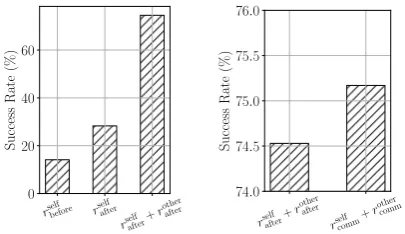
Figure 2: The chance of both agents correctly guessing the answer depends on the reward (averaged over three runs): (left) it is important to reward the collective be-haviour in order for two agents to collaborate; (right) the success rate goes up when we encourage agents to maximize the accuracyimprovementafter communica-tion.
with a reward structureR, designed specifically to
require communication-based collaboration. The exchange of information through the
communica-tion channelM can take any form. By learning to
play the game, agents develop a communication protocol about the observations. This framework allows us to control for proximity constraints, pop-ulation size and degree of interaction, through the underlying graph structure.
Throughout the game, each agent observes one part of an image that contains an object of a
spe-cific shape and color and is given a set of ncap
synthetic compositional captions (e.g. “there is a green triangle”) of which only one correctly
de-scribes the image1.
The goal is for the agents to identify the correct
caption y∗ for the image. Since each agent only
1ShapeWorld (Kuhnle and Copestake,2017) was used to derive the data set which includes both the images and cap-tions. See the supplementary material for details.
has partial information, the pair of agents must co-operate via communication to be effective at
solv-ing the problemtogether.
At the beginning of the game, each agent makes
an initial guess y0ˆ of the correct answer,
fol-lowed bykrounds of communication in which the
agents take turns transmitting a binary message to the other agent. In the experiments discussed in this paper, agents communicate using 8-bit binary message vectors. Binary message vectors have been used before for studying the emergence and
evolution of language (Kirby and Hurford,2002).
While we selected this type of communication for efficiency reasons, it is straightforward to replace
it with sequences of discrete symbols (Jorge et al.,
2016;Havrylov and Titov,2017;Lee et al.,2017;
Cao et al.,2018;Lazaridou et al.,2018), continu-ous vectors or larger binary vectors. After several rounds of communication, each agent makes their
final guessyˆ1. The game is considered successful
ifbothof the agents correctly guessed the answer.
During training, a pair of agents corresponding
to adjacent vertices, ai ∈ A andaj ∈ A, is
se-lected at random according to interaction weights
wij ∈W. One of them is randomly picked as the
starting agent. The agents then play one instance of the reference game and their parameters are up-dated accordingly. The community structure can change during training. For instance, we are able to merge separately trained linguistic communities into a single community and fine-tune the agents from both communities (i.e. bring the communi-ties into contact) to investigate linguistic contact. Once training is done, we can test pairs of distant agents to understand what changed in the protocol.
[image:3.595.81.284.255.372.2]when it correctly guesses the answer after
com-municationrselfafter =1y∗=ˆy
1, where1is an
indica-tor function, in order to encourage it to incorporate information received from the other agent. Sec-ond, we reward cooperation by giving each agent a shared reward composed of both its own and the
other agent’s rewards, i.e.,rafter=rselfafter+rotherafter. As
Fig. 2shows, we empirically validate the
impor-tance of rewarding after-communication behavior and observe that the cooperation reward signifi-cantly boosts the success rate. Lastly, we explic-itly encourage the agents to rely on
communica-tion by rewarding them for relative improvement
from communication, rather than the success
af-ter communication: r = rselfcomm+rothercomm, where
rcommself =rafterself −rbeforeself androthercomm=rotherafter−rotherbefore. This final reward, which encourages both coop-eration and explicit reliance on communication, reaches the highest success rate.
Training Each agent is trained using a hybrid of supervised and reinforcement learning. Each agent computes two predictive distributions
be-fore and after message exchange,pbefore(y|h)and
pafter(y|h), where y refers to one of the ncap
im-age captions andhis the hidden state of the agent
network, which fuses perceptual input with the last received message. Since we know the
cor-rect caption y∗ during training, we use
super-vised learning to train these two predictive
dis-tribution, max logpbefore(y∗|h) + logpafter(y∗|h),
using backpropagation and stochastic gradient
de-scent (Rumelhart et al.,1986). Since messages are
discrete, the message generating process cannot be backpropagated through. Instead, we use
REIN-FORCE (Williams,1992) to maximize the reward
r;maxEm|h,p(y|h)[r]. We add the entropy of the message distribution as a regularization term, en-couraging the exploration of various communica-tion strategies in the early stage of learning.
Loss Functions There are four loss functions in-volved in each game. The first one is a prediction
loss function. Given the indexy∗of a correct
cap-tion, the prediction loss function is
Lpred =−logp(y=y∗|h).
This loss is used twice based on the predictions before and after the message exchange; denoted asLbefore
pred andLafterpred respectively.
The second loss is a value loss function.
Af-ter playing a game, the agent receives a rewardr.
The agent’s value sub-network (seeFig.1) learns
to predict this reward:
Lvalue= (r−V(h))2.
The third loss is a message loss function.
Dur-ing trainDur-ing, we sample one message m˜ from
the message distribution generated by the agent
p(m|h, p(y|h)). If this message led to a success,
we increase the probability of the sampled mes-sage. Otherwise, we decrease it. The success is measured relative to the predicted value. The cost function is then:
Lmsg=−(r−Vˆ(h)) logp(m= ˜m|h, p(y|h)),
whereVˆ(h)refers to using the predicted value but
not updating the value sub-network according to this loss function. The gradient of this message
loss function with respect top(m= ˜m|h, p(y|h))
corresponds to REINFORCE (Williams,1992).
Lastly, we include an entropy penalty.
Follow-ing (Evtimova et al.,2018), we encourage the
en-tropy of the message distribution to be higher to facilitate exploration:
Lentropy=−H(p(m|h, p(y|h))).
The overall loss function is then the weighted sum of the four loss functions:
L=αpredLpred+αvalueLvalue
+αmsgLmsg+αentropyLentropy,
where we setαpred = 1.0, αvalue = 1.0, αmsg =
1.0andαentropy = 0.01.
4 Experiments
When Are Protocols Symmetric? We first ex-amine whether it is sufficient to have just two autonomous agents to develop a common com-munication protocol. That is, we ask whether a
symmetriclanguage emerges when there are only two agents in a linguistic community, or that they
learn to speak distinct idiolects. We formally
define “mutual intelligibility” in the communica-tion protocol as the ability for each agent to play
the game against itself. This is an elegant
2 3 4 5 8 10 # of Agents
0 20 40 60
Success
Rate
(%)
self-play cross-play
(a)
3 4 5 8 10 20 30 # of agents
0.0 20.0 40.0 60.0 80.0
#
of
pla
ys
p
er
agen
t
to
first
observ
e
70%
acc.(
×
1000)
(b)
3 4 5 8 10 # of agents 0.0
50.0 100.0 150.0 200.0
#
of
pla
ys
p
er
agen
t
to
75%
on
avg.
(
×
1000)
(c)
104
# of plays per agent to first observe x% acc. 30
40 50 60 70
Success
Rate
(%)
2 agents 3 agents 4 agents 5 agents 8 agents 10 agents 20 agents
[image:5.595.143.454.68.335.2](d)
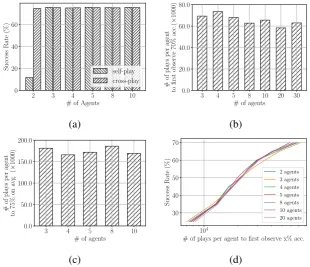
Figure 3: Emergence of symmetric linguistic protocols (averaged over five runs). (a) Six communities were trained: we show the success rates under self-play and cross-play. We observe that at least three agents are neces-sary for the emergent protocol to be symmetric—without any specialized mechanism that enforces the symmetry of emergent protocol.(b)The average number of plays per agent to the first observed success rate≥70%between a pair of agents in a linguistic community approximately stays constant with respect to the community size. (c)
The number of plays required for each agent in a linguistic community to reach the success rate of 75% on average across all agents pairs in the community approximately stays constant with respect to the community size. (d)
Each agent learns at approximately the same rate regardless of community size, which suggests that the emergent protocol emerges incrementally in a distributed manner rather than in a centralized way.
random initialization and examine the success rate between two agents averaged over all the test ex-amples, where the agents succeed on each exam-ple if both of them correctly guess the answer after communication.
As shown inFig.3(a), two agents can play the
game with a high success rate when they play with each other (cross-play). However, the success rate drops to random chance (10%) when each agent plays against itself (self-play). This suggests that the emergent communication protocol is not sym-metric: each agent has developed its own proto-col, to which the other has adapted, leading to two incompatible idiolects, similar to previous
obser-vations in both fully (Matignon et al., 2012) and
partially observable settings (Lanctot et al.,2017).
We then run additional experiments having more than two agents, where every pair of agents
(vi, vj) interacts with an equal interaction
inten-sitywij = c(the success rate is averaged over all
possible pairs of agents, unless stated otherwise).
We notice that the success rates between self-play and cross-play are indistinguishable, strongly im-plying that a common, shared language emerges as a social convention if and only if we have more
than two language users. This finding
demon-strates that it is not strictly necessary to specif-ically equip an agent with an innate mechanism that ties listening and speaking, such as the
ob-verter technique (Oliphant and Batali,1997;Choi
et al., 2018), nor any explicit community-wide coordination. All that is needed in order for a common language to emerge, at least within this framework, is a minimum number of agents.
We observe no detrimental effect to increasing the number of agents per linguistic community, even though more agents have to come to agree
on a single protocol. As shown inFig.3(b–c), it
Intra-connection Inter-connection
Community 1 Community 2
Bridge agents
(a)
104 105
# of plays 20
40 60
Success
Rate
(%)
Bridge Agents Others
(b)
100
6×10⁻¹ 2×100
winter/wintra
10−1
2×10⁻¹
3×10⁻¹
4×10⁻¹
6×10⁻¹
pinter
40.00 44.00
48.00 52.00
52.00
56.00 60.0064.00
[image:6.595.97.524.65.188.2](c)
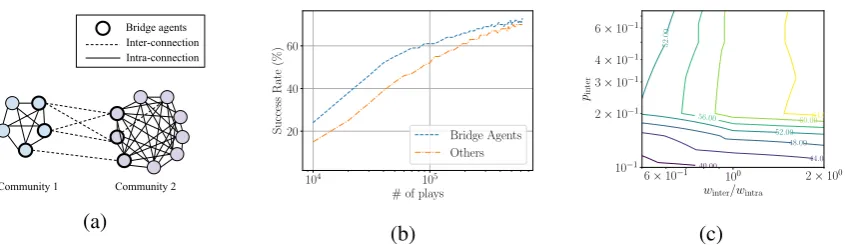
Figure 4: The consequences of contact between two linguistic communities with initially distinct protocols. (a)
Two linguistic communities come in contact. (b)Two communities of population ten each came in contact with the ratio of learning frequencies(K winter)/(L wintra) = 1and the inter-group connectivitypinter= 0.2, after being
separately trained in isolation (averaged over five runs). The bridge agents, who interact with the agents from the other community, learn faster and better the new, shared emergent protocol. All the other agents however also rapidly learn to communicate with the agents from the other community, although they never interact directly with them. (c)Contour plot visualization of the success rate after 200,000 plays after the contact by two linguistic communities while varying the ratio of learning frequencies(Kwinter)/(Lwintra)and the inter-group connectivity pinter(linearly interpolated from 15 experiments.) We observe that the success rate, which measures the level of
convergence of two protocols, requires a certain level of the inter-group connectivity (pinter>0.2). Even when the
inter-group connectivity is high enough, we further see that the bridge agents must interact with the agents from the other community enough ((Kwinter)/(Lwintra)≥ 1) for the converged protocol to be well understood by the
agents from both communities.
150-200,000 plays per agent for the success rate averaged over all pairs of agents in a commu-nity to reach 75%, again, regardless of the size of the community. Surprisingly, the speed at which each agent learns stays constant with respect to
the community size, as inFig.3(d). That is, we
did not observe any correlation between commu-nity size and linguistic convergence of the entire community, which would probably only come into play with orders of magnitude more agents or for more complex reference games.
Understanding Convergence We next examine what happens when we expose different
linguis-tic communities to each other. Specifically, we
consider two linguistic communities of population
sizesN1andN2, which are trained independently
from each other as fully-connected communities and have developed separate communication pro-tocols. We bring these two communities into con-tact with each other by introducing a new set of
inter-community edges with probability pinter to
form a new linguistic community. We assign a
weightwinter to all the inter-group edges and
an-other weightwintrato all the intra-group edges. We
then examine how “interaction intensity” relates to
language shift. SeeFig.4(a).
We first investigate two communities of
iden-tical population sizes (N1 = N2) with the ratio
of the learning frequencies of the intra-group pairs
and inter-group pairs set to(Kwinter)/(Lwintra) =
1, whereKis the number of inter-community
con-nections andLis the number of intra-community
connections, and the inter-group connectivity
chance set topinter = 0.2. We notice inFig.4(b)
that the bridge agents learn to communicate bet-ter more rapidly (evident from the higher suc-cess rate among themselves), but the other agents quickly catch up (according to the success rate among themselves excluding the bridge agents), although these other agents never directly inter-act with agents from the other community. This finding demonstrates the rapid shift toward a com-mon protocol in both groups where all agents learn to speak a shared language, regardless of whether they actually interact with agents from the other group.
Having established that linguistic contact leads to convergence of the communication protocol, we delve deeper into the impact of two major
parameters, the ratio (Kwinter)/(Lwintra) and the
connectivity probability pinter. We vary the ratio
(Kwinter)/(Lwintra)of the learning frequencies of the intra-group pairs and inter-group pairs between
2/1, 1/1 and 1/2, while fixing the inter-group
connectivity topinter = 0.2. After 200,000 plays,
the former ((Kwinter)/(Lwintra) = 2/1) converges
0.3 0.4 0.5 0.6 0.7 0.8 0.9 1.0 Population RatioN2/N1
0 20 40 60
Success
Rate
(%)
S(L0 1kL∞)
S(L0 2kL∞)
(a)
0.3 0.4 0.5 0.6 0.7
Na/(N1+N2),Na=N1orN2
20 40 60
S
(
L
0ka
L
∞)
(%),
L
0=a
L
0 1or
L
0 2
[image:7.595.147.451.68.200.2](b)
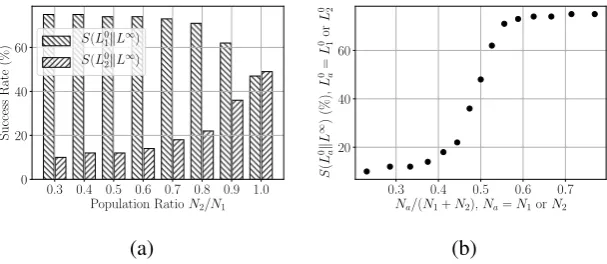
Figure 5: Relationship between the common emergent protocol and the original protocols after linguistic contact between two communities (averaged over five runs). (a)Divergence of the common emergent protocol from the original protocols. Agents converge either to the majority protocol or to one in-between the two originals. (b)By varying the population ratio, it becomes clear that a near-even balance between two communities is necessary for a novel, contact protocol to emerge rather than the domination by a majority protocol.
achieving 65.6% success rate between agents that never interacted with each other. On the other hand, when the inter-group interaction occurred only half as frequently as the intra-group inter-action, the agents from the two groups can play together with a much lower 52.4% success rate. We observed similar patterns over many differ-ent combinations of the ratio and inter-group con-nectivity. For example, we varied the inter-group
connectivity pinter between 0.1, 0.15, 0.2, 0.5
and 0.75 while the interaction ratio was fixed to
(Kwinter)/(Lwintra) = 2/1. After 200,000 plays, we observed the success rates, averaged over all possible inter-group pairs, reach 42.1%, 51.1%, 65.55%, 66.65% and 66.3%, respectively. This implies that there is a critical level of inter-group
connectivity (around0.2in this specific case) after
which language propagation saturates.
In Fig. 4 (c), we plot the interplay between
the ratio (Kwinter)/(Lwintra) and the inter-group
connectivity pinter after interpolating from the
fif-teen experiments varying these parameters. This demonstrates that both parameters are important in determining the level of linguistic convergence.
Birth of a New Language: Emergence of a Contact Language We investigate the effect of
the population size ratioN1/N2between two
lin-guistic communities when they come in contact. We study how population size is a factor in one language coming to “dominate” another language
upon contact. We vary the ratio by fixingN1 = 10
and varyingN2 ∈ {3, . . . ,10}. Each community
is pretrained in isolation to develop its own proto-col before being exposed to the other. We set the
interaction ratio(Kwinter)/(Lwintra) to1 and the
inter-group connectivity chancepinterto0.2.
We refer to the original protocols of the
commu-nities right after pretraining byL01 andL02. Each
of these is then evolved further after these two
communities come in contact, resulting inL∞1 and
L∞2 . The previous experiment on linguistic
con-tact suggests that L∞1 ≈ L∞2 based on the fact
that the agents from both communities can suc-cessfully play the game after coming in contact,
so we refer to the final protocol as L∞. We
ex-amine how similarL∞is to either of the original
protocols, L01 orL02. This similarity is measured
by letting the agent using L01 or L02 play against
the one using L∞, which is naturally facilitated
by the proposed framework. This “historical
self-play” accuracyS(L0·kL∞)reflects the similarly of
the original and final protocols.
When the population ratio deviates from
N1/N2 = 1, we observe that the final protocol
rapidly converges to the majority protocol (L01),
evident from the near-perfectS(L01kL∞) and the
near-chance S(L02kL∞) in Fig. 5. This results
from the fact that members of both communities are rewarded for cooperating and playing the game well (via the bridge agents). In other words, the agents prefer to integrate or assimilate rather than segregate, similar to how it has been found that mi-nority groups shift toward the use of dominant
lan-guage (Fase et al.,1992). On the other hand, we
observeS(L01kL∞) ≈ S(L12kL∞) and that both
of these historical self-play accuracies are signifi-cantly above chance, when the population ratio is
closer to or exactly 1. It is impossible to
0 10000 20000 30000 # of Plays per Agent
0.5 0.6 0.7
Success
Rate
(%)
10-10 10-9 10-4 10-3
(a) Success Rate
0 10000 20000 30000 # of Plays per Agent
1.5 1.6 1.7 1.8 1.9
E
[
H
(
m
)]
10-10 10-9 10-4 10-3
(b)E[H(p(m|h, p(y|h)))]
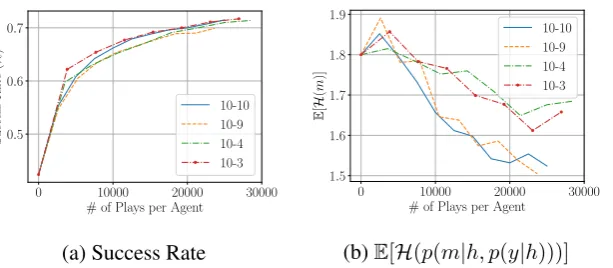
Figure 6: Evolution of success rate and protocol complexity as two communities of varying populations come into contact (averaged over three runs). Agents were finetuned until the average success rate reached at least70%. The success rate evolves similarly in terms of the number of plays per agent.(a)We observe significantly different levels of complexity dependent on the population ratio. (b)The complexity is generally lower when the sizes of two communities are more balanced (10-10 and 10-9), while the complexity does not decrease as much when there is a significant imbalance in sizes between two communities (10-4 and 10-3).
L∞ is rather a combination of these two original
protocols, which is a key characteristic of contact
languages (Matras,2009). Both of these
observa-tions suggest the potential of the proposed frame-work for simulating and understanding the birth and death of new languages via linguistic contact.
We further investigate the complexity of the contact language arising from two linguistic com-munities coming into contact. We define complex-ity as the uncertainty of an agent when generating a message, and measure the entropy of the
mes-sage distributionH(p(m|h, p(y|h))). Higher
en-tropy indicates that agents can express states in many different ways: in other words, the more complex a language, the higher the degree of
free-dom. For each linguistic community, we then
compute the average of their message distributions in order to characterize the complexity of a learned communication protocol.
We observe in Fig. 6 (b) that the complexity
decreases when two communities come into con-tact. This observation agrees with a similar phe-nomenon of structural simplification in creole lan-guages which are understood to arise from the
contact of two or more languages (Parkvall,2008;
Bakker et al., 2011). We also observe that the complexity plateaus earlier when there is a larger imbalance between two communities’ population (10-3 and 10-4), while it drops further with more balanced communities (10-9 and 10-10). This im-plies that the new-born contact languages arising from the contact of two similarly-sized communi-ties tend to be substantially simpler.
A Linguistic Continuum of Contact We
gen-eralize the previous setting to havingM > 2
lin-guistic communities in various topologies. We
start by pretrainingM linguistic communities of
populations N1, N2, . . . , NM respectively,
evolv-ingMdistinct communication protocols. We then
chain them such that each consecutive pair,Ciand
Ci+1, comes in contact with a pre-specified
inter-group connectivity chancepinterand interaction
ra-tio (Kwinter)/(Lwintra), and begin training all of the communities jointly. We study the emergence of a linguistic continuum, similar to the dialect continuums that can be found in natural languages such as the Nordic Germanic dialects of
Scandi-navia (Chrystal, 1987). Often, speakers on the
border are mutually intelligible, while those from communities geographically separated by many intermediate ones cannot communicate.
We start by considering a chain of five
com-munities of equal population (M = 5). As
plot-ted in Fig. 7 (a), we clearly observe the
emer-gence of a linguistic continuum. The agents from a pair of adjacent communities can communicate with each other almost as well as those within a single community, while communicability rapidly degrades as the distance between a pair of
commu-nities grows (off-diagonal). The agents from C1
andC5cannot understand each other at all,
achiev-ing the near-chance success rate. A similar con-tinuum is observed when we increased the
popu-lation of the center community two-fold (5→10).
This continuum however exhibits properties dif-ferent from the original chain of equal-sized
[image:8.595.151.458.66.200.2]C1 C1 C2 C2 C3 C3 C4 C4 C5 C5 Success Rate (%) 0 10 20 30 40 50 60 70 (a) 5-5-5-5-5 C1 C1 C2 C2 C3 C3 C4 C4 C5 C5 Success Rate (%) 0 10 20 30 40 50 60 70 (b) 5-5-10-5-5 C1 C1 C2 C2 C3 C3 C4 C4 C5 C5 Difference −10 −5 0 5 10 (c) Difference (b)-(a) C1 C1 C2 C2 C3 C3 C4 C4 C5 C5 Success Rate (%) 0 10 20 30 40 50 60
(d) Dense (a)
C1 C1 C2 C2 C3 C3 C4 C4 C5 C5 Success Rate (%) 0 10 20 30 40 50 60 70
(e) Dense (b)
Figure 7: We plot the protocol similarities among five communities in a chain (averaged over three runs). (a)
Neighbouring communities exhibit higher protocol similarities, but distant communities are not mutually intelli-gible. (b)With a larger community in the middle of a chain, we observe higher levels of protocol similarities among the communities in the chain.(c)Differences between the two, showing that the protocols near the center become more similar to each other when the center community dominates, at the expense of intelligibility between further-removed communities.(d, e)We do not observe a continuum when the communities are connected densely.
become more tightly coupled, as evident from the
higher success rate among those in Fig. 7 (b-c).
This however happens at the cost of communica-bility between the agents from furthest-removed communities.
To see if the emergence of such a continuum is due to topological properties of communities,
we show similaritiesS(L∞i kL∞j )among the five
communities when densely connected inFig.7
(d-e). Unlike for chaining, we ensure that every pair of communities comes in contact with each other in a densely connected topology. All communities are uniformly similar, confirming that the linguis-tic continuum arises from the topology.
5 Discussion and Conclusion
We have described a framework for the large-scale investigation of complex linguistic phenomena via multi-agent communication games. We started by observing that a symmetric communication proto-col emerges without any innate, explicit mecha-nism built in an agent, when there were three or more of them in a community. We then demon-strated the emergence of several complex linguis-tic phenomena in this simple framework.
First, the result of linguistic contact between communities is determined by inter- and intra-group connectivity patterns. Given sufficient inter-group connectivity, languages become mutually intelligible through contact, even for agents that have not been exposed to the other language. Sec-ond, linguistic contact over time either converges to the majority protocol, leading to the extinction of the other language, or gives rise to an origi-nal “creole” protocol that has lower complexity than the original languages, if the communities are balanced. Third, a linguistic continuum emerges,
where neighboring languages are more mutually intelligible than farther removed languages. The topology of the continuum governs its behavior, and a very dominant central language causes its neighbors to lose mutual intelligibility with com-munities that are not directly exposed to that cen-tral language.
We conclude that intricate properties of lan-guage evolution need not depend on
com-plex evolved linguistic capabilities, but can
emerge from simple social exchanges between perceptually-enabled agents playing communica-tion games. Language evolucommunica-tion and its properties can be effectively and efficiently investigated in-depth under the proposed framework.
In future work, it would be useful to investigate more complicated environments and more com-plex agent interactions. The setting in this paper included a very simple vision task, and we suspect emergent linguistic phenomena would be more pronounced and even more interesting to study in more sophisticated settings.
Acknowledgments
We thank the anonymous reviewers for providing helpful feedback. We thank Marco Baroni, Alex Peysakhovich and Adina Williams for their com-ments on an earlier draft of this work.
References
Peter Bakker, Aymeric Daval-Markussen, Mikael Park-vall, and Ingo Plag. 2011. Creoles are typologically distinct from non-creoles. Journal of Pidgin and Creole Languages, 26:5–42.
[image:9.595.76.514.68.155.2]Ted Briscoe. 2002. Linguistic evolution through lan-guage acquisition. Cambridge UP.
Patricia J Brooks and Sonia Ragir. 2008. Prolonged plasticity: Necessary and sufficient for language-ready brains. Behavioral and Brain Sciences, 31(5):514–515.
Kris Cao, Angeliki Lazaridou, Marc Lanctot, Joel Z Leibo, Karl Tuyls, and Stephen Clark. 2018. Emer-gent communication through negotiation. InICLR.
Edward Choi, Angeliki Lazaridou, and Nando de Fre-itas. 2018. Compositional obverter communication learning from raw visual input. ICLR.
Morten H Christiansen and Simon Kirby. 2003. Lan-guage evolution: Consensus and controversies. Trends in Cognitive Sciences, 7(7):300–307.
David Chrystal. 1987. The cambridge encyclopedia of language.Cambridge ua.
Abhishek Das, Samyak Datta, Georgia Gkioxari, Ste-fan Lee, Devi Parikh, and Dhruv Batra. 2018. Em-bodied question answering. InCVPR.
Katrina Evtimova, Andrew Drozdov, Douwe Kiela, and Kyunghyun Cho. 2018. Emergent communication in a multi-modal, multi-step referential game. In ICLR.
Willem Fase, Koen Jaspaert, and Sjaak Kroon. 1992. Maintenance and loss of minority languages. John Benjamins Publishing.
Joshua A Fishman. 1964. Language maintenance and language shift as a field of inquiry. a definition of the field and suggestions for its further development. Linguistics, 2(9):32–70.
F. Flores and T. Winograd. 1987.Understanding Com-puters and Cognition: A New Foundation for De-sign. Addison-Wesley Longman.
Jakob Foerster, Ioannis Alexandros Assael, Nando de Freitas, and Shimon Whiteson. 2016. Learning to communicate with deep multi-agent reinforcement learning. In Advances in Neural Information Pro-cessing Systems, pages 2137–2145.
Paul Grouchy, Gabriele MT DEleuterio, Morten H Christiansen, and Hod Lipson. 2016. On the evo-lutionary origin of symbolic communication. Scien-tific Reports, 6:34615.
Serhii Havrylov and Ivan Titov. 2017. Emergence of language with multi-agent games: learning to com-municate with sequences of symbols. InAdvances in Neural Information Processing Systems, pages 2149–2159.
Emilio Jorge, Mikael K˚ageb¨ack, Fredrik D Johansson, and Emil Gustavsson. 2016. Learning to play guess who? and inventing a grounded language as a con-sequence. Deep Reinforcement Learning Workshop at Advances in Neural Information Processing Sys-tems.
Brian D. Joseph. 2017. Historical linguistics. In Mark Aronoff, editor,The handbook of linguistics, chap-ter 15. John Wiley & Sons.
Simon Kirby. 2002. Natural language from artificial life.Artificial Life, 8(2):185–215.
Simon Kirby, Hannah Cornish, and Kenny Smith. 2008. Cumulative cultural evolution in the lab-oratory: An experimental approach to the origins of structure in human language. Proceedings of the National Academy of Sciences, 105(31):10681– 10686.
Simon Kirby and James R. Hurford. 2002. The emer-gence of linguistic structure: An overview of the iterated learning model. In Angelo Cangelosi and Domenico Parisi, editors, Simulating the Evolu-tion of Language, pages 121–147. Springer London, London.
David B Knoester, Philip K McKinley, Benjamin Beck-mann, and Charles Ofria. 2007. Directed evolution of communication and cooperation in digital organ-isms. In European Conference on Artificial Life, pages 384–394. Springer.
Alexander Kuhnle and Ann Copestake. 2017. Shapeworld-a new test methodology for multi-modal language understanding. arXiv preprint arXiv:1704.04517.
Marc Lanctot, Vinicius Zambaldi, Audrunas Gruslys, Angeliki Lazaridou, Karl Tuyls, Julien P´erolat, David Silver, and Thore Graepel. 2017. A unified game-theoretic approach to multiagent reinforce-ment learning. In Advances in Neural Information Processing Systems, pages 4190–4203.
Angeliki Lazaridou, Karl Moritz Hermann, Karl Tuyls, and Stephen Clark. 2018. Emergence of linguistic communication from referential games with sym-bolic and pixel input.ICLR.
Angeliki Lazaridou, Alexander Peysakhovich, and Marco Baroni. 2016. Multi-agent cooperation and the emergence of (natural) language. ICLR.
Yann LeCun, Yoshua Bengio, and Geoffrey Hinton. 2015. Deep learning. Nature, 521(7553):436.
Jason Lee, Kyunghyun Cho, Jason Weston, and Douwe Kiela. 2017. Emergent translation in multi-agent communication.ICLR.
David Lewis. 2008. Convention: A philosophical study. John Wiley & Sons.
Mike Lewis, Denis Yarats, Yann Dauphin, Devi Parikh, and Dhruv Batra. 2017. Deal or no deal? end-to-end learning of negotiation dialogues. InEMNLP, pages 2443–2453.
Yaron Matras. 2009. Language contact. Cambridge UP.
Carol Myers-Scotton. 2002. Contact linguistics: Bilin-gual encounters and grammatical outcomes. Oxford University Press on Demand.
Martin A. Nowak and David C. Krakauer. 1999. The evolution of language. Proceedings of the National Academy of Sciences, 96(14):8028–8033.
Michael Oliphant and John Batali. 1997. Learning and the emergence of coordinated communication. Cen-ter for Research on Language NewsletCen-ter, 11(1):1– 46.
Mikael Parkvall. 2008. The simplicity of creoles in a cross-linguistic perspective. Language Complexity: Typology, contact, change, pages 265–285.
James R. Hurford. 1989. Biological evolution of the saussurean sign as a component of the language ac-quisition device. Lingua, 77:187–222.
David E Rumelhart, Geoffrey E Hinton, and Ronald J Williams. 1986. Learning representations by back-propagating errors.Nature, 323(6088):533.
Richard J Senghas, Ann Senghas, and Jennie E Pyers. 2005. The emergence of nicaraguan sign language: Questions of development, acquisition, and evolu-tion. Biology and knowledge revisited: From neuro-genesis to psychoneuro-genesis, pages 287–306.
Brian Skyrms. 2010.Signals: Evolution, learning, and information. Oxford UP.
Vito Trianni and Marco Dorigo. 2006. Self-organisation and communication in groups of sim-ulated and physical robots. Biological Cybernetics, 95(3):213–231.
Peter Trudgill. 1974. Linguistic change and diffusion: Description and explanation in sociolinguistic di-alect geography. Language in Society, 3(2):215– 246.
Ronald J Williams. 1992. Simple statistical gradient-following algorithms for connectionist reinforce-ment learning. In Reinforcement Learning, pages 5–32. Springer.