Joint Inference for Event Timeline Construction
Quang Xuan Do Wei Lu Dan Roth
Department of Computer Science University of Illinois at Urbana-Champaign
Urbana, IL 61801, USA
{quangdo2,luwei,danr}@illinois.edu
Abstract
This paper addresses the task of construct-ing a timeline of events mentioned in a given text. To accomplish that, we present a novel representation of the temporal structure of a news article based on time intervals. We then present an algorithmic approach that jointly optimizes the temporal structure by coupling local classifiers that predict associations and temporal relations between pairs of tempo-ral entities with global constraints. Moreover, we present ways to leverage knowledge pro-vided by event coreference to further improve the system performance. Overall, our experi-ments show that the joint inference model sig-nificantly outperformed the local classifiers by 9.2%of relative improvement inF1. The
ex-periments also suggest that good event coref-erence could make remarkable contribution to a robust event timeline construction system.
1 Introduction
Inferring temporal relations amongst a collection of events in a text is a significant step towards vari-ous important tasks such as automatic information extraction and document comprehension. Over the past few years, with the development of the Time-Bank corpus (Pustejovsky et al., 2003) , there have been several works on building automatic systems for such a task (Mani et al., 2006; Chambers and Jurafsky, 2008; Yoshikawa et al., 2009; Denis and Muller, 2011).
Most previous works devoted much efforts to the task of identifying relative temporal relations (such as before, or overlap) amongst events (Chambers
• −∞
|
• t1
|
• t2
| • t3
• |
t4
|
•
+∞ | Time
−→
I1
I2
I3 e1
e2
e4 e3/e5
[image:1.612.322.542.245.341.2]e7−e6
Figure 1: A graphical illustration of our timeline representation. Thee’s,t’s andI’s are events, time points and time intervals, respectively.
and Jurafsky, 2008; Denis and Muller, 2011), with-out addressing the task of identifying correct asso-ciations between events and their absolute time of occurrence. Even if this issue is addressed, certain restrictions are often imposed for efficiency reasons (Yoshikawa et al., 2009; Verhagen et al., 2010). In practice, however, being able to automatically infer the correct time of occurrence associated with each event is crucial. Such information not only leads to better text comprehension, but also enables fusion of event structures extracted from multiple articles or domains.
In this work, we are specifically interested in map-ping events into an universal timeline representa-tion. Besides inferring the relative temporal rela-tions amongst the events, we would also like to au-tomatically infer a specific absolute time of occur-rence for each event mentioned in the text. Unlike previous work, we associate each event with a spe-cific absolute time interval inferred from the text. An example timeline representation is illustrated in Fig.
1. Further details of our timeline representation are given in Sec. 2.3.
We perform global inference by combining a col-lection of local pairwise classifiers through the use of an Integer Linear Programming (ILP) formula-tion that promotes global coherence among local de-cisions. The formulation allows our model to pre-dict both event-event relations and event-time inter-val associations simultaneously. We show that, with the use of time intervals instead of time points, our approach leads to a more concise ILP formulation with reduced number of variables and constraints.
Moreover, we observed that event coreference can reveal important information for such a task. We propose that different event mentions that refer to the same event can be grouped together before clas-sification and performing global inference. This can reduce the amount of efforts in both classification and inference stages and can potentially eliminate mistakes that would be made otherwise without such coreference information. To the best of our knowl-edge, our proposal of leveraging event coreference to support event timeline construction is novel.
Our experiments on a collection of annotated news articles from the standard ACE dataset demon-strate that our approach produces robust timelines of events. We show that our algorithmic approach is able to combine various local evidences to produce a global coherent temporal structure, with improved overall performance. Furthermore, the experiments show that the overall performance can be further im-proved by exploiting knowledge from event corefer-ence.
2 Background
We focus on the task of mapping event mentions in a news article to a timeline. We first briefly describe and define several basic concepts.
2.1 Events
Following the annotation guidelines of the ACE project, we define an event as an action or occur-rence that happens with associated participants or arguments. We also distinguish between events and event mentions, where a unique event can be core-ferred to by a set of explicit event mentions in an article. Formally, an event Ei is co-referred to by
a set of event mentions(ei1, ei2, . . . , eik). Each event mentionecan be written asp(a1, a2, . . . , al), where the predicatepis the word that triggers the presence ofein text, anda1, a2, . . . alare the arguments asso-ciated withe. In this work we focus on four tempo-ral relations between two event mentions including
before,after,overlapandno relation.
2.2 Time Intervals
Similar to Denis and Muller (2011), we define time intervals as pairs of time endpoints. Each time in-tervalI is denoted by[t−, t+], wheret−andt+are two time endpoints representing the lower and upper bound of the intervalI, respectively, witht− ≤t+. The general form of a time endpoint is written as “YYYY-MM-DD hh:mm:ss”. An endpoint can be un-defined, in which case it is set to an infinity value:
−∞, or+∞. There are two types of time intervals:
Explicit intervals are time intervals that can be extracted directly from a given text. For example, consider the following snippet of an article in our data set: The litigation covers buyers in auctions outside the United States between January 1, 1993 and February 7, 2000. In this example, we can tract and normalize two time intervals which are ex-plicitly written, includingJanuary 1, 1993→ [1993-01-01 00:00:00, 1993-[1993-01-01 23:59:59] and Febru-ary 7, 2000 → [2000-02-07 00:00:00, 2000-02-07 23:59:59]. Moreover, an explicit interval can also be formed by one or more separate explicit temporal expressions. In the example above, the connective termbetweenrelates the two expressions to form a single time interval: between January 1, 1993 and February 7, 2000→ [1993-01-01 00:00:00, 2000-02-07 23:59:59]. To extract explicit time intervals from text, we use the time interval extractor de-scribed in Zhao et al. (2012).
can-not identify its time of occurrence. We also consider DCT as an implicit interval.
We say that the time intervalIiprecedes the time interval Ij on a timeline if and only if t+i ≤ t−j , which also implies thatIisucceedsIj if and only if
t−i ≥t+j . The two intervals overlap, otherwise.
2.3 Timeline
We define a timeline as a partially ordered set of time intervals. Fig. 1 gives a graphical illustration of an example timeline, where events are annotated and associated with time intervals. Relations amongst events can be properly reflected in the timeline rep-resentation. For example, in the figure, the eventse1
ande2are both associated with the intervalI1. The
relation between them isno relation, since it is un-clear which occurs first. On the other hand,e5 and
e3 both happen in the interval I2 but they form an
overlaprelation. The eventse6 ande7occur within
the same intervalI3, bute7precedes (i.e. before)e6
on the timeline. The evente4 is associated with the
interval (−∞,+∞), indicating there is no knowl-edge about its time of occurrence.
We believe that such a timeline representation for temporally ordering events has several advan-tages over the temporal graph representations used in previous works (Chambers and Jurafsky, 2008; Yoshikawa et al., 2009; Denis and Muller, 2011). Unlike previous works, in our model the events are partially ordered in a single timeline, where each event is associated with a precise time interval. This improves human interpretability of the temporal re-lations amongst events and time. This property of our timeline representation, thus, facilitates merg-ing multiple timelines induced from different arti-cles. Furthermore, as we will show later, the use of time intervals within the timeline representation simplifies the global inference formulation and thus the inference process.
3 A Joint Timeline Model
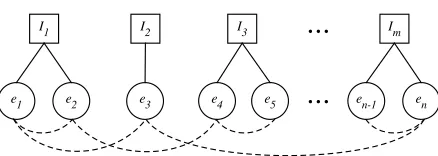
Our task is to induce a globally coherent timeline for a given article. We thus adopt a global infer-ence model for performing the task. The model consists of two components: (1) two local pairwise classifiers, one between event mentions and time in-tervals (the E–T classifier) and one between event
mentions themselves (the E–E classifier), and (2) a joint inference module that enforces global co-herency constraints on the final outputs of the two local classifiers. Fig. 2 shows a simplified temporal structure of event mentions and time intervals of an article in our model.
Our E–T classifier is different from previous work (Chambers and Jurafsky, 2008; Yoshikawa et al., 2009; Denis and Muller, 2011), where such clas-sifiers were trained to identify temporal relations be-tween event mentions and a temporalexpression. In our work, in order to construct absolute timeline of event mentions, temporal expressions are captured and normalized as absolute time intervals. TheE–T
classifiers are then used to assign event mentions to their contextually corresponding time intervals.
We also lifted several restrictions imposed in pre-vious work (Bethard et al., 2007; Yoshikawa et al., 2009; Verhagen et al., 2010). Specifically, we do not require that event mentions and time expressions have to appear in the same sentence, and we do not require two event mentions have to appear very close to each other (e.g., main event mentions in adjacent sentences) in order to be considered as candidate pairs for classification. Instead, we performed clas-sifications over all pairs of event mentions and time intervals as well as over all pairs of event mentions. We show through experiments that lifting these re-strictions is indeed important (see Sec. 5).
Another important improvement over previous work is our global inference model We would like to highlight that our work is also distinct from most previous works in the global inference component. Specifically, our global inference model jointly op-timizes the E-E relations amongst event mentions and their associations,E-T, with temporal informa-tion (intervals in our case). Previous work (Cham-bers and Jurafsky, 2008; Denis and Muller, 2011), on the other hand, assumed that theE-Tinformation is given and only tried to improveE-E.
3.1 The Pairwise Classifiers
We first describe our local classifiers that associate event mention with time interval and classify tempo-ral relations between event mentions, respectively.
e1 e2 e3 e4 e5 • • • en-1 en
[image:4.612.76.295.51.129.2]I1 I2 I3 • • • Im
Figure 2: A simplified temporal structure of an article. There aremtime intervalsI1· · ·Imandnevent mentionse1· · ·en.
A solid edge indicates an association between an interval and an event mention, whereas a dash edge illustrates a temporal relation between two event mentions.
whether the former associates with the latter.
CE−T(ei, Ij)→ {0,1},
∀i, j,1≤i≤n,1≤j≤m, (1)
where n andm are the number of event mentions and time intervals in an article, respectively.
CE−E: is the E–E classifier that identifies the temporal relation between two event mentions. Given a pair of event mentions, the classifier predicts one of the four temporal relations between them: ¯before,¯after,overlap¯ andno relation¯ . Specifically:
CE−E(ei, ej)→ {¯b,a,¯ o,¯ ¯n},
∀i, j,1≤i, j≤n, i6=j, (2)
For training of the classifiers, we define a set of features following some previous work (Bethard et al., 2007; Chambers and Jurafsky, 2008; Yoshikawa et al., 2009), together with some additional features that we believe to be helpful for the interval-based representation. We describe the base features below and use†and‡to denote the features used forCE−T andCE−E, respectively. We use the termtemporal
entity(orentity, for short) to refer to either an event mention or a time interval.
Lexical Features: A set of lexical features related to the temporal entities: (i)†‡ the word, lemma and part-of-speech of the input event mentions and the context surrounding them, where the context is de-fined as a window of 2 words before and after the mention; (ii)† the modal verbs to the left and to the right of the event mention; (iii)‡ the temporal con-nectives between the event mentions1.
1We define a list of temporal connectives includingbefore,
after,since,when,meanwhile,lately, etc.
Syntactic Features: (i)†‡ which entity appears first in the text; (ii)†‡whether the two entities appear in the same sentence; (iii)†‡the quantized number of sentences between the two entities2; (iv)†‡ whether the input event mentions are covered by preposi-tional phrases and what are the heads of the phrases; (v)†‡if the entities are in the same sentence, what is their least common constituent on the syntactic parse tree; (vi)†whether there is any other temporal entity that is closer to one of the two entities.
Semantic Features‡: A set of semantic features, mostly related to the input event mentions: (i) whether the input event mentions have a common synonym from their synsets in WordNet (Fellbaum, 1998); (ii) whether the input event mentions have a common derivational form derived from WordNet.
Linguistic Features†‡: The tense and the aspect of the input event mentions. We use an in-house rule-based recognizer to extract these features.
Time Interval Features†: A set of features re-lated to the input time interval: (i) whether the interval is implicit; (ii) if it is implicit, identify its interval type: “dct” = [t−DCT, t+DCT], “past”= (−∞, t−DCT], “feature” = [t+DCT,+∞), and “en-tire”= (−∞,+∞); (iii) the interval is before, after or overlapping with the DCT.
We note that unlike many previous work (Mani et al., 2006; Chambers and Jurafsky, 2008; Denis and Muller, 2011), our classifiers do not use any gold annotations of event attributes (event class, tense, as-pect, modal and polarity) provided in the TimeBank corpus as features.
In our work, we use a regularized averaged Per-ceptron (Freund and Schapire, 1999) as our classifi-cation algorithm3. We used the one-vs.-all scheme to transform a set of binary classifiers into a multi-class multi-classifier (for CE−E). The raw prediction scores were converted into probability distribution using the Softmax function (Bishop 1996). If there arenclasses and the raw score of classiisacti, the posterior estimation for classiis:
˜
P(i) = e acti
P
1≤j≤neactj
2
We quantize the number of sentences between two entities to0,1,2, less than5and greater than or equal to5
3.2 Joint Inference for Event Timeline
To exploit the interaction among the temporal enti-ties in an article, we optimize the predicted tempo-ral structure, formed by predictions fromCE−T and
CE−E, w.r.t. a set of global constraints that enforce coherency on the final structure. We perform exact inference using Integer Linear Programming (ILP) as in (Roth and Yih, 2007; Clarke and Lapata, 2008). We use the Gurobi Optimizer4as a solver.
Let I = {I1, I2, . . . , Im} denote the set of time intervals extracted from an article, and let E =
{e1, e2, . . . , en} denote all event mentions in the same article. Let EI = {(ei, Ij) ∈ E × I|ei ∈
E, Ij ∈ I} denote the set of all pairs of event mentions and time intervals. We also denote the set of event mention pairs by EE = {(ei, ej) ∈
E × E|ei ∈ E, ej ∈ E, i6=j}. The prediction prob-ability of an association of a pair eI ∈ EI, given by classifierCE−T, is denoted bypheI,1i5. Now, let
R={¯b,¯a,¯o,n¯}be the set of temporal relations be-tween two event mentions. The prediction proba-bility of an event mention pair ee ∈ EE that takes temporal relation r, given byCE−E, is denoted by
phee,ri. Furthermore, we definexheI,1ito be a binary
indicator variable that takes on the value 1 iff an as-sociation is predicted between eand I. Similarly, we define a binary indicator variableyhee,riof a pair
of event mentionseethat takes on the value 1 iffee
is predicted to hold the relationr.
The objective function is then defined as a linear combination of the prediction probabilities from the two local classifiers as follows:
arg max x,y
h
λ X
eI∈EI
pheI,1i·xheI,1i
+ (1−λ) X ee∈EE
X
r∈R
phee,ri·yhee,ri
i
(3)
subject to the following constraints:
xheI,1i∈ {0,1}, ∀eI∈ EI (4)
yhee,ri∈ {0,1}, ∀ee∈ EE, r∈ R (5)
X
r∈R
yhee,ri= 1, ∀ee∈ EE (6)
4http://gurobi.com/
5This value is complementary to the non-association proba-bility, denoted bypheI,0i= 1−pheI,1i
We use the single parameterλto balance the over-all contribution of two componentsE-T andE-E.
λis determined through cross validation tuning on a development set. We use (4) and (5) to make sure
xheI,1i and yhee,ri are binary values. The equality
constraint (6) ensures that exactly one particular re-lation can be assigned to each event mention pair.
In addition, we also require that each event is as-sociated with only one time interval. These con-straints are encoded as follows:
X
I∈I
xheI,1i= 1, ∀e∈ E (7)
Our model also enforces reflexivity and transitiv-ity constraints on the relations among event men-tions as follows:
yheiej,ri−yhejei,rˆi= 0,
∀eiej = (ei, ej)∈ EE, i6=j (8)
yheiej,r1i+yhejek,r2i−yheiek,r3i≤1, ∀eiej, ejek, eiek ∈ EE, i6=j6=k (9)
The equality constraints in (8) encode reflexive property of event-event relations, where the rela-tion rˆdenotes the inversion of the relation r. The set of possible (r,rˆ) pairs is defined as follows:
(¯b,¯a),(¯a,¯b),(¯o,o¯),(¯n,n¯) . Following the work of (Bramsen et al., 2006; Chambers and Jurafsky, 2008), we encode transitive closure of relations be-tween event mentions with inequality constraints in (9), which states that if the pair(ei, ej)has a certain relationr1, and the pair(ej, ek)has the relationr2,
then the relationr3must be satisfied betweeneiand
ek. Examples of such triple (r1,r2,r3) include (¯b,¯b,
¯b) and (¯a,a¯,¯a).
Finally, to capture the interactions between our local pairwise classifiers we add the following con-straints:
xheiIk,1i+xhejIl,1i−yheiej,¯bi ≤1, ∀eiIk, ejIl∈ EI,∀eiej ∈ EE,
Ik precedes Il, i6=j, k6=l (10)
time intervals. Specifically, if two event mentionsei andej are associated with two time intervalsIkand
Il respectively, and Ik precedes Il in the timeline, theneimust happen beforeej.
It is important to note that our interval-based for-mulation is more concise in terms of the number of variables and constraints needed in the ILP relative to time expression-based (or timepoint-based) for-mulations used in previous work (Chambers and Ju-rafsky, 2008). Specifically, in such timepoint-based formulations, the relation between each event men-tion and each time expression needs to be inferred, resulting in |E||T ||RT| variables, where |E|, |T |,
and|RT| are the numbers of event mentions, time
points, and temporal relations respectively. In con-trast, only |E||I| variables are required in our for-mulation, where|I|is the number of intervals (since we extract intervals explicitly, |I| is roughly equal to|T |). Furthermore, performing inference with the timepoint-based formulation would require |E||T |
equality constraints to enforce that each event men-tion can take only one relamen-tion inRT for a particular
time point, whereas our interval-based model only requires|E| constraints, since each event is strictly associated with one interval (see Eqn. (7)). We jus-tify the benefits of our formulation later in Sec. 5.4.
4 Incorporating Knowledge from Event Coreference
One of the key contributions of our work is using event coreference information to enhance the time-line construction performance. This is motivated by the following two principles:
(P1) All mentions of a unique event are associ-ated with the same time interval, and overlap with each other.
(P2)All mentions of an event have the same tem-poral relation with all mentions of another event.
The example below, extracted from an article pub-lished on03/11/2003in the Automatic Content Ex-traction (ACE), 2005, corpus6serves to illustrate the significance of event coreference to our task.
6
http://www.itl.nist.gov/iad/mig/tests/ace/2005/
The world’s most powerful fine art auction houses, Sotheby’s and Christie’s, have agreed to [e1
1 = pay] 40 million dollars to settle an international price-fixing scam, Sotheby’s said. The[e12 = pay-ment], if approved by the courts, would settle a slew of [e21 = suits] by clients over auctions held between 1993 and 2000 outside the US. ... Sotheby’s and Christie’s will each[e1
3 = pay]20 million dol-lars,” said Sotheby’s, which operates in 34 countries.
In this example, there are4event mentions, whose trigger words are highlighted in bold face. The un-derlined text gives an explicit time interval: I1 =
[1993-01-01 00:00:00, 2000-12-31 23:59:59] (we ignore 2 other intervals given by 1993 and 2000
to simplify the illustration). Now if we consider the event mentione12, it actually belongs to the im-plicit future interval I2 = [2003-03-11 23:59:59,
+∞). Nevertheless, there is a reasonable chance thatCE−T associates it withI1, given that they both
appear in the same sentence, and there is no di-rect evident feature indicating the event will actu-ally happen in the future. In such a situation, using a local classifier to identify the correct temporal as-sociation could be challenging.
Fortunately, precise knowledge from event coref-erence may help alleviate such a problem. The knowledge reveals that the 4 event mentions can be grouped into 2 distinct events: E1 = {e1
1, e12, e13},
E2 ={e21}. IfCE−T can make a strong prediction in associating the event mentione11(ore13) toI2,
in-stead of I1, the system will have a high chance to
re-assigne12toI2based on principle (P1). Similarly,
ifCE−E is effective in figuring out that some men-tion of eventE1 occursaftersome mention of E2,
then all the mentions of E1 would be predicted to occurafterall mentions inE2according to (P2).
To incorporate knowledge from event coreference into our classifiers and the joint inference model, we use the following procedure: (1) performing classi-fication withCE−T andCE−Eon the data, (2) using the knowledge from event coreference to overwrite the prediction probabilities obtained by the two lo-cal classifiers in step (1), and (3) applying the joint inference model on the new prediction probabilities obtained from (2). We note that if we stop at step (2), we get the outputs of the local classifiers enhanced by event coreference knowledge.
event coreference knowledge, we propose two ap-proaches as follows:
MaxScore: We define the probability between any mentione∈Eiand an intervalI as follows:
pheI,1i= max e0∈Ei
˜
P(e0, I) (11)
where P˜(e0, I) is the classifier (CE−T) probability for associating event mentione0to the time interval. On the other hand, the probabilities for associat-ing the set of temporal relations,R, to each pair of mentions inEi×Ej, is given by the following pair:
(ei, ej)∗ = arg max
(ei0,ej0)∈Ei×Ej,r∈R
˜
P (ei0, ej0), r)
phee,ri = P˜ (ei, ej)∗, r
,∀r ∈ R (12)
In other words, over all possible event mention pairs and relations, we first pick the pair who glob-ally obtains the highest probability for some rela-tion. Next, we simply take the probability distri-bution of that event mention pair as the distridistri-bution over the relations, for the event pair.
SumScore:The probability between any mention
e∈Eiand an intervalIis obtained by:
pheI,1i= 1
|Ei|
X
e0∈Ei
˜
P(e0, I) (13)
To obtain the probability distribution over the set of temporal relations,R, for any pair of mentions in
Ei×Ej, we used the following procedure:
r∗ = arg max r∈R
X
ei∈Ei X
ej∈Ej
˜
P (ei, ej), r
(ei, ej)∗ = arg max
(ei0,ej0)∈Ei×Ej
˜
P (ei0, ej0), r∗
phee,ri = P˜ (ei, ej)∗, r
,∀r∈ R (14)
In other words, given two groups of event men-tions, we first compute the total score of each rela-tion, and select the relation which has the highest score. Next from the list of pairs of event mentions from the two groups, we select the pair which has the relation r* with highest score compared to all other pairs. The probability distribution of this pair will be used as the probability distribution of all event mention pairs between the two events.
In both approaches, we assign the overlap rela-tions to all pairs of event menrela-tions in the same event with probability 1.0.
5 Experimental Study
We first describe the experimental data and then present and discuss the experimental results.
5.1 Data and Setup
Most previous works in temporal reasoning used the TimeBank corpus as a benchmark. The cor-pus contains a fairly diverse collection of anno-tated event mentions, without any specific focus on certain event types. According to the annotation guideline of the corpus, most of verbs, nominal-izations, adjectives, predicative clauses and preposi-tional phrases can be tagged as events. However, in practice, when performing temporal reasoning about events in a given text, one is typically interested in significant and typed events, such as Killing, Leg-islation, Election. Furthermore, event mentions in TimeBank are annotated with neither event argu-ments nor event coreference information.
We noticed that the ACE 2005 corpus contains the annotation that we are interested in. The corpus con-sists of articles annotated with event mentions (with event triggers and arguments) and event coreference information. To create an experimental data set for our work, we selected from the corpus 20 newswire articles published in March 2003. To extract time intervals from the articles, we used the time inter-val extractor described in (Zhao et al., 2012) with minimal post-processing. Implicit intervals are also added according to Sec. 2.2. We then hired an anno-tator with expertise in the field to annotate the data with the following information: (i) event mention and time interval association, and (ii) the temporal relations between event mentions, including {¯b, ¯a, ¯
Data #Intervals #E-mentions #E-T #E-E
Initial 232 324 305 376
[image:8.612.72.299.58.97.2]Saturated 232 324 324 5940
Table 1: The statistics of our experimental data set.
than a corresponding classifier in an existing work (see Sec. 5.4).
We conducted all experiments with 5-fold cross validation at the instance level on our data set after saturation. The global inference model was applied on a whole document. The results of the systems are reported in averaged precision, recall and F1 score
on the association performance, forCE−T, and the temporal relations (we excluded the n¯ relation, for
CE−E). We also measured the overall performance of the systems by computing the average of the per-formance of the classifiers.
5.2 A Baseline
We developed a baseline system that works as fol-lows. It associates an event mention with the closest time interval found in the same sentence. If such an interval is not found, the baseline associates the mention with the closest time interval to the left. If the interval is again not found, the mention will be associated with the DCT interval. The baseline is based on the intuition of natural reading order: events that are mentioned earlier are likely to pre-cede those mentioned later. For the temporal rela-tion between a pair of event menrela-tions, the baseline treats the event mention that appears earlier in the text as temporally happening before the other men-tion. The baseline performance is shown in the first group of results in Table 2.
5.3 Our Systems
For our systems, we first evaluated the performance of our local pairwise classifiers and the global in-ference model. The second group of results in Ta-ble 2 shows the systems’ performance. Overall, the results show that our global inference model relatively outperformed the baseline and the local classifiers by 57.8% and9.2% in F1, respectively.
We perform a bootstrap resampling significance test (Koehn, 2004) on the output predictions of the lo-cal classifiers with and without the inference model.
The test shows that the overall improvement with the inference model is statistically significant (p <
0.01). This indicates the effectiveness of our joint inference model with global coherence constraints.
Next, we integrated event coreference knowledge into our systems (as described in Sec. 4) and eval-uated their performance. Our experiments showed that theSumScoreapproach works better forCE−T, whileMaxScoreis more suitable forCE−E. Our ob-servations showed that event mentions of an event may appear in close proximity with multiple time intervals in the text, making CE−T produce high prediction scores for many event mention-interval pairs. This, consequently, confuses MaxScore on the best association of the event and the time inter-vals, whereasSumScoreovercomes the problem by averaging out the association scores. On the other hand, CE−E gets more benefit from MaxScore be-causeCE−Eworks better on pairs of event mentions that appear closely in the text, which activate more valuable learning features. We will report the results using the best approach of each classifier.
To evaluate our systems with event coreference knowledge, we first experimented our systems with gold event coreference as given by the ACE 2005 corpus. Table 2 shows the contribution of event coreference to our systems in the third group of the results. The results show that injecting knowledge from event coreference remarkably improved both the local classifiers and the joint inference model. Overall, the system that combined event corefer-ence and the global infercorefer-ence model achieved the best performance, which significantly overtook all other compared systems. Specifically, it outper-formed the baseline system, the local classifiers, and the joint inference model without event coreference with80%,25%, and14%of relative improvement in
F1, respectively. It also consistently outperformed
the local classifiers enhanced with event corefer-ence. We note that the precision and recall ofCE−T in the joint inference model are the same because the inference model enforced each event mention to be associated with exactly one time interval. This is also true for the systems integrated with event coreference because our integration approaches as-sign only one time interval to an event mention.
ex-Model CE−T CE−E Overall Prec. Rec. F1 Prec. Rec. F1 Prec. Rec. F1 1 Baseline 33.29 33.29 33.29 20.86 32.81 25.03 27.06 33.05 29.16
2
No Event Coref.
Local classifiers 62.70 34.50 43.29 40.46 42.42 40.96 51.58 38.46 42.13 Global inference 47.88 47.88 47.88 41.42 48.04 44.14 44.65 47.96 46.01
3
With Gold Event Coref.
Local classifiers 50.88 50.88 50.88 43.86 52.65 47.46 47.37 51.77 49.17 Global inference 50.88 50.88 50.88 48.04 62.45 54.05 49.46 56.67 52.47
4
With Learned Event Coref.
[image:9.612.91.522.52.194.2]Local classifiers 46.37 46.37 46.37 40.83 45.28 42.60 43.60 45.83 44.49 Global inference 46.37 46.37 46.37 42.09 52.50 46.47 44.23 49.44 46.42
Table 2: Performance under various evaluation settings. All figures are averaged scores from 5-fold cross-validation experiments.
periment, we re-trained the event coreference sys-tem described in Chen et al. (2009) on all arti-cles in the ACE 2005 corpus, excluding the 20 ar-ticles used in our data set. The performance of these systems are shown in the fourth group of the re-sults in Table 2. The rere-sults show that by using a learned event coreference system, we achieved the same improvement trends as with gold event coref-erence. However, we did not obtain significant im-provement when comparing with global inference without event coreference information. This result shows that the performance of an event coreference system can have a significant impact on the over-all performance. While this suggests that a better event coreference system could potentially help the task more, it also opens the question whether event coreference can be benefited from our local classi-fiers through the use of a joint inference framework. We would like to leave this for future investigations.
5.4 Previous Work-Related Experiments
We also performed experiments using the same set-ting as in (Yoshikawa et al., 2009), which followed the guidelines of the TempEval challenges (Verha-gen et al., 2007; Verha(Verha-gen et al., 2010), on our sat-urated data. Several assumptions were made to sim-plify the task. For example, only main events in adjacent sentences are considered when identifying event-event relations. See (Yoshikawa et al., 2009) for more details. We performed 5-fold cross valida-tion without event coreference. Overall, the system achieved29.99F1for the local classifiers and34.69
when the global inference is used. These results are better than the baseline but underperform our full models where those simplification assumptions are
not imposed, as shown in Table 2, indicating the im-portance of relaxing their assumptions in practice.
We also evaluated our CE−E on the TimeBank corpus. We followed the settings of Chambers and Jurafsky (2008) to extract all event mention pairs that were annotated withbefore(oribefore, “imme-diately before”) andafter(oriafter) relations in183 news articles in the corpus. We trained and evalu-ated ourCE−Eon these examples with the same fea-ture set that we evaluated in our experiments above, with gold tense and aspect features but without event type. Following their work, we performed 10-fold cross validation. Our classifier achieved a micro-averaged accuracy of 73.45%, whereas Chambers and Jurafsky (2008) reported 66.8%. We next in-jected the knowledge of an event coreference sys-tem trained on the ACE2005 corpus into ourCE−E, and obtained a micro-averaged accuracy of73.39%. It was not surprising that event coreference did not help in this dataset because: (i) different domains – the event coreference was trained on ACE 05 but applied on TimeBank, and (ii) different annotation guidelines on events in ACE 2005 and TimeBank.
the relation between a time point and an event men-tion takes exactly one value. Proper changes were also made to other constraints in (10) to reflect the fact that time points are considered rather than inter-vals. We observed that experiment with such a for-mulation was unable to finish within 5 hours (we ter-minated the ILP inference after waiting for 5 hours), whereas our interval-based model finished the ex-periment with an average of21seconds per article.
6 Related Work
Research in temporal reasoning recently received much attention. Allen (1983) introduced an interval based temporal logic which has been used widely in the field. Recent efforts in building an annotated temporal corpus (Pustejovsky et al., 2003) has pop-ularized the use of machine learning techniques for the task (Mani et al., 2006; Bethard et al., 2007). This corpus was later used (with simplifications) in two TempEval challenges (Verhagen et al., 2007; Verhagen et al., 2010). In these challenges, several temporal-related tasks were defined including the tasks of identifying the temporal relation between an event mention and a temporal expression in the same sentence, and recognizing temporal relations of pairs of event mentions in adjacent sentences. However, with several restrictions imposed to these tasks, the developed systems were not practical.
Recently, there has been much work attempting to leverage Allen’s interval algebra of temporal re-lations to enforce global constraints on local pre-dictions. The work of Tatu and Srikanth (2008) used global relational constraints to not only expand the training data but also identifies temporal incon-sistencies to improve local classifiers. They used greedy search to select the most appropriate config-uration of temporal relations among events and tem-poral expressions. For exact inferences, Bramsen et al. (2006), Chambers and Jurafsky (2008), Denis and Muller (2011), and Talukdar et al. (2012) for-mulated the temporal reasoning problem in an ILP. However, the inference models in their work were not a joint model involving multiple local classifiers but only one local classifier was involved in their ob-jective functions.
The work of Yoshikawa et al. (2009) did formu-late a joint inference model with Markov Logic
Net-work (MLN). They, however, used the same setting as the TempEval challenges, thus only pairs of tem-poral entities in the same or adjacent sentences are considered. Our work, on the other hand, focuses on constructing an event timeline with time intervals, taking multiple local pairwise predictions into a joint inference model and removing the restrictions on the positions of the temporal entities. Furthermore, we propose for the first time to use event coreference and evaluate the importance of its role in the task of event timeline construction.
7 Conclusions and Future Work
We proposed an interval-based representation of the timeline of event mentions in an article. Our rep-resentation allowed us to formalize the joint infer-ence model that can be solved efficiently, compared to a time point-based inference model, thus open-ing up the possibility of buildopen-ing more practical event temporal inference systems. Our inference model achieved significant improvement over the lo-cal classifiers. We also showed that event coref-erence can naturally support timeline construction, and good event coreference led to significant im-provement in the system performance. Specifically, when such gold event coreference knowledge was injected into the model, a significant improvement in the overall performance could be obtained. While our experiments suggest that the temporal classi-fiers can potentially help enhance the performance of event coreference, in future work we would like to investigate into coupling event coreference with other components in a global inference framework.
Acknowledgments
References
James F. Allen. 1983. Maintaining knowledge about temporal intervals.Communications of the ACM. Steven Bethard, James H. Martin, and Sara Klingenstein.
2007. Timelines from text: Identification of syntactic temporal relations. InICSC.
P. Bramsen, P. Deshpande, Y. K. Lee, and R. Barzilay. 2006. Inducing temporal graphs. InEMNLP.
N. Chambers and D. Jurafsky. 2008. Jointly combin-ing implicit constraints improves temporal ordercombin-ing. InEMNLP.
Zheng Chen, Heng Ji, and Robert Haralick. 2009. A pairwise event coreference model, feature impact and evaluation for event coreference resolution. In Work-shop on Events in Emerging Text Types.
J. Clarke and M. Lapata. 2008. Global inference for sentence compression: An integer linear programming approach.Journal of Artificial Intelligence Research. Pascal Denis and Philippe Muller. 2011. Predicting
globally-coherent temporal structures from texts via endpoint inference and graph decomposition. In IJ-CAI.
C. Fellbaum. 1998. WordNet: An Electronic Lexical Database. MIT Press.
Yoav Freund and Robert E. Schapire. 1999. Large mar-gin classification using the perceptron algorithm. Ma-chine Learning.
Philipp Koehn. 2004. Statistical significance tests for machine translation evaluation. InEMNLP.
Inderjeet Mani, Marc Verhagen, Ben Wellner, Chong Min Lee, and James Pustejovsky. 2006. Machine learning of temporal relations. InACL.
J. Pustejovsky, P. Hanks, R. Sauri, A. See, R. Gaizauskas, A. Setzer, D. Radev, B. Sundheim, D. Day, L. Ferro, and M. Lazo. 2003. The TIMEBANK corpus. In Corpus Linguistics.
D. Roth and W. Yih. 2007. Global inference for entity and relation identification via a linear programming formulation. InIntroduction to Statistical Relational Learning.
Partha Pratim Talukdar, Derry Wijaya, and Tom Mitchell. 2012. Coupled temporal scoping of relational facts. In WSDM.
Marta Tatu and Munirathnam Srikanth. 2008. Experi-ments with reasoning for temporal relations between events. InCOLING.
Marc Verhagen, Robert Gaizauskas, Frank Schilder, Mark Hepple, Graham Katz, and James Pustejovsky. 2007. Semeval-2007 task 15: Tempeval temporal re-lation identification. InSemEval-2007.
Marc Verhagen, Roser Sauri, Tommaso Caselli, and James Pustejovsky. 2010. Semeval-2010 task 13: Tempeval-2. InSemEval-2010.
Katsumasa Yoshikawa, Sebastian Riedel, Masayuki Asa-hara, and Yuji Matsumoto. 2009. Jointly identify-ing temporal relations with markov logic. In ACL-IJCNLP.