Dynamic Programming for Higher Order Parsing of Gap-Minding Trees
Emily Pitler, Sampath Kannan, Mitchell Marcus Computer and Information Science
University of Pennsylvania Philadelphia, PA 19104
epitler,kannan,[email protected]
Abstract
We introduce gap inheritance, a new struc-tural property on trees, which provides a way to quantify the degree to which intervals of de-scendants can be nested. Based on this prop-erty, two new classes of trees are derived that provide a closer approximation to the set of plausible natural language dependency trees than some alternative classes of trees: unlike projective trees, a word can have descendants in more than one interval; unlike spanning trees, these intervals cannot be nested in ar-bitrary ways. The1-Inheritclass of trees has
exactlythe same empirical coverage of natural language sentences as the class of mildly non-projective trees, yet the optimal scoring tree can be found in an order of magnitude less time. Gap-minding trees (the second class) have the property that all edges into an interval of descendants come from the same node, and thus an algorithm which uses only single in-tervals can produce trees in which a node has descendants in multiple intervals.
1 Introduction
Dependency parsers vary in what space of possi-ble tree structures they search over when parsing a sentence. One commonly used space is the set of projective trees, in which every node’s descen-dants form a contiguous interval in the input sen-tence. Finding the optimal tree in the set of projec-tive trees can be done efficiently (Eisner, 2000), even when the score of a tree depends on higher order fac-tors (McDonald and Pereira, 2006; Carreras, 2007; Koo and Collins, 2010). However, the projectivity assumption is too strict for all natural language de-pendency trees; for example, only 63.6% of Dutch
sentences from the CoNLL-X training set are pro-jective (Table 1).
At the other end of the spectrum, some parsers search over allspanning trees, a class of structures much larger than the set of plausible linguistic struc-tures. The maximum scoring directed spanning tree can be found efficiently when the score of a tree de-pends only on edge-based factors (McDonald et al., 2005b). However, it is NP-hard to extend MST to in-clude sibling or grandparent factors (McDonald and Pereira, 2006; McDonald and Satta, 2007). MST-based non-projective parsers that use higher order factors (Martins et al., 2009; Koo et al., 2010), uti-lize different techniques than the basic MST algo-rithm. In addition, learning is done over a relaxation of the problem, so the inference procedures at train-ing and at test time are not identical.
We propose two new classes of trees between pro-jective trees and the set of all spanning trees. These two classes provide a closer approximation to the set of plausible natural language dependency trees: un-like projective trees, a word can have descendants in more than one interval; unlike spanning trees, these intervals cannot be nested in arbitrary ways. We in-troduce gap inheritance, a new structural property on trees, which provides a way to quantify the de-gree to which these intervals can be nested. Differ-ent levels of gap inheritance define each of these two classes (Section 3).
The1-Inheritclass of trees (Section 4) hasexactly the same empirical coverage (Table 1) of natural lan-guage sentences as the class ofmildly non-projective trees(Bodirsky et al., 2005), yet the optimal scoring tree can be found in an order of magnitude less time (Section 4.1).
Gap-minding trees (the second class) have the
property that all edges into an interval of descen-dants come from the same node. Non-contiguous intervals are therefore decoupled given this single node, and thus an algorithm which uses only single intervals (as in projective parsing) can produce trees in which a node has descendants in multiple inter-vals (as in mildly non-projective parsing (G´omez-Rodr´ıguez et al., 2011)). A procedure for finding the optimal scoring tree in this space is given in Sec-tion 5, which can be searched in yet another order of magnitude faster than the1-Inheritclass.
Unlike the class of spanning trees, it is still tractable to find the optimal tree in these new spaces when higher order factors are included. An exten-sion which finds the optimal scoring gap-minding tree with scores over pairs of adjacent edges (grand-parent scoring) is given in Section 6. These gap-minding algorithms have been implemented in prac-tice and empirical results are presented in Section 7.
2 Preliminaries
In this section, we review some relevant defini-tions from previous work that characterize degrees of non-projectivity. We also review how well these definitions cover empirical data from six lan-guages: Arabic, Czech, Danish, Dutch, Portuguese, and Swedish. These are the six languages whose CoNLL-X shared task data are either available open source1or from the LDC2.
Adependency treeis a rooted, directed spanning tree that represents a set of dependencies between words in a sentence.3 The tree has one artificial root node and vertices that correspond to the words in an input sentencew1,w2,...,wn. There is an edge from
htomifmdepends on (or modifies)h.
Definition 1. Theprojectionof a node is the set of words in the subtree rooted at it (including itself).
A tree is projectiveif, for every node in the tree, that node’s projection forms a contiguous interval in the input sentence order.
A tree isnon-projectiveif the above does not hold, i.e., there exists at least one word whose descendants
1http://ilk.uvt.nl/conll/free_data.html 2
LDC catalogue numbers LDC2006E01 and LDC2006E02
3
Trees are a reasonable assumption for most, but not all, linguistic structures. Parasitic gaps are an example in which a word perhaps should have multiple parents.
do not form a contiguous interval.
Definition 2. Agapof a nodevis a non-empty, max-imal interval that does not contain any words in the projection of v but lies between words that are in the projection of v. The gap degree of a node is the number of gaps it has. Thegap degree of a tree is the maximum of the gap degrees of its vertices. (Bodirsky et al., 2005)
Note that a projective tree will have gap degree 0. Two subtreesinterleaveif there are verticesl1,r1
from one subtree andl2,r2 from the other such that
l1< l2 < r1< r2.
Definition 3. A tree iswell-nestedif no twodisjoint subtrees interleave (Bodirsky et al., 2005).
Definition 4. A mildly non-projectivetree has gap degree at most one and is well-nested.
Mildly non-projective trees are of both theoret-ical and practtheoret-ical interest, as they correspond to derivations in Lexicalized Tree Adjoining Grammar (Bodirsky et al., 2005) and cover the overwhelming majority of sentences found in treebanks for Czech and Danish (Kuhlmann and Nivre, 2006).
Table 1 shows the proportion of mildly non-projective sentences for Arabic, Czech, Danish, Dutch, Portuguese, and Swedish, ranging from 95.4% of Portuguese sentences to 99.9% of Ara-bic sentences.4 This definition covers a substan-tially larger set of sentences than projectivity does — an assumption of projectivity covers only 63.6% (Dutch) to 90.2% (Swedish) of examples (Table 1).
3 Gap Inheritance
Empirically, natural language sentences seem to be mostly mildly projective trees, but mildly non-projective trees are quite expensive to parse (O(n7)
(G´omez-Rodr´ıguez et al., 2011)). The parsing com-plexity comes from the fact that the definition al-lows two non-contiguous intervals of a projection to be tightly coupled, with an unbounded number of edges passing back and forth between the two inter-vals; however, this type of structure seems unusual
4
Arabic Czech Danish Dutch Portuguese Swedish Parsing Mildly non-proj 1458 (99.9) 72321 (99.5) 5175 (99.7) 12896 (96.6) 8650 (95.4) 10955 (99.2) O(n7)
Mild+1-Inherit 1458 (99.9) 72321 (99.5) 5175 (99.7) 12896 (96.6) 8650 (95.4) 10955 (99.2) O(n6) Mild+0-Inherit 1394 (95.5) 70695 (97.2) 4985 (96.1) 12068 (90.4) 8481 (93.5) 10787 (97.7) O(n5)
Projective 1297 (88.8) 55872 (76.8) 4379 (84.4) 8484 (63.6) 7353 (81.1) 9963 (90.2) O(n3)
[image:3.612.66.549.56.129.2]# Sentences 1460 72703 5190 13349 9071 11042
Table 1: The number of sentences from the CoNLL-X training sets whose parse trees fall into each of the above classes. The two new classes of structures,Mild+0-InheritandMild+1-Inherit, have more coverage of empirical data than projective structures, yet can be parsed faster than mildly non-projective structures. Parsing times assume an edge-based factorization with no pruning of edges. The corresponding algorithms for Mild+1-Inherit and Mild+0-Inherit are in Sections 4 and 5.
for natural language. We therefore investigate if we can define further structural properties that are both appropriate for describing natural language trees and which admit more efficient parsing algorithms.
Let us first consider an example of a tree which both has gap degree at most one and satisfies well-nestedness, yet appears to be an unrealistic struc-ture for a natural language syntactic tree. Consider a tree which is rooted at nodexn+2, which has one
child, nodexn+1, whose projection is [x1, xn+1]∪
[xn+3, x2n+2], withnchildren (x1, ...,xn), and each child xi has a child at x2n−i+3. This tree is
well-nested, has gap degree 1, but allnofxn+1’s children
have edges into the other projection interval. We introduce a further structural restriction in this section, and show that trees satisfying our new prop-erty can be parsed more efficiently with no drop in empirical coverage.
Definition 5. A child is gap inheritingif its parent has gap degree 1 and it has descendants on both sides of its parent’s gap. Theinheritance degree of a nodeis the number of its children which inherit its gap. Theinheritance degree of a treeis the maximum inheritance degree over all its nodes.
Figure 1 gives examples of trees with varying de-grees of gap inheritance. Each projection of a node with a gap is shown with two matching rectangles. If a child has a projection rectangle nested inside each of the parent’s projection rectangles, then that child inherits the parent’s gap. Figure 1(a) shows a mildly projective tree (with inheritance degree 2), with both node 2 and node 11 inheriting their parent (node 3)’s gap (note that both the dashed and dotted rectangles each show up inside both of the solid rectangles). Figure 1(b) shows a tree with inheritance degree 1:
there is now only one pair of rectangles (the dot-ted ones) which show up in both of the solid ones. Figure 1(c) shows a tree with inheritance degree 0: while there are gaps, each set of matching rectangles is contained within a single rectangle (projection in-terval) of its parent, i.e., the two dashed rectangles of node 2’s projection are contained within the left interval of node 3; the two dotted rectangles of node 12’s projection are contained within the right inter-val of node 3, etc.
We now ask:
1. How often does gap inheritance occur in the parses of natural language sentences found in treebanks?
2. Furthermore, how often are theremultiplegap inheriting children of the same node (inheri-tance degree at least two)?
Table 1 shows what proportion of mildly non-projective trees have the added property of gap heritance degree 0 (Mild+0-Inherit) or have gap in-heritance degree 1 (Mild+1-Inherit). Over all six languages, there are no examples of multiple gap inheritance — Mild+1-Inherit has exactly the same empirical coverage as the unrestricted set of mildly non-projective trees.
4 Mild+1-Inherit Trees
6
2 3
4
1 5 7 11 12
13 9
8 10
(a) Mildly Non-Projective: The projec-tions (set of descendants) of both node 2 (the dashed red rectangles) and node 11 (dotted magenta) appear in both of node 3’s intervals (the solid blue rectangles).
6
2 3
4
1 5 7 11 12
13 9
8 10
(b) Mild+1-Inherit: Only node 2 inherits node 3’s gap: the dashed red rectangles appear in each of the two solid blue rect-angles.
6
2 3
4
1 5 7 11 12
13 9
8 10
(c) Mild+0-Inherit: Even though node 3 has children with gaps (node 2 and node 12), neither of them inherit node 3’s gap. There are several nodes with gaps, but every node with a gap is properly con-tained within just one of its parent’s in-tervals.
Figure 1: Rectangles that match in color and style indicate the two projection intervals of a node, separated by a gap. In all three trees, node 3’s two projection intervals are shown in the two solid blue rectangles. The number of children which inherit its gap vary, however; in 1(a), two children have descendants within both sides; in 1(b) only one child has descendants on both sides; in 1(c), none of its children do.
subtrees (constituents). One of the fundamental as-sumptions of syntactic theory is that movement is upward in the phrase structure tree.5
Consider one movement operation and its effect on the gap degree of all other nodes in the tree: (a) it should have no effect on the gap degree of the nodes in the subtree itself, (b) it can create a gap for an an-cestor node if it movesoutof its projection interval, and (c) it can create a gap for a non-ancestor node if it moves in to its projection interval. Now con-sider which cases can lead to gap inheritance: in case (b), there is a single path from the ancestor to the root of the subtree, so the parent of the subtree will have no gap inheritance and any higher ancestors will have a single child inherit the gap created by this movement. In case (c), it is possible for there to be multiple children that inherit this newly created gap if multiple children had descendents on both sides. However, the assumption of upward movement in the phrase structure tree should rule out movement into the projection interval of a non-ancestor. There-fore, under these syntactic assumptions, we would expect at most one child to inherit a parent’s gap.
5The Proper Binding Condition (Fiengo, 1977) asserts that a
moved element leaves behind atrace(unpronounced element), which must bec-commanded (Reinhart, 1976) by the corre-sponding pronounced material in its final location. Informally, c-commanded means that the first node is descended from the lowest ancestor of the other that has more than one child.
4.1 Parsing Mild+1-Inherit Trees
Finding the optimal Mild+1-Inherit tree can be done by bottom-up constructing the tree for each node and its descendants. We can maintain subtrees with two intervals (two endpoints each) and one root (O(n5)
space). Consider the most complicated possible case: a parent that has a gap, a (single) child which inherits the gap, and additional children. An exam-ple of this is seen with the parent node 3 in Figure 1(b).
This subtree can be constructed by first starting with the child spanning the gap, updating its root index to be the parent, and then expanding the inter-val indices to the left and right to include the other children. In each case, only one index needs to be updated at a time, so the optimal tree can be found inO(n6)time. In the Figure 1(b) example, the sub-tree rooted at3 would be built by starting with the intervals[1,2]∪[12,13]rooted at2, first adding the edge from2to3(so the root is updated to3), then adding an edge from3to4to extend the left inter-val to[1,5], and then adding an edge from3to11to extend the right interval to[8,13]. The subtree cor-responds to the completed item[1,5]∪[8,13]rooted at3.
This procedure corresponds to G´omez-Rodr´ıguez et al. (2011)’s O(n7) algorithm for parsing mildly
more than one child inheriting its gap.
This is also similar in spirit to the algorithm de-scribed in Satta and Schuler (1998) for parsing a restricted version of TAG, in which there are some limitations on adjunction operations into the spines of trees.6That algorithm has similar steps and items, with the root portion of the item replaced with a node in a phrase structure tree (which may be a non-terminal).
5 Gap-minding Trees
The algorithm in the previous section used O(n5)
space and O(n6) time. While more efficient than parsing in the space of mildly projective trees, this is still probably not practically implementable. Part of the difficulty lies in the fact that gap inheritance causes the two non-contiguous projection intervals to be coupled.
Definition 6. A tree is calledgap-minding7if it has gap degree at most one, is well-nested, and has gap inheritance degree 0.
Gap-minding trees still have good empirical cov-erage (between 90.4% for Dutch and 97.7% for Swedish). We now turn to the parsing of gap-minding trees and show how a few consequences of its definition allow us to use items ranging over only oneinterval.
In Figure 1(c), notice how each rectangle has edges incoming fromexactly onenode. This is not unique to this example; all projection intervals in a gap-minding tree have incoming edges from exactly one node outside the interval.
Claim 1. Within a gap-minding tree, consider any node n with a gap (i.e., n’s projection forms two non-contiguous intervals [xi, xj]∪[xk, xl]). Letp be the parent ofn.
1. For each of the intervals ofn’s projection:
(a) If the interval contains n, the only edge incoming to that interval is frompton.
6That algorithm has a running time ofO(Gn5
), where as writtenGwould likely add a factor ofn2
with bilexical selec-tional preferences; this can be lowered tonusing the same tech-nique as in Eisner and Satta (2000) for non-restricted TAG.
7The terminology is a nod to the London Underground but
imagines parents admonishing children to mind the gap.
(b) If the interval does not containn, all edges incoming to that interval come fromn.
2. For the gap interval ([xj+1, xk−1]):
(a) If the interval contains p, then the only edge incoming is fromp’s parent top
(b) If the interval does not containp, then all edges incoming to that interval come from
p.
As a consequence of the above,[xi, xj]∪ {n}forms a gap-minding tree rooted at n, [xk, xl] ∪ {n} also forms a gap-minding tree rooted at n, and
[xj+1, xk−1]∪ {p}forms a gap-minding tree rooted
atp.
Proof. (Part 1): Assume there was a directed edge
(x, y)such thatyis inside a projection interval ofn
andxis not inside the same interval, andx6=y6=n.
yis a descendant ofnsince it is contained inn’s pro-jection. Since there is a directed edge fromxtoy,
x is y’s parent, and thus x must also be a descen-dant ofnand therefore in another ofn’s projection intervals. Since x andy are in different intervals, then whichever child ofnthatxandyare descended from would have inheritedn’s gap, leading to a con-tradiction.
(Part 2): First, suppose there existed a set of nodes inn’s gap which were not descended fromp. Then
phas a gap over these nodes. (pclearly has dants on each side of the gap, because all descen-dants ofnare also descendants ofp). n, p’s child, would then have descendants on both sides of p’s gap, which would violate the property of no gap in-heritance. It is also not possible for there to be edges incoming from other descendants of p outside the gap, as that would imply another child of p being ill-nested with respect ton.
From the above, we can build gap-minding trees using only single intervals, potentially with a sin-gle node outside of the interval. Our objective is to find the maximum scoring gap-minding tree, in which the score of a tree is the sum of the scores of its edges. LetScore(p,x)indicate the score of the directed edge fromptox.
1. C[i,j,p]: The maximum score of any gap-minding tree, rooted atp, with vertices[i, j]∪ {p}(pmay or may not be within[i, j]).
This improves our space requirement, but not nec-essarily the time requirement. For example, if we built up the subtree in Figure 1(c) by concatenating the three intervals[1,5]rooted at3,[6,7]rooted at6, and[8,13]rooted at3, and add the edge6 →3, we would still need 6 indices to describe this operation (the four interval endpoints and the two roots), and so we have not yet improved the running time over theInherit-1case.
By part 2, we can concatenate one interval of a child with its gap, knowing that the gap is entirely descended from the child’s parent, and forget the concatenation split point between the parent’s other descendants and this side of the child. This allows us to substitute all operations involving 6 indices with two operations involving just 5 indices. For exam-ple, in Figure 1(c), we could first merge[6,7]rooted at 6 with [8,13] rooted at 3 to create an interval
[6,13]and say that it is descended from6, with the rightmost side descended from its child3. That step required 5 indices. The following step would merge this concatenated interval ([6,13]rooted at6and3) with[1,5]rooted at3. This step also requires only 5 indices.
Our helper subtype we make use of is then:
2. D[i,j,p,x,b]: The maximum score of any set of two gap-minding trees, one rooted atp, one rooted at x, with vertices [i, j]∪ {p, x} (x /∈
[i, j], pmay or may not be in [i, j]), such that for somek, vertices[i, k]are in the tree rooted at p if b = true (and at x if b = false), and vertices[k+ 1, j]are in the tree rooted atx(p).
Consider an optimum scoring gap-minding treeT
rooted atpwith verticesV = [i, j]∪ {p}and edges
E, whereE 6=∅. The form of the dynamic program may depend on whether:
• pis within(i, j)(I)or external to[i, j](E)8
8In the discussion we will assume thatp 6= iandp 6= j,
since any optimum solution withV = [i, j]∪ {i}and a root atiwill be equivalent toV = [i+ 1, j]∪ {i}rooted ati(and similarly forp=j).
We can exhaustively enumerate all possibilities for
T by considering all valid combinations of the fol-lowing binary cases:
• phas a single child(S)or multiple children(M)
• iandjare descended from the same child ofp (C)or different children ofp(D)
Note that case(S/D) is not possible: iandjcannot be descended from different children of p if p has only a single child. We therefore need to find the maximum scoring tree over the three cases ofS/C,
M/C, andM/D.
Claim 2. Let T be the optimum scoring gap-minding tree rooted atp with verticesV = [i, j]∪ {p}. Then T and its score are derived from one of the following:
S/C Ifphas a single childxinT, then ifp ∈(i, j)
(I),T’s score isScore(p,x) +C[i,p−1,x] +
C[p+1,j,x]; if p /∈ [i, j] (E), T’s score is
Score(p,x) +C[i,j,x].
M/C If p has multiple children in T and i and j
are descended from the same childxinT, then there is a split pointk such thatT’s score is:
Score(p,x)+C[i,k,x]+D[k+1,j,p,x,T]
if x is on the left side of its own gap, and
T’s score is: Score(p,x) + C[k,j,x] +
D[i,k−1,p,x,F]ifxis on the right side.
M/D If p has multiple children in T and i and j
are descended from different children inT, then there is a split point k such that T’s score is
C[i,k,p] +C[k+1,j,p].
T has the maximum score over each of the above cases, for all valid choices ofxandk.
Proof. Case S/C: If p has exactly one child x, then the tree can be decomposed into the edge from p to x and the subtree rooted at x. If p
is outside the interval, then the maximum scor-ing such tree is clearly Score(p,x) + C[i,j,x]. If p is inside, then x has a gap across p, and so using Claim 1, the maximum scoring tree rooted at p with a single child x has score of
Score(p,x) +C[i,p−1,x] +C[p+1,j,x].
the childxhas to have gap degree 1. x itself is on either the left or right side of its gap. For the mo-ment, assume xis in the left interval. By Claim 1, we can split up the score of the tree as the score of the edge fromptox(Score(p,x)), the score of the subtree corresponding to the projection of x to the left of its gap (C[i,k,x]), and the score of the sub-trees rooted atpwith its remaining children and the subtree rooted at x corresponding to the right side ofx’s projection (D[k+1,j,p,x,T]). The case in whichxis on the right side of its gap is symmetric.
Case M/D: If there are multiple children and the endpoints are descended from different children of
p, then there must exist a split point k that parti-tions the children ofpinto two non-empty sets, such that each child’s projection is either entirely on the left or entirely on the right of the split point. We show one such split point to demonstrate that there always exists at least one. Let x be the child of p
thati is descended from, and let xl andxr be x’s leftmost and right descendants, respectively.9 Con-sider all the children ofp (whose projections taken together partition [i, j]− {p}). No child can have descendants both to the left of xr and to the right ofxr, because otherwise that child andxwould be ill-nested. Therefore we can split up the interval at
xr to have two gap-minding trees, both rooted atp. The score ofT is then the sum of the scores of the best subtree rooted at p over [i, k] (C[i,k,p]) and the score of the best subtree rooted atpover[k+1, j]
(C[k+1,j,p]).
The above cases cover all non-empty gap-minding trees, so the maximum will be found.
Using Claim 2 to Devise an AlgorithmThe above claim showed that any problem of type C can be decomposed into subproblems of types C and D. From the definition ofD, any problem of typeDcan clearly be decomposed into two problems of typeC
— simply split the interval at the split point known to exist and assignporx as the roots for each side of the interval, as prescribed by the booleanb:
D(i,j,p,x,T) =maxkC[i,k,p] +C[k+1,j,x]
D(i,j,p,x,F) =maxkC[i,k,x] +C[k+1,j,p]
9Note thatx
l=iby construction, andxr6=j(because the endpoints are descended from different children).
Algorithm 1 makes direct use of the above claims. Note that in every gap-minding tree referred to in the cases above, all vertices that were not the root formed a single interval. Algorithm 1 builds up trees in increasing sizes of [i, j]∪ {p}. The tree in C[i,j,p] corresponds to the maximum of four subroutines: SingleChild (S/C), EndpointsDiff (M/D), EndsFromLeftChild (M/C), and EndsFrom-RightChild (M/C). TheDsubproblems are filled in with the subroutine Max2Subtrees, which uses the above discussion. The maximum score of any gap-minding tree is then found inC[1,n,0], and the tree itself can be found using backpointers.
5.1 Runtime analysis
If the input is assumed to be the complete graph (any word can have any other word as its parent), then the above algorithm takes O(n5) time. The most expensive steps areM/C, which takeO(n2)time to fill in each of theO(n3) Ccells. and solving aD
subproblem, which takesO(n) time on each of the
O(n4)possible such problems.
Pruning: In practice, the set of edges considered (m) is not necessarily O(n2). Many edges can be
ruled out beforehand, either based on the distance in the sentence between the two words (Eisner and Smith, 2010), the predictions of a local ranker (Mar-tins et al., 2009), or the marginals computed from a simpler parsing model (Carreras et al., 2008).
If we choose a pruning strategy such that each word has at most k potential parents (incoming edges), then the running time drops toO(kn4). The five indices in anM/Cstep were: i,j,k,p, andx. As there must be an edge fromptox, andxonly has
kpossible parents, there are now onlyO(kn4)valid such combinations. Similarly, each D subproblem (which ranges overi, j, k, p, x) may only come into existence because of an edge fromptox, so again the runtime of these such steps drops toO(kn4).
6 Extension to Grandparent Factorizations
directed edges in the tree. LetScore(g,p,c) indi-cate the score of this grandparent-parent-child triple. We now show how to extend the above algorithm to find the maximum scoring gap-minding tree with grandparent scoring.
Our two subproblems are now C[i,j,p,g] and
D[i,j,p,x,b,g]; each subproblem has been aug-mented with an additional grandparent index g, which has the meaning thatgisp’s parent. Note that
gmust be outside of the interval[i, j](if it were not, a cycle would be introduced). Edge scores are now computed over(g, p, x)triples. In particular, claim 2 is modified:
Claim 3. Let T be the optimum scoring gap-minding tree rooted atpwith verticesV = [i, j]∪ {p}, wherep ∈ (i, j)(I), with a grandparent index
g (g /∈ V). ThenT and its score are derived from one of the following:
S/C If p has a single child x in T, then if
p ∈ (i, j) (I), T’s score is Score(g,p,x) +
C[i,p−1,x,p]+C[p+1,j,x,p]; ifp /∈[i, j]
(E),T’s score isScore(g,p,x) +C[i,j,x,p].
M/C If p has multiple children in T and i
and j are descended from the same child
x in T, then there is a split point k
such that T’s score is: Score(g,p,x) +
C[i,k,x,p] + D[k+1,j,p,x,T,g] if x is on the left side of its own gap, and T’s score is: Score(g,p,x) + C[k,j,x,p] +
D[i,k−1,p,x,F,g]ifxis on the right side.
M/D If p has multiple children in T and i and j
are descended from different children inT, then there is a split point k such that T’s score is
C[i,k,p,g] +C[k+1,j,p,g].
T has the maximum score over each of the above cases, for all valid choices ofxandk.
Note that for subproblems rooted at p, g is the grandparent index, while for subproblems rooted at
x, pis the updated grandparent index. TheD sub-problems with the grandparent index are shown be-low:
D(i,j,p,x,T,g) =maxkC[i,k,p,g] +C[k+1,j,x,p]
D(i,j,p,x,F,g) =maxkC[i,k,x,p] +C[k+1,j,p,g]
We have added another index which ranges over
n, so without pruning, we have now increased the running time toO(n6). However, every step now
in-cludes both agand ap(and often anx), so there is at least one implied edge in every step. If pruning is done in such a way that each word has at mostk
parents, then each word’s set of grandparent and par-ent possibilities is at mostk2. To run all of theS/C
steps, we therefore needO(k2n3)time; for all of the M/Csteps,O(k2n4)time; for all of theM/Dsteps,
O(kn4); for all of theDsubproblems,O(k2n4). The overall running time is therefore O(k2n4), and we
have shown that when edges are sufficiently pruned, grandparent factors add only an extra factor ofk, and not a full extra factor ofn.
7 Experiments
The space of projective trees is strictly contained within the space of gap-minding trees which is strictly contained within spanning trees. Which space is most appropriate for natural language pars-ing may depend on the particular language and the type and frequencies of non-projective structures found in it. In this section we compare the parsing accuracy across languages for a parser which uses either the Eisner algorithm (projective), MST (span-ning trees), or MaxGapMindingTree (gap-minding trees) as its decoder for both training and inference. We implemented both the basic gap-minding al-gorithm and the gap-minding alal-gorithm with grand-parent scoring as extensions to MSTParser10. MST-Parser (McDonald et al., 2005b; McDonald et al., 2005a) uses the Margin Infused Relaxed Algo-rithm (Crammer and Singer, 2003) for discrimina-tive training. Training requires a decoder which produces the highest scoring tree (in the space of valid trees) under the current model weights. This same decoder is then used to produce parses at test time. MSTParser comes packaged with the Eis-ner algorithm (for projective trees) and MST (for spanning trees). MSTParser also includes two sec-ond order models: one of which is a projective de-coder that also scores siblings (Proj+Sib) and the other of which produces non-projective trees by re-arranging edges after producing a projective tree (Proj+Sib+Rearr). We add a further decoder with
10
the algorithm presented here for gap minding trees, and plan to make the extension publicly available. The gap-minding decoder has both an edge-factored implementation and a version which scores grand-parents as well.11
The gap-minding algorithm is much more effi-cient when edges have been pruned so that each word has at most k potential parents. We use the weights from the trained MST models combined with the Matrix Tree Theorem (Smith and Smith, 2007; Koo et al., 2007; McDonald and Satta, 2007) to produce marginal probabilities of each edge. We wanted to be able to both achieve the running time bound and yet take advantage of the fact that the size of the set of reasonable parent choices is vari-able. We therefore use a hybrid pruning strategy: each word’s set of potential parents is thesmallerof a) the topkparents (we chosek= 10) or b) the set of parents whose probabilities are above a thresh-old (we chose th = .001). The running time for the gap-minding algorithm is thenO(kn4); with the grandparent features the gap-minding running time isO(k2n4).
The training and test sets for the six languages come from the CoNLL-X shared task.12 We train the gap-minding algorithm on sentences of length at most 10013(the vast majority of sentences). The projective and MST models are trained on all sen-tences and are run without any pruning. The Czech training set is much larger than the others and so for Czech only the first 10,000 training sentences were used. Testing is on the full test set, with no length restrictions.
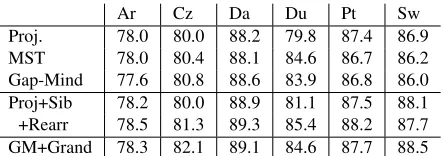
The results are shown in Table 2. The first three lines show the first order gap-minding decoder com-pared with the first order projective and MST
de-11
The grandparent features used were identical to the fea-tures provided within MSTParser for the second-order sibling parsers, with one exception — many features are conjoined with a direction indicator, which in the projective case has only two possibilities. We replaced this two-way distinction with a six-way distinction of the six possible orders of the grandparent, parent, and child.
12
MSTParser produces labeled dependencies on CoNLL for-matted input. We replace all labels in the training set with a single dummy label to produce unlabeled dependency trees.
13
Because of long training times, the gap-minding with grandparent models for Portuguese and Swedish were trained on only sentences up to 50 words.
Ar Cz Da Du Pt Sw
[image:9.612.315.537.56.134.2]Proj. 78.0 80.0 88.2 79.8 87.4 86.9 MST 78.0 80.4 88.1 84.6 86.7 86.2 Gap-Mind 77.6 80.8 88.6 83.9 86.8 86.0 Proj+Sib 78.2 80.0 88.9 81.1 87.5 88.1 +Rearr 78.5 81.3 89.3 85.4 88.2 87.7 GM+Grand 78.3 82.1 89.1 84.6 87.7 88.5
Table 2: Unlabeled Attachment Scores on the CoNLL-X shared task test set.
coders. The gap-minding decoder does better than the projective decoder on Czech, Danish, and Dutch, the three languages with the most non-projectivity, even though it was at a competitive disadvantage in terms of both pruning and (on languages with very long sentences) training data. The gap-minding de-coder with grandparent features is better than the projective decoder with sibling features on all six of the languages. On some languages, the local search decoder with siblings has the absolute high-est accuracy in Table 2; on other languages (Czech and Swedish) the gap-minding+grandparents has the highest accuracy. While not directly comparable be-cause of the difference in features, the promising performance of the gap-minding+grandparents de-coder shows that the space of gap-minding trees is larger than the space of projective trees, yet unlike spanning trees, it is tractable to find the best tree with higher order features. It would be interesting to ex-tend the gap-minding algorithm to include siblings as well.
8 Conclusion
Gap inheritance, a structural property on trees, has implications both for natural language syntax and for natural language parsing. We have shown that the mildly non-projective trees present in natural language treebanksallhave zero or one children in-herit each parent’s gap. We also showed that the as-sumption of 1 gap inheritance removes a factor of
Acknowledgments
We would like to thank Aravind Joshi for comments on an earlier draft. This material is based upon work supported under a National Science Founda-tion Graduate Research Fellowship.
Algorithm 1:MaxGapMindingTree Init:∀i∈[1,n]C[i, i, i] = 0
forsize= 0ton−1do fori= 1ton−sizedo
j=i+size
/* Endpoint parents */
ifsize >0then
C[i, j, i] =C[i+ 1, j, i]
C[i, j, j] =C[i, j−1, j]
/* Interior parents */
forp=i+ 1toj−1do
C[i, j, p] = max(SingleChild(i,j,p), EndpointsDiff(i,j,p),
EndsFromLeftChild(i,j,p), EndsFromRightChild(i,j,p))
/* Exterior parents */
forall thep∈[0, i−1]∪[j+ 1, n]do C[i, j, p] = max(SingleChild(i,j,p), EndpointsDiff(i,j,p),
EndsFromLeftChild(i,j,p), EndsFromRightChild(i,j,p))
/* Helper subproblems */
forp∈[0, n]do
forall thex∈P osChild[p]∧x /∈[i, j]do ifp6=jthen
D[i, j, p, x, T] =M ax2Subtrees(i, j, p, x, T)
ifp6=ithen
D[i, j, p, x, F] =M ax2Subtrees(i, j, p, x, F)
Final answer:C[1, n,0]
FunctionSingleChild(i,j,p)
X =P osChild[p]∩[i, j]
/* Interior p */
ifp > i∧p < jthen
returnmaxx∈XC[i, p−1, x]
+C[p+ 1, j, x] +Score(p, x)
/* Exterior p */
else
returnmaxx∈XC[i, j, x] +Score(p, x)
FunctionEndpointsDiff(i,j,p)
returnmaxk∈[i,j−1]C[i, k, p] +C[k+ 1, j, p]
FunctionEndsFromLeftChild(i,j,p)
/* Interior p */
ifp > i∧p < jthen
X =P osChild[p]∩[i, p−1]
forall thex∈X∧x < pdo K[x] = [x, p−1]
/* Exterior p */
else
X =P osChild[p]∩[i, j]
forall thex∈Xdo K= [x, j−2]
returnmaxx∈X,k∈K[x]C[i, k, x]
+Score(p, x) +D[k+ 1, j, p, x, T]
FunctionEndsFromRightChild(i,j,p)
/* Interior p */
ifp > i∧p < jthen
X =P osChild[p]∩[p+ 1, j]
forall thex∈X∧x > pdo K[x] = [p+ 1, x]
/* Exterior p */
else
X =P osChild[p]∩[i, j]
forall thex∈Xdo K[x] = [i+ 2, x]
returnmaxx∈X,k∈K[x]C[k, j, x]
+Score(p, x) +D[i, k−1, p, x, F]
FunctionMax2Subtrees(i,j,p,x,pOnLeft)
/* Interior p */
ifp≥i∧p≤jthen ifpOnLeftthen
K= [p, j−1]
returnmaxk∈KC[i, k, p] +C[k+ 1, j, x]
else
K= [i, p−1]
returnmaxk∈KC[i, k, x] +C[k+ 1, j, p]
/* Exterior p */
else
K= [i, j−1]}
ifpOnLeftthen
returnmaxk∈KC[i, k, p] +C[k+ 1, j, x]
else
References
M. Bodirsky, M. Kuhlmann, and M. M¨ohl. 2005. Well-nested drawings as models of syntactic structure. In
In Tenth Conference on Formal Grammar and Ninth Meeting on Mathematics of Language, pages 88–1. University Press.
X. Carreras, M. Collins, and T. Koo. 2008. Tag, dynamic programming, and the perceptron for efficient, feature-rich parsing. InProceedings of CoNLL, pages 9–16. Association for Computational Linguistics.
X. Carreras. 2007. Experiments with a higher-order projective dependency parser. InProceedings of the CoNLL Shared Task Session of EMNLP-CoNLL, vol-ume 7, pages 957–961.
J. Chen-Main and A. Joshi. 2010. Unavoidable ill-nestedness in natural language and the adequacy of tree local-mctag induced dependency structures. In
Proceedings of the Tenth International Workshop on Tree Adjoining Grammar and Related Formalisms (TAG+ 10).
J. Chen-Main and A.K. Joshi. 2012. A depen-dency perspective on the adequacy of tree local multi-component tree adjoining grammar. In Journal of Logic and Computation. (to appear).
N. Chomsky. 1981. Lectures on Government and Bind-ing. Dordrecht: Foris.
K. Crammer and Y. Singer. 2003. Ultraconservative on-line algorithms for multiclass problems. Journal of Machine Learning Research, 3:951–991, March. J. Eisner and G. Satta. 2000. A faster parsing algorithm
for lexicalized tree-adjoining grammars. In Proceed-ings of the 5th Workshop on Tree-Adjoining Grammars and Related Formalisms (TAG+5), pages 14–19. J. Eisner and N.A. Smith. 2010. Favor short
dependen-cies: Parsing with soft and hard constraints on depen-dency length. In Harry Bunt, Paola Merlo, and Joakim Nivre, editors,Trends in Parsing Technology: Depen-dency Parsing, Domain Adaptation, and Deep Parsing, chapter 8, pages 121–150. Springer.
J. Eisner. 2000. Bilexical grammars and their cubic-time parsing algorithms. In Harry Bunt and Anton Nijholt, editors,Advances in Probabilistic and Other Parsing Technologies, pages 29–62. Kluwer Academic Publishers, October.
R. Fiengo. 1977. On trace theory. Linguistic Inquiry, 8(1):35–61.
C. G´omez-Rodr´ıguez, J. Carroll, and D. Weir. 2011. De-pendency parsing schemata and mildly non-projective dependency parsing. Computational Linguistics, 37(3):541–586.
T. Koo and M. Collins. 2010. Efficient third-order de-pendency parsers. InProceedings of ACL, pages 1–11.
T. Koo, A. Globerson, X. Carreras, and M. Collins. 2007. Structured prediction models via the matrix-tree theo-rem. InProceedings of EMNLP-CoNLL.
T. Koo, A.M. Rush, M. Collins, T. Jaakkola, and D. Son-tag. 2010. Dual decomposition for parsing with non-projective head automata. InProceedings of EMNLP, pages 1288–1298.
M. Kuhlmann and J. Nivre. 2006. Mildly non-projective dependency structures. In Proceedings of COLING/ACL, pages 507–514.
A.F.T. Martins, N.A. Smith, and E.P. Xing. 2009. Con-cise integer linear programming formulations for de-pendency parsing. InProceedings of ACL, pages 342– 350.
R. McDonald and F. Pereira. 2006. Online learning of approximate dependency parsing algorithms. In Pro-ceedings of EACL, pages 81–88.
R. McDonald and G. Satta. 2007. On the complexity of non-projective data-driven dependency parsing. In
Proceedings of the 10th International Conference on Parsing Technologies, pages 121–132.
R. McDonald, K. Crammer, and F. Pereira. 2005a. On-line large-margin training of dependency parsers. In
Proceedings of ACL, pages 91–98.
R. McDonald, F. Pereira, K. Ribarov, and J. Hajiˇc. 2005b. Non-projective dependency parsing using spanning tree algorithms. In Proceedings of HLT-EMNLP, pages 523–530.
T. Reinhart. 1976. The Syntactic Domain of Anaphora. Ph.D. thesis, Massachusetts Institute of Technology. G. Satta and W. Schuler. 1998. Restrictions on tree
ad-joining languages. InProceedings of COLING-ACL, pages 1176–1182.